
What Is Customer Service in Aviation Industry?
Customer service in aviation isn’t a soft metric. It’s a profit lever. A study of Indian carriers found a 97% correlation between satisfaction and loyalty, while PwC found that superior customer experience can increase willingness to pay by up to 10% (tnmt.com). For airline executives, that changes the question from “How do we reduce service cost?” to “How do we turn service into revenue protection, loyalty growth, and lower disruption expense?”
That reframing matters even more in India, where domestic traffic reached 150 million in 2024 and service expectations are rising alongside scale (wifitalents.com). In this market, customer service isn’t limited to cabin crew courtesy or call centre etiquette. It includes schedule reliability, baggage recovery, digital responsiveness, multilingual support, and the speed at which an airline resolves irregular operations.
For anyone asking what is customer service in aviation industry, the best answer is this: it’s the end-to-end system that shapes whether a passenger trusts an airline enough to fly again, pay a premium, and recommend it when something goes wrong.
TL;DR
- Aviation customer service spans the full passenger journey, booking, airport handling, in-flight support, and post-flight resolution, and it is judged on whether an airline prevents avoidable contact, not just how politely it handles the contact that reaches an agent.
- Most service demand in aviation is failure demand, delays, misinformation, or baggage issues that never needed to reach a call centre, which is why prevention matters more than politeness alone.
- A 2023 SERVQUAL study of Indian carriers found reliability alone drives 42% of the variance in CX scores, with each 1% drop in on-time performance costing 0.7 points of NPS.
- CSAT alone misleads leadership, since it measures sentiment after an interaction without showing whether that interaction should have happened at all.
- Disruption handling in India carries real compliance exposure through DGCA oversight, which makes inconsistent service a regulatory risk, not just a brand one.
- Voice AI’s strongest use cases in aviation are predictable, high-volume, low-ambiguity queries, flight status, baggage tracking, and booking changes, not a replacement for human judgment on complex cases.
What Is Customer Service in Aviation?
Customer service in aviation is the coordinated system of people, processes, and technology that supports a passenger across booking, airport handling, in-flight support, and post-flight resolution such as baggage recovery and refunds. It is measured less by individual politeness and more by whether the airline prevents avoidable contact in the first place, since most service demand in aviation is failure demand: delays, misinformation, or baggage issues that never needed to reach a call centre.
Defining Aviation Customer Service as a Strategic Asset
For an airline leadership team, customer service is the commercial system that protects yield, lowers avoidable operating cost, and determines whether disruption turns into loyalty loss. Passengers experience the carrier as one brand across booking, notifications, airport interactions, inflight requests, baggage resolution, and post-trip support. Finance feels the same chain in a different language: repeat bookings, compensation outflows, call volume, queue pressure, agent productivity, and churn.
A narrow contact-centre definition misses where value is created. Service quality starts shaping economics before a passenger speaks to an agent.
Service quality affects revenue and cost at the same time
In aviation, demand does not convert on price alone. Trust reduces hesitation at booking. Clear policies reduce abandonment. Fast disruption handling protects future share of wallet. Poor service does the reverse, pushing passengers into refund requests, repeat contacts, social escalation, and competitor consideration on the next trip.
That makes customer service a capital allocation issue, not a support line item. Three financial effects matter most:
- Revenue retention: better communication during delays, changes, and baggage issues reduces defection at the next purchase cycle.
- Cost control: fewer handoff failures mean fewer repeat contacts, lower average handling time, and less manual intervention across airport and contact-centre teams.
- Pricing resilience: carriers with stronger service trust face less pressure to rely on discounting to defend load factors.
The non-obvious point is operational. Service investment often pays back outside the service budget. An accurate proactive notification can reduce airport desk congestion. Better self-service for changes can lower voice volumes. Faster case resolution can prevent compensation, chargebacks, and public complaints from spreading across channels.
Aviation customer service is a coordination discipline
A useful executive definition is this: customer service in aviation is the coordinated use of people, processes, and systems to deliver reliable information, fast resolution, and confidence across the full journey.
That definition matters because airline service failures usually come from broken coordination, not isolated agent performance. A schedule update that does not reach the app, airport staff, and voice channel at the same time creates duplicate demand instantly. A baggage issue with no common case record forces passengers to repeat the same problem across desk, phone, and social channels. Each repeat interaction raises cost-to-serve.
This is why digitally mature airlines treat service design as part of the operating model. For a practical operator view, this analysis of aviation customer service systems shows how airlines are tying customer support more closely to operations and revenue outcomes.
The strongest airline leaders do not ask whether service matters. They ask which service failures destroy margin fastest, which interventions reduce repeat demand, and where automation can improve both response speed and unit economics. That is the mechanism that converts operational reliability into commercial performance.
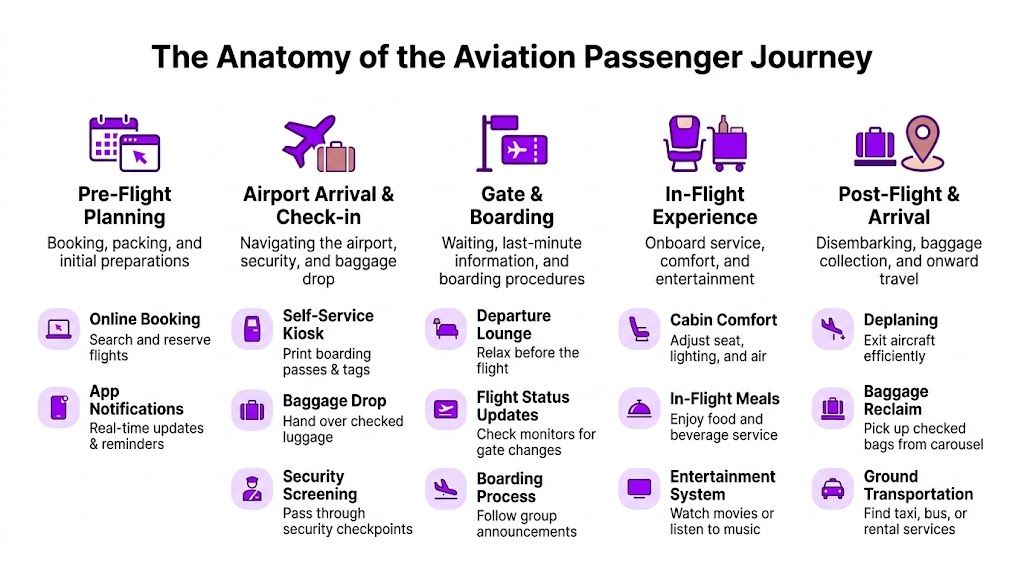
The Anatomy of the Aviation Passenger Journey
An airline’s service model behaves like a relay. One team hands the passenger to the next. If the baton is dropped early, every downstream team pays for it.
That’s why journey design matters more than isolated touchpoints. Passenger frustration rarely starts at the final failure point. It usually begins with an earlier missed handoff.
Pre-flight sets the tone
Pre-flight service includes search, booking, payment confidence, schedule visibility, change policies, and support access. Here, airlines either reduce uncertainty or create it.
Three pre-flight service questions matter to executives:
- Can passengers find answers without friction?
- Can they change plans without starting over?
- Do digital channels match what airport staff will later tell them?
Airport execution determines trust
At the airport, service becomes visible. Queues, counters, kiosks, gate updates, and staff interactions shape whether passengers feel the airline is in control.
A 2023 study on Indian carriers using the SERVQUAL framework found that reliability, especially on-time performance, drives 42% of the variance in customer experience scores. The same study found that each 1% drop in on-time performance correlates to a 0.7-point decline in Net Promoter Scores, with a mean delay of 27 minutes amplifying complaints (ijemh.com).
That finding matters because it expands the meaning of service. Passengers don’t treat punctuality as a separate operations metric. They experience it as service reliability.
Reliability is the hidden frontline employee in aviation. When it fails, every channel inherits the problem.
Post-flight is where loyalty is won or lost
Many airlines under-manage the final stage. That’s a mistake. Post-flight includes baggage delivery, claim resolution, refunds, loyalty recognition, and feedback capture.
If baggage is delayed, the flight itself is no longer the passenger’s memory. The recovery process becomes the experience. If the passenger has to chase updates through multiple channels, the airline compounds the original failure with avoidable effort.
A simple journey model for executives looks like this:
|
Journey Phase |
Primary Passenger Need |
Main Service Risk |
|---|---|---|
|
Pre-flight |
Clarity and confidence |
Conflicting information |
|
Airport and boarding |
Speed and control |
Queue friction and poor coordination |
|
In-flight |
Comfort and reassurance |
Inconsistent service delivery |
|
Arrival and post-flight |
Closure and problem resolution |
Slow baggage or weak recovery |
The strongest operators manage this as one service supply chain, not as separate departmental tasks.
Mapping the Key Channels and Service Roles
Airline customer service isn’t delivered by one team. It’s delivered by an ecosystem. The failure point usually isn’t the absence of channels. It’s the absence of coordination across them.
Human channels still carry the emotional load
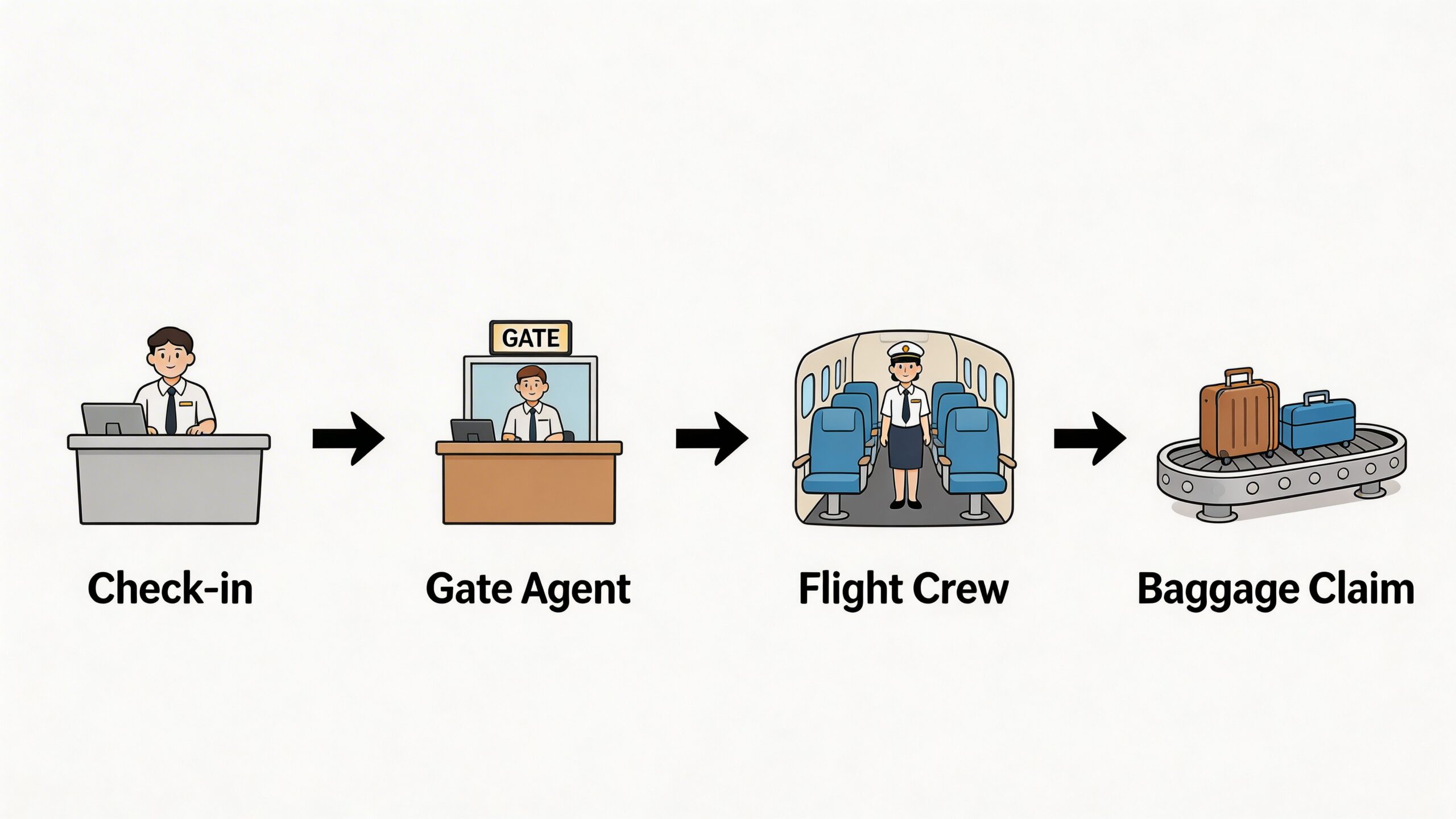
During normal operations, digital channels can carry routine work. During disruption, passengers still look for people. The most visible service roles include:
- Check-in and baggage agents: they handle document review, exceptions, and early issue detection.
- Gate staff: they manage boarding, delay communication, and emotionally charged crowd control.
- Cabin crew: they often shape the passenger’s final judgement of the airline, especially when earlier friction already exists.
- Contact-centre agents: they absorb overflow from every upstream failure, from payment issues to missed connections.
A contact-centre leader who wants to improve this layer should look closely at role design, coaching, and escalation handling, not just staffing. This overview of the modern contact center agent role is relevant because airline service depends on agents who can resolve operational ambiguity, not just read scripts.
Digital channels shape speed and consistency
Passengers now expect immediate access to status, answers, and resolution. That puts pressure on digital systems to do more than publish static information. The key service channels are usually:
:
| Channel | What passengers expect | Executive risk if weak |
|---|---|---|
| Mobile app | Self-service and real-time updates | Higher call volumes |
| Website | Accurate booking and policy clarity | Drop-off and repeat queries |
| Social media support | Fast public response | Reputation damage |
| Chatbot or virtual assistant | Quick answers for routine needs | Escalation spikes if answers feel robotic |
| Airport kiosks | Fast check-in and lower queue time | Counter congestion |
A fragmented setup creates a familiar failure. The app says one thing. The gate agent says another. The social team asks the passenger to call. The call centre has no record of the earlier interaction. That inconsistency doesn’t just reduce trust, it raises cost, because the passenger re-enters the queue through multiple channels until someone takes ownership.
Integration is the real operating model
Executives often ask which channel deserves more investment. The better question is whether channels share the same truth. A mature model has three traits:
- Shared passenger context: booking history, disruption status, baggage case, and prior contact should travel with the customer.
- Clear role boundaries: automation should handle routine tasks, humans should handle exceptions, empathy, and judgement.
- Consistent service logic: every channel should reflect the same policy, timing, and next-best action.
Without that integration, an airline doesn’t have omnichannel service. It has channel sprawl.
Integration is the real operating model
Executives often ask which channel deserves more investment. The better question is whether channels share the same truth.
A mature model has three traits:
- Shared passenger context: Booking history, disruption status, baggage case, and prior contact should travel with the customer.
- Clear role boundaries: Automation should handle routine tasks. Humans should handle exceptions, empathy, and judgement.
- Consistent service logic: Every channel should reflect the same policy, timing, and next-best action.
Without that integration, an airline doesn’t have omnichannel service. It has channel sprawl.
Measuring What Matters: Aviation CX Metrics and KPIs
Airlines rarely have a data shortage. They have a translation problem. Customer service dashboards often sit apart from operations, digital, revenue management, and airport performance.
That separation hides the economic value of CX. A strong satisfaction score can coexist with rising contact volumes, higher disruption handling costs, and weaker repeat booking intent. For a CXO, the priority is not more metrics, it’s a measurement system that shows which service failures destroy margin and which service improvements reduce cost-to-serve or protect revenue.
Why CSAT alone misleads leadership teams
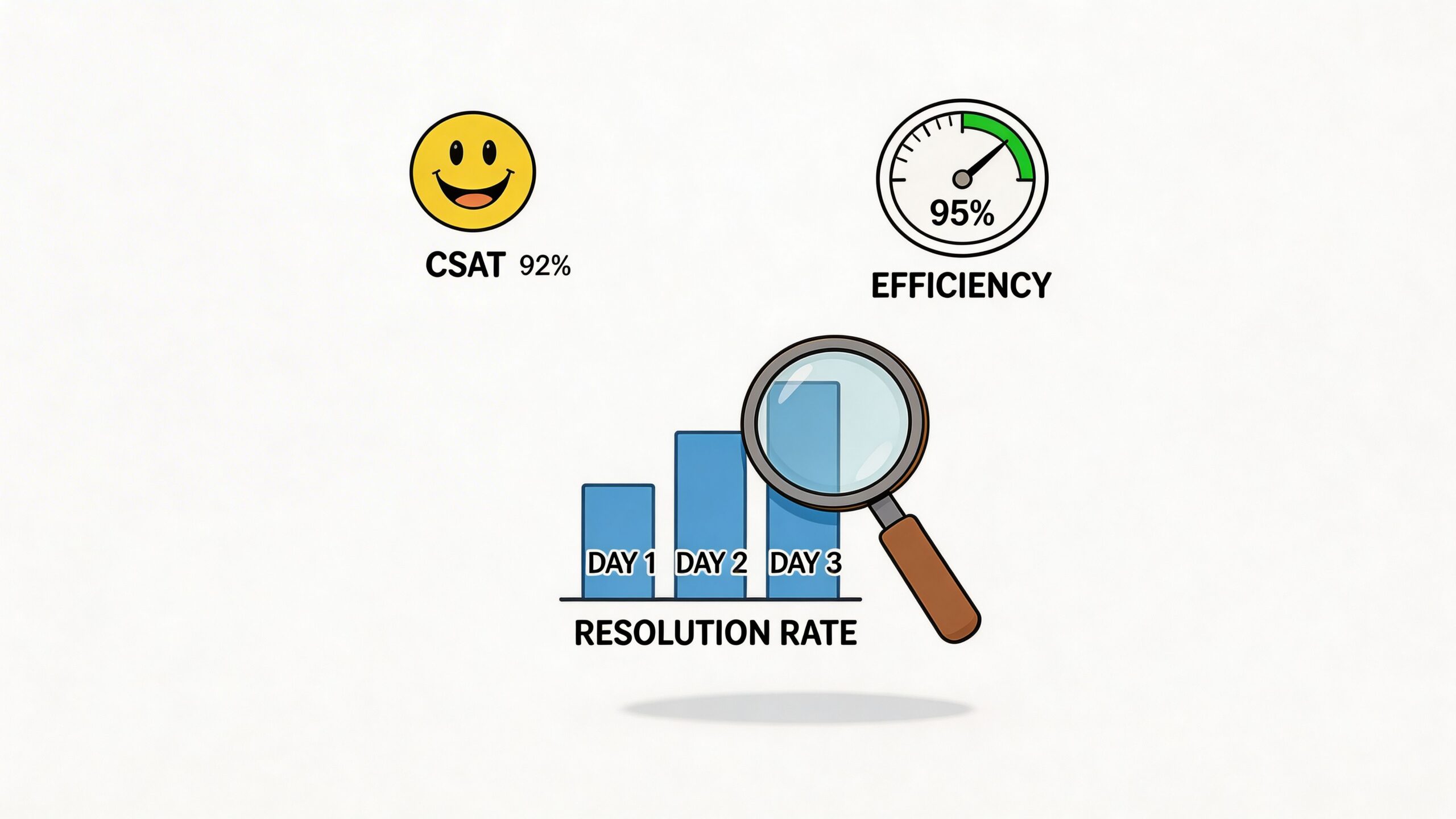
CSAT captures sentiment after an interaction. It does not explain whether that interaction should have happened at all.
That distinction matters in aviation because a large share of service demand is failure demand. Passengers contact the airline because a flight update arrived late, baggage visibility was poor, a refund case stalled, or the app could not complete a basic task. In those cases, a polite agent may recover part of the experience, but the airline still absorbs avoidable cost through repeat contacts, escalations, compensation, and reputational drag.
The more useful executive question is simple: how much support demand did the airline prevent? A carrier that reduces inbound calls during disruptions, lowers repeat baggage contacts, or improves self-service completion rates is improving both experience and unit economics.
Executive lens: the highest-value service KPI often measures avoided contact, faster recovery, or reduced rework, not survey sentiment alone.
A balanced scorecard for airline CX
Aviation CX works best when leadership reviews it in three linked layers: service reliability, customer effort, and commercial outcome.
- Service reliability
These metrics show whether the airline created the conditions for a stable experience in the first place.
- On-time performance.
- Baggage delivery and mishandling rates.
- Refund and claim turnaround time.
- Disruption recovery speed.
- Airport queue time and check-in throughput.
These are operational metrics, but they also predict service load. If reliability slips, contact centre traffic rises, airport desks get congested, and social complaints accelerate.
- Customer effort and responsiveness
These metrics show how much work the passenger had to do to get a basic issue resolved.
- First-contact resolution.
- Average response time across voice, chat, and social.
- Cross-channel transfer rate.
- Self-service success rate.
- Repeat contact rate for the same issue.
Many digital programs underperform here. An airline may shift traffic from voice to app or chatbot, then discover that passengers still end up calling because the digital journey stops at the first exception. The result is not efficiency, it’s channel deflection followed by human recovery, which usually costs more.
- Loyalty and commercial outcome
These metrics determine whether service quality is protecting future revenue.
- Net Promoter Score.
- Repeat booking rate.
- Retention by fare class or customer segment.
- Ancillary conversion after service recovery.
- Willingness to repurchase after disruption.
Industry research has linked stronger customer satisfaction with higher loyalty and greater willingness to pay. For airline executives, that changes the investment case, CX influences pricing power, premium product uptake, and the payback period on acquisition spend.
How to connect service metrics to financial outcomes
The mistake is to review these numbers as separate scorecards. They should sit in one operating model with a clear cause-and-effect chain.
| KPI type | What it affects next | Financial implication |
|---|---|---|
| OTP, baggage reliability, refund cycle time | Contact volume, complaint intensity, recovery workload | Lower servicing cost and fewer compensation-driven losses |
| First-contact resolution, response speed, self-service completion | Rework, handle time, escalation rates | Lower cost-to-serve and better agent productivity |
| NPS, repeat booking, retention by segment | Revenue quality and future demand | Higher customer lifetime value and stronger pricing resilience |
This framework helps airlines make better capital allocation decisions. If a delay-notification fix reduces repeat contacts at scale, the value does not sit only in CX. It appears in lower telecom cost, lower outsourced support demand, shorter queue times, and fewer airport interventions.
Which KPIs matter most in an India-focused airline context
Indian carriers need one more filter. They should rank CX metrics by financial sensitivity in a high-volume, low-margin market. Three questions help:
- Which failures generate the highest volume of avoidable contacts?
- Which service breakdowns create the highest compensation, refund, or manpower cost?
- Which recovery improvements have a measurable effect on repeat booking or ancillary revenue?
That usually shifts leadership attention away from broad averages and toward failure points with the highest economic drag. A five-point gain in CSAT may look positive in a board deck. A reduction in repeat disruption contacts or faster automated resolution of routine requests often creates more value.
Why advanced measurement now points toward Voice AI
Once an airline can identify its top drivers of contact volume, repeat queries, and after-hours demand, the business case for automation becomes more precise. Voice AI is particularly relevant when the airline faces high volumes of predictable queries such as flight status, reschedules, and baggage updates, exactly the use cases covered later in this guide.
Navigating Turbulence Common Challenges and Compliance
A disruption event is where customer service stops being a support function and starts affecting unit economics.
For an airline, the immediate operational problem is obvious. Aircraft rotations slip, crews time out, and airport resources tighten. The less visible problem is often more expensive. Poor communication during delays and misconnects drives repeat contacts, longer queue times, waiver disputes, compensation claims, and public complaints that depress future booking intent.
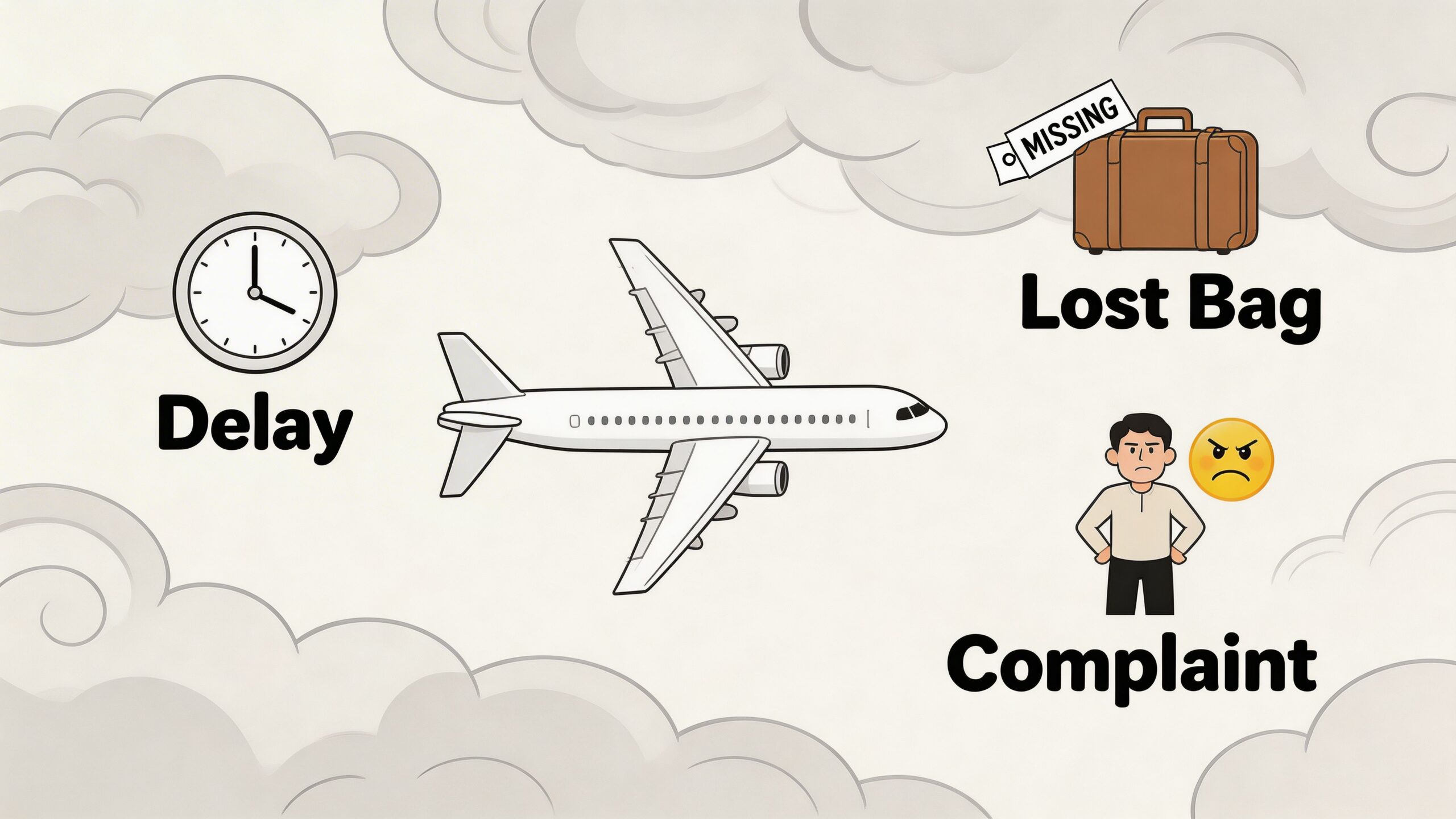
Indian aviation runs at scale, and that scale amplifies every service breakdown. With domestic passenger volumes high and airport congestion concentrated around a few major hubs, even small failures in notification speed can multiply into thousands of inbound interactions within hours.
The pattern is predictable:
- Operations updates the delay internally.
- Customer-facing systems refresh at different speeds.
- Gate staff, app notifications, and call-centre agents work from partial information.
- Passengers check multiple channels because they do not trust the first answer.
- Contact volumes rise just as frontline staff are under the most pressure.
The financial effect is not limited to slower recovery. It increases handling cost per disrupted passenger and pulls skilled agents away from high-value exceptions such as protected connections, special assistance cases, and premium travellers at risk of churn.
Executives should therefore track uncertainty minutes, not only delay minutes. A 45-minute delay communicated clearly can create less cost than a 20-minute delay managed poorly.
Baggage failures become more expensive when visibility is weak
Baggage is one of the clearest examples of how an operational issue turns into a customer service issue, then into a margin issue.
A missing bag creates immediate compensation exposure and recovery work. A missing status update creates repeated calls, airport desk visits, and social escalation. If the baggage team, airport staff, and contact centre cannot see the same case record, the airline pays for the same failure several times through duplicated handling effort.
A common monsoon scenario makes the point. A passenger misconnects, the checked bag is rerouted incorrectly, and the airport team logs the case locally. If the call centre cannot view that case, the customer calls again, repeats details, and challenges the airline’s credibility because each employee gives a different answer. The bag problem remains the same. The service cost keeps rising.
One shared workflow for baggage status, promised actions, compensation rules, and outbound updates reduces that waste. It also lowers average resolution time because agents spend less time reconstructing the case history.
A useful primer on disruption dynamics appears below.
Compliance increases the cost of inconsistent service
In India, disruption handling sits under regulatory scrutiny through DGCA oversight and passenger-rights obligations. That changes the executive calculation. Service inconsistency is not only a brand problem, it can become a compliance problem if compensation guidance, denial handling, refund communication, or escalation records are applied unevenly.
| Failure type | Immediate impact | Secondary impact |
|---|---|---|
| Delay with weak communication | Complaint surge and queue growth | Lower repeat purchase, higher service cost, public criticism |
| Mishandled baggage with poor tracking | Escalations across airport and contact-centre teams | Rework, compensation friction, reputation loss |
| Inconsistent compensation handling | Passenger disputes and manual exceptions | Audit exposure, regulatory scrutiny, slower cash recovery |
The strategic conclusion is straightforward. Aircraft recovery plans and passenger recovery plans need to be designed together, with trigger-based notifications, approved compensation guidance, multilingual scripts, and shared case data. Dialnexa’s voice AI report covering over a million AI-assisted business calls found that automated voice support absorbs routine status requests reliably during exactly these kinds of spikes, protecting agent capacity for the cases where judgment still matters most.
Best Practices from Industry Leaders in 2026
Airlines that treat customer service as an operating system, rather than a support function, protect revenue more effectively during disruption and convert demand more efficiently during normal operations.
The gap between average and leading carriers is execution discipline. Strong operators connect commercial data, operational signals, and service workflows so the passenger gets the right answer quickly, through the right channel, with minimal rework inside the business.
What separates leaders from laggards
A practical comparison makes the economics clearer.
| Operating model | Typical behaviour | Business effect |
|---|---|---|
| Reactive | Waits for passengers to initiate contact after a problem | Contact spikes, lower trust, higher handling cost |
| Partially digital | Adds self-service tools without shared context across teams | Faster simple transactions, but repeat contacts and fragmented recovery |
| Proactive and integrated | Connects passenger data, operations data, and triggered outreach | Better retention, lower avoidable volume, stronger ancillary conversion |
The pattern is consistent across better-run service organisations. They do not add channels for the sake of coverage. They remove friction between channels so airport staff, contact centres, digital support, and loyalty teams work from the same passenger context.
That is where technology choices start to affect margin.
A unified service stack helps airlines reduce duplicate handling, improve first-contact resolution, and protect higher-value customers during service failures. Tools such as advanced AI chatbot technology can absorb repetitive digital queries, while AI call bot systems for airline voice support handle routine inbound and outbound calls at scale. The financial case is straightforward. Every interaction resolved automatically or routed correctly on the first attempt lowers service cost and frees trained agents for exceptions that carry higher compensation risk or stronger loyalty impact.
What leading carriers are doing differently
The strongest operators follow a repeatable model.
- They build a single passenger view. Booking data, service history, loyalty status, disruption status, and prior complaints sit in one working record instead of separate tools.
- They trigger communication from operational events. Delay, gate change, misconnections, baggage milestones, and refund status updates generate outreach automatically.
- They prioritise by commercial value and urgency. High-risk connections, premium passengers, families, and special assistance cases get faster intervention.
- They design service and revenue together. Reaccommodation, upgrades, vouchers, and ancillary offers are presented in ways that recover both trust and spend.
- They standardise frontline judgment. Scripts, approval rules, and escalation logic reduce variance between agents, airports, and outsourcing partners.
These practices improve more than satisfaction scores. They reduce average handle time, limit compensation leakage from inconsistent decisions, and preserve future revenue from passengers who might otherwise defect after a single poorly managed event.
Leadership teams should note a less obvious point. Best practice in 2026 is not defined by having the most visible app or the largest support team. It is defined by service governance. Airlines that set clear rules for data ownership, automation thresholds, exception routing, and recovery offers are easier to run and harder for competitors to imitate.
The Future Is Automated: Scaling Service with Voice AI
Airlines have a scale problem. Passenger demand is growing, disruption volumes are uneven, and multilingual support expectations keep rising. Hiring alone won’t solve that. The service model has to become more automated without becoming colder.
Voice AI has strategic value here. It handles repetitive, time-sensitive conversations at scale, freeing human agents for the judgment calls automation still can’t make.
Where Voice AI fits in the airline stack
The strongest use cases are predictable:
- Flight status and delay notifications.
- Routine baggage status queries.
- Booking confirmations and simple modifications.
- 24/7 multilingual inbound support.
- Proactive outbound communication during irregular operations.
The caution is equally important. Indian passengers report 25% higher dissatisfaction with automated responses during delays when automation lacks empathy or contextual understanding. But advanced Voice AI trials show a more promising path. Vistara achieved 91% connect rates in 2025 and improved booking conversions from 2% to 8% through natural, multilingual conversations (webengage.com).
That result points to the right model. Automation should handle speed, consistency, and availability. Humans should handle exception judgement, emotional recovery, and complex cases.
What executives should automate first
A practical rollout sequence usually starts with high-volume, low-ambiguity tasks.
- Disruption alerts and confirmations: these interactions are urgent, repetitive, and time-sensitive.
- Baggage enquiry intake: structured capture reduces queue pressure on human teams.
- Multilingual booking and schedule assistance: voice systems can extend reach beyond the operating hours of a traditional centre.
- Smart escalation routing: if the issue needs human intervention, the AI should pass context forward instead of forcing the passenger to repeat it.
Voice-led automation also works best when paired with operational integration. If the system can’t access live booking, baggage, and disruption data, it becomes another IVR with better phrasing. If it can, it becomes a capacity multiplier.
Conclusion
Airlines won’t compete only on fare or network going forward. They’ll compete on how quickly and credibly they can respond when the journey stops being smooth.
The carriers that win this decade will be the ones that treat service reliability, coordinated channels, and honest CX measurement as one system, not three separate initiatives run by three separate teams.
DialNexa builds human-like voice AI agents for airlines and travel operators exploring round-the-clock multilingual support, proactive disruption outreach, or lower cost-to-serve without sacrificing service quality. Visit DialNexa to evaluate the platform on your own call scripts.
FAQs
1. What is customer service in the aviation industry?
Customer service in aviation is the coordinated system of people, processes, and technology supporting a passenger from booking through post-flight resolution. It is measured less by individual politeness and more by whether an airline prevents avoidable contact, since most service demand is failure demand rather than routine enquiry.
2. Why does customer service matter for airline revenue, not just satisfaction?
Research links stronger customer satisfaction directly to loyalty and willingness to pay a premium. Poor service pushes passengers toward refund requests, repeat contacts, and competitor consideration on their next trip, which makes service quality a revenue and cost issue, not a soft brand metric.
3. Why does CSAT alone give an incomplete picture of airline service quality?
CSAT measures sentiment after an interaction happens, but it does not show whether that interaction was avoidable in the first place. A large share of airline service demand comes from failure demand, delays, poor baggage visibility, or stalled refunds, which a high CSAT score can mask.
4. What compliance risks apply to airline customer service in India?
Disruption handling in India sits under DGCA oversight and passenger-rights obligations. Inconsistent compensation guidance, denial handling, or escalation records can create audit exposure and regulatory scrutiny, which makes service consistency a compliance requirement, not only a brand consideration.
5. Where does Voice AI fit into airline customer service today?
Voice AI works best on high-volume, predictable queries such as flight status, baggage tracking, and simple booking changes. It is not intended to replace human agents on complex or emotionally sensitive cases, which still need judgment, empathy, and discretion that automation cannot fully replicate.
6. What should airlines automate first when adopting Voice AI?
A practical rollout starts with disruption alerts, baggage enquiry intake, and multilingual booking assistance, all high-volume and low-ambiguity. Smart escalation routing should be built in from day one, so a call that needs a human carries full context instead of forcing the passenger to repeat themselves.

[…] a useful parallel in other transport-heavy sectors. Teams that spend time understanding aviation customer support often notice the same pattern. Service quality isn’t just about front-end responsiveness. It […]
[…] is moving between facilities, doctors, and ground transport providers. Broader discussions of customer service in aviation can help explain why clear handoffs, responsiveness, and expectation-setting make such a difference […]
This is a highly insightful piece that connects aviation customer service directly with revenue protection, operational efficiency, and long-term loyalty. The emphasis on proactive communication, integrated channels, and Voice AI as a strategic enabler reflects the future direction of customer experience in the airline industry.