
Revolutionize Your ROI with a Cutting-Edge Voice Call Service
When most people think of a voice call service, they picture a simple phone line—a necessary cost of doing business. But for today's strategic leaders, that view is dangerously outdated. Modern voice technology is no longer a cost centre; it's a strategic asset that actively drives growth, using powerful tools like Voice AI to scale and enrich every customer conversation, directly impacting your bottom line.
Moving Beyond the Dial Tone to Strategic Growth

For decades, business phone systems have been treated like a utility. As a senior leader, you probably see your call infrastructure the same way: as long as there’s a dial tone, it's working. The trouble is, this traditional mindset puts a hard ceiling on your growth. Legacy phone systems are rigid, expensive to scale, and offer almost zero strategic intelligence. A recent analysis by Gartner highlights that companies clinging to legacy systems face operational inefficiencies costing them up to 30% more than their modernized competitors.
Now, imagine your outreach could scale tenfold overnight without hiring a single new agent. Picture every customer call being perfectly on-brand, rich with data, and fine-tuned to drive a 15% increase in conversion rates. This isn't a far-off vision; it's the reality made possible by a modern voice call service built on Voice AI.
Redefining Scale and Efficiency
Traditionally, scaling customer outreach meant a linear increase in headcount. More agents meant higher costs, extensive training, and greater operational complexity. A modern voice call service completely flips that model. With Voice AI, you can handle thousands of concurrent calls, ensuring no lead is ever missed and every customer receives an immediate response, 24/7.
This shift from a manual, people-first process to an automated, scalable system is delivering measurable results for forward-thinking companies.
- Drastic Cost Reduction: Automating routine calls can reduce operational expenses by up to 60%, freeing up capital for strategic growth initiatives.
- Accelerated Revenue: By boosting connect rates from a typical 47% to over 90%, you start more qualified conversations, directly shortening the sales cycle.
- Enhanced Agent Productivity: Your human experts are freed from repetitive tasks to focus on high-value, complex interactions that require strategic thinking and empathy—activities that drive 80% of your revenue.
From Cost Centre to Growth Engine
This guide is your playbook for gaining a decisive competitive advantage. We’re shifting the conversation from telephony costs to tangible business outcomes. A modern voice call service delivers the automation and data needed to make a direct, measurable impact on your company's financial performance.
A voice call service isn’t just about making calls; it’s about making every call count. By automating and analysing conversations at scale, you can qualify leads with 97% accuracy—matching the performance of your top human agents but at a fraction of the cost.
This allows you, as a leader, to focus on what truly matters: turning conversations into conversions, data into strategic decisions, and operational expenses into undeniable ROI. We'll show you exactly how this technology delivers measurable results, positioning your communication strategy as a core pillar of your business's success.
What Is a Modern Voice Call Service?
When you hear "business phone system," what comes to mind? For many, it’s a simple utility—a dial tone, an extension, a basic VoIP setup. It’s like a trusty calculator: reliable for one job but offering no real strategic insights.
A modern voice call service, however, is a completely different animal. It’s less like a calculator and more like a powerful business intelligence platform that communicates by voice. It doesn’t just connect calls; it understands, learns from, and automates them at a scale previously unimaginable.
Beyond the Dial Tone: Service and Intelligence
The real shift is in the definition of “service.” We’re not just talking about keeping lines open. We’re talking about delivering on-demand scalability, deep conversational intelligence, and seamless data integration that directly fuels your bottom line.
This is where Voice AI comes into play. Instead of just patching two people together, a modern voice call service uses AI to conduct thousands of intelligent, human-like conversations simultaneously. These are not the clunky, robotic menus that drive customers away. They are dynamic, multi-turn dialogues built to handle complex business objectives. For those interested in the underlying infrastructure, you can learn more about how Twilio phone numbers operate within these advanced systems.
Imagine your systems performing these tasks 24/7, with perfect compliance:
- Qualifying thousands of inbound leads with detailed, multi-minute conversations, scoring them based on budget, authority, and need.
- Booking appointments and scheduling demos directly into your sales team’s calendars, reducing lead response time from hours to seconds.
- Executing KYC reminders or initial support diagnostics, ensuring 100% consistency and creating a complete audit trail.
This transforms your communication system from a passive cost centre into an active, intelligent workforce. It's a necessary evolution. A study by Forrester found that a staggering 85% of consumers are dissatisfied with traditional IVR systems, a clear signal that the market demands intelligent, not frustrating, interactions.
A modern voice call service is the strategic response to this demand.
A Strategic Business Comparison
The choice between a legacy system and a modern one is not merely technical—it's deeply strategic. For any CXO, this decision directly shapes operational capacity, cost structure, and the ability to outmanoeuvre competitors. A side-by-side comparison makes the business implications crystal clear.
This table breaks down the core differences from a leadership perspective, showing why an AI-powered voice solution is no longer a "nice-to-have" but a fundamental tool for growth.
Traditional Telephony vs Modern Voice Call Service
| Feature | Traditional Telephony/Basic VoIP | Modern Voice AI Service (e.g., DialNexa) |
|---|---|---|
| Scalability | Limited and expensive. Requires adding physical lines, licences, and more human agents. | Instant and virtually infinite. Scales from a hundred to thousands of simultaneous calls on demand. |
| Business Intelligence | Minimal. At best, you get basic call logs with time and duration. | Deep conversational analytics, sentiment analysis, and intent recognition on 100% of calls. |
| Operational Cost | High. Directly tied to agent headcount, training, and infrastructure maintenance. | Dramatically lower. Automates up to 80% of routine calls, slashing cost-per-interaction by over 50%. |
| Lead & Customer Response | Delayed. Depends on agent availability and is restricted to business hours. | Immediate, 24/7 engagement. No lead goes cold, and no customer is left waiting. |
| Data Integration | Manual or clunky. Data is often siloed, requiring manual entry into CRMs. | Seamless. Native CRM integration automatically syncs all call data, transcripts, and outcomes in real-time. |
| Consistency | Variable. Depends on individual agent performance, mood, and training level. | Flawlessly consistent. Every call follows the optimal script and brand voice without deviation. |
As you can see, the gap is not about features; it's about business outcomes. One approach anchors you to past limitations, while the other equips you to build a faster, smarter, and more profitable operation.
What Really Makes a Modern Voice Call Service Work?
When we discuss a modern voice call service, it's easy to get lost in feature lists. But for any director, VP, or senior leader, the only thing that matters is the result. How does this technology actually improve the bottom line? The answer lies not in bells and whistles, but in a few core capabilities designed to turn your company’s phone lines from a necessary expense into a significant revenue generator.
It’s a fundamental change from the old model of manual, one-off calls to a smarter, scalable engagement strategy. This diagram highlights the leap from outdated systems to what is possible with today’s voice AI.
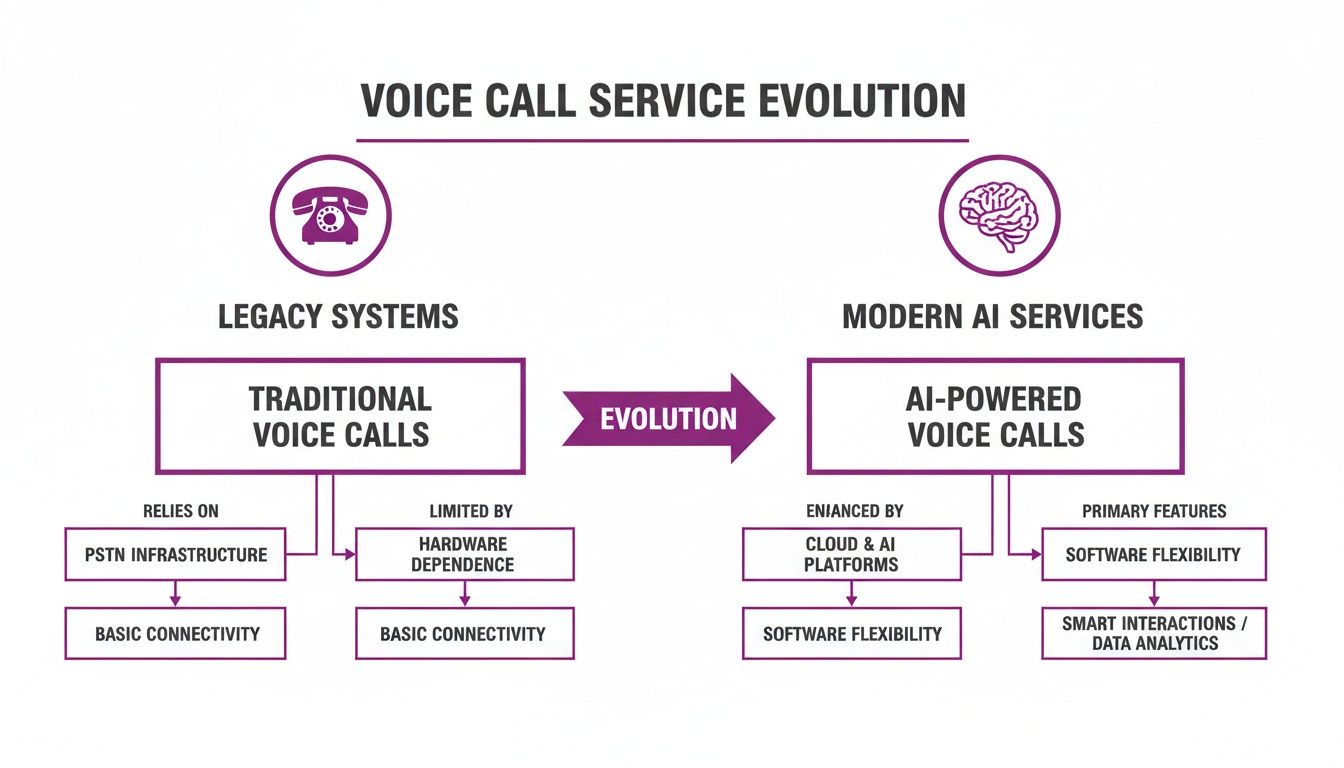
The key takeaway for any executive is that we’ve moved from a static tool to a dynamic system that learns and actively contributes to business growth. Let’s break down what makes that happen.
Genuinely Human-Like Conversations
The single most critical element is the ability to conduct a natural, multi-minute conversation that doesn't feel robotic. We’ve all been trapped by frustrating "press one for sales" IVR menus. Today's AI is engineered to understand intent, handle interruptions, and remember conversational context. This is the cornerstone of a superior voice call service.
Practical Example: A prospective student calling a university rarely asks just one simple question. They might compare two degree programs, inquire about financial aid, and then check application deadlines. A sophisticated AI agent navigates this entire dialogue, provides accurate information, and schedules a call with an admissions advisor—all without sounding scripted.
When you achieve this level of conversational quality, the results are immediate. You’re not just answering queries; you’re creating valuable, positive interactions at the first touchpoint.
An AI agent that can hold a real, flowing dialogue isn’t just a support bot—it becomes a powerful sales and qualification tool. We've seen this capability lift lead-to-booking rates from a standard 2% to over 8%, simply because that first interaction is dramatically more effective and human.
This is about focusing on the quality of the conversation, not just the quantity of calls. You can dive deeper into architecting these intelligent systems in our guide on building an effective AI call bot.
Deep Integration with Your CRM
Every phone call contains a goldmine of data. But that data is worthless if it remains in a call log, disconnected from your core business systems. A primary function of any modern voice platform is its ability to plug directly into the systems you already rely on, especially your CRM.
This goes far beyond just noting that a call occurred. We’re talking about feeding actionable intelligence directly into your customer profiles.
- Automatic Call Logging: Every call, inbound or outbound, is logged against the correct contact in your CRM without any manual effort.
- Full Transcripts and Summaries: A complete transcript and an AI-generated summary of the conversation are attached to the contact's record, giving your team full context for any follow-up.
- Real-Time Data Sync: The AI updates a lead’s status, books appointments in a calendar, and syncs key details—like their budget, timeline, or specific interests—directly into the custom fields in your CRM.
Practical Example: A Marketing Director can see in real-time which campaigns are generating the most qualified conversations, with leads automatically tagged by intent. This enables you to reallocate budget to high-performing channels within hours, not weeks, maximizing marketing ROI.
Live Dashboards and Operational Analytics
As the adage goes, you can't manage what you don't measure. The best voice call platforms provide leaders with live dashboards offering a clear, up-to-the-minute view of their entire communication operation. This is far more than just call volume or duration.
These analytics are built for strategic oversight. A VP of Sales can track lead qualification scores in real-time. A Head of Support can spot trends in customer sentiment and address recurring issues before they escalate.
Practical Example: A dashboard reveals a spike in negative sentiment related to a new product feature. The Head of Product is automatically alerted, reviews the call transcripts, and can fast-track a fix, turning a potential crisis into a demonstration of responsiveness—all driven by voice data. This data-first approach transforms your call operations from a "black box" into a transparent, fine-tuned part of your business.
The Three Pillars of ROI for Your Voice Call Service
When evaluating any new technology, the first question is always: what’s the ROI? With a modern voice call service, the answer is clear, measurable, and built on three fundamental pillars: radical cost reduction, accelerated revenue, and a significant boost in operational efficiency. This isn't about incremental gains; it's about fundamentally rethinking the economics of customer engagement.
Pillar 1: Radical Cost Reduction
The most immediate win comes from automating high-volume, repetitive calls. Consider the thousands of routine conversations your teams handle monthly—appointment confirmations, lead qualification, or basic support queries. Each call has a cost tied to an agent's salary, training, and overheads. An AI-powered voice call service can handle up to 80% of these tasks automatically, 24/7, without fatigue or error.
- Real Estate Example: A property firm automating initial lead qualification and site visit scheduling can eliminate the need for a dedicated five-person call centre team. This translates to a direct saving of over ₹25 lakhs annually in salaries alone, not including hiring and training costs.
- EdTech Example: An education platform automating outreach to thousands of applicants about deadlines can scale its campaign by 5x without hiring a single new person. This allows skilled counsellors to focus on converting high-value prospects, not manual dialling.
The financial logic is simple. By automating routine interactions, you drastically lower your cost-per-call and reallocate your most valuable resource—your skilled human agents—to where they can create the most value.
This shift is happening on a massive scale. The international call services market was valued at USD 1.87 billion in 2026 and is expected to grow to USD 2.54 billion by 2030. As you can see from how India's call centre industry is evolving, modernising this function is the key to managing costs in a growing market.
Pillar 2: Revenue Acceleration
Cutting costs is only half the story. A smart voice call service is also a powerful tool for generating more revenue, faster. It addresses two of the biggest bottlenecks in sales: low connect rates and inconsistent lead qualification. With legacy diallers and manual calling, connect rates often stagnate around a disappointing 47%. A modern service using intelligent dialling and instant response capabilities can push that figure above 90%. More connections mean more conversations, which directly translates to more sales opportunities.
Furthermore, a well-designed AI agent can qualify leads with 97% accuracy, on par with your best human performers. It asks the right questions, captures key details, and passes genuinely interested, conversation-ready leads directly to your sales team. This combination of higher connect rates and superior qualification has a direct impact on your bottom line. To measure these gains accurately, review our guide on calculating your service level formula.
Pillar 3: A Major Boost in Operational Efficiency
Beyond direct financial impact, a voice call service improves efficiency across the entire organization. When your best agents are no longer bogged down by simple, repetitive calls, they can dedicate their expertise to work that truly matters.
This means they can focus on:
- Closing complex, high-value deals.
- Managing sensitive customer escalations that require empathy and a human touch.
- Building strategic relationships with key accounts to drive long-term growth.
This is where the real magic happens for a business leader. For instance, a real estate firm we worked with, using DialNexa, doubled its site visit bookings in a single quarter. Why? Its agents stopped wasting time on initial screening and only engaged with pre-qualified buyers who were ready to talk. The AI handled the volume, while the humans focused on closing deals. It's not just about doing things faster; it's about creating a smarter operating model where technology handles scale and your people drive value.
How Voice AI is Solving Real-World Problems Across Industries
It’s one thing to discuss technology in theory, but as a leader, you care about tangible results. The real power of a modern voice call service comes to life when applied to specific, high-stakes problems in your industry. This is no longer a future concept; it's a practical tool delivering measurable ROI today.
This transformation is accelerating, particularly in India. We’re witnessing a major shift driven by the fact that 85% of consumers are fed up with outdated IVR systems. The market is demanding smarter interactions. With today's speech-to-speech AI achieving response times around 800 milliseconds, the experience is nearly indistinguishable from natural human conversation. For a deeper dive, you can discover more insights about Indian communication trends for 2026.
Let's get specific and see how this plays out in key sectors.
A New Approach for EdTech Admissions
As a Director of Admissions, you face a constant challenge: your team is inundated with thousands of inquiries, but a high percentage are from unqualified candidates. This leaves your expert counsellors spending valuable time on basic fee and eligibility questions instead of nurturing high-potential applicants.
A Voice AI agent from DialNexa changes this equation entirely. Suddenly, you have a system that can:
- Field tens of thousands of inbound and outbound calls concurrently.
- Guide applicants through complex program details and eligibility criteria with expert precision.
- Provide instant, accurate answers to common questions, 24/7.
- Automatically book meetings with your human counsellors, but only for the most qualified and engaged applicants.
The Result: One institution that adopted this model saw its volume of qualified applications increase by 40% in the first semester. Their admissions team was finally free to focus on strategic relationship-building and closing enrolments, directly boosting revenue.
Gaining an Edge in Real Estate Sales
For a VP of Sales in the hyper-competitive real estate market, speed is everything. Every lead from a property portal is a race against competitors, yet your team can only make so many calls. Many leads go cold simply because of delayed response times.
A voice call service transforms this dynamic. An AI agent works around the clock to:
- Instantly contact every new lead the moment it arrives.
- Engage prospects in a natural, multi-minute conversation to qualify their budget, location, and property requirements.
- Book site visits directly into your agents' calendars, but only with pre-qualified, high-intent buyers.
The Result: One prominent firm implemented this strategy and doubled its site visit booking rate in a single quarter. Their agents arrived at the office to find their calendars already populated with high-quality appointments, dramatically increasing their sales efficiency and commissions.
Nailing Compliance in BFSI
As a Compliance Officer in Banking, Financial Services, and Insurance (BFSI), you must balance customer service with rigid regulatory adherence. Repetitive but critical tasks like KYC reminders and payment follow-ups are fraught with the risk of human error and non-compliance.
A voice call service offers a solution with flawless execution. An AI agent can:
- Automate all KYC and payment reminder calls using a perfectly compliant, pre-approved script that never deviates.
- Handle initial customer support for common issues like password resets or transaction inquiries.
- Automatically document every interaction with a full transcript, creating a perfect, immutable audit trail for regulators.
The Result: This ensures 100% compliance on routine communications, freeing up your compliance team to focus on complex risk management and strategic policy. This is critical in a sector where a single compliance breach can cost millions. Voice AI improves functions like call center quality assurance by providing 100% call monitoring, a feat impossible with human-only teams.
Your Strategic Implementation Roadmap
Integrating a modern voice call service is a strategic business initiative, not just a tech upgrade. As a leader, your role is to steer this initiative with a clear, results-oriented plan. This five-step roadmap is designed for executives to ensure the investment delivers measurable ROI from day one.
1. Define Your Primary Business Objective
Before evaluating vendors, define your primary goal. What does success look like? Are you aiming to slash operational costs by 30% by automating routine calls? Is the goal to boost revenue by qualifying leads 50% faster than competitors? Or is it about improving customer satisfaction scores by 20 points? Pinpoint your number one priority. This singular focus becomes your north star, guiding every decision.
2. A Buyer's Checklist for Strategic Partnership
Choosing a provider is not a simple procurement; it's a strategic partnership. Your evaluation must go beyond feature lists and assess their ability to support your long-term business goals. Ensure your team asks the tough questions:
- Scalability and Reliability: Can your platform handle a sudden surge from 1,000 to 100,000 calls a day without degradation? What uptime do you guarantee in your SLA, and what are the financial penalties for failure?
- Integration Capabilities: Show us a live demonstration of a seamless, bi-directional integration with our specific CRM (e.g., Salesforce, HubSpot). How is custom field mapping handled?
- Security and Compliance: How do you ensure data sovereignty and protection? Provide your ISO 27001, SOC 2, and any industry-specific certifications (e.g., HIPAA, PCI-DSS). This is non-negotiable for sectors like BFSI and healthcare.
A true partner will provide transparent, confident answers backed by evidence.
3. Design Your First AI Agent (No-Code Simplicity)
A common myth is that building an AI agent requires a team of developers. Modern platforms like DialNexa use no-code or low-code interfaces, empowering your operational leaders—the people who understand customer conversations best—to design and refine the AI. The process is straightforward: define a clear task (e.g., qualify inbound property leads), map the ideal conversational flow, and provide the AI with the necessary information.
This accessibility is fuelling explosive market growth. The AI in India's contact centre market is projected to grow from USD 103.8 million in 2024 to USD 452.5 million by 2030, a CAGR of 27.9%. This rapid adoption by savvy businesses is a clear indicator of proven ROI.
4. Launch a Strategic Pilot Program
Don’t attempt a company-wide overhaul at once. Start with a focused pilot program tied directly to the business objective you defined in step one. Select a specific, high-impact use case—like scheduling demos for a SaaS product—and run a controlled test for 30-60 days. The goal is to prove the ROI on a smaller scale. Track KPIs like cost-per-qualified-lead, conversion rate, and agent time saved. A successful pilot provides the hard data and internal advocacy needed to justify a broader rollout. A great starting point for many is using Voice AI for in-depth customer voice analysis, turning conversations into actionable intelligence.
5. Scale Success Across the Organisation
Once your pilot delivers clear, positive ROI, you have a proven blueprint. Use the data and lessons learned to identify other high-impact areas across the business—from customer service to HR to collections. By expanding methodically, you ensure each deployment is built on a solid foundation of success, transforming your voice call service from a tactical tool into a powerful engine for company-wide growth and profitability.
Your Top Questions Answered
As a business leader, you care about outcomes, not just technology. Let's address the strategic questions we hear most frequently from CXOs considering a modern voice call service.
How Much Work Is It to Connect This with Our CRM?
This is a critical question. The answer: for a modern platform, it should be minimal. These services are built with an API-first philosophy, designed for seamless integration, not to create another data silo. Think of it less as a complex IT project and more like activating a pre-built connector for major CRMs like Salesforce, HubSpot, or Zoho. All critical data—call transcripts, lead scores, and conversation outcomes—should flow directly into your existing customer records automatically, providing a single source of truth for your revenue teams.
Can Voice AI Actually Understand Indian Accents and Languages?
Absolutely, and this is a key differentiator of leading platforms today. They are no longer just adapted for India; they are trained extensively on diverse Indian accents and support multiple languages like Hindi, Tamil, and Bengali from the ground up.
Why this matters for a leader: This is not a "nice-to-have." It is the key to unlocking the entire Indian market. It allows you to deliver a consistent, high-quality experience to customers in Tier-2 and Tier-3 cities just as effectively as in metros, dramatically expanding your addressable market without a proportional increase in headcount.
What’s the Story on Data Security and Compliance?
For any enterprise leader, security is non-negotiable. Reputable providers build their service on a foundation of robust security, including end-to-end encryption and secure data handling protocols. They must demonstrate compliance with global standards like ISO 27001 and SOC 2, as well as any regulations specific to your industry, like BFSI or healthcare. When evaluating a partner, demand to see their compliance certifications and audit reports. A provider who takes security seriously will welcome this scrutiny.
Isn't This Just a Fancy IVR?
This is a common misconception, but they are fundamentally different. An IVR is a rigid, frustrating phone menu ("press 1, press 2") that forces the customer down a pre-set path. A modern voice call service, powered by conversational AI, is the opposite. It is a dynamic, two-way dialogue. It listens, understands intent, and adapts the conversation in real-time. It’s the difference between a static roadblock and an intelligent, problem-solving agent. The former creates friction and customer churn; the latter builds satisfaction and drives business outcomes.
Ready to see how a true conversational AI can transform your business outcomes? At DialNexa Labs Private Limited, we build voice agents that drive revenue and efficiency. Explore DialNexa and book your personalised demo today.

[…] where automated calling and spoken workflows belong in the customer journey, this overview of a voice call service provides a practical decision […]