

The BPO Guide: shrinkage formula for bpo and Operational Efficiency
Quick answer: the BPO shrinkage formulas
Overall shrinkage % = (Total Unproductive Hours ÷ Total Scheduled Hours) × 100. Unproductive hours cover every paid hour an agent is not available for customer-facing work.
- Planned shrinkage % = (Planned Unproductive Hours ÷ Total Scheduled Hours) × 100. Planned hours are scheduled: training, coaching, team meetings, paid breaks and approved leave.
- Unplanned shrinkage % = (Unplanned Unproductive Hours ÷ Total Scheduled Hours) × 100. Unplanned hours are unpredictable: unscheduled absences, tardiness, extended breaks and system downtime.
- Total shrinkage = planned shrinkage % + unplanned shrinkage %.
Worked example: for 100 agents on a 40-hour week (4,000 scheduled hours), 650 planned hours (breaks + meetings) and 200 unplanned hours (absences) give 16.25% planned + 5% unplanned = 21.25% total shrinkage. A healthy BPO range is roughly 20–25%.
Shrinkage vs attrition: shrinkage measures paid hours agents are unavailable each day; attrition measures the rate at which agents permanently leave. Attrition is a major cause of unplanned shrinkage, but they are not the same metric.
To any senior leader, BPO shrinkage is the 'phantom payroll' that quietly drains your budget. It's the paid time when your agents aren't actively helping customers or generating revenue. In short, it’s the gap between the hours you pay for and the hours that actually drive your business forward, making the shrinkage formula a vital tool for financial oversight.
Why BPO Shrinkage Is a Critical Metric for Your Bottom Line
For VPs and Directors, BPO shrinkage isn't some minor operational detail; it’s a direct reflection of your company's financial health. Think of it as a hidden leak in your operational budget. Every percentage point signals overstaffing costs, lost revenue opportunities, and a reduced return on your workforce investment. Getting a handle on this metric shifts the conversation from day-to-day management to strategic financial control.

The Strategic View of BPO Shrinkage
High shrinkage creates a ripple effect across the entire business, impacting more than just staffing numbers. For a clearer picture, this table frames shrinkage in terms senior leaders care about—direct business impact.
| Shrinkage Driver | Examples for Leaders | Direct Business Impact |
|---|---|---|
| Unplanned Absences | Sick leave, no-shows, personal emergencies. | Disrupts scheduling, forces overtime, lowers team morale. |
| Planned Time Off | Holidays, planned leaves, vacation time. | Requires higher buffer staffing, increasing payroll costs. |
| Non-Productive Paid Time | Team meetings, training sessions, system downtime. | Inflates cost-per-contact, reduces revenue-generating hours. |
| Attrition & Churn | Agents leaving the company, ramp-up time for new hires. | Incurs significant recruitment and training expenses, creates skill gaps. |
As you can see, what starts as an operational metric quickly becomes a strategic concern. Each driver directly erodes profitability and operational stability.
The Financial Consequences
The financial toll of unchecked shrinkage is significant. In the Indian BPO sector, for example, shrinkage commonly hovers around 30%, and can even spike to 50% in some operations. This means that to ensure 50 agents are available on the floor, a company might have to schedule and pay for 65. That's a huge inflation of payroll without any corresponding increase in output.
These costs directly affect other performance indicators. You can explore our detailed guide on essential voice agent KPIs to see just how interconnected these metrics are.
For the C-suite, mastering the shrinkage formula isn't about micromanaging breaks. It's about optimising resource allocation and maximising the ROI on your entire outsourced operation, ensuring every dollar spent contributes directly to business growth.
Ultimately, getting shrinkage under control is a leadership imperative. It demands a strategic view that connects operational efficiency directly to profitability, turning a simple metric into a powerful lever for boosting your bottom line.
Unpacking the BPO Shrinkage Formula
If you’re running a BPO, the word ‘shrinkage’ might sound like vague industry jargon. But it's far from it. It's a hard metric, governed by a simple formula that has a massive impact on your bottom line. Getting to grips with this calculation is the first real step in turning a major cost centre into a lean, efficient operation.
The core shrinkage formula for BPO is surprisingly straightforward, yet its implications for budgeting and planning are huge.
Shrinkage % = (Total Unproductive Hours / Total Scheduled Hours) x 100
What this formula really tells you is the percentage of time you're paying for that isn't spent on productive, customer-facing work. But the real insight comes when you dig into what "Unproductive Hours" actually means. To truly get a handle on shrinkage, you have to split it into two very different categories, because each one needs a unique approach from leadership.
Planned Shrinkage: The Necessary Cost of Business
Planned shrinkage covers all the scheduled activities that pull agents away from their primary duties. Think of this not as 'lost' time, but as a necessary investment in your people and processes.
For example, a Director of Operations at a financial services BPO might schedule a mandatory 2-hour compliance training for all 200 agents. This creates 400 hours of planned shrinkage for that week. While it's non-productive time, it's a strategic investment to mitigate regulatory risk and improve service quality.
This includes things like:
- Training and Coaching: Upskilling sessions, new product briefings, and one-on-one performance reviews. These are vital.
- Team Meetings: Essential for keeping everyone aligned, sharing updates, and building a strong team culture.
- Scheduled Breaks: Mandatory breaks that are crucial for preventing agent fatigue and burnout.
- Paid Time Off: Approved holidays and leave that you absolutely must account for in your staffing models.
While these activities are essential, they still need to be managed carefully. If your team meetings drag on or your training sessions aren't efficient, your planned shrinkage can easily creep up, inflating your costs without giving you a good return on that investment.
Unplanned Shrinkage: The True Threat to Your Operation
On the other side of the coin, you have unplanned shrinkage. This is the unpredictable stuff that throws a wrench in your workforce plan. This is the category that really threatens your budget, service levels, and ultimately, your profitability. To really understand the formula, it helps to be familiar with metrics like Bradford Factor Calculations, which can help you measure the disruptive effect of frequent, short absences.
Consider a retail BPO during the holiday season. If a sudden IT outage takes the CRM system offline for an hour, 150 agents are left idle. This single event instantly creates 150 hours of unplanned shrinkage, jeopardizing sales targets and service levels during a critical revenue period.
Unplanned shrinkage is made up of:
- Unscheduled Absences: Agents calling in sick or dealing with last-minute personal emergencies.
- Tardiness: Staff arriving late, leaving early, or taking longer to get set up.
- System Downtime: When technology fails and agents are left sitting idle, unable to work.
- Extended Breaks: Agents stretching their scheduled break times.
This kind of shrinkage is often a symptom of bigger problems lurking under the surface—things like poor employee morale, unreliable IT infrastructure, or ineffective management. Unlike planned shrinkage, which you manage, unplanned shrinkage is something you need to fight to minimise. It creates chaos in your operations, forcing you into expensive, reactive fixes like paying for overtime or overstaffing just to keep the lights on.
A Practical Guide to Calculating Shrinkage
Let's move beyond the theory and get our hands dirty with a real-world example. For anyone in a leadership role, seeing a shrinkage percentage on a report doesn't always hit home. But when you translate that number into staffing costs and operational drag, it becomes a very real, tangible business problem.
We'll walk through a clear, step-by-step calculation to show you exactly how shrinkage impacts your budget and your ability to deliver.
Setting the Scene: Your BPO Unit
Imagine you're running a BPO team of 100 agents. Each person is scheduled for a standard 40-hour work week.
This gives you a baseline of 4,000 total scheduled hours every week (100 agents x 40 hours). This is the total time you're paying for—your full workforce capacity, at least on paper.
Finding the Lost Time
Now, where does that paid time actually go? Let's break down the common activities that take agents away from their core tasks. These components, both planned and unplanned, are the ingredients for our shrinkage calculation.
- Scheduled Breaks: Each agent gets two 15-minute breaks plus a 30-minute lunch. That’s one hour per day. Across 100 agents over a 5-day week, this adds up to 500 hours.
- Team Meetings & Training: Think about weekly team huddles, coaching sessions, and mandatory compliance training. If this takes up 1.5 hours per agent each week, that's another 150 hours gone.
- Unplanned Absences: Life happens. On average, you might find that 5% of your team is unexpectedly absent on any given day due to sickness or personal emergencies. This means 5 agents miss an 8-hour shift daily, costing you 200 hours a week.
The calculation itself is straightforward, as this flow diagram shows.
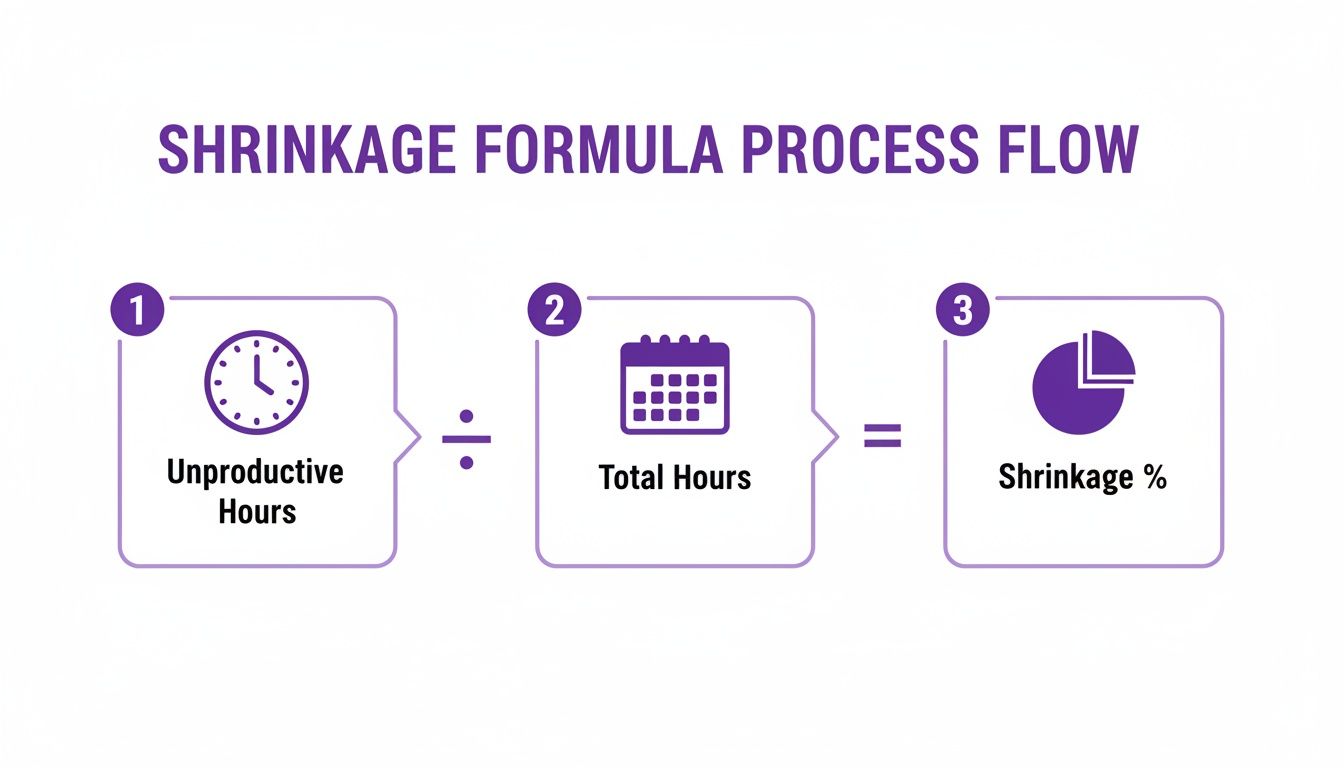
You simply divide the time agents aren't available by the total time you've paid for to find your shrinkage percentage.
Putting the Formula into Action
With all our numbers gathered, we can plug them into the formula.
- Add Up Unproductive Hours: 500 (Breaks) + 150 (Meetings) + 200 (Absences) = 850 total unproductive hours.
- Calculate the Shrinkage Percentage: (850 Unproductive Hours / 4,000 Total Scheduled Hours) x 100 = 21.25%.
This 21.25% shrinkage rate is the number that should grab your attention. It means that for every 100 agents on your payroll, you really only have about 79 available to handle customer queries at any given moment.
For BPOs in India, where operational efficiency is the name of the game and shrinkage often hovers between 20% to 30%, this calculation is non-negotiable. It allows managers to spot inefficiencies and make smarter, data-driven staffing decisions. For a deeper dive into these metrics, you can find more insights on BPO operational efficiency from Alohaa.ai.
To make this even clearer, here is the data organised in a table.
Sample Shrinkage Calculation for a 100-FTE BPO Unit
| Shrinkage Component | Hours Lost (Per Week) | Formula Input |
|---|---|---|
| Scheduled Breaks & Lunch | 500 hours | Unproductive Time |
| Meetings & Training | 150 hours | Unproductive Time |
| Unplanned Absences | 200 hours | Unproductive Time |
| Total Unproductive Hours | 850 hours | Numerator |
| Total Scheduled Hours | 4,000 hours | Denominator |
| Shrinkage Percentage | 21.25% | (850 / 4,000) * 100 |
This table neatly summarises how quickly small pockets of unproductive time accumulate into a significant operational factor.
The Leadership Takeaway: Your 21.25% shrinkage isn't just a metric—it's a direct cost. It tells you that to meet a service level agreement requiring 100 agents on the floor, you actually need to hire, train, and pay for approximately 127 agents. That 27-person buffer is the real, tangible cost of shrinkage hitting your bottom line.
How Employee Attrition Fuels Uncontrolled Shrinkage
Of all the things that chip away at your productive hours, one culprit stands out as the most damaging to your operational stability: employee attrition. High turnover is so much more than an HR headache; it’s a direct financial leak that continuously inflates your shrinkage numbers and throws your entire workforce strategy into disarray. If you're only looking at attrition as a recruitment problem, you're missing its most corrosive effects.
Attrition kicks off a destructive cycle that attacks your budget from two different angles. First, every time an employee walks out the door, they leave an empty seat. That seat represents 100% unplanned shrinkage until a replacement is hired, trained, and fully productive. This immediate gap forces you into costly overtime or, worse, leads to dropped service levels that directly impact your customers and your bottom line.
Then there's the other side of the coin. The constant scramble to recruit and train new hires massively increases your planned shrinkage. Onboarding isn't a quick fix. It’s weeks, sometimes months, of training classes, on-the-job nesting, and ramp-up time where new agents are on your payroll but aren't yet contributing to the workload. This never-ending training pipeline becomes a large, fixed cost in your operational budget.
The True Cost of High Turnover
For anyone overseeing the budget, this cycle translates into spiralling costs that go far beyond recruitment agency fees. You're paying for lost institutional knowledge, inconsistent service quality, and the constant drain on your managers' time as they focus on interviewing instead of coaching their teams. It quickly becomes a major strategic risk that undermines your long-term profitability.
High attrition doesn't just empty seats; it empties your budget. It transforms a manageable operational metric into an uncontrolled financial leak, making it impossible to accurately forecast staffing or control costs effectively.
Take India’s BPO industry, for example. The attrition rate there consistently hovers around 30%, with some reports putting it as high as 55%. This level of turnover pours fuel on the fire, driving up internal shrinkage through constant training and external shrinkage from empty seats and absenteeism. On that note, studies show that engaged employees are 41% less likely to be absent, which points to a clear solution.
Addressing the Root Cause
Getting a handle on high attrition requires a real strategy, not just exit interviews. Investing in employee engagement, creating clear career paths, and improving the work environment are essential first steps.
Beyond that, refining your hiring process from the very beginning can make a huge difference. You can learn more about how AI voice agents can streamline HR job interviews and improve candidate selection, helping you find people who are a better long-term fit right from the start.
Actionable Strategies to Reduce BPO Shrinkage
Knowing how to calculate shrinkage is one thing; actually doing something about it is another game entirely. For any senior leader, the goal isn't to get rid of breaks or team huddles. It's about making sure every single hour you're paying for is used as effectively as possible. The best way to tackle this is with a two-pronged attack: shoring up your core management practices while embracing smart technology.

This dual approach helps you get to the root of both planned and unplanned shrinkage, building a far more efficient and resilient operation. Let’s break down the most effective moves you can make in each area.
Foundational Management Levers
Before you even think about new software, you need to get your house in order. These fundamental strategies focus on the human side of the shrinkage equation—think engagement, scheduling, and company policy.
- Optimise Scheduling for Work-Life Balance: Nothing burns out agents faster than rigid, unforgiving schedules. This is a huge driver of absenteeism. A practical example is a telecom BPO that introduced a "shift-bidding" system, allowing top-performing agents first pick of schedules. Unplanned absences dropped by 15% within a quarter because agents felt more control over their work-life balance.
- Refine Attendance Policies: Strict, punitive policies often backfire. A better approach is to reward the behaviour you want to see. Introduce a small bonus or some public recognition for perfect attendance. You’d be surprised how much a little positive reinforcement can discourage casual absenteeism and boost morale.
- Invest in High-ROI Engagement Programmes: A disengaged employee is far more likely to call in sick or quit. Put your energy into things that actually move the needle, like creating clear career paths, conducting regular one-on-one coaching, and fostering a supportive team culture. An engaged team is a present and productive team.
Technology-Driven Solutions
Great management is the bedrock, but technology is the force multiplier. It allows you to manage shrinkage with incredible precision. Modern tools help you shift from putting out fires to preventing them in the first place.
From a leadership perspective, technology is the key to unlocking predictive insights. Instead of just reacting to yesterday's attendance report, you can anticipate and mitigate shrinkage before it impacts service levels and costs.
A powerful first step is to find ways to automate repetitive tasks and boost efficiency for your team. This is a direct hit against the time agents spend on work that isn't customer-facing.
Here are some of the most impactful tech solutions:
- Leverage AI-Powered Workforce Management (WFM): The latest WFM tools are lightyears ahead of basic schedulers. For example, a global travel company's BPO used a WFM tool to analyze call patterns, discovering that Monday mornings were overstaffed while Friday afternoons were critically understaffed. By rebalancing schedules, they reduced idle time by 18% and cut overtime costs by 22%.
- Deploy Intelligent Automation: Think about all the repetitive tasks agents do—post-call notes, data entry, CRM updates. Automating these frees up a significant chunk of their day, letting them focus on what they do best: talking to customers. This directly reduces the amount of time that gets logged as unproductive work.
- Use Analytics to Pinpoint Hotspots: Advanced analytics can reveal hidden patterns in your shrinkage data. Are absences spiking on Mondays? Is one team struggling more than others? This data-driven approach lets you find the root cause and apply a targeted fix. For example, analytics can highlight who needs more support. For a deeper dive on this, check out our guide on how speech analytics helps improve coaching and training.
By weaving together these two pillars—strong management fundamentals and smart technology—you build a powerful system to get shrinkage under control. This is how the shrinkage formula for bpo goes from being a static calculation to a dynamic tool for driving real operational and financial improvement.
Answering Your Key Questions About BPO Shrinkage
As a leader, you know metrics are only useful if they lead to action. The BPO shrinkage formula is a perfect example. To help you turn that crucial data into a winning strategy, we've tackled the most common high-level questions we hear from executives.
What Is a Good Shrinkage Percentage for a BPO?
While there's no single magic number, a healthy and manageable shrinkage rate for most BPOs typically falls between 20% and 25%. If your organisation is consistently creeping above 30%, it’s often a red flag for deeper operational issues that need your attention, like poor employee engagement or inefficient planning.
But context is everything. A highly technical support centre, for instance, might have a higher planned shrinkage simply because of the need for continuous, intensive training. The real goal for leadership isn't to chase a universal benchmark. It's to track your own historical data and drive steady, continuous improvement, month after month.
How Is Shrinkage Different from Attrition?
It's easy to confuse shrinkage and attrition, but they measure two very different things. Attrition is the rate at which employees permanently leave your company. Shrinkage, on the other hand, measures all the paid time your agents are not available for customer-facing work—this includes everything from breaks and meetings to both planned and unplanned time off.
Think of it this way: attrition is a major cause of shrinkage. A vacant seat left by a departing employee contributes 100% shrinkage for that role until it's filled. But the overall shrinkage metric gives you a much broader, day-to-day snapshot of your workforce's available productivity, capturing everything from holidays to system downtime.
Leadership Takeaway: Focus on attrition to solve a major root cause of unplanned shrinkage. Focus on the overall shrinkage percentage to get a complete, real-time picture of your operational efficiency and true staffing capacity.
Can Technology Like AI Genuinely Reduce Shrinkage?
Absolutely. Modern AI-driven platforms aren't a futuristic concept anymore; they are powerful, practical tools for actively reducing shrinkage. You'll see their impact across both planned and unplanned categories, delivering some serious efficiency gains.
Here’s how it works in the real world:
- Smarter Scheduling: AI-powered Workforce Management (WFM) systems can analyse historical data to build incredibly optimised schedules. They match staffing levels to predicted customer demand almost perfectly, which cuts down on costly idle time.
- Predictive Insights: Advanced algorithms can spot employees who are at high risk of an unplanned absence based on past behaviour. This allows managers to step in proactively with support or offer more flexible scheduling.
- Automating Tasks: A CXO at a utility company implemented AI voice agents to handle simple billing inquiries. This reduced average handle time by 30% and freed up human agents to focus on complex account issues, effectively turning previously unproductive task-switching time into productive, high-value work.
Putting technology to work like this directly chips away at non-productive hours, leading to significant and measurable cost savings.
How Often Should My Leadership Team Review Shrinkage Metrics?
The right review schedule really depends on the leadership level and what they control. A one-size-fits-all approach just doesn't work.
- Operational Managers: They need to be on top of shrinkage daily, or even hourly. This is essential for making real-time staffing adjustments on the floor to hit service level agreements (SLAs).
- Directors and VPs: A weekly review is usually most effective. This timeframe is perfect for spotting emerging trends, seeing if a new policy (like a revised attendance bonus) is working, and making tactical changes.
- C-Suite Executives: For the C-suite, shrinkage should be reviewed monthly or quarterly as part of a broader operational performance dashboard. This high-level view allows senior leadership to track long-term progress and make sure shrinkage targets align with the bigger business and financial goals.
At DialNexa, we deliver intelligent Voice AI agents that automate routine conversations, freeing your team to focus on high-value interactions. By handling tasks like qualification and support at scale, our AI agents directly reduce unproductive time, helping you control shrinkage and boost efficiency. See how our human-like agents can transform your operations at https://dialnexa.com.

Excellent breakdown of how shrinkage directly impacts profitability, workforce planning, and operational efficiency in BPOs. Turning shrinkage data into strategic action is exactly what helps leaders optimise costs while maintaining strong service levels.
[…] one of three core workforce KPIs every BPO leader should track together. See how it relates to the BPO shrinkage formula and the utilization formula in BPO for a complete view of workforce […]