

The CXO Guide to the BPO Attrition Formula
At its core, the BPO attrition formula is straightforward: it’s the percentage of employees who leave your organization over a specific period. But for a VP, Director, or CXO, this isn’t just a number for a quarterly report. It’s a direct reflection of your operational stability, client confidence, and ultimately, your bottom line.
Quick answer: The BPO attrition formula is (Number of Employees Who Left ÷ Average Headcount) × 100. Example: if 25 agents leave out of an average headcount of 490, monthly attrition = (25 ÷ 490) × 100 = 5.1%. Multiply the monthly rate by 12 for an annualised estimate (5.1% × 12 = 61.2%).
Why the Attrition Formula Is a CXO Imperative
As a senior leader, you can’t afford to see attrition as just another HR metric. It’s one of the most critical, forward-looking indicators of your organisation’s health. Think of it as a leading indicator of financial performance; a sudden spike in attrition is often the first symptom of deeper operational problems, whether that’s ineffective mid-level management, process friction, or a culture that fails to retain top talent. Ignoring it is like ignoring a recurring warning light on a mission-critical server; the problem only becomes more expensive and damaging the longer you wait.
I’ve seen this play out with a major financial services BPO. A leadership team dismissed a 5% monthly attrition rate as a “seasonal blip.” At first, the impact was barely noticeable. But within a single quarter, that so-called blip created a domino effect with severe consequences:
- Service Delivery Failures: Key metrics like Average Handle Time (AHT) and First Call Resolution (FCR) took a nosedive. Why? Because you can’t replace seasoned agents who understand complex financial products with new hires and expect the same performance overnight.
- Eroding Client Trust: As inexperienced agents struggled with compliance-heavy calls, customer hold times shot up, and satisfaction scores plummeted. It wasn’t long before the client started escalating complaints directly to the senior team, questioning the BPO’s ability to manage their brand reputation.
- Loss of a Flagship Account: The consistent drop in service quality eventually led the client to terminate their multi-million dollar contract. The revenue loss was immediate, but the damage to the BPO’s reputation in the competitive financial sector was far more costly.
This isn’t just a worst-case scenario; it’s a reality for many who don’t treat this metric with the strategic importance it deserves. For executives, the BPO attrition formula is more than a calculation; it’s a vital diagnostic tool. Understanding its nuances allows you to stop reacting to crises and start building proactive, data-driven strategies. This is especially true in sectors like financial services, where effective data use is a game-changer, something we explore in our guide on how data and AI will transform contact centres.
As a leader, you must reframe the conversation internally. Attrition isn’t a “cost of doing business.” It is a direct threat to the business itself. Every single percentage point represents lost institutional knowledge, decreased efficiency, and potential revenue at risk.
By truly mastering how to apply and interpret this formula, you gain the foresight to protect revenue, build a more resilient operation, and drive sustainable growth. It gives you the power to ask the right questions and hold your entire organisation accountable for retaining your most valuable assets: your people.
Getting to Grips with BPO Attrition Formulas
As a senior leader, the term “attrition formula” might sound like something to be delegated. But these aren’t just HR metrics; they are the vital signs of your operational health. Understanding them is fundamental to knowing what’s really happening on your operations floor and how it impacts your financial statements.
It’s less about complex mathematics and more about turning raw numbers into a clear, compelling story about your workforce stability.
Let’s walk through this with a practical scenario. Imagine you’re the VP of Operations for a 500-seat BPO supporting a major telecom client. You started the month with 500 agents. By the end of the month, that number is down to 480. During that period, 25 agents resigned, and you managed to hire 5 new trainees.
Your Monthly Attrition Rate
Think of the monthly attrition rate as your immediate pulse check. It’s the most direct way to measure the percentage of your team you lost in a given month and serves as your first line of defence for spotting worrying trends.
Here’s the calculation:
(Number of Employees Who Left / Average Number of Employees) x 100
First, you need the average number of employees for the month. It’s simply the headcount at the start plus the headcount at the end, divided by two.
- Average Employees = (Start Headcount + End Headcount) / 2
- For our example: (500 + 480) / 2 = 490
Now, let’s plug that into the formula to get our monthly attrition rate:
- Monthly Rate = (25 Agents Left / 490 Average Employees) x 100 = 5.1%
A 5.1% monthly attrition rate isn’t just a number; it’s a significant operational risk that should immediately raise eyebrows in any executive meeting.
A sudden spike like this can have a domino effect, leading to missed service levels and, in the worst-case scenario, lost contracts.
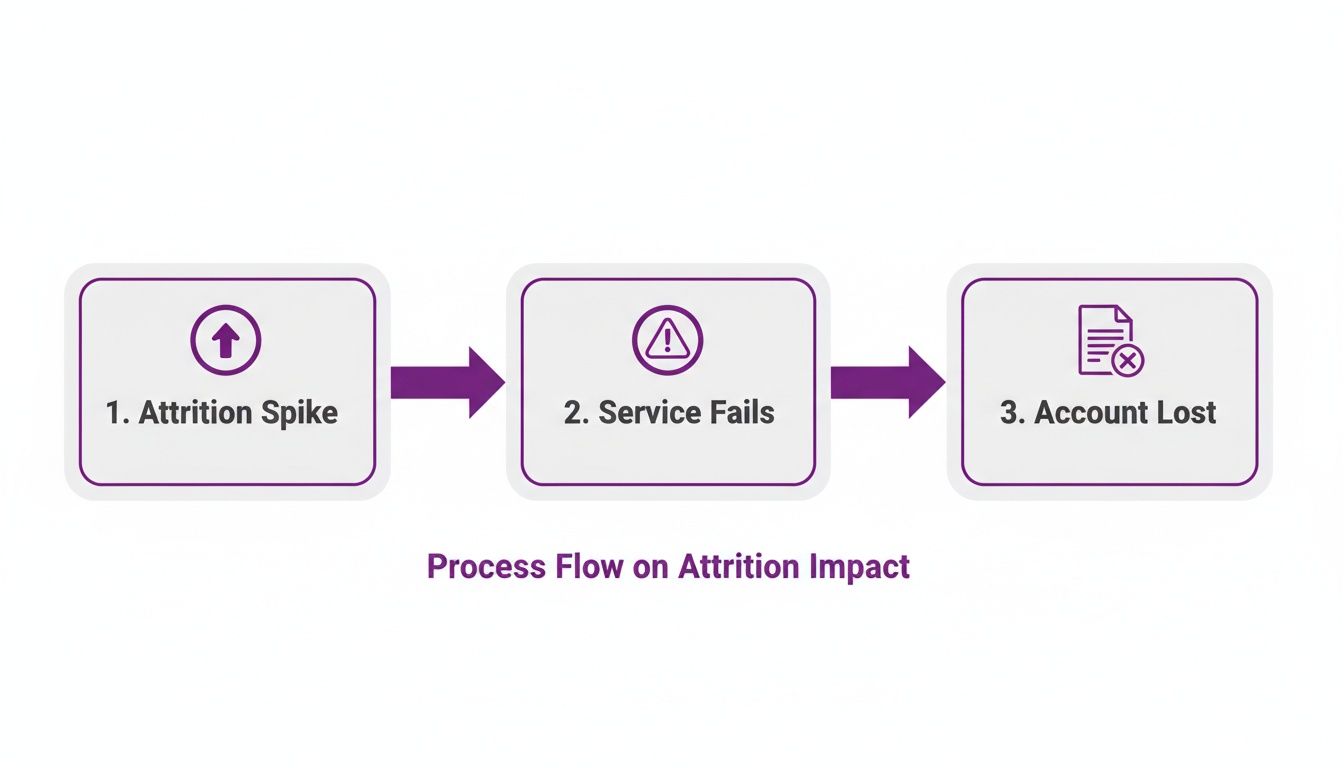
As you can see, attrition isn’t a fire you can contain in one department. Its flames can quickly spread and threaten your client relationships and bottom line.
Key BPO Attrition Formulas at a Glance
To make sense of your workforce dynamics, you need the right tools. This table is a quick-reference guide to the essential attrition formulas every BPO leader should have in their strategic toolkit, defining what they measure and why they’re so critical for C-suite decision-making.
| Formula Type | Calculation Method | What It Tells You (Strategic Insight for CXOs) |
|---|---|---|
| Monthly Attrition | (Number of Leavers / Average Headcount) x 100 | Your immediate, short-term operational stability. It’s your early warning system for sudden problems like a toxic manager or a poorly-handled policy change. |
| Annualised Attrition | Monthly Attrition Rate x 12 | The projected annual impact on your P&L if the current monthly rate continues. Crucial for long-term financial planning and budgeting for recruitment. |
| Voluntary Attrition | (Voluntary Leavers / Average Headcount) x 100 | The percentage of employees who chose to leave. This points directly to strategic failures in culture, compensation, or management effectiveness. |
| Involuntary Attrition | (Involuntary Leavers / Average Headcount) x 100 | The percentage of employees terminated. High rates can signal flaws in your recruitment strategy or performance management systems. |
| Rolling Average | (Sum of Last N Months’ Attrition / N) | Smooths out monthly spikes to show a more stable, underlying trend. Excellent for tracking the real impact of your strategic retention initiatives over time. |
These aren’t just calculations; they are lenses through which you can diagnose the health of your organisation and take targeted, effective action.
Attrition is one of three core workforce KPIs every BPO leader should track together. See how it relates to the BPO shrinkage formula and the utilization formula in BPO for a complete view of workforce efficiency.
The Annualised Attrition Rate: Seeing the Bigger Picture
While a monthly figure gives you an immediate snapshot, the annualised rate provides the strategic, long-term view that boards and investors care about. It answers the critical question: “If this trend continues, what is the full-year financial and operational impact?”
The formula couldn’t be simpler:
Annualised Rate = Monthly Attrition Rate x 12
Let’s apply it to our scenario:
- Annualised Rate = 5.1% x 12 = 61.2%
A projected annual attrition of over 60% is a massive red flag. It tells a story of instability that impacts everything from recruitment budgets to your ability to deliver consistent service quality for key clients. This is the figure that should grab the attention of the entire C-suite and trigger an immediate strategic review.
To put this in context, the Indian BPO sector has historically seen industry-wide averages fluctuate between 20% to 40%. Top-tier BPOs work relentlessly to keep their rates closer to 25%.
Digging Deeper: Voluntary vs. Involuntary Attrition
Just knowing how many people left isn’t enough for strategic action; you need to know why. The most critical first step is to split your attrition into two buckets:
- Voluntary Attrition: These are the employees who choose to resign. This metric is a direct reflection of your company culture, management effectiveness, compensation packages, and career pathing. High voluntary attrition is a sign that something is actively pushing your talent away.
- Involuntary Attrition: This refers to employees terminated, usually for performance or policy reasons. A high rate here could mean your hiring process is bringing in the wrong profiles, or your training and coaching programmes are failing to get them up to speed.
If, in our example, 20 of the 25 agents who left did so voluntarily, the story changes completely. The problem isn’t just hiring the wrong people; it’s about failing to create an environment where the right people choose to stay and grow.
For anyone wanting to model these numbers for their own team, a tool like an Attrition Calculator can be a great way to quickly run different scenarios.
Translating Attrition Data Into Strategic Action
You’ve run the numbers. What now? Calculating your BPO attrition formula is just the start. For senior leaders, the real value comes from turning that number into a strategic narrative—one that uncovers what’s really happening in your operation and points toward smart, decisive actions.
Think of your attrition rate less as a KPI and more as a diagnosis of your organisational health.

A high voluntary attrition rate, for example, is rarely about just one thing. It’s often a massive red flag signalling systemic issues with your mid-level management, company culture, or career paths. Are your best agents walking out the door because they feel stuck, unappreciated, or see no future with the company?
Conversely, a sudden spike in involuntary attrition should trigger an immediate review of your talent acquisition and training pipeline. If you consistently let new hires go for poor performance, the problem likely began long before their first call. It suggests a serious mismatch between who you’re hiring and what the job actually demands.
Benchmarking for Realistic Goals
To know whether your attrition rate is a five-alarm fire or business as usual, you need context. Comparing your figures against industry averages is essential for setting goals that are both ambitious and achievable.
Take the Indian BPO industry. Attrition has always been a major hurdle, with rates floating around 35% in the mid-2010s. While an agent in a western call centre might stick around for years, the average tenure in an Indian BPO was often a mere 11 months. Knowing these benchmarks helps you separate a normal market trend from a critical internal problem that needs your immediate attention.
A number without context is just noise. Your goal isn’t necessarily to hit a universal ‘good’ number, but to consistently outperform your direct competitors and demonstrate a steady downward trend quarter over quarter. This shows stakeholders and clients that your retention strategy is working.
From Data to Decisive Action: A Real-World Scenario
Let’s see how this works in practice. A Director at a large BPO noticed a disturbing pattern: high turnover among her top-performing agents—the very people she couldn’t afford to lose. Her overall attrition number was holding steady, but when she drilled down into the segmented data, she saw a crisis brewing in her most skilled teams.
Instead of guessing, she went straight to her exit interview data. A clear pattern jumped out. Nearly every top agent who left mentioned the same toxic team leader, whose management style was crushing morale and driving away talent.
Armed with this insight, she took precise action:
- Pinpointed the Root Cause: The problem wasn’t pay or workload; it was a single person’s leadership failure.
- Implemented Targeted Coaching: The team leader was immediately enrolled in an intensive management coaching programme. Understanding how to use analytics for better coaching can be a game-changer here, and it pays to hold that leader accountable against the right measures, which we cover in our guide to the KPIs of a team leader in BPO.
- Monitored Progress: She kept a close eye on the team’s monthly attrition rate, looking for any sign of improvement.
The result was staggering. Within a single quarter, attrition in that department plummeted by 15%. This scenario is a perfect example of why you must move beyond the raw bpo attrition formula. It’s about using data to ask the right questions, find the real story, and roll out focused solutions that deliver tangible results. This is how raw data becomes powerful strategic intelligence.
Common Pitfalls in Attrition Calculation and How to Avoid Them
Bad data leads to bad strategy. It’s that simple. As a leader, you rely on attrition reports to make crucial decisions on talent, operations, and budget. If the numbers you’re looking at are skewed, you could be steering the entire organization in the wrong direction.
Let’s walk through the most common traps executives fall into when using the BPO attrition formula. Getting this right is fundamental to building a strategy that actually works.
The Danger of Extrapolating a Single Month
One of the most frequent—and dangerous—mistakes is taking one month’s data and annualising it. Imagine a high-attrition month in May due to seasonal trends or a project ending. Annualising that number might project a catastrophic 60% annual turnover. This sparks panic and leads to knee-jerk decisions, like across-the-board pay raises, that don’t solve the real, isolated problem.
Conversely, an unusually low attrition month in December could create a false sense of security, masking deep-seated issues that are bubbling just beneath the surface. Trusting a single data point is like judging an entire film by watching one scene; you’re missing the plot.
Expert Tip: For strategic planning, always use a rolling three-month or six-month average for annualisation. This approach smooths out the peaks and troughs, giving you a much more stable and reliable picture of your real attrition trend. It helps you stay proactive without overreacting to normal business cycles.
Failing to Segment Your Data
Another critical error is looking only at the aggregate, company-wide attrition figure. An overall rate of 15% might sound manageable, but that single number can hide serious problems festering in specific areas of your organization.
For example: A BPO’s overall annual attrition was a respectable 22%. However, by segmenting the data, the COO discovered that the attrition rate for agents working on their most complex, high-value client account was over 45%. The ‘acceptable’ average was masking a critical failure that was putting their largest contract at risk.
Without segmenting, you’d never know that:
- Your top-performing team is bleeding talent with a 30% attrition rate.
- A huge chunk of new hires are walking out the door within their first 90 days, pointing to a broken onboarding or recruitment process.
- One particular department, under one specific manager, has a turnover rate that’s double the company average.
Segmentation transforms a generic number into actionable intelligence. It shows you exactly where the fire is, enabling targeted solutions instead of wasting resources on broad, ineffective initiatives.
Confusing Internal Transfers with Exits
This sounds obvious, but it happens more often than you’d think: counting internal transfers as attrition. When an agent moves from a customer service role to a quality assurance position, they haven’t left the business—they’ve grown with it. Including these movements in your attrition formula incorrectly inflates your turnover rate and masks genuine retention wins.
I once saw a BPO make this exact mistake. Their reports showed an alarming attrition rate in their main voice process, which triggered a costly and time-consuming overhaul of the department’s entire incentive structure. Months later, they realised the “problem” was that their best agents were being promoted into other teams. What they diagnosed as a crisis was actually a sign of a healthy career development programme.
It’s vital to standardise your reporting. Get HR and Operations in a room and agree on a crystal-clear, unified definition of an “exit.” This simple alignment prevents misinterpretation and ensures you’re focusing energy on solving the right problems.
Actionable Retention Strategies for the Modern BPO
Knowing your attrition numbers is one thing; acting on them is what protects your bottom line. Once you have a firm grip on the bpo attrition formula, it’s time for senior leadership to drive meaningful change. This isn’t about quick fixes; it’s about building a proactive culture that makes your best people want to stay.
The whole game changes when you stop seeing agents as replaceable cogs and start treating them as long-term investments. You need to create an environment where people see a future, not just a job.
Build Tangible Career Paths
One of the biggest drivers of voluntary attrition is a perceived lack of growth. Agents need to see a clear, achievable path forward that takes them beyond the call centre floor.
- Promote from Within: Make this a non-negotiable policy. Before you even consider an external hire, advertise every team lead, quality analyst, or trainer role internally.
- Fund Their Growth: Offer to pay for certifications in valuable skills like data analysis, project management, or advanced client-specific knowledge. It’s a powerful signal that you’re invested in their career, not just their current role.
- Create Leadership Pipelines: Pair your high-potential agents with senior managers for mentorship. This simple step builds loyalty and provides them with invaluable guidance. A practical example is creating a “Future Leaders” program where top agents spend 10% of their time shadowing operational managers, preparing them for the next step.
To make a real dent in BPO attrition, you have to get serious about applying proven employee retention best practices.
Invest in Smarter Technology
In a modern BPO, technology is more than an efficiency tool—it’s a powerful retention lever. Strategic investments in solutions like voice AI can radically improve the agent experience, slash burnout, and deliver a significant ROI.
Imagine being able to analyse agent sentiment on every single call. You could spot the early signs of burnout in your top performers and have their manager intervene with support long before they even think about quitting. That’s what happens when technology becomes a core part of your retention strategy.
AI is brilliant at handling the repetitive, soul-crushing tasks that agents hate, like writing post-call summaries or tedious data entry. This frees them up to focus on more challenging and rewarding customer conversations, directly boosting job satisfaction. AI can even help you hire better in the first place by improving your screening process. You can learn more about how AI voice agents can improve candidate selection.
Prioritise Employee Well-being and Feedback
Let’s be honest: the BPO world is demanding. Prioritising employee well-being isn’t just a “nice-to-have” anymore; it’s a strategic necessity. And it pays off.
Recent trends in India show that BPO companies offering benefits 15-20% above the minimum wage and providing flexible work options saw their attrition rates drop by 18-23%. This is concrete proof that investing in your people works.
Implement modern, anonymous feedback systems. But more importantly, act on what you hear. When your team sees that their concerns about a difficult process or a demanding client are being heard and addressed by leadership, it builds a foundation of trust. That trust is what creates a stable, engaged, and ultimately more profitable workforce.
Common Questions About BPO Attrition Answered
As a leader in the BPO space, you’re no stranger to tough conversations about workforce stability. Getting a firm grip on attrition formulas and what they really mean for the business is non-negotiable. Let’s tackle the questions that always come up in the boardroom.
What Is the Attrition Formula in BPO?
The standard BPO attrition formula is (Number of Employees Who Left ÷ Average Headcount) × 100, expressed as a percentage over a chosen period (usually monthly). Average headcount is the starting headcount plus the ending headcount, divided by two.
How Do You Calculate Attrition Rate in a Call Center?
Take the number of agents who exited during the period, divide by the average number of agents employed during that same period, then multiply by 100. For example, 25 exits ÷ 490 average agents × 100 = 5.1% for the month.
What’s a Good BPO Attrition Rate?
For years, the industry standard in India floated somewhere between a staggering 20-40%. But the game has changed. Today, the most competitive BPOs are pushing hard to get that number below 20%.
However, a single ‘good’ number is a myth. A healthy rate for a simple, high-volume retail campaign will be different from that for a complex, licensed financial services account. Your real goal shouldn’t be to chase an arbitrary percentage. Instead, focus on demonstrating a consistent, downward trend in attrition every quarter and ensuring you are outperforming your direct competitors. That’s a far more powerful story for stakeholders and clients.
How Often Should We Be Looking at Attrition?
The answer depends entirely on who’s asking.
Your team leaders and operational managers need to have their fingers on the pulse of attrition monthly. This frequency is crucial for them to catch sudden spikes or worrying trends on the ground floor—like the impact of a new team leader—before they escalate into systemic issues.
For the C-suite and board-level meetings, a quarterly review is much more strategic. Looking at the numbers through a rolling three-month average smooths out the inevitable monthly blips and provides a clearer, high-level picture of the underlying trend. This perspective helps you spot those stubborn, long-term patterns that require top-down strategic intervention.
The biggest mistake I see leaders make is viewing attrition as a lagging indicator—something HR cleans up after the fact. The sharpest leaders treat it as a leading indicator. It’s a canary in the coal mine for deeper problems in your management style, training programs, or overall company culture. By the time that attrition number is red-lining, the root cause has been damaging your organisation for months.
When you shift your mindset like this, attrition data stops being a reactive report card and becomes a powerful tool for predicting challenges and driving proactive improvement. It’s about getting ahead of problems before they ever impact your P&L.
Ready to turn attrition insights into retention wins? DialNexa’s Voice AI agents can automate routine tasks, reduce agent burnout, and improve job satisfaction, helping you keep your best people. Discover how at https://dialnexa.com.

[…] and contract retention. That is why accurate workforce math matters, including a clear method for calculating BPO attrition rates and a disciplined understanding of turnover benchmarks such as Mastering the Employee Turnover Rate […]