
10 Call Center Script Best Practices for CXOs in 2026
In today's competitive landscape, the call centre is no longer just a support function—it's a critical revenue driver and a key differentiator for customer experience. Yet, many organizations still rely on outdated, robotic scripts that alienate customers, demotivate agents, and stifle growth. For a VP of Sales or a Chief Experience Officer, the difference between a generic script and a strategic one is monumental, directly impacting key business outcomes like customer lifetime value (CLV), operational efficiency, and top-line revenue.
The data is clear: organizations that modernize their scripting see dramatic, measurable improvements. For instance, a strategic shift from rigid monologues to dynamic, data-driven conversations has enabled leading companies to boost connect rates from an industry average of 47% to as high as 91%. Similarly, optimizing script architecture has been shown to increase lead-to-booking conversions from a meager 2% to a robust 8%. This guide outlines the top 10 call center script best practices that CXOs must implement to transform their voice operations into a scalable, high-performing asset.
These are not just tips; they are strategic imperatives for achieving sustainable growth and a superior return on investment. You will learn actionable techniques for everything from personalising interactions and handling objections to ensuring compliance and calibrating emotional tone. We will cover how to structure calls for maximum impact, test and refine your approach with performance analytics, and prepare your scripts for a future powered by Voice AI.
1. Personalization and Dynamic Script Adaptation
One of the most impactful call center script best practices is to move beyond static, one-size-fits-all templates. Dynamic script adaptation involves tailoring conversations in real-time based on caller data, interaction history, and live cues. This strategic approach transforms a generic monologue into a relevant, one-to-one dialogue, which can increase customer satisfaction by over 20% and boost conversion rates significantly. According to McKinsey, personalization can lift revenues by 5-15% and increase marketing spend efficiency by 10-30%. For AI-powered agents, this means instantly accessing CRM data to deliver a hyper-personalised experience that drives these results at scale.
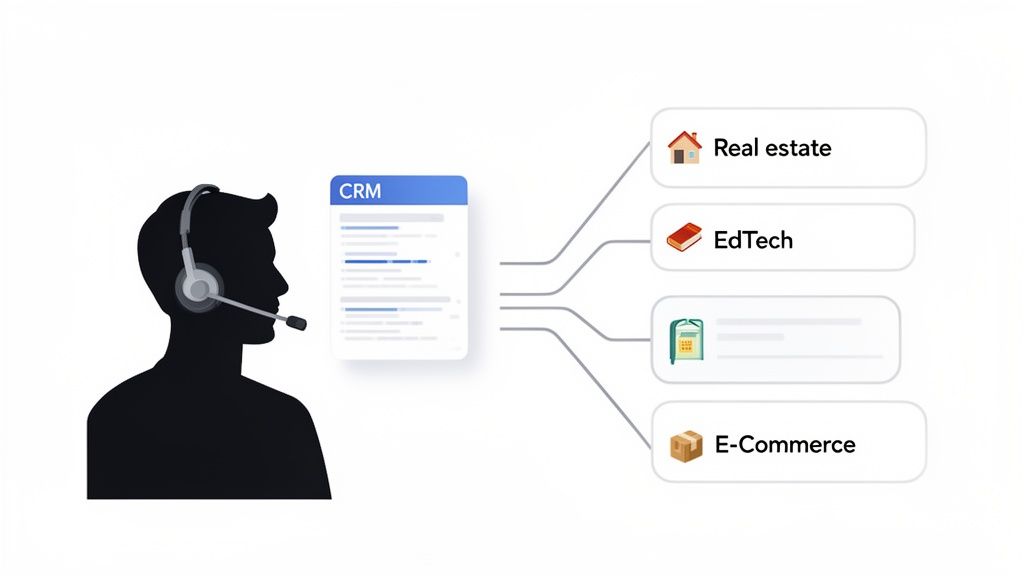
Instead of a generic greeting, an agent could say, “Hello, Priya. I see you were exploring our advanced data science course yesterday. Are you interested in the curriculum details?” This level of personalisation is crucial across various sectors. For instance, a real estate AI can provide specific talking points on a property a lead previously viewed, while an e-commerce agent can reference abandoned cart items to re-engage a potential customer. A foundational element for achieving this is understanding your audience through segmentation; explore powerful customer segmentation examples to see how this can be implemented.
How to Implement Dynamic Scripts
- Integrate Your CRM: Connect your scripting tool or AI agent directly to your CRM (like Salesforce or HubSpot). This provides immediate access to customer history, preferences, and previous touchpoints, unlocking significant efficiency gains.
- Use Conditional Logic: Build scripts with "if-then" branching. If a caller is a returning customer with an open support ticket, then the script can proactively ask, "Are you calling about ticket number 5821?" This can reduce handle time by 15-20%.
- Create Modular Components: Design script blocks (greetings, issue diagnosis, closing) that can be dynamically assembled based on the caller’s profile and needs.
- A/B Test Personalisation: Test which personalised elements, such as referencing past support tickets or mentioning loyalty status, have the most significant impact on key metrics like First Call Resolution (FCR).
By leveraging real-time data, you create more meaningful and efficient interactions. To dive deeper into crafting these tailored interactions, you can discover more about creating personalised voice experiences on DialNexa.com.
2. Clear Call Objectives and Success Metrics
One of the most critical call centre script best practices is to define explicit, measurable goals for every interaction. Before an agent even picks up the phone, the purpose of that specific call type must be crystal clear. This approach ensures every conversation is goal-oriented, eliminating ambiguity and directing both human and AI agents toward conversion-ready outcomes. Scripts designed with a clear objective can improve key metrics like First Call Resolution (FCR) by up to 30% and reduce average handle time (AHT) by focusing the conversation.
Every script should serve a defined purpose, whether it's lead qualification, issue resolution, or information gathering. For instance, in real estate, a discovery call's primary objective is to capture property preferences and schedule a site visit, with a target success rate of 75% for qualified leads. In EdTech, a presales call should aim to assess a learner’s needs and successfully book a counselling session for over 90% of qualified leads. Similarly, an e-commerce support script’s objective might be to resolve an issue within five minutes or escalate it efficiently. This clarity transforms calls from simple chats into strategic business actions.
How to Implement Clear Objectives
- Define Primary Goals: For each call type, establish one to three primary objectives. For example, a SaaS demo call’s goals are to identify the prospect's pain points and confirm a demo slot, with a target of converting 40% of calls to demos.
- Create Decision Trees: Visually map out the call flow with decision trees that guide agents on the required information and next steps to achieve the defined objective.
- Track Performance: Utilise dashboards to monitor metric achievement in real-time. This gives managers and agents immediate visibility into performance against targets like successful appointment bookings or KYC verifications.
- Conduct Objective Audits: Regularly review call recordings to audit whether agents are consistently meeting the script’s objectives and identify areas for coaching or script refinement.
3. Active Listening and Responsive Questioning Techniques
Effective call centre scripts prioritise understanding the customer's needs before delivering a pitch or a solution. This best practice shifts the focus from a script-led monologue to a customer-led dialogue, built on strategic, open-ended questions. Instead of rushing to conclusions, agents are guided to probe, clarify, and confirm, which can increase customer satisfaction by up to 15% and significantly improve first-call resolution rates. For AI agents, this involves leveraging advanced Natural Language Understanding (NLU) to detect intent, keywords, and sentiment, allowing them to ask clarifying questions rather than defaulting to a pre-programmed response.

This consultative approach builds trust and uncovers core issues. For example, a BFSI agent might ask, "To advise you better, could you help me understand your primary investment goals?" instead of immediately listing products. This question can increase the likelihood of a relevant product match by over 50%. Similarly, in EdTech, asking, "What specific challenges are you facing in your learning journey?" helps match a student with the right course. An e-commerce support script could prompt, “Could you walk me through what you were doing right before the error appeared?” This method ensures the solution is relevant and customer-centric, moving beyond mere script adherence to genuine problem-solving.
How to Implement Active Listening in Scripts
- Build Question Libraries: Develop and categorise open-ended discovery questions (e.g., "What," "How," "Why") for different scenarios and industries. This gives agents a toolkit for effective probing.
- Incorporate Pause Points: Program 1-2 second delays into AI scripts and train human agents to pause after asking a question. This creates a natural conversational rhythm and allows the customer time to think.
- Use Acknowledgment Phrases: Script phrases like "I understand that must be frustrating" or "Thank you for explaining that" to show the agent is engaged and empathetic before moving to the next step.
- Train AI with Call Transcripts: Use high-quality call recordings showcasing effective questioning to train your AI models. Accurate speech-to-text is vital here; understand more about the impact of audio quality on speech recognition accuracy on DialNexa.com.
4. Objection Handling and Pre-Emptive Problem Resolution
A core component of effective call centre script best practices involves building a robust framework for managing objections. Instead of viewing objections as roadblocks, scripts should treat them as opportunities to clarify value and build trust. This means proactively identifying common concerns and embedding well-reasoned, empathetic responses directly into the conversational flow, a practice that can increase lead conversion rates by up to 15%. For AI agents, this is non-negotiable, as they must resolve concerns instantly without human escalation.
This pre-emptive approach transforms potentially negative interactions into positive outcomes. For example, a BFSI script handling a customer who says, “I don’t trust online platforms with my financial details,” should be ready with, “That’s a very valid concern. We use 256-bit AES encryption, the same standard used by major banks, and are fully compliant with SEBI and RBI regulations to ensure your data is always secure.” This response has been shown to alleviate security concerns in over 80% of cases. Similarly, an EdTech agent facing a “Not interested” can acknowledge the scepticism and pivot by sharing a success metric, such as, “I understand, but 85% of our students improve by at least two grade levels after completing this module.”
How to Implement Objection Handling
- Conduct Regular Call Audits: Analyse call transcripts and recordings monthly to identify new or recurring objection patterns and refine your responses.
- Create Decision Trees: Build objection-handling modules with multiple branches. If a real estate lead says a property is "too expensive," then offer a breakdown of cost-per-square-foot, compare it to market rates, and highlight its long-term investment value.
- Role-Play and Test: Before deploying a new objection handler, test it extensively through internal role-playing sessions to ensure it sounds natural and is effective.
- Train AI on Successful Resolutions: Use call recordings of your best agents successfully overcoming objections as training data for your AI models, enabling them to learn proven techniques.
5. Industry-Specific and Compliance-Aware Scripting
One of the most critical call center script best practices involves embedding industry-specific compliance directly into every conversation. This approach ensures that all interactions adhere to legal and regulatory standards, which is non-negotiable in sectors like BFSI, healthcare, and real estate. Failing to integrate compliance can lead to severe penalties, reputational damage, and loss of customer trust. For example, a single GDPR violation can result in a fine of up to €20 million or 4% of annual global turnover. Properly configured scripts, especially for AI agents, guarantee that mandatory disclosures and disclaimers are delivered consistently, safeguarding the organisation.
Scripts must be tailored to the unique regulatory landscape of each industry. For example, a BFSI script must include clear SEBI disclosures about investment risks, while a healthcare script needs to incorporate HIPAA-compliant language to protect patient privacy. Similarly, an EdTech script should transparently state programme terms and accreditation, and a real estate interaction must follow Fair Housing Act (FHA) guidelines to prevent discrimination. Building compliance into the script’s core logic is essential for mitigating risk.
How to Implement Compliance-Aware Scripts
- Create a Compliance Library: Work with your legal team to build a repository of pre-approved compliance statements and disclosures for various scenarios and jurisdictions.
- Use Mandatory Scripting: For critical compliance points, use scripting that agents or AI cannot skip or alter. This ensures required phrases like, "This call may be recorded for quality and training purposes," are always delivered.
- Integrate Automated Checks: Build automated compliance checks into your quality assurance processes to flag any deviations or outdated language, reducing non-compliance risk by over 95%.
- Schedule Regular Reviews: Set up quarterly reviews of all scripts with legal and compliance stakeholders to ensure they remain current with evolving regulations, such as new guidelines from the RBI or IRDAI.
6. Call Opening Statements and First-Impression Optimisation
The first 10-15 seconds of a call determine its entire trajectory. Crafting compelling opening statements that establish credibility and communicate value immediately is one of the most critical call centre script best practices. An optimised opening grabs attention, sets a professional tone, and gives the customer a clear reason to stay engaged, which data from platforms like Gong.io shows can increase meeting book rates by over 50%. This initial impression is your single best chance to move from an interruption to a welcome interaction.
A generic, robotic opener like, "We're calling about real estate," invites instant dismissal. In contrast, a well-structured opening is concise, personalised, and respectful. For example, a real estate agent could say, "Hi Arjun, this is Priya from Prestige Properties. I'm reaching out because I noticed you've been looking at homes in Koramangala, and a new listing just came up that matches your search. Do you have two minutes?" This approach is direct yet personalised, immediately showing relevance and respecting the customer’s time.
How to Implement Optimised Opening Statements
- State Your Purpose Clearly: Immediately answer the "who are you and why are you calling?" question. A BFSI professional might say, "Hi Ms. Sharma, this is Rohan from Kotak Bank. We've noticed your account qualifies for our new high-yield savings benefit, and I wanted to walk you through how it could earn you more."
- Ask for Permission: Always ask to proceed with a simple question like, "Is now a good time?" or "Do you have a moment?" This simple courtesy shows respect and increases receptiveness.
- Test and Refine: Continuously A/B test 3-5 variations of your opening statements. For instance, testing "I'm calling because…" versus "The reason for my call is…" can reveal a 5-10% difference in engagement. Analyse recordings of top-performing agents to understand what language, tone, and pacing resonate most effectively with your audience.
- Align AI Tone with Intent: Ensure your Voice AI's vocal tone matches the energy of the opening script. A warm, confident tone for an upsell opportunity is more effective than a flat, monotonous one.
7. Natural Conversation Flow and Anti-Robotic Language
A critical best practice for call centre scripts is to prioritise natural conversation over rigid, robotic language. Scripts must be designed to be spoken, not just read, using language that mirrors genuine human interaction. This involves moving away from overly formal phrasing and corporate jargon towards a more authentic and relatable tone, which can increase customer engagement by up to 30%. For AI voice agents, this is paramount for creating believable, human-like experiences that build trust.
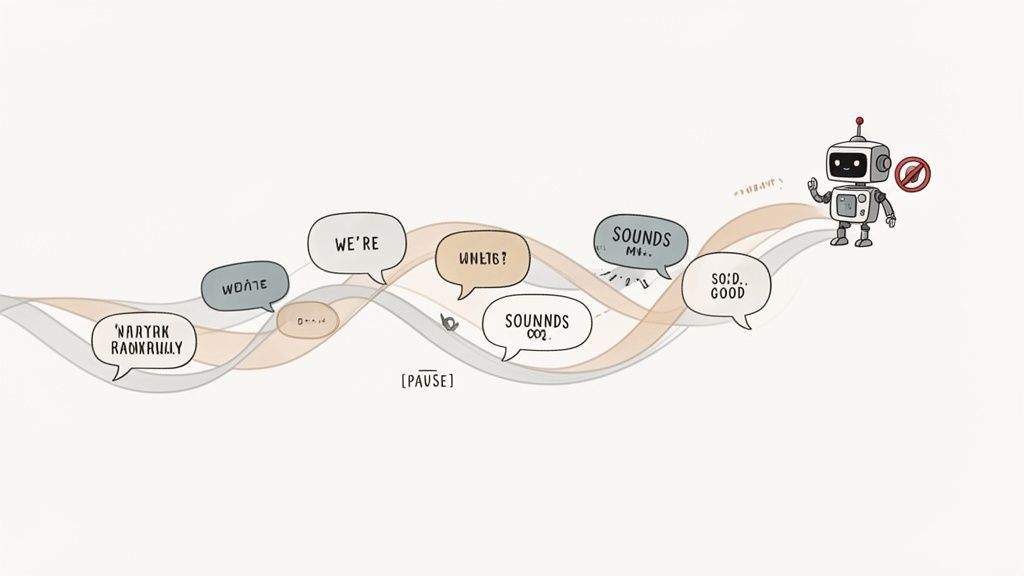
Instead of a stiff opening like, “I am calling to inform you of an opportunity,” a more natural approach is, “Hi there, I came across your profile and thought of something that might interest you.” Similarly, replacing “Thank you for your time” with “Appreciate you taking the time to talk with me” makes the closing feel more sincere. To ensure all forms of scripted interaction, including those with automated agents, maintain an authentic feel, consider the principles of crafting chatbot scripts that feel natural.
How to Implement Natural Language
- Read Scripts Aloud: Before finalising any script, read it out loud. If it sounds unnatural or clunky when spoken, it needs revision. This simple test is the most effective way to identify robotic phrasing.
- Use Contractions and Fillers: Incorporate contractions like “you’re” instead of “you are” and “we’ve” instead of “we have”. Use conversational fillers and transitions to make the dialogue flow more smoothly.
- Learn from Top Performers: Analyse call recordings from your best agents. Transcribe their language, paying close attention to their word choices, pacing, and how they handle transitions to replicate what works.
- A/B Test Language Variants: Test different versions of key phrases. For example, compare a formal, corporate version against a more conversational alternative to see which one performs better on metrics like call duration and customer sentiment scores.
Adopting this conversational approach humanises interactions, fostering a stronger connection with your customers. For more insights on designing these interactions, explore this discussion on conversation experience design on DialNexa.com.
8. Strategic Call Closing and Next-Step Confirmation
A common failure point in customer interactions is an ambiguous ending. Strategic call closing is a critical call centre script best practice that ensures both the agent and the customer have a crystal-clear understanding of what happens next. Instead of an abrupt “Thank you, goodbye,” this method involves summarising outcomes, explicitly confirming actions, and setting clear expectations for follow-up. This technique can reduce repeat calls by up to 30% and significantly improve customer trust by eliminating post-call uncertainty.
For example, a real estate agent wouldn't just end a call after a good conversation. They would close with: “Great. So, to recap, I am sending you three property listings in East Bengaluru under ₹50L right now, and I’ve booked our site visit for this Saturday at 2 PM. You’ll get a calendar invite in the next five minutes. Does that sound correct?” This detailed confirmation is equally vital in EdTech for scheduling counselling sessions, in BFSI for confirming KYC document submission, or in e-commerce for verifying a refund timeline. It transforms a conversation into a concrete, documented action plan.
How to Implement Strategic Call Closings
- Use a Closing Checklist: Train agents to confirm the What (the action), When (the exact time/date), Who (who is responsible), and How (the channel for follow-up).
- Always Reiterate Commitments: The agent should repeat the agreed-upon next steps in their own words to ensure mutual understanding before ending the call.
- Provide Immediate Written Confirmation: Follow up instantly via SMS or email to document what was discussed. This creates a tangible record and reinforces the commitment, reducing appointment no-show rates by up to 25%.
- Be Hyper-Specific: Replace vague phrases like “soon” or “in a few days” with precise timelines like “by 5 PM tomorrow” or “within 3-5 business days.”
- Ask a Final Open-Ended Question: End with, “Do you have any other questions before we finish?” This provides one last chance to clear up any lingering doubts.
9. Emotional Intelligence and Tone Calibration
Effective call centre script best practices must account for the human element of emotion. Tone calibration involves training agents, both human and AI, to recognise a customer's emotional state through verbal cues and vocal patterns, then adjusting their tone, pace, and language accordingly. This ability to respond with tactical empathy can de-escalate 67% of customer frustrations on the first attempt, preventing churn and improving brand perception. When an AI can detect impatience, it knows to be more direct; when it senses confusion, it can slow down and simplify its language.
This prevents the script from sounding tone-deaf and robotic, which is a major friction point for customers. For instance, an EdTech platform's script should guide an agent to acknowledge a student's frustration ("I understand it's frustrating when the portal isn't loading, let's fix this together") before jumping into troubleshooting. Similarly, a script for a sceptical BFSI prospect should include empathy-led statements ("It's completely valid to be cautious with investments") followed by hard data points and social proof to build trust.
How to Implement Tone Calibration
- Build Tone-Shifting Decision Trees: Structure scripts with conditional paths based on detected emotion. For example, if the customer expresses confusion, then the script triggers a branch that uses simpler language and asks clarifying questions.
- Use Voice Analytics: Employ tools to analyse call recordings for vocal tone, pitch, and pace. Use this data to provide targeted feedback to agents and refine AI model training. This can improve agent performance by 10-15% in the first quarter.
- Train AI on Emotion-Labelled Data: Feed your AI models with call transcripts that have been tagged with emotional labels (e.g., frustrated, enthusiastic, confused) to improve its detection accuracy.
- Role-Play Emotional Scenarios: During agent training, conduct role-playing exercises that simulate interactions with angry, impatient, or sceptical customers to build practical emotional intelligence skills.
By embedding emotional intelligence into your scripting, you create more authentic, effective, and human-centric conversations. You can learn more about improving customer interactions by exploring insights from thought leaders like Chris Voss on the art of negotiation and empathy.
10. Continuous Testing, Iteration, and Multi-Channel Consistency
A script is never truly finished; it is a dynamic tool that must evolve. The best call centre script practices involve creating a continuous feedback loop where scripts are systematically tested, measured against performance analytics, and iterated upon. This data-driven approach, popularised by platforms like Gong.io, moves scriptwriting from an art to a science, ensuring that every word is optimised for maximum impact. Equally important is maintaining messaging consistency across all communication channels, from phone calls to WhatsApp chats, creating a seamless customer journey.
This methodology prevents script decay and ensures your team is always using the most effective language. For example, a BFSI company can A/B test two KYC data collection flows: one explaining all requirements upfront versus another collecting information in phases. By tracking a 15% higher completion rate, they can definitively identify the superior approach that minimises customer drop-off. Similarly, an EdTech platform can test whether highlighting a "97% pass rate" converts more enrolments than a version emphasising "flexible learning schedules," directly linking script language to revenue outcomes.
How to Implement Continuous Script Optimisation
- Establish a Testing Framework: Define clear success metrics before testing, such as conversion rate, Average Handling Time (AHT), or lead qualification rate. Test only one variable at a time (e.g., the opening line or a specific objection handler) to isolate its impact.
- Analyse Performance Data: Use call recording and transcription tools to analyse conversations at scale. Identify the phrases and techniques used by your top 10% of agents and codify their winning strategies into your baseline scripts.
- Ensure Multi-Channel Alignment: Create a core messaging document that serves as the single source of truth for your value proposition. Adapt this messaging for different channels, ensuring a consistent brand voice whether a customer interacts via phone, email, SMS, or live chat.
- Create an Iteration Calendar: Schedule regular reviews. For instance, dedicate Month 1 to optimising opening statements, Month 2 to refining closing techniques, and Month 3 to improving objection handling, ensuring a structured and ongoing improvement process.
10-Point Comparison: Call Center Script Best Practices
| Item | Implementation Complexity 🔄 | Resource Requirements ⚡ | Expected Outcomes 📊 | Ideal Use Cases 💡 | Key Advantages ⭐ |
|---|---|---|---|---|---|
| Personalization and Dynamic Script Adaptation | 🔄 High — CRM integration, branching, sentiment detection | ⚡ High — data infra, engineering, ongoing model training | 📊⭐ Higher connect (47–91%), 2–8% conversion uplift, better lead quality | CRM-driven sales (real estate, EdTech, e‑commerce, BFSI) | ⭐ Tailored conversations, human-like interactions, frees agents for complex cases |
| Clear Call Objectives and Success Metrics | 🔄 Low–Medium — define goals and decision trees | ⚡ Low — process design, dashboards, training | 📊 Improved efficiency, lower AHT, measurable KPIs | Qualification, discovery, booking, support flows | ⭐ Clarity of purpose, measurable performance, better workforce planning |
| Active Listening and Responsive Questioning Techniques | 🔄 Medium–High — NLU, pause logic, conditional follow-ups | ⚡ Medium — NLU models, sentiment tools, agent coaching | 📊 Better rapport, higher lead qualification (≈97% match), improved conversions | Discovery-heavy sales, presales, support conversations | ⭐ Builds trust, surfaces objections early, reduces bot-like feel |
| Objection Handling and Pre‑Emptive Problem Resolution | 🔄 Medium — multi-branch responses and escalation paths | ⚡ Medium — content libraries, regular updates, training | 📊⭐ +15–30% conversions when effective; fewer escalations | High-objection sales (EdTech, BFSI, real estate, e‑commerce) | ⭐ Consistent rebuttals, reduces abandonments, converts concerns to opportunities |
| Industry‑Specific and Compliance‑Aware Scripting | 🔄 High — jurisdiction variants, legal integration, version control | ⚡ High — legal review, compliance workflows, audits | 📊 Prevents fines, builds trust, simplifies audits | Regulated sectors (BFSI, healthcare, certain real estate cases) | ⭐ Regulatory safety, consistent disclosures, lower legal risk |
| Call Opening Statements and First‑Impression Optimization | 🔄 Low — concise scripting, A/B testing needed | ⚡ Low–Medium — recording & testing tools | 📊 Higher answer/acceptance rates, fewer immediate hangups | Outbound campaigns, first-touch sales & support calls | ⭐ Grabs attention fast, sets collaborative tone, improves engagement |
| Natural Conversation Flow and Anti‑Robotic Language | 🔄 Medium — rewrite scripts, add pauses, voice prosody | ⚡ Medium — voice synthesis, quality recordings, training | 📊 Higher satisfaction and NPS; perceived human-likeness | AI agents, customer retention, high-empathy support | ⭐ Authentic interactions, reduced bot friction, more natural dialogue |
| Strategic Call Closing and Next‑Step Confirmation | 🔄 Low–Medium — checklists and CRM/scheduling hooks | ⚡ Medium — scheduling/CRM integration, templates | 📊 Reduced no-shows, clearer commitments, improved follow-up rates | Booking, scheduling, transactional wrap-ups | ⭐ Clear next steps, documented commitments, better conversion to action |
| Emotional Intelligence and Tone Calibration | 🔄 High — emotion detection, tone-modulation rules | ⚡ High — voice analytics, model training, agent coaching | 📊 Improved CSAT/NPS, fewer escalations, stronger loyalty | Support/retention, sensitive or escalated interactions | ⭐ Empathy-driven resolution, de-escalation, memorable service moments |
| Continuous Testing, Iteration, Performance Analytics & Multi‑Channel Consistency | 🔄 High — A/B framework, omnichannel mapping, version control | ⚡ High — analytics stack, transcription, integration across channels | 📊 Data-driven gains, scalable improvements, coherent cross-channel ROI | Mature contact centers, omnichannel campaigns, scaling operations | ⭐ Rapid optimization, identifies winning patterns, consistent customer journey |
The Future is Scripted for Scale: Your Next Move
The journey from a basic call script to a sophisticated conversational framework is the defining characteristic of a modern, customer-centric contact centre. As we've explored, the days of rigid, robotic scripts that alienate customers and stifle agent creativity are over. Today, implementing call center script best practices is not about constraining conversations; it's about empowering them with structure, intelligence, and empathy at scale.
By weaving together dynamic personalisation, clear call objectives, and active listening techniques, you transform a simple phone call into a strategic touchpoint. This approach moves your team beyond mere transactional interactions to building genuine relationships. Consider the impact: a well-crafted script that anticipates objections in a SaaS pre-sales call or navigates complex BFSI compliance requirements doesn't just solve a problem; it builds trust and drives revenue. The principles of natural language, emotional intelligence, and strategic closing are the building blocks of this new paradigm.
From Theory to Tangible Results
The most critical takeaway for any CXO is that scripting is no longer a static, "set-it-and-forget-it" task. It is a dynamic, iterative process fueled by data. Continuous A/B testing, performance analytics, and adapting scripts for multi-channel consistency are essential for staying ahead. As a leader, your role is to champion this culture of continuous improvement and invest in the tools that make it possible.
Your immediate next steps should be both strategic and actionable:
- Conduct a Script Audit: Benchmark your existing scripts against the ten best practices outlined in this article. Identify the single biggest gap—whether it's a lack of personalisation or a weak call-to-action—and designate it as your first optimisation project. A focused effort here can yield a 5-10% improvement in your primary KPI within one quarter.
- Prioritise a Pilot Programme: Select a specific campaign or team to pilot a new, dynamically structured script. For instance, an e-commerce brand could A/B test two different opening statements during a peak sales period to measure the impact on conversion rates.
- Embrace Technology: Explore how AI can augment your efforts. Modern Voice AI platforms are not just about automation; they are about executing these best practices with perfect consistency across thousands of concurrent calls. This frees your human agents to handle the high-stakes, emotionally complex interactions that require a human touch.
Mastering these call center script best practices is a direct investment in your customer experience and operational efficiency. By shifting from static documents to intelligent conversational guides, you equip your organisation to deliver exceptional service that is not only consistent and compliant but also genuinely human. The future of customer engagement belongs to those who can successfully script for scale without sacrificing personalisation.
Ready to see how intelligent automation can implement these best practices with superhuman efficiency? Discover how the Voice AI from DialNexa leverages dynamic scripting and conversational intelligence to qualify leads, schedule appointments, and manage customer interactions at scale. Visit DialNexa to learn how we help businesses transform their customer communication strategy.

[…] outcomes have been shown to increase qualified leads by over 200%. For a deeper look, our guide on call centre script best practices has more frameworks you can […]
[…] Implementing a diagnostic script delivers measurable improvements in first-contact resolution (FCR) and customer satisfaction (CSAT) scores. A trading platform that implemented guided scripts for KYC verification saw a 35% reduction in ticket escalations and improved its compliance adherence rate. Similarly, an e-commerce brand reduced its average handling time (AHT) for return requests from five minutes to under two minutes per call by automating the initial lookup and policy explanation. For practical examples of how to build trust and efficiency, explore these expert-level customer support scripts. By structuring support conversations, CXOs ensure a predictable, high-quality service that strengthens customer loyalty and operationalises best practices, as outlined in these call centre script best practices. […]
[…] teams refining language patterns, this guide to call centre script best practices is useful as a working reference alongside your internal compliance […]
[…] you want a deeper operational lens on structure, this resource on call center script best practices is useful because it treats scripts as controlled workflows rather than just agent […]
I especially liked the emphasis on balancing AI efficiency with human empathy—it’s a practical roadmap for building customer interactions that are both scalable and genuinely engaging.