

How to Start a Call Center: A C-Suite Guide
Starting a call centre is about more than just headsets and software. The real work begins long before that, in the planning stages. This is where you lay the strategic groundwork that defines the centre's purpose, proves its financial worth, and aligns its entire structure with your bigger business goals.
Get this foundation right, and every decision you make—from who you hire to the tech you invest in—will drive real, measurable results.
Building Your Strategic Foundation
Before you even think about ordering a single piece of equipment, the most important work happens in the boardroom. Launching a call centre isn't just an operational item to tick off a list; it's a major strategic decision. It needs a clear vision and, just as importantly, a solid financial case to back it up. Without this blueprint, even the most advanced setup can quickly become a very expensive, misaligned headache.
First things first, you have to define your centre’s core mission with absolute clarity. This mission will guide every single choice you make down the line. Are you setting up an inbound support hub for a high-end financial services firm, where getting it right the first time (First Call Resolution) is everything? Or are you building an aggressive outbound sales engine for an EdTech company, where the lead conversion rate is the only number that matters?
Defining Objectives with Measurable Outcomes
Vague goals like "improving customer service" just won't cut it. To get buy-in from leadership, you need to tie your objectives to specific, quantifiable business outcomes. This is how you transform a call centre from a perceived cost centre into a strategic driver of revenue and customer loyalty.
Let’s look at some practical examples:
- A Real Estate Enterprise: The goal isn't simply to "answer calls." It's to increase site visit bookings from qualified leads by 30% within six months. This directly impacts the sales pipeline and revenue projections.
- An E-commerce Brand: The objective is to reduce customer churn related to post-purchase problems by 15% year-over-year. For a company with $10M in annual revenue, this single initiative could save $1.5M by offering proactive support and improving customer loyalty.
- An EdTech Platform: The target is to boost the lead-to-enrolment conversion rate from a modest 2% to a solid 8% by refining how initial counselling and qualification calls are handled. For a program costing $5,000, this could mean an additional $300,000 in revenue for every 1,000 leads generated.
This process flow maps out the essential steps for building your strategic foundation, from defining your mission right through to selecting the best operational model for your needs.
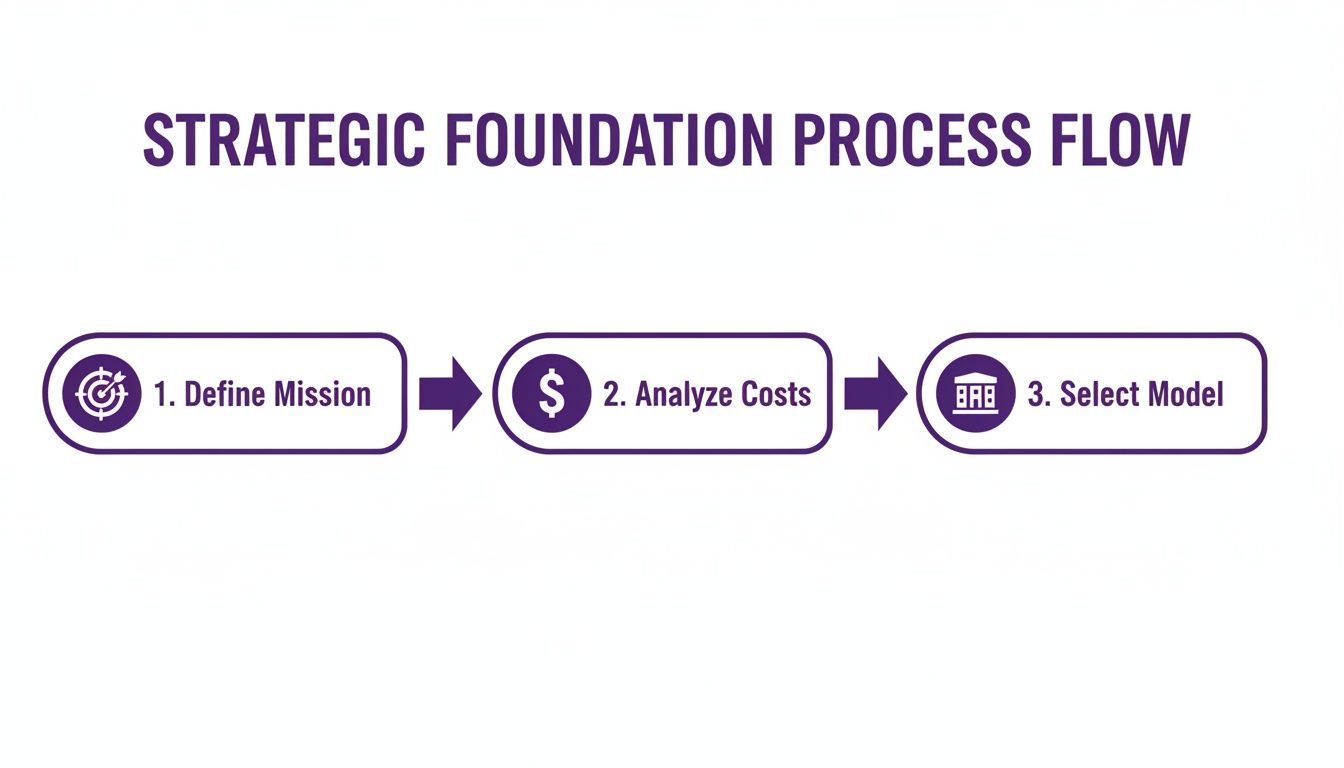
As you can see, a successful launch always starts with clear objectives before you get bogged down in the financial or structural details.
Constructing a Compelling Cost-Benefit Analysis
Once your objectives are crystal clear, you can build a cost-benefit analysis that will resonate with your senior leadership. This means projecting ROI not just in terms of direct revenue, but also by showing the gains in operational efficiency and the increase in customer lifetime value (CLV).
For example, a dedicated call center can offload initial lead qualification from senior sales executives. If a senior rep spends 10 hours a week on prospecting, freeing up that time for closing high-value deals can boost their productivity by an estimated 20-25%. That's a direct efficiency gain that strengthens the bottom line and makes a powerful case for the investment.
For any CXO, the real question isn't "What will this cost?" It's "What value will this generate?" A strong business case frames the call centre as an investment in growth, not an expense. It highlights how it will improve crucial metrics like Customer Acquisition Cost (CAC) and, of course, CLV.
Selecting the Right Operational Model
The final piece of your strategic puzzle is choosing the right operational model. Your main options are in-house, outsourced, or a virtual/hybrid setup. Each one comes with its own set of trade-offs when it comes to cost, control, and your ability to scale.
Here’s a high-level look at how these models stack up, designed to help leaders make the best choice for their specific business needs.
Comparing Call Center Models for Executive Decision-Making
| Operational Model | Key Advantages for Leadership | Primary Considerations | Ideal Industry Use Case |
|---|---|---|---|
| In-House | Complete control over brand voice, quality, and data security. Deep integration with company culture. | Higher initial capital investment (CAPEX) and ongoing operational costs. Slower to scale. | Banking, Financial Services, and Insurance (BFSI) where compliance and brand trust are non-negotiable. |
| Outsourced | Lower upfront costs and immediate access to a skilled, scalable workforce. Reduces management overhead. | Less direct control over agent performance and brand representation. Potential for cultural misalignment. | E-commerce or tech start-ups needing rapid, cost-effective scalability for customer support or sales. |
| Virtual/Hybrid | Unmatched flexibility and access to a global talent pool. Significantly lower real estate and infrastructure costs. | Requires robust technology for remote management, training, and security. Can be challenging to build a cohesive team culture. | Software-as-a-Service (SaaS) companies or businesses with fluctuating seasonal demand. |
Choosing the right model is a critical decision. An in-house setup, for instance, gives you maximum control, which is often essential for businesses in sensitive sectors like finance. However, it also comes with the biggest price tag.
On the other hand, exploring a partnership with the best call center outsourcing companies can dramatically lower your upfront costs and give you instant access to experienced agents. This is an especially compelling option in a market like India, where call centre and BPO revenue is projected to hit USD 7,065.6 million by 2035.
Finally, a virtual model gives you incredible flexibility and opens up a diverse talent pool while slashing real estate costs. This approach has become a go-to for its scalability and resilience. The best choice for you will always come back to your mission, your growth plans, and your comfort level with risk.
Navigating the Regulatory and Compliance Maze
With your strategic blueprint ready, it's time to tackle what is, for any senior leader, one of the most critical phases: mitigating risk. When setting up a call centre in India, this means getting to grips with a complex web of regulations that touches everything from your telecom licence to how you handle customer data.
Let's be clear: overlooking this isn't a minor slip-up. It's a strategic failure that can trigger staggering fines, force a complete operational shutdown, and cause irreversible harm to your brand's reputation. Proactive compliance is simply non-negotiable.
First Things First: Securing Your Licence to Operate
Your first major hurdle is registering with the Department of Telecommunications (DoT). In India, most call centres fall under an Other Service Provider (OSP) registration. While the government has thankfully simplified the guidelines over the years, getting registered is still a mandatory first step. If you don't, your entire operation could be declared unauthorised and shut down overnight.
The process is managed through the DoT’s online portal. The good news is that the old requirement for a bank guarantee has been removed for most OSPs, but the core obligation to register and operate within the rules remains firmly in place.

The government's aim is to promote ease of doing business, but the fundamental need to register and stick to telecom resource policies is non-negotiable.
Protecting Data and Respecting Industry Rules
Getting your DoT registration is just the beginning. Your call centre must operate in strict alignment with India's data privacy laws. The Digital Personal Data Protection (DPDP) Act has completely changed the game, placing serious obligations on how you collect, process, and safeguard customer information. Get this wrong, and you could be looking at penalties reaching up to ₹250 crore.
For any CXO, the DPDP Act is far more than an IT problem—it's a core business risk. A single data breach can vaporise customer trust that took years to build, hitting loyalty and long-term revenue much harder than the initial fine.
On top of this, you’ll have industry-specific regulations to deal with, adding another layer of complexity.
- TRAI Regulations: If you're doing any kind of telemarketing, you must follow the rules set by the Telecom Regulatory Authority of India (TRAI). This means scrubbing your calling lists against the National Do Not Call (NDNC) registry to avoid massive fines for bothering people with unsolicited calls.
- BFSI Compliance: A call centre serving the banking or financial services sector has to live by strict RBI and SEBI guidelines covering data security, call recording, and customer verification.
- Healthcare Protocols: Any centre handling patient data has a duty to maintain confidentiality and follow very specific protocols for sensitive health information.
Ultimately, building a compliance-first culture is the only way forward. This means rolling out robust data security measures, creating secure call recording policies, and training your agents relentlessly on these standards. As you develop these policies, particularly with new tech in mind, our guide on the ethics and legality of AI in phone calls can offer some valuable insights.
Taking a proactive approach to this regulatory maze doesn't just keep you out of trouble. It becomes a powerful competitive advantage, signalling to the market that your operation is built on a solid foundation of trust and integrity.
Before any outbound campaign can dial or message a single customer, the call centre's sender identity has to be cleared through a separate gate: our TRAI DLT registration guide walks through the entity, header, and template approvals TRAI requires ahead of any commercial voice or SMS traffic.
Architecting Your Modern Technology Stack
Once you've got your strategy and compliance frameworks sorted, it's time to build the engine that will power your entire operation. In a modern call centre, technology isn't just a background support function; it's the very heart of your efficiency, scalability, and customer satisfaction. Getting the tech stack right from day one is a critical decision that will directly shape your operational costs and revenue potential.
Forget the clunky, on-premises phone systems of the past. Today's world demands a move to the cloud. This isn't just a trend—it's a fundamental shift driven by the need for genuine flexibility and advanced features. The explosive growth of cloud solutions in India tells the whole story. The market for cloud-based contact centres here is expected to hit USD 7.5 billion by 2033, growing at a staggering CAGR of 21.38%. This signals a massive pivot away from legacy models toward platforms that can actually support remote work and deep personalisation. If you want to dig deeper, you can discover more insights about the Indian cloud contact centre market here.
The Core Components of a Modern Contact Centre
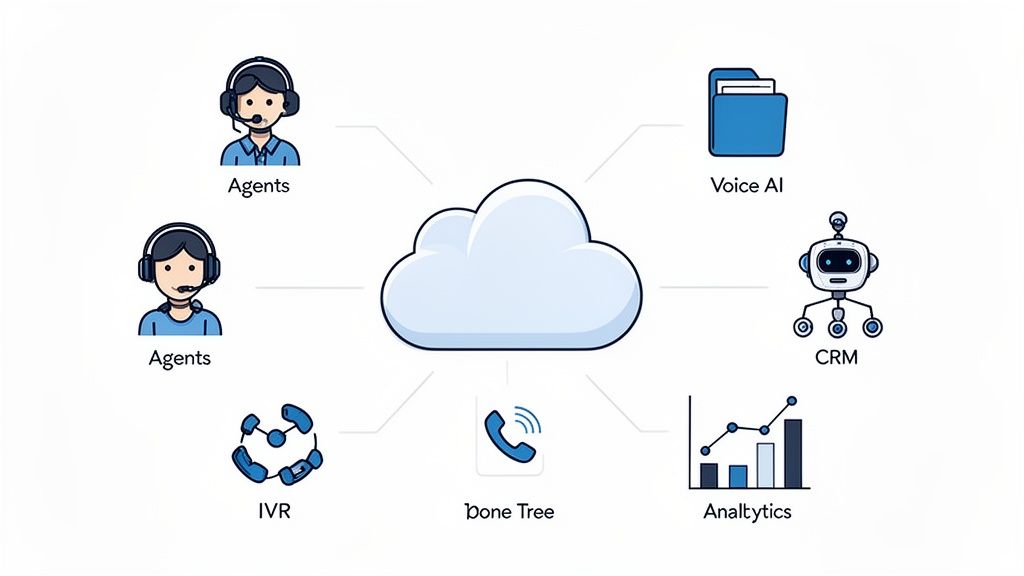
Building a tech stack that can grow with you means weaving together several key components that work in harmony. The goal is to create an ecosystem that empowers your agents, simplifies workflows, and gives you a single, clear view of every customer.
- Automatic Call Distributor (ACD): Think of this as the intelligent traffic controller for your call centre. A smart ACD doesn't just pass calls to the next free agent. It uses skill-based routing to match a customer's specific problem (like a technical glitch) with the agent who is best qualified to solve it. This one feature can improve First Call Resolution rates by up to 15%.
- Interactive Voice Response (IVR): A well-thought-out IVR lets customers solve simple issues themselves (like checking an account balance) or get to the right department without a fuss. Modern conversational IVRs that use natural language processing can successfully handle over 40% of inbound call volume, freeing up human agents significantly.
- Customer Relationship Management (CRM) Integration: This is completely non-negotiable. Your call centre platform must talk to your CRM seamlessly. When a call comes in, a screen-pop should instantly show the agent the customer's entire history—every past purchase, support ticket, and interaction. This context is what turns a generic call into a personal, high-value conversation.
The table below breaks down these core technologies and shows how they directly influence the metrics that matter most to your business.
Core Technology Components and Their Business Impact
| Technology Component | Core Function | Impact on Key Business Metrics (KPIs) |
|---|---|---|
| ACD (Automatic Call Distributor) | Intelligently routes incoming calls to the most appropriate agent based on predefined rules (e.g., skills, availability). | Improves First Call Resolution (FCR), reduces Average Handle Time (AHT), and boosts overall agent productivity. |
| IVR (Interactive Voice Response) | Provides self-service options for customers and gathers initial information to direct them to the correct department or agent. | Reduces call volume for live agents, lowers operational costs, and improves customer satisfaction by offering quick answers. |
| CRM Integration | Connects call centre software with customer data, providing agents with a complete view of the customer's history. | Increases agent efficiency, enables personalised service, and improves Customer Satisfaction (CSAT) and Net Promoter Score (NPS). |
| Voice AI & Analytics | Automates routine tasks, transcribes calls, and analyses conversations for sentiment, compliance, and coaching opportunities. | Slashes Customer Acquisition Cost (CAC), improves lead qualification rates, and provides deep insights for quality assurance. |
| Omnichannel Platform | Unifies all communication channels (voice, email, chat, social media) into a single agent interface. | Enhances customer experience by providing seamless cross-channel support and increases agent productivity by centralising workflows. |
Each of these pieces plays a vital role in creating an efficient, customer-centric operation.
The Strategic Deployment of Voice AI
The biggest competitive advantage you can get right now comes from smartly integrating Voice AI. This isn't about replacing your people. It's about making them better at their jobs by automating the repetitive, high-volume tasks so they can focus on what humans do best: building relationships and solving complex problems.
For example, you can deploy a Voice AI agent to handle your initial lead qualification. Instead of human agents burning hours on cold calls with terrible connection rates, an AI can dial through lists, hold natural conversations, and figure out who's actually interested. We've seen this single change boost connect rates from a typical 47% to an incredible 91%.
By automating the top of the sales funnel, you free up your best agents to talk only to warm, pre-qualified leads. This shift doesn't just slash your Customer Acquisition Cost; it dramatically improves agent morale and performance.
The AI can achieve 97% accuracy in matching the qualification judgement of a human manager, ensuring your sales team gets a steady stream of high-quality opportunities. The same idea applies to inbound support. AI can handle routine queries like "Where's my order?" or password resets, freeing your support team for more critical issues. Our article on how data and AI will transform contact centres for financial services dives into these applications with more detail.
Building a Scalable Omnichannel Infrastructure
Finally, your technology has to support an omnichannel experience. Your customers don't just call anymore; they reach out through email, chat, social media, and SMS. A truly modern setup brings all these channels together into a single, unified view for your agents.
This gives your team a complete, chronological story of every interaction, no matter which channel the customer used. An agent can see that a customer first sent an email, then started a web chat, and is now on the phone looking for a solution. This unified view stops customers from having to repeat themselves—a major point of frustration—and empowers your team to deliver the kind of seamless, personal service that builds real loyalty.
Building and Empowering a High-Performance Team
Once your technology stack is architected, it's time to shift your focus to the people. Your tech might be the engine, but your team is the heart of the operation. Frankly, they are your most valuable asset and, when managed well, your most powerful competitive advantage. Building a top-tier team isn't just about filling seats; it's a strategic mission involving smart talent acquisition, ongoing development, and creating a culture that makes your best people want to stay.
In today's market, the ideal call centre agent is a unique mix of soft skills and technical savvy. You absolutely need empathy, problem-solving, and resilience—those are non-negotiable. But just as important is their ability to navigate complex CRM systems and get comfortable with new AI-powered tools. The real trick is finding candidates who possess this dual competency right from the start.
Data-Driven Training for Real-World Challenges
Forget generic, one-size-fits-all training modules. They're a recipe for failure. A modern onboarding programme has to be driven by data and tailored to the actual challenges your team will face on the floor. This means getting past simple script memorisation and into immersive, scenario-based learning that mirrors the true complexity of your industry.
Let's look at a few practical examples:
- EdTech Call Centre: Training needs to involve intensive role-playing for complex student counselling calls. Agents must learn how to guide potential students through programme options, handle tough questions about finances, and build genuine rapport—not just read from a brochure.
- BFSI Call Centre: Onboarding in this sector demands rigorous, repeatable modules on compliance. Before an agent ever takes a live call, they must have mastered KYC protocols, data privacy laws, and secure communication practices. There's no room for error here.
- Real Estate Pre-Sales: Here, the focus is on teaching agents how to ask sharp, insightful discovery questions. The training should be all about pinpointing a prospect's real needs, gracefully overcoming objections, and skillfully steering the conversation toward booking a site visit.
This tailored approach ensures your agents are not just prepared, but confident from day one.
Leveraging Technology for Targeted Coaching
Your tech stack shouldn't just sit there; it should be a central part of your coaching strategy. Call recording analysis isn't just for ticking a quality assurance box anymore—it's an incredible development tool. By reviewing actual customer conversations, managers can give specific, actionable feedback that genuinely helps agents improve.
Modern platforms take this a giant leap further with AI-powered performance feedback. These systems can analyse thousands of calls to spot patterns, gauge sentiment, and pinpoint moments where an agent either shined or struggled. This allows for hyper-personalised coaching that addresses an agent's specific weaknesses while reinforcing their strengths. If you're looking to dive deeper, it's worth learning more about how speech analytics improves coaching and training.
For a CXO, the goal isn't just to monitor performance but to actively improve it. AI-driven insights transform coaching from a subjective art into a data-backed science, directly impacting agent effectiveness and, consequently, customer satisfaction.
Tackling the Costly Challenge of Agent Attrition
Agent attrition is one of the biggest, and often hidden, costs in running a call centre. High turnover is a constant drain on resources, sucking up time and money through an endless cycle of recruitment, hiring, and training. The solution isn't just throwing more money at salaries; it's about building a supportive and empowering culture from the ground up.
Fortunately, the talent landscape is showing some positive signs. In 2025, India's call centre and BPO industry created approximately 700,000 new jobs. Attrition rates, which historically shot as high as 50%, have improved significantly, now sitting around 30-35% thanks to more strategic retention efforts. With a working-age population expected to grow by 64% by 2030, India provides a deep and stabilising talent pool for new operations.
To make the most of this opportunity, focus on these proven retention strategies:
- Offer Clear Career Paths: People need to see a future. Create a transparent career ladder that shows a clear route from a frontline agent to a team lead, quality analyst, or even a management role.
- Foster a Positive Culture: Recognise great work publicly. Encourage your team to support each other. Invest in team-building activities that aren't a chore. A culture built on respect and appreciation is a game-changer for morale.
- Design Meaningful Incentive Programmes: Think beyond basic bonuses. Align your incentives with key business goals like First Call Resolution (FCR) or Customer Satisfaction (CSAT) scores. This helps agents feel directly connected to the company's success.
Designing Workflows That Drive Results
Think of standardised processes as the blueprint for delivering consistently great service. A solid workflow means every customer interaction is handled professionally and efficiently, no matter which agent picks up the phone. It's how you turn good intentions into reliable, repeatable operational excellence.
The aim here isn't to create rigid, robotic scripts that agents have to follow word-for-word. Instead, we're building flexible frameworks that empower them. These guides should steer the conversation in the right direction, not dictate it, leaving room for a natural, human touch while making sure all the important details are captured. For a deep dive into building these processes, check out this guide on mastering standard operating procedure templates.
Crafting Industry-Specific Frameworks
A one-size-fits-all script just won't cut it in a specialised business. You need workflows that are tailor-made for the unique challenges and goals of your specific industry.
Take a real estate pre-sales framework, for example. This should feel more like a guided discovery process. It would prompt agents to ask smart questions about a prospect's budget, ideal location, and family needs. The goal is to build rapport and gather key information before smoothly transitioning to scheduling a site visit.
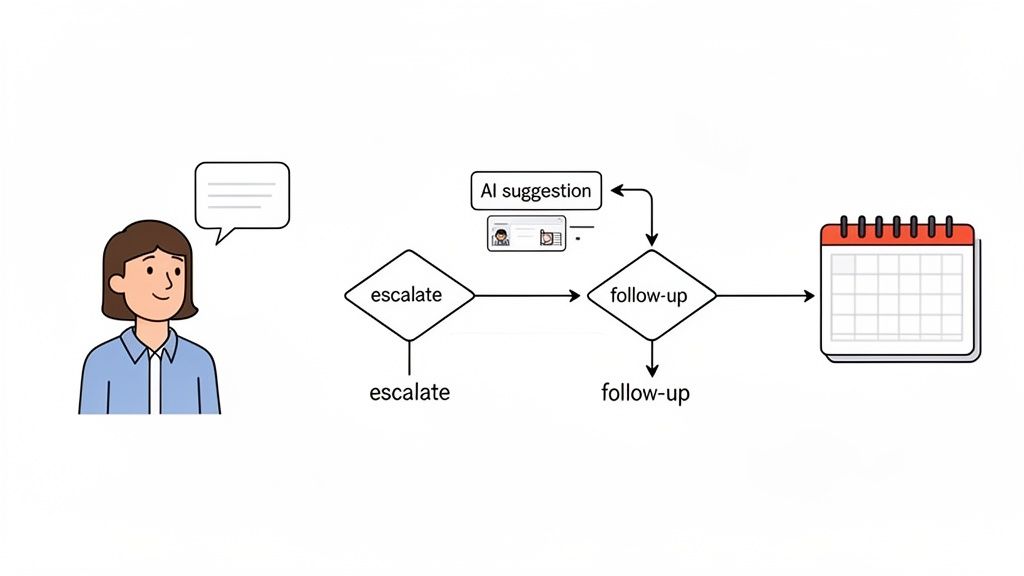
On the other hand, an e-commerce support workflow needs crystal-clear escalation paths. When a customer calls about a missing delivery, the framework should walk the agent through the first few troubleshooting steps. If the issue isn't solved, it should provide a simple, one-step process to transfer the call to a logistics specialist. This stops customers from getting bounced around between departments—a major source of frustration.
Integrating AI for Real-Time Agent Assistance
One of the best ways to boost agent performance is to give them AI-powered assistance tools that work right within their workflow. Think of it as a co-pilot, offering real-time support during live calls.
A McKinsey study found that 65% of consumers still prefer picking up the phone to get a quick answer. AI assistance helps your team deliver those answers faster and more accurately than ever, which is exactly what customers want.
Picture this: an agent is on a call, trying to solve a tricky technical problem for a software product. As the customer explains the issue, an AI tool can instantly pull up the right knowledge base articles, troubleshooting guides, and even suggest what to say next, all on the agent's screen. This has a massive impact on metrics like Average Handle Time (AHT) and First Call Resolution (FCR), effectively turning every agent into your top expert.
Ensuring Seamless Handoffs and Follow-Ups
A great workflow doesn’t just stop when the call ends. It needs to cover exactly what happens next to keep sales moving and make sure customer problems are truly solved.
- Standardised Call Logging: Every call needs to be logged in your CRM using consistent tags and notes. This creates a clean, reliable data trail that anyone can understand later.
- Automated Follow-Up Triggers: Your workflow should automatically create tasks for the next steps. After a sales discovery call, for instance, the system should prompt the agent to send a proposal email within 24 hours.
- Clear Inter-Departmental Handoffs: When an issue needs escalating, the workflow must specify what information is needed for a clean transfer. This simple step saves the customer from the headache of repeating their story to a new person.
Measuring Performance with Business-Critical KPIs
You can't fix what you can't see. As a leader, you need a crystal-clear, real-time view of what's happening on the floor to steer the ship effectively. Forget vanity metrics; we're going to cut through the noise and focus on the Key Performance Indicators (KPIs) that actually tell you how your operation is performing and directly impact the bottom line.
The whole point is to build a culture where data drives constant improvement. The insights you pull from your dashboards should be the catalyst for better training, smarter workflows, and strategic decisions that make customers happier and your business more profitable.
Focusing on Operational Efficiency
How well is your call centre actually running? These metrics look under the bonnet to gauge the internal health and cost-effectiveness of your team.
Average Handle Time (AHT): This is the total time an agent spends on an interaction, from the moment they pick up to finishing the after-call notes. What's a "good" AHT? It depends entirely on the context. An AHT of 6 minutes might be fantastic for a complex technical support issue, but if it's for a simple order status check, you'd want it well under 3 minutes.
First Call Resolution (FCR): This is the gold standard. It measures the percentage of calls where the customer's issue is solved on the very first try, with no need for a follow-up. A high FCR—you should be aiming for 75-80%—is a powerful sign of competent agents and smooth processes. It’s also a massive driver of customer satisfaction.
Tracking the Customer Experience
Operational metrics are important, but they don't tell you how your customers feel. These KPIs give you a direct line into the customer's perspective and are often early warning signs of churn.
Take Customer Satisfaction (CSAT), for example. It's that quick "How did we do?" survey on a 1-5 scale right after a call, giving you immediate feedback on a specific interaction. Then there's the Net Promoter Score (NPS), which zooms out to measure long-term loyalty by asking how likely a customer is to recommend your company. A consistently high CSAT score above 80% paired with a positive NPS is a strong signal of a healthy customer base.
Don't forget, 65% of consumers will pick up the phone when they want a quick answer. If your service is slow or unhelpful, you're not just failing an interaction; you're actively damaging your brand's reputation.
Measuring Crucial Business Outcomes
At the end of the day, your call centre has to contribute to the company's financial health. These metrics are the ones that connect your team's day-to-day activities directly to revenue and profitability.
For an outbound sales team, the Conversion Rate is everything. It’s simply the percentage of calls that lead to a sale. If your team makes 1,000 calls and closes 50 deals, your conversion rate is a solid 5%.
For any call centre, Cost Per Acquisition (CPA) is a must-track metric. It calculates the total cost to run the operation divided by the number of new customers it brought in. This KPI provides undeniable proof of your call centre’s value, shifting its perception from a necessary cost centre to a powerful revenue engine in the eyes of the board.
Frequently Asked Questions
When you're mapping out how to start a call center, certain questions always come up in the boardroom. Getting these sorted out early clarifies the business case and grounds everyone in the operational realities of getting a modern contact centre off the ground. Let's tackle some of the most common ones we hear from leaders.
What’s the Biggest Hidden Cost I Should Worry About?
It’s almost never the tech or the office space; it’s agent attrition. This is the silent killer of call centre budgets. Turnover rates have historically floated between a staggering 30-50%, and that creates a constant, draining cycle of costs.
Every time an agent walks out the door, you're not just losing a person. You're paying to recruit, hire, and train their replacement from scratch, a process that can take weeks or even months. For an agent earning $40,000 annually, the cost of replacement can be as high as $10,000-$15,000 per agent when you factor in lost productivity and training expenses. This doesn't just hit your finances; it creates inconsistent service for your customers and can seriously damage team morale. The best defence is a good offence: invest in a positive work culture, pay competitively, and show your people a real career path.
How Can I Bring in Voice AI Without My Team Freaking Out?
The key is to introduce it as a helpful tool, not a replacement. Think augmentation, not automation. Start small by letting AI handle the simple, repetitive tasks that no one really enjoys anyway. A perfect starting point is using a Voice AI agent to pre-qualify inbound leads or answer the same basic questions over and over, like "What are your opening hours?".
This move immediately frees up your experienced agents to focus on the complex, emotionally driven conversations where they truly shine. Frame the AI as a "digital assistant" that handles the grunt work, and your team will see the value right away. It helps them perform better, reduces burnout, and lets everyone get comfortable with the new tech at a natural pace.
By automating the top of the funnel, you’re not just cutting costs; you're elevating the role of your human agents. They move from transactional tasks to strategic relationship-building, which directly impacts both morale and revenue.
Realistically, How Soon Will I See a Return on Investment?
Your ROI timeline really depends on what your call centre is built to do. If you're running an outbound sales operation, where every call is tied directly to revenue, you could see a positive return in as little as 6-9 months. Once the team hits its stride, the conversions start adding up quickly.
On the other hand, an inbound support centre's ROI is measured in things like higher customer retention and lower churn. These metrics take longer to move and measure, so you're probably looking at a 12-18 month timeframe. The good news? Using cloud platforms and AI from the get-go can seriously speed things up by slashing initial setup costs and making your operation more efficient from day one. For instance, automating 30% of inbound queries with an IVR or Voice AI can reduce operational costs significantly, accelerating your path to positive ROI.
Ready to see how Voice AI can accelerate your call centre's ROI and streamline operations? DialNexa delivers human-like AI agents designed to handle everything from lead qualification to customer support, freeing your team to focus on high-value conversations. Discover how to build, train, and deploy your custom AI agents today.

[…] If you’re building a new voice operation, this becomes more compelling when paired with a clear plan to start a call center. […]
The focus on customer experience, data-driven coaching, and scalable cloud infrastructure clearly shows that a high-performing call centre is no longer just a support function but a powerful driver of revenue, retention, and competitive advantage.