

First Call Resolution: A Strategic Guide for CXOs in 2026
A repeat contact is never “just another call”. In contact centres, it is a second round of agent time, queue pressure, and customer frustration, and that friction shows up in service cost, CSAT, and eventually revenue. For Indian teams serving high-volume journeys in BFSI, e-commerce, telecom, and edtech, first call resolution is the cleanest signal that your operating model is solving problems, not just handling them.
Table of Contents
- Moving Beyond the Metric An Introduction to FCR
- Why FCR Is a C-Suite Concern
- How to Accurately Measure First Call Resolution
- FCR Benchmarks Across Key Indian Industries
- A Tactical Blueprint for Improving FCR
- Implementing Your FCR Optimisation Programme
- Conclusion The Future of First Call Resolution
Moving Beyond the Metric An Introduction to FCR
For Indian contact centres, the benchmark matters because repeat contact is still treated too often as a normal operating cost. A strong first call resolution operation in India generally sits in the 70% to 79% range, and 80%+ signals world-class performance, a bar that matters in a market shaped by rapid digital adoption, heavy service volumes, and high customer expectations. A team resolving 750 of 1,000 interactions on the first touch is already working at the upper end of the standard, while 800 of 1,000 moves into world-class territory.
That spread separates a service organisation that absorbs friction from one that keeps creating it. In India's high-volume environments, the second contact is rarely cheap. It adds handle time, routing work, escalation load, and customer effort, especially when the first interaction should have closed the issue.
Practical rule: if the customer calls back because the issue was misrouted, under-explained, or closed too early, the process failed even if the agent was polite.
FCR exists to replace narrow call-count thinking with outcome thinking. The question is not whether the centre answered quickly. The question is whether the customer's issue was resolved on the first interaction, without handing avoidable work to the next agent.
For board-level leaders, that makes FCR a signal about revenue protection, compliance risk, and cost-to-serve. Weak resolution drives repeat contacts, weaker CSAT, and more operational spend. Strong resolution supports retention, lowers rework, and reduces the chance that unresolved issues spill into complaints or regulatory exposure. For teams building the operating model, the enterprise first contact resolution best practices guide gives a useful framework for organising resolution discipline around ownership, knowledge access, and escalation control.
Why FCR Is a C-Suite Concern
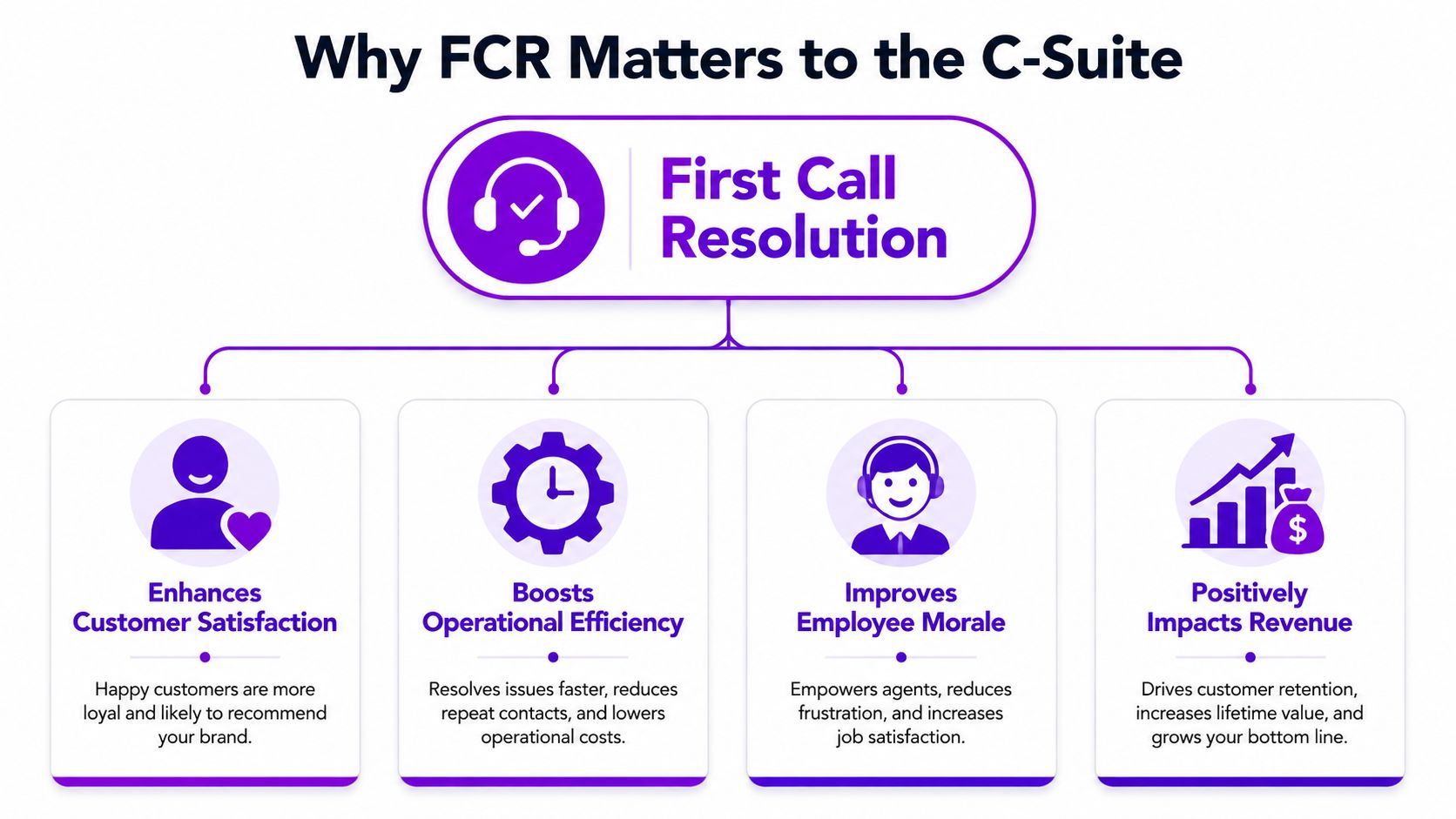
The board should treat first call resolution as a revenue and risk indicator, not a service vanity metric. Industry research summarised in 2026 materials shows that better FCR performance tracks directly with higher customer satisfaction and lower repeat-contact cost, which is why it matters to both growth and margin 2026 FCR research summary. In Indian contact centres, that link is sharper because every unresolved interaction adds pressure on queues, escalations, and the cost to serve in high-volume lines such as telecom, BFSI, e-commerce, and shared services.
CSAT and customer effort
Customers do not measure service by internal ownership charts. They measure it by whether they had to repeat the issue, wait for a callback, or explain the same identity details to another agent. A stronger FCR process lowers that effort because the first interaction closes the issue instead of creating another service loop.
That is why FCR remains a practical predictor of satisfaction. It does not replace CSAT, but it shapes the conditions that drive CSAT up or down. For a board, the implication is direct, an agent who resolves the issue cleanly on the first contact protects the relationship, reduces complaint probability, and reduces the chance that a simple service request becomes a retention problem. For a broader view of how this measure sits alongside other contact-centre KPIs, see this KPI guide from DialNexa, and because FCR is one of the metrics a floor leader is measured on directly, our guide to the KPIs of a team leader in BPO shows where it fits on their scorecard.
Weak resolution is not abstract. For concrete examples of what goes wrong when contact centres skip this discipline, see DialNexa’s roundup of poor customer service examples and their measurable cost.
Cost to serve
Repeat contacts consume the same labour twice. They also add routing work, queue pressure, and escalation handling, all of which raise operating cost without creating any new value for the customer. If an operation handles 100,000 contacts and lifts FCR from 70% to 75%, it avoids 5,000 repeat-resolution cases, which means fewer callbacks, less rework, and less time spent on avoidable follow-up 2026 FCR research summary.
A centre that keeps solving the same issue twice is paying for the same problem more than once. That principle extends to the underlying telephony spend too: DialNexa’s MyOperator pricing breakdown shows how annual billing commitments and per-minute add-ons can quietly double the cost of a contact centre’s calling infrastructure.
Retention and revenue
Retention risk usually starts with friction. A customer who has to re-contact support for a billing correction, a booking error, or a KYC clarification is already doing the organisation's work twice, and that friction shows up in renewal risk, lower repeat purchase intent, and weaker referral behaviour. In Indian markets, where service often sits close to payment, fulfilment, or account access, the commercial impact appears quickly in BFSI, e-commerce, telecom, and education services.
FCR also affects revenue quality. Poor resolution creates hesitation at the point of renewal, adds avoidable churn pressure, and weakens cross-sell because the customer no longer trusts the service channel to solve problems quickly. A leadership team that wants durable growth should track FCR alongside CSAT and revenue leakage, not after them.
Compliance and risk
In regulated operations, low FCR is a control weakness. It can mean incomplete verification, inconsistent disclosure, or a handoff that leaves a case unresolved across service, operations, and complaints. That matters in India's compliance-heavy environments, especially where RBI, SEBI, and IRDAI expectations depend on accurate customer handling, clear disclosures, and clean case closure. In those workflows, repeated contacts are not just inefficient, they can expose the organisation to rework, complaint escalation, and avoidable regulatory scrutiny.
Boards should pay close attention when unresolved cases reopen or move between teams without closure discipline. That pattern signals that the process is absorbing risk instead of controlling it.
How to Accurately Measure First Call Resolution
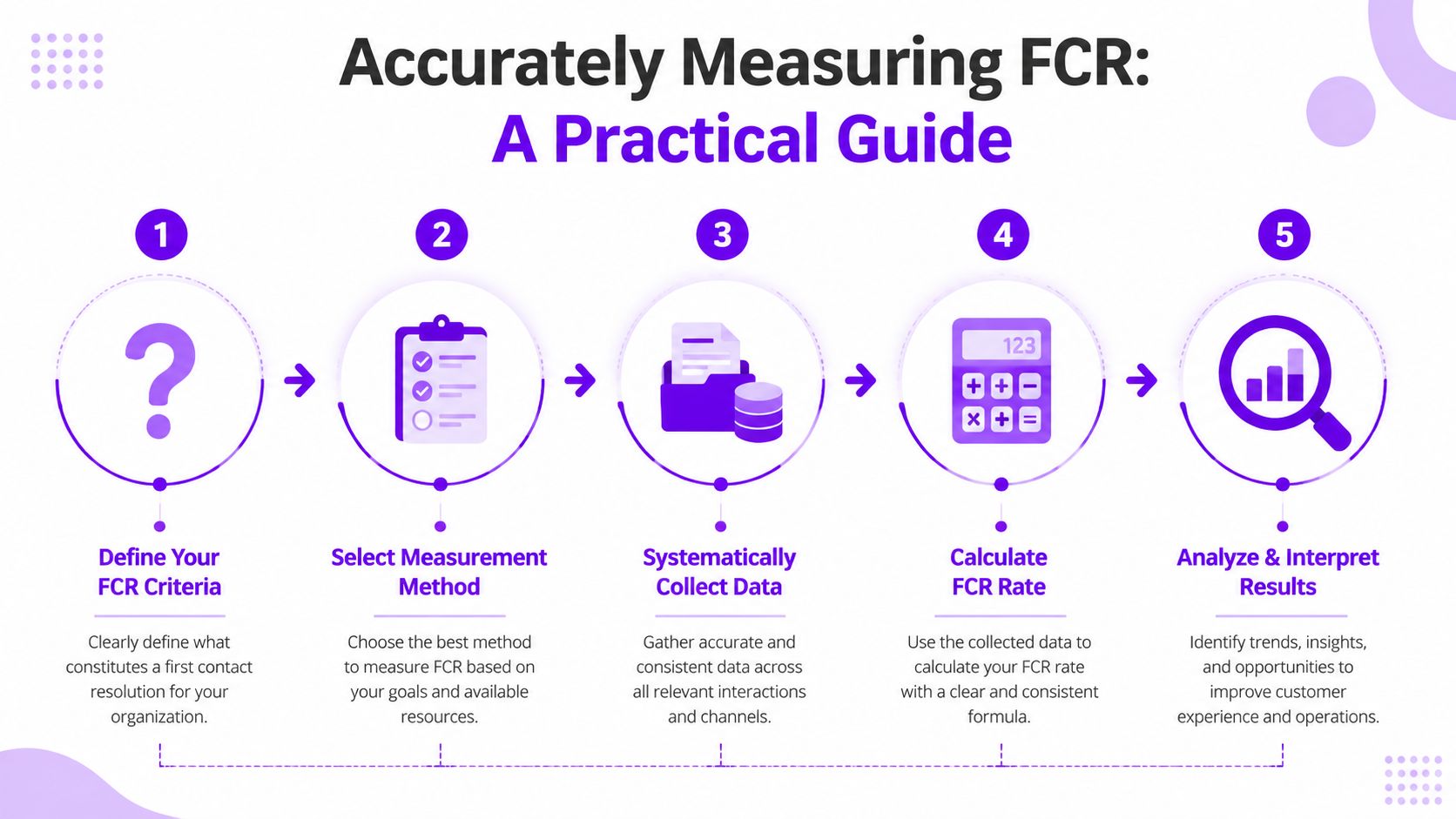
The formula is simple enough to write on a whiteboard, FCR = (issues resolved on first contact ÷ total issues) × 100, and it is the same core method used in standard service measurement frameworks Salesforce's FCR definition. The challenge is not arithmetic. It is deciding, with discipline, what the business is counting as resolved, and whether that definition protects CSAT, contains cost, and supports revenue retention.
Start with a resolution rule, not a dashboard
A metric only has value when the organisation agrees on the closure standard behind it. If one queue marks a case as resolved after an agent gives an explanation, while another only closes it after the customer confirms the issue is fixed, the report stops being an operating tool and starts becoming an argument. Measurement guidance from TechTarget's FCR definition points to the same discipline, define resolution clearly and route the customer to the right queue on the first attempt.
That distinction matters because many weak FCR results are process failures, not agent failures. They come from poor routing, unclear ownership, weak knowledge access, or a service model that forces the customer to repeat context across teams.
In Indian operations, the definition also has to reflect channel behaviour. A customer may start on voice, move to email, and then continue on WhatsApp or another local messaging path. If the business does not connect those touchpoints, the issue looks closed in one system and unresolved in the customer journey, which distorts FCR and hides the actual cost of repeat service.
Account for reopened cases
A clean closure on paper is not the same as a solved issue in practice. RingCentral's approach subtracts reopened cases from the resolved pool before the total is calculated, which is useful in environments where a case appears closed but later returns because the root cause never left the system RingCentral's FCR guide. That is a better fit for complex service operations, because it measures whether the customer stayed resolved, not just whether the ticket was marked complete.
For leadership reporting, that distinction matters. A board does not need a vanity number that flatters the operation. It needs a repeat-contact measure that shows whether the centre is reducing friction, limiting avoidable cost, and protecting trust at the moment the customer decides whether to renew, repurchase, or escalate.
Build measurement from the customer journey
Post-contact surveys, agent disposition codes, and journey analytics each expose a different failure point. Customer feedback shows whether the customer believes the issue was solved. Agent codes show which categories of contact keep breaking down. Journey analytics shows where the handoff failed, especially when a case moves from one team to another or shifts across channels.
The strongest view comes from combining those signals rather than relying on one report. If the customer says the issue was not resolved, but the agent marked it closed, the gap is a signal. If the agent is closing cases cleanly while reopen rates rise, the process is probably overstating closure quality. Teams that want to connect FCR to the wider KPI stack can use contact-centre KPI design to place FCR alongside the other measures that explain repeat contact, case handling, and service cost.
Operational test: if your FCR number rises but reopened cases also rise, the process is probably inflating closure quality.
Avoid the common traps
- Inconsistent definitions: A “resolved” case must mean the same thing across voice, chat, email, and back office.
- Channel switching blindness: A customer who starts on phone and finishes on WhatsApp, email, or another messaging path may still have an unresolved issue.
- Premature closure: A case should not be marked solved just because the agent ended the call cleanly.
- No issue taxonomy: If the organisation cannot tag repeat reasons, it cannot remove them.
Measurement should also support the business case, not just the contact centre scorecard. A cleaner FCR model improves CSAT because customers spend less time repeating themselves. It lowers operational cost because fewer contacts need to be handled again. It also protects revenue by reducing the friction that drives churn, delayed renewal, and complaint escalation.
FCR Benchmarks Across Key Indian Industries
Indian contact centres should treat first call resolution as a business control, not a generic service score. The useful benchmark is not a single national number, because issue mix, compliance load, and customer tolerance vary by sector. The clearer question is where FCR should sit relative to complexity, and where repeat contact is creating avoidable cost and revenue loss.
EdTech and admission workflows
Admissions counselling usually produces stronger FCR than technical support because the conversation is structured. Agents can resolve questions about eligibility, programme fit, fees, and next steps in one interaction when product information and handoff rules are clear. Technical support is different. It often depends on device checks, login access, learner-side troubleshooting, and repeated follow-up, so a single target for both work types obscures an accurate operating picture.
For EdTech leaders, the board-level issue is not only service quality. Low FCR in admissions can slow enrolment and increase drop-off, while low FCR in support raises cost and damages trust after the sale. A practical benchmark should separate pre-sales, admissions, and learner support, then track each queue against its own call complexity and average handling time expectations, which you can align with average handling time benchmarks and controls.
BFSI and regulated service
BFSI carries the heaviest compliance burden in this group. KYC checks, account servicing, loan questions, fraud disputes, and complaint handling often require validation before a customer can receive a final answer. That lowers the ceiling for same-call resolution, but it also makes bad FCR more expensive when it causes repeat contacts, complaint escalation, or avoidable callbacks.
A board should separate necessary control from internal inefficiency. If a query needs back-office approval, low FCR may be acceptable. If the issue keeps bouncing because teams lack authority, or because case ownership is unclear, the organisation is paying for poor design twice, once in labour and again in customer churn risk. In Indian BFSI operations, benchmark conversations should focus on issue type, because a compliant process can still deliver strong FCR on routine service requests while staying conservative on regulated exceptions.
E-commerce and D2C support
E-commerce and D2C teams see very different FCR outcomes across returns, delivery status, and pre-purchase questions. Delivery checks and returns often involve logistics, warehouse systems, refund approvals, and merchant policy, so they are rarely simple. Pre-purchase questions are usually easier to close if stock, product content, and delivery promise data are current and consistent across channels.
That distinction matters because revenue is directly tied to speed and certainty. If a customer cannot get a straight answer on availability, refund timing, or delivery commitment, the contact centre becomes a conversion barrier, not a service layer. Stronger FCR here protects revenue by reducing abandonment, post-order complaints, and repeated follow-up contacts that consume margin.
Real estate and healthcare journeys
Real estate and healthcare support show the same pattern. Site-visit booking, appointment scheduling, and routine coordination can often be resolved in one interaction when ownership is clear. Post-possession complaints, medical billing questions, insurance coordination, and provider follow-up usually require more hands, which lowers the practical FCR ceiling.
Leadership teams should read that gap carefully. Low FCR is sometimes the price of regulation, clinical caution, or sales-to-operations coordination. It is also a sign that no one owns the full journey. In those cases, the cost is not just another call. It is slower revenue recognition, lower customer confidence, and more work for supervisors who must clean up missed handoffs.
The right executive benchmark is by issue type, not just by industry. A company can look respectable on the overall scorecard while underperforming badly on the journeys that matter most to CSAT, cost per contact, and retention. The strategic question is simple. Which customer journeys are creating repeat contact, who owns the fix, and what is that leakage costing the business?
A Tactical Blueprint for Improving FCR
The fastest gains usually come from fixing routing, knowledge, and agent confidence before adding heavier automation. A strong FCR programme starts with the basics, then uses AI only where it cuts friction and protects service quality.
Fix the front door first
If callers land in the wrong queue, the operation starts behind. Skill-based routing and IVR design should reflect the actual customer journey, not the org chart. Concrete resolution criteria and routing on the first attempt matter because vague closure rules create repeat contacts, as noted earlier.
That means the routing logic should distinguish between a quick billing query, a refund status check, and a complaint that needs back-office coordination. The first is a same-call resolution candidate. The second may need a managed follow-up, not a forced closure. In Indian contact centres, that routing also has to account for language preference, regional accents, and channel switching, or the call gets transferred before the agent can solve anything.
Build agents for resolution, not just compliance
Agent training has to cover product knowledge, decision authority, de-escalation, and multilingual support. If the script is too rigid, the agent avoids ownership. If it is too loose, the agent improvises badly. The right balance is a clear playbook with enough room to solve common issues without waiting for permission, which protects CSAT and cuts the cost of repeat contacts.
That training should include the complaints that drive revenue leakage, disputed charges, failed deliveries, onboarding errors, and policy questions that can damage trust if they are answered incorrectly. A call that ends with partial reassurance but no action often creates a second contact, a supervisor escalation, or a lost customer.
Keep knowledge usable under pressure
A knowledge base only helps if agents can find the answer while the customer is still on the line. Long articles, inconsistent naming, and stale policy documents reduce FCR because they force the agent to search instead of resolve. The practical standard is simple. The best answer should be the easiest one to reach.
For Indian teams, that also means content needs to be searchable in the language the agent uses, not just in corporate English. Short decision trees, policy summaries, and exception handling notes matter more than polished pages. When agents can confirm eligibility, escalation rules, or compliance steps quickly, average handling time falls too, which supports both cost control and customer satisfaction. See the internal note on average handling time for the operational link between speed and resolution.
Use AI where it reduces repeat work
The most useful AI applications are real-time guidance, conversation analytics, and predictive prompts that improve FCR without sacrificing service quality. That matters because pushing FCR alone can create rushed answers and poor incentives. AI should help agents recognise intent faster, surface the right next step, and cut dead time without forcing premature closure.
Board-level filter: if a tool improves FCR by pushing agents to end calls early, it is damaging the metric that matters most.
One practical example is a voice-AI layer for repetitive qualification or support calls. DialNexa Labs Private Limited's voice AI agents handle qualification, customer support, recruitment, and presales at scale, which can offload routine conversations and let human agents focus on the cases requiring judgement. That matters in sectors such as edtech, BFSI, real estate, and e-commerce, where routine intake work can distract skilled staff from higher-value resolution and where compliance, consent, and audit trails cannot be left to guesswork.
AI should also be judged against business outcomes, not novelty. If it lowers repeat contacts, it improves CSAT and reduces supervisor load. If it only shortens calls by cutting corners, revenue and trust both suffer.
Implementing Your FCR Optimisation Programme
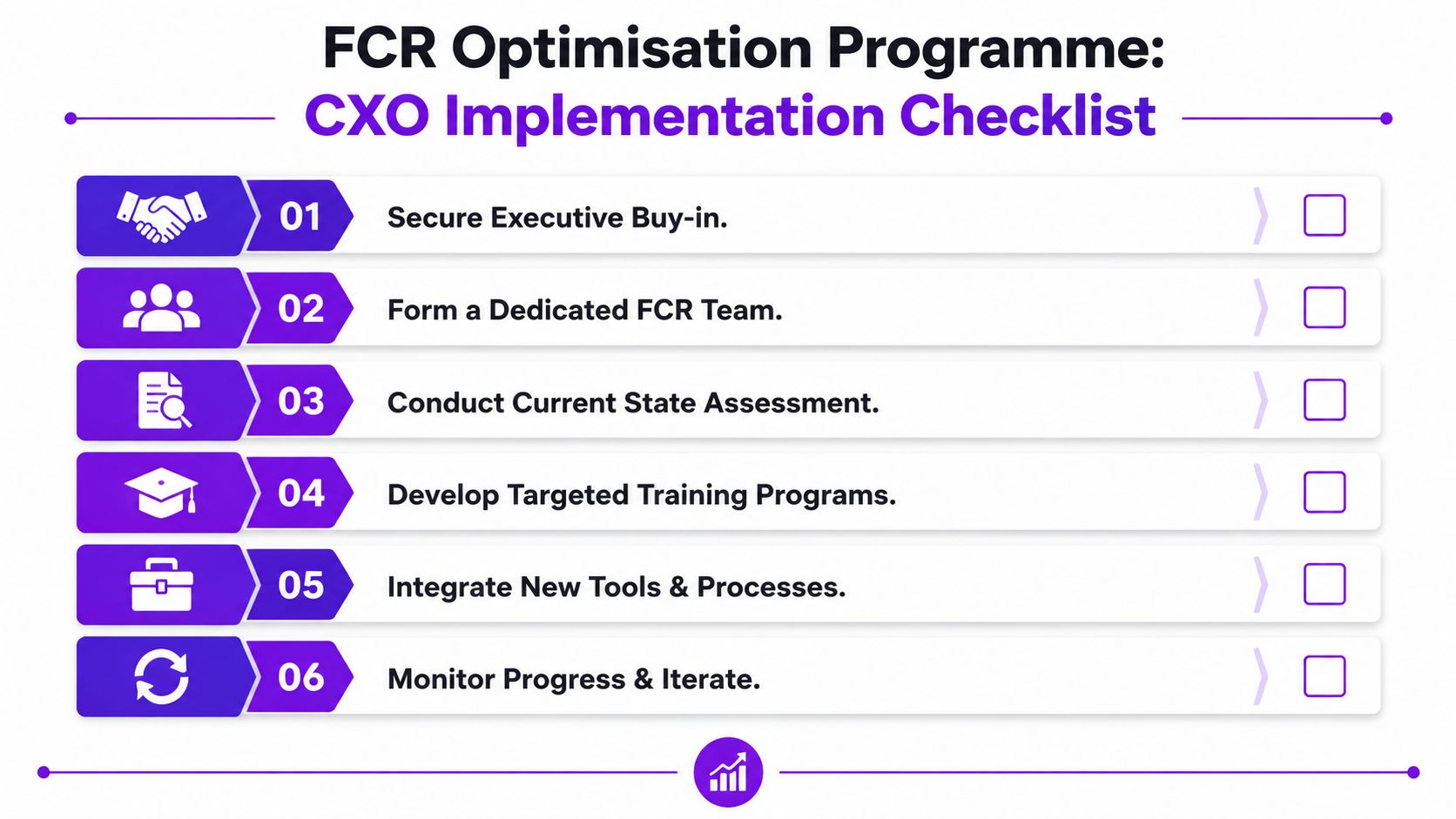
A serious optimisation programme needs ownership, a baseline, and a reporting rhythm. Without those three, FCR becomes a reporting artefact instead of a management discipline.
Establish the baseline
Start by separating simple queries from complex ones, then measure current FCR by contact type. That baseline tells leadership whether the issue is systemic or confined to specific journeys. It also stops the team from comparing unrelated workstreams as if they were the same thing.
Define resolution criteria cross-functionally
Customer care, operations, compliance, and product teams should agree on what counts as resolved. If compliance needs a follow-up for a regulated journey, that follow-up should not automatically be labelled failure. But if the customer must recontact because the first team was not equipped to finish the job, that is a true FCR gap.
Select tools that preserve context
The right stack should show call history, case status, failure reasons, and full conversation transcripts. That is where FCR becomes operationally useful, because leaders can see where the handoff broke instead of guessing. For teams using broader quality frameworks, the internal reference on BPO quality parameters can help connect FCR with audit discipline and service consistency.
DialNexa’s companion guide to quality parameters for BPO lists the specific, measurable parameters that feed into that same audit process.
Pilot, then scale
A pilot should focus on one journey with visible repeat-contact pain, such as booking, admissions, or support triage. Measure changes in FCR, CSAT, and repeat-call reasons before expanding the model. That keeps the organisation from rolling out a concept that works in theory but fails in the live queue.
Build a feedback loop
The most useful dashboard is the one managers use. It should show FCR, repeat reasons, AHT, and CSAT together so supervisors can spot trade-offs quickly. If FCR improves while CSAT drops, the team may be closing cases too aggressively. If CSAT rises while FCR falls, the organisation may be being too accommodating without solving the root issue.
A clean implementation rhythm usually follows one rule, inspect the reasons before you inspect the averages. Averages tell you the trend. Reasons tell you where revenue and compliance are leaking.
Conclusion The Future of First Call Resolution
First call resolution now sits at the centre of revenue protection, compliance control, and service economics. A contact centre that closes the loop on the first interaction reduces repeat contacts, protects agent capacity, and lowers the operational drag that weakens CSAT and slows growth. In India's high-volume sectors, that matters because every repeat call adds friction across sales, service, and audit performance.
The goal is disciplined resolution with a clear benchmark, a clear definition, and a clear improvement loop. High-performing teams still need people, process, and routing discipline, but sustained 80%+ performance increasingly depends on intelligent automation, real-time guidance, and better visibility into call history. Zendesk benchmark guidance Balto's best-practices guidance
Voice AI does not replace skilled agents. It removes repetitive work, keeps context intact, and lets human staff focus on conversations that require judgement, compliance awareness, and empathy. That improves CSAT, reduces cost-to-serve, and supports cleaner revenue protection at the same time.
If you want to turn first call resolution into a measurable operating advantage, start with a baseline, close the routing and definition gaps, and pilot automation on one high-repeat journey. To see how Voice AI can help turn first call resolution into a measurable operating advantage, explore the solutions at DialNexa Labs Private Limited.

This content clearly explains why First Call Resolution is more than a customer service metric—it directly impacts cost, customer satisfaction, and retention. I especially like the practical focus on measuring true resolution and reducing repeat contacts.
This is a very practical and insightful guide to improving First Call Resolution, especially for high-volume Indian contact centres. I like how it connects FCR with customer satisfaction, cost reduction, and AI-driven service improvements.
This is a clear and insightful explanation of why First Contact Resolution is more than just a call-centre metric. The strong connection between FCR, customer satisfaction, operational efficiency, and cost-to-serve makes the topic especially valuable for business leaders.
This is an insightful guide to the importance of First Call Resolution for improving customer experience and operational efficiency. The strategic perspective makes it especially valuable for CXOs looking to strengthen support performance and customer satisfaction.