
Cloud Contact Center Solutions: A CXO’s Complete Guide
India's cloud-based contact center market reached USD 1.4 billion in 2025 and is projected to reach USD 7.9 billion by 2034, a trajectory that makes cloud contact centre infrastructure look less like an optional upgrade and more like a core operating layer for customer-facing organisations IMARC's India cloud-based contact centre market analysis. For CXOs, the signal isn't just market size. It's that customer conversations now sit at the intersection of scalability, compliance, automation, and revenue conversion, which means the contact centre has moved from back-office utility to board-level capability.
That shift is particularly sharp in India. Teams are dealing with larger digital audiences, distributed workforces, and language diversity, while buyers expect faster responses across voice and digital channels. In that environment, cloud contact center solutions aren't just about replacing phone hardware. They're about building a platform that can route work intelligently, support remote teams, and preserve governance in critical situations.
Table of Contents
- Why Cloud Contact Center Solutions Matter Today
- Understanding Cloud Contact Center Solutions
- Exploring Key Capabilities
- Deployment Models and Migration Checklist
- Measuring ROI and Key Performance Indicators
- Vendor Selection Criteria
- Vertical Use Cases and Practical Examples
- Conclusion and Strategic Next Steps
Why Cloud Contact Center Solutions Matter Today
As noted earlier, India's cloud-based contact centre market is expanding quickly, but the more important signal for CX leaders is what that growth implies. Demand is shifting toward operating models that can absorb more customer conversations, more channels, and more process complexity without forcing a full rebuild of the service stack.
The strategic shift is bigger than telephony
Legacy telephony was designed for fixed seats, fixed locations, and fixed call flows. Cloud contact center solutions are built for change, which makes them more suitable for teams that have to support remote agents, variable workloads, and voice, chat, and digital touchpoints at the same time.
That difference matters because customer engagement is no longer a single-channel function. A platform that can route interactions across channels, support distributed teams, and adjust capacity as demand changes gives leaders more control over service quality and less dependence on hardware planning cycles.
Practical rule: if the contact centre cannot flex with demand, it becomes a constraint on growth rather than a support function.
The India-specific challenge is not only volume. CX teams also have to handle multilingual conversations, peak-load spikes, and uneven network conditions while keeping response quality consistent. Platforms that are designed for those realities reduce the risk of service degradation during busy periods and make it easier to maintain a stable customer experience across locations.
Cloud changes the economics of customer service
Cloud models shift the workload away from large internal infrastructure decisions and toward managed software delivery. That gives teams more room to launch new workflows, test automation, and add channels without waiting for hardware refresh cycles.
It also changes how the contact centre fits into the wider enterprise stack. Cloud platforms are easier to connect with CRM and case management systems, which matters because CX performance depends on how well service agents can see customer context, not just on how quickly calls are answered.
For Directors and VPs, the strategic value is clear. A cloud platform supports faster change, tighter oversight, and better customer experience with less reliance on local infrastructure choices. For CXOs, that means the contact centre becomes a controllable growth lever instead of a fixed utility cost.
Understanding Cloud Contact Center Solutions
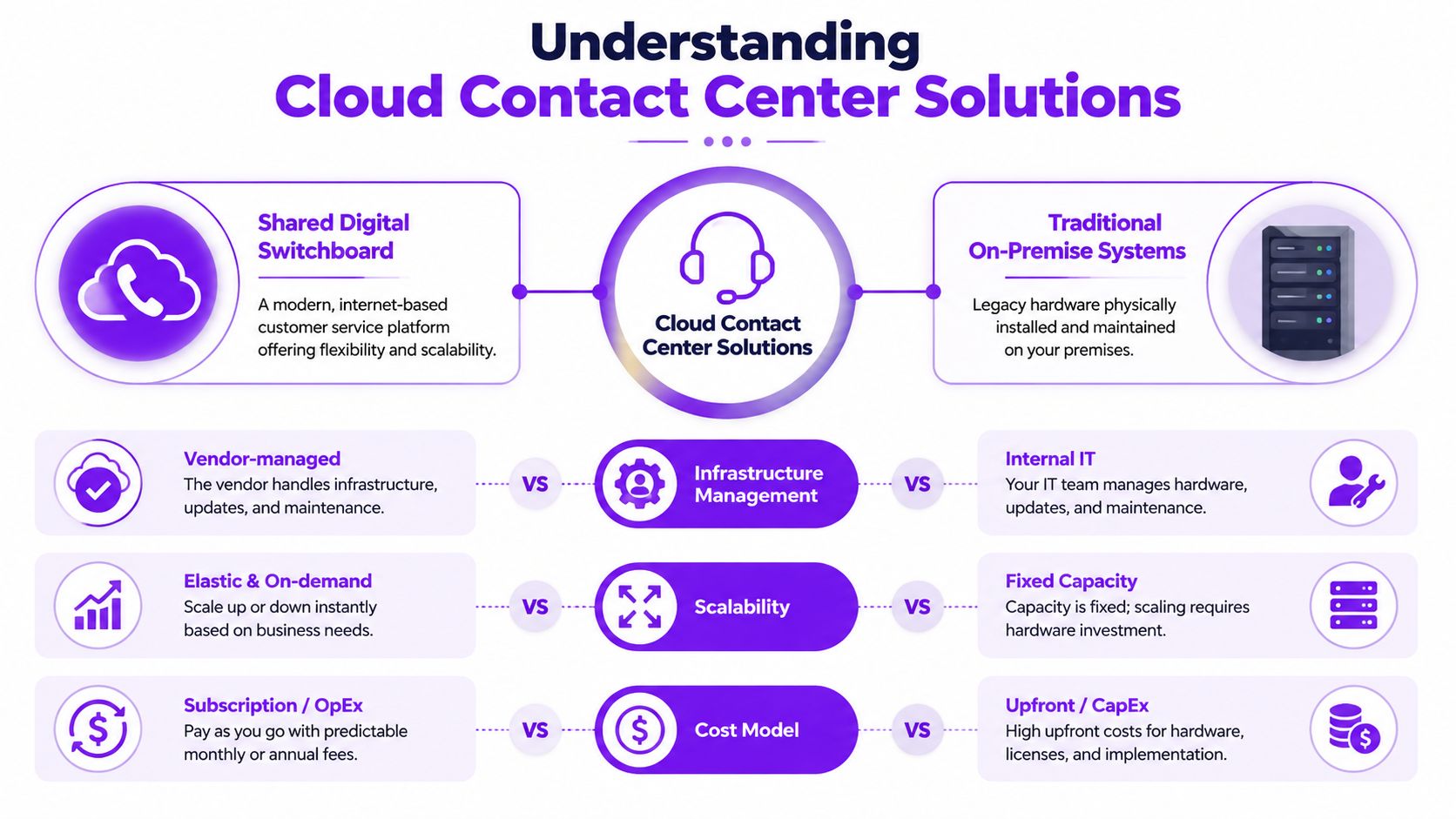
A cloud contact centre is best understood as a shared digital switchboard. Instead of keeping servers, telephony equipment, and routing logic inside your office, the platform lives online and is accessed through web applications. That setup makes it easier for agents to work from different locations while staying inside one operational environment.
Cloud versus on-premise in plain terms
Traditional on-premise systems are like maintaining a private electrical grid for a single building. They can work well, but every expansion requires more equipment, more configuration, and more maintenance. A cloud model is closer to using shared infrastructure that scales with demand, so the business can focus on service design rather than hardware upkeep.
The cloud model supports elastic scaling. If a support queue grows, the platform can add capacity more cleanly than a fixed hardware environment. That's one reason adoption has moved well beyond early experimentation. A 2026 benchmark analysis of 500+ businesses found that 62% had shifted to cloud-based contact centre solutions, up from 40% in 2022 Frejun's contact centre technology benchmark.
Cloud contact centres are not just modern call systems. They're operating platforms for customer-facing work.
Why this changes CX leadership decisions
A key advantage is not only that cloud systems host voice calls. They unify customer activity across channels and preserve context for agents. A customer can start on chat, move to email, and then call, and the service team can still work from a shared interaction history.
That is why cloud transformation is now a leadership issue. It affects hiring flexibility, business continuity, campaign velocity, and service consistency. It also changes how teams evaluate vendors. The question is no longer whether cloud is a trend. The question is whether the platform can support your service model without forcing you back into rigid processes.
Exploring Key Capabilities
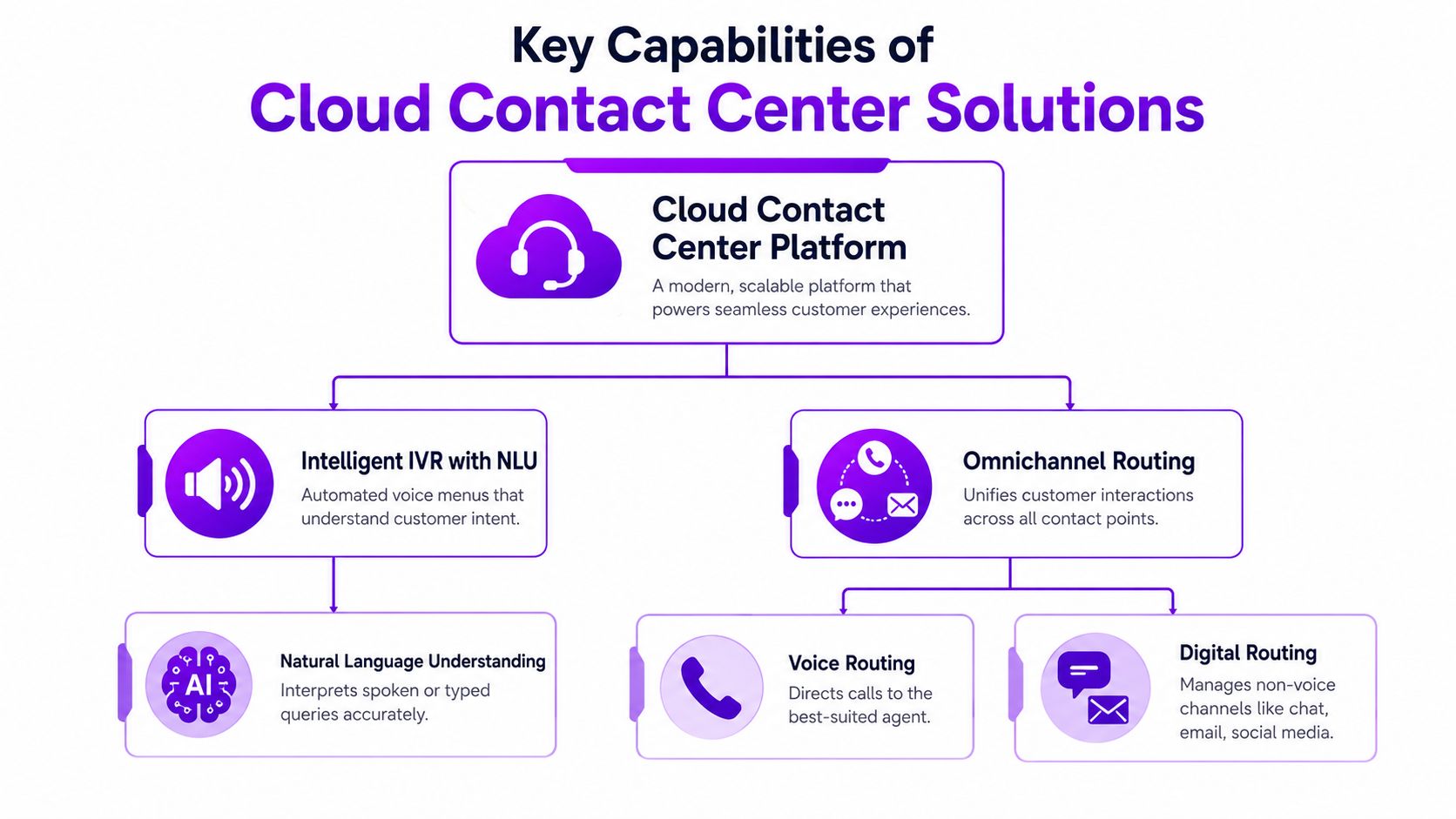
The strongest cloud contact centres aren't defined by one feature. They're defined by how well their capabilities work together. IVR, omnichannel routing, analytics, workforce tools, integrations, and security controls each solve a different bottleneck, and CXOs should evaluate them as an operating system rather than a menu of add-ons.
Intelligent IVR and natural language understanding
IVR used to mean menu trees and button presses. In a modern cloud setup, it becomes a front door that can understand intent. That matters because customers don't always know the right department name or process label, they just know what they need fixed.
Natural language understanding helps turn vague requests into usable routing signals. That reduces the friction of multi-step menus and gives support teams a better chance of getting the caller to the right place on the first try. The strategic value is simple. Every unnecessary transfer adds delay, and every delay weakens customer confidence.
Omnichannel routing, analytics, and integration
Omnichannel routing is the difference between a contact centre and a queue of disconnected channels. The platform has to preserve context across voice, chat, email, and social interactions, otherwise agents spend time reconstructing the conversation instead of resolving it.
Real-time analytics gives managers visibility into queue health, agent load, and customer patterns as they happen. Prebuilt integrations with CRM and ticketing systems matter for the same reason. A contact centre that can update records automatically reduces duplicate entry and helps keep operational data cleaner. That's especially important when support teams and sales teams work from the same account history.
The operational stack also has to include workforce optimisation and governance. Scheduling, quality monitoring, encryption, audit trails, and data-residency support aren't side features. They're what make the platform acceptable in regulated environments.
Practical rule: evaluate features by the number of manual handoffs they remove, not by how impressive they sound in a demo.
For teams considering AI voice workflows, the platform layer matters as much as the model itself. DialNexa's blog on AI call centre software is a useful reference point for how voice automation sits inside broader contact workflows, especially when the goal is to combine routing, qualification, and support without adding friction.
For a deeper look at how these AI-led queues perform end to end, DialNexa’s AI call center agent guide breaks down architecture, KPIs, and vendor selection for 2026 deployments.
Deployment Models and Migration Checklist
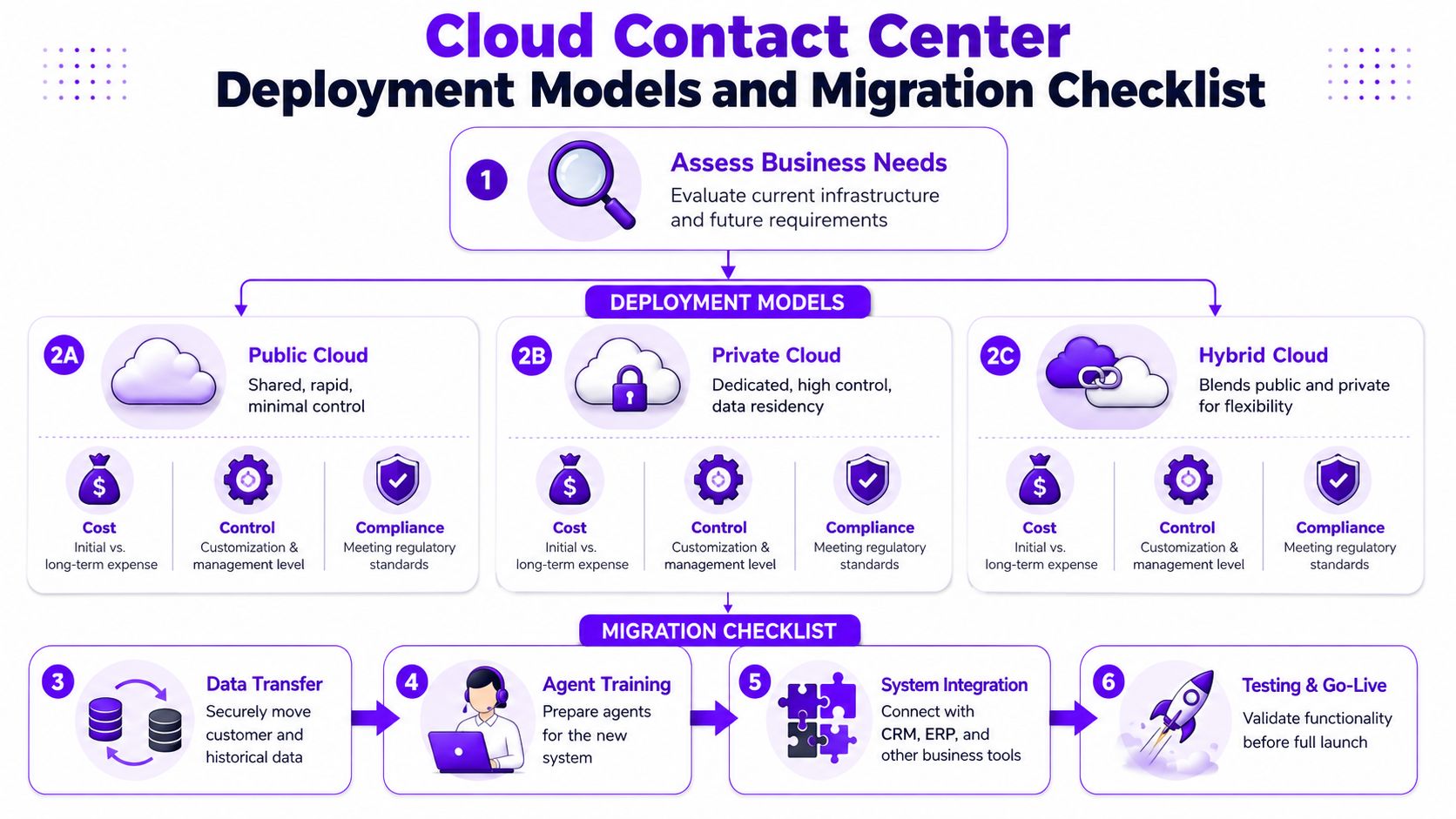
Deployment choice is where many cloud projects succeed or stall. The right model depends on how much control you need, how strict your compliance environment is, and how quickly you want to launch. Public cloud favours speed, private cloud supports tighter control, and hybrid gives leadership teams a middle path when business units have different risk profiles.
Pick the model around governance, not preference
Public cloud is usually the fastest way to move. Private cloud is more useful when residency or control requirements are central. Hybrid models can bridge the gap, but only if the integration plan is deliberate. Otherwise the organisation ends up with two environments that don't quite behave as one.
For India-specific deployments, the network baseline matters too. A practical starting point is at least 1 Mbps per concurrent call, with 10 Mbps recommended for teams of 10+ to keep call quality and analytics performance stable Frejun's cloud telephony guidance for India. In the same environment, teams also need TRAI-compliant registered entity support for virtual number provisioning and DND scrubbing for outbound workflows, so architecture has to respect regulation from the start.
A migration checklist leaders can actually use
- Assess current usage, map call flows, channel volumes, and points of failure.
- Validate compliance needs, including residency, consent capture, and escalation rules.
- Run a proof of concept, ideally on one queue or business unit.
- Integrate core systems, especially CRM, ticketing, and reporting.
- Train agents and supervisors, so they can work inside the new workflow rather than around it.
- Test under load, then roll out in phases rather than all at once.
That sequence reduces avoidable disruption. It also gives leaders a better view of where the new system is helping and where process changes are still needed.
Measuring ROI and Key Performance Indicators
A cloud contact centre business case should start with measurable operational change, not vague promises. The right model looks at total cost of ownership, service speed, and conversion performance together, because a platform can save money and still underperform if it doesn't improve customer handling.
Build the business case around outcomes
TCO reduction is usually driven by fewer hardware dependencies, less manual maintenance, and more efficient routing. Revenue impact comes from better connect rates, better follow-up discipline, and fewer dropped opportunities between support and sales. Automation savings show up when the system handles tasks that used to consume agent time.
The most useful KPIs are still the basics, but they need to be viewed together. Average Handle Time, First-Call Resolution, Customer Satisfaction, and Agent Utilisation tell a better story when they're tracked across a pilot and compared against the current baseline. If AHT falls but FCR also falls, the organisation may just be rushing agents through calls.
Tie metrics to process ownership
A good CFO will want a simple structure, and this is the one that tends to work:
- Efficiency metrics show whether agents are spending less time on repetitive work.
- Quality metrics show whether customers are getting answers without repeat contact.
- Revenue metrics show whether the contact centre is helping sales, collections, or renewals.
- Compliance metrics show whether the platform can operate safely in regulated workflows.
For leaders building AI-enabled voice workflows, DialNexa's contact centre KPI guide is relevant because it frames performance around operational movement rather than vanity numbers. That matters when you're trying to link automation to outcomes that matter to the board.
A dashboard is only useful if it helps managers decide what to fix next.
The strongest ROI cases combine service data and business data. If the platform improves handling quality, the financial impact often follows through reduced rework, better conversion discipline, and stronger customer retention. CXOs should insist that every pilot includes a clear before-and-after measurement plan, otherwise the deployment will be judged on perception instead of evidence.
Vendor Selection Criteria
The best vendor isn't the one with the most features on paper. It's the one whose controls, architecture, and support model fit your operating reality. That's especially true in India, where compliance, connectivity, and multi-team coordination can all become deployment risks.
Start with risk, then move to scale
Compliance and data-residency controls should come first for regulated sectors. If the vendor can't support your governance requirements, no amount of AI polish will make the deployment safe. Scalability is the next gate because the platform has to survive peak concurrency without degrading service quality.
AI maturity matters, but it should be judged carefully. A vendor can automate quickly and still fail in a real enterprise environment if escalation rules are weak or review trails are opaque. For BFSI and other regulated support environments, the more important question is whether the AI can be governed, not just whether it can answer.
Score vendors on business-fit, not feature count
Use a scorecard that includes:
- Data residency and compliance support
- Peak-load scalability
- Integration depth with CRM and case tools
- Multilingual and multi-region support
- Transparency in pricing and change management
- Service-level commitments and support responsiveness
One point that often gets overlooked is how fast real-time analytics reaches decision-makers. If supervisors can see issues earlier, they can intervene sooner and reduce escalations. That matters because the contact centre is often where problems are detected before they reach wider customer or regulatory impact.
For buyers comparing providers, the discussion on cloud telephony providers is useful as a market lens, especially if you're trying to separate transport-layer capability from full contact-centre functionality.
For a granular look at one of the most-evaluated providers, DialNexa's Exotel pricing guide covers plan tiers, per-minute rates and DLT pass-through charges.
Vertical Use Cases and Practical Examples
Cloud contact centres don't behave the same way in every industry. The same platform can support admissions, collections, lead qualification, or support, but the operating logic changes by vertical. That's why CXOs should look for workflow fit, not just a generic feature checklist.
Sector by sector, the pain points are different
In EdTech, high-volume registration questions can overwhelm staff during campaign periods. In BFSI, the issue is often compliant handling of KYC-related queries and sensitive customer data. In real estate, the challenge is qualification speed, site-visit scheduling, and follow-up discipline. In e-commerce, support teams need to reduce friction across order status, returns, and payment queries.
Healthcare and SaaS have their own demands. Healthcare teams need booking and reminder workflows that are reliable and easy to audit. SaaS teams need fast qualification and demo scheduling without letting hot leads cool off in manual queues.
Where DialNexa fits in the workflow
DialNexa's Voice AI agents are relevant here because they can handle qualification, support, recruitment, and presales workflows on top of existing telephony, CRM, and ticketing systems. That makes them useful in environments where the contact centre needs to do more than answer questions. It has to push the conversation toward a measurable next step.
When that workflow breaks down, the cost is real: DialNexa’s roundup of poor customer service examples shows what happens when contact centres get this wrong.
For a lighter-touch entry point into the same governance discussion, DialNexa’s AI phone receptionist guide covers how Indian CXOs can automate call handling and lead qualification before scaling into a full contact centre platform.
The most important point in BFSI is governance. A contrarian but necessary view is that compliance-first AI governance matters more than automation speed in regulated support, because data residency, consent capture, and human-in-the-loop escalation all have to be respected Mordor Intelligence's cloud contact centre market analysis. In practice, that means the workflow has to be designed for accountability, not just efficiency.
| Industry | Challenge | DialNexa Impact |
|---|---|---|
| EdTech | High enquiry volume around admissions, counselling, and follow-ups | Automates qualification and routing so staff can focus on conversion-ready conversations |
| BFSI | KYC-heavy support, consent-sensitive workflows, and escalation discipline | Supports controlled handoffs and structured conversation handling |
| Real Estate | Lead qualification, site-visit booking, and repeated follow-up calls | Standardises outreach and booking workflows |
| E-commerce | Customer support around orders, returns, and payment queries | Handles routine support so agents can focus on exceptions |
| Healthcare | Appointment booking and reminder coordination | Supports booking-oriented conversations with clear next steps |
| SaaS | Presales qualification and demo scheduling | Improves lead handling and follow-up consistency |
One practical example matters across all these sectors. If an AI voice agent handles the first layer of triage well, human agents spend more time on exceptions and less time repeating the same discovery questions. That is the source of the operational efficiency.
Conclusion and Strategic Next Steps
Cloud contact centre choices now sit at the intersection of customer experience, compliance, and operating discipline. In India, the key differentiator is not whether a platform can route calls or record transcripts. It is whether the deployment can hold up under consent requirements, data residency expectations, and escalation rules without slowing frontline work. Leaders who treat those controls as an afterthought usually discover the failure late, after the stack is already embedded in daily operations.
The more dangerous mistake is assuming Voice AI value comes from speed alone. A faster response can still create a weak outcome if intent is not captured correctly, if handoffs break, or if reporting cannot prove what happened in each interaction. For CXOs, the strategic test is whether the platform can turn every customer conversation into an auditable workflow, with clear ownership, consistent escalation, and usable evidence for operations and compliance teams.
A practical next step is to start with one high-value workflow and measure it against business control points, not just contact handling time. Benchmark current call performance, define the compliance guardrails, and test how the system records intent, routes exceptions, and preserves escalation quality. If you are evaluating Voice AI alongside the wider contact centre stack, the pilot should show whether it improves decision quality and control discipline as much as it reduces routine handling.
A common pitfall is to judge the rollout by average efficiency gains and miss the outliers. One poorly governed workflow can expose the entire programme to regulatory, reputational, and service risk, even if the rest of the stack looks efficient on paper. The stronger path is to validate governance first, then scale the use cases that can prove both operational lift and accountable automation.
A CTA for DialNexa Labs Private Limited.

This content gives a clear and practical view of how cloud contact centres can improve scalability, flexibility, and customer experience. I especially like how it connects technology adoption with measurable KPIs, ROI, and real operational outcomes.
This is a clear and insightful overview of how cloud contact centres are transforming customer experience and operational flexibility. The practical focus on omnichannel routing, AI, analytics, integrations, and scalability makes the content especially valuable for CX leaders.
This is a comprehensive guide to how cloud contact center solutions can improve customer service, streamline operations, and support business growth. The strategic insights are valuable for decision-makers looking to enhance customer experiences, empower support teams, and build more flexible and efficient communication systems.
This is an excellent guide for business leaders looking to modernize customer support with cloud contact center solutions. The insights into scalability, automation, and improved agent productivity highlight how cloud technology can streamline operations, enhance customer experiences, and support long-term business growth.