
Customer Interaction Management Solutions: A 2026 Guide
A customer service operation that cuts query handling time from 480 seconds to 300 seconds changes more than queue performance. It changes unit economics, staffing efficiency, compliance exposure, and the speed at which revenue teams can act on demand signals. In Indian BFSI, that shift has already been tied to AI-driven customer interaction management solutions that reduce average handle time by 30 to 40%, improve first-call resolution to 85%, and support 20 to 30% opEx savings when scaled across large interaction volumes (LogicalDOC blog).
That’s why boards should stop treating customer interaction management as a support-layer procurement decision. It’s an operating model decision. In sectors where buyer attention is short, regulatory scrutiny is high, and response speed shapes conversion, fragmented interactions cost more than software licences ever will.
Table of Contents
- The Strategic Imperative for Interaction Management
- What Are Customer Interaction Management Solutions
- The Core Components of a Modern CIM Platform
- Engagement determines whether demand turns into revenue or rework
- Integration determines whether context changes decisions
- Analytics identifies where margin is being lost
- Automation and AI improve labour productivity when workflow is redesigned first
- Value comes from operating model design, not software layers in isolation
- Unlocking Strategic Business Benefits for Your Organisation
- CIM in Action Use Cases Across Key Indian Industries
- A CXOs Checklist for Implementation and Vendor Selection
- Integrating Voice AI to Maximise CIM Outcomes with DialNexa
- Frequently Asked Questions for Executives
The Strategic Imperative for Interaction Management
McKinsey has estimated that improving customer experience can increase sales revenues, reduce service costs, and improve employee engagement. For boards, the implication is straightforward. Customer interaction management belongs in the value-creation agenda, not only in the service budget.
The strategic issue is fragmentation. Revenue teams often run campaigns in one system, service teams manage cases in another, and contact centres operate through separate telephony and messaging tools. Each break in context raises the probability of a missed sale, a repeat contact, a slower resolution, or a preventable compliance error. Those failures do not stay in the front office. They show up in lower conversion, higher operating cost, and greater audit exposure.
This matters more in Indian sectors where customer journeys are high-frequency and high-stakes. In BFSI, a poor handoff can delay onboarding or trigger a complaint. In healthcare, it can reduce appointment conversion and create documentation gaps. In e-commerce, it can turn a delivery query into a cancellation or return. Interaction management is therefore an operating model decision. It determines whether customer demand is converted efficiently or diluted by process friction.
A well-designed CIM strategy gives management a single control layer for interactions across voice, email, messaging, and live chat software. The economic logic is simple. Better orchestration reduces duplicate effort, preserves customer intent across channels, and improves routing discipline. That combination supports three board-level outcomes: lower cost to serve, higher revenue capture, and better control.
The less obvious benefit is managerial visibility. Many leadership teams can see channel volumes and ticket counts, but not the full commercial path from first enquiry to sale, service event, renewal, or churn. CIM closes that gap by connecting interaction data to business outcomes. That is why many firms now treat contact center automation strategies as part of margin improvement, not only as a technology upgrade.
For CXOs, the decision should be framed in capital-allocation terms. If customer conversations influence acquisition, retention, collections, and compliance, then a fragmented interaction stack is not an IT inconvenience. It is a recurring drag on EBITDA and a source of avoidable operational risk.
What Are Customer Interaction Management Solutions
A useful way to think about customer interaction management solutions is this. Your CRM stores memory. Your helpdesk records incidents. Your contact centre stack moves calls. A CIM platform acts more like the conductor of the entire customer conversation.
It coordinates who speaks, through which channel, with what context, and toward which business objective.
More than a CRM or ticketing layer
A CRM can tell your team who the customer is. It usually can’t govern the full flow of live interactions across voice, chat, email, messaging apps, and follow-ups with operational discipline.
A CIM solution does that orchestration work. It helps the organisation manage the lifecycle of interactions across:
- Marketing enquiries that need immediate triage
- Sales conversations that require qualification and scheduling
- Service requests that depend on prior context
- Retention or renewal moments where timing matters
- Compliance-sensitive interactions that need traceability
That’s why executives often underestimate CIM at first. They assume it’s another front-office application. In reality, it sits across front office, operations, and risk.
The orchestration layer leaders actually need
In practice, a CIM environment should unify channels and decisioning. If a prospect starts on web chat, continues on voice, and then needs a follow-up message, the system should preserve context instead of forcing a restart.
That’s also where adjacent tools fit. For digital-first support teams, good live chat software can be one part of the engagement stack, but it only becomes strategically useful when chat transcripts, customer history, routing rules, and downstream actions sit inside a broader CIM model.
A simple test helps separate real CIM capability from a bundle of disconnected tools.
| Question | If the answer is no | Business consequence |
|---|---|---|
| Can one interaction continue across channels without context loss? | Teams re-ask basic questions | Lower conversion and poorer experience |
| Can managers see interaction performance across the full journey? | Reporting stays siloed | Weak ROI visibility |
| Can routine tasks be automated with governance? | Agents absorb repetitive volume | Higher operating cost |
| Can the platform connect to core systems? | Data must be re-entered manually | More delay and more risk |
Some teams begin this journey through operational programmes such as contact centre automation. That’s often a sensible entry point. But automation alone isn’t CIM. The strategic value comes from coordinating interactions across the entire customer lifecycle rather than accelerating one isolated function.
A mature CIM model doesn’t ask, “Which team owns this customer?” It asks, “How should the business manage this conversation from first touch to final outcome?”
That shift is what turns interaction management from software into strategy.
The Core Components of a Modern CIM Platform
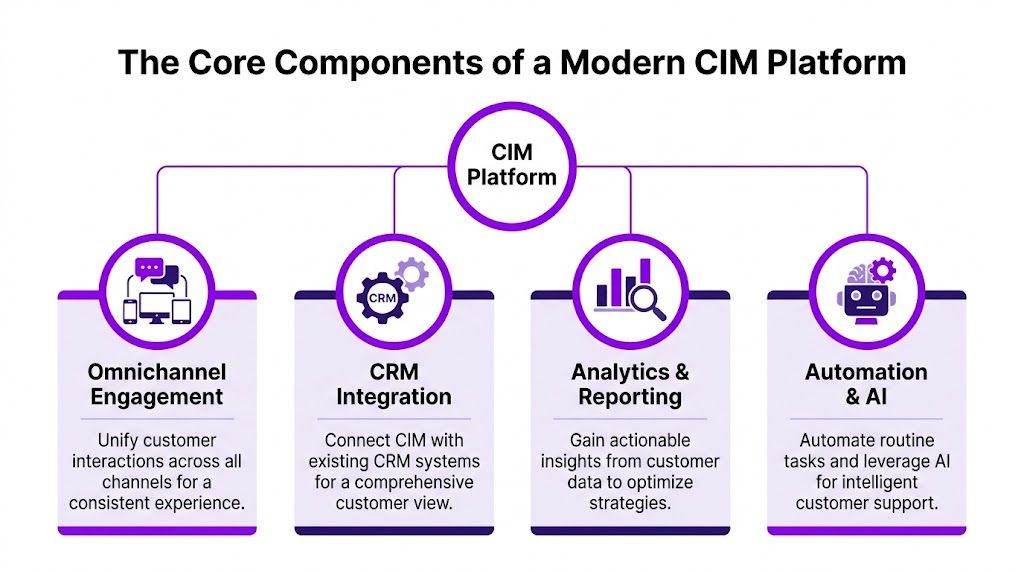
A modern CIM platform earns its budget only if it changes business performance in measurable ways. For a board, the evaluation standard is straightforward. Each component should improve one of four outcomes: revenue conversion, cost to serve, cash-flow speed, or control over compliance and operational risk.
Engagement determines whether demand turns into revenue or rework
The engagement layer brings voice, chat, email, messaging, and social conversations into one managed flow. Its business value comes from continuity. When context stays intact across channels, the organisation protects purchase intent, reduces customer effort, and prevents the repeat contacts that inflate service cost.
This matters most in moments where the economics are asymmetric. A dropped sales enquiry can mean lost revenue. A broken service interaction often creates a second or third contact, raising handling cost without creating any new value. The same design flaw can therefore hit both growth and margin.
Board review should focus on one question. Can a customer move from one channel to another without restarting the process? If the answer is yes, the company is in a better position to increase conversion, improve complaint resolution, and shorten the path from enquiry to outcome.
Integration determines whether context changes decisions
Integration with CRM, billing, ticketing, workflow, and industry systems decides whether interaction data can be used in real time. Without those connections, agents see fragments. Automation remains shallow. Management gets activity data but limited control over outcomes.
The value of integration is clearest in sectors where timing and accuracy affect both revenue and risk. In banking, interaction handling may depend on KYC status, fraud indicators, product eligibility, or account state. In insurance, it may depend on policy tenure, claims records, or renewal timing. In retail and ecommerce, it may depend on inventory, delivery status, returns history, or payment exceptions.
Stronger system integration improves decision quality at the point of contact. It reduces manual re-entry, cuts avoidable delays, and creates a cleaner audit trail. Those gains matter financially because they lower labour waste, reduce error-related rework, and support faster case completion.
Leaders reviewing telephony-led service design often start with IVR interactive voice response software. The board-level issue is wider. IVR, authentication, routing, CRM updates, and case handling should operate as one controlled process with clear accountability for outcomes.
Analytics identifies where margin is being lost
Analytics becomes strategically useful when it explains why interactions fail, repeat, convert poorly, or create risk. Activity dashboards rarely do that. Boards need a clearer line of sight from interaction patterns to financial leakage.
That means analysing demand by intent, journey stage, customer segment, and downstream result. If first-contact resolution is weak, management needs to know whether the problem comes from policy design, poor routing, training gaps, missing data, or product complexity. Each cause requires a different intervention and has a different payback profile.
A finance-oriented analytics model should answer five questions:
- Which contact reasons generate the highest avoidable volume
- Which journeys show the greatest drop-off before purchase, payment, or resolution
- Which agent behaviours correlate with stronger conversion or fewer repeat contacts
- Which customer segments cost disproportionately more to serve
- Which interaction patterns signal compliance, fraud, or churn exposure
This level of visibility supports decisions that standard service reporting often misses. It helps leadership move budget away from symptom management and toward root-cause correction.
Automation and AI improve labour productivity when workflow is redesigned first
Automation and AI produce returns when they remove low-value work from the operating model and improve decision speed inside high-value interactions. The objective is targeted redesign, not automation for its own sake.
The first use case is predictable, high-volume activity. Authentication, intent capture, appointment booking, payment reminders, order-status updates, document collection, and routine policy changes are common examples. Automating these tasks lowers queue pressure and releases agent capacity for exceptions, retention cases, and sales conversations.
The second use case is agent assistance. Recommended next actions, conversation summarisation, quality monitoring, and real-time prompts improve consistency during live interactions. That supports lower handling time, faster ramp-up for new hires, and narrower performance gaps across teams.
The financial logic is stronger when automation is governed tightly. Escalation rules, decision logs, transfer accuracy, containment rates, and downstream resolution must be measured. In regulated or multilingual environments, poor automation can create hidden costs through repeat contact, complaints, or remediation effort.
Value comes from operating model design, not software layers in isolation
These components create return only when they work as a single commercial and operational system. Strong engagement without integration raises expectations but leaves agents unable to act. Integration without analytics digitises process but does not show where to intervene. Automation without governance can shift cost into complaints, exceptions, and compliance review.
That is why CIM should be assessed as an operating model investment, not a feature purchase. The right design changes how demand is handled, how labour is deployed, how risk is controlled, and how quickly revenue opportunities are captured. For CXOs, that is the key threshold for approval.
Unlocking Strategic Business Benefits for Your Organisation
Technology features don’t earn board approval. Financial outcomes do.

Cost takeout without service erosion
Most cost programmes in customer operations fail because they reduce labour before redesigning workflow. CIM reverses that sequence.
When routine interactions are routed, resolved, or assisted automatically, the organisation reduces avoidable manual effort first. Only then does the cost base change sustainably. In the Indian BFSI benchmark already cited earlier, cloud-based CIM architectures scaling to 10,000+ daily interactions were associated with 20 to 30% opEx savings without proportional staff increases (LogicalDOC blog).
That is a better cost story than blunt headcount reduction. It preserves service quality while changing labour mix.
Revenue lift through better interaction design
Revenue growth from CIM rarely comes from one dramatic event. It comes from removing friction in high-intent moments.
A strong interaction model improves revenue in several ways:
- Faster response to inbound demand: Buyers are less likely to drop when qualification and routing happen immediately.
- Better lead prioritisation: Sales teams spend time on higher-quality conversations.
- Cleaner handoffs: Context preserved across channels reduces drop-off before booking or purchase.
- More disciplined follow-up: Automated reminders and next-step workflows prevent demand leakage.
For boards, the key insight is that conversion problems often look like marketing inefficiency when they are interaction-management failures. The lead arrived. The system mishandled it.
Risk control becomes operational rather than reactive
In regulated sectors, poor interaction management creates more than inconvenience. It creates audit and conduct risk.
A mature CIM setup supports stronger governance through:
| Risk area | How CIM helps |
|---|---|
| Inconsistent customer communication | Centralises scripts, routing logic, and interaction records |
| Missed escalations | Uses sentiment and workflow triggers to surface cases earlier |
| Weak auditability | Creates traceable histories across channels |
| Manual process drift | Standardises repetitive workflows |
Strong interaction management reduces the number of decisions left to improvisation.
That matters in BFSI, healthcare, and education admissions, where the quality of an interaction can affect customer trust, legal exposure, and commercial outcomes simultaneously.
Boards often ask whether CIM belongs under customer experience, operations, or digital transformation. The honest answer is all three. But the investment case becomes clearer when it is treated as an enterprise lever for cost reduction, revenue protection, and risk mitigation rather than a customer service line item.
CIM in Action Use Cases Across Key Indian Industries
Industry economics determine whether customer interaction management produces a marginal productivity gain or a step-change in enterprise value. In India, that difference is pronounced because many sectors combine high interaction volumes, multilingual demand, uneven digital maturity, and price-sensitive operating models. The right CIM design changes conversion velocity, service cost, and control quality at the same time.
For CXOs, the useful question is not which features a platform offers. It is which interaction bottleneck is suppressing revenue, inflating servicing cost, or creating avoidable risk in a given industry.
EdTech
EdTech revenue depends heavily on response speed and follow-up discipline. Prospects compare multiple institutions, switch attention quickly, and often require several contact attempts before a meaningful counselling conversation happens. A weak interaction model turns marketing spend into decaying inventory.
As noted earlier, EdTech providers are dealing with rising enquiry volumes, high no-answer rates, and low AI adoption relative to the scale of outreach required. That combination creates a simple financial problem. Counsellors spend expensive hours on first-touch attempts and repetitive scheduling instead of qualification, objection handling, and conversion.
A stronger CIM model routes fresh enquiries instantly, automates retry logic, assigns follow-ups by language and course interest, and records every touchpoint in the CRM. The outcome is better yield on existing lead spend. For boards, that matters because improving contactability often raises enrolment revenue faster than increasing media budgets.
BFSI
In BFSI, the highest-return use case is often risk control rather than pure service efficiency.
Banks, insurers, NBFCs, and brokerages manage interactions where the cost of inconsistency can exceed the cost of delay. Missed disclosures, weak authentication flows, unrecorded consent, and poor escalation discipline create exposure across complaints, regulatory reviews, and reputational damage. A fragmented contact environment makes those failures more likely because agents, channels, and workflows operate with different scripts and incomplete histories.
CIM helps standardise communication logic across voice, chat, email, and assisted service. It also creates auditable records of what was said, when it was said, and how the case was resolved. That changes the economics of compliance. Instead of adding supervisory overhead to inspect scattered interactions after the fact, firms can build policy controls into routing, scripting, verification, and exception handling from the start.
The board-level implication is straightforward. In BFSI, CIM should be evaluated partly as a conduct-risk and governance investment. Lower remediation effort, fewer avoidable disputes, and stronger audit readiness can produce material savings even before any contact-centre productivity gains are counted.
Real Estate
Real estate has a pipeline conversion problem disguised as a calling problem.
Demand generation is usually fragmented across property portals, paid campaigns, broker networks, and direct enquiries. Revenue is lost when speed-to-contact, follow-up cadence, and site-visit scheduling vary by project or sales team. As noted earlier, this sector often suffers from weak connect rates and low AI adoption despite the obvious need for persistent outreach.
CIM improves performance by connecting lead capture, outbound attempts, qualification, appointment setting, and reminder workflows in one operating layer. That creates three financial benefits. Sales teams reach more live prospects from the same lead pool, site visits are scheduled with less manual effort, and fewer warm leads disappear between first enquiry and booking discussion.
For developers and channel partners, that means better inventory velocity without adding sales headcount in proportion to enquiry growth.
E-commerce
In e-commerce and D2C, interaction management directly affects contribution margin.
Margins are often too thin to absorb avoidable service contacts, failed delivery coordination, repetitive payment follow-ups, and poorly handled returns. Yet many brands still manage these moments through disconnected tools across chat, telephony, order systems, and campaign platforms. The result is duplicated work and inconsistent customer context.
A good CIM setup coordinates post-purchase updates, delivery exception handling, return status communication, payment reminders, and abandoned-cart recovery from a common record. As noted earlier, compliant AI-led outbound workflows can materially reduce operating cost in these environments. The more important strategic point is broader. Interaction continuity lowers service effort per order while protecting repeat purchase intent, which makes the margin impact larger than the contact-centre line item suggests.
Healthcare
Healthcare organisations manage interactions where delay and ambiguity create both operational strain and trust erosion.
Hospitals, clinics, diagnostics chains, and health platforms handle appointment requests, pre-visit questions, test preparation instructions, reminder flows, billing clarifications, and escalation to trained staff. When those touchpoints sit across separate teams and systems, front-desk congestion rises, no-shows increase, and staff spend time reconstructing context instead of resolving the case.
CIM introduces structure into that workflow. Patients receive timely reminders, routine queries are handled consistently, and non-routine cases are routed with full interaction history attached. The financial case usually appears in three places. Higher appointment adherence, lower administrative workload, and better documentation of patient communications.
In a sector where trust affects retention and referral behaviour, cleaner interaction management supports revenue protection as much as operational efficiency.
SaaS
For SaaS firms, CIM influences the entire revenue engine from first demo request to renewal and expansion.
Growth teams often separate marketing automation, sales calls, onboarding support, and customer success into different systems with weak continuity between them. That fragmentation creates leakage. Prospects repeat information, account context disappears at handoff, and warning signs of churn sit in isolated channels until renewal is at risk.
CIM reduces that leakage by preserving interaction history across acquisition, onboarding, support, and success motions. This supports faster qualification, more accurate routing, and earlier intervention when usage or sentiment signals deteriorate. In financial terms, the value is not limited to lower service cost. Better interaction continuity can improve pipeline conversion, reduce time-to-value, and protect net revenue retention.
For boards assessing software and service businesses, that makes CIM a revenue-quality investment as much as an operations decision.
A CXOs Checklist for Implementation and Vendor Selection
Most CIM programmes fail before launch, not after. They fail because the company buys software before it defines the business case, governance model, and integration priorities.
Implementation readiness questions
A board or steering group should press management on five questions before approving vendor selection.
Which business outcome matters most first
Pick one dominant outcome. Cost reduction, faster qualification, lower repeat contact, stronger compliance control, or improved booking flow. If every outcome is a priority, none is measurable.
Where does interaction data currently live
If customer context is trapped across CRM, telephony, spreadsheets, and inboxes, the first implementation risk is not AI maturity. It’s data fragmentation.
Which workflows are rules-based enough to automate
Start where policies are stable and exception rates are manageable. Routine verification, appointment scheduling, FAQ handling, and initial qualification are often stronger starting points than emotionally complex or high-risk conversations.
Who owns cross-functional decisions
CIM touches sales, support, IT, operations, and compliance. One department can’t govern it alone. A cross-functional steering group prevents local optimisation.
How will the board know the programme is working
Tie measurement to operational and financial indicators the business already respects. If reporting sits in a separate transformation dashboard that operating leaders ignore, adoption usually weakens.
Practical rule: Don’t launch with a platform-centred business case. Launch with a workflow-centred one.
Key Vendor Selection Criteria for CIM Solutions
| Evaluation Criterion | What to Look For | Red Flag |
|---|---|---|
| Industry fit | Evidence that the vendor understands your sector’s workflows, service expectations, and control requirements | Generic demos with no industry-specific use case depth |
| Integration capability | Clear API approach, CRM connectivity, and ability to connect to operational systems that hold customer context | Heavy manual workarounds or vague promises about future integrations |
| Workflow flexibility | Configurable routing, escalation, and channel logic that matches how your teams actually work | Rigid templates that force process redesign around the tool |
| Analytics quality | Management reporting that links interaction performance to business outcomes | Dashboards full of activity metrics with little operational meaning |
| Scalability | Capacity to support growth in interaction volume without service instability | Pricing or architecture that becomes inefficient as volume grows |
| Security and compliance | Strong controls, access governance, and traceability of customer interactions | Incomplete answers on data handling or auditability |
| Commercial model | Transparent view of implementation effort, support model, and total cost of ownership | Low entry pricing paired with expensive customisation and dependence on services teams |
| Change management support | Practical onboarding, training, and rollout planning for business users | Vendor treats implementation as purely technical |
The best procurement teams also insist on scenario testing. Ask vendors to demonstrate a real cross-channel journey, not just a polished channel-specific workflow. If a platform looks strong in demo conditions but struggles with messy handoffs, it won’t deliver enterprise value.
Integrating Voice AI to Maximise CIM Outcomes with DialNexa
Voice still carries a disproportionate share of revenue, service cost, and compliance risk in sectors such as BFSI, healthcare, real estate, education, and recruitment. For boards evaluating customer interaction management solutions, that matters because the call channel is often where labour cost is highest and conversion leakage is hardest to detect.
Why Voice AI changes the ROI equation
A CIM platform coordinates interactions across channels. Voice AI improves the economics of the most expensive channel inside that operating model.
The financial case is straightforward. If a large share of inbound and outbound calls follows repeatable patterns, automation can lower handling cost, increase coverage, reduce queue pressure, and create cleaner interaction data for downstream teams. Those gains show up in three board-level metrics: lower cost to serve, higher conversion from contactable leads, and better control over service consistency.
That is why Voice AI should be assessed as a margin improvement tool, not as a feature add-on.
DialNexa is one example in this category. It provides voice AI agents for qualification, customer support, recruitment, and presales workflows. The deployment case depends on practical readiness, including telephony, integrations, and infrastructure. Those requirements are outlined in DialNexa’s guide to hardware and software requirements for voice AI deployment.
The highest-return use cases tend to share the same traits. They are high-volume, rules-based, time-sensitive, and expensive to staff manually. Typical examples include lead qualification, appointment confirmation, payment reminders, first-level support, and structured information capture. In those workflows, the commercial benefit comes from speed and consistency. A human team does not need to spend hours on repetitive first-contact conversations before a sales manager, relationship manager, recruiter, or specialist takes over.
There is also a less obvious gain. Voice AI improves management visibility because every interaction can be transcribed, categorised, and reviewed at scale. Tools such as WhisperAI for AI Transcription can strengthen this layer by turning call audio into searchable records that support QA, compliance review, and workflow optimisation.
Where to scrutinise deployment fit
Voice AI produces the strongest returns when leaders apply it selectively.
Automating a high-emotion complaint call or a complex collections negotiation can create more risk than value. Automating reminder calls, lead screening, routine FAQs, or standard scheduling often produces the opposite outcome. The strategic test is simple. If the workflow has clear decision rules, a defined escalation path, and measurable business outcomes, it is a credible candidate for Voice AI.
For Indian enterprises, this matters at scale. Many firms have already invested in CRMs, contact centre tools, and channel systems, yet still carry avoidable voice costs because every call begins from zero, depends on variable agent quality, or reaches skilled staff too early in the journey. Adding Voice AI to the CIM layer addresses that inefficiency directly. It increases contact capacity, standardises early-stage interactions, and preserves human time for exceptions, persuasion, and high-value relationship moments.
The result is not merely operational efficiency. It is a clearer path to ROI from CIM itself.
Frequently Asked Questions for Executives
How is CIM different from the CRM we already bought
A CRM is primarily a system of record. CIM is a system of interaction control.
The CRM stores customer information and relationship history. CIM manages live conversations across channels, routing rules, workflows, and next-step actions. If your teams still lose context between chat, calls, and follow-ups, the CRM isn’t solving the interaction problem on its own.
What’s a realistic timeframe to see ROI
The answer depends on the workflow chosen first. Programmes aimed at high-volume, repetitive interactions usually show value sooner than broad transformation initiatives.
The most reliable path is to begin with one measurable process such as routine support, lead qualification, or appointment scheduling. Boards should expect evidence through operational improvement first, then financial impact as the workflow scales.
Can we implement CIM in phases
Yes, and that’s usually the better path.
A phased rollout reduces operational disruption and lets leadership test adoption, integration quality, and workflow fit before expanding. Many firms start with one channel or one business unit, then broaden the model once reporting and governance are stable.
Will AI reduce service quality
It can if leadership automates the wrong tasks.
Service quality usually improves when AI handles repetitive, rules-based interactions and hands over complex cases with full context. In voice-led workflows, transcription quality is one practical factor to examine. Teams comparing tooling in that area may find resources such as WhisperAI for AI Transcription useful when evaluating how speech data supports downstream workflows.
What should the board ask in the first review meeting
Ask four things.
- What workflow are we changing first
- What business metric will prove value
- Which systems must integrate for context to persist
- What category of interaction will remain human-led
Those questions keep the programme anchored in economics rather than software theatre.
DialNexa Labs Private Limited helps organisations design and deploy voice-led customer interaction workflows for qualification, support, recruitment, and presales. If your team is evaluating how CIM could reduce operating cost, improve conversion discipline, or scale customer conversations without equivalent headcount growth, review the platform and implementation options at DialNexa Labs Private Limited.

Excellent analysis that clearly shows customer interaction management as a strategic business asset rather than just a support function. The connection between revenue growth, operational efficiency, and risk control is explained in a highly practical and insightful way.