
Adam Voice AI: Your Guide to Strategic CX Automation in 2026
Customer response rates can change materially when the voice on the line sounds more natural, handles context well, and maintains consistency across high-volume outreach. For CXOs, that is not a narrow product question. It affects unit economics across acquisition, service, and retention.
Adam voice ai should be evaluated as an operating asset, not just a text-to-speech option. In practice, the decision is whether your current phone workflows are converting reachable demand efficiently, or losing value through rigid delivery, uneven agent performance, and limited language coverage. That is why Adam is increasingly relevant to leaders prioritizing margin protection and revenue efficiency through contact center automation strategies.
The stronger strategic case is deployment, not novelty. On DialNexa’s platform, Adam can be configured as a customer-facing voice persona tied to call objectives, escalation logic, CRM data, and compliance controls. That gives executive teams a clearer path from voice quality to measurable outcomes such as higher connection quality, better conversion performance, shorter handling time, and lower cost per interaction.
The broader direction of the market also supports this shift. Investment and product design across future voice technology point toward voice systems that are judged less on whether they can speak and more on whether they can produce reliable business results at scale.
Table of Contents
- Why Leading CXOs Are Turning to Adam Voice AI
- Understanding Adam Voice AI Beyond a Simple TTS
- Core Features of Adam Voice AI Driving Business Impact
- Strategic Deployment Models for Adam Voice AI Across Industries
- Integration and Deployment on the DialNexa Platform
- How Adam Compares to Other AI Voice Personas
- Answering Your Key Questions About Adam Voice AI
Why Leading CXOs Are Turning to Adam Voice AI
Executives usually spot the problem before they approve the solution. Traditional outbound and support calls often fail for predictable reasons. The voice sounds synthetic, agents vary in quality, and multilingual execution breaks under scale.
Adam voice ai entered that gap at the right time. ElevenLabs’ 2023 release coincided with a 4.7x chatbot adoption boom, and deployments using Adam-style voices reported multi-minute natural conversations, 97% lead qualification accuracy, and up to 91% connect rates, according to the ElevenLabs Adam voice library reference.
The strategic shift is from labour arbitrage to conversion engineering
Most boards still hear “voice AI” and think call deflection. That’s too narrow.
The more meaningful shift is this:
- Revenue teams can use a consistent voice layer to qualify and route demand faster.
- Operations teams can standardise repetitive call tasks without creating script drift.
- Compliance teams can reduce variation in how regulated conversations are delivered.
- Regional growth teams can localise outreach without rebuilding the function market by market.
That’s why adam voice ai belongs in the same strategic conversation as broader future voice technology. Voice is becoming an interface layer for acquisition, onboarding, and service, not just a feature inside the contact centre.
Board lens: If a voice system materially improves connection rates and keeps conversations natural for longer, it changes funnel efficiency before headcount changes.
Where leaders are focusing first
The most pragmatic CXOs aren’t replacing the whole call stack on day one. They’re targeting workflows where consistency matters more than improvisation.
Common first moves include:
- Lead qualification: High volume, repetitive, easy to score.
- Appointment or demo scheduling: Clear business outcome, low ambiguity.
- Reminder and follow-up flows: Frequent, operationally expensive, scriptable.
- Support triage: Useful when the goal is routing and information capture.
For teams evaluating operating changes in the contact centre, the practical starting point is workflow design rather than voice novelty. That’s also why conversations around contact centre automation have become more commercially important than feature checklists.
Understanding Adam Voice AI Beyond a Simple TTS
Voice quality has a direct financial effect. In automated calling and service workflows, even small gains in call continuation and task completion can change unit economics at scale. That is why executives should evaluate Adam voice ai as a revenue and operations asset, not as another text-to-speech feature.
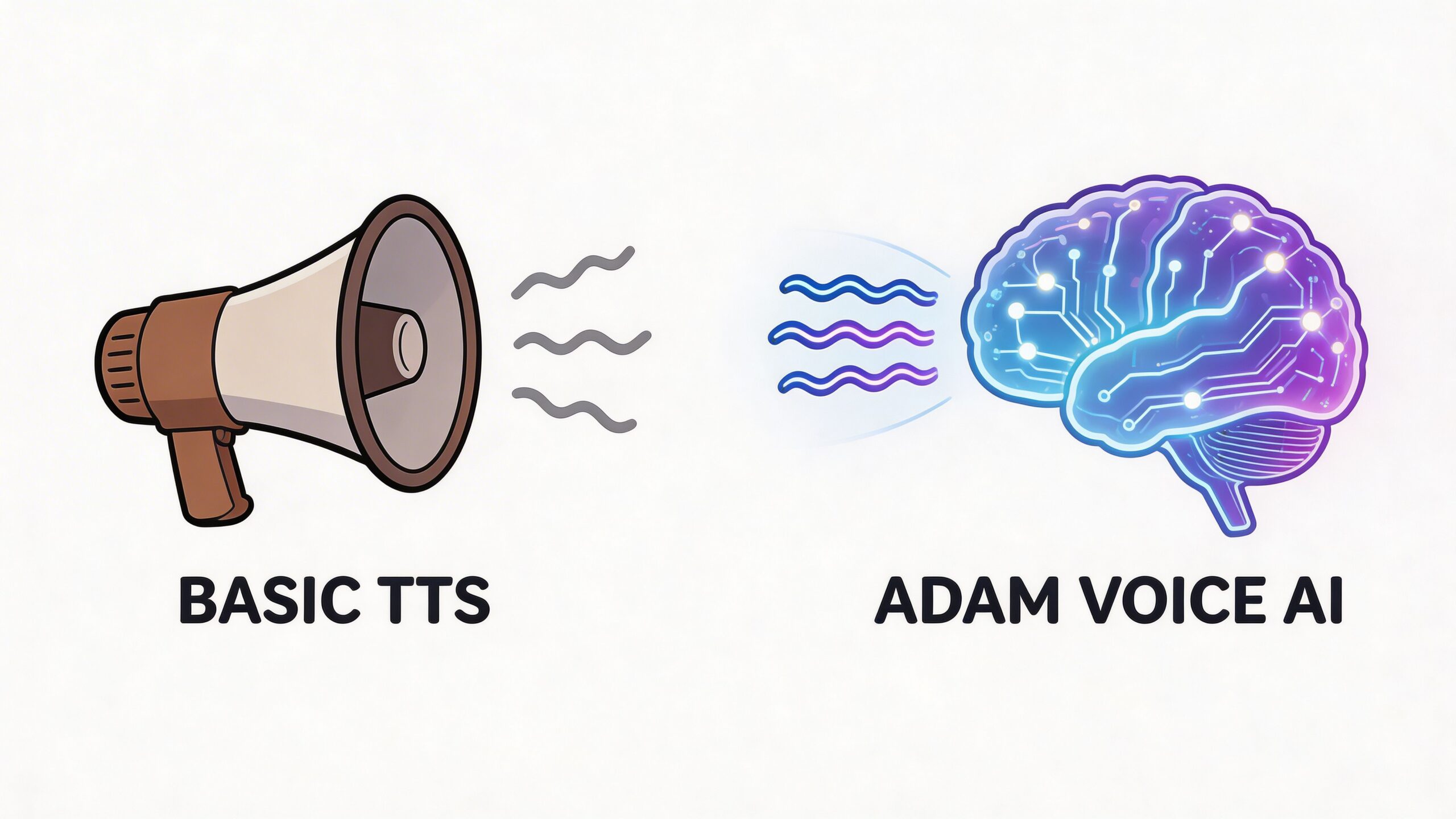
A standard TTS engine converts written text into audible speech. Adam voice ai is better understood as a deployable voice persona that can carry brand tone, handle repetition without obvious degradation, and support multilingual interactions that matter in real customer journeys. That difference affects conversion, compliance consistency, and the amount of human supervision required after launch.
Why the distinction matters commercially
For a board or operating committee, the relevant question is not whether the voice sounds impressive in a demo. The question is whether it can hold attention long enough to complete a business objective. That could mean qualifying a lead, confirming an appointment, collecting information accurately, or delivering a regulated script with low variance.
Adam AI Voice, developed by ElevenLabs, supports broad multilingual use, including Indian language requirements that matter in high-volume outreach and service operations. Used through a workflow platform such as DialNexa, that makes the voice more than a synthesis layer. It becomes part of the operating model.
Three differences separate adam voice ai from commodity TTS in practical terms:
- Conversation durability: The voice is designed for sustained interaction, not just one-way playback.
- Market coverage: Multilingual support improves fit for regional acquisition and service programs.
- Execution consistency: Delivery stays more stable across volume spikes, time windows, and repeated scripts.
This framing also aligns with how AI systems create value elsewhere in the stack. In the same way that workflow discipline matters in an AI Content Generation DevOps Pipeline, voice ROI depends on how well the persona is governed, tested, and connected to business logic.
What boards should listen for
Leadership teams often over-index on realism. A better evaluation standard is operational trust. If the voice can reliably move a caller from opening line to next step, it has business value even if no one mistakes it for a human.
That means assessing the voice against workflow-specific outcomes, not abstract quality scores.
| Business test | What to listen for |
|---|---|
| Qualification calls | Does the voice maintain enough credibility to get complete answers to discovery questions? |
| Scheduling flows | Does it sound clear and confident enough to secure commitment without agent intervention? |
| Compliance scripts | Is delivery consistent across repeated conversations and long operating hours? |
| Regional outreach | Does pronunciation fit local expectations closely enough to reduce early exits? |
A strong AI voice is operationally reliable because it reduces friction in repeatable interactions.
For teams benchmarking persona-led voice systems against baseline synthesis tools, this overview of Amazon Polly text-to-speech options provides a useful reference point. The comparison clarifies why CXOs should treat Adam as part of a broader deployment strategy, with governance, prompt design, call flows, and performance measurement tied back to ROI.
Core Features of Adam Voice AI Driving Business Impact
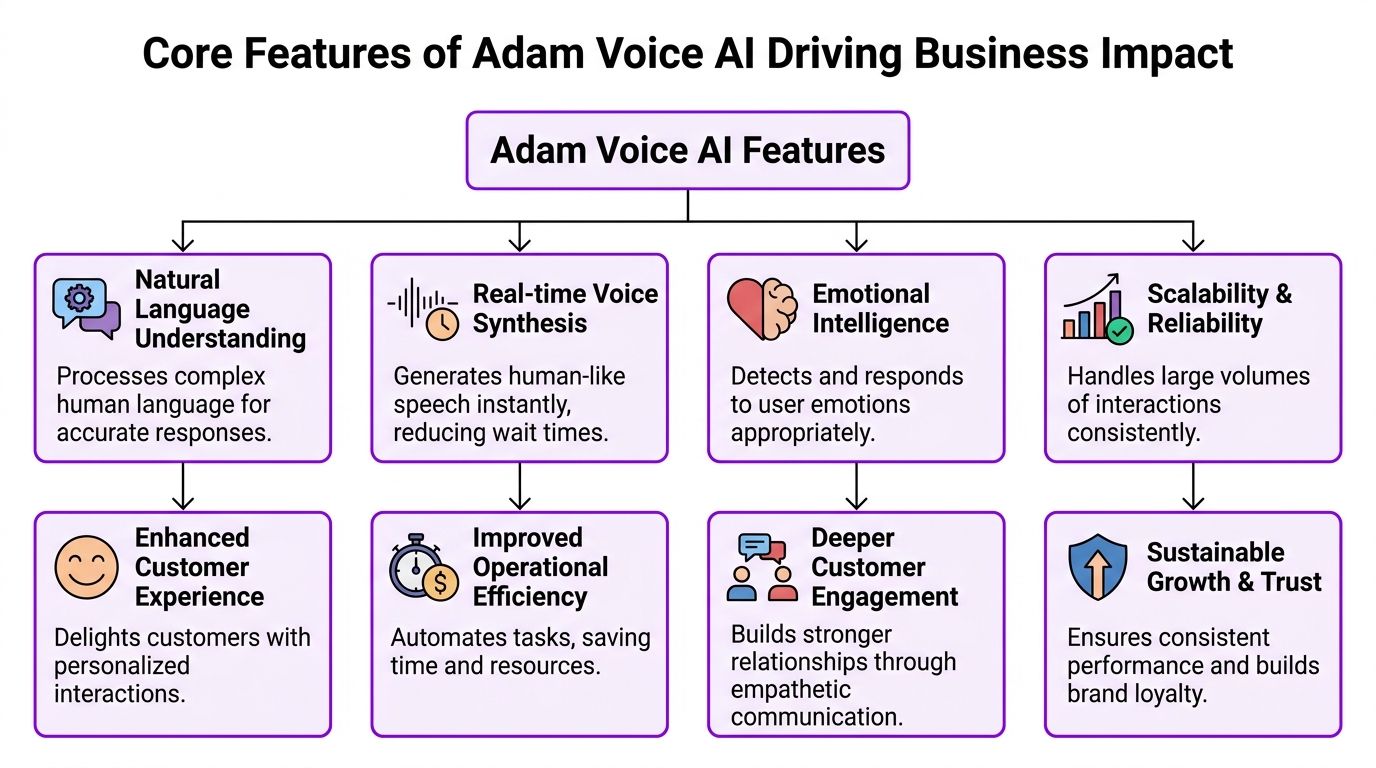
The financial case for adam voice ai doesn’t sit in the model architecture. It sits in what specific voice characteristics change inside the funnel.
Adam Voice AI uses advanced neural networks to replicate characteristics such as tone and pace, achieving human-like quality. In deployment data tied to Indian lead qualification workflows, that adaptation to cultural context and prosody improved connect rates from 47% to 91% and reduced listener drop-offs by 44%, according to this Adam Voice AI technical overview.
Natural pacing changes call economics
Many AI voice projects fail because they optimise for intelligibility, not rhythm. Customers don’t disengage only when they can’t understand a voice. They disengage when the cadence feels wrong.
With Adam, pacing and intonation are part of the commercial outcome. In practical terms, that means:
- Fewer immediate disconnects: Better early-call retention improves the odds of qualification.
- Longer viable conversations: The system can ask follow-up questions without sounding machine-led.
- Less agent variance: Teams no longer depend on each caller’s personal style to maintain call quality.
A useful way to think about it is that prosody becomes a conversion input.
Multilingual fluency expands reachable demand
In India, language strategy isn’t a localisation add-on. It is market access.
A voice persona that can operate across major Indian languages gives teams one scalable operating layer for outreach, reminders, presales, and support. That reduces the need to fragment operations by language or over-hire for narrowly defined language queues.
For a CXO, this creates two advantages:
- Broader addressable contact base
- More standardised execution across regions
Stability supports process control
The strongest use cases for adam voice ai are the ones where the company wants a conversation to be natural but tightly governed.
That includes:
- KYC guidance
- Lead qualification
- Appointment confirmation
- Recruitment screening
- Presales discovery
In those workflows, the value isn’t improvisation. It’s disciplined consistency. Teams exploring this model often start with an AI call bot architecture because it gives them a controllable frame for prompts, routing, escalation, and outcome tracking.
Operational rule: Use Adam where trust, consistency, and throughput matter at the same time.
Emotional range should be applied selectively
The voice’s strength is measured professionalism. That’s powerful for formal and high-volume interactions. It is not a licence to automate every spoken workflow.
Executives get better outcomes when they map the persona to the right job. Adam is strongest where clarity, authority, and repeatability outperform warmth-for-its-own-sake.
Strategic Deployment Models for Adam Voice AI Across Industries
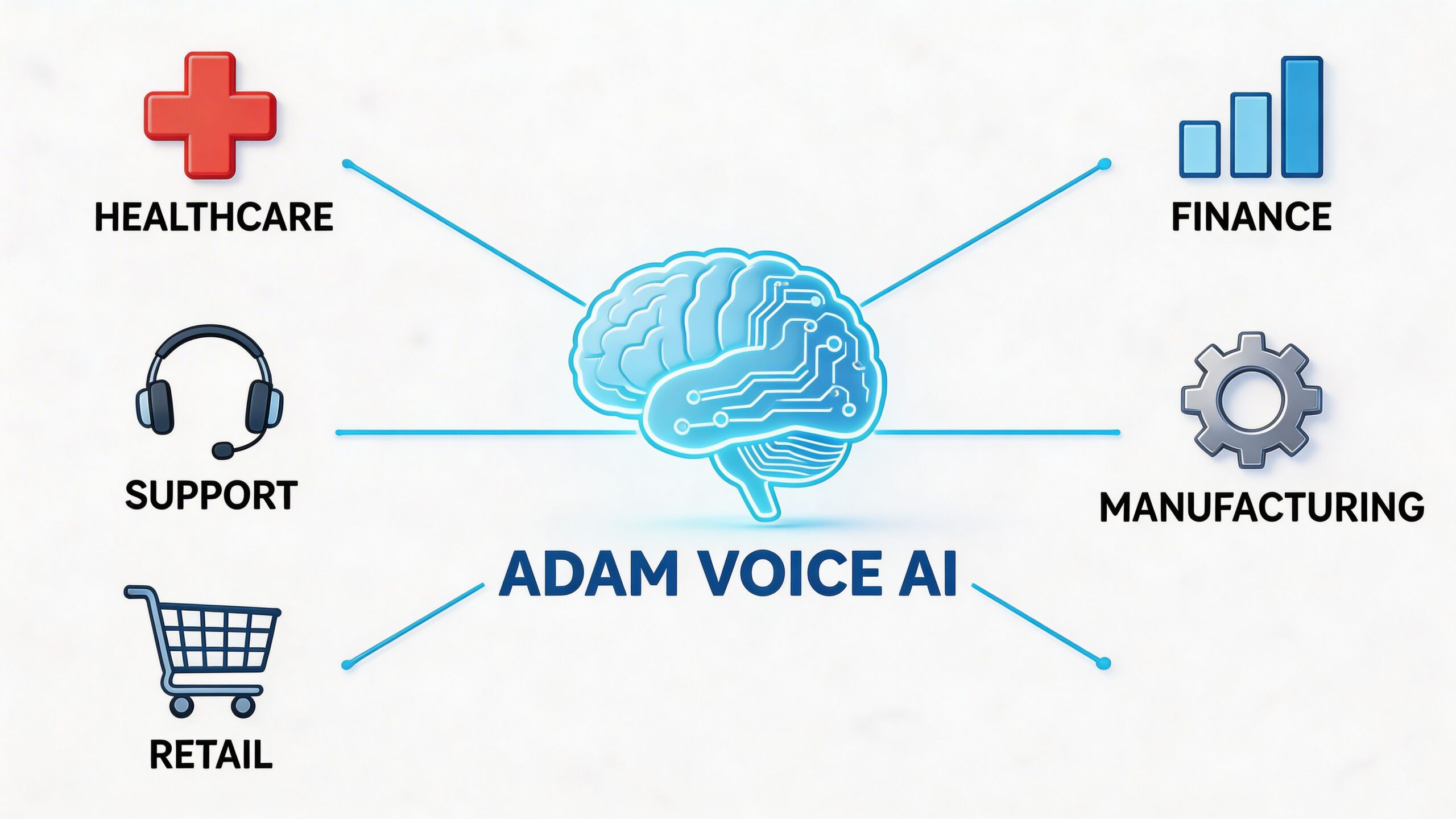
The fastest way to miss the ROI is to deploy adam voice ai as a generic “virtual agent”. Stronger results come from tighter deployment models tied to a commercial outcome.
Real estate and EdTech with qualification first
This is the cleanest starting point. In both sectors, the business needs to contact a large lead pool, ask a repeatable set of questions, and route only serious prospects forward.
An Adam-based workflow can:
- verify interest,
- capture timing and budget signals,
- answer standard questions,
- and schedule the next action.
In practice, that sounds like:
“Hi, I’m calling about your enquiry. Are you looking to visit this week, or are you still comparing options?”
That style works because it sounds purposeful without feeling rushed. In real estate-related deployments, lead-to-booking conversion for site visits moved from 2% to 8% in the verified data provided for Adam-style implementations.
For EdTech, the same model applies to programme counselling. The call doesn’t need hard selling. It needs continuity, qualification, and a clear hand-off.
BFSI with compliance-centred call design
BFSI teams should treat Adam less as a sales voice and more as a controlled delivery layer. The highest-value use cases are KYC guidance, document reminders, onboarding explanations, and first-line qualification before a human adviser joins.
A sample pattern is simple:
- the AI confirms identity checkpoints,
- delivers approved information,
- captures intent,
- then routes the case.
That structure matters because in regulated environments, the risk often sits in inconsistency. A stable voice persona reduces interpretive drift in repetitive conversations.
E-commerce and SaaS with scheduling and presales
For SaaS teams, a common bottleneck is not lead generation. It’s the lag between form fill and qualified demo.
Adam works well when the call’s job is to recover speed. A presales agent can call, confirm use case, identify urgency, and offer a meeting slot. The result is a cleaner sales calendar and fewer manual follow-ups.
For e-commerce and D2C, the same principle applies to order-related outreach, reactivation, and high-intent product support. Operational design then starts to matter as much as content design. Teams building repeatable AI workflows often benefit from thinking in systems, and this explainer on an AI Content Generation DevOps Pipeline is useful because voice automation also needs governance, testing, and iteration, not just launch readiness.
Healthcare with bounded interactions
Healthcare is well suited to Adam when the conversation has clear guardrails. Appointment booking, reminders, and front-door information handling fit that profile.
The right design principle here is restraint. Use the voice to handle intake and logistics. Escalate ambiguity and emotional complexity to people.
Keep the AI at the front of the process, not at the centre of emotionally sensitive judgement.
Integration and Deployment on the DialNexa Platform
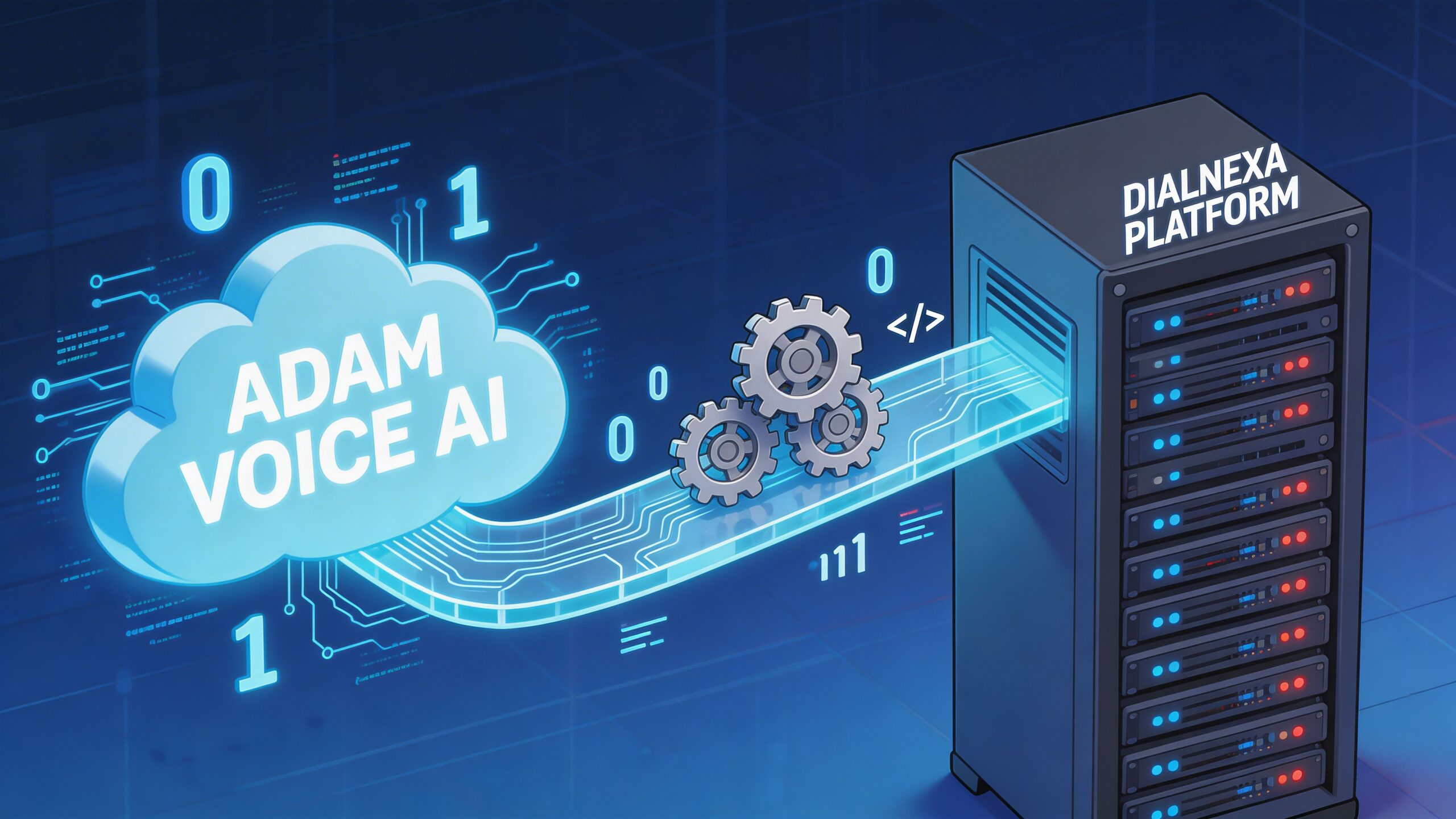
Executive resistance to voice AI usually appears during procurement and rollout. Leaders want clear answers on time to launch, script ownership, compliance controls, and what happens under peak demand. Those concerns are justified because ROI depends less on how a demo sounds and more on whether the operating model holds up in production.
Start with a bounded workflow
The strongest implementation pattern is narrow at first. Deploy adam voice ai into a single workflow with clear intent, limited variation, and measurable outcomes. Good starting points include lead qualification, demo scheduling, appointment booking, and KYC guidance.
A controlled first use case forces decisions that many teams postpone for too long:
- Entry trigger: the exact event that starts the call
- Approved dialogue paths: what the system may say, and where the limits are
- Handoff logic: the conditions that require a human agent
- Success metric: the business result that justifies expansion
That discipline matters. It turns voice AI from an interesting capability into an accountable operating asset.
At the platform level, DialNexa Labs Private Limited provides Voice AI agents with APIs, dashboards, and ready-made personas for workflows such as qualification, customer support, recruitment, and presales, based on the publisher background provided. For CXOs, the strategic value is not only speed of setup. It is the ability to standardise deployment, review performance in one place, and reduce the cost of running disconnected pilots across teams.
Establish governance before increasing volume
Scale exposes weak ownership fast. If operations defines call logic, legal reviews disclosures, sales or CX leaders set acceptance thresholds, and technology manages integrations and failure handling, the programme has a clear chain of accountability. If those roles blur, performance reviews turn into opinion rather than diagnosis.
| Function | Primary responsibility |
|---|---|
| Operations | Workflow logic, routing rules, escalation design |
| Compliance or legal | Script boundaries, disclosures, audit requirements |
| Sales or CX leadership | Outcome metrics and acceptance thresholds |
| Technology | Integration, monitoring, failure handling |
This structure changes the economics of deployment. Teams can identify whether underperformance comes from routing, scripting, conversion design, or system reliability, then correct the specific issue instead of questioning the whole programme.
A short product walkthrough can help teams visualise the operating model in practice:
Expand only after the workflow proves its economics
A pilot should earn the right to scale. The threshold is not whether the voice sounds credible. The threshold is whether the workflow routes the right conversations, exits the wrong ones, and does so with stable performance.
A practical rollout sequence looks like this:
- One workflow
- One team or region
- One set of escalation rules
- Then broader rollout
That order reduces rework. It also gives leadership cleaner evidence on where Adam creates value, whether through faster response times, lower handling costs, better scheduling throughput, or improved conversion from qualified intent. In board-level terms, the deployment decision becomes easier when Adam is treated as a managed revenue and efficiency programme rather than a standalone AI feature.
How Adam Compares to Other AI Voice Personas
The right question isn’t whether Adam is the best voice persona. It’s whether Adam is the right persona for the job.
That distinction helps prevent a costly mismatch between voice tone and business objective. Adam is strongest when the brand needs authority, clarity, and stable delivery. It is less suitable when the conversation depends on visible empathy or conflict de-escalation.
According to the verified data, Adam underperforms in high-empathy scenarios like dispute resolution, where success is 62% versus 89% for humans, while DialNexa’s ready-made personas have lifted lead-to-booking from 2% to 8% for presales and scheduling in relevant deployments, as described in this Adam voice overview.
AI Voice Persona Selection Guide
| Attribute | Adam Persona (Authoritative) | Bella Persona (Empathetic) |
|---|---|---|
| Best fit | Qualification, onboarding, scheduling, formal guidance | Complaint handling, reassurance, emotionally sensitive support |
| Tone profile | Clear, professional, measured | Warm, supportive, conversational |
| Operational strength | Repeatable script delivery and decisiveness | Relationship preservation in tense interactions |
| Risk if misused | Can feel too neutral in distress scenarios | Can sound too soft for compliance-heavy or formal workflows |
| Executive use case | Revenue operations and controlled support flows | Retention and service recovery moments |
A practical selection rule
If the customer needs confidence, direction, and a next step, Adam is usually the better fit.
If the customer needs to feel heard after a problem, a more empathetic persona or a human agent is often the better decision.
Choose the persona that matches the emotional burden of the task, not the one with the most impressive demo.
Answering Your Key Questions About Adam Voice AI
How should leaders think about ROI
Start with a workflow that already has a measurable bottleneck. Qualification, scheduling, reminders, and front-line information handling are the strongest candidates.
Track business movement in areas such as connection quality, progression to the next stage, human agent time released, and consistency of script delivery. The ROI case is strongest when voice automation removes repetitive effort while improving movement through the funnel.
Can adam voice ai handle regional complexity
It can handle multilingual execution far better than basic voice systems, but leaders should still treat regional nuance as a design responsibility. The right model is controlled adaptation, not unrestricted improvisation.
That means reviewing pronunciation, call flow, escalation paths, and local vocabulary before expanding into new segments.
What about privacy, compliance, and regulated sectors
In BFSI and healthcare, governance has to come first. Keep scripts bounded, define escalation triggers, and document what the system is allowed to collect and say.
The most effective deployments use AI for structured, repeatable interactions and reserve edge cases for people. That’s how firms gain efficiency without creating uncontrolled risk.
Should firms replace human agents
No. They should reassign them.
Adam voice ai is best used to absorb repetitive, time-sensitive, and consistency-heavy conversations. Human teams should spend more time on exceptions, judgement calls, negotiation, and emotionally complex service moments.
If your team is evaluating whether voice automation can improve qualification, scheduling, onboarding, or support without creating more operational risk, DialNexa Labs Private Limited is one place to assess how human-like Voice AI agents fit your current workflows and escalation model.

Excellent perspective on how voice AI should be viewed as a strategic operating layer rather than just another automation tool. The emphasis on matching the right AI persona to the right business workflow offers a practical roadmap for achieving both efficiency and better customer outcomes.