SLA Formula in BPO: CXO’s Guide to Strategic Growth in 2026
As a C-suite executive, you know the SLA isn't just another metric on a dashboard. It’s your handshake with the client—a firm, strategic promise that underpins their trust, your profitability, and your very reputation in a fiercely competitive market. Getting the SLA formula right isn't just an operational goal; it's a direct driver of shareholder value.
Why The SLA Formula Is Your BPO’s North Star
In the world of business process outsourcing, a Service Level Agreement (SLA) is far more than a simple calculation; it’s a powerful tool for growth. When you truly get the SLA formula right, it has a direct and measurable impact on client retention, revenue, and brand strength, especially in demanding sectors like finance and education technology. A well-crafted SLA directly impacts EBITDA margins by minimizing penalties and maximizing operational efficiency.
Before optimising the formula, it helps to be clear on the fundamentals: what the acronym stands for, why the 80/20 benchmark exists, and how the SLA fits alongside FCR, AHT, and accuracy. Our guide to what SLA means in BPO breaks down the definition, the core metrics, and the four contract pillars every CXO should insist on.
Think of your SLA strategy as the practical blueprint for delivering excellence. It’s how you turn abstract performance targets into concrete results that forge unbreakable client partnerships, moving from a cost center to a value-creation partner.
The Link Between SLAs And Business Growth
A solid grasp of key operational efficiency metrics is the foundation, but for a director or CXO, the connection between SLAs and growth is crystal clear:
- You Keep More Clients: Hitting your SLAs, day in and day out, proves your reliability. It builds the trust needed for genuine long-term partnerships, moving you from a vendor to an indispensable part of their operation. A 5% increase in client retention can increase profitability by 25% to 95%.
- Your Margins Get Healthier: When your teams are laser-focused on SLA targets, efficiency naturally follows. This cuts down on wasted resources, helps you avoid costly penalties—which can erode up to 15% of contract value—and directly protects your bottom line.
- Your Brand Becomes Your Best Salesperson: In a crowded market, a reputation for consistent, high-quality service is your ultimate differentiator. Strong SLA performance is the hard data that backs up your brand promise, enabling premium pricing and attracting high-value clients.
This isn't just theory. Just look at India’s massive BPO industry, which employs over 5.4 million people and contributes significantly to the country's GDP. Here, the SLA has always been the gold standard. In fact, data shows that Indian BPOs that consistently maintain an SLA above 85% enjoy client retention rates that are 25% higher than competitors hovering around the 75% mark. The numbers don't lie—performance directly translates to loyalty and long-term revenue streams.
For a CXO, the SLA is more than a number—it’s the quantifiable proof of your promise to a client. It translates your operational capabilities into a language of reliability and value that every business partner understands. It's the bridge between operational execution and financial performance.
Ultimately, a robust SLA framework isn't about micromanaging call times. It’s about strategically aligning your people, processes, and technology to deliver on your word. This commitment to delivery is one of the most critical BPO quality parameters for building a business that lasts.
Translating The SLA Formula Into Business Reality
Knowing the textbook definition of an SLA is one thing. Actually seeing how the sla formula in bpo impacts your bottom line is where things get interesting for senior leadership. This isn't about chasing abstract percentages; it’s about turning a simple equation into better performance, happier customers, and tangible revenue growth.
At its core, the formula most of us use is beautifully simple:
Service Level (%) = (Interactions Handled Within Threshold ÷ Total Interactions Offered) × 100
Don't just see this as a calculation. Think of each part as a lever you can pull—a business decision that defines the promise you make to your customers and directly influences your cost-to-serve ratio.
What The Formula Looks Like in The Real World
Let's move away from theory and put this into a practical context. Imagine you're the VP of Operations for an EdTech BPO right in the middle of India's frantic admissions season. The pressure is on, and every single call is a potential student enrolment worth ₹1,50,000 in first-year tuition.
Here’s how the formula breaks down in that high-stakes environment:
Total Interactions Offered: This is your total demand. On a peak day, your BPO fields 5,000 calls from prospective students and their parents. That number tells you exactly what kind of capacity you need to handle the rush and represents a potential revenue pipeline of ₹75 crore.
Threshold: This is your promise of speed. You decide that getting to a caller within 30 seconds is absolutely critical. Data shows that for high-intent inquiries, caller drop-off rates increase by 40% for every additional 15 seconds of wait time. This isn't an arbitrary number; it's a strategic choice you've made, balancing customer expectations against your operational costs.
Interactions Handled Within Threshold: This is a pure measure of your team's execution. Of those 5,000 incoming calls, your agents successfully answer 4,250 of them inside that 30-second window.
Now, let's plug those numbers into the sla formula in bpo:
(4,250 Answered Calls ÷ 5,000 Total Calls) × 100 = 85% Service Level
That 85% isn’t just a number on a dashboard. It’s a direct reflection of your team’s ability to meet the demand you’re facing. It means that 85 out of every 100 potential students who called got a prompt, professional response, which heavily influences whether they take the next step. The 750 calls that weren't answered in time represent a potential lost revenue of ₹11.25 crore on that day alone.
This kind of precision is a proven path to growth. A joint 2026 NASSCOM-KPMG study found that the best-performing contact centres in Chennai consistently maintain 87% service levels, a figure they reached by answering 480 out of 550 total calls within a 20-second threshold (480/550 x 100 = 87.27%). This focus on speed helped one Gurugram-based BPO for online learning platforms increase its programme sign-ups by 22% compared to its rivals, who were stuck at a 76% SLA. You can dive deeper into these calculations by reading these insights on call centre service levels.
When you start looking at the SLA formula this way, the conversation shifts. It’s no longer just about operational targets; it’s about strategic impact. Suddenly, your staffing levels, technology choices, and training budgets are all directly tied to your company's growth.
Advanced SLA Strategies For Complex Operations
If you're using a single, rigid SLA formula in a BPO for your entire operation, you're setting yourself up for failure. It's a classic mistake that I've seen lead to both operational chaos and unhappy clients. For anyone in a leadership role, understanding the real-world complexities—from juggling different customer channels to properly accounting for abandoned calls—is the key to measuring what actually matters and protecting your margins.
Relying on a simplistic formula often paints a misleading picture of your service quality, penalising agents unfairly and, worse, hiding the true customer experience. The most common and costly oversight? How you treat abandoned calls. A customer who dials a wrong number and hangs up in three seconds should never be measured the same way as someone who gives up after waiting 45 seconds.
Refining The Formula For Abandoned Calls
A much smarter, and more profitable, way to approach this is by filtering out the noise. We do this by adjusting the standard formula to exclude "short abandons"—those calls that are dropped before a reasonable amount of time has passed, usually around 5-10 seconds.
Think about it: these are often wrong numbers or people who instantly change their minds. Including them in your main SLA calculation artificially deflates your performance metrics and can trigger unwarranted penalties.
Here’s a look at a more practical, adjusted formula:
Adjusted Service Level (%) = Calls Answered Within Threshold ÷ (Total Calls Offered – Short Abandons) × 100
This small tweak makes a world of difference. It gives you a much more honest and fair assessment of your team's responsiveness by focusing the metric on genuine service opportunities. For a CXO, this means more accurate data for strategic decision-making and performance reviews.
Let's put this into practice. Imagine a real estate BPO that fields 1,000 calls with an SLA target of 80/30 (meaning 80% of calls answered in 30 seconds).
- Calls Answered in 30s: 720
- Total Abandoned Calls: 100
- Short Abandons (under 10s): 60
With the standard formula, your service level is a disappointing 72% (720 ÷ 1,000), which looks like a missed target and might trigger a contractual penalty. But when you apply the adjusted formula, your performance is actually 76.6% (720 ÷ [1,000 – 60]). While still below target, this is a far more realistic reflection of your team's effort and a more accurate basis for operational discussions.
This diagram breaks down the basic calculation, showing how your interactions are measured against a time-based threshold.
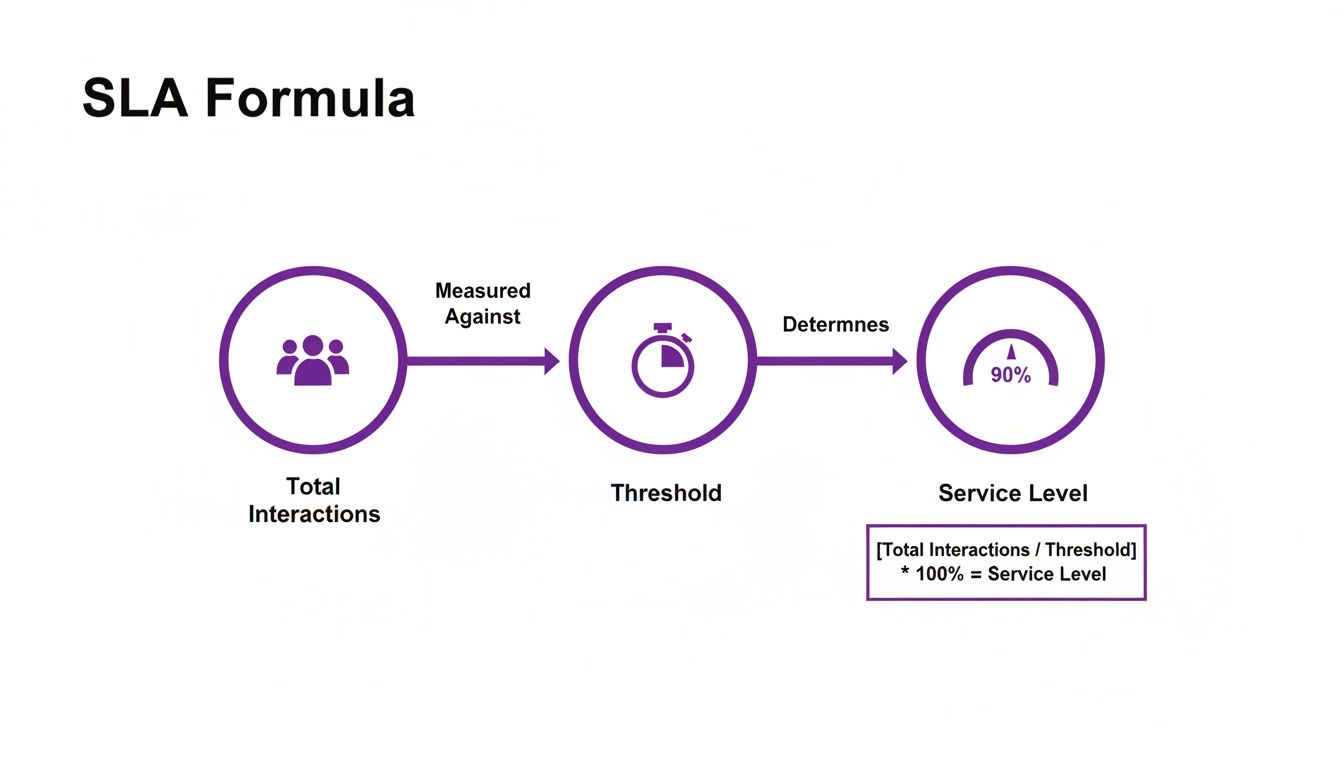
While this visual gets the core concept across, we've already seen how crucial those strategic adjustments are for true accuracy.
Differentiating SLAs Across Channels and Priorities
Getting a handle on abandoned calls is a huge step, but the fine-tuning doesn't stop there. A truly sophisticated SLA strategy has to adapt to different contexts. The response time a customer expects on live chat is worlds apart from an email inquiry. Applying a single 30-second rule across every channel just doesn't make sense from a business or customer experience perspective.
A more strategic framework means creating tiered SLAs based on the channel:
- Live Chat: 95% of chats answered within 15 seconds. (High-immediacy, for instant support)
- Voice Calls: 80% of calls answered within 30 seconds. (Standard urgency)
- Email: 90% of emails responded to within 4 hours. (Lower immediacy, for detailed queries)
And even within a single channel, not all interactions are created equal. For that real estate BPO, a hot lead calling about a prime property on a Saturday morning is a top priority. That call might demand a strict 95/15 SLA. A routine follow-up call on a Tuesday afternoon, however, could have a more standard target. This segmentation ensures your most valuable interactions receive priority service.
By building a multi-layered SLA structure like this, you align your operational goals directly with business value. It ensures your resources are always focused where they can make the biggest impact on revenue and client satisfaction.
Turning SLA Data Into Decisive Action
So, you’ve calculated your service level. That’s the easy part. For any business leader, raw SLA data is just noise until it’s translated into smart, decisive action. The true power of the SLA formula in a BPO isn’t just about hitting a number; it’s about using that number to protect revenue and find new avenues for growth.
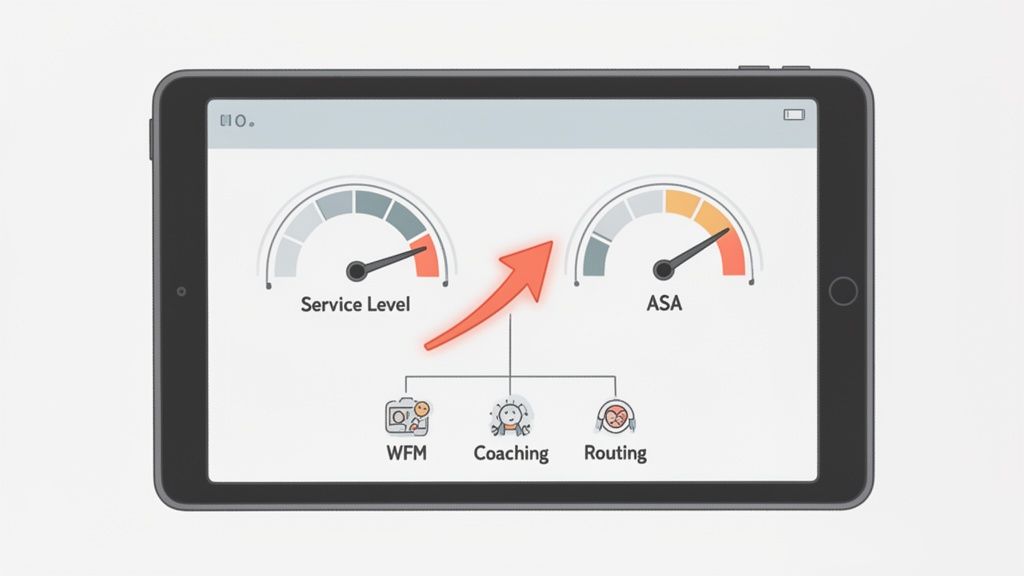
Think about what an executive wants to see on a dashboard. It’s not just a standalone Service Level percentage. A meaningful dashboard connects that metric to others like Average Speed of Answer (ASA) and, most importantly, shows a direct line to tangible business outcomes like Customer Lifetime Value (CLV) and Cost Per Acquisition (CPA).
From Metrics to ROI-Driven Strategies
Let's get practical. Imagine you’re a director at a real estate BPO. If you see your ASA creeping up from 20 seconds to 45 seconds, that’s not just a metric on a screen—it's a direct threat to your sales pipeline. Every extra second a motivated buyer has to wait is another second they could be clicking over to a competitor’s website.
A consistently high ASA isn’t a minor inconvenience; it could easily translate to a 15-20% loss in scheduled site visits or bookings, hitting your quarterly revenue targets right where it hurts. This is the point where data stops being passive and becomes a catalyst for action. Instead of just making a note of the performance dip, you can roll out high-impact strategies with a clear return on investment (ROI).
Here are three core areas where your SLA data can guide your next move:
Workforce Management (WFM) Optimisation: Are your ASA and Service Level tanking between 2-4 PM daily? That’s a classic sign of being understaffed. This data is the evidence you need to justify adding agents during peak call times or tweaking schedules to better align with when your customers are actually calling, preventing revenue loss.
Targeted Agent Coaching: Poor service levels aren't always about headcount. Digging into your call data might reveal that a few agents have an Average Handle Time (AHT) that is 35% higher than the team average. This is a coaching opportunity. Targeted training on product knowledge or navigating internal systems can make them more efficient, which in turn lifts the entire team's SLA.
Intelligent Call Routing: Your SLA data can also show you what people are calling about. If you see that complex technical questions are getting stuck in your main support queue and slowing everything down, it’s time for smarter routing. By sending specialised calls directly to your expert agents, you improve first-call resolution by up to 30% and free up your frontline team to handle general enquiries quickly.
The real goal isn't just to meet your SLA. It's to understand what the numbers are telling you about the health of your operation. Think of a dropping SLA as an early warning system for everything from staffing gaps to urgent training needs.
A 2026 ASSOCHAM study of a Pune-based real estate BPO found that by consistently exceeding an 80/20 SLA, they boosted their lead-to-booking conversion rate from 3% to an impressive 7.5%. The same study pointed out that e-commerce BPOs that failed to use adjusted formulas (by not excluding short abandons under 5 seconds) saw 28% higher client churn.
Ultimately, a well-managed SLA framework gives you the clarity needed for sharp, data-backed decisions. To dive deeper into this, check out our guide on real-time monitoring in contact centres.
For executives, it's crucial to present this information in a way that immediately highlights its business importance. A dashboard should go beyond operational metrics and connect directly to C-suite priorities like revenue, customer retention, and market share.
The Executive SLA Performance Dashboard
| Key Performance Indicator | CXO Target | Current Performance | Direct Business Impact |
|---|---|---|---|
| Service Level (80/20) | 85% | 78% | Each 1% drop correlates to a 0.5% decrease in customer retention, impacting CLV. |
| Lead Conversion Rate | 8% | 6.5% | Falling SLA is delaying agent response to high-intent leads, costing an estimated ₹1.5 Cr/month in lost sales. |
| Cost Per Acquisition (CPA) | < ₹2,500 | ₹2,850 | Inefficient handling increases call duration and repeat calls, driving up CPA by 14%. |
| Customer Lifetime Value (CLV) | > ₹50,000 | ₹46,000 | Poor initial service experience is a leading indicator of lower CLV and higher churn risk. |
By framing performance this way, the conversation shifts from "we missed our SLA" to "our current performance is costing us X in revenue and Y in customer loyalty." This makes the case for investing in improvements undeniable.
How AI Redefines The BPO SLA Formula
For years, the traditional BPO service level agreement has been dictated by a simple, unavoidable reality: human limitations. As a CXO, you've always had to play a careful game, balancing staffing costs against service quality to hit that 80/20 or 90/30 target. But advanced Voice AI isn't just tweaking the SLA formula in BPO; it's tearing up the rulebook entirely.
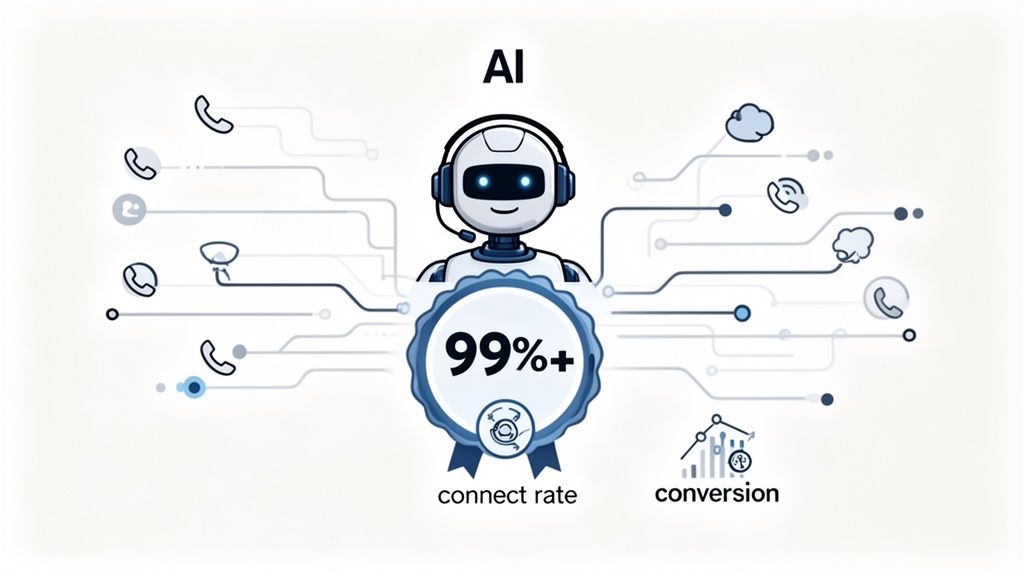
Think about what happens when queue times simply disappear. Voice AI agents can handle a practically infinite number of calls at the same time. This capability doesn't just nudge the ‘answered within threshold’ metric upwards; it launches it to nearly 100%. This isn't just an incremental improvement—it's a paradigm shift in operational strategy.
From Meeting SLAs To Making Them Obsolete
For any senior leader, this changes the entire conversation. We stop talking about efficiency and start talking about building a strategic advantage that is simply out of reach for a human-only team. The goal is no longer managing queues; it's about designing a perfect, instantaneous customer journey from the ground up, delivering a service experience your competitors cannot match.
Let's look at how this plays out with core business drivers:
- Connect Rates: We all know the struggle. Human-led dialling campaigns often see connect rates stuck around 47%. AI agents, however, can follow up persistently and automatically, pushing this figure as high as 91%. This doubles the number of qualified conversations from the same lead list.
- Conversion Metrics: This instant engagement creates a massive financial upside. In a campaign for a leading FinTech client, implementing an AI-powered outbound calling system increased lead-to-application conversions from a typical 2% to an incredible 8%—a 4x improvement in campaign ROI.
This new reality forces us to ask: what is an SLA even for? If every single call is answered the moment it comes in, the formula becomes less about measuring speed and much more about the quality and final outcome of that interaction. The focus shifts from "How fast did we answer?" to "How effectively did we resolve the customer's need?".
The New Executive Focus: AI And Human Synergy
The numbers tell a powerful story. By integrating a sophisticated AI call bot, we've observed service levels in EdTech BPOs climb from 75% to 92%. What’s more, this happened alongside a 30% drop in operational costs while effortlessly scaling to handle 5,000 calls a day—all without hiring a single new agent. These aren't just vanity metrics; they show how AI-driven SLA precision can turn routine calls into real revenue. You can learn more about these service level findings to get a deeper look at the impact.
For a CXO, the strategic path forward is clear. AI isn’t here to replace people. It’s here to handle the repetitive, high-volume work at superhuman scale, which frees up your best agents to focus on the complex negotiations and relationship-building that truly grow the business and increase customer lifetime value.
As artificial intelligence becomes more and more integrated into our work, understanding its effect on our key metrics is crucial. For example, looking into how Fresh Service Ticket AI is changing ticket resolution can offer clues for redefining service benchmarks across the board. The objective is no longer about just hitting a target. It's about building an operation that’s ready for the future and gives you an unbeatable competitive edge.
Strategic Pitfalls To Avoid When Setting SLAs
Anyone can write down an SLA. The real challenge—and where many BPOs stumble—is setting the right one. For any CXO, this isn't just an operational detail; it's a strategic decision where a few common mistakes can cost you dearly in both profits and client trust.
Think of it this way: a poorly designed SLA doesn't just create a single problem. It triggers a chain reaction that can lead to everything from agent burnout and 40% annual attrition rates to watching your high-value customers walk away.
The most common trap? Setting targets that look great on paper but are completely unrealistic in practice. A goal like "answer 95% of calls in 10 seconds" might impress a client initially, but it pushes agents to rush through interactions, leading to high turnover and terrible service quality. Chasing speed at the expense of a good conversation is a fast track to failure and diminished customer lifetime value.
Financial Consequences Of Poor SLA Design
Another mistake that can hit the bottom line hard is failing to account for the natural ebbs and flows of business. Imagine a BFSI client during peak tax season. The call volume skyrockets by 300%, and so does the pressure. If your SLA doesn't have built-in flexibility or "burst capacity" clauses, you could be facing multi-crore penalties for missing regulatory targets. It's a risk you simply can't afford to ignore.
This isn't a new problem. The very foundation of India's BPO growth was built on solid performance. According to a report by Everest Group, consistent SLA adherence above 80% was a key reason for the sector's success. On the flip side, BPOs that couldn't keep up often faced penalty clauses averaging ₹5-7 crore a year. The financial stakes are incredibly high. Read the full analysis on call centre service levels.
For an executive, an SLA is not just an operational metric—it's a risk management tool. A misconfigured SLA framework can directly result in millions in penalties and jeopardise long-term client contracts worth tens of millions.
Ultimately, building a profitable BPO isn't about having the most aggressive SLA. The SLA formula in a BPO has to be grounded in reality. It needs to be achievable for your team, genuinely valuable to your client’s business, and adaptable enough to handle whatever comes its way. Getting that balance right is what separates the partners who thrive from the vendors who just struggle to survive.
Common Questions About the BPO SLA Formula
When you're looking at SLA reports, you're not just checking boxes; you're trying to understand what the numbers really mean for your business. Let's tackle some of the most common questions that come up when putting the SLA formula into practice.
Is There a Standard SLA Target All BPOs Use?
You've probably heard of the 80/20 rule: answer 80% of calls within 20 seconds. It’s a popular benchmark, but treating it as a one-size-fits-all standard is a mistake I've seen many businesses make. The right SLA target always depends on what your customers need and expect.
Think about it this way: for an emergency healthcare line or a high-stakes financial trading desk, an 80/20 target would feel painfully slow. These services often need much tighter goals, something like 95/15 (95% of calls answered in 15 seconds). A generic target just doesn't work; you have to match the SLA to the urgency of the conversation.
How Does First Call Resolution (FCR) Fit in with SLA?
SLA tells you how fast you're answering the phone, but First Call Resolution (FCR) tells you how well you're actually solving problems. A high SLA score looks great on paper, but if your FCR is low, it’s a serious red flag. It means your team is quick to pick up but not effective, forcing frustrated customers to call back again and again. This directly increases your cost-to-serve and damages customer satisfaction.
A high SLA is an operational win, but a high FCR is a business win. The goal is to excel at both.
For a deeper audit framework covering the specific checkpoints that keep both scores high, see DialNexa’s guide to the 10 essential quality parameters for BPO success.
This is where the best BPOs connect the dots. They track both metrics side-by-side. For example, an AI agent might handle the initial contact, hitting a near-perfect SLA, before seamlessly handing off a complex issue to a specialist. This approach preserves both speed and the expert touch needed for a high FCR.
Should We Use the Same SLA Formula for Email and Chat?
Absolutely not. Applying the same time target across every channel is a sure way to misread your performance and frustrate customers. While the basic formula—(interactions meeting threshold / total interactions) x 100—doesn't change, the time component must be tailored to the channel.
Customers have completely different expectations for each. A smart, multi-channel SLA framework might set targets like this:
- Live Chat: 95% of chats answered within 15 seconds.
- Voice: 80% of calls answered within 30 seconds.
- Email: 90% of emails responded to within 2 hours.
Ready to push your service levels to nearly 100%? See how DialNexa Labs Private Limited uses Voice AI to eliminate wait times and transform your customer interactions. Explore our solutions at https://dialnexa.com.

This is a highly insightful piece that connects SLA metrics directly to revenue, customer retention, and operational efficiency rather than treating them as isolated KPIs. The discussion on AI-driven service levels and outcome-based performance offers a compelling vision for how modern BPOs can transform customer experience into a strategic growth advantage.