
Healthcare Call Centers: A CXO’s Guide for 2026
India's healthcare leaders don't have a capacity problem only inside the hospital. They have it at the front door. The country's population crossed 1.40 billion in 2023, while the National Health Profile 2023 reported only about 1.4 hospital beds per 1,000 population and roughly 0.9 allopathic doctors per 1,000 population. At the same time, the government's eSanjeevani platform crossed 100 million teleconsultations in 2023, confirming that remote intake is already part of mainstream care delivery, not a side channel for edge cases (data on healthcare demand and teleconsultation scale).
That combination changes how a CXO should think about healthcare call centers. This isn't a back-office telephony function. It's the operating layer that decides whether a patient gets booked, routed, reassured, escalated, followed up, or lost. In Indian healthcare, the call centre often determines how efficiently scarce clinical capacity is consumed.
The strategic shift for 2026 is straightforward. Hospitals and health systems that still manage their call centre as a labour cost will keep firefighting queues. Providers that redesign it as a value-creation hub, then layer in AI for routing, follow-up, summarisation, and workflow orchestration, will create measurable advantages in access, utilisation, staff productivity, and patient retention.
Table of Contents
- Why Your Healthcare Call Centre Is a Strategic Asset
- The Three Pillars of a Modern Healthcare Call Centre
- Architecting Your Call Centre Technology Stack
- KPIs That Drive Performance and Patient Satisfaction
- Mitigating Risk with Strong Compliance and Security
- Building a High-Performance Team for a Diverse Patient Base
- The Future Is Now AI-Powered Healthcare Call Centres
Why Your Healthcare Call Centre Is a Strategic Asset
Most hospital leadership teams still inherit an outdated assumption. The call centre exists to answer calls cheaply.
That framing is expensive. In practice, the call centre controls patient access, shapes first impressions, protects downstream utilisation, and determines whether operational friction turns into leakage. When a patient can't book, can't clarify preparation instructions, or can't reach someone after discharge, the problem doesn't stay inside the contact centre. It spills into missed appointments, underused clinician time, repeat calls, complaints, and avoidable attrition.
A stronger way to evaluate healthcare call centers is to treat them as the commercial and operational front door. Every interaction either preserves demand or wastes it. For a hospital CFO, that means the centre influences revenue capture. For a COO, it influences throughput. For a CMO or patient experience leader, it influences trust.
Practical rule: If your call centre is still measured mainly on staffing cost, you're under-measuring one of the few functions that touches acquisition, experience, and continuity of care in a single workflow.
A simple example makes the point. A patient calls to book a specialist consult. If the centre verifies the need, finds the right clinician, confirms slot availability, shares prep instructions, and sends reminders, that single interaction does more than “resolve a call”. It converts intent into attended care. That's why tools such as patient appointment scheduling software matter strategically. They compress friction at the exact point where demand becomes revenue.
The executive question isn't whether the call centre costs money. Of course it does. The better question is whether it protects enough demand, clinician utilisation, and patient loyalty to justify redesigning it as a growth and efficiency engine. In Indian healthcare, the answer is increasingly yes.
The Three Pillars of a Modern Healthcare Call Centre
A modern healthcare call centre does three jobs at once. It acts as the front door, the concierge, and the first responder. When leaders collapse these into one vague “support” function, they usually underinvest in process design and overfocus on call volume.
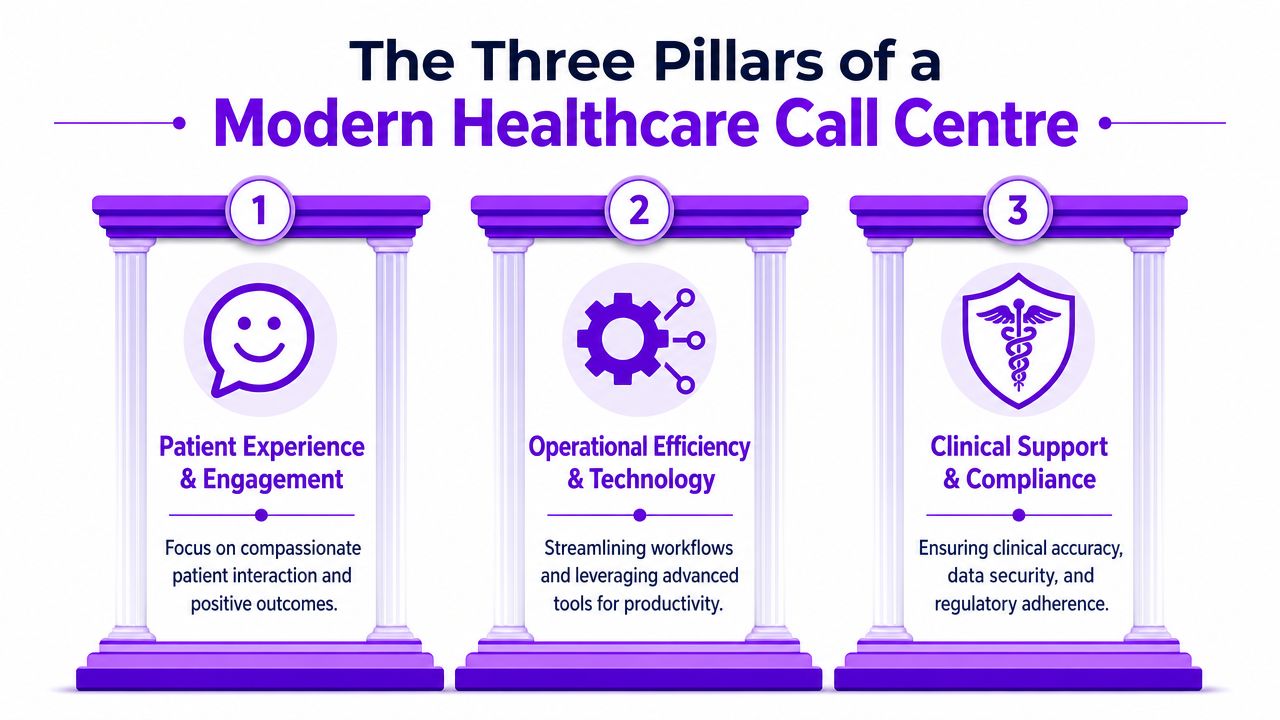
Patient access and scheduling
This is the front door to care. It includes appointment booking, rescheduling, referral intake, registration support, and physician matching.
Done well, this pillar protects demand. Done poorly, it creates silent leakage because patients don't always complain before moving elsewhere. A tertiary hospital, for example, may receive calls from patients who know they need cardiology but don't know which sub-specialist to see. A strong access workflow doesn't merely place them in the next available slot. It routes them based on need, geography, urgency, payer constraints, and clinician fit.
From a bottom-line perspective, this pillar affects:
- Capacity utilisation: Better slot matching reduces idle clinical time.
- Revenue capture: Fewer abandoned bookings mean more completed visits.
- Channel efficiency: A well-designed workflow cuts repeat calls caused by incomplete booking.
Patient support and navigation
This is the concierge layer. Patients call not only to book, but to understand. They need test preparation guidance, document checklists, billing clarification, discharge follow-up, location assistance, and reminders.
The business value here is often underestimated because the interaction may not generate immediate revenue. But support and navigation reduce friction that would otherwise surface as no-shows, delayed admissions, cancelled procedures, and avoidable dissatisfaction. For a multi-speciality provider, even a basic pre-procedure call can prevent wasted theatre time when a patient arrives unprepared.
A practical example. A patient scheduled for imaging calls because they're unsure whether fasting is required. If the agent has access to the relevant protocol and can provide standardised guidance, the organisation avoids confusion, repeat calls, and potentially a lost slot.
Support is where hospitals either feel organised to patients or fragmented to them.
Clinical triage and escalation
This is the first-responder function, and it's where operational design meets clinical risk. Some centres handle symptom intake, urgent routing, nurse callbacks, post-discharge monitoring, or referral prioritisation. Those workflows can improve access, but they also create liability if triage logic is weak or escalation thresholds are vague.
The literature in the supplied evidence notes a critical tension. Healthcare call centres can improve coordination and reduce unnecessary emergency use, but poor telephone triage can create a false sense of reassurance or delay urgent care, which raises medico-legal exposure (evidence on triage risk and liability).
For CXOs, that means triage shouldn't sit inside a generic operations playbook. It needs:
- Defined symptom pathways: Which complaints can stay in phone workflow, and which require immediate escalation.
- Escalation ownership: Who receives urgent transfers, and what response window is acceptable.
- Documentation discipline: What was said, what advice was given, and when escalation occurred.
These three pillars aren't equal in risk, but they're tightly linked in value. Access drives throughput. Navigation protects experience. Triage protects safety. A mature operating model recognises that all three belong inside the same strategic conversation.
Architecting Your Call Centre Technology Stack
Indian providers no longer have the option to treat the call centre as a basic switchboard. Remote intake is already part of mainstream care delivery, patient expectations are rising, and labour capacity remains constrained. In that environment, the technology stack determines whether the contact centre absorbs demand at low cost or converts access demand into booked appointments, retained patients, and better utilisation of clinical capacity.
The design question for a CXO is simple. Does the stack reduce avoidable handling time, improve conversion from enquiry to visit, and protect clinical judgement where risk is highest?
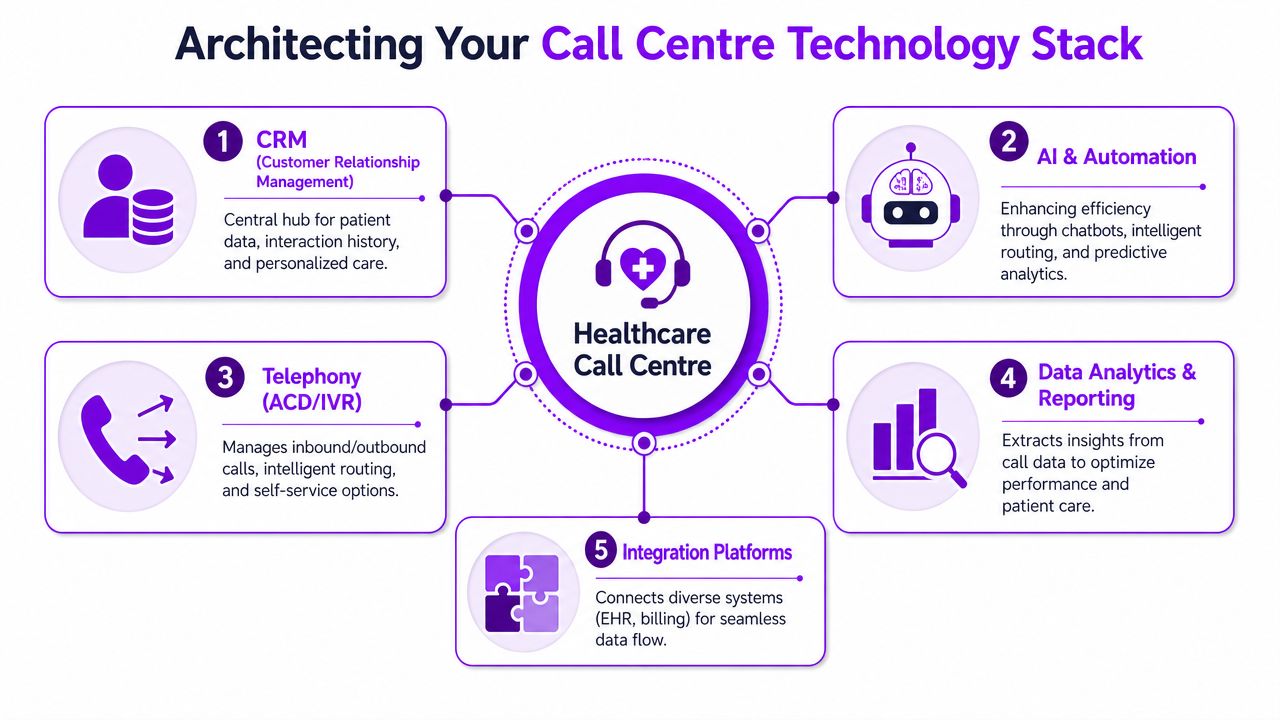
Start with the patient record, not the phone line
The operating model should centre on the CRM or patient interaction layer. Agents need one working screen that brings together prior calls, appointment status, pending service requests, follow-ups, and referral context. The EHR remains the system of clinical record, but it is rarely the best tool for managing live service interactions.
That distinction has direct financial consequences. Every extra screen, repeated identity check, or manual search adds seconds to handle time and increases the probability of abandonment or rework. At scale, those small frictions turn into higher staffing costs and lower appointment conversion.
CTI, or computer telephony integration, closes much of that gap. It connects the incoming call to the patient context before the conversation starts, so the agent can see queue history, likely intent, and the next approved workflow. Hospitals that skip CTI often force agents to reconstruct context manually. Hospitals that implement it well reduce repetition and make service quality less dependent on individual memory.
A practical stack usually connects these systems:
- Telephony platform
- CRM or patient engagement system
- EHR or hospital information system
- Scheduling platform
- Billing or payment workflow
- Knowledge base for scripts and guidance
Route work by value and risk
Routing logic is where strategy becomes visible. If every caller enters the same queue, the hospital is treating a high-value specialist enquiry, a payment dispute, and a medication question as operationally identical. They are not.
ACD, or automatic call distribution, should route by specialty, language, urgency, patient segment, and workflow type. That improves more than service speed. It protects revenue from lost high-intent patients, reduces transfers that weaken confidence, and reserves scarce clinical or senior agent capacity for cases where judgement affects safety or conversion.
This matters in India because the economics of growth are unforgiving. Multi-specialty hospitals and digital-first providers are competing for the same patient across phone, WhatsApp, website, and referral channels. A weak routing model increases leakage at the top of the funnel. A well-configured one increases the share of enquiries that become completed consultations or procedures.
One transfer is rarely just one transfer. It adds labour minutes, increases the chance of drop-off, and often triggers a repeat call later.
Use AI where variation is low and volume is high
The highest-return automation usually sits in repetitive workflows. IVR can still handle basic call steering, but IVA and AI-assisted workflows are more relevant for providers trying to move the contact centre from cost centre to value-creation hub.
Appointment reminders, rescheduling, status checks, FAQ handling, insurance document prompts, callback scheduling, and structured intake can often be automated safely if escalation rules are clear. That does not remove the human layer. It concentrates human time where empathy, judgement, or cross-selling matter more.
For Indian healthcare providers, this is the strategic shift. AI reduces the cost of serving routine demand, but the larger gain comes from capacity reallocation. Agents can spend more time converting elective procedures, supporting chronic-care follow-up, and recovering patients who might otherwise drop out of the journey. That changes the ROI equation from labour reduction alone to revenue capture and patient retention.
The stack also needs a reporting layer that connects technology choices to management decisions. Dashboards should show where calls stall, which intents are driving repeat contact, and which queues are generating the highest abandonment or transfer rates. Teams that want a tighter measurement framework should define contact centre KPI benchmarks that tie efficiency to patient experience before scaling automation.
For executive planning, the stack should be judged against five business outcomes:
| Stack component | Operational role | Executive outcome |
|---|---|---|
| CRM or patient engagement layer | Centralises interaction context | Higher continuity, fewer repeat explanations, better conversion control |
| CTI | Connects telephony and patient data | Shorter handle time and less agent effort |
| ACD | Routes by intent, priority, and skill | Lower transfer rates and better use of specialised staff |
| IVR or IVA | Automates repeatable interactions | Lower queue pressure, broader access hours, and lower cost per contact |
| Analytics and reporting | Identifies bottlenecks and demand patterns | Better staffing, stronger quality control, and clearer capital allocation |
A strong stack is not defined by how many tools it includes. It is defined by whether it lowers the cost to serve, increases access conversion, and gives leadership a repeatable way to scale patient experience without scaling overhead at the same rate.
KPIs That Drive Performance and Patient Satisfaction
The wrong KPI dashboard makes a healthcare call centre look busy. The right one shows whether the operation is protecting revenue, preserving patient trust, and using staff time intelligently.
The most useful executive view separates metrics into efficiency, service level, and outcome quality. Only one of those categories measures speed alone. That matters because a fast centre can still be a poor one if patients are routed incorrectly or call back for the same issue.
Executive KPI table
The most concrete benchmark in the supplied evidence is operational. In healthcare call centres, average handle time is typically benchmarked at about 3 minutes 28 seconds, while average hold time is often targeted at 30 to 60 seconds. When hold time stretches beyond that range, abandonment risk rises and patient experience degrades (healthcare contact centre metric benchmarks).
| KPI | Industry Benchmark | What It Tells a CXO |
|---|---|---|
| Average Handle Time | About 3 minutes 28 seconds | Whether workflows, tools, and scripts are helping agents resolve efficiently |
| Average Hold Time | Target 30 to 60 seconds | Whether queue design and staffing are protecting experience before the conversation even starts |
| First Call Resolution | Qualitative metric, no verified benchmark provided | Whether the centre is actually solving problems or generating repeat workload |
| Abandonment Rate | Qualitative metric, no verified benchmark provided | Whether demand is leaking before the organisation can serve it |
| Patient Satisfaction | Qualitative metric, no verified benchmark provided | Whether interactions feel clear, empathetic, and trustworthy |
| Appointment Show Rate | Qualitative metric, no verified benchmark provided | Whether communication quality is translating into attended care |
A broader framework for measuring contact centre health is useful when building executive dashboards. This guide to contact centre KPI selection is a practical reference if your team is standardising scorecards across service lines.
What the numbers really mean
Average handle time is often misused. Leaders see it rise and immediately push for shorter calls. In healthcare, that can backfire. A longer call may be justified if the agent resolves a complex issue, prevents a no-show, or escalates correctly. AHT only becomes useful when read alongside repeat contacts, transfers, and patient feedback.
Hold time is more straightforward. Patients calling a hospital are often already stressed. Waiting too long before speaking to anyone signals disorganisation, regardless of what happens later. For a provider competing on experience, hold time is one of the earliest visible failures.
Three executive interpretations matter most:
- High AHT with low repeat calls may indicate productive problem-solving.
- Low AHT with high transfer volume often means calls are being moved, not resolved.
- Rising hold time is usually a capacity, scheduling, or workflow design issue before it becomes a quality issue.
A high abandonment pattern isn't just a queueing problem. It often means the organisation is losing patients before registration, before booking, and before any clinician has a chance to deliver value.
Build the dashboard around decisions
A KPI is useful only if someone knows what action it triggers. That's where many healthcare call centers fall short. They collect numbers, but they don't tie them to operational levers.
A practical decision map looks like this:
- If hold time rises, review staffing mix, callback options, and routing rules.
- If AHT rises, inspect system switching, script quality, and knowledge access before blaming agents.
- If repeat calls increase, look for broken downstream workflows such as reminders, billing clarity, or referral closure.
- If satisfaction falls, audit tone, empathy, and transfer friction, not just speed metrics.
CXOs achieve a stronger position. A disciplined KPI model turns the call centre from a volume-reporting function into an operating dashboard for access performance.
Mitigating Risk with Strong Compliance and Security
For Indian healthcare providers, call centre risk is no longer a narrow IT concern. It affects revenue, legal exposure, insurer relationships, and patient retention. A single failure in identity verification, symptom escalation, or call documentation can trigger privacy breaches, treatment delays, disputed advice, and avoidable attrition.
That makes compliance a management system, not a checklist. Hospitals that treat it as an operating discipline build lower-risk workflows, defend claims more effectively, and create a trust advantage that low-cost competitors struggle to match. As AI takes a larger role in call handling, this discipline matters even more. Automation increases scale, but it can also multiply errors if governance is weak.

Exposure Sits in Workflows
The largest risk in many healthcare call centers is not theft of data alone. It is failure inside routine communication. Telephone triage, appointment changes, payment clarification, and referral coordination all shape whether a patient gets the right next step at the right time. If those workflows are vague, the organisation creates clinical and legal risk long before a formal incident review begins.
Consider a common failure pattern. A patient reports symptoms that should trigger urgent review. The agent follows an unclear script, the escalation threshold is poorly defined, and the record does not capture the advice given or the timing of the handoff. The immediate issue is patient safety. The next issue is weaker legal defensibility. The longer-term issue is financial. Claims management costs rise, avoidable complaints increase, and trust erodes in a market where patients can switch providers quickly.
For CXOs, the implication is strategic. Security and compliance controls should be designed into workflows that generate revenue and shape patient loyalty, not layered on after operations are built.
Controls that reduce operational and financial exposure
Strong compliance environments usually rely on a small set of controls executed consistently across every shift, channel, and vendor team.
- Role-based access: Agents should view only the data required for their task. This lowers breach risk and reduces accidental disclosure.
- Secure data handling: Notes, recordings, and follow-up instructions need controlled storage and transmission. This is especially important when multiple systems and outsourced teams are involved.
- Recording governance: If calls are recorded, retention periods, retrieval rights, and review protocols must be defined in advance.
- Escalation protocols: Symptom-related calls need clear thresholds for transfer, callback timing, and clinical review.
- Audit trails: Supervisors must be able to reconstruct who accessed information, what advice was documented, and when actions were taken.
- AI governance: If AI is used for transcription, summarisation, triage support, or quality monitoring, providers need human review rules, exception handling, and clear accountability for errors.
The return on these controls is broader than regulatory posture. They reduce repeat work, shorten dispute resolution, improve insurer and auditor confidence, and protect brand value. In India's high-growth healthcare market, that matters. Providers scaling into new cities or handling rising patient volumes through AI-assisted call flows need governance that can grow without increasing failure rates.
Compliance is part of service design. Patients may not see the control framework, but they notice the consequences when private information is exposed or urgent concerns are mishandled.
Boards and executive teams should assess the call centre as an enterprise risk point and a value-creation point at the same time. Well-governed operations lower downside risk. They also create a stronger base for AI adoption, better patient trust, and more profitable growth.
Building a High-Performance Team for a Diverse Patient Base
Even the best technology stack underperforms if the workforce model assumes every patient communicates the same way. In India, that assumption fails quickly.
Effective support requires more than generic multilingual capability. The evidence provided stresses that call centre workflows must be designed for regional dialects and varying literacy levels to prevent patient journey breakdowns, especially across India's mixed urban-rural patient base (evidence on vernacular and low-literacy access needs).
Hire for language reality not brochure multilingualism
Many providers say they offer multilingual support. Fewer can specify which languages matter by service line, shift, geography, or patient segment.
A stronger staffing model starts with demand mapping. Which regions generate calls. Which departments attract patients from outside the primary city. Which workflows break most often when instructions become more complex. Those answers should shape hiring profiles.
For example, a hospital serving referral patients from multiple districts may need different language coverage for oncology scheduling than for urban day-care procedures. The issue isn't only translation. It's comprehension under stress, especially when patients are discussing symptoms, medication, fasting, or financial clearance.
Train for empathy and escalation judgment
Healthcare conversations are rarely neutral. Patients may be anxious, in pain, confused, or calling on behalf of an older family member. Agents need more than system training. They need structured coaching on tone, reassurance, listening, and safe escalation.
The highest-value quality programmes focus on:
- Empathy in plain language: Can the agent communicate clearly without sounding scripted or overly technical.
- Journey awareness: Does the agent understand where the caller sits in the care pathway.
- Escalation judgement: Can the agent recognise when the script no longer applies and clinical review is needed.
This is especially important in mixed-acuity environments where the same centre handles routine bookings and more sensitive post-discharge or symptom-related calls.
A strong QA programme doesn't only ask, “Was the script followed?” It asks, “Did the patient get safely and clearly to the next step?”
Reduce churn by making the role investable
Leadership teams often talk about agent attrition as an HR issue. It's also a service-quality and cost issue. Frequent turnover erodes consistency, increases training load, and weakens institutional memory.
The practical fix isn't only compensation. It's role design. Agents stay longer when there's visible progression into senior support, quality, workflow supervision, training, or specialised service lines. That matters in healthcare because domain knowledge compounds. An experienced agent who understands scheduling nuance, referral logic, and escalation pathways often delivers far more value than a newly hired replacement, even when both have similar call etiquette.
For CXOs, the workforce strategy should be explicit:
- Recruit for language and composure
- Train for empathy and process judgement
- Coach through QA, not only scorecards
- Create progression paths that preserve capability
That's how a centre becomes resilient enough to serve a diverse patient base without collapsing into inconsistency.
The Future Is Now AI-Powered Healthcare Call Centres
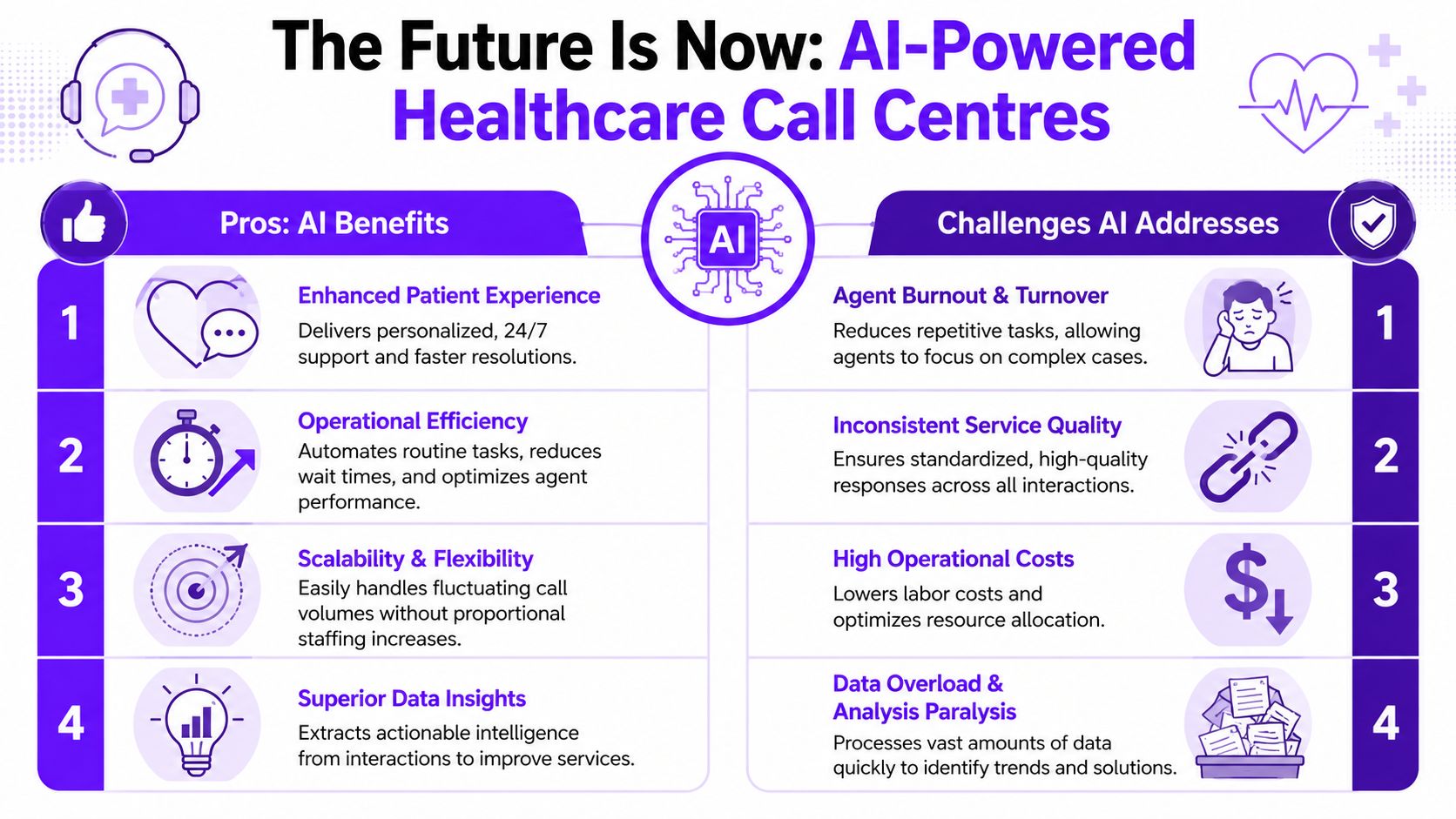
For Indian providers, the economics are hard to ignore. Large hospital networks are adding digital touchpoints faster than frontline staffing can scale, which makes patient access a capacity problem, not just a service problem. AI matters here because it can absorb predictable communication volume, reduce avoidable agent workload, and improve conversion from inquiry to booked appointment.
AI creates financial value when it is applied to bottlenecks with clear workflow boundaries. In most healthcare call centres, those bottlenecks sit in routine interactions that consume time but do not require clinical judgement.
Where AI creates value first
The first ROI wave usually comes from high-volume tasks with standard decision paths.
- Appointment booking and reminders: AI voice systems can manage routine booking, confirmations, and rescheduling, then transfer exceptions to human agents.
- Structured intake: AI can capture reason for call, preferred doctor, language, and availability before an agent joins, which shortens handling time.
- Follow-up communication: Post-visit reminders, payment prompts, and care-navigation callbacks can be automated with tighter consistency.
- Agent assist: Real-time guidance, summarisation, and workflow prompts reduce documentation load and improve process adherence during live calls.
This operating model changes workforce allocation. Human agents spend less time on repetitive transactions and more time on conversations where reassurance, judgement, or escalation discipline affects outcomes and revenue.
The upside extends beyond the contact centre. Hospitals reviewing front-office transformation should also examine how AI and RPA in revenue cycle reduces friction after the visit, because patient communication, collections, and administrative throughput are increasingly linked.
As maturity increases, providers can move from isolated automations to orchestrated voice workflows across access, follow-up, and service recovery. Teams assessing that path can start with this overview of Voice AI in healthcare workflows. One example in this category is DialNexa Labs Private Limited, which offers configurable voice AI agents for support, follow-ups, qualification, and workflow-driven calling.
A short product demonstration is useful here because executives can evaluate containment logic, conversation quality, and handoff design more effectively by hearing the interaction model:
Why India is ready faster than many markets
India's digital health infrastructure makes AI integration more feasible than many leadership teams assume. The Ayushman Bharat Digital Mission has accelerated the shift toward digitally mediated patient journeys, which gives providers a stronger foundation for AI-enabled communication than in many less digitised markets.
That does not mean every healthcare organisation should rush into full automation. It means the market is increasingly suited to hybrid operating models where AI handles standardisable interactions and human teams retain control of complexity, escalation, and risk.
The most useful executive mindset is this:
- Use AI for consistency-heavy work
- Keep humans on high-empathy and high-risk interactions
- Measure ROI through access, utilisation, and staff productivity
- Treat AI as workflow infrastructure, not a novelty layer
For Indian healthcare providers, that shift has strategic importance. A call centre built only as a cost centre will always be pressured on headcount and service levels. A call centre designed as a value-creation hub can improve appointment capture, reduce leakage, support collections, extend after-hours access, and protect clinician capacity.
That is the larger takeaway from this article. The modern healthcare call centre is no longer just a support function. With the right process design, technology stack, governance, and workforce model, it becomes a measurable driver of patient experience, operational efficiency, and revenue performance.
DialNexa Labs Private Limited helps organisations deploy human-like Voice AI agents for support, follow-ups, qualification, and workflow-driven conversations at scale. For teams evaluating how to convert patient communication into a stronger access and value engine, DialNexa Labs Private Limited is one option to assess within that operating model.

This is an insightful and well-structured analysis that clearly shows how healthcare call centres have evolved from cost centres into strategic drivers of patient experience and revenue growth. Great emphasis on combining technology, compliance, and human empathy to build a future-ready healthcare ecosystem.
This is a valuable guide to improving healthcare call centers through smarter technology and efficient communication strategies. The insights on patient experience, AI automation, and operational efficiency can help healthcare leaders deliver more responsive, reliable, and patient-focused support.