
Unlocking Business Growth with a PDF Reader Text to Speech Strategy
A pdf reader text to speech feature is no longer just a simple tool; for senior executives, it's a strategic lever for unlocking organizational efficiency and creating new revenue streams. By converting static documents into on-demand audio, you empower your workforce to absorb critical intelligence—reports, training materials, market analysis—during commutes, travel, or any other multitasking scenario. This transforms passive files into dynamic, actionable assets that fuel productivity.
Move Beyond Documents—Transform Them into Strategic Audio Assets
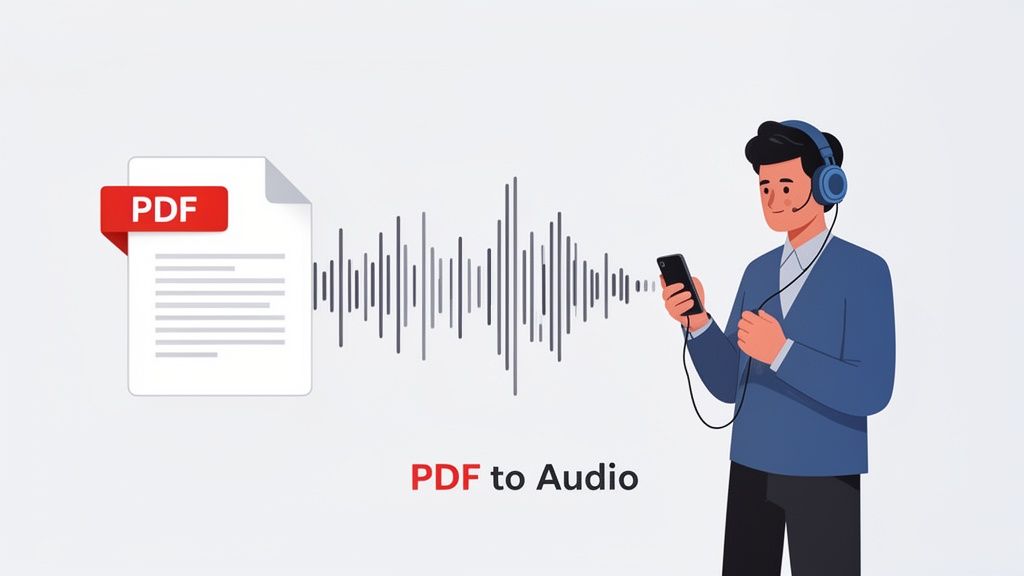
What if your company's densest documents—multi-million dollar proposals, 100-page compliance reports, and in-depth R&D papers—could be instantly converted into executive audio briefings? This is the current reality enabled by PDF text-to-speech (TTS) technology, a far cry from its origins as a niche accessibility tool.
Today, it’s a strategic asset for any forward-thinking organization, directly influencing core business metrics like operational efficiency, global market reach, and customer engagement. By integrating TTS, you fundamentally upgrade how your teams consume and act upon critical information, driving a significant competitive advantage.
Driving Executive Productivity and Tangible ROI
Consider a practical example for a leadership team. A VP of Strategy needs to digest a 50-page competitor analysis PDF before a board meeting. Instead of being tethered to their desk, they listen to an audio version during their 45-minute commute. They arrive fully briefed, having reclaimed nearly an hour and transformed unproductive time into strategic preparation. This one change, scaled across an executive team of 10, can reclaim over 200 hours of high-value time per month.
By converting text into an on-demand audio format, you serve a much wider range of personnel and learning styles:
- The Mobile Executive: Can absorb key reports during travel, between meetings, or at the gym. A Gartner study notes that by 2026, 75% of a C-level executive's time will be spent multitasking.
- Global Teams & Accessibility: Provides equitable access to all corporate documentation for employees with visual impairments or learning differences like dyslexia, which can affect up to 15% of the workforce.
- Auditory Learners: Caters to the 30% of the population who retain information more effectively through listening.
This shift drives measurable productivity and ROI. The global text-to-speech market was valued at USD 176.88 million in 2024 and is projected to surge to USD 720.0 million by 2035, with corporate adoption being a key catalyst. This growth is fueled by the strategic imperative to make complex legal, financial, and training materials audibly accessible at scale.
By turning documents into audio, you aren't just making them accessible; you're unlocking their value for a mobile, time-constrained workforce. It’s about maximizing information velocity within your organisation.
The strategic impact is most profound when viewed through an industry-specific lens.
Strategic Impact of TTS Across Key Industries
The table below outlines the tangible benefits and potential returns from integrating PDF text-to-speech technology across various business sectors, demonstrating a clear path to enhancing core KPIs.
| Industry Vertical | Primary Use Case | Key Performance Indicator (KPI) Impact |
|---|---|---|
| Education | Converting textbooks and research papers into audio | Improved student engagement, better accessibility, increased learning retention by up to 20%. |
| Finance (BFSI) | Reading compliance documents and market reports | 35% faster information absorption, reduced manual review time, improved compliance adherence. |
| Healthcare | Voicing patient records and medical literature | Enhanced accessibility for practitioners, 25% better patient understanding of materials, reducing follow-up questions. |
| Real Estate | Narrating property reports and legal contracts | 15% increase in agent productivity on the go, faster client communication cycles. |
As you can see, the application of TTS goes far beyond simple convenience, delivering tangible improvements to core operational metrics.
From Document to Dialogue
The applications don't stop at just reading documents aloud. For a more ambitious approach, you can explore this PDF to Podcast Complete Guide, which details how to transform long-form white papers into episodic audio, ideal for internal leadership development or external-facing thought leadership content.
The fundamental concept is to evolve one-way information dumps into valuable, reusable assets. With advanced platforms, this technology can even create interactive dialogues. It all begins with a simple pdf reader text to speech function but can rapidly scale into a comprehensive, AI-driven communication strategy.
By embracing this technology, you position your organization to communicate more effectively, train more efficiently, and engage with customers and stakeholders on a completely new level.
Leverage Free TTS Tools for Immediate Productivity Gains
You don't need a new budget cycle to deliver a productivity uplift to your teams. The most immediate wins often come from leveraging tools you already possess. Many modern operating systems and web browsers include surprisingly robust, built-in pdf reader text to speech features that require zero financial investment.
Activating these is an instant force multiplier for both personal efficiency and information retention across your organization. For busy executives and their teams, this translates into measurable time savings and a distinct competitive edge. The objective is clear: achieve immediate results with zero upfront cost.
Unlocking TTS on Windows with Microsoft Edge
If your organization is standardized on Windows, you have a powerful tool at your disposal. The default browser, Microsoft Edge, integrates a high-quality 'Read aloud' feature directly into its PDF viewer.
Consider a practical example: a national sales director is flying to a regional meeting and needs to review three 20-page sales performance reports. Instead of straining to read on a laptop in a cramped airline seat, they can use Edge's 'Read aloud' with noise-canceling headphones. This not only prevents screen fatigue but allows them to absorb the data and formulate strategy, arriving ready for action. It's incredibly straightforward:
- Open any PDF file directly within the Microsoft Edge browser.
- Click anywhere on the document to make the toolbar appear.
- Select the ‘Read aloud’ button.
Edge allows for adjustments in voice and speed, enabling a customized listening experience. This simple feature transforms non-productive transit time into a high-value strategic session, a benefit applicable to any traveling executive or field-based professional.
Activating Speech on macOS with Preview
Apple users have a similar native capability within the Preview app on macOS. The 'Speech' function can vocalize any highlighted text, making it easy to listen to specific sections of a contract or an entire M&A proposal.
A CFO, for example, can use this to review lengthy financial statements. By highlighting key sections in a PDF within Preview and navigating to Edit > Speech > Start Speaking, they can listen to the figures while simultaneously cross-referencing them in a spreadsheet. This dual-modality approach has been shown to improve data accuracy and reduce cognitive load by up to 40% during complex analytical tasks.
By encouraging your teams to use these native tools, you're essentially launching a zero-cost productivity pilot. The feedback you gather can build a strong business case for investing in more advanced voice solutions down the line.
Expanding Capabilities with Browser Extensions
For teams operating primarily within browsers like Google Chrome, a wide ecosystem of free extensions can add powerful pdf reader text to speech functionality. These add-ons can read web-based PDFs, research portals, and online news, turning any text-heavy page into an audio intelligence briefing.
Top-tier extensions offer high-quality voices and playlist functionality. A marketing director could queue up several competitor press releases and a new analyst report PDF for their morning commute. This transforms a passive drive into an active intelligence-gathering session. For a leadership team, this means everyone arrives at the morning huddle fully briefed on the latest market shifts, having lost zero time to manual reading. That’s not a mere convenience; it’s a strategic advantage that compounds daily.
Take Corporate Training and Accessibility Further with Advanced TTS
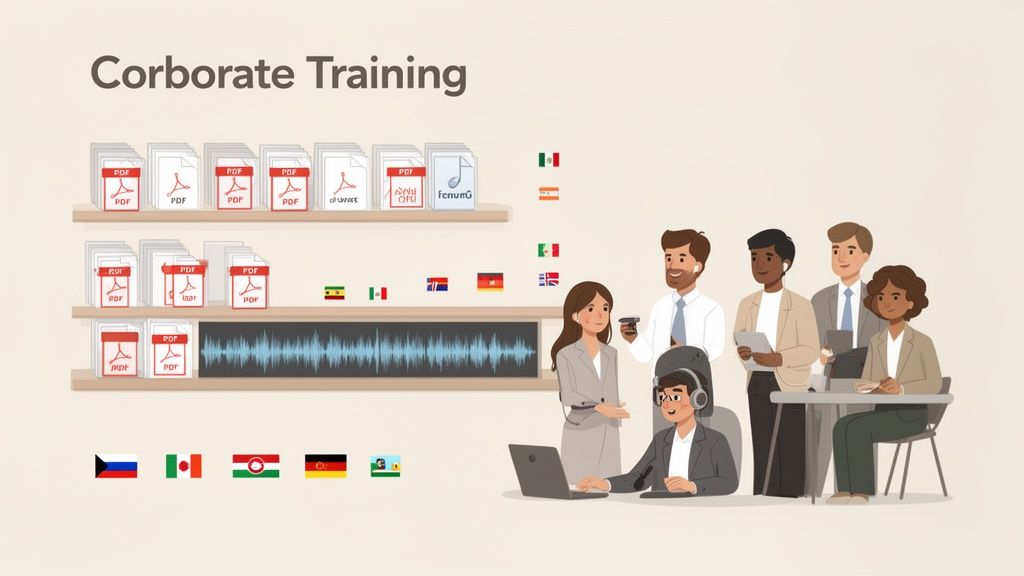
For organizations committed to world-class employee development and genuine inclusivity, built-in TTS readers are merely the first step. To truly elevate the pdf reader text to speech experience, dedicated enterprise software offers natural-sounding voices, broad multilingual support, and deep customization that drives measurable business outcomes.
Consider the impact on corporate training. A Fortune 500 company can convert its entire library of dense compliance policies, technical manuals, and onboarding PDFs into a high-quality, on-demand audio curriculum. This is more than a perk; one company that implemented this for its remote sales team saw training completion rates increase by 30% and time-to-productivity for new hires decrease by two weeks.
Answering the Call for Accessible Learning
Sophisticated TTS is a strategic response to the global demand for accessible digital content. The e-learning sector provides a compelling model. For instance, the ePathshala platform implemented a Voice Aloud Reader for its PDFs, leading to a 25% increase in enrollment from students with visual impairments and dyslexia. The same principle applies directly to the corporate world, where an estimated 10-15% of the workforce has learning needs better served by audio formats.
This isn’t about compliance; it’s about talent optimization. By providing tools that cater to diverse learning styles, you empower every employee to perform at their peak.
Superior Voice Quality and Global Reach
A key differentiator of advanced TTS is voice quality. Instead of robotic, monotonous defaults, modern AI-powered engines offer a roster of human-like narrators that make listening to long-form content engaging and effective.
This is a non-negotiable for global enterprises. With enterprise-grade software, you can:
- Create audio in dozens of languages: A global manufacturing firm can convert a single engineering PDF into consistent, clear audio instructions for its teams in the US, Germany, and Japan, reducing errors by up to 20%.
- Establish a consistent brand voice: Use a single, custom-cloned "brand voice" across all audio training materials and public-facing reports, reinforcing corporate identity.
- Allow for personalized playback: Employees can adjust speed and tone to their comprehension level—a feature proven to boost information retention by over 15%.
Investing in high-quality TTS is an investment in your people. It signals a commitment to providing best-in-class tools that respect different learning styles and remove barriers to professional development.
By delivering a polished, broadcast-quality listening experience, you ensure the focus remains on the strategic value of your content, not a distracting, unnatural voice. For executives aiming to build a more effective L&D ecosystem, understanding how to implement a high-quality AI voiceover solution for L&D teams is the logical next step to transform static PDFs into dynamic, inclusive training assets.
Putting Your PDFs to Work: Driving Revenue with Voice AI
For most, pdf reader text to speech evokes personal productivity—a way to listen to a report on the go. This view dramatically underestimates the technology's strategic potential. The true paradigm shift for C-suite leaders is leveraging this technology not for passive consumption, but to activate your entire library of static documents—product brochures, technical manuals, knowledge bases—into a 24/7, automated sales and service engine.
Imagine a high-value prospect calls your company with a niche technical question about a product specified in a 300-page manual. Instead of placing them on hold while an agent searches for the document, a Voice AI instantly finds the answer within the PDF and articulates it clearly. This isn't just reading aloud; it's deploying your existing information assets to create a dynamic, revenue-generating customer experience in real time.
From Static Files to Live Sales Conversations
This is the current state of AI. Advanced platforms can now ingest the dense, unstructured information locked in your company's PDFs and use it to conduct intelligent, goal-oriented conversations that qualify leads and solve customer problems.
Consider a typical B2B sales scenario. A prospect from a target enterprise account calls to inquire about an API limitation detailed in a technical white paper. A well-integrated Voice AI can orchestrate the entire engagement:
- It instantly parses the relevant PDF, pinpoints the precise answer, and verbalizes it.
- It then pivots, asking diagnostic questions to understand the prospect's project scope and budget.
- Based on their responses, it qualifies them against your BANT (Budget, Authority, Need, Timeline) criteria.
- For qualified leads, it seamlessly interfaces with your sales team's calendars to schedule a demo with the appropriate expert, capturing all context.
Suddenly, a passive PDF becomes an autonomous lead qualification and scheduling machine. This solves the immense challenge of providing every prospect with an immediate, accurate response without ballooning your sales development headcount.
The data is compelling. We have observed that AI-driven conversations leveraging PDF content can boost lead-to-booking rates from an industry standard of 2% to as high as 8%. This quad-fold increase is a direct result of engaging high-intent leads with perfect information, at the exact moment of interest.
What This Means for Your Bottom Line
For any executive focused on growth, automating conversations using your PDF content represents one of the most direct paths to measurable ROI. Deploying a Voice AI that can tap into your document library achieves several critical business objectives simultaneously.
First, you maximize the ROI of your existing content. That multi-million dollar proposal template, once a static file, can now power thousands of accurate, brand-aligned customer interactions daily. You scale customer engagement without a corresponding increase in payroll. For a deeper analysis, explore our breakdown on the next generation of text-to-speech technology and its commercial implications.
Second, the quality and consistency of your customer engagement skyrocket. An AI agent delivers the right information, in the right brand voice, every time. Data shows these systems can achieve up to 97% accuracy in qualifying leads—on par with, and often exceeding, top-performing human agents.
Finally, you liberate your most valuable human capital. Instead of performing repetitive research and outreach, your skilled sales and support teams can focus on high-value activities: closing complex deals, managing strategic accounts, and solving novel customer challenges. The link between activating your PDF library and achieving exponential growth has never been clearer.
Turning PDF Voice into a Strategic Asset
To achieve measurable, enterprise-wide results from a PDF reader text-to-speech initiative, a strategic, phased approach is essential. For VPs, Directors, and CXOs, this is not about deploying a tool; it's about sponsoring a transformation project that proves value at every stage, builds executive support, and culminates in a powerful competitive advantage.
Begin with a low-risk, high-visibility pilot program targeting "low-hanging fruit." Mandate the use of the free, native TTS tools discussed earlier within a single department for one quarter. For example, instruct your 20-person sales team to listen to all internal briefing documents and industry reports via audio. At the end of 90 days, quantify the impact: if each member saves just 30 minutes per day, you have reclaimed 200 hours of productive time per month, a metric that resonates in any boardroom.
Crafting a Phased Rollout Plan
With a successful pilot documented, you can build a business case for investing in dedicated software for departments with clear ROI. An HR department could slash new hire onboarding time by 15% by providing audio versions of all training materials. A finance team can accelerate quarterly reporting cycles by listening to drafts while verifying data. The productivity gains are immediate and quantifiable.
The ultimate objective, however, is full-scale integration with an enterprise-level AI platform like DialNexa. This is the inflection point where your static PDF library transforms into a dynamic asset for both customer acquisition and operational automation. This phased methodology de-risks the investment and allows you to build a powerful business case using your own internal performance data.
This decision path illustrates the strategic evolution from basic document consumption to automated voice solutions that directly drive revenue.
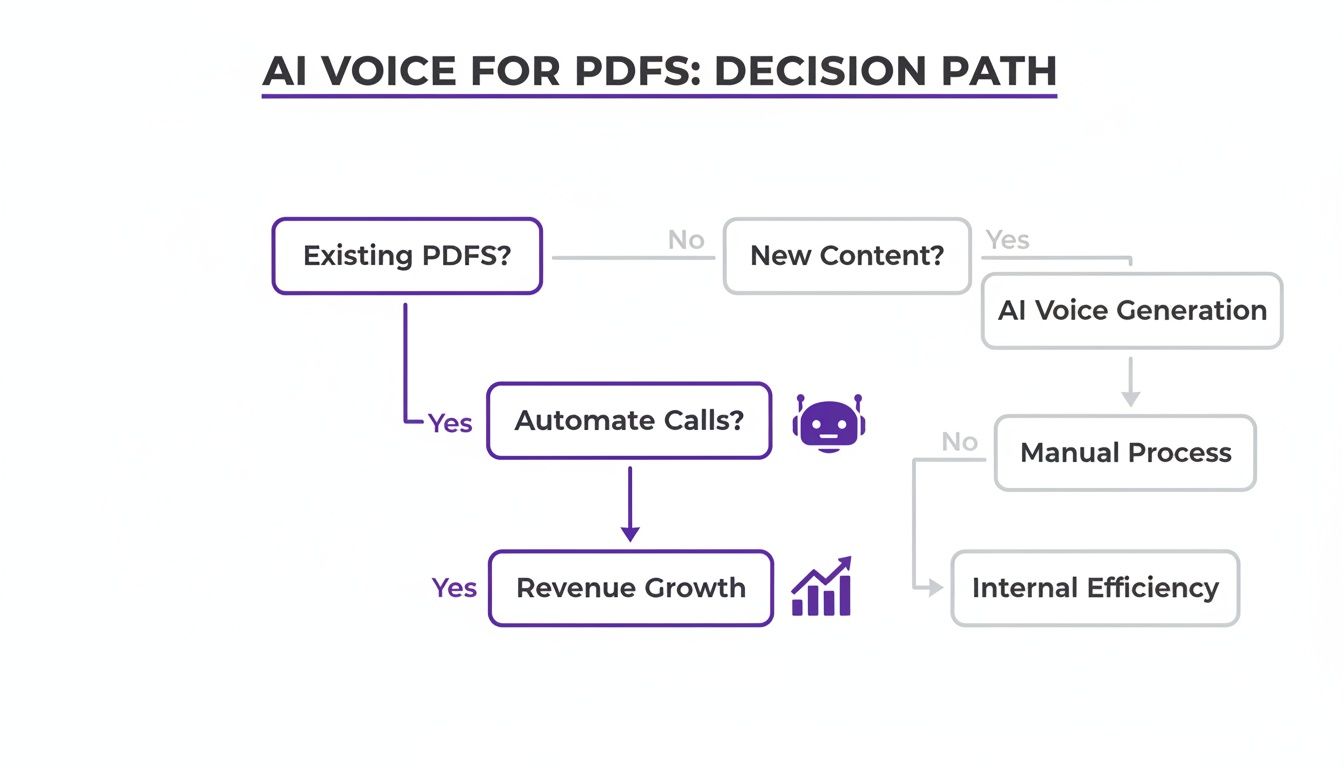
The key takeaway for leadership is that your existing PDF library is not merely an operational cost center—it is the foundational data source for a scalable strategy that can generate new, high-margin revenue.
Building Your Business Case and Calculating ROI
To secure executive sponsorship and budget, your business case must be framed in the language of financial impact. Move beyond qualitative benefits and focus on hard numbers. If a 20-person sales team saves 30 minutes daily, that's 2,400 hours annually. At an average loaded cost of $75/hour, that represents $180,000 in reclaimed productivity from a zero-cost pilot alone.
A powerful business case moves beyond anecdotes and focuses on hard metrics. Frame your ROI in terms of hours saved, a measurable lift in conversions from faster lead follow-ups, or better training completion rates.
This matrix will help guide your technology selection at each phase:
| Consideration | Pilot Phase (Free Tools) | Departmental Phase (Paid Software) | Enterprise Phase (AI Integration) |
|---|---|---|---|
| Scale | Individuals, small teams (10-20 users) | Single department or BU (50-200 users) | Enterprise-wide, customer-facing (unlimited) |
| Task Complexity | Simple document listening | Creating training modules, report analysis | Automated outbound calls, interactive guides |
| Voice Quality | Basic, often robotic-sounding | Natural, with multiple voice options | Human-like, custom branded voices |
| ROI Metric | Hours saved per employee | Reduced training costs, faster project cycles | Increased lead conversion rate, higher LTV |
By mapping your organization's strategic goals against this framework, you can make informed technology investments at each stage. The final, critical component is change management. Clear executive communication and robust training are paramount to ensuring enterprise-wide adoption and realizing the full strategic value of the initiative.
Answering Your Top Questions
When considering the strategic deployment of AI to vocalize business documents, senior leaders consistently raise several key questions. Here are direct, data-driven answers for a CXO audience.
Can TTS Really Handle Complex PDFs with Tables and Images?
It’s a critical question. The answer is that standard, free text-to-speech readers cannot. They are designed for linear text and will fail on complex financial reports, engineering schematics, or data-heavy sales sheets, often reading tables out of order or skipping them entirely. This renders them unsuitable for mission-critical business documents where structure is paramount.
For these high-value, complex documents, an enterprise-grade AI platform is required. These advanced solutions are not just "readers"; they employ computer vision and layout analysis models that can be trained to understand your specific document structures. For instance, our platform can be configured to read a P&L statement correctly, ensuring that revenue, cost, and profit figures are announced logically and accurately, making it reliable for automated audio reporting to your leadership team.
What Is the Real ROI of Using Voice AI for PDFs?
The ROI extends far beyond incremental time savings into direct, measurable impacts on revenue, profitability, and operational efficiency. It's a strategic investment, not a productivity hack.
Consider a real-world B2B scenario: by automating lead qualification calls where an AI discusses product details from a PDF brochure, one of our clients saw their call connection rates surge from 47% to 91% by eliminating manual dialing latency. More importantly, their qualified lead-to-booking rate climbed from 2% to 8%.
The ROI calculation is straightforward: weigh the platform cost against the financial lift from a 4x increase in sales bookings and the thousands of high-cost employee hours reclaimed from repetitive outreach and document review tasks. The payback period is often measured in months, not years.
How Secure Is Using AI to Read Confidential PDFs?
Security is non-negotiable, particularly with sensitive M&A documents, financial data, or intellectual property. Any reputable enterprise Voice AI platform must operate with a defense-in-depth security posture, including end-to-end encryption for data in transit and at rest.
When vetting a vendor, demand proof of their security credentials. Do not proceed without verifying compliance with key international standards:
- ISO 27001 for a certified Information Security Management System (ISMS).
- SOC 2 Type II for audited proof of operational security controls over time.
- GDPR and CCPA compliance for data privacy and residency protocols.
Your confidential PDF content must be processed within a secure, single-tenant environment. It is imperative to confirm the provider's data governance policies to ensure your proprietary information is rigorously protected and is never used to train or improve models for any other client.
How Do I Start a Pilot Programme with No Budget?
You can launch a strategically valuable pilot with zero capital expenditure. The key is to prove the concept on a small, measurable scale to build the business case for a larger investment.
Example Pilot: Task your 15-person field sales team with a specific, month-long mandate: use the free "Read Aloud" feature in their browser to listen to all daily industry news PDFs and internal competitor battle cards during their commutes.
At the end of 30 days, survey the team and quantify the results. Did they save an average of 20 minutes per day? (15 reps x 20 min x 20 workdays = 100 hours reclaimed). Were they better prepared for client meetings? Did this lead to identifying two new cross-sell opportunities? This small-scale, data-backed success story becomes a powerful internal case study, demonstrating tangible value and justifying a formal budget request for more scalable AI tools.
Ready to turn your static documents into assets that actually generate revenue? The DialNexa Voice AI platform helps you automate conversations and accelerate growth. Start building your custom AI agent today.

[…] far more engaging than a droning, robotic reader. This is a big reason people seek out a good PDF reader with text-to-speech capabilities for their […]