
Unlocking Strategic Growth with Cloud Solutions for Call Centers
For senior leadership, moving the call centre to the cloud isn't just another IT project; it's a strategic imperative. This shift is about architecting a competitive advantage that directly impacts revenue, customer lifetime value, and operational agility. It’s the key to unlocking scalable growth in a market where customer expectations are relentlessly rising.
The Executive Case for Cloud Call Centre Transformation
In today's market, running a call centre on legacy, on-premise systems is a strategic liability, akin to a global enterprise relying on a single, physical storefront. This model imposes a hard ceiling on growth, scalability, and the ability to meet customers on their terms. The capital expenditure is immense, the infrastructure is rigid, and the system's inability to adapt to market shifts or enable a distributed workforce directly erodes the bottom line and damages customer satisfaction scores. For example, a retail company on a legacy system might need 3-6 months to scale up for the holiday season, missing crucial revenue opportunities.
Cloud solutions for call centres dismantle these barriers. Instead of being anchored to depreciating hardware and significant upfront capital investment, you adopt a flexible, subscription-based model that scales dynamically with business demand.
Redefining Operational Excellence and Cost Efficiency
At its core, the migration to the cloud is about achieving superior business outcomes. The most immediate impact is the financial model's pivot from unpredictable Capital Expenditure (CapEx) to a manageable, predictable Operational Expenditure (OpEx). This strategic shift eliminates the significant costs of server maintenance, hardware refreshes, and the dedicated IT overhead required just to maintain telephony. For instance, a mid-sized enterprise could see a reduction in TCO (Total Cost of Ownership) by as much as 35% within the first two years of migration.
For C-level executives, the argument isn't about technology for technology's sake. It's about the direct, measurable line from cloud adoption to P&L improvement. It’s about empowering teams with superior tools to elevate the customer experience while engineering a leaner, more resilient operation.
The data corroborates this strategic shift. A staggering 73% of contact centres report superior uptime and business continuity after migrating to the cloud. Simultaneously, 43% realize substantial cost savings due to optimized resource allocation. This isn't theoretical; these are tangible, board-level metrics. You can explore more of these call centre statistics to build your business case.
This move delivers tangible benefits that resonate at the executive level:
- Increased Agility: A financial services firm facing a sudden surge in inquiries due to market volatility can scale from 200 to 500 agents in a matter of minutes, not months, ensuring no customer is left waiting.
- Enhanced Productivity: Agents gain a unified, 360-degree customer view integrated with CRM data, which studies show can boost first-call resolution (FCR) rates by up to 20%.
- Greater Resilience: You leverage enterprise-grade reliability with geo-redundant data centers, guaranteeing service continuity and mitigating revenue loss from downtime.
Ultimately, adopting a cloud solution is a strategic investment in the future-proof architecture of your customer engagement model.
How Modern Cloud Call Centre Architecture Works
To maximize the ROI of a cloud call centre investment, a high-level understanding of the underlying architecture is essential for strategic decision-making. You don't need to be a technologist, but grasping the architectural models allows you to align the solution with long-term business goals.
Consider the analogy of establishing a new corporate headquarters. The approach you choose dictates your level of control, responsibility, and capital outlay.
The first option is Infrastructure as a Service (IaaS). This is analogous to leasing a custom-built, empty corporate campus. The provider supplies the core infrastructure—servers, networking, data centers—but your team is responsible for architecting everything on top, from the operating systems to the application software. This model offers maximum control but requires significant in-house technical expertise.
Then there’s Software as a Service (SaaS), the predominant model for modern contact centers. This is like moving into a fully managed, state-of-the-art office tower. The provider handles everything: the infrastructure, the platform, the software, the updates, and the security. You simply subscribe and operate. For most enterprises, this model offers the fastest time-to-value and the lowest TCO.
The Key Components That Power Performance
Regardless of the model, a modern cloud call centre's performance is driven by core components that directly impact key business metrics. These are not mere features; they are the engines of operational efficiency and customer satisfaction.
- Automated Call Distribution (ACD): This is the strategic core of the system. It intelligently routes interactions to the ideal agent based on skills, language proficiency, customer value, or past history. A well-tuned ACD can reduce average handle time (AHT) by 15-20% and improve customer satisfaction (CSAT) scores by several points.
- Interactive Voice Response (IVR): This is far from the frustrating phone menus of the past. Modern IVRs leverage conversational AI to understand natural language, enabling customers to self-serve for routine tasks like balance inquiries, order tracking, or appointment scheduling. Deploying a conversational IVR can deflect up to 40% of routine calls, freeing up human agents for high-value interactions.
- CRM Integration: This is a non-negotiable for any serious customer-centric organization. Deep, native integration with your CRM provides agents with a complete, real-time view of the customer journey. This single capability can decrease call handle time by 10% and significantly boost first-call resolution.
These components function as a cohesive system, architected to reduce operational costs and enhance productivity, creating a sustainable competitive advantage.
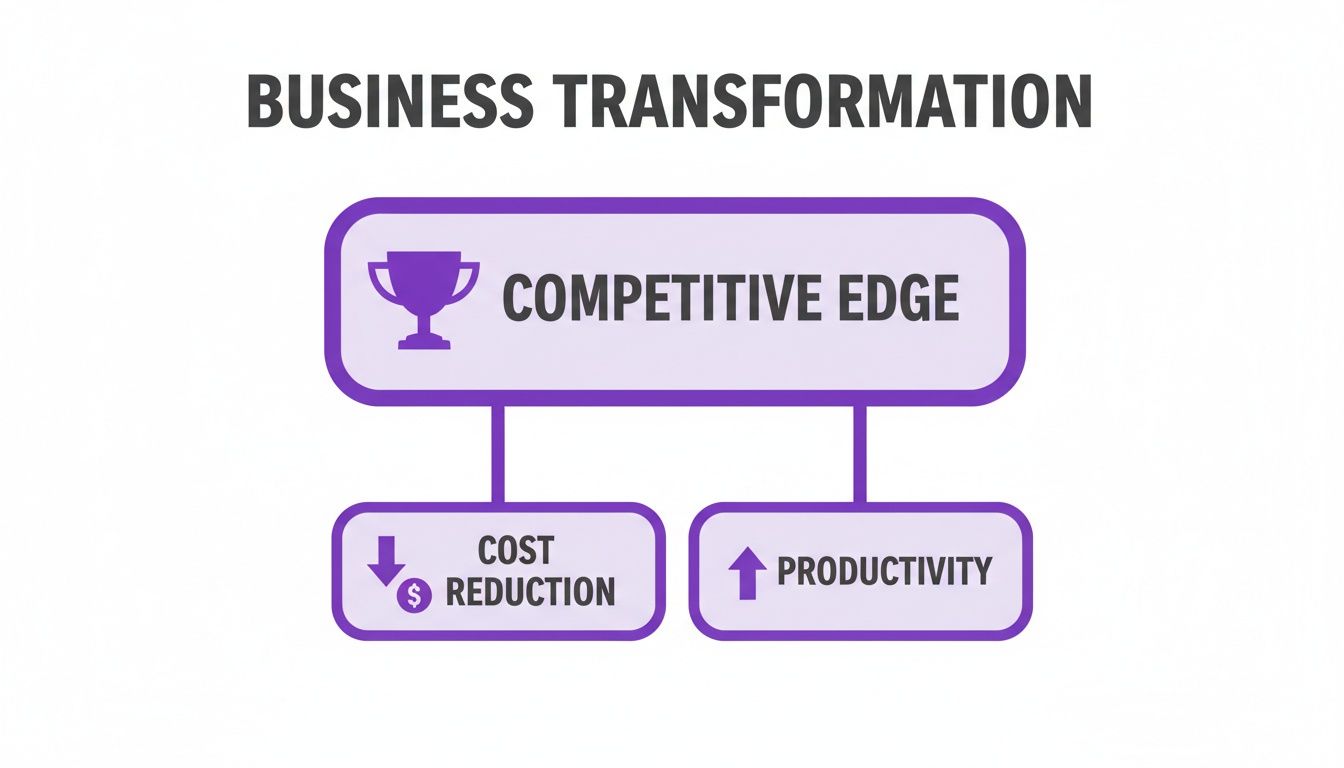
As you can see, a well-designed cloud architecture isn't just a technical upgrade; it's a strategic move that strengthens your entire business.
On-Premise Vs Cloud Call Centers A Strategic Comparison
For leaders evaluating this critical migration, a direct comparison of the business impact is essential. This table frames the differences from a strategic, board-level perspective, clarifying why the cloud has become the default architecture for modern customer engagement hubs.
| Business Aspect | On-Premise Solution | Cloud-Based Solution |
|---|---|---|
| Initial Investment | High upfront capital expenditure (CapEx) on hardware, software licenses, and facilities, impacting cash flow. | Low-to-zero upfront costs; predictable monthly OpEx model improves financial planning and agility. |
| Scalability | Rigid and slow. Scaling requires hardware procurement cycles of 3-6 months. | Elastic and instant. Scale from 500 to 5,000 agents in minutes to meet peak demand. |
| Maintenance & Upgrades | Managed entirely by an in-house IT team, incurring ongoing salary and operational costs. | Handled by the provider; updates are automatic, ensuring access to the latest innovation without additional cost. |
| Agent Flexibility | Agents must be physically located in the office, limiting the talent pool to a specific geography. | Enables a global, remote, or hybrid workforce, widening the talent pool and reducing real estate costs. |
| Data & Analytics | Limited to basic call logs; advanced analytics require separate, costly BI investments. | Rich, real-time dashboards and advanced analytics are built-in, enabling data-driven decision-making. |
| Business Continuity | Vulnerable to local outages (power, internet) with complex and expensive disaster recovery plans. | High uptime (99.99%+) SLAs with built-in geo-redundancy across multiple data centres. |
Ultimately, the comparison reveals a fundamental shift. On-premise solutions lock capital and strategy into a fixed-cost, high-maintenance model, while cloud solutions offer the agility, cost-efficiency, and resilience required to win in today's dynamic market.
Building a Foundation for Growth
This move to the cloud is happening in a booming market. The Indian cloud computing sector is set to hit USD 266.90 billion by 2034. Right now, IaaS models hold a 38.1% market share as businesses look for flexible resources without the massive upfront cost. By adopting a cloud contact centre, you're positioning your business to ride this wave of growth.
The real strategic value of cloud architecture is its adaptability. You're no longer constrained by physical servers. A large e-commerce platform can scale from 500 agents to 2,500 to handle a holiday rush, then scale back down, paying only for the peak capacity used. For leaders serious about building a truly resilient and scalable operation, understanding cloud native architecture is a great next step.
Driving Measurable Business Growth and ROI
Migrating your call centre to the cloud is a strategic investment with a clear and compelling ROI. The business case is built on four pillars, each directly impacting operational efficiency, customer satisfaction, and bottom-line financial performance. This is about transforming a traditional cost centre into a lean, responsive engine for customer engagement and revenue generation.

The switch to a cloud model fundamentally changes your financial landscape. You’re no longer dealing with huge, unpredictable capital investments. Instead, you move to a stable, predictable operational cost, which provides both immediate financial breathing room and a long-term strategic edge.
Pillar 1: Cost Optimisation
The most immediate return is the elimination of expensive on-premise hardware and associated maintenance. By shifting from a Capital Expenditure (CapEx) to an Operational Expenditure (OpEx) model, enterprises typically reduce their total IT overhead by 25-40%. For a 500-seat call center, this can translate to millions in savings over a five-year period.
The savings are multifaceted:
- Hardware Procurement: Zero investment in servers, PBX hardware, or physical handsets.
- Maintenance Contracts: The provider manages all system upkeep, security patching, and software upgrades, eliminating costly annual contracts.
- IT Personnel: Frees up high-value internal IT resources from telephony maintenance to focus on strategic, revenue-generating initiatives.
This lean financial model enhances budget predictability and allows capital to be redeployed for growth initiatives rather than infrastructure maintenance.
Pillar 2: Unmatched Scalability
Imagine a B2C company launching a major marketing campaign. With a legacy system, handling a sudden 300% surge in call volume is impossible without massive over-provisioning and capital investment. With a cloud solution, this challenge becomes a trivial operational adjustment.
A key benefit of cloud solutions for call centres is elastic scalability. You can seamlessly scale from 100 to 1,000 agents during peak season with zero hardware lead time, and then scale back down just as easily. This agility is a powerful competitive differentiator, impossible to achieve with on-premise systems.
This ensures you capture every revenue opportunity and protect brand reputation during critical high-volume periods.
Pillar 3: Enhanced Agent Performance
A cloud platform enables flexible workforce models, unlocking significant productivity gains. By supporting remote and hybrid teams, you expand your talent pool globally and improve operational metrics. Businesses that embrace this model often see agent utilisation improve by as much as 30% and attrition rates drop by 15%.
This performance uplift is driven by:
- Workforce Flexibility: Agents can operate securely from any location, reducing absenteeism and improving work-life balance, which directly impacts retention.
- Unified Desktop: A single, intuitive interface integrates all communication channels and CRM data, reducing cognitive load and saving an average of 30-60 seconds per interaction.
- Reduced Idle Time: Intelligent, AI-powered routing and predictive dialers ensure agents are consistently engaged in productive activities, maximizing their contribution.
Ultimately, a more efficient agent is a more effective agent, directly contributing to both cost savings and revenue generation.
Pillar 4: Superior Customer Experience
Every investment in your contact centre must ultimately elevate the customer experience. Cloud solutions excel by leveraging data and integrations to create seamless, personalized interactions. By integrating your cloud platform with your CRM, an agent gets an instant, contextual view of a customer's history, which can reduce average handle time by 15-25%.
This efficiency translates directly into higher customer satisfaction (CSAT) and Net Promoter Scores (NPS). Faster, more informed resolutions reduce customer effort and build brand loyalty. When agents can solve problems on the first contact, you not only improve operational metrics but also cultivate profitable, long-term customer relationships.
Where Cloud Call Centres Make a Real-World Impact
The theoretical benefits of a cloud call centre are compelling, but its true value is realized in solving specific, high-stakes business challenges. The technology's strength lies in its adaptability to the unique pressures and workflows of different industries. For senior leaders, understanding these practical applications provides a direct line of sight from technology investment to improved financial performance, stricter compliance, and enhanced customer loyalty.
Let's examine how these solutions are delivering quantifiable results in some of the most demanding sectors.
For Financial Services and BFSI, It's All About Trust
In the banking, financial services, and insurance (BFSI) sector, security and compliance are paramount. Enterprise-grade cloud platforms provide hardened, certified environments essential for sensitive operations like payment processing, identity verification, and fraud detection.
Consider Know Your Customer (KYC) verification—a critical but often slow and costly process.
- The Problem: High operational costs and significant compliance risk associated with manual KYC checks, leading to slow customer onboarding and potential regulatory penalties.
- The Cloud Solution: Deploying AI-powered voice agents on a secure cloud platform to automate initial KYC interactions. These agents collect and verify information against databases in real-time, escalating only complex exceptions to human specialists.
- The Measurable Outcome: This automation can reduce manual KYC processing effort by up to 60% and cut onboarding time from days to minutes. The result is accelerated customer acquisition and a consistent, auditable compliance trail. To see how this works in practice, you can learn more about how AI is transforming contact centres in financial services.
This secure automation, coupled with PCI-DSS compliant environments, enables financial institutions to innovate without compromising regulatory obligations.
Helping Education Technology Scale with Demand
The EdTech sector is characterized by extreme seasonal demand cycles, particularly during admissions periods. A traditional on-premise system cannot elastically scale to handle the massive influx of inquiries, resulting in lost admission opportunities and a poor initial experience for prospective students.
In EdTech, a missed call is a lost admission. Cloud solutions offer the elasticity to handle these massive peaks in enquiries without breaking a sweat, turning a high-stress period into a strategic enrolment advantage.
Let's analyze the admissions funnel impact:
- The Problem: A low lead-to-enrolment conversion rate because admissions teams are overwhelmed by thousands of simultaneous inquiries, leading to long hold times and high abandonment rates.
- The Cloud Solution: Implementing a scalable cloud contact centre that uses AI voicebots for initial lead qualification. The bots handle common questions, confirm eligibility, and schedule appointments directly into counsellors' calendars.
- The Measurable Outcome: By automating the top of the funnel, EdTech platforms have increased their lead-to-enrolment rates from a typical 2% to as high as 8%—a 4X improvement in conversion that directly drives top-line revenue.
Converting Leads in the Fast-Paced Real Estate Market
In real estate, speed-to-lead is the single most important factor in conversion. A prospective buyer expects an immediate response. Cloud solutions, particularly those augmented with intelligent AI agents, are revolutionizing lead engagement.
- The Problem: Abysmal connection rates with potential buyers. Human agents are often busy, and calls are made at inconvenient times, resulting in an industry-average connection rate of just 47%.
- The Cloud Solution: Deploying AI agents to handle outbound follow-up and appointment scheduling 24/7. These agents can respond to a web inquiry within seconds, engage in a natural conversation, and book a property viewing without human intervention.
- The Measurable Outcome: This persistent, automated outreach has achieved a 91% connection rate—nearly double the industry standard—ensuring no high-intent lead is ever lost.
These are not isolated anecdotes. They reflect a market-wide trend, with India's cloud-based contact centre market hitting USD 27.1 billion in 2023. This growth is driven by the strategic need for more agile, intelligent, and data-driven customer service platforms, though successful adoption requires careful navigation of data security and infrastructure planning.
Integrating Voice AI for a Competitive Advantage
A solid cloud foundation is the prerequisite for modernizing your contact centre, but the true competitive differentiator is the integration of intelligent Voice AI.
This transcends simple IVR replacement. We are talking about deploying human-like AI agents capable of autonomously handling complex, end-to-end conversations. This strategic automation frees your most valuable human talent to focus exclusively on high-stakes, revenue-generating interactions.
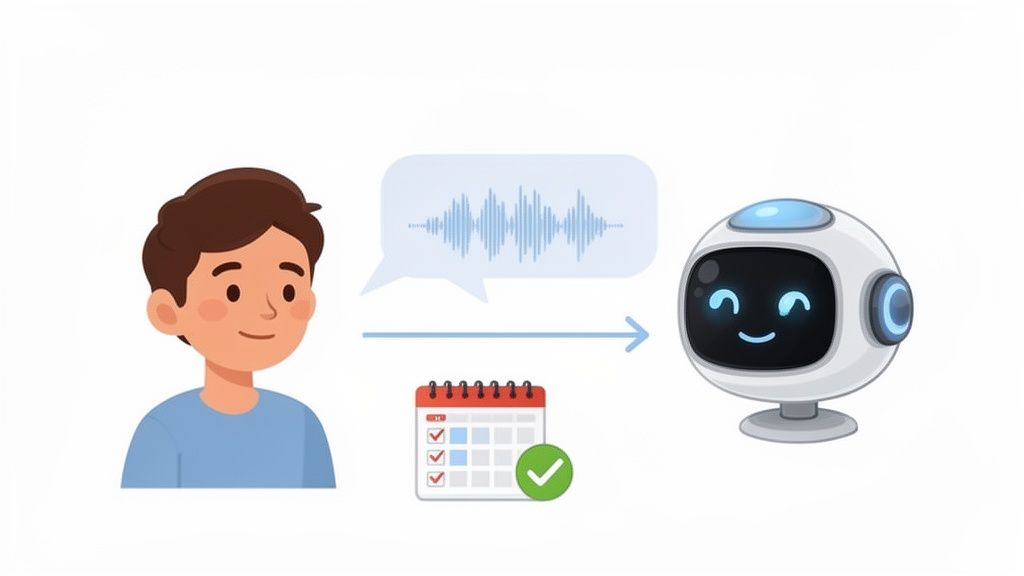
Today's advanced Voice AI can manage tasks previously thought to be the exclusive domain of senior human agents, such as pre-sales qualification, complex technical support triage, and even initial recruitment screening.
Imagine an AI agent conducting a natural, multi-turn conversation with a C-level executive prospect. It understands their business needs, qualifies their budget, and schedules a demo directly onto a senior sales director's calendar. This is happening today with 97% accuracy, performing on par with experienced human sales development representatives.
From Cost Centre to Revenue Engine
This level of automation fundamentally transforms the strategic role of the contact centre. By automating high-volume, repetitive tasks, the focus shifts from cost containment to revenue acceleration. Your most skilled agents are no longer mired in routine inquiries.
Instead, they are redeployed to high-value activities:
- Closing complex deals: Engaging with high-value, pre-qualified leads delivered by AI agents.
- Managing critical escalations: Providing expert, empathetic support for high-value customers with complex issues, preventing churn.
- Building customer relationships: Proactively focusing on customer retention, upselling, and cross-selling opportunities identified through data analysis.
This strategic reallocation of human capital has a direct and significant impact on the P&L. You achieve greater operational efficiency by increasing contact handling capacity without increasing headcount, while simultaneously accelerating revenue growth by focusing human talent on conversion and retention.
By automating the top of the sales funnel, organisations can see a massive jump in conversion rates. We have seen businesses increase their lead-to-booking rates from a standard 2% to as high as 8% just by using AI agents for that initial qualification and scheduling.
Real-World AI Deployments
The power of Voice AI within cloud solutions for call centers is best illustrated through practical application. In the real estate sector, AI agents follow up on web inquiries in under 60 seconds, achieving a connection rate of 91%, nearly double the human-agent average of 47%. This ensures maximum lead capture.
Similarly, in financial services, AI agents can handle initial KYC verification or guide new users through complex platform onboarding, ensuring 100% compliance and a seamless customer experience. These agents operate 24/7, delivering a consistent, on-brand interaction every time. To fully grasp the potential, understanding how AI voice agents are transforming customer service and sales provides a clear strategic roadmap.
By integrating Voice AI, you are not merely optimizing a call centre. You are architecting an intelligent, scalable engine for customer engagement that drives sustainable business growth and creates a formidable competitive barrier.
Selecting The Right Cloud Partner For Your Business
Choosing a provider for your cloud call centre is not a procurement decision; it is the formation of a long-term strategic partnership. The right partner becomes an extension of your team, a catalyst for innovation and growth. The wrong one becomes a source of operational friction and strategic limitation.
A rigorous evaluation process must extend beyond marketing claims and feature checklists to the core capabilities that underpin business success.
This requires a serious assessment of a provider’s foundational abilities. Leaders must ask probing questions and demand empirical evidence of performance and reliability.
Evaluating Core Capabilities
Your evaluation must be built on four non-negotiable pillars that determine a partner's ability to meet your needs today and scale with your ambitions for tomorrow.
First, demand proven scalability and reliability. Do not accept vague assurances. Require a service-level agreement (SLA) that contractually guarantees 99.99% uptime or higher. Ask for referenceable case studies from companies of a similar scale. How did their platform perform during a client's Black Friday sale or a sudden service outage event? A top-tier partner will readily provide evidence of their platform's resilience under extreme pressure.
Next, conduct a thorough audit of their security and compliance posture. Customer data is a critical asset, and its protection is non-negotiable. Verify certifications like ISO 27001 and SOC 2 Type II. For regulated industries, specific compliance is mandatory: HIPAA for healthcare, PCI-DSS Level 1 for payment processing. A deeper understanding of best practices for secure cloud adoption is crucial.
Assessing Strategic Fit
Once technical fundamentals are verified, the focus must shift to strategic alignment. A technologically advanced platform is useless if it operates in a data silo or requires cumbersome workarounds from your team.
Critically examine their deep integration capabilities. How seamlessly does the platform integrate with your core business systems, particularly your CRM and business intelligence (BI) tools? Look for a provider with a robust API and a comprehensive library of pre-built connectors. This ensures a frictionless flow of data, empowering your agents with a true 360-degree customer view.
Finally, analyze their pricing model for transparency and value. The best partners offer value-based pricing that aligns with your business metrics. Beware of complex, opaque fee structures. You need a clear, predictable model that allows you to scale costs in direct proportion to your business activity.
The objective is to find a provider whose technology and business model are architected to support your strategic goals, not force you to conform to their platform's limitations. This alignment is the hallmark of a true strategic partnership.
As you prepare to make this critical decision, leveraging resources like a guide to the Top 12 VoIP Providers for Call Centers can provide valuable comparative insights. By focusing on these strategic pillars, you can confidently select a partner who will be a catalyst for building a more agile, efficient, and customer-centric enterprise.
Frequently Asked Questions
When considering a foundational shift in your customer communications architecture, senior leaders will naturally have questions focused on risk, implementation, and integration. This section provides direct, executive-level answers to the most common concerns, enabling informed and confident decision-making.
How Secure Is Our Customer Data in a Cloud Call Centre?
This is the paramount concern for any executive. Leading cloud providers deliver a level of security that is prohibitively expensive and complex for most organizations to replicate in-house. They invest hundreds of millions in multi-layered physical and cybersecurity protocols, which are subject to continuous, independent audits.
Look for a provider that can demonstrate compliance with key global standards as a baseline:
- SOC 2 Type II: This report validates the effectiveness of their security controls over time.
- ISO 27001: The international gold standard for information security management.
- GDPR, CCPA & Regional Laws: Ensures strict adherence to data privacy and residency regulations.
During due diligence, demand to see these certifications and query their data encryption policies, both in transit and at rest. This ensures your data is not only secure but also compliant with all relevant regulatory frameworks.
What Is a Realistic Timeline for Migrating to the Cloud?
A key strategic advantage of cloud solutions is the dramatically accelerated time-to-value compared to on-premise deployments, which can take 6-12 months.
For a small to mid-sized organization, a full migration can often be completed in 2-4 weeks. For a large enterprise with complex integrations and multi-site operations, a phased rollout over 6-12 weeks is a realistic timeline. The speed is possible because there is no physical hardware procurement, installation, or configuration. A best practice is to launch a pilot program with a single department to refine workflows before a full-scale deployment.
The core benefit here is accelerated value. Your teams can start leveraging advanced features like intelligent call routing and AI-powered analytics in a fraction of the time, directly impacting performance metrics from day one.
How Will a Cloud Solution Integrate With Our Existing CRM?
Modern cloud contact centre platforms are designed as open, integration-first ecosystems. They are built to seamlessly connect with the systems of record that run your business. Leading providers offer extensive libraries of pre-built, turnkey connectors for major CRMs like Salesforce, Zoho, and HubSpot, as well as robust, well-documented APIs for custom integrations.
This deep integration creates a unified agent desktop, presenting a 360-degree view of the customer. The business impact is immediate and measurable. Access to complete customer context within a single interface typically improves first-call resolution rates by an average of 15-20% and reduces average handle time by a similar margin, driving both customer satisfaction and operational efficiency.
Ready to transform your customer communications with an intelligent, scalable solution? Discover how DialNexa's human-like Voice AI agents can automate routine calls, accelerate lead qualification, and free your team to focus on high-value conversations. Explore DialNexa today.

This is an excellent analysis of how cloud call centres and Voice AI are transforming customer engagement from a cost centre into a growth engine. The practical examples, ROI metrics, and strategic insights make a compelling case for modern, scalable customer service operations.