
Master Your Cold Calling Script: CXO Guide for 2026
A cold calling script stops being a rep aid the moment you scale outbound. It becomes an operating asset. That matters because current benchmarks are tight. One 2025 benchmark roundup reports an average B2B cold-calling success rate of 6.7%, up from 2% in 2023, while another found an average conversion rate of 2.3% across more than 200,000 calls in the same research set (Martal cold call statistics). At that level, small script flaws don't create small losses. They leak pipeline, inflate acquisition cost, and waste paid traffic, SDR time, and manager coaching cycles.
Senior teams usually diagnose outbound problems in the wrong order. They look at rep effort, dial volume, and tooling first. The script often gets treated as copy. In practice, the script governs whether the prospect stays on the line, whether compliance risk is contained, whether qualification happens quickly enough, and whether the next step is asked for cleanly.
In India, the stakes are even higher. The telecom environment has pushed outbound teams towards concise, transparent, consent-aware calling. A script that sounds aggressive, vague, or evasive doesn't just underperform. It can damage trust before discovery begins.
Table of Contents
- Deconstructing the High-Performance Cold Calling Script
- Tailoring Your Script for Industry and Indian Compliance
- Building Proactive Objection Handling into Your Script
- Your Data-Driven Script Optimisation Loop
- Scaling Your Perfected Script with Voice AI Agents
Deconstructing the High-Performance Cold Calling Script
A high-performing cold calling script is less like a speech and more like a decision tree. Its job isn't to impress. Its job is to move a stranger through four moments with minimal friction: attention, relevance, qualification, and commitment.
Treat the script as system design
Top-performing cold calls are typically 3–5 minutes long, and engagement drops sharply after that window (Cognism on cold calling success rates). That single fact changes how the entire script should be built. Long introductions, broad company narratives, and feature dumps are structural mistakes, not style issues.
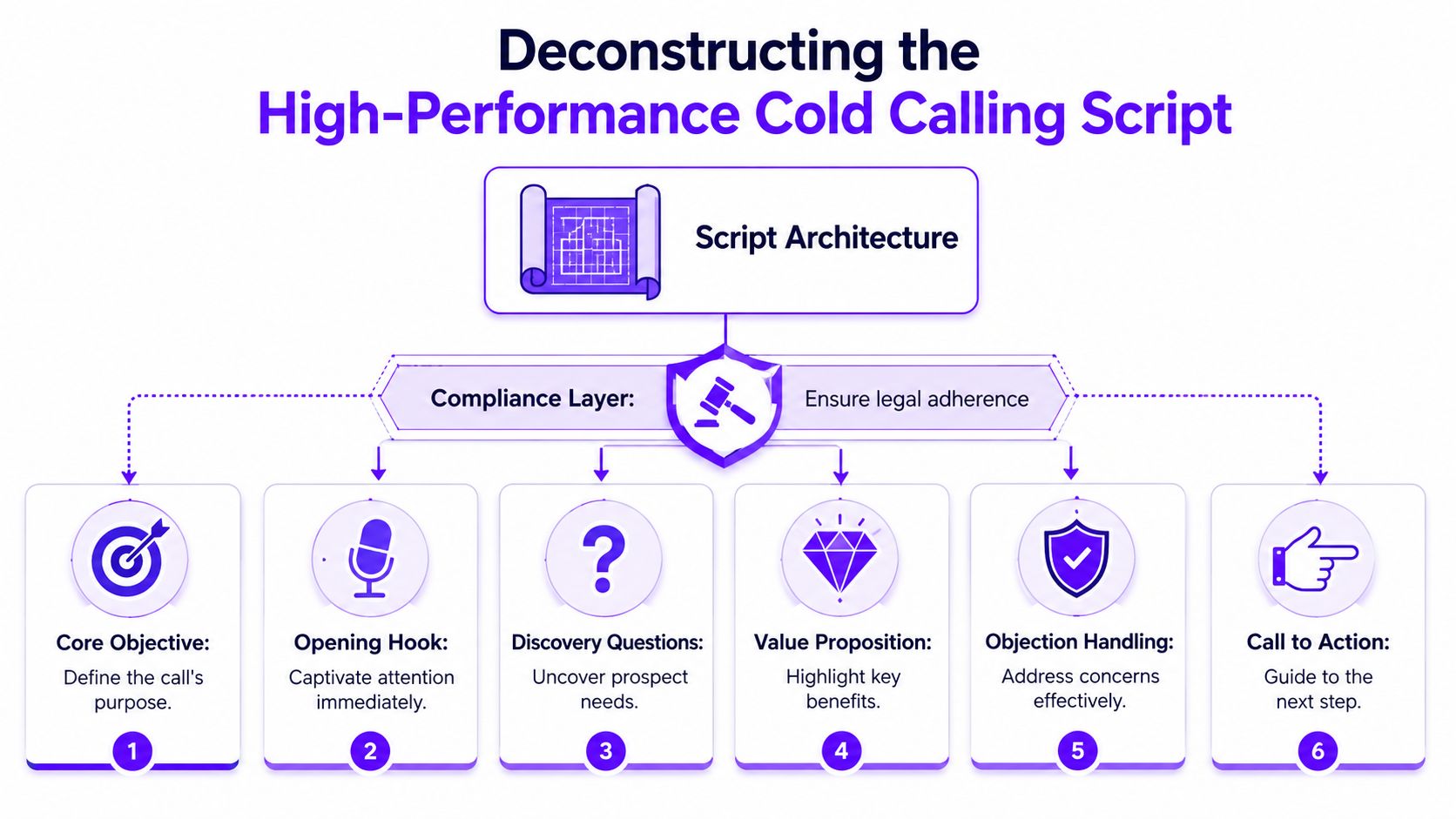
If you manage outbound across business units, evaluate the script the same way you'd evaluate a funnel page or product journey.
- Opening design: Does it earn another few seconds without sounding deceptive?
- Relevance statement: Does it tie to a likely operational or revenue problem?
- Discovery flow: Does it quickly expose fit, timing, and current process?
- CTA design: Does it ask for a realistic next step instead of an oversized commitment?
Practical rule: If a rep needs too many words to explain why they're calling, the offer isn't clear enough yet.
A useful contrast appears when you compare generic property prospecting lines with more targeted patterns in resources such as Saleswise real estate cold calling. The better examples don't rely on hype. They anchor the call in a specific ownership situation, then move fast to qualification.
For teams that also handle inbound handoffs, the same architecture should align with your inbound call script design, otherwise leads experience one voice on acquisition and a different one on follow-up.
The four parts that decide outcomes
1. Permission-based opener
A strong opener doesn't “pitch”. It lowers resistance. In practice, that means identifying yourself, naming the purpose briefly, and making the next few seconds feel manageable.
Example:
“Hello Mr Mehta, this is Rohan calling from Apex Learning. I'm calling about executive certification enrolments. Is now a bad time for a brief question?”
That works better than:
“Hello sir, I hope you're doing well today, I'm from Apex and we are a leading platform offering industry-relevant programmes for ambitious professionals…”
The first version respects attention. The second spends attention.
2. High-relevance value proposition
The value proposition should point to a business issue the prospect likely owns. Not your product category. Not your company history.
Examples:
- For SaaS: “We help sales teams shorten lead qualification before demos are booked.”
- For real estate: “We help developers turn enquiry volume into site visits with structured calling.”
- For EdTech: “We help counselling teams qualify intent before counsellors spend time on low-fit leads.”
3. Strategic qualifying questions
Qualification has to do two jobs at once. It should reveal fit, and it should make the conversation feel personalized.
Useful questions are narrow:
- “How are you handling this today?”
- “Who owns this process internally?”
- “Is the issue volume, speed, or conversion quality?”
- “Are you evaluating change now, or just mapping options?”
Weak questions are broad:
- “Can you tell me about your business?”
- “What challenges are you facing overall?”
4. Low-friction call to action
The CTA should match the temperature of the conversation. A cold call should usually earn a next conversation, not force a decision.
Examples:
- “Would it make sense to schedule a short review with your admissions lead?”
- “Can we put fifteen minutes on the calendar with the sales ops owner?”
- “If this is relevant, should I send two time options for a walkthrough?”
The script should sound like a controlled conversation, not a recital. Reps who cling to wording instead of intent usually miss the moment when the buyer is ready to move.
Tailoring Your Script for Industry and Indian Compliance
Generic scripts fail for a simple reason. They assume every buyer evaluates risk, urgency, and trust in the same way. They don't.
What changes by industry
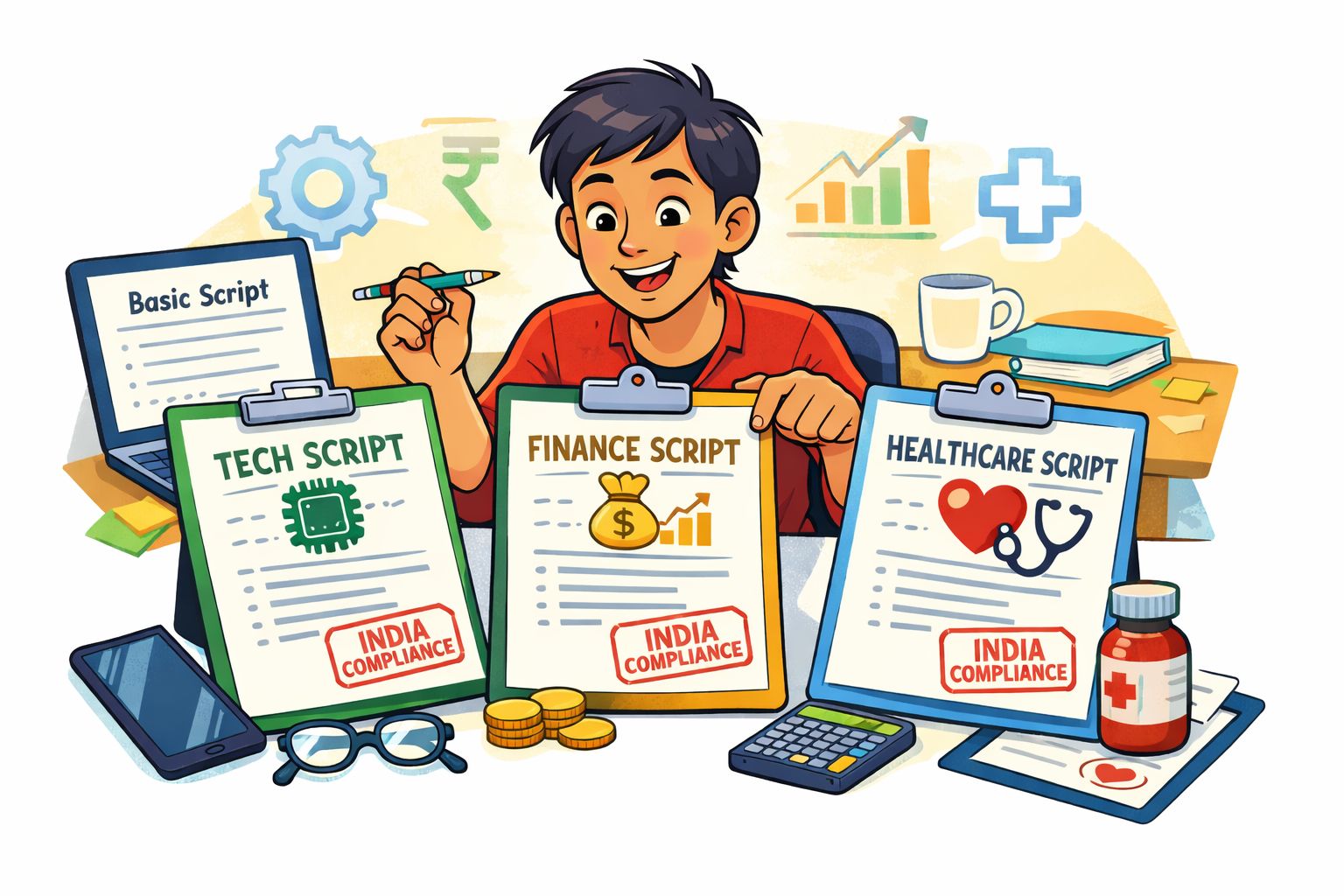
In Indian outbound, the market context often matters as much as the wording. Non-English users make up the majority of internet users in India, and that creates a practical need for regional-language and mobile-first follow-up design, especially in sectors like EdTech, real estate, BFSI, and healthcare (The Sales Blog discussion referencing the vernacular gap). A script that works in polished English for metro B2B buyers may stall with consumers who'd rather continue over SMS or WhatsApp in a local language.
EdTech
EdTech scripts should quickly establish programme relevance, learner profile, and timing. Buyers often need clarity on suitability before they need detail. The fastest path is to ask what outcome they're pursuing and whether the programme is for career transition, promotion, certification, or academic progression.
A poor EdTech opener leads with accreditation language and catalogue depth. A better one says:
“Calling from Northstar Executive Programmes. I'm reaching out because you'd shown interest in career advancement options. Are you exploring for immediate enrolment or comparing programmes first?”
Real estate
Real estate outbound lives or dies on local context. The opener should refer to area, project type, ownership status, or enquiry category. Discovery should clarify purchase intent, timeline, and whether the buyer is an investor, end-user, or seller. That opening context is only as strong as the underlying real estate calling data feeding the dialer, since a sharp script can’t compensate for a stale or mismatched lead record.
For teams trying to improve answer quality before the pitch begins, a cleaner front-end call flow often matters more than adding persuasion. That same principle applies to improving pick-up and early-call engagement, where the first seconds determine whether you even reach discovery.
BFSI
BFSI scripts need a stricter trust frame. The prospect must know who is calling, why, and what will not happen on the call. You should avoid language that creates pressure or sounds like unverifiable financial advice.
A stronger BFSI opener:
“Good afternoon, this is Ananya calling from Crest Financial Services regarding business lending solutions. This is an informational call. If this isn't relevant, I can mark your preference accordingly.”
That line does three things. It identifies the caller, frames the purpose, and lowers defensive tension.
What Indian compliance changes in the script
India's cold-calling environment isn't just a sales issue. It is shaped by telecom rules. TRAI introduced the National Customer Preference Register in 2010, and the Telecom Commercial Communications Customer Preference Regulations, 2018 tightened rules around telemarketing and consent-based outreach (Instantly on Indian cold calling compliance).
That means your cold calling script must include compliance as part of the wording, not as a legal note somewhere else.
A compliant Indian script should account for:
- Clear identification: State the caller's name and company immediately.
- Business purpose: Explain why the call is being made in one sentence.
- Consent-aware progression: Ask whether the person is open to continuing.
- Opt-out handling: Offer a straightforward way to decline or stop future outreach.
- Escalation language: Give the rep a safe path when a prospect questions legitimacy.
Most published templates miss this. They optimise persuasion but ignore telecom enforcement realities. In India, that's a design flaw.
A compliant script often converts better because it sounds legitimate. Buyers don't reward cleverness when they suspect the call itself may be unwanted.
A practical compliant opener might read:
“Hello Ms Rao, this is Vivek from Sterling Capital. I'm calling regarding our working-capital advisory services. If you'd prefer not to receive calls like this, please let me know and I'll update that immediately. May I take thirty seconds to explain why I called?”
That language is not accidental. It protects the organisation, signals legitimacy, and gives the prospect control. For Indian boards reviewing outbound risk, that is what sustainable script design looks like.
Building Proactive Objection Handling into Your Script
Reps are commonly taught rebuttals. Better teams redesign the script so fewer objections appear in the first place.
Most objections start upstream
When a prospect says “I'm not interested”, that usually doesn't mean they completed a balanced evaluation and rejected your offer. It usually means the opening gave them no reason to continue. “Send me an email” often means the value proposition was too vague. “We already have a solution” often means the caller framed the offer as a replacement instead of an improvement.
That distinction matters because reactive coaching focuses on the moment of resistance. Proactive design fixes the sentence that caused it.
Here's the simplest way to look at it.
| Common Objection | Likely Script Weakness | Strategic Script Response |
|---|---|---|
| I'm not interested | The opener is generic and sounds interchangeable | Lead with a relevant business reason for the call, not a company introduction |
| I don't have time | The rep didn't set scope or duration early | Ask for permission and signal a brief, specific purpose |
| Send me an email | The value proposition is too abstract | Clarify one concrete issue you help solve before agreeing on follow-up |
| We already have a solution | The script assumes rip-and-replace | Position the call around gaps, process friction, or evaluation rather than replacement |
| Call me later | The timing ask is weak or undefined | Propose a specific next step and confirm what should be discussed then |
| We're not the right person | Qualification came too late | Identify role relevance early and ask who owns the process if needed |
Design the response before the objection appears
A practical objection-resistant cold calling script usually includes four design choices.
Time containment early
If the prospect thinks the call will drift, they'll try to end it fast. Say what the next moments are for.Narrow relevance instead of broad benefit
“We improve efficiency” is easy to dismiss. “We help admissions teams qualify applicants before counsellor follow-up” is harder to ignore if that problem exists.Inline objection pre-emption
Mention common resistance points before they surface. For example:
“This may not be a fit if your team already has qualification tightly handled, but I wanted to check because many teams still lose time on manual first-response calls.”Specific next-step framing
Don't ask “Would you like a demo?” too early. Ask for the smallest logical commitment.
Consider the common “send me details” brush-off. Many reps hear it as mild interest. Usually it is a request to exit politely. The script should respond by narrowing the ask:
“Happy to send something over. So I send the right thing, are you looking at this because your team needs better lead qualification, or is this more about follow-up speed?”
That keeps the conversation alive without sounding combative.
If the same objection appears repeatedly across the team, stop coaching individuals first. Audit the script.
There is also a burnout issue here. Reps who spend all day fighting avoidable objections become mechanical. Managers then hear flatter delivery, lower energy, and weaker curiosity. The usual response is more role-play. Often the better fix is simpler. Rewrite the opening, shorten the value proposition, and tighten the transition to discovery.
For leadership, proactive objection handling does two board-level things. It makes performance more predictable, and it reduces the cost of ramping new callers. A script that absorbs common resistance in its structure creates less variance across the floor.
Your Data-Driven Script Optimisation Loop
Most script debates are still driven by opinion. The loudest manager likes one opening. The most experienced rep prefers another. Nobody isolates variables, so nobody knows what caused the result.
What to test and what to freeze
A disciplined script optimisation loop should be run as a controlled A/B test. Define one outcome metric, change only one variable per variant, and keep the rep, list quality, and time of day constant so the result is interpretable (SalesHive on A/B testing cold calling scripts).
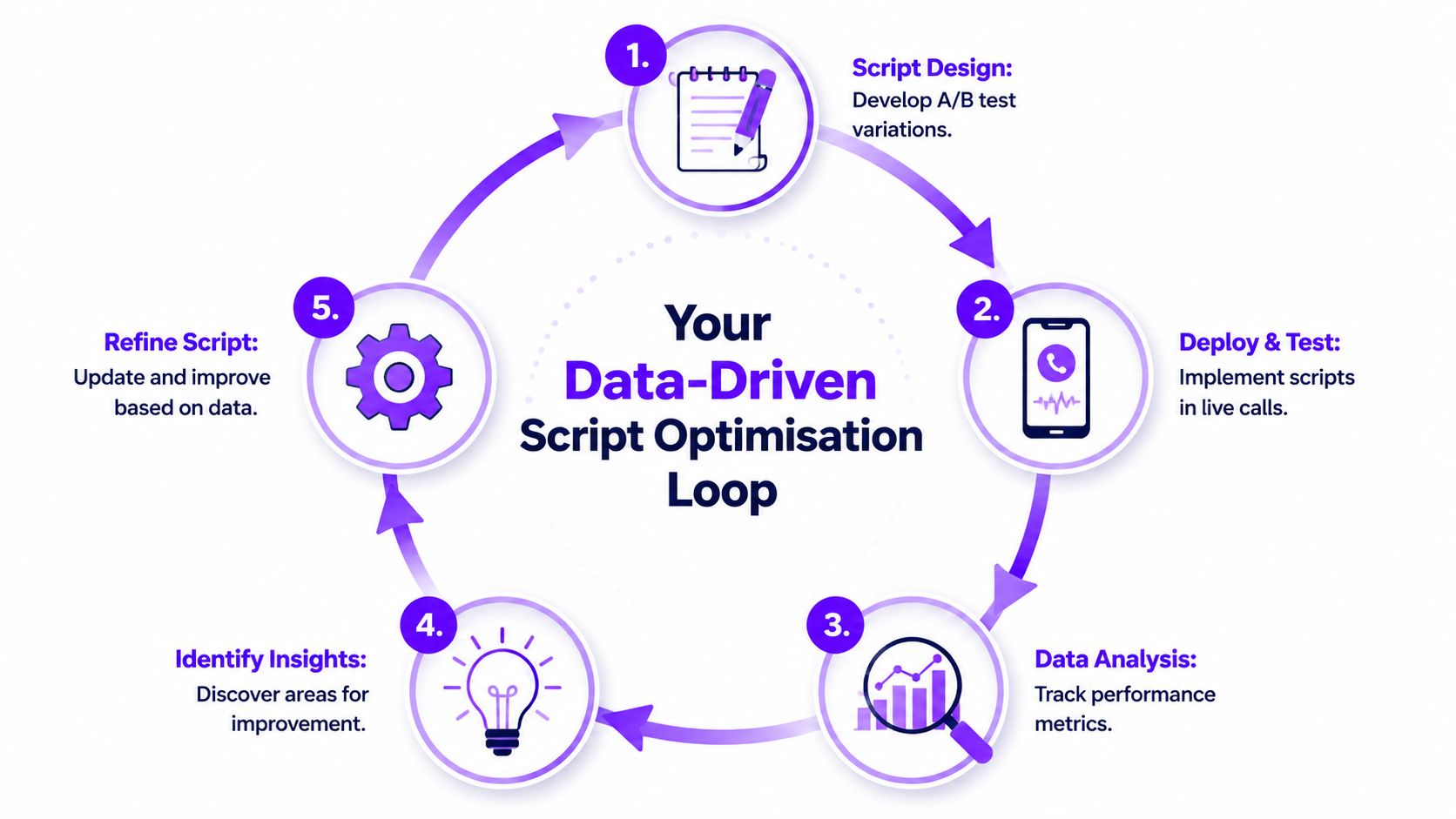
The practical threshold is to review about 50–100 live conversations per variant before naming a winner, and the same research notes that only about 24% of scripts are considered effective (SalesHive A/B testing guidance). That should reassure leaders that poor first drafts are normal. What matters is whether the team has an optimisation discipline.
Useful variables to test one at a time include:
- Opener phrasing: permission-based versus direct-problem opening
- Value proposition wording: KPI-led versus role-led relevance
- Question sequence: qualification first versus current-process first
- CTA language: meeting ask versus review ask
- Objection handling line: email-response branch A versus branch B
A simple operating mistake is testing two changes at once. If you alter both opener and CTA, any result is muddy.
A practical walk-through helps. If your team believes call length is too short because reps are being brushed off, test only the first sentence. Keep the same rep, same list segment, same call window, and same offer. Then compare continuation into discovery.
This video gives a useful visual primer on optimisation thinking before teams formalise the process.
How leaders should read script data
The script should be judged by stage progression, not just outcomes at the end of the funnel.
Track signals like:
- Introduction-to-conversation rate
- Conversation-to-discovery progression
- First objection category
- Meeting booked or qualified next step
- Call recording patterns by script branch
- CRM outcome tags linked to exact opener variant
The cleanest review ritual combines three inputs:
| Review input | What it tells you | What to do with it |
|---|---|---|
| CRM outcome tags | Whether the script moves prospects to the next stage | Remove variants that create activity but not progression |
| Call recordings | Where tone, pacing, or wording breaks | Rewrite awkward phrases and tighten transitions |
| Objection patterns | Which script element triggers resistance | Fix the upstream line rather than adding more rebuttals |
Boards should care, for cost discipline enters outbound through this process. When scripts improve through controlled testing, the team spends less labour on dead-end calls and less management time on subjective coaching loops. Moreover, the process produces a reusable operating asset that can be transferred across regions, industries, and channels.
Scaling Your Perfected Script with Voice AI Agents
Once the script is stable, the next question is scale. Not more headcount first. Scale.
Where AI fits in the outbound stack
Voice AI is most useful after the script has already been engineered and tested by humans. If you automate a weak script, you industrialise underperformance. If you automate a strong one, you create consistency that human teams usually struggle to maintain.
For India-focused outbound teams, this matters because benchmarks remain narrow. Independent research places average cold-calling success at about 2.3%–2.7%, while high-performing teams reach roughly 5%–8% meeting rates, and strong calls move the prospect into discovery quickly with a short, personalised introduction and an explicit meeting ask (Cognism benchmark discussion). That gap is exactly where standardised delivery, controlled branching, and rapid follow-up can help.
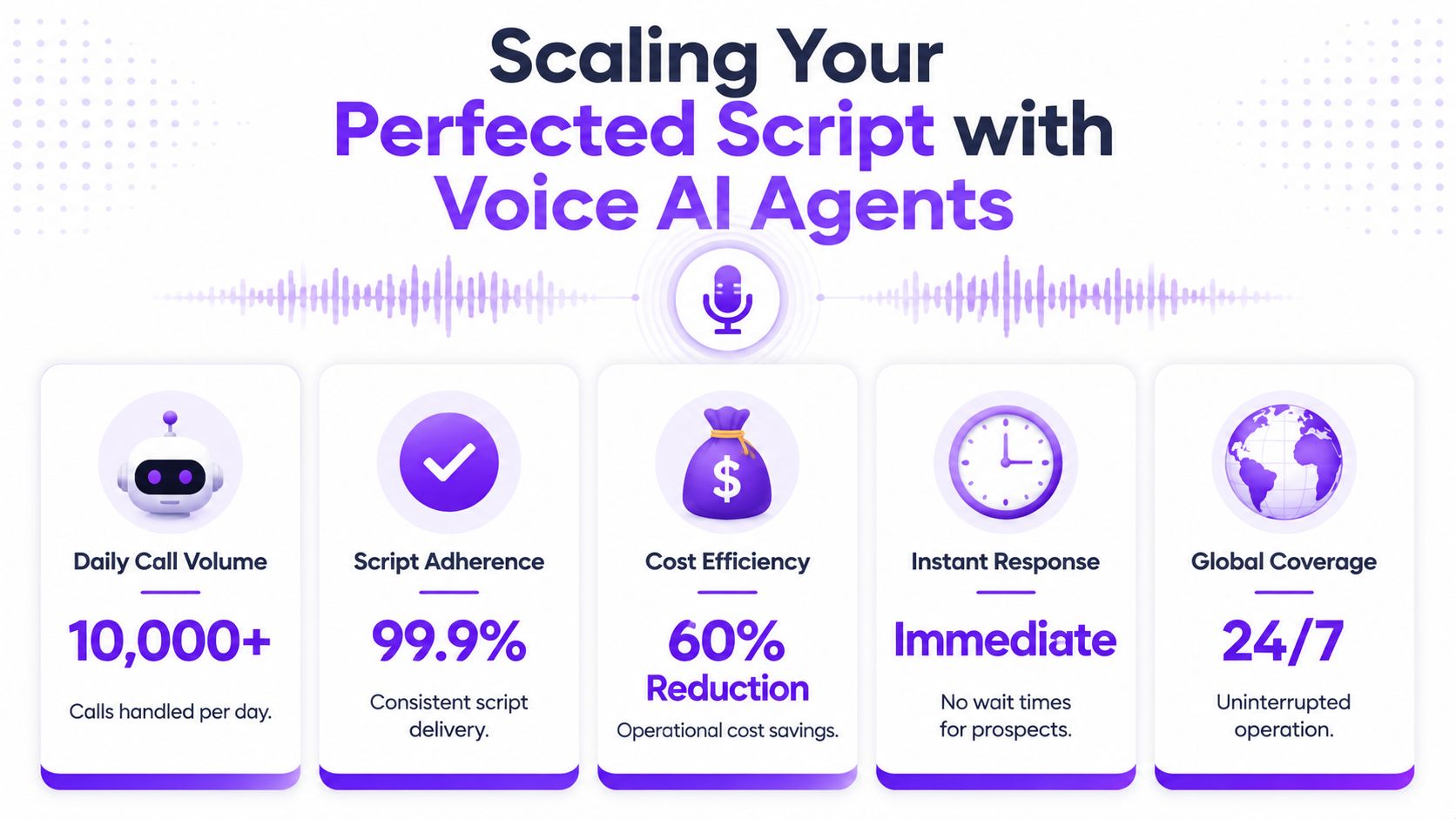
The practical use cases are clear:
- Top-of-funnel qualification: AI handles first contact, filters fit, and routes high-intent prospects.
- Compliance consistency: Required identification and opt-out phrasing can be standardised.
- Regional adaptation: Language branches can be pre-set for audience segments.
- Follow-up discipline: AI can reattempt, remind, and schedule without rep fatigue.
For agencies comparing implementation models, resources such as Automated call assistant for agencies are useful for seeing how automated calling gets packaged operationally, especially where lead response and qualification volume matter.
Once a script is validated, scaling it responsibly in India also means getting the dialling layer right; this outbound dialer software guide covers TRAI-compliant pacing, number series, and abandoned-call controls for exactly that handoff.
What boards should expect from deployment
One platform mention is sufficient. DialNexa's guide to cold calling challenges and AI voice agents outlines the operating case for using voice agents in repetitive outbound workflows. In the publisher background provided for this article, customers report connect rates rising from 47% to 91%, lead-to-booking improvement from 2% to 8%, and AI-qualified leads matching human judgment with 97% accuracy. Those are publisher-provided product claims, not market-wide benchmarks.
A board should still evaluate deployment on practical criteria, not novelty:
- Is the script already validated by human calls?
- Can the AI follow approved call branches reliably?
- Does the deployment support Indian compliance wording and opt-out logic?
- Will human reps receive only the conversations that merit human time?
- Can outcomes be tied back to campaign, segment, and script version?
Used properly, voice AI turns the cold calling script from a training document into an execution layer. Human sellers then spend their time where judgement matters most: complex discovery, negotiation, and closing.
DialNexa Labs Private Limited helps teams deploy human-like Voice AI agents for qualification, presales, support, recruitment, and follow-up workflows across sectors including EdTech, BFSI, real estate, healthcare, e-commerce, and software. If your outbound operation has already identified script inconsistency, compliance exposure, or rep-capacity limits as bottlenecks, review DialNexa Labs Private Limited as one option for operationalising tested scripts at scale.

Excellent breakdown of cold calling as a structured, data-driven process rather than a simple sales pitch. The focus on compliance, objection prevention, and scalable Voice AI integration makes this a highly practical guide for modern sales teams.
A valuable guide for mastering cold-calling scripts and building meaningful connections with CXO-level decision-makers.\
The practical tips on handling objections and communicating value can help sales professionals boost confidence and improve conversion rates.