
Automated Appointment Reminders: The CXO’s ROI Guide
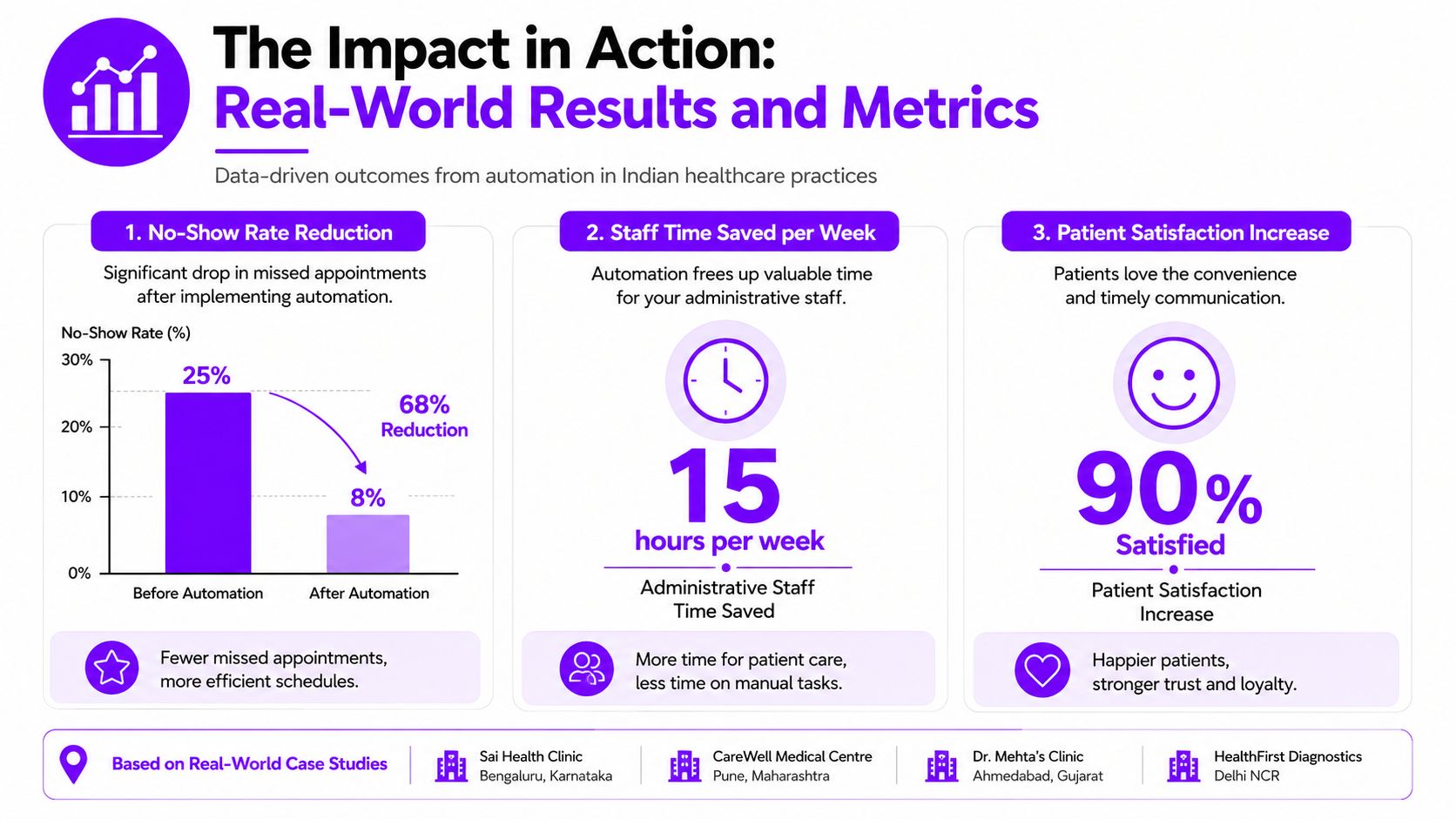
A reminder system that merely broadcasts messages is no longer a serious operating model. In Indian clinics, urban multispecialty providers have reduced no-show rates from 25–35% to 8–12% within 60 days after implementing automated reminders, according to Clarivis Intelligence. That result changes the board-level conversation. This is not about sending texts. It is about recovering booked revenue, releasing staff capacity, and protecting scarce appointment inventory.
For CXOs across healthcare, BFSI, EdTech, real estate, and service businesses, the strategic question isn't whether reminders matter. It's whether the organisation is still relying on one-way notification logic in a market that increasingly rewards two-way conversational resolution. The difference is material. A static reminder tells the customer an appointment exists. A conversational workflow confirms, reschedules, cancels, and returns the slot to inventory while there's still time to refill it.
Table of Contents
- Beyond Notifications The Strategic Value of Reminders
- Calculating the ROI of Automated Reminders
- Choosing Your Channel Strategy SMS vs Email vs Voice AI
- Best Practices for High-Impact Reminder Workflows
- Navigating Compliance in Healthcare and BFSI
- The Impact in Action Real-World Results and Metrics
- Your Implementation Checklist for Launching Automation
Beyond Notifications The Strategic Value of Reminders
Executives often classify reminders as administrative hygiene. That framing understates their commercial value. Every missed appointment leaves a paid asset idle, whether that asset is a clinician, counsellor, relationship manager, admissions advisor, or property consultant.
The more useful lens is revenue assurance. When no-shows fall, the business doesn't just improve communication. It lifts utilisation of fixed-cost teams and restores bookable capacity without adding headcount.
One-way reminders are the old model
One-way SMS campaigns solved a first-generation problem: forgetfulness. They don't solve the second-generation problem: what happens when the customer can't attend. If the only outcome available is silence, the business still absorbs the loss.
That is why two-way design matters. A modern reminder should let the recipient confirm, cancel, or request a new slot with minimal friction. In practical terms, this turns a reminder from a notification into a scheduling control layer.
Practical rule: If a reminder can't resolve a conflict, it can't protect revenue.
A hospital can use this approach to identify cancellations early enough to refill specialist slots. An EdTech admissions team can use it to keep counselling calendars full. A BFSI operation can reduce missed KYC or advisory calls by making rescheduling immediate rather than manual.
Reminders now sit inside the broader customer journey
Reminder systems also intersect with lead capture and workflow orchestration. Teams that already use structured forms and triggered follow-up journeys can extend that discipline into scheduling. For example, Growform's notification features show how notification workflows can fit naturally into operational processes where timing and handoff quality matter.
The strategic takeaway is simple. A reminder programme should be judged the same way you judge any commercial system: by its effect on conversion, utilisation, labour efficiency, and customer continuity. Once viewed that way, one-way broadcasting looks less like automation and more like underpowered infrastructure.
Calculating the ROI of Automated Reminders
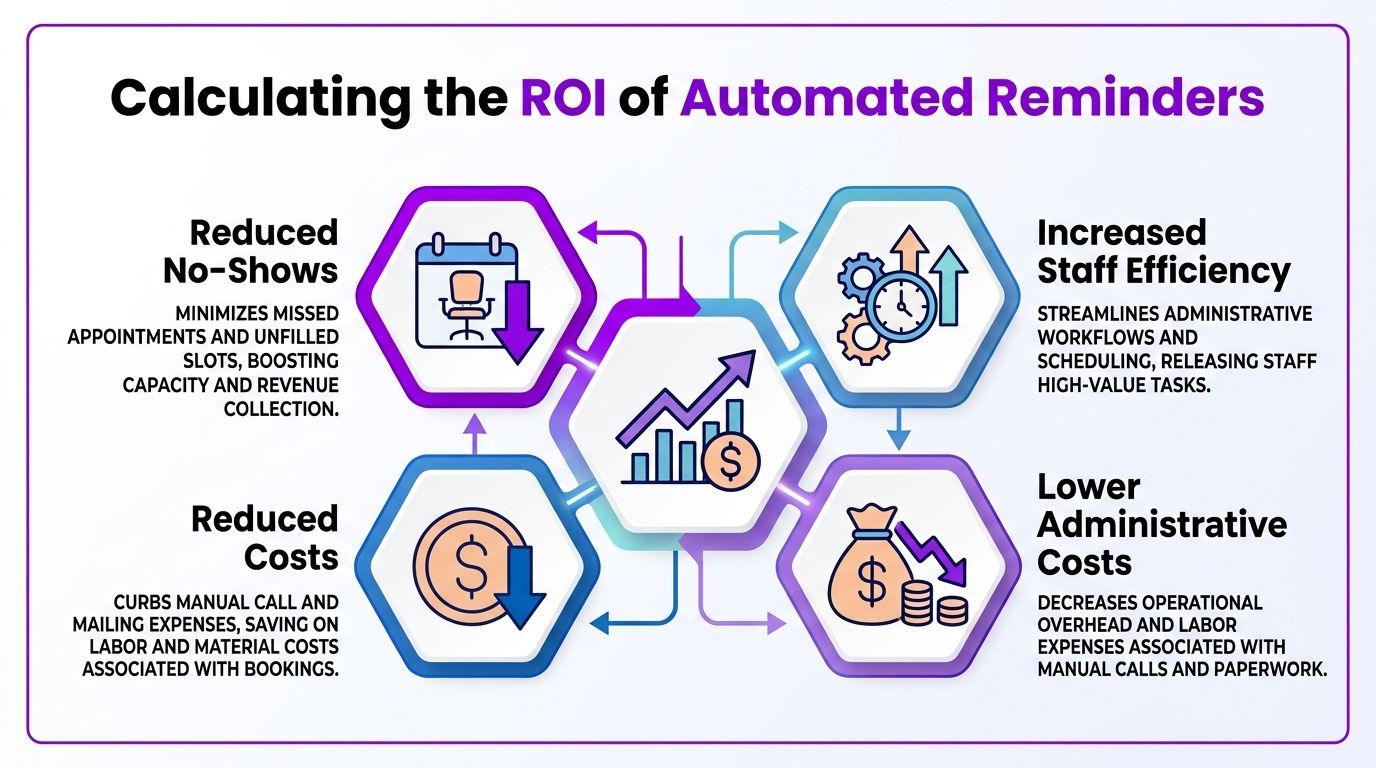
A reminder programme earns budget approval when it improves margin, not when it merely automates a task. That distinction matters because the financial return does not come from sending more messages. It comes from protecting booked revenue, releasing staff capacity, and increasing the share of appointment inventory that converts into completed interactions.
In India, automated reminder systems cost approximately ₹10.50 per 90-second call, while comparable manual telephone reminders cost around €0.90 per contact. Automated systems therefore represent a 75% cost reduction per contact, while removing routine execution time from staff workflows, according to Bolti's analysis of automated reminder economics.
The Correct Cost Equation for Boards
A narrow business case looks only at reminder cost versus no-show reduction. Boards should use a wider equation.
The relevant comparison is manual outreach and passive one-way reminders versus systems that can confirm, cancel, and reschedule in the same interaction. One-way broadcasts may lower some forgetfulness-related misses, but they leave unresolved conflicts in the queue. Two-way conversational reminders, especially voice-based workflows, create financial value because they recover appointments that would otherwise be lost and return cancelled slots to the schedule early enough to refill them.
That changes the ROI model in four ways:
- Recovered revenue: More booked slots convert into completed appointments, consultations, or calls.
- Higher capacity utilisation: High-cost calendars, clinician time, advisors, counsellors, and field teams run closer to planned occupancy.
- Lower administrative cost: Staff spend less time calling, chasing confirmations, and manually handling reschedules.
- Better planning accuracy: Earlier confirmation and cancellation signals improve staffing, queue design, and daily load balancing.
This is a yield-management problem as much as an operations problem. The value of the system rises with appointment value, replacement difficulty, and the cost of idle capacity.
A practical ROI model for service businesses
CFOs do not need a complex forecasting model to test this category. A disciplined baseline is enough.
- Calculate missed-slot volume over a representative period.
- Assign economic value per slot using realised revenue, contribution margin, or another finance-approved measure.
- Compare manual contact cost with automated contact cost across your current reminder mix.
- Add labour savings from staff time no longer spent on repetitive outreach and rescheduling.
- Measure backfill rate for cancelled appointments, because backfilled inventory is often where the strongest return appears.
- Separate one-way reminder performance from two-way resolution performance so the business case reflects actual conflict recovery, not message volume.
That final step is often missed. A broadcast reminder can produce high delivery and open rates while still failing to resolve attendance risk. A two-way reminder that handles a cancellation or secures a new time slot can generate lower apparent message volume but higher economic return. For boards assessing investment, resolution rate is the more important metric.
The same framework applies outside healthcare. A real estate brokerage can model site visits. An EdTech provider can model counselling sessions. A BFSI firm can model onboarding or advisory calls. If the interaction has economic value and the current process still depends on manual follow-up, reminder automation should be evaluated as a capacity and revenue system rather than a communications line item.
Execution discipline determines whether that return is visible. Teams need reporting on confirmation rates, cancellation windows, reschedule completion, recovered slots, and staff time released. A structured approach to performance reporting for reminder and calling workflows helps finance and operations track whether the programme is reducing avoidable revenue leakage or merely sending notifications at lower cost.
Choosing Your Channel Strategy SMS vs Email vs Voice AI
Channel choice shouldn't be driven by habit. It should follow the value of the appointment and the complexity of the likely customer response.
SMS remains useful because it is immediate. But immediacy is not the same as resolution. In India, 98% of SMS are opened within 3 minutes, yet 45% of no-shows persist because one-way texts lack a two-way reschedule path. In contrast, AI-driven voice agents have seen connect rates rise from 47% to 91% in Indian markets, making them more effective for higher-value appointments where conversation matters, according to Inshalytics' review of reminder performance.
What each channel is really for
SMS is strongest when the objective is a low-cost, high-speed nudge. It works well for simple confirmations and day-of prompts, particularly when the recipient already has context and doesn't need explanation.
Email plays a different role. It is less suitable for urgent action, but useful for sending longer-form details such as directions, preparation steps, documentation requirements, or policy notes. In regulated sectors, that written detail can be operationally valuable.
Voice AI belongs in a different category. It is best used when missed appointments are costly, when customer intent is uncertain, or when the recipient may need help rescheduling. A voice agent can handle natural responses, reduce no-response dead ends, and route the outcome back into the scheduling system.
That responsiveness depends on the underlying voice assistant architecture, since the speed and accuracy of the speech and dialogue layers determine whether a rescheduling request is understood correctly on the first try.
Channel Effectiveness Comparison for Appointment Reminders
| Metric | SMS | Voice AI | |
|---|---|---|---|
| Primary strategic use | Fast broadcast reminder | Detailed pre-appointment information | Conversational confirmation and conflict resolution |
| Best fit | Routine, low-friction appointments | Appointments needing instructions or documents | High-value, high-risk, or multilingual appointments |
| Limitation | One-way messages often leave conflicts unresolved | Lower urgency for near-term attendance | Requires stronger workflow and system integration |
| Evidence from India | 98% opened within 3 minutes, but 45% of no-shows persist when texts are one-way | Best treated qualitatively as a supporting channel | Connect rates rising from 47% to 91% in Indian markets |
| Executive takeaway | Efficient for reach | Useful for context | Best for protecting revenue when action is required |
A healthcare chain might use SMS for routine reminders, email for pre-visit instructions, and Voice AI for specialty consults where a missed slot is expensive. A property developer can follow the same logic for site visits. A brokerage can remind with SMS first, then escalate to a voice conversation if the prospect hasn't confirmed.
For teams evaluating recorded or automated voice touchpoints, automated voicemail message workflows are worth reviewing because channel design often fails when businesses treat voice as a generic fallback rather than a deliberate intervention.
If the appointment value is high, a channel that can only notify is usually the wrong channel.
Best Practices for High-Impact Reminder Workflows
The highest-performing reminder systems don't send more messages at random. They use timing, channel escalation, and response handling to move an appointment towards one of three outcomes: confirmed, rescheduled, or released for backfill.
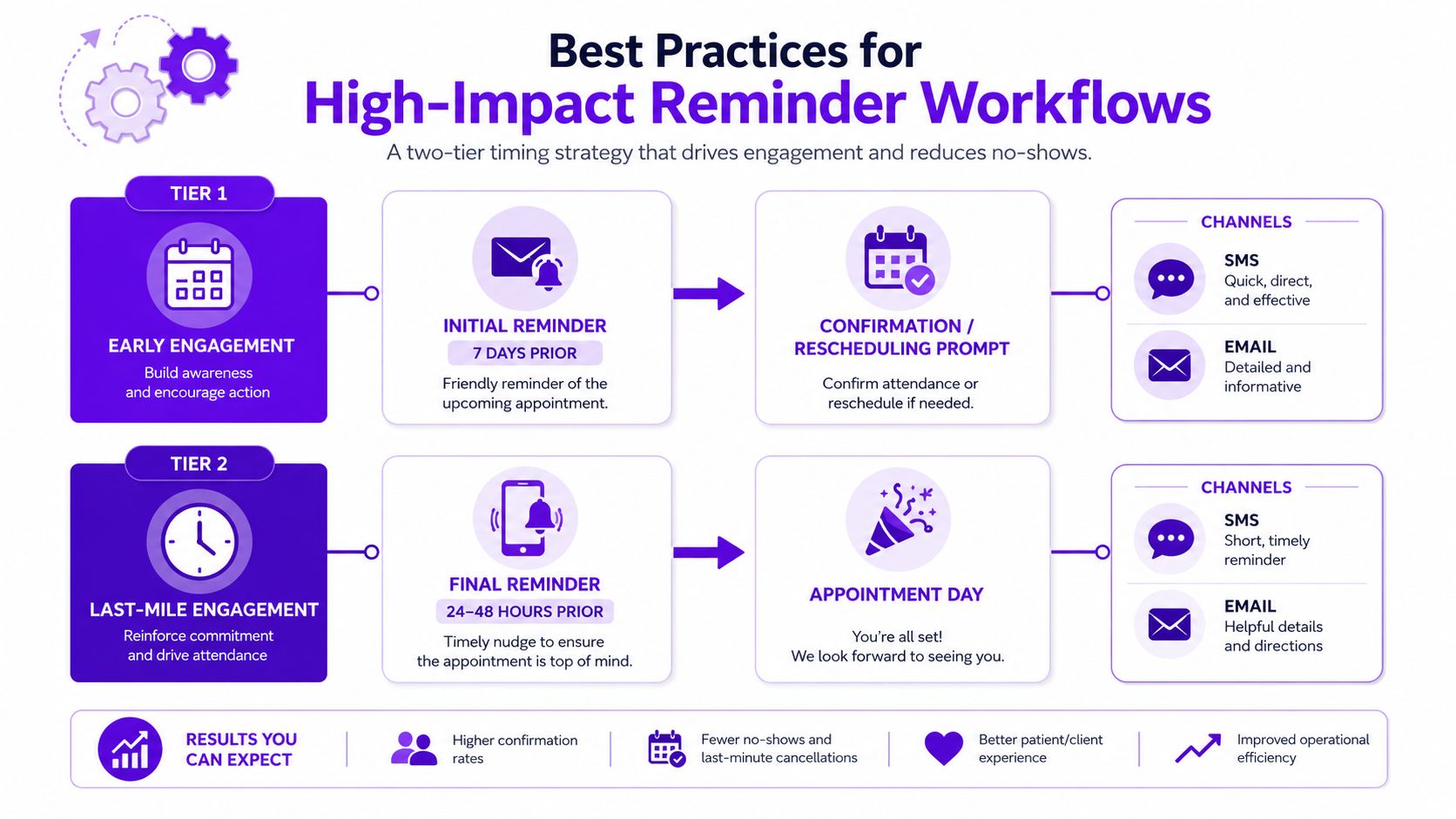
A strong workflow begins with a proven cadence. Implementing a two-tier timing strategy, with a primary confirmation call 24–48 hours prior and a final reminder 2 hours before, reduces no-show rates by 40%. The same workflow requires bidirectional integration with management systems so responses can be parsed and cancelled slots can be backfilled immediately, according to Edesy's appointment reminder workflow guidance.
Timing matters more than volume
Many organisations overload customers with repeated prompts and then assume more frequency equals more compliance. That isn't the lesson from the strongest implementations. However, the lesson is that each touchpoint should serve a distinct decision moment.
Use the workflow this way:
- First touch at 24–48 hours: Ask for a commitment. The customer still has time to resolve conflicts.
- Final touch near the appointment: Reinforce attendance once the plan is already made.
- System response: Update the status automatically and trigger the next best action.
One-way broadcasts underperform because they tell the customer the appointment exists but don't give them a practical next step. Two-way workflows remove friction. That's why they are more commercially effective.
Practical workflow examples
A healthcare clinic might send:
- Initial prompt: “You're scheduled for your consultation tomorrow. Reply Confirm to keep your slot or Reschedule if you need a different time.”
- Final reminder: “This is your reminder for today's appointment. If you can't attend, reply Reschedule now so we can assist.”
A real estate team might adapt the same logic:
- Site visit confirmation: “Your property visit is scheduled for tomorrow. Reply Confirm to proceed or Reschedule to choose another time.”
- Same-day reminder: “Your consultant is preparing for today's visit. Reply Confirm if you're on your way.”
An EdTech admissions team can do likewise for counselling calls, especially when candidate intent changes quickly and calendar inventory is tight.
A practical operational point often gets overlooked. Calendar infrastructure and reminder infrastructure need to align. Teams refining booking flows may find it useful to review managing event notifications in Google Calendar, especially when multiple calendars and reminder timings interact.
“Good reminder design doesn't chase the customer. It gives the customer a clean path to act.”
Navigating Compliance in Healthcare and BFSI
In healthcare and BFSI, reminder automation succeeds only if it is built as a compliant communication system. Leadership teams should treat this as a governance issue, not a template-writing exercise.
Compliance is an operating design issue
Healthcare organisations handle sensitive patient information. BFSI organisations manage identity, account, and transaction-adjacent data. In both cases, the reminder itself may be simple, but the workflow behind it involves consent, timing, channel governance, data access, auditability, and response handling.
That means compliance needs to be embedded in platform design. Sender registration, consent records, access controls, system logs, and secure integrations are not optional extras. They are the controls that let the organisation scale outreach without creating unmanaged risk.
Boards should also insist on purpose discipline. Reminder messages should contain only the minimum operational information needed for attendance or rescheduling. If the workflow requires a more detailed interaction, the system should route that securely rather than overload the reminder itself.
What boards should require from platforms
A compliant reminder programme typically needs the following safeguards:
- Consent governance: Teams must be able to document and manage customer communication permissions.
- Role-based access: Only authorised staff should be able to view, modify, or trigger sensitive workflows.
- Auditability: The system should preserve a clear record of what was sent, when, and how the recipient responded.
- Controlled integrations: Scheduling, CRM, and communication systems should exchange data in a structured and limited way.
- Channel appropriateness: Businesses should choose channels that match both customer preference and regulatory expectations.
This is also where platform architecture matters. Tools built for conversational automation can reduce risk if they centralise logs, standardise scripts, and make responses traceable rather than leaving staff to manage ad hoc calling patterns. For enterprises evaluating options, DialNexa Labs Private Limited offers Voice AI agents that can automate appointment reminders and related conversational workflows across sectors, with API-driven deployment and dashboards that fit structured operations.
The strategic point is straightforward. Compliance shouldn't be the reason automation slows down. It should be the reason the organisation replaces informal manual outreach with controlled, observable workflows.
The Impact in Action Real-World Results and Metrics
Missed appointments rarely look strategic on a dashboard. In practice, they act like a hidden tax on revenue, staff productivity, and asset utilisation. The strongest reminder programmes improve all three because they do more than notify. They convert uncertainty into confirmed attendance, early cancellation, or immediate rescheduling.
Healthcare example from India
Healthcare offers a clear operating model because the cost of an unfilled slot is visible and difficult to recover once the time passes. As noted earlier, Indian multispecialty clinics reported materially lower no-show rates after introducing automated reminder workflows. The more useful lesson is not the reminder itself. It is the workflow design behind it.
Teams that stage outreach across multiple decision windows get better utilisation because each contact serves a different purpose. An earlier reminder gives the patient time to identify a conflict. A follow-up closer to the appointment secures commitment. A final touchpoint captures last-minute changes that would otherwise become wasted chair time. One-way broadcast messages can support recall, but they leave operational value on the table if the patient cannot confirm, cancel, or shift the booking in that same interaction.
That distinction matters at scale. A reminder system that merely sends messages reduces forgetfulness. A two-way conversational system resolves scheduling friction. The second model produces higher realised capacity because cancelled slots return to the schedule early enough for backfilling.
Later in the customer journey, seeing how conversational reminder experiences play out in practice can help non-technical stakeholders understand the model:
What these results mean outside healthcare
The same economics apply anywhere the business depends on scheduled, high-intent interactions. Education providers, property developers, insurers, banks, and advisory teams all face the same operational question. Does the reminder merely announce the appointment, or does it actively protect the slot?
Consider three examples:
- EdTech counselling sessions: A missed admissions call can slow conversion and increase reacquisition cost. Two-way reminders reduce that risk by shifting the conversation into a new slot while intent is still high.
- Real estate site visits: Weekend inventory and field staff time are finite. Conversational reminders let the prospect confirm attendance or reschedule early enough for the sales team to reassign consultant capacity.
- BFSI advisory and onboarding calls: Delayed KYC, lending, or wealth conversations lengthen cycle times. A reminder that handles customer responses directly can cut manual follow-up queues and keep progression on track.
For boards, the strategic takeaway is straightforward. Reminder automation should be evaluated as capacity management, not message automation. The ROI improves when the system recovers revenue that would otherwise be lost to idle time and fragmented follow-up.
This is also why channel and workflow decisions should sit close to scheduling infrastructure. Enterprises reviewing their stack should examine how conversational reminders connect with booking logic, escalation rules, and slot recovery. A useful reference point is this guide to patient appointment scheduling software, which shows why reminder performance depends on the scheduling system beneath it. Firms that need external build support often work with an AI automation agency to design those flows and connect them to CRM, telephony, and calendar systems.
The executive conclusion is simple. Broadcast reminders improve awareness. Intelligent two-way reminders improve revenue efficiency. Voice AI becomes especially valuable when the organisation needs to resolve conflicts in real time, return inventory to the schedule, and expand throughput without adding equivalent headcount.
Your Implementation Checklist for Launching Automation
A reminder programme becomes valuable when it is launched with the same discipline as any other operating change. For high-risk and high-value appointments, the business case for richer workflows is even stronger. Adding a 72-hour AI voice call for high-risk appointments can increase confirmation rates into the 70–80% range, and the architecture must handle natural language responses such as “Reschedule” to trigger automated workflows, according to Intellivizz's guidance on reminder automation for high-risk appointments.
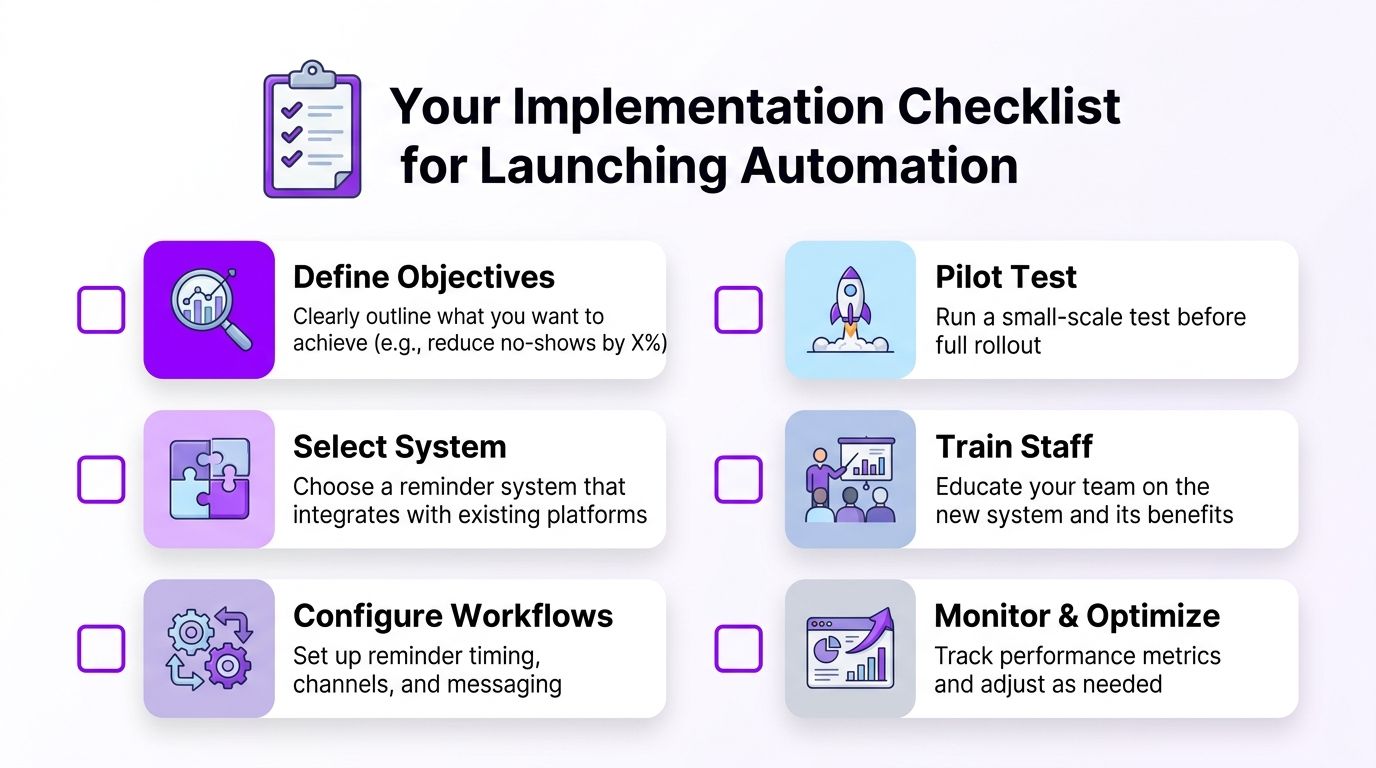
A seven-step launch plan
Audit current no-show loss
Start with appointment categories that are hardest to refill or most expensive to miss. That gives the pilot commercial relevance.Segment by appointment value
Not every booking needs the same channel. Use lighter reminder paths for routine interactions and conversational paths for high-value or high-risk ones.Define the action model
Every reminder should allow confirm, cancel, or reschedule. If the recipient can't act, the workflow is incomplete.Check systems integration early
Scheduling, CRM, PMS, and communication layers need to write back status changes. If they don't, staff will rebuild the process manually.Pilot with one business unit
A hospital department, admissions team, branch office, or property portfolio is often enough to prove the workflow before wider rollout.Choose specialist support where needed
Teams without internal workflow expertise may benefit from working with an AI automation agency that can map routing logic, escalation paths, and integration requirements.Measure and optimise weekly
Review confirmations, reschedules, cancellations, and recovered slots. Then refine scripts, timing, and escalation rules. Teams comparing software options can also review patient appointment scheduling software considerations to make sure booking and reminder logic are aligned from the start.
The core implementation principle is straightforward. Start narrow, automate the full decision path, and scale only after the organisation can measure operational impact with confidence.
DialNexa Labs Private Limited helps organisations deploy Voice AI agents for appointment reminders, scheduling conversations, and other operational call workflows across healthcare, EdTech, BFSI, real estate, and service environments. If your team wants to move beyond one-way reminders and build a measurable, two-way communication system, explore DialNexa.

This is a valuable perspective on how two-way reminders can reduce no-shows and improve customer engagement. The practical examples and ROI-focused approach make the content especially useful for businesses across healthcare, BFSI, real estate, and EdTech.
good platform
This is a highly practical guide to using automated reminders as a revenue and capacity management tool rather than just an administrative task. The clear ROI framework, channel comparison, and two-way workflow strategies make the content especially useful for businesses looking to reduce no-shows.
This article offers valuable insights into how automated appointment reminders can reduce missed appointments and improve operational efficiency. The focus on ROI and smarter communication helps businesses save time, enhance customer satisfaction, and achieve better results through automation.