
Text to Audio Converter Telugu: A CXO’s Guide for 2026
The biggest mistake in Telugu voice automation usually isn't the voice model. It's the operating model around it. Teams often spend weeks comparing synthetic voices, then push inconsistent Telugu text into the system, skip dialect testing, and wonder why customer comprehension drops. That's expensive because the Telugu opportunity is large: the 2011 Census recorded 81,127,740 Telugu speakers, making Telugu the fourth-largest language community in India (Telugu speaker scale in India).
For a CXO, a text to audio converter for Telugu isn't a narrow content tool. It's infrastructure for customer communication. It shapes how your brand sounds in IVR, collections, onboarding, education, reminders, support, and outbound engagement. The technical choices matter, but only when they're tied to business outcomes such as faster deployment, cleaner QA, lower manual effort, and more consistent customer experience across Andhra Pradesh and Telangana.
Table of Contents
- Selecting Your Telugu Text to Audio Engine
- Preparing Telugu Text for Flawless Synthesis
- Crafting a Brand Voice with SSML and Prosody Tuning
- Integrating Telugu Audio into Your Tech Stack
- Deploying and Scaling for Enterprise Performance
- The Strategic Advantage of High-Quality Telugu Audio
Selecting Your Telugu Text to Audio Engine
Why engine choice becomes a board-level decision
Most companies treat engine selection as a developer procurement task. That's too narrow. Your Telugu text to audio converter determines how quickly you can launch, how much control you have over pronunciation, where customer data flows, and how hard it will be to maintain quality when use cases expand from simple announcements to live support automation.
The first serious fork in the road is cloud TTS versus a custom model deployed on-premise or in a private cloud. Cloud platforms from providers such as Google, AWS, and Azure usually win on speed to market, tooling, and developer productivity. A custom stack can win on control, governance, and deep language adaptation, but only if your organisation is prepared for model lifecycle management, voice QA, and ongoing tuning.
Practical rule: If Telugu voice is a near-term channel for operations, start with the deployment model that reduces implementation friction. If Telugu voice is becoming core IP, optimise for control.
Cloud TTS vs Custom Model Decision Matrix
| Criterion | Cloud TTS Providers (Google, AWS, Azure) | Custom On-Premise/Private Cloud Model |
|---|---|---|
| Speed to launch | Faster to pilot, easier API access, simpler procurement in many enterprises | Slower initial rollout because infra, training, and validation must be built |
| Engineering burden | Lower. Teams focus on integration and QA | Higher. Teams own model operations and language tuning |
| Voice customisation | Moderate to strong, depending on vendor controls | Highest potential if you need domain-specific Telugu pronunciation rules |
| Data control | Depends on vendor architecture and compliance terms | Stronger control for regulated environments |
| Scalability | Easier to scale quickly for spikes in traffic | Scales well if architecture is strong, but requires planning |
| Long-term flexibility | Good for common use cases | Better for firms that want a proprietary speech layer |
| Risk profile | Lower execution risk, more vendor dependency | Higher execution risk, lower vendor dependency |
A cloud-first route is often the rational first move for BFSI support alerts, EdTech lesson narration, appointment reminders, or outbound campaign workflows. The interfaces are mature, and modern Telugu systems already support te-IN, which matters because it aligns with Indian language localisation needs. For example, SpeechGen's Telugu offering explicitly supports te-IN and allows playback speed control from 0.5x to 2.0x through a programmable interface (Telugu te-IN voice controls).
What usually works in practice
In live enterprise programmes, a hybrid model tends to be the most sensible. Use cloud TTS for rapid rollout, then isolate the parts of the workflow that require heavier control. Those usually include:
- Compliance-sensitive audio where legal wording and pronunciation must remain stable.
- Brand-critical customer journeys such as KYC guidance or premium support.
- Dialect-heavy use cases where generic models underperform.
- High-volume automation where operational predictability matters more than experimentation.
One practical benchmark for evaluating platforms is whether they're built for enterprise voice workflows rather than just raw TTS playback. A useful reference point is this overview of Voice AI platforms in India, especially if your roadmap extends into calling, qualification, or support automation.
A custom model makes sense when Telugu audio is no longer a feature but a capability your business wants to own. That's common in large contact centres, education publishers with recurring content pipelines, or regulated support environments. But many teams move too early. They underestimate data preparation, tuning effort, fallback handling, and linguistic QA. Unless you have a clear operating case for full control, the complexity can outweigh the benefit.
Preparing Telugu Text for Flawless Synthesis
Clean text is a quality control function
If the input is messy, the output will sound messy. That's obvious in English. In Telugu, it becomes operational risk.
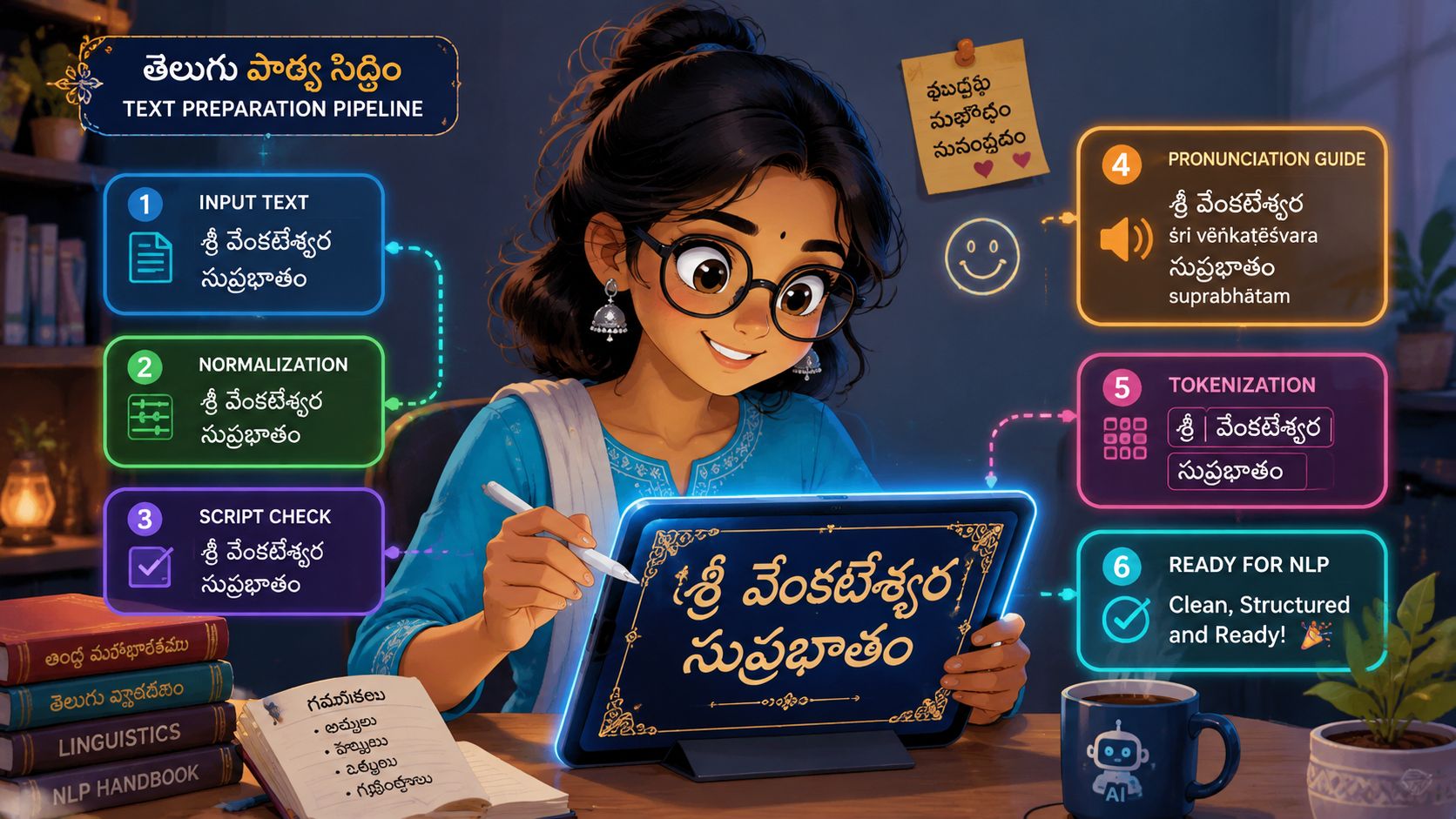
When converting Telugu text to audio using cloud-based neural engines, the process should begin with Unicode normalisation in UTF-8, followed by phoneme-level segmentation using Telugu-specific grapheme-to-phoneme models. The reason is straightforward. Telugu script complexity exceeds 10,000 characters, so casual copy-paste handling often creates broken rendering, incorrect joins, or malformed input. Independent speech synthesis evaluations also indicate 94.2% naturalness for modern Telugu AI models, but failure to handle the pure letter (swara) pronunciation, which appears in 12% of Telugu sentences, can cause an 18% drop in intelligibility for non-native listeners.
That gap is why text preparation isn't a developer nicety. It's brand protection.
Poor preprocessing doesn't always fail loudly. It often produces audio that sounds almost right, which is worse because weak pronunciation slips into customer-facing journeys undetected.
A useful technical primer for teams building this layer is DialNexa's piece on text-to-speech synthesis, especially if your internal teams need a common vocabulary before implementation.
A production-grade preparation pipeline
For enterprise use, the input pipeline should be standardised before any API call is made. In practice, that means:
Normalise encoding first
Every source system should emit UTF-8 clean text. CRM exports, spreadsheets, CMS entries, and support macros often introduce invisible formatting issues.Expand non-spoken symbols
Currency, dates, abbreviations, policy codes, and mixed Telugu-English tokens shouldn't be left to default interpretation. Write explicit conversion rules.Handle swara and compound forms carefully
In this area, many teams lose clarity. A pronunciation QA list should include common brand names, district names, product terms, and service phrases.Separate standard Telugu from local variants
Internal teams often mix conversational variants into master scripts. That's acceptable, but only if the use case calls for it.Create approval gates
Linguistic review should happen before synthesis, not after audio is generated in bulk.
Here's what works better than ad hoc editing: a controlled content layer where marketing, support, compliance, and language reviewers all work from approved phrase banks. That turns your Telugu text to audio converter into a governed asset instead of a one-off utility.
Crafting a Brand Voice with SSML and Prosody Tuning
Why default voices weaken brand perception
A default Telugu voice may be acceptable for internal tools. It's rarely enough for customer experience. In voice automation, tone signals intent before words are fully processed. A reminder call, a payment prompt, a lesson module, and a premium support callback shouldn't all sound the same.
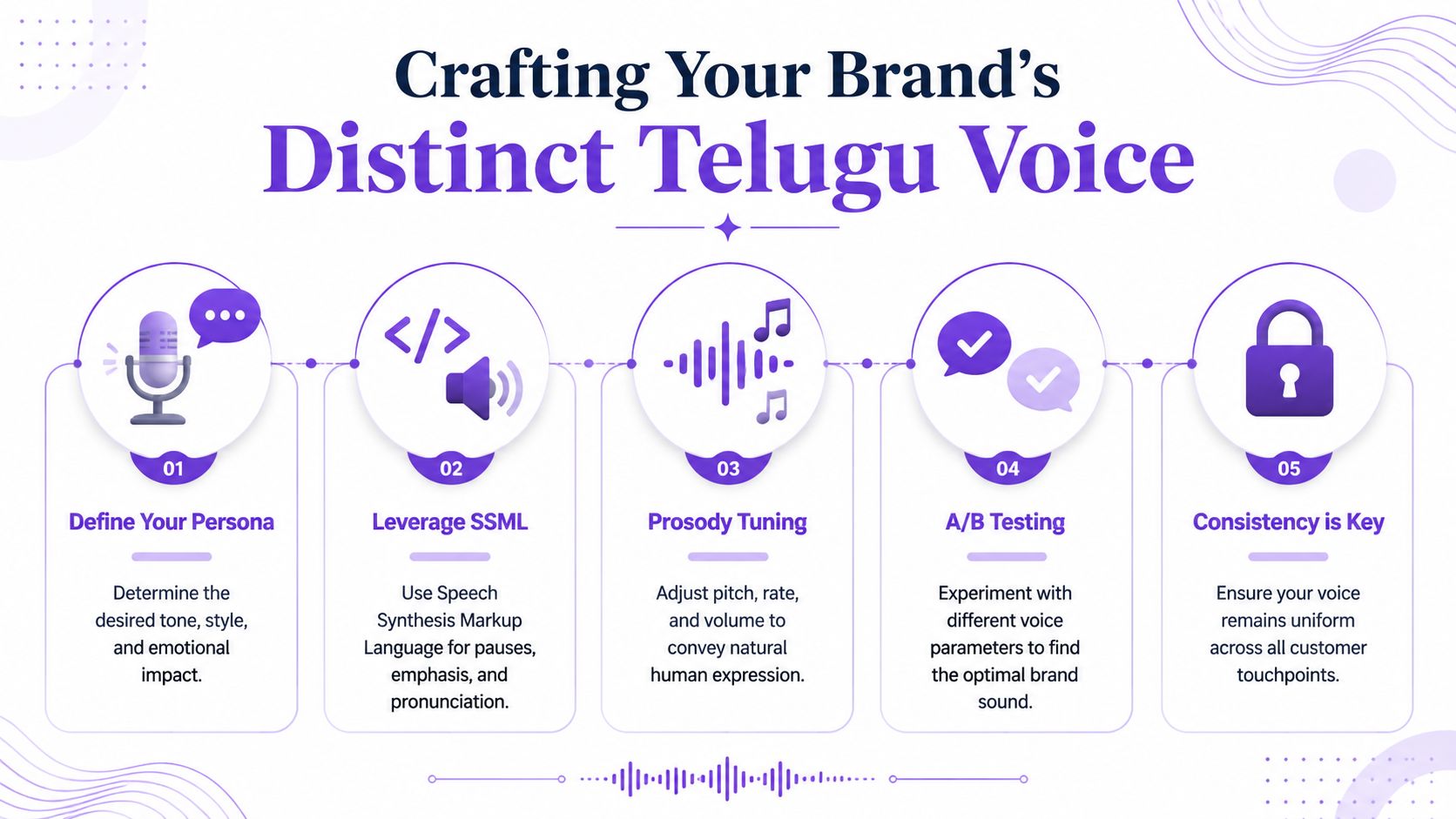
That's where SSML and prosody tuning matter. They let teams control pauses, emphasis, rate, pitch, and pronunciation so the same engine can serve different business contexts without sounding generic. Modern Telugu TTS systems such as SpeechGen support the te-IN standard and allow adjustable playback speed from 0.5x to 2.0x through programmable interfaces, which gives teams meaningful control over delivery style without rebuilding the stack from scratch.
A strong brand voice is usually defined by a small set of choices:
- Formality level for banking, healthcare, education, or commerce
- Speech rate based on whether the task is instructional or transactional
- Pause design for legal clarity, OTP instructions, and menu prompts
- Pronunciation rules for product names, place names, and English brand terms embedded in Telugu
Practical SSML patterns for Telugu deployments
Teams often overcomplicate SSML. Start with the parts that directly affect comprehension and trust.
Use pauses to make dense prompts digestible
<speak>
మీ KYC ప్రక్రియ ప్రారంభమైంది.
<break time="500ms"/>
దయచేసి మీ నమోదిత మొబైల్ నంబర్ను సిద్ధంగా ఉంచండి.
</speak>
This is useful in BFSI, insurance, and healthcare flows where customers must retain instructions.
Use prosody to soften or formalise the delivery
<speak>
  <prosody rate="90%" pitch="-2st">
    మీ చెల్లింపు విజయవంతంగా స్వీకరించబడింది.
  </prosody>
</speak>
A lower, steadier tone often sounds more assured in transactional confirmations.
Protect pronunciation for brand-specific terms
<speak>
  మా సేవ <say-as interpret-as="characters">VIP</say-as> కస్టమర్ల కోసం అందుబాటులో ఉంది.
</speak>
This matters when Telugu sentences include product tiers, acronyms, or mixed-language labels.
Brand test: If the same voice can read a recovery notice and a festive promotion with no tuning changes, it probably isn't tuned enough.
For organisations moving deeper into conversational design, this guide on AI voice tone tuning is a practical next read because it connects technical controls to actual customer experience design.
The business payoff is consistency. Instead of every team generating Telugu audio in its own style, SSML gives central control over how the brand sounds across channels. That reduces revision cycles, avoids awkward robotic delivery, and makes localisation feel deliberate rather than improvised.
Integrating Telugu Audio into Your Tech Stack
Where the business value actually appears
A standalone text to audio converter for Telugu is useful. An integrated one changes operating efficiency.
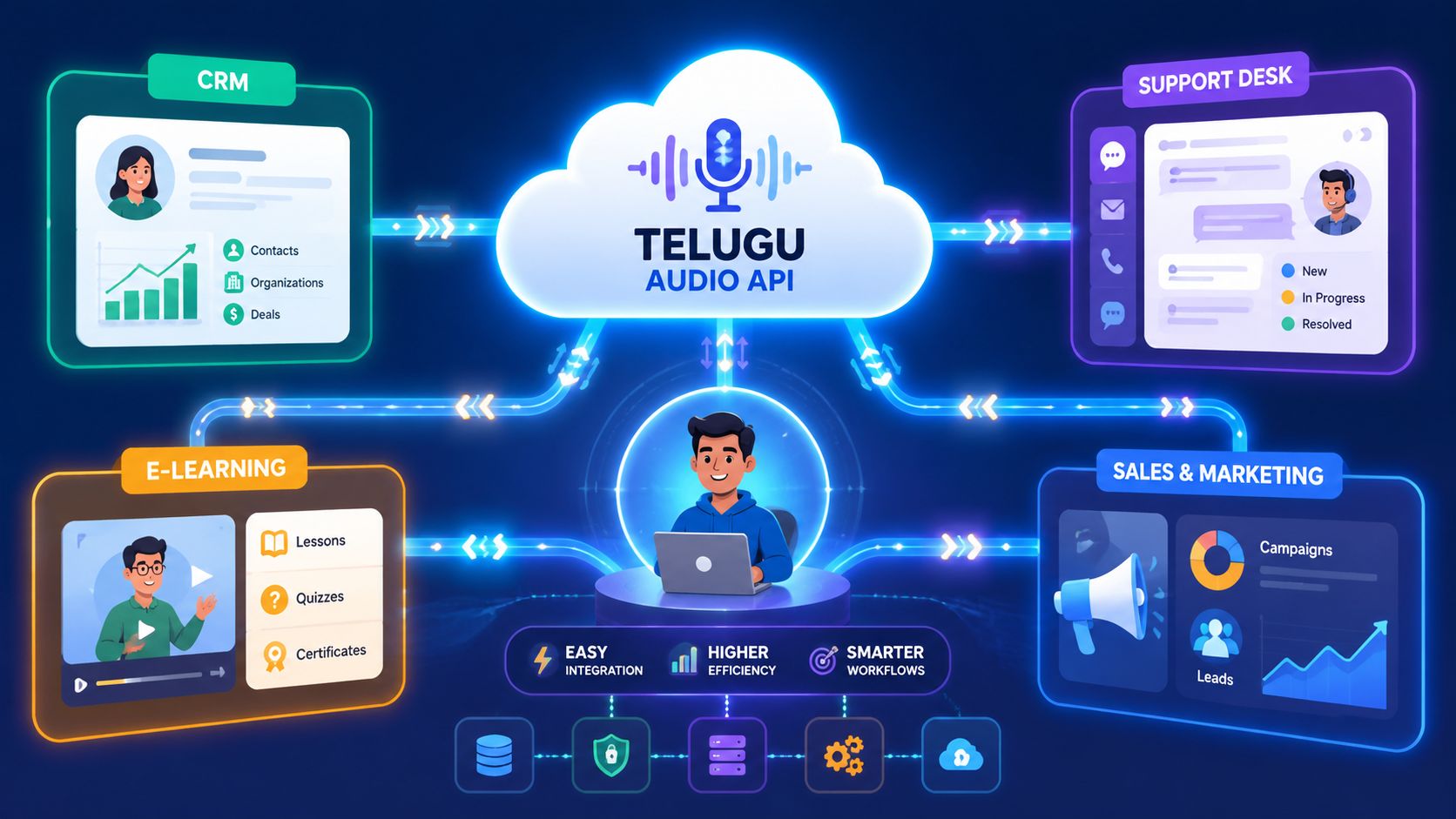
The returns show up when Telugu audio is generated inside the systems your teams already use. That includes CRMs for reminders, support platforms for status updates, LMS platforms for course narration, mobile apps for accessibility, and IVR systems for self-service flows. Once Telugu synthesis is exposed as an API-driven capability, content creation stops being manual production work and becomes a programmable workflow.
The strategic design question is simple: where should audio be created, and who triggers it? In most enterprises, there are three common patterns:
- System-triggered audio from CRM events, ticket updates, or payment milestones
- Agent-assisted generation where staff launch pre-approved Telugu messages from a console
- Bulk publishing pipelines for learning content, announcements, and recorded support prompts
A simple API pattern
The exact schema depends on the provider, but the workflow usually looks like this:
{
  "text": "మీ ఆర్డర్ పంపించబడింది. త్వరలో డెలివరీ అవుతుంది.",
  "language": "te-IN",
  "voice": "female-formal",
  "format": "m4a",
  "bitrate": "128kbps"
}
A backend service submits the text, receives an audio file or stream, stores metadata, and routes the output to the relevant system. For example:
- An e-commerce team can trigger Telugu shipping updates from the order system.
- An EdTech platform can convert approved lesson summaries into audio modules.
- A support desk can insert Telugu callback messages into ticket workflows.
One enterprise-oriented option in this category is DialNexa Labs Private Limited, which provides Voice AI agents and workflow integrations for customer support, qualification, and related automation use cases. The fit depends on whether you need only TTS output or broader voice operations across channels.
Real-time versus batch generation
The biggest architecture mistake is using the same delivery pattern for every use case.
Real-time generation fits interactive experiences. IVR, live support prompts, and app-based conversational flows need immediate response and shorter text payloads. Here, latency discipline matters more than catalogue size.
Batch generation fits repeatable content. Course narration, outbound reminder libraries, and multilingual announcement banks should be synthesised asynchronously, reviewed, cached, and reused. That lowers runtime dependency and makes quality assurance easier.
The strongest stacks don't ask one Telugu voice pipeline to do everything. They separate conversational speed from content production discipline.
Another practical detail matters here. Enterprise workflows for customer support often use a three-step production path: validated Telugu script, a selected dynamic speaker profile, and export in .m4a at 128 kbps. That format discipline reduces downstream friction when audio is reused across apps, IVR systems, and support tools.
Deploying and Scaling for Enterprise Performance
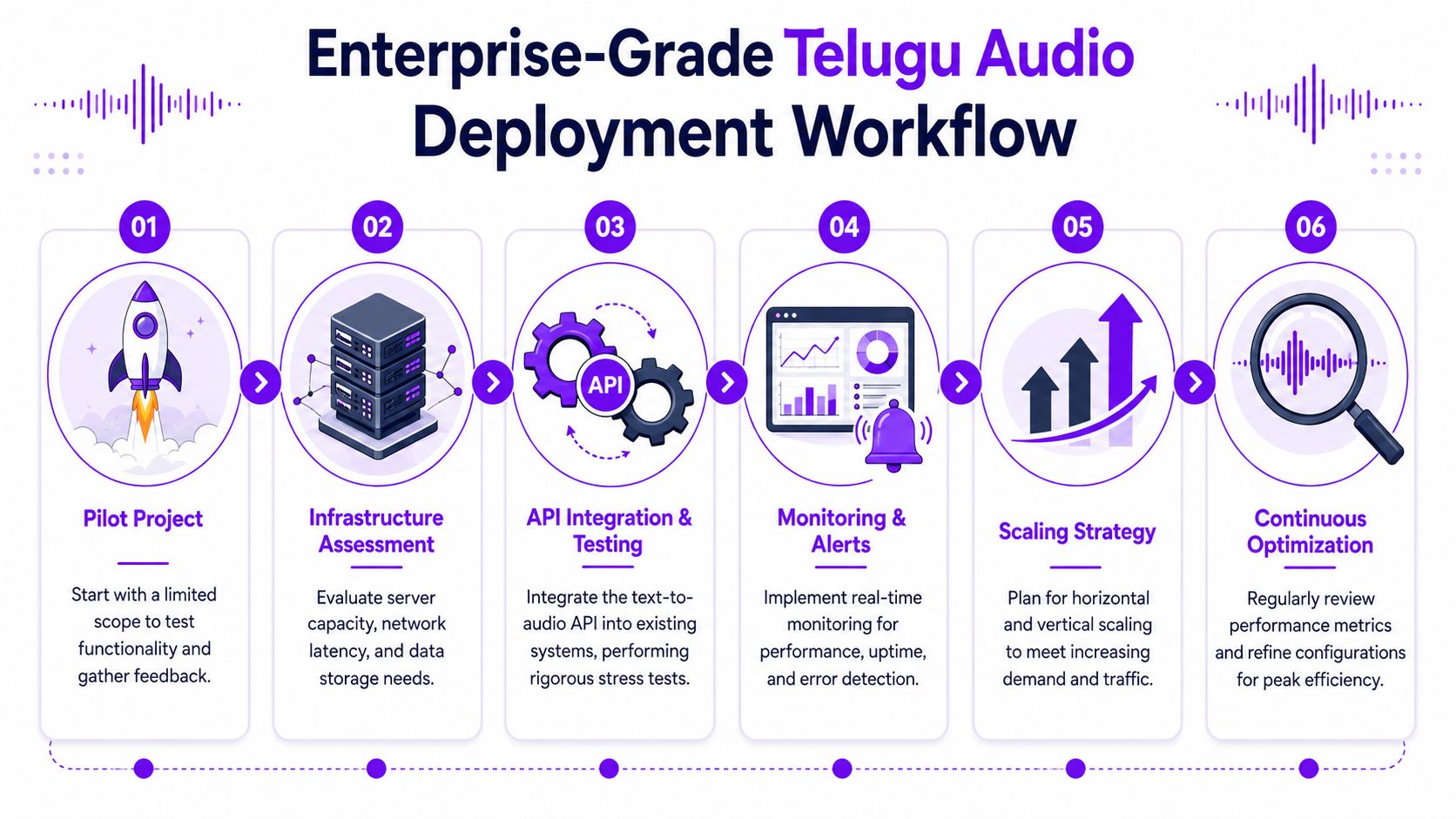
Build QA before volume
Teams usually discover weaknesses in Telugu audio after a pilot starts getting traction. At that point, fixes are harder because scripts, prompts, routing rules, and customer expectations are already in motion.
A serious deployment needs a QA framework that checks more than whether audio was generated successfully. The output must be tested for linguistic accuracy, naturalness, consistency of speaker profile, pronunciation of mixed-language terms, and suitability across dialect contexts. In customer support workflows, benchmark data indicates 92.5% word-level accuracy, while the remaining 8.5% error rate is driven largely by compound-word mispronunciation. Another recurring issue is the omission of context-dependent stress markers, which affects 22% of sentences and reduces comprehension. Sampling rates also matter. Research cited in the verified brief notes that rates below 24 kHz can degrade tonal clarity for Telugu.
That's why QA needs both machine checks and human listening review.
The operational checklist for scale
A scalable deployment model usually includes the following controls.
Script validation before synthesis
Don't let raw text from operational systems flow directly into production audio. Add validation for encoding, approved vocabulary, and content class.Reference phrase libraries
Build a bank of standard Telugu prompts for repeated workflows such as reminders, payment notices, admissions guidance, and customer support callbacks.Dialect testing in the target market
Telugu isn't uniform in real-world usage. If your users span multiple regional speech patterns, test prompts with representative listener groups before broad rollout.Voice profile governance
Limit the number of production voices. Too many variants make quality control harder and weaken brand coherence.Monitoring and alerting
Log synthesis failures, unusual retry patterns, empty audio responses, and low-confidence prompt categories. Operations teams need visibility, not post-mortem surprises.
How to think about ROI without guesswork
For CXOs, ROI doesn't come from “using AI”. It comes from replacing slow, inconsistent, manual communication with repeatable, measurable voice workflows.
A practical measurement model has three layers:
| Measurement layer | What to track | Why it matters |
|---|---|---|
| Quality layer | Pronunciation defects, script rejection rates, listening review outcomes | Protects comprehension and brand trust |
| Operational layer | Audio generation turnaround, reuse of approved prompts, failure handling time | Shows whether the stack is reducing workload |
| Business layer | Contact success, completion of guided tasks, escalation patterns, agent time saved | Connects voice automation to outcomes leaders care about |
The most important scaling insight in Telugu deployments is dialect adaptation. To achieve 97% accuracy matching human judgment, systems must implement speaker-adaptive training for regional dialects. Without that, success rates can fall by 18%. Properly calibrated dynamic voice profiles have also been shown to improve connect rates from 47% to 91%.
Those figures matter because they change the implementation priority list. Many teams focus first on voice aesthetics. In production, the bigger gains often come from effective dialect support, profile calibration, and operational monitoring.
If your pilot sounds good in a demo but isn't tested for regional variation, you don't have a scalable Telugu voice strategy. You have a polished sample.
The deployment mindset should be conservative at the start. Launch in one workflow, measure quality and business response, tighten prompt standards, then expand. That's how a text to audio converter for Telugu becomes enterprise infrastructure instead of a short-lived experiment.
The Strategic Advantage of High-Quality Telugu Audio
High-quality Telugu audio changes the unit economics of customer communication.
The strategic value comes from disciplined execution across the full stack. Engine selection determines whether pronunciation quality holds up in production. Text preparation reduces avoidable synthesis errors before they reach customers. SSML and prosody tuning turn a generic voice into a controlled brand asset. Integration decides whether Telugu audio fits cleanly into CRM, contact center, IVR, learning, and notification workflows. Deployment and scaling practices determine whether quality remains stable under volume, regional variation, and real operating constraints.
For CXOs, the investment case is straightforward. Better audio quality reduces repeat calls, manual intervention, and exception handling. Standardised Telugu prompts improve compliance and message consistency across teams. Well-integrated voice automation shortens turnaround time for outreach and service workflows, while giving operations leaders clearer control over approval, versioning, and QA.
The main advantage is not audio generation by itself. It is the ability to run Telugu voice communication as a managed enterprise capability.
That requires governance. Teams need approval workflows for scripts, listening review standards, fallback logic for failed generations, and performance reporting that links voice quality to business outcomes such as containment, task completion, and agent time saved. Without that operating model, even a strong text to audio converter for Telugu remains a point tool rather than infrastructure.
If you're evaluating how to operationalise Telugu voice automation across support, outreach, onboarding, or education workflows, DialNexa Labs Private Limited is one option to review. Its platform is designed for organisations that need Voice AI agents and workflow integration rather than a basic playback tool, including Telugu-language customer interactions across business functions.

Leave a Reply