
Cloud Based Call Center Solutions: CXO Guide 2026
India's cloud market is expanding at a pace that boards can no longer treat as an IT footnote. NASSCOM reported that public cloud services in India reached about USD 7.8 billion in 2023 and is projected to approach USD 17.8 billion by 2027. For customer operations leaders, that growth changes the investment lens. Cloud based call center solutions are no longer just a technology refresh. They are part of a broader shift in how Indian firms build resilience, scale service capacity, and turn customer interactions into usable commercial insight.
The call centre's role has expanded beyond handling complaints. In many Indian businesses, it now influences conversion, retention, collections, cross-sell, and compliance outcomes at the same time. Every customer conversation can reveal purchase intent, churn risk, product friction, fraud signals, or service bottlenecks. When that information sits in disconnected systems, management reacts late. When it sits inside a cloud platform linked to CRM, analytics, and workforce tools, leadership gets a faster read on where margin is being protected or lost.
That is the strategic change. The contact centre is moving from cost centre to intelligence hub.
For Indian companies managing high-volume customer operations across regions, languages, and channels, architecture choices now shape revenue outcomes. A cloud model can reduce the delays and rigidity associated with legacy telephony, but the larger benefit is managerial. It gives executives a way to standardise service quality, deploy AI where it improves unit economics, and connect front-line interactions to planning decisions. That same logic also applies in sectors where service speed directly affects deal conversion, including businesses adopting real estate CRM solutions and related sales workflows.
The infrastructure layer matters as well. Contact operations depend on network reliability, application performance, and secure distributed access, which is why firms evaluating customer service modernisation often review their cloud-based networking architecture at the same time. The strongest business case comes from treating the call centre as part of a revenue system, not an isolated support desk.
Table of Contents
- Beyond Cost Cutting The Strategic Imperative for Cloud Call Centers
- The Architecture of Modern Customer Communication
- Core Capabilities Enabled by the Cloud
- The Business Case Quantifying the Benefits
- Cloud Call Centres in Action Across Industries
- Your Migration and Evaluation Checklist
- Key Questions for Indian Business Leaders
Beyond Cost Cutting The Strategic Imperative for Cloud Call Centers
Indian enterprises are shifting core operations to the cloud at scale. For boards, that trend is not a technology fashion. It is a capital allocation signal. If finance, commerce, and analytics are becoming cloud first, customer communication cannot remain tied to fixed telephony estates, fragmented reporting, and upgrade cycles that slow every operating change.
That shift changes how a call centre should be evaluated. The relevant question is no longer whether cloud based call center solutions reduce telephony overhead. The more important question is whether they turn customer interactions into a system for protecting revenue, improving conversion, and strengthening control.
In the Indian market, that distinction carries unusual weight. Demand is volatile across festive commerce, lending, insurance renewals, admissions, healthcare scheduling, and service collections. Language diversity increases routing complexity. Compliance scrutiny is rising. Under those conditions, a call centre designed only for cost efficiency becomes a weak management instrument. A cloud model creates a stronger operating layer because it can adapt faster, consolidate decision data, and support AI driven workflows without repeated infrastructure projects.
Why leaders should treat this as infrastructure
Three business pressures now sit on the same stack:
- Customer expectations have changed: Buyers expect fast resolution, consistent context, and continuity across voice and digital channels.
- Commercial demand is uneven: Peaks arrive around campaigns, payment cycles, seasonal spikes, and service disruptions, not in stable monthly patterns.
- Management needs one operating view: Sales, service, fraud, compliance, and collections leaders need shared visibility into customer journeys, not separate reports from separate tools.
A legacy environment handles each pressure with a workaround. A cloud platform addresses them as one design problem.
A contact centre becomes strategic when management measures it by revenue retained, leads converted, collections improved, and compliance exposure reduced.
This represents the board level shift. The contact centre stops being a support utility and starts acting as an intelligence hub. Every interaction adds data on intent, churn risk, payment behaviour, product demand, and service friction. With the right workflows and call routing logic built around customer intent and priority, that data can improve both unit economics and customer outcomes.
The hidden cost of delay
A delayed migration is often framed as caution. In practice, it can preserve structural cost and strategic drag.
| Constraint | What it looks like in practice | Strategic consequence |
|---|---|---|
| Fixed capacity | Infrastructure is sized for peak periods that may last only a few weeks | Lower asset efficiency and weaker cost control |
| Tool fragmentation | Telephony, CRM, QA, and reporting operate in separate systems | Slower decisions, poorer agent context, and weaker conversion |
| Slow adaptation | Workflow changes depend on vendors, custom integrations, or hardware changes | AI deployment, process redesign, and policy updates take longer than the business can tolerate |
For Indian firms, the risk is not limited to inefficiency. It is lost responsiveness. If service teams cannot adjust routing, staffing, and automation quickly, the business absorbs the cost elsewhere through abandoned leads, lower collections, repeat contacts, and avoidable escalation.
The stronger case for cloud is therefore strategic, not cosmetic. It gives management a way to treat customer operations as revenue infrastructure. That is a different investment thesis from simple cost reduction, and it is the one boards should use.
The Architecture of Modern Customer Communication
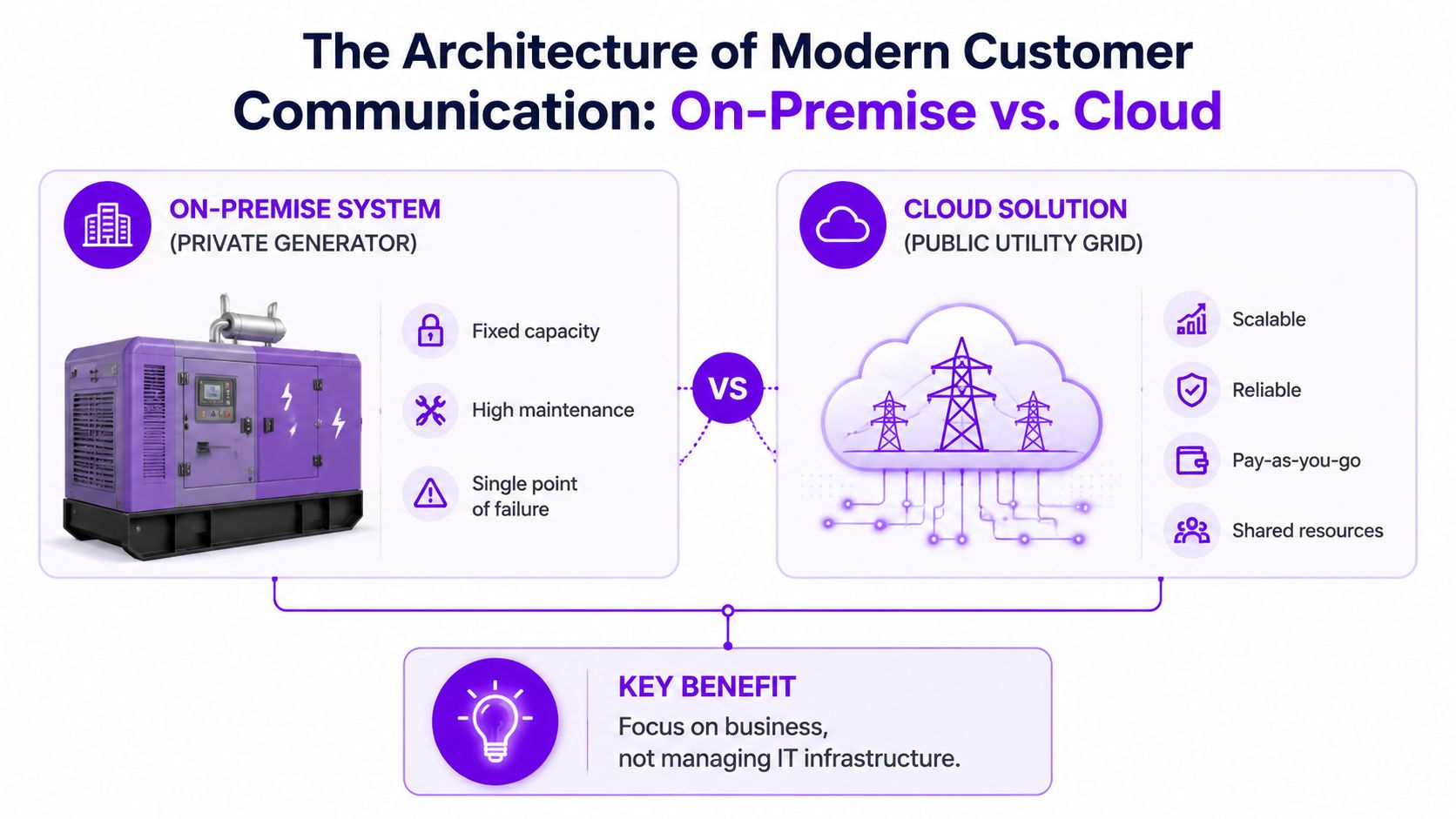
An on-premise call centre is like running your own private generator for an office complex. You buy for peak demand, maintain specialised equipment, absorb failure risk yourself, and still struggle when usage changes suddenly. A cloud platform is closer to plugging into a utility grid. Capacity expands when you need it, the infrastructure is managed centrally, and your team spends less time operating the plumbing.
That distinction sounds technical, but it changes executive options. It determines how quickly you can launch new campaigns, support remote teams, connect business systems, and introduce AI into customer-facing workflows.
Why the architecture changes executive options
The most important technical feature isn't a dashboard or an AI widget. It's elastic capacity. A cloud-based call center can dynamically scale agent seats and routing capacity instead of forcing the business to size fixed hardware for peak load. It also centralises telephony and CRM data so the agent desktop can present caller context immediately, which improves first-contact resolution, as described in Nextiva's explanation of cloud contact centre architecture.
For a CXO, this translates into practical choices:
- Launch faster: New teams, campaigns, or service lines don't have to wait for telecom hardware cycles.
- Operate across locations: Distributed staff can work through the same system rather than improvised local setups.
- Change workflows quickly: Routing logic, scripts, and escalation paths can evolve with business needs.
What sits inside the operating stack
A modern cloud call centre usually combines several layers into one managed environment:
- Voice and routing infrastructure: Incoming and outbound calls, IVR, queue logic, and skill-based distribution.
- Agent workspace: A browser-based or app-based console where agents view customer history, notes, and workflow prompts.
- Integrations: CRM, ticketing, order systems, lead platforms, and compliance logging.
- Analytics and automation: Supervisory dashboards, conversation summaries, QA workflows, and AI support tools.
That stack is why cloud based call center solutions are now tightly linked to broader digital operations. In sectors where lead management matters, teams often pair contact workflows with tools such as real estate CRM solutions so enquiry data, follow-up status, and booking actions remain connected.
For leaders assessing network readiness, it also helps to understand how communication architecture fits into a wider digital stack. A useful primer on that dependency is DialNexa's guide to cloud-based networking.
Practical rule: If your telephony system can't share context with your CRM and workflow tools in real time, you don't have a modern customer operations platform. You have isolated utilities.
The board-level takeaway is simple. Architecture determines whether customer communication behaves like fixed infrastructure or like an adaptive business system. That distinction affects growth capacity, operating resilience, and the speed at which AI can create value.
Core Capabilities Enabled by the Cloud
Boards should assess cloud based call center solutions as operating infrastructure, not as a software feature set. Feature lists change with each vendor release. Operating capabilities shape how quickly the business converts demand, protects service quality, and turns customer interactions into usable commercial insight. For Indian businesses facing uneven demand, multilingual service expectations, and pressure to improve unit economics, that distinction has direct P&L consequences.
Automation that protects scarce human capacity
The first capability is intelligent automation.
Its value is economic before it is technical. IVR, voice bots, workflow prompts, and AI-assisted handling reduce the volume of repetitive work assigned to trained staff. That matters in sectors where skilled agents or counsellors influence conversion rates, retention, or collections outcomes. If those employees spend large portions of the day answering basic eligibility questions, checking payment status, or repeating policy information, management is using expensive labour on low-yield tasks.
Consider an EdTech admissions operation. Early-stage enquiry volumes often spike around exam cycles, result periods, and intake deadlines. Many callers ask the same questions about programmes, fees, eligibility, and counselling availability. A cloud setup can direct these repeatable requests into self-service or automated qualification flows, while counsellors spend time on applicants who need explanation, persuasion, or reassurance. The commercial effect is stronger follow-up quality on higher-intent leads.
This also changes how firms respond to volatility. Instead of solving every surge with more hiring, longer shifts, or lower service standards, management can redesign demand handling at the workflow level.
Unified operations that improve revenue response
The second capability is unification. Cloud systems bring routing, interaction history, and agent workflows into a single operating layer, which is particularly important in India's mobile-first customer environment where one buying journey may move between ad response, phone call, WhatsApp message, and follow-up call.
That operating model improves more than convenience. It improves response quality at the moment revenue is most at risk.
- A real estate lead from a campaign can reach an agent with project, source, and prior enquiry context already visible.
- A support caller can continue an existing issue without repeating the full history.
- A collections team can prioritise outreach through workflow rules tied to risk or delinquency bands, rather than manually sorting spreadsheets.
One design choice matters more than many buyers expect. Routing logic determines whether high-value interactions reach the right team fast enough to protect conversion and service levels. Leaders reviewing this area should understand the business implications of call routing design and logic, because routing often decides whether the platform improves outcomes or merely digitises queue management.
Unified operations let management shape customer journeys by intent, value, and urgency. Fragmented operations force teams to react after the queue has already formed.
Intelligence management can use
The third capability is operational intelligence. Many organisations already collect call recordings, ticket notes, and interaction logs. The problem is that the information sits in separate systems, arrives too late, or lacks enough structure to guide action.
A well-implemented cloud platform converts conversation flow into management input at three levels:
| Level | Management question | What the platform should reveal |
|---|---|---|
| Frontline | Why are queues building right now? | Intent mix, routing pressure, agent availability |
| Team leadership | Where are agents losing time? | Repeated handoffs, after-call work, tool switching |
| Executive | What are customers signalling? | Product friction, demand spikes, lead quality, complaint patterns |
The strategic shift becomes evident as the contact centre stops serving only as a cost centre measured by handle time and staffing ratios. It starts functioning as an intelligence hub that captures buying signals, detects service failures early, and shows where customer demand is changing before those changes appear in monthly reports.
AI has the strongest value when it supports that shift. Its role is not limited to answering simple questions in the IVR. It can classify intent patterns, summarise conversations for supervisors, surface common objections in sales calls, and identify recurring causes of dissatisfaction. For an Indian business operating across languages, regions, and uneven service demand, that intelligence can improve campaign quality, branch performance, and resource allocation.
One option in this category is DialNexa Labs Private Limited, which provides voice AI agents for workflows such as qualification, customer support, recruitment, and presales, and integrates with existing telephony, CRM, and ticketing systems. That is the standard buyers should apply in evaluation. The relevant question is whether AI fits real operating workflows and produces measurable management value, not whether a vendor can demonstrate AI as a standalone feature.
The common thread is straightforward. Cloud changes the unit of value from handling calls to directing customer outcomes, revenue opportunities, and business intelligence in one system.
The Business Case Quantifying the Benefits
Indian enterprises that still treat the contact centre as a support overhead often miss a larger balance-sheet effect. Every missed callback, abandoned service request, or delayed collections conversation has a revenue consequence, even when it is booked under operations rather than sales.
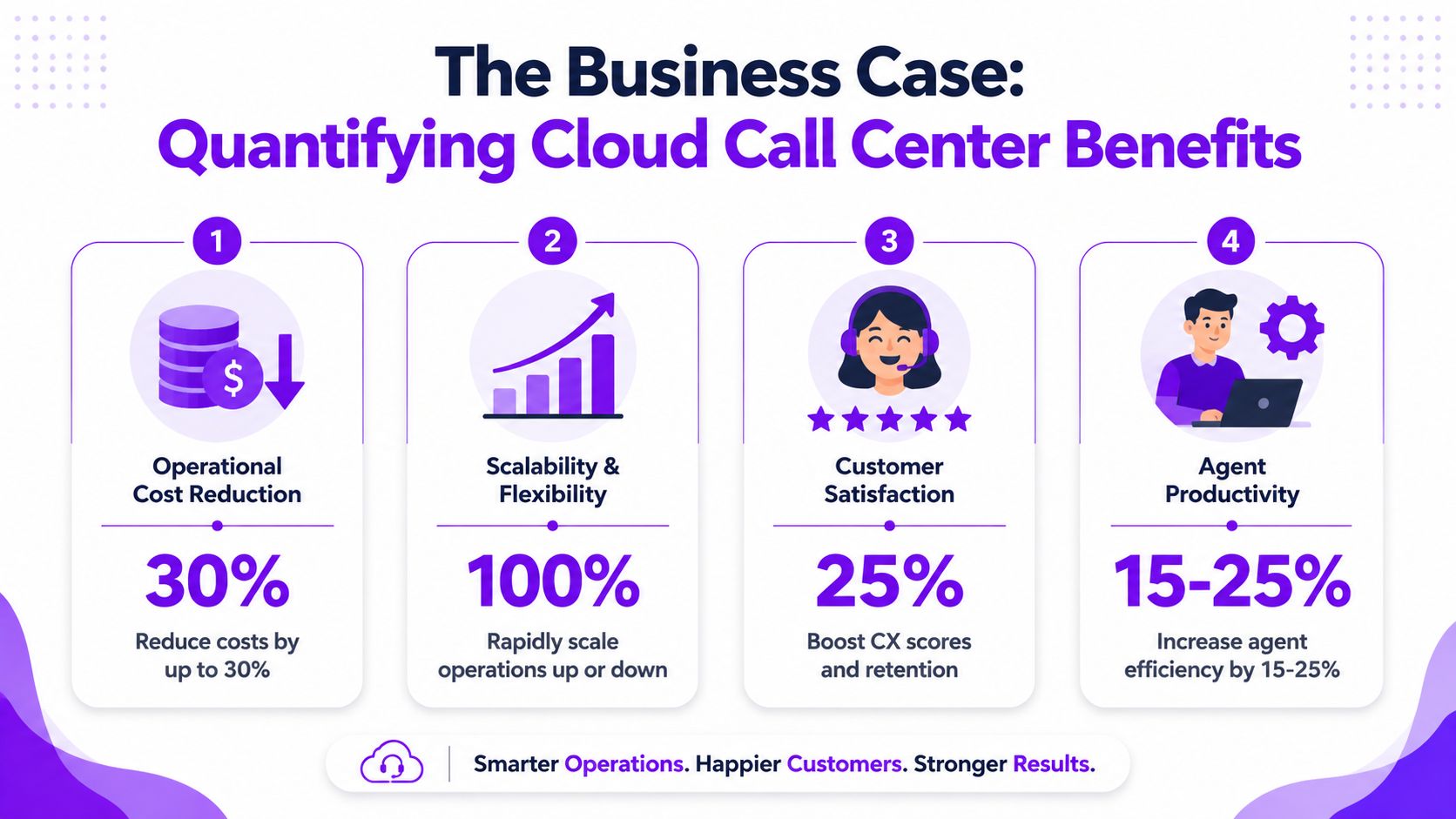
The business case for cloud based call center solutions is stronger when management evaluates communication as a revenue infrastructure layer, not a telephony line item. The comparison is between a fixed-cost setup built for average demand and a variable model that can support growth, protect service continuity, and improve conversion economics.
Financial flexibility and operating control
On-premise environments usually require capacity decisions before demand is clear. Companies pay for hardware, implementation, maintenance contracts, and periodic upgrades whether utilisation is high or low. Cloud shifts that cost structure toward operating expenditure and makes capacity easier to adjust.
That change matters most in Indian sectors with uneven demand patterns, such as admissions, lending, insurance servicing, healthcare scheduling, and festival-led retail support. In those environments, overprovisioning ties up capital. Underprovisioning damages response times at the exact moment commercial intent is highest.
Management usually sees value in three areas:
- Faster scaling during demand spikes: Teams can add seats, campaigns, or remote capacity without waiting for infrastructure procurement cycles.
- Lower cost of experimentation: New support lines, outbound sales motions, or regional language workflows can be tested with less sunk cost.
- Stronger capital allocation discipline: Funds that would have gone into telephony estate maintenance can be redirected to customer acquisition, branch expansion, or product development.
Vendor selection affects whether these gains appear in practice. A useful starting point is to compare cloud telephony providers for Indian business communication needs based on integration depth, routing controls, reporting quality, and support for distributed operations, rather than headline pricing alone.
Reliability belongs in the same financial model. If the contact centre supports collections, lead qualification, policy servicing, or appointment booking, downtime is not just an IT event. It interrupts revenue, slows cash flow, and increases the cost of recovery.
Revenue protection and conversion economics
The larger upside often sits outside the IT budget. Better routing, faster deployment, and integrated customer context can reduce the revenue lost between first contact and resolution.
A board-level discussion is more useful when it starts with leakage points than with software features.
| Leakage point | Typical legacy symptom | Financial consequence | Cloud-enabled response |
|---|---|---|---|
| Lead response | Delayed callbacks and missed handovers | Lower conversion on high-intent enquiries | Faster routing, campaign deployment, and queue management |
| Customer retention | Repeated issue explanation and poor continuity | Higher churn risk and more repeat handling cost | Shared customer context across teams and channels |
| Service continuity | Local outages interrupt operations | Lost collections, bookings, or service transactions | Centralised operations with failover planning |
| Managerial oversight | Reports arrive late or lack detail | Slow corrective action and weak accountability | Near real-time operational visibility |
This short explainer gives a quick visual overview of how modern contact centre economics and operations fit together:
A hard ROI model should include more than licence and telecom savings. It should test four value pools against current operating data: lower fixed infrastructure cost, better utilisation during demand volatility, reduced business interruption risk, and higher commercial yield from customer interactions.
That framing changes the investment decision. For Indian businesses operating across regions, languages, and volatile demand cycles, the contact centre can move from a cost-control function to an AI-ready intelligence and revenue engine, provided the migration is tied to measurable commercial outcomes rather than treated as a software refresh.
Cloud Call Centres in Action Across Industries
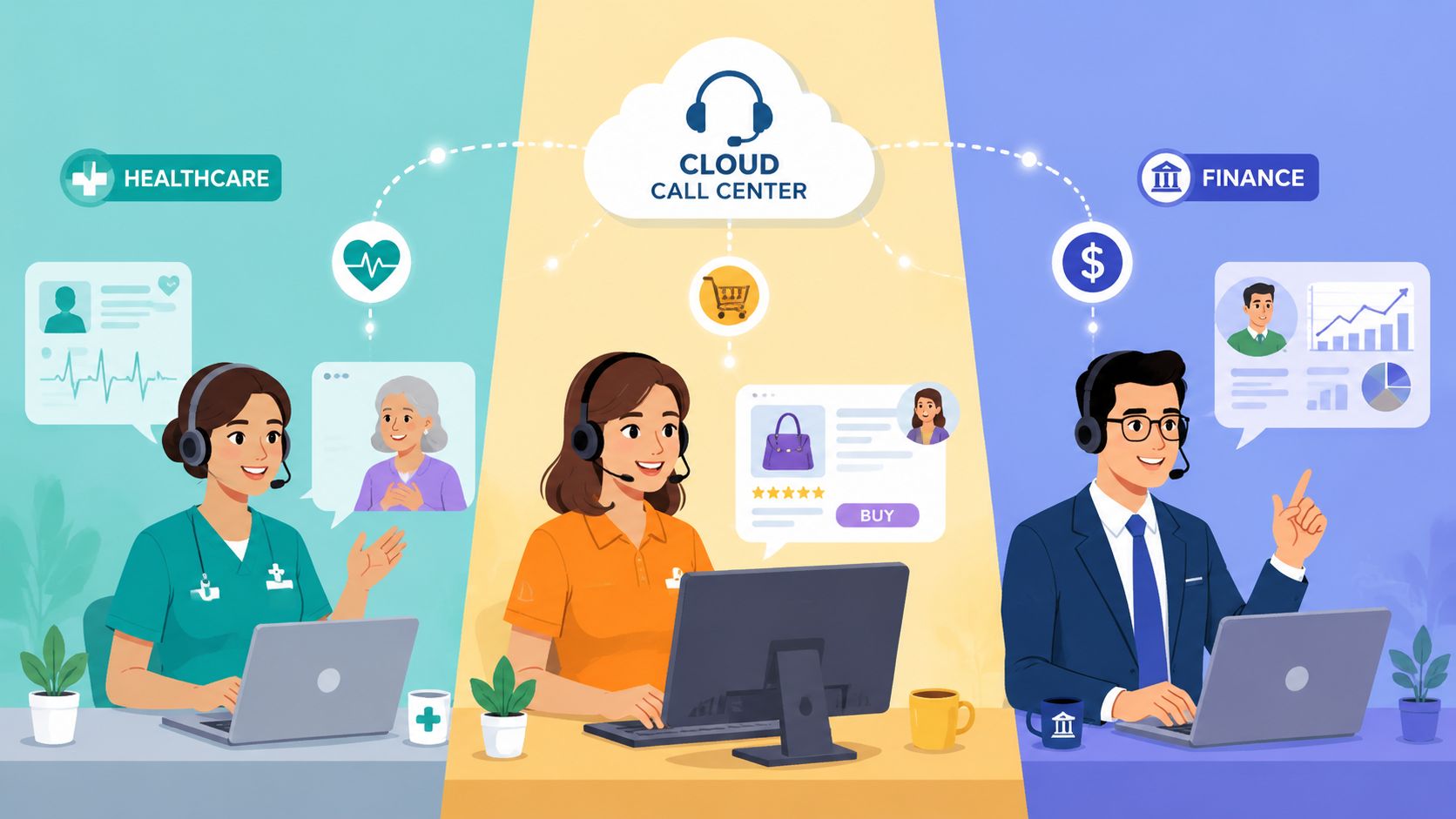
Industry examples matter because the same platform can create very different value depending on what the business is trying to protect. In some sectors, the priority is lead conversion. In others, it's compliance, continuity, or service load management.
Where the model changes outcomes
EdTech operations often face intense spikes around admissions windows, counselling, and payment follow-up. A cloud call centre helps by separating repetitive informational calls from high-intent counselling conversations. Management gets two advantages: better utilisation of counsellors and cleaner visibility into where applicants are dropping out of the journey.
BFSI teams tend to care less about volume alone and more about traceability, customer identity workflows, and controlled communication. Here, the cloud model is useful when it combines routing discipline, recording controls, and audit-friendly workflows. The strategic win is consistency. Every conversation path can be designed, monitored, and refined.
Real estate teams benefit when enquiry handling, qualification, and booking coordination sit close to the CRM. Instead of losing prospective buyers across manual follow-ups, the business can run a more disciplined flow from first call to site visit scheduling. The revenue value doesn't come from “more calls”. It comes from faster qualification and fewer missed handovers.
What executives should notice in these examples
The strongest use cases usually share four characteristics:
- Demand is variable: There are spikes driven by campaigns, seasonality, or event-based triggers.
- Response speed matters: Delay reduces conversion, retention, or collection success.
- Context matters: Agents need prior interaction history to work effectively.
- Management needs visibility: Leaders want to see why interactions happen, not just how many occurred.
Healthcare and e-commerce show this pattern clearly. A healthcare platform may use cloud workflows for appointment handling, reminder calls, and patient support triage. An e-commerce brand may use the same model for order status, return requests, and exception handling during peak sale periods. The workflows differ, but the executive logic is the same: use automation for routine interactions, reserve human judgement for exceptions, and preserve one operating view across the journey.
The contact centre becomes commercially important when it compresses the time between customer intent and business response.
These examples also explain why the old “cost centre” label is no longer adequate. In many Indian businesses, the contact function now sits directly on top of lead velocity, customer trust, collections discipline, and service continuity. That's a revenue and risk system, not merely a support desk.
Your Migration and Evaluation Checklist
Migration succeeds when leadership treats it as an operating redesign, not a software swap. The best buying teams don't start with a feature comparison grid. They start with the conditions the business must satisfy after go-live.
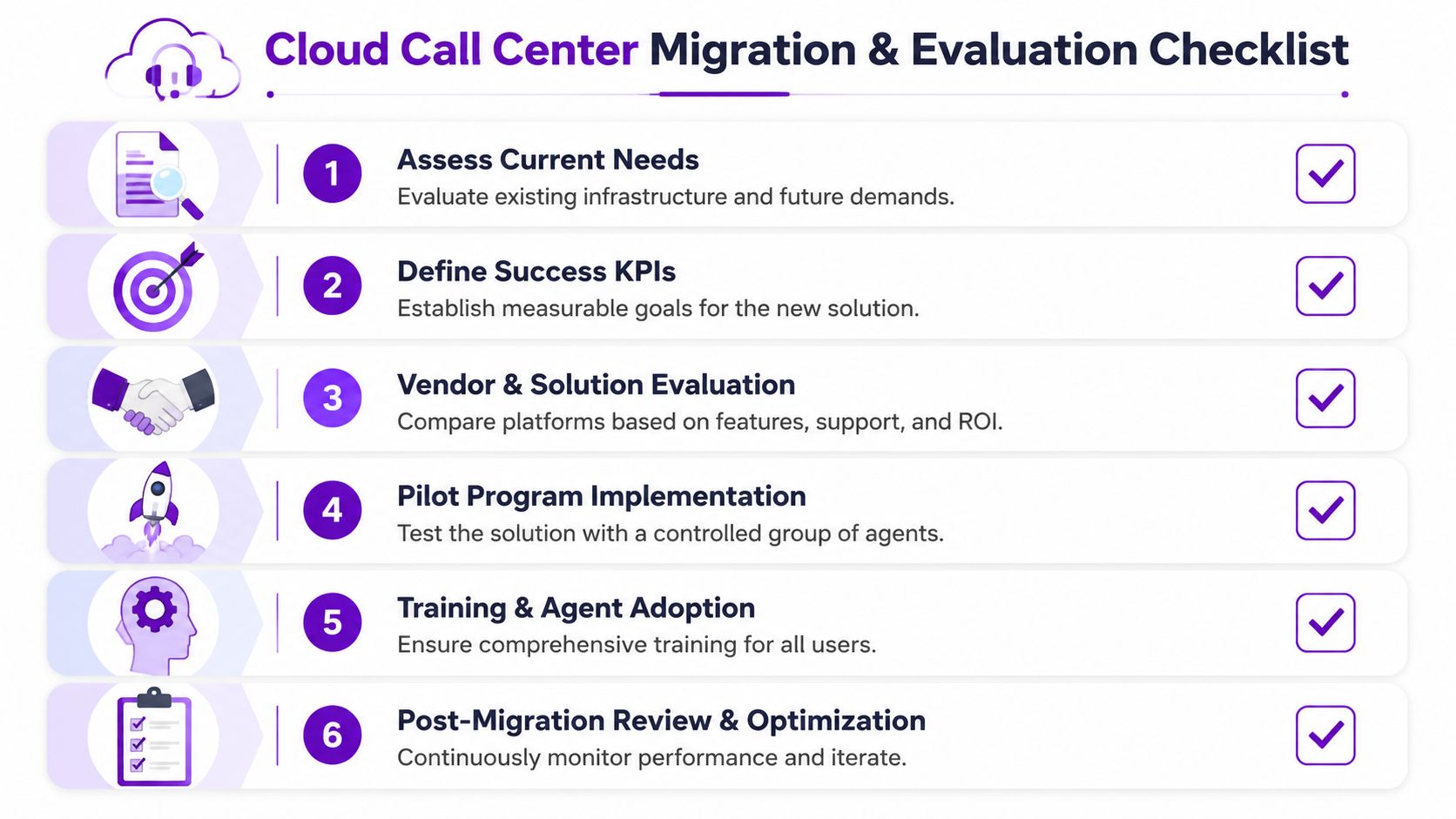
The six decisions that matter most
Assess current constraints
Identify where the present setup fails. Queue surges, reporting delays, poor integration, remote team friction, and local outage exposure should all be documented before vendor evaluation begins.Define board-level success
Don't approve migration on vague language such as “modernisation”. Tie the programme to measurable internal goals like faster deployment, better utilisation of skilled staff, stronger compliance controls, or improved service continuity.Map integration dependencies
The most important technical question is often not telephony. It's whether the platform can work with your CRM, ticketing, identity, lead, and reporting systems without creating a second layer of manual work.Pilot before full cutover
Start with one function, one geography, or one customer journey. That reveals process issues early and gives operations leaders evidence before they ask frontline teams to change at scale.Train supervisors, not just agents
Agent training is necessary, but supervisors determine whether the platform produces better outcomes. They need to understand routing logic, exception handling, reporting, and workflow changes.Review the supplier ecosystem
Platform quality matters, but support capability matters too. Teams comparing providers should look closely at service design, implementation support, and change responsiveness. DialNexa's overview of cloud telephony providers is a useful starting point for framing that vendor market.
Questions worth asking every vendor
Use these questions in procurement meetings:
- How does the platform handle failover and continuity during local connectivity problems?
- What customer and call records remain traceable for audit purposes?
- How are routing, recordings, and agent actions surfaced to supervisors?
- Which integrations are native, and which require custom work?
- Can we phase migration by workflow or location rather than cut everything over at once?
- What operational changes will our managers need to make for the platform to deliver value?
Buy for operating fit, not product theatre. A polished demo is irrelevant if your supervisors can't manage exceptions and your compliance team can't defend the data trail.
A disciplined checklist protects the budget in two ways. It reduces implementation surprises, and it stops the organisation from buying features that look advanced but don't solve the actual bottlenecks in customer operations.
Key Questions for Indian Business Leaders
Global cloud contact centre advice often skips the operational conditions Indian firms face. That omission creates risk at procurement stage because the most important questions aren't always about features. They're about survivability, traceability, and integration with what already exists.
How do we plan for uneven connectivity
This should be a board-level question, not an afterthought. Generic messaging says cloud works anywhere with internet access. In practice, Indian businesses need to ask how the system behaves on weak links, during short outages, and across distributed teams.
That concern is grounded in the scale and unevenness of the telecom environment. India had about 1,182.04 million telecom subscribers and 2,000 million broadband subscribers as of March 2025, as noted in Zendesk's discussion of cloud call centre realities. Large-scale adoption doesn't remove last-mile variability across cities and Tier 2 and Tier 3 locations.
Boards should insist on design answers in three areas:
- Link redundancy: What happens when a primary connection degrades?
- Local survivability: Can teams continue essential operations during short interruptions?
- Quality protection: How are voice quality, logging, and routing maintained under constrained conditions?
What should leadership ask about compliance and auditability
Compliance is becoming more important because customer communication systems increasingly sit at the intersection of cloud, AI, and regulated data handling. For Indian businesses in BFSI, healthcare, and education, that raises questions about consent, recording retention, customer communications, and defensible audit trails.
This issue is gaining relevance as enterprise AI adoption accelerates. The government's India AI Mission was approved with an outlay of ₹10,371.92 crore, a point highlighted in Zoom's overview of cloud contact centres. That doesn't tell you what to buy. It tells you the environment is moving toward more AI-enabled operations, which makes governance design more urgent.
Leadership teams should ask:
| Compliance area | Question to ask internally | Why it matters |
|---|---|---|
| Consent | When and how is customer consent captured? | It affects recording and downstream data use |
| Retention | How long are recordings and transcripts kept? | Sectoral rules may differ by workflow |
| Audit trail | Can actions and communications be traced end to end? | Reviewability matters in disputes and inspections |
| AI usage | Where does automation influence customer interaction? | Defensibility matters when decisions are challenged |
Can cloud based call center solutions work with legacy systems
Yes, if integration is treated as a design programme rather than a checkbox. Most Indian organisations won't replace every system at once. They'll operate with a mix of CRM platforms, on-premise databases, local reporting tools, and workflow applications.
That means the practical question isn't “cloud or legacy”. It's “which workflows should move first, and how will data stay consistent while both environments coexist?” In many cases, the safest path is phased integration. Start with high-friction customer journeys, prove operational stability, and only then expand.
The companies that do this well don't chase a perfect architecture diagram. They sequence the migration around business risk. That's the right mindset for Indian customer operations.
If your team is evaluating how voice AI, routing, and cloud contact workflows could fit into your current customer operations stack, DialNexa Labs Private Limited is one option to review. The company builds voice AI agents for qualification, support, presales, recruitment, and related call workflows, with integration into existing telephony, CRM, and ticketing environments.

Leave a Reply