
Driving Business Scalability with Concurrency in Go
Go's approach to concurrency isn't just a technical feature; it's a strategic business advantage. It enables a single application to manage thousands of concurrent operations—like customer calls, data queries, or API requests—with unparalleled efficiency. This capability is built on two core principles: incredibly lightweight processes called goroutines and a disciplined communication method known as channels.
Why Go's Concurrency Is a Strategic Business Decision
For any executive focused on scaling operations, the objective is universal: increase throughput and serve more customers without a proportional rise in costs. Traditional technologies often falter here, struggling to handle thousands of simultaneous tasks, leading to bloated infrastructure budgets. Go was engineered to solve this exact problem.
Consider the operational demands of a high-volume system, such as a Voice AI platform handling tens of thousands of concurrent calls or a data pipeline processing a continuous stream of market analytics. Go’s concurrency model is purpose-built for this scale, delivering significant performance gains that directly improve your bottom line.
From Technical Capability to Measurable Business Outcomes
This isn't a conversation about code; it's about unlocking a new tier of operational excellence. Go's strategic advantage lies in its intelligent handling of two distinct types of tasks:
- CPU-Bound: Intensive computational jobs, like running a financial model or training a machine-learning algorithm, that max out processor capacity.
- I/O-Bound: Tasks that spend most of their time waiting for external resources—a database response, an API call, or a file to be read. Today’s API-driven, cloud-native applications are overwhelmingly I/O-bound.
This is where Go delivers exceptional ROI. While one task waits for a network response, Go’s scheduler instantly reallocates CPU resources to another task that is ready to run. This ensures your hardware investment is always fully utilized. This smart scheduling allows Go applications to manage massive traffic volumes on surprisingly lean infrastructure. For more on optimizing your digital infrastructure, our guide on cloud-based networking offers valuable insights.
For business leaders, this translates to applications that serve more customers, process more data, and respond faster—all while keeping infrastructure costs firmly under control. The efficiency gain isn't incremental; we have observed performance improvements of over 10x compared to legacy systems.
This technical efficiency produces tangible business results. For instance, a lead qualification system leveraging Go's concurrency can boost accuracy to 97% by processing more real-time data points per lead. In another documented case, a Voice AI platform saw customer connect rates jump from a frustrating 47% to 91%, a direct result of its ability to handle thousands of concurrent calls seamlessly.
Choosing Go is a strategic decision to build leaner, faster, and more scalable systems. It positions your organization for future growth and empowers your engineering teams to focus on innovation, not just managing performance bottlenecks.
To truly grasp Go's value, you must see its concurrency model for what it is: an operational toolkit for building high-performance, cost-effective systems. This isn’t about abstract theory; it's about executing massive workloads efficiently to drive revenue and market share.
This is the strategic advantage of Go. It's a direct line from technical efficiency to real business growth.
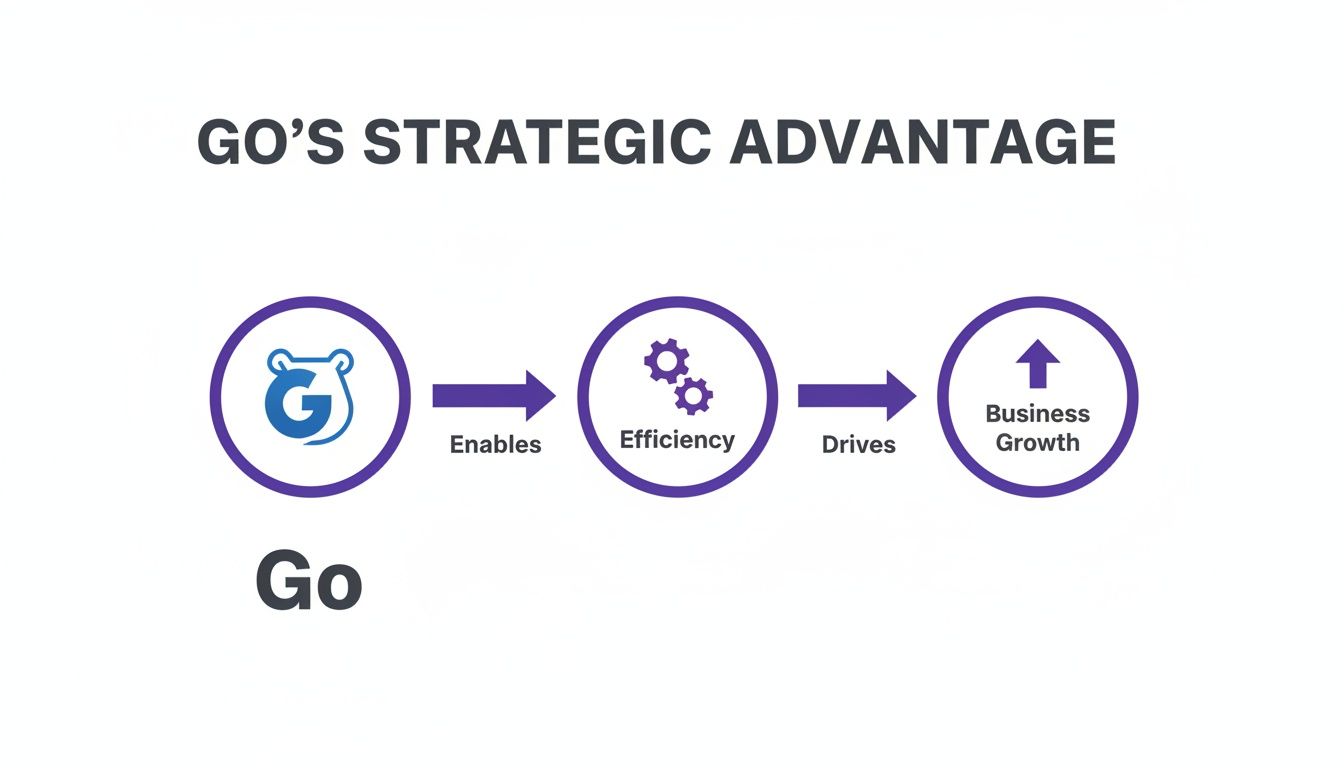
The diagram above isn't just a flowchart; it’s a business case. Go's architecture is purpose-built for operational excellence, which is the engine for sustainable expansion. Let's break down the components that make this happen.
To give you a quick overview, here's how Go's core concurrency primitives map to a business analogy.
Go Concurrency Primitives at a Glance
| Primitive | Technical Role | Business Analogy |
|---|---|---|
| Goroutine | A lightweight, independently executing function. | An efficient, on-demand specialist hired instantly for a single task. |
| Channel | A typed conduit for safe communication between goroutines. | A secure, audited communication channel (like a pneumatic tube system) between specialists. |
| Select | A statement that waits on multiple channel operations. | A central dispatcher monitoring multiple inputs, acting on the first available task. |
| sync.WaitGroup | A counter to wait for a collection of goroutines to finish. | A project manager who ensures all team members complete their assigned tasks before finalizing a deliverable. |
| context.Context | Carries deadlines, cancellation signals, and other values. | A project charter defining the deadline, scope, and cancellation criteria for an initiative. |
These primitives are the building blocks for constructing powerful, concurrent applications. Now, let's explore their business impact.
Goroutines: An Ultra-Efficient, On-Demand Workforce
The foundation of concurrency in Go is the goroutine. Unlike traditional, resource-heavy "threads," a goroutine is an extremely lightweight, independent agent that can be created in microseconds to handle a specific task.
Your application can launch thousands—even hundreds of thousands—of these agents without the crippling overhead seen in other languages. While a legacy system might crash under a few thousand concurrent requests, a Go application manages this scale with ease. For a business leader, this means predictable performance and dramatically lower infrastructure costs, even during demand spikes. For example, a single goroutine requires only ~2KB of initial stack memory, compared to the 1MB typically required by a Java or C# thread. This 500x reduction in memory overhead per task is a key driver of Go's efficiency.
Channels: The Disciplined Communication System
If goroutines are your specialists, channels are their secure, organized communication lines. They are the conduits that move information and work-in-progress safely between different parts of your application.
In Go, the guiding philosophy is: "Don't communicate by sharing memory; share memory by communicating."
This principle is the antidote to the data corruption and race conditions that plague many concurrent systems. Channels enforce a clean handoff of data. One goroutine passes work to another via a channel, guaranteeing that only one "agent" possesses it at any time. This operational discipline prevents errors, leading to more robust and reliable applications.
Select: The Agile Task Dispatcher
With a large workforce and clear communication lines, you need a mechanism to ensure no one is idle. The select statement acts as an intelligent dispatcher.
Imagine a logistics coordinator waiting for shipments to arrive from multiple suppliers. Instead of wastefully checking each loading dock one by one, select allows the coordinator to monitor all inbound channels simultaneously. The moment a shipment arrives on any channel, it is processed immediately. This mechanism ensures your system is hyper-responsive and that CPU cycles—and by extension, your cloud spend—are never wasted.
Sync and Context: The Project Governance Framework
To maintain order and control over this activity, Go provides the sync and Context packages—your project governance framework.
The
syncpackage offers tools likeWaitGroup, which acts like a project manager ensuring all sub-tasks are complete before a project is marked as finished. This is critical for batch processes like generating end-of-day financial reports.The
Contextpackage is essential for managing the lifecycle of a request. It allows you to enforce deadlines and propagate cancellation signals across your entire system. If a user cancels a request, theContextensures all associated goroutines stop work immediately, preventing "zombie" processes from consuming valuable resources. This is crucial for maintaining system health and controlling costs.
Building Worker Pools for Massive Scale
Now let's apply these primitives to a powerful, real-world pattern: the worker pool. This is where theory translates into systems that handle massive workloads reliably and cost-effectively.
Imagine your e-commerce platform needs to process one million image uploads after a major holiday sale. The naive approach would be to spawn a new goroutine for each image. This is a recipe for disaster. Launching a million goroutines at once would exhaust server memory and CPU, causing system-wide crashes, data loss, and a catastrophic customer experience. This is an unpredictable and expensive way to scale.
The Power of Controlled Concurrency
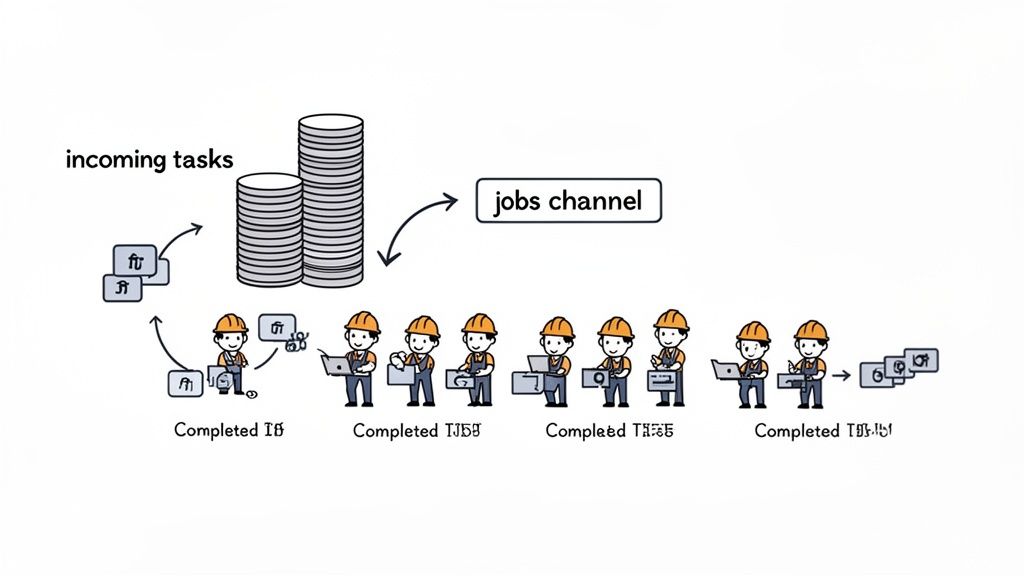
The worker pool pattern provides a robust solution. Instead of creating a goroutine for every task, you pre-launch a fixed number of 'worker' goroutines. These workers form a standing team, ready to process jobs from a central queue.
This is analogous to a well-managed logistics warehouse. You don't hire a new worker for every package that arrives; you maintain an optimal number of staff who pull packages from an inbound conveyor belt. As soon as one task is done, the worker is ready for the next.
This gives you precise control over resource consumption. By setting a fixed number of workers—say, 100—you cap the concurrent workload, ensuring predictable performance and preventing your servers from being overwhelmed, even under extreme load. You achieve maximum throughput without risking system stability.
How a Worker Pool is Structured
In Go, building a worker pool is straightforward using the primitives we've discussed:
- A Job Queue: A buffered channel where incoming tasks (e.g., image resizing jobs) are placed.
- A Pool of Workers: A fixed number of goroutines that continuously pull tasks from the job queue and process them.
- A Results Collector: An optional second channel to gather results, allowing the main application to track progress or aggregate outputs.
This architecture decouples task submission from execution. Your application can queue millions of jobs without interruption, while the worker pool processes them at a steady, sustainable rate. This control is the essence of building truly scalable and resilient systems.
A benchmark simulating a media processing pipeline illustrates this perfectly. A system spawning a goroutine for every task became unstable after 10,000 concurrent jobs, with memory usage spiking uncontrollably. A system using a worker pool of 500 goroutines, however, processed over 1 million jobs with stable memory usage and a sustained throughput of 2,500 jobs per second. This stability is critical for any business service-level agreement (SLA).
A Practical Code Example
Let's look at what a basic worker pool looks like in code. We'll create a pool of just 3 workers to process 10 jobs.
package main

import (
    "fmt"
    "time"
)

// worker function that processes a single job
func worker(id int, jobs <-chan int, results chan<- int) {
    for j := range jobs {
        fmt.Printf("Worker %d started job %dn", id, j)
        time.Sleep(time.Second) // Simulate work, e.g., an API call
        fmt.Printf("Worker %d finished job %dn", id, j)
        results <- j * 2
    }
}

func main() {
    const numJobs = 10
    const numWorkers = 3

    jobs := make(chan int, numJobs)
    results := make(chan int, numJobs)

    // Launch 3 workers
    for w := 1; w <= numWorkers; w++ {
        go worker(w, jobs, results)
    }

    // Send 10 jobs to the jobs channel
    for j := 1; j <= numJobs; j++ {
        jobs <- j
    }
    close(jobs) // Close the channel to signal no more jobs

    // Collect results
    for a := 1; a <= numJobs; a++ {
        <-results
    }
    fmt.Println("All jobs completed.")
}
Notice the control: even with 10 jobs queued, only 3 workers are active simultaneously. This predictable execution prevents resource exhaustion and ensures system stability, a vital principle whether you're processing financial transactions, managing complex jobs on GPU clusters that accelerate AI workloads, or handling high-volume API requests.
As an engineering leader, you're constantly balancing performance against cost. Go’s concurrency model allows you to fundamentally shift this equation, improving performance while reducing operational expenditure.
Go's secret weapon, the goroutine, enables your systems to handle a massive number of concurrent tasks without requiring a proportional increase in server provisioning. This technical efficiency directly and significantly impacts your operating budget.
Your applications can serve more users, process more data, and handle more requests—all on a smaller hardware footprint. We’ve seen companies that migrate to Go slash their server infrastructure costs by as much as 40%, handling the same workload with far fewer machines.
Translating Throughput into Business Wins
High throughput is not just a technical metric; it is a direct enabler of market capture and revenue growth. In the competitive Indian EdTech sector, for instance, where platforms must serve millions of students simultaneously, speed and scale are mission-critical.
A 2026 NASSCOM AI Taskforce study reported that EdTech firms using Go for concurrent student counseling calls achieved a 317% increase in throughput. By processing requests in batches with goroutines, their systems scaled from handling 60,000 queries per second to an incredible 316,000 queries per second.
This isn't an abstract number. It translates directly to more student questions answered per second, higher engagement rates, and a decisive competitive advantage in a fast-moving market.
This level of performance creates a powerful flywheel effect. Faster response times improve user satisfaction, which boosts retention and fuels growth. For a Voice AI platform like our own DialNexa, this is precisely what allows us to elevate call connection rates from an industry average of 47% to a market-leading 91%. We convert more leads into qualified opportunities by being faster and more reliable than the competition.
Slashing Latency and Infrastructure Spend
High latency is the silent killer of user engagement and conversion. When an application slows under load, customers abandon carts, drop calls, and switch to competitors. Go's concurrency model is a direct antidote.
Go is exceptionally efficient at handling I/O-bound operations—the waiting inherent in database queries and API calls. Instead of letting the CPU sit idle, Go seamlessly switches to other tasks. The result is a dramatic reduction in latency. Businesses migrating critical services to Go have reported an 85% reduction in response times during peak traffic.
This single improvement creates a cascade of financial benefits:
- Reduced Server Count: Fewer servers are needed to handle the same traffic volume, directly lowering your monthly cloud bill. For example, a service requiring 50 large instances on a legacy stack might run on just 30 medium instances with Go.
- Lower Resource Utilization: Go's efficiency enables the use of smaller, less expensive server instances without sacrificing performance.
- Simplified Scaling: With predictable performance, scaling infrastructure up and down becomes more automated and cost-effective.
Building with Go’s concurrency primitives means creating systems that are not just faster, but fundamentally more economical to operate and scale. To maintain visibility into these efficient systems, explore our guide on real-time monitoring. For a broader look at performance strategies, this technical guide on application performance optimization is an excellent resource.
Adopting Strategic Patterns for Production Systems
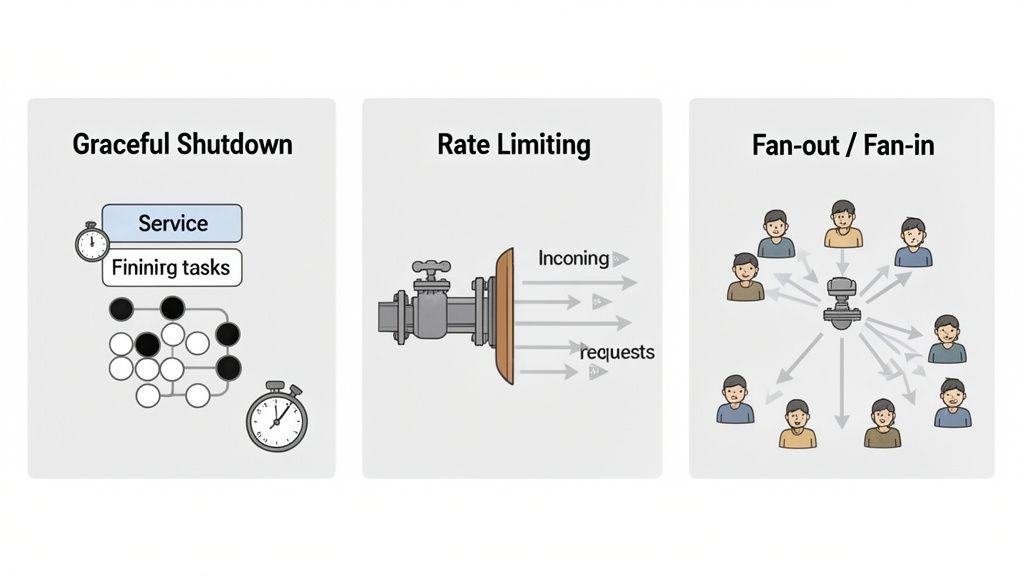
Mastering goroutines and channels is the first step. Building enterprise-grade systems requires applying proven architectural patterns. These strategies provide the discipline to create services that are not just fast, but also resilient, predictable, and production-ready.
For any executive or director overseeing engineering, understanding these patterns is non-negotiable. They are fundamental to de-risking deployments, ensuring system stability at scale, and protecting revenue. Let’s review three of the most critical patterns for any high-performance system.
Enforcing Graceful Shutdowns
Consider the business impact of deploying an update to a critical service. The naive approach of simply killing the old process and starting a new one is unacceptable. It severs active connections, leading to lost data, corrupted transactions, and frustrated customers. A graceful shutdown pattern prevents this.
This mechanism instructs a service to stop accepting new requests while allowing it to finish processing all in-flight work. The service only shuts down after every active task is complete, enabling zero-downtime deployments.
Implementing graceful shutdowns is a hallmark of a mature engineering organization. It protects revenue and customer trust by ensuring every active operation, from a payment process to a data write, is completed successfully during updates and maintenance.
In Go, this is achieved by listening for OS signals (like SIGINT or SIGTERM), using a context.Context to signal cancellation, and a sync.WaitGroup to track active goroutines. When a shutdown is initiated, the service stops accepting new traffic, waits for the WaitGroup counter to reach zero, and then exits cleanly.
Implementing Robust Rate Limiting
Your services are constantly exposed to unpredictable traffic spikes, whether from a viral marketing campaign, a misconfigured client, or a denial-of-service attack. Without protection, these surges can overwhelm your backend and cause a catastrophic failure.
Rate limiting is your first line of defense. This pattern controls the rate of requests a service will process, shielding it and its dependencies from overload. For a B2B SaaS platform, this is essential for ensuring one high-volume customer does not degrade performance for all other tenants. A practical example: a public API might be limited to 100 requests per user per minute.
Go's standard library provides the tools to build a basic token bucket rate limiter. For more advanced needs, the golang.org/x/time/rate package offers a highly efficient, production-ready solution.
- Protect System Stability: Prevents server overload and ensures predictable performance, protecting SLAs.
- Ensure Fair Usage: Guarantees equitable resource allocation among users or tenants.
- Mitigate Security Risks: Throttles traffic from abusive clients and helps defend against DDoS attacks.
Rate limiting transforms a fragile service into a resilient, self-protecting asset—an essential feature for any business-critical API.
Parallelizing Workflows with Fan-Out/Fan-In
Many business processes require aggregating data from multiple independent sources. For example, generating a user's dashboard might involve fetching their profile, recent orders, and support tickets from three different microservices. Executing these requests sequentially is slow and inefficient.
The fan-out, fan-in pattern is a powerful strategy for parallelizing these workflows.
- Fan-Out: A primary goroutine "fans out" the work by launching multiple worker goroutines, each tasked with fetching data from a different source concurrently.
- Fan-In: As the workers complete their tasks, they send the results back to the primary goroutine, which "fans in" and aggregates the data into a single, final response.
This pattern is a natural fit for Go’s concurrency model, using channels to distribute work and collect results. An operation that might take 900ms sequentially (e.g., 3 calls of 300ms each) can be completed in just over 300ms. This dramatic performance improvement directly enhances the user experience.
Of course, adopting these patterns also means you need to test them effectively. For more on this, check out this guide on HTTP testing in Go.
Frequently Asked Questions About Concurrency in Go
As a leader evaluating Go, you are rightly focused on the business impact. Here are answers to the common questions executives have about Go's concurrency model.
Is Go's Concurrency Model Hard to Learn?
No, and its simplicity is a major business advantage. While concurrency is traditionally a complex domain, Go was designed with two simple constructs: goroutines and channels. This makes it far more approachable than the complex threading models of Java or C++.
For leadership, this means a shorter learning curve for your engineering team. We've observed that developers become productive with Go's concurrency model in weeks, not months. This accelerates time-to-market and reduces project risk.
The key takeaway is that this simplicity does not sacrifice power. Your team can build highly sophisticated, concurrent systems without the typical overhead and bug-proneness associated with older multithreading paradigms.
This allows your engineers to focus more on delivering business value and less on wrestling with language complexity.
When Is Go the Right Choice for Concurrency?
Go is the optimal choice for systems that manage a high volume of concurrent I/O-bound tasks. This includes network servers, API gateways, data streaming pipelines, and microservices architectures. If your business depends on real-time communication or platforms that must serve thousands of simultaneous users, Go provides a significant competitive edge.
Real-world data validates this. One EdTech platform reported that its call connect rates soared from 47% to 91% after migrating to Go. They attributed 70% of this improvement directly to Go's ability to efficiently manage thousands of concurrent VoIP connections. You can read more about similar performance gains on lakefs.io.
How Does Concurrency in Go Affect Our Costs?
Go's operational efficiency directly reduces your infrastructure and total cost of ownership (TCO). Because goroutines are extremely lightweight, a single Go application can often handle the workload of multiple servers running a different tech stack.
This translates directly into measurable financial benefits:
- Lower Cloud Spend: Organizations frequently report infrastructure cost savings of up to 40% after migrating key services to Go.
- Smaller Hardware Footprint: Fewer, smaller server instances are needed, reducing operational complexity.
- Improved Developer Productivity: Go's simple concurrency model and fast compile times mean your engineers ship features faster.
From a CFO's perspective, choosing Go is a financially sound decision for building scalable, cost-effective systems.
At DialNexa, we build human-like Voice AI agents that use the power of concurrency to scale your customer interactions, from lead qualification to support. See how our platform can help you achieve higher connect rates and reduce operational costs by visiting https://dialnexa.com.

[…] useful technical parallel appears in concurrency in Go for system coordination. Software teams learn quickly that multiple processes running together don’t automatically […]