
What Is Inbound and Outbound A CXO Guide to Driving Growth
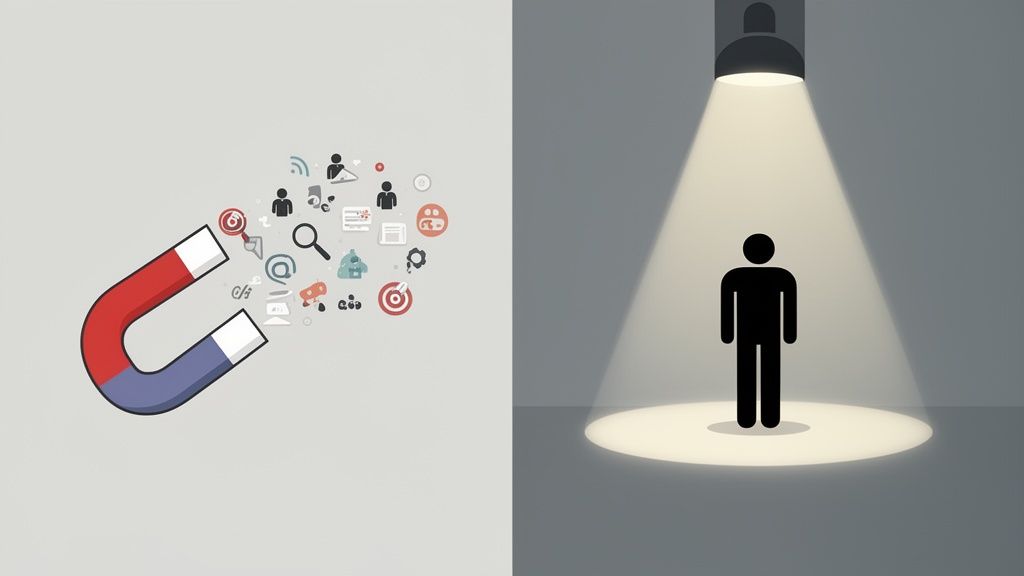
At its heart, inbound communication is the magnet, pulling in customers who are already looking for answers. Outbound is the spotlight, shining a light on your brand for people who might not even know they have a problem you can solve. For any executive steering a company towards sustainable growth, mastering the strategic blend of both isn't just a marketing task—it's a core business imperative. Understanding how to deploy each method is the key to creating a predictable and powerful growth engine.
The Magnet and The Spotlight: Understanding Inbound and Outbound
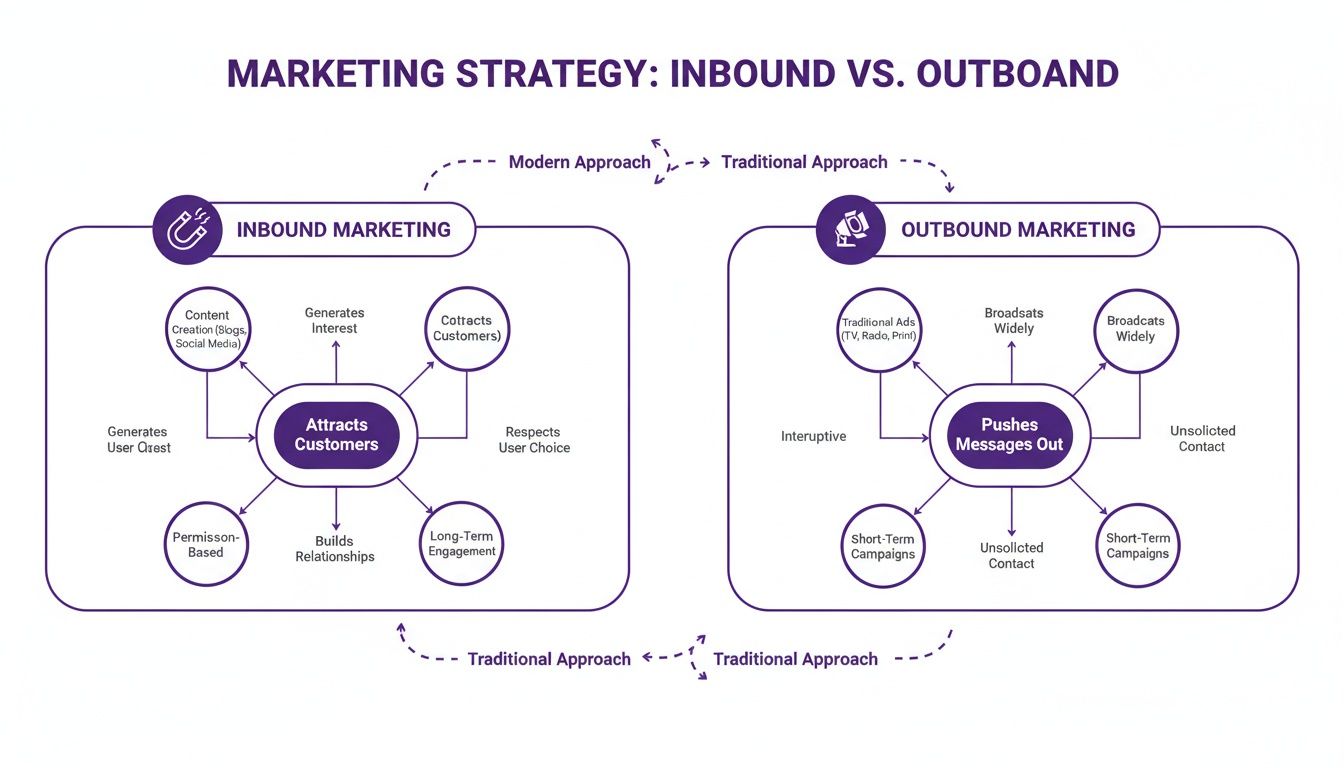
To truly grasp the strategic value of inbound and outbound, we must think beyond simple definitions. They are two distinct, yet complementary, approaches to revenue generation. It's the classic "pull vs. push" dynamic, dictating how your entire organization engages with the market.
Inbound is about earning attention, not buying it. The objective is to create valuable content and seamless experiences that naturally draw high-intent prospects to your business. Potential customers discover you through a targeted search, a data-rich whitepaper, or a valuable social media discussion because you are providing a direct solution to their problem. This isn't merely a brand-building exercise; it has a direct impact on the bottom line. According to HubSpot, inbound leads cost, on average, 61% less than outbound leads, making it an incredibly efficient strategy for lowering Customer Acquisition Cost (CAC) and scaling predictably.
A practical example: A SaaS company targeting CFOs creates a detailed whitepaper on "5 Strategies to Reduce Cloud Spend by 30% in 2024." This high-value asset, promoted through LinkedIn and optimized for search engines, attracts finance executives who are actively researching cost-saving measures. This is inbound in action.
This approach usually involves:
- Creating genuinely useful content: Think blog posts, whitepapers, or how-to guides that position your company as an expert.
- Search Engine Optimisation (SEO): This is about making sure you show up when someone is actively searching for a solution you offer.
- Engaging on social media: It's not just about posting; it's about building a community and joining conversations where your audience already hangs out.
This visual helps break down the core difference between the magnet-like inbound approach and the spotlight-focused outbound strategy.
The main takeaway for leadership is clear: inbound pulls customers in by offering value, while outbound pushes a message out to create awareness and generate immediate pipeline.
For leaders who need a quick, high-level overview, this table cuts straight to the chase, comparing how each approach impacts core business metrics.
Executive Quick Guide: Inbound vs Outbound
| Business Metric | Inbound (The Magnet) | Outbound (The Spotlight) |
|---|---|---|
| Customer Intent | High – they are actively seeking solutions. | Low to None – you are initiating the contact. |
| Lead Quality | Generally higher, self-qualified. | Varies; requires heavy filtering. |
| Speed to Results | Slower; builds momentum over time. | Faster; can generate immediate conversations. |
| Cost Per Lead | Lower in the long run. | Higher upfront investment. |
| Scalability | Highly scalable once the "flywheel" is spinning. | Scalability is tied directly to budget and headcount. |
| Targeting | Broad, based on personas and search intent. | Hyper-specific, based on ideal customer profiles (ICPs). |
This table isn't about picking a winner; it's about understanding the right tool for the right job to build a balanced, resilient business.
The Power of Proactive Outreach
On the other hand, outbound is all about taking the initiative. This strategy involves actively reaching out to a handpicked audience to spark their interest. It’s the classic "push" method where you start the conversation. While some might think of it as old-school, modern outbound is anything but. It's precise, driven by data, and absolutely essential for breaking into new markets or landing those high-value "whale" accounts. For a deeper look at this, guides on Mastering Outbound Lead Generation can offer a wealth of practical advice.
A strategic blend of inbound and outbound isn't just a marketing goal; it's a financial imperative. The objective is to lower Customer Acquisition Cost (CAC) by attracting organic interest while maximising Lifetime Value (LTV) through targeted, high-value pursuits.
The most successful companies don't pick a side. They build a hybrid engine. Their inbound machine works tirelessly to nurture a steady stream of qualified interest, while their outbound team acts as a special forces unit, precisely targeting the most profitable customer segments to accelerate growth.
Mapping The Customer Journey For Both Strategies
Let's move from high-level strategy to on-the-ground execution. To make either inbound or outbound work, you have to truly understand the customer's journey in each scenario. They couldn't be more different. One is all about letting the customer take the lead, while the other is a carefully choreographed campaign you initiate. As a leader, visualizing these two paths is critical for allocating budget and defining success metrics.
The Inbound Customer Journey: A Self-Guided Path to Conversion
Think of the inbound journey as a "pull" model. You’re not chasing anyone; you're attracting them. The customer is firmly in the driver's seat, and their journey doesn't start with a sales pitch. It starts with a problem they're trying to solve, usually by typing a question into Google.
From an executive's point of view, every single blog post, video, or guide you publish is a potential doorway for a prospect who already knows what they need.
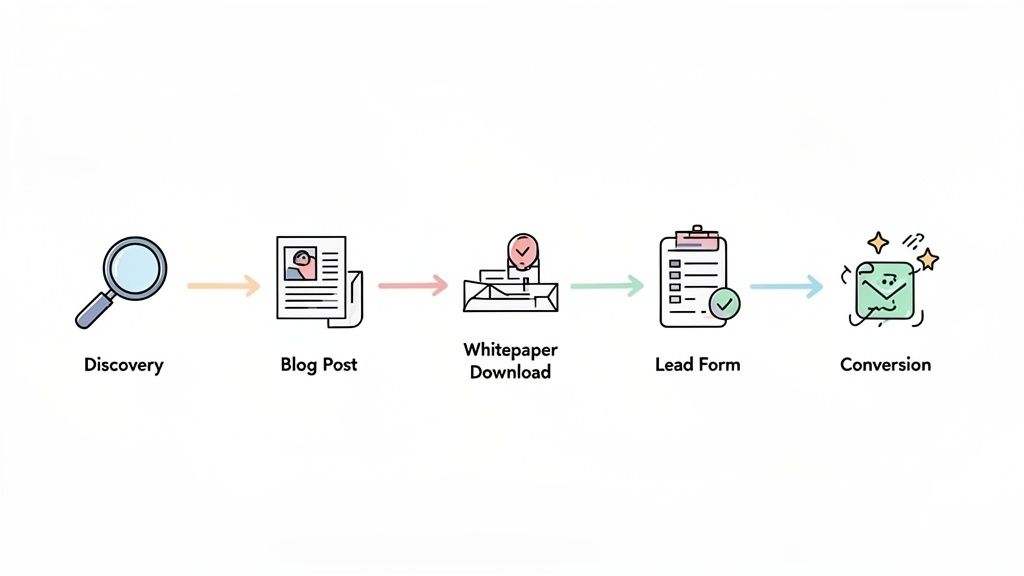
This journey usually plays out like this:
- Awareness: Someone stumbles upon your content—a blog post, a video tutorial, a social media update—while looking for answers. They've found you on their own terms.
- Consideration: They like what they see. You've proven you know your stuff, so they decide to download a more detailed guide, like a whitepaper or an e-book, giving you their contact details in return.
- Decision: Bingo! You now have a Marketing-Qualified Lead (MQL). Automated emails keep them engaged until they're ready to book a demo or a consultation, at which point they become a Sales-Qualified Lead (SQL).
Because these leads have done their own homework and came to you, their sales cycles are often much shorter. The numbers back this up: inbound leads cost, on average, 61% less than outbound leads. For any CXO watching the customer acquisition cost (CAC), that's a stat that's impossible to ignore.
The Outbound Customer Journey: A Structured Path to Engagement
The outbound journey, on the other hand, is a highly structured, company-led process. This is a "push" model. You're not waiting for demand; you're actively creating it. A VP of Sales typically masterminds this by defining a laser-focused Ideal Customer Profile (ICP) and curating a list of target accounts. To get this right, it’s incredibly helpful to apply the principles of customer experience mapping.
The outbound process is a methodical campaign with multiple touchpoints:
- Prospecting & List Building: The sales team digs in, identifying and researching the key decision-makers at your target companies.
- Multi-Channel Outreach: A carefully planned sequence of contact begins. This isn't just cold calling; it's a mix of AI-powered calls, personalised emails, and strategic LinkedIn messages.
- Qualification & Meeting: The immediate goal isn't to close a deal. It's to secure a qualified meeting for a senior Account Executive.
The name of the game in modern outbound is efficiency at scale. It's all about using technology to systematically turn cold contacts into warm, qualified sales meetings. This ensures your best closers are spending their time doing what they do best: having conversations that generate revenue.
This structured approach gives you a predictable pipeline you can count on. For a closer look at how voice technology fits into this, you can find some great insights on the role of voice in customer journey mapping.
By clearly mapping both journeys, leaders can build a powerful, dual-engine model for sustainable growth.
Industry Playbooks: Putting Inbound and Outbound to Work
Theory is one thing, but as a CXO, you're focused on how these ideas drive real results in your market. The right mix of inbound and outbound isn’t a one-size-fits-all formula. It’s a playbook that has to be adapted to the unique challenges and customer habits of your industry. Let’s break down how this works in a few key sectors.
Real Estate: The High-Touch Hybrid Model
In real estate, speed and timing are paramount. A proactive outbound calling strategy is the engine that fills the immediate pipeline with site visit appointments. For instance, a new luxury apartment launch requires targeted calls to a database of high-net-worth individuals and brokers to generate initial buzz and secure early bookings. This direct outreach is how you spark interest and fill the calendar.
Simultaneously, a powerful inbound strategy captures high-intent buyers already searching platforms like Zillow or MagicBricks. When these prospects call, they aren't just browsing—they're often pre-qualified and ready to act. A single well-handled inbound call can close a multi-million dollar deal.
The sheer volume of calls in Indian real estate—over 500 million outbound calls for lead generation and 320 million inbound calls from interested buyers annually—makes a hybrid approach essential. This is where tools like DialNexa's Voice AI become a strategic asset, helping firms boost their lead-to-booking rates from a typical 2% to as high as 8% by expertly handling both inbound discovery calls and outbound scheduling. You can get more insights on the growth of Voice AI in India on Dialnexa.com.
EdTech: Nurturing the Decision Journey
The education technology sector is built on trust and consultative selling. The journey from a curious parent to an enrolled student is often long and requires careful nurturing. This is where inbound strategy shines.
-
The Inbound Engine: An EdTech platform might create webinars on "Navigating College Admissions" or detailed guides on "Choosing the Right Coding Bootcamp." This content attracts prospects, who then call in for personalized counseling. These inbound calls handle admission inquiries, course details, and application status updates.
-
Supportive Outbound: Once a prospect downloads a guide or attends a webinar, targeted outbound calls become crucial. These are not cold calls; they are timely follow-ups offering a one-on-one counseling session, or reminders about application deadlines and fee payments. Each touchpoint nudges a warm lead closer to conversion.
BFSI: Balancing Compliance and Growth
For the Banking, Financial Services, and Insurance (BFSI) industry, the challenge is balancing strict regulatory compliance with aggressive growth targets. This demands a sophisticated, dual-pronged communication strategy.
For BFSI leaders, inbound communication is the bedrock of customer trust and service efficiency, handling millions of support and KYC queries. Outbound, in contrast, is the precision tool for driving revenue through strategic cross-selling and ensuring critical compliance adherence.
Inbound channels are essential for managing the high volume of sensitive interactions, such as customer support, account inquiries, and KYC verification. They provide a secure and efficient way for customers to get the help they need, reducing operational costs.
Outbound is used with surgical precision for revenue generation. For example, after analyzing transaction data, a bank's outbound team might call a customer who frequently travels abroad to offer a new forex card with better rates. This proactive approach helps BFSI companies deepen relationships and increase customer lifetime value (LTV) while adhering to all regulations.
The scale of these operations is immense. The data below shows just how many voice interactions these sectors handle, underscoring why a smart, automated strategy is no longer a luxury—it's a necessity.
Call Volume Benchmarks in Strategic Indian Markets
| Industry | Annual Inbound Calls | Annual Outbound Calls |
|---|---|---|
| Real Estate | 320 Million | 500 Million |
| EdTech | 450 Million | 600 Million |
| BFSI | 1.2 Billion | 900 Million |
| E-commerce | 950 Million | 700 Million |
| Healthcare | 600 Million | 400 Million |
These numbers paint a clear picture for any CXO. Across India's most dynamic industries, the flow of communication is constant and massive. Managing this volume effectively is the key to unlocking growth and maintaining customer satisfaction.
Striking the Right Balance: When to Go Inbound vs. Outbound
Every leader wrestles with the same question: "Where do we put our money and effort for the best return?" Figuring out the right mix between inbound and outbound isn’t a one-and-done decision. It's a living strategy that needs to shift with your market, your product, and where you are on your growth journey. The most resilient businesses don't just pick a side; they build a hybrid engine that can adapt.
So, how do you decide where the needle should point? A few key factors will tell you whether it's time to double down on your inbound content machine or build out a sharp-shooting outbound team.
Is Your Product a Quick Buy or a Considered Purchase?
The price and complexity of what you sell are your first major clues. If you’re selling a high-ticket, complex piece of enterprise software with a sales cycle that spans months, investing in a dedicated outbound team makes perfect sense. The potential Lifetime Value (LTV) of a single client is so high that it easily justifies the cost of personalised, hands-on outreach. A company selling ERP software with an average contract value of $250,000 can justify a senior sales team actively pursuing a curated list of 100 enterprise accounts.
On the other hand, if your business is built on a high-volume, lower-priced consumer product or a simple self-service SaaS tool, an inbound strategy is your best bet. You need to acquire customers at scale, and the lower Customer Acquisition Cost (CAC) that comes with great SEO and content marketing is the only way to do it profitably. It’s all about matching your spending to the potential reward.
Are You Educating a New Market or Competing in a Crowded One?
Next, take a hard look at your market. If you're fighting for attention in a mature, noisy industry, a powerful inbound strategy is what will make you stand out. You need to build trust and establish yourself as the go-to authority, especially if customers take their time and do a ton of research before they buy. A cybersecurity firm, for example, would invest heavily in research reports and webinars to build credibility in a crowded space.
But what if you're launching something new or entering a market that doesn’t even know it has a problem yet? This is where a targeted outbound push can create momentum out of thin air. It lets you get in front of people, educate them directly, and land those crucial first customers that provide the revenue and social proof you need to get off the ground.
At its heart, the principle is straightforward: use outbound to create demand and inbound to capture it. The magic happens when you do both at once, creating a self-reinforcing cycle of growth.
You can see this playing out on a massive scale in India's BFSI and trading sectors. Inbound support lines are fielding a staggering 1.2 billion calls each year for things like KYC checks and trading help. At the same time, a huge 28% of their total call volume is strategic outbound—think compliance reminders and upselling. The only way to manage this is with smart automation. Innovators are turning to Voice AI to handle the load, seeing incredible results like jumping from a 47% to a 91% connect rate. You can read more about how Bengaluru's Voice AI leaders are making this happen on Dialnexa.com.
The KPIs That Truly Measure Inbound and Outbound Performance
Effective leadership runs on data, not intuition. If you're only looking at surface-level numbers like website visits or the total number of calls made, you're missing the real story. To truly understand how well your growth engine is running, you need to track the Key Performance Indicators (KPIs) that directly tie back to revenue and profitability.
This is especially true for inbound and outbound, because they’re playing two different games. Inbound is a long game focused on attracting and converting the right people efficiently. Outbound is all about proactive outreach, creating opportunities from thin air, and moving quickly.
Key Metrics for Your Inbound Engine
With inbound, the goal isn't just to get attention; it's to turn that attention into paying customers. You need to look past the initial traffic and focus on the KPIs that show you how well your entire funnel is working, from the first blog post they read to the moment they sign a contract.
Here are the numbers that really matter for a CXO:
- Lead-to-Customer Conversion Rate: This is the ultimate metric. It answers the simple question: "Of all the leads generated by marketing, what percentage actually becomes a paying customer?" A benchmark for a strong SaaS inbound funnel is a 3-5% conversion rate from lead to customer.
- Content-Sourced Revenue: Take it a step further. Can you trace a new customer's revenue directly back to the specific piece of content that first brought them to you? Knowing this helps you create more of what works.
- Customer Acquisition Cost (CAC): A low CAC is the signature of a well-oiled inbound machine. It’s the ultimate proof that you’re not just getting customers, but getting them profitably. The goal is to keep your CAC-to-LTV ratio below 1:3.
Measuring inbound is all about connecting the dots between your creative efforts and actual revenue. If you can’t draw a straight line from a webinar to a closed deal, you're just hoping for the best.
Essential KPIs for Your Outbound Team
Outbound is a game of disciplined action. Success here is measured by how efficiently your team can turn their activities—calls, emails, outreach—into genuine, qualified sales opportunities. It’s about both volume and quality.
For example, India's EdTech space is a great illustration of this. Some platforms handle over 75 million inbound calls a year. To cut through that noise, smart companies use personalised outbound calls, which have been shown to lift enrolment rates by as much as 32%. This is where tracking the right outbound KPIs becomes so important. Modern AI tools are already helping companies boost their connect rates from 47% to 91% and push lead-to-booking conversions from a mere 2% all the way up to 8%.
To keep a firm grip on your outbound performance, keep a close eye on these metrics:
- Dial-to-Connect Rate: This simple ratio tells you how good your calling lists and timing are. If your team is dialling all day but barely anyone is picking up, you’ve got a data problem, not a sales problem. Top-performing teams aim for a 10-15% connect rate.
- Meetings Booked per Representative: This is the most direct measure of an individual rep’s productivity. It tells you who is effective at turning a cold conversation into a real meeting in the calendar. A solid benchmark is 8-12 qualified meetings booked per month, per rep.
- Sales Cycle Velocity: Once a lead is generated through outbound, how quickly does it move through your pipeline? A faster cycle means your reps are finding high-quality, motivated prospects.
By focusing on these distinct sets of KPIs, you get a clear, data-backed view of how both your inbound and outbound strategies are performing. For a deeper dive, check out our guide on how to measure the success of your outbound campaigns.
How Voice AI Is Redefining Both Inbound and Outbound
The future of customer engagement is here, and it's built on a simple reality: a single human agent can only have one conversation at a time. For any leader focused on growth, that's a serious bottleneck. This is where modern Voice AI steps in, acting as a force multiplier that completely redefines both your inbound and outbound strategies.
We aren't talking about the clunky, robotic phone trees of the past. Today’s AI agents are sophisticated enough to grasp context, figure out a caller's intent, and hold genuinely natural conversations that can last for several minutes. This fundamentally changes the economics of customer communication, turning what was once a linear, costly process into something far more efficient and scalable.
Automating Inbound for Instant Qualification
When it comes to your inbound strategy, the biggest enemy is response time. Research from Harvard Business Review shows that companies that respond to a lead within an hour are nearly 7 times more likely to have a meaningful conversation with a decision-maker. Voice AI eliminates this risk entirely.
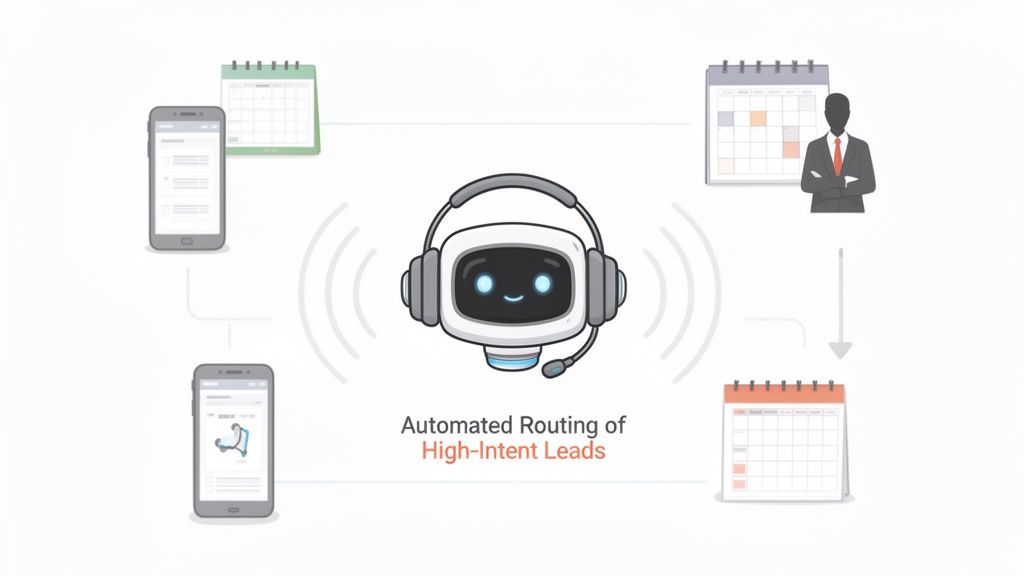
Imagine thousands of incoming calls being answered on the first ring, 24/7, without a single one ever hitting voicemail. An AI agent can handle that crucial first-touch qualification, asking the right questions to understand a caller's needs and urgency with up to 97% accuracy. It then intelligently routes only the most valuable, pre-qualified leads straight to your top sales talent.
This achieves two critical goals:
- No high-intent lead is ever missed. Every single inbound query is captured and qualified the moment it arrives.
- Your best people are protected. They can focus their valuable time on conversations that have a high probability of converting, not on repetitive filtering.
Voice AI turns your inbound function from a reactive cost centre into a proactive, round-the-clock qualification engine. It’s the ultimate safety net for your marketing spend, ensuring you get the maximum return on every lead you generate.
Scaling Outbound Without Scaling Headcount
On the outbound side, the challenge is different but just as significant. Those top-of-funnel activities are incredibly time-consuming and often deliver a pretty low return. Think about it: your highly-paid sales development team likely spends most of its day navigating gatekeepers and hearing "no."
Voice AI automates this entire gruelling process. An AI-powered agent can make thousands of initial outreach calls every single day, delivering a perfectly consistent opening pitch every single time. It can navigate complex phone systems, identify the right decision-makers, and book qualified meetings directly into your sales team's calendars.
The results are staggering. Companies using this approach have reported massive improvements, like boosting connect rates from a typical 47% all the way up to 91%. They've also seen lead-to-booking conversions jump from a standard 2% to an impressive 8%. This isn't just a small step forward; it's a strategic shift that gives you a major competitive edge. You can learn more about how AI voice agents are transforming customer service and sales in our detailed guide.
By bringing Voice AI into the mix, business leaders no longer have to choose between quality and scale. They can finally achieve both, redefining what’s possible for inbound lead capture and outbound prospecting.
Frequently Asked Questions
As you start piecing together your growth strategy, a few common questions always come up. Here are some straight answers to help you figure out what inbound and outbound really mean for your business.
Which Strategy Is Better for a B2B Company?
For most B2B companies, the winning formula isn't choosing one over the other—it's blending them strategically. Think of it as a two-pronged attack. You use a focused outbound approach, often called Account-Based Marketing (ABM), to target a specific list of high-value, must-win accounts. For example, a fintech company might create a target list of 50 enterprise banks to pursue with personalized outreach from senior executives.
At the same time, your inbound efforts are humming in the background, building your reputation as a thought leader and pulling in a wider audience with genuinely helpful content. This is crucial for nurturing leads through what can be a very long sales cycle. The right balance really comes down to your Average Contract Value (ACV); the higher it is, the more you can justify investing in a dedicated outbound sales team.
How Can We Implement Inbound With a Limited Budget?
If you're just starting out or your budget is tight, don't try to do everything at once. Instead, get laser-focused. Pinpoint the single biggest challenge your ideal customer faces and create one phenomenal piece of content that solves it—think of it as the ultimate guide or an incredibly practical checklist. A practical example: a startup providing project management software could create a "Definitive Guide to Remote Team Productivity" with templates and expert interviews.
This approach costs you more in time than it does in money. Once you have this asset, your job is to promote it everywhere your customers hang out, whether that’s on LinkedIn or in specialised online communities. The aim is to build authority and create a steady trickle of high-quality leads, proving the concept before you scale up your spending.
Is Outbound Calling No Longer Effective?
Let’s be clear: the old-school, interrupt-and-pitch style of cold calling is on its last legs. It just doesn't work anymore. But what has emerged in its place is a much smarter, data-driven approach to outbound that is more effective than ever.
Modern outbound uses tools like Voice AI to make sure you're calling the right person with a relevant message at the perfect moment.
By automating the initial outreach and qualification stages, you can have thousands of conversations simultaneously. This ensures your highly-paid sales team invests their time only on prospects who are genuinely interested and already warmed up.
This shift completely changes the ROI of outbound calling. What was once an inefficient numbers game becomes a predictable engine for your sales pipeline, proving that intelligent outbound is far from dead.
DialNexa transforms your communication strategy by deploying human-like Voice AI agents that handle everything from lead qualification to customer support at scale. Free your team from repetitive calls and turn more conversations into revenue. Discover how by visiting DialNexa's official website.

[…] latency by engaging leads instantly. For a deeper analysis of the core mechanics, our guide on the fundamental differences between inbound and outbound strategies provides a detailed […]
Excellent analysis that clearly explains how inbound and outbound strategies complement each other to drive sustainable business growth. The practical examples, KPIs, and Voice AI insights make this a highly valuable guide for modern business leaders and marketers.