
A CXO Guide to Lead Management in CRM Strategy
Think of lead management in CRM as the systematic journey you guide a prospect on, from their first flicker of interest all the way to becoming a loyal customer. It’s not just about ticking boxes in a sales process; it’s the strategic framework that turns potential into profit. For any leader, this means building a predictable revenue pipeline out of a raw list of leads.
Why Lead Management in CRM Is a Strategic Imperative
For any executive, the real goal is sustainable growth, not just day-to-day efficiency. Too many organisations treat lead management as a purely tactical sales activity, but that’s a narrow view that misses the bigger picture. In reality, effective lead management in CRM is the engine driving your entire revenue machine.
Imagine your business is a power plant. Your marketing division invests, for instance, $500,000 annually in campaigns to generate leads. Without a robust system to channel that energy, a significant portion of that investment dissipates. Research from Gleanster Research indicates that 25% of marketing-generated leads are legitimate and should progress to sales. However, many businesses lose them due to slow follow-ups, poor handling, or a complete lack of personalisation. This isn't just a process failure; it's a direct financial leak.
From Chaos to Control
A modern CRM brings order to this chaos. It transforms a leaky, unpredictable process into a disciplined, data-driven system that gives you a crystal-clear view of your revenue pipeline. For a director, this oversight means knowing precisely where your highest-potential prospects are, what they need, and the optimal moment for engagement. It empowers your teams to stop guessing and start executing data-backed strategies.
This isn't just about organising contacts. This strategic shift directly impacts your bottom line:
- Bigger Market Share: Companies with mature lead management processes see a 9.3% higher sales quota achievement rate. When you convert more leads faster than your competitors, you naturally capture a larger piece of the market.
- Higher Customer Lifetime Value (CLV): A structured nurturing process builds stronger relationships from day one, which translates into greater loyalty and long-term value.
- Stronger Competitive Edge: Being agile in how you respond to leads and using data to guide your decisions creates a powerful advantage that’s hard to beat.
The Financial Justification for Executive Focus
Ignoring this has serious financial consequences. The Indian CRM market, valued at USD 2.48 billion in 2025, is projected to explode to USD 14.24 billion by 2034. This massive growth is driven by the urgent need for businesses across all sectors—from EdTech to real estate—to centralise sales data and improve customer retention strategies.
The numbers speak for themselves: effective lead nurturing generates 50% more sales-ready leads at a 33% lower cost. What's more, nurtured leads make purchases that are 47% larger than those from non-nurtured leads. This isn't a small operational tweak; it's a fundamental driver of profitability.
To capitalise on this, choosing the right platform is critical. For instance, a firm in the property market should explore the best CRM for real estate agents to find a solution built for their unique sales cycles and client needs. That level of specialisation is key to maximising return on investment.
Ultimately, for any leader focused on growth, mastering lead management in a CRM isn't an option. It's the very foundation on which predictable, scalable revenue is built.
Deconstructing Your High-Performance Lead Management Framework
Moving from theory to practice means having a clear blueprint. A high-performance lead management framework isn't just a list of tasks; it's a living system where each part makes the others stronger. For an executive, understanding these pillars isn't about micromanaging sales activities—it's about gaining strategic control to drive predictable revenue growth.
This framework is built on four core components that work in tandem, creating a seamless journey from a curious prospect to a loyal customer. When you get this right inside your CRM, you transform a leaky sales funnel into a high-pressure revenue pipeline.
This flowchart shows the strategic flow of lead management, detailing how a business can acquire new leads, manage potential leaks in the process, systematise its management, and ultimately, drive real growth.
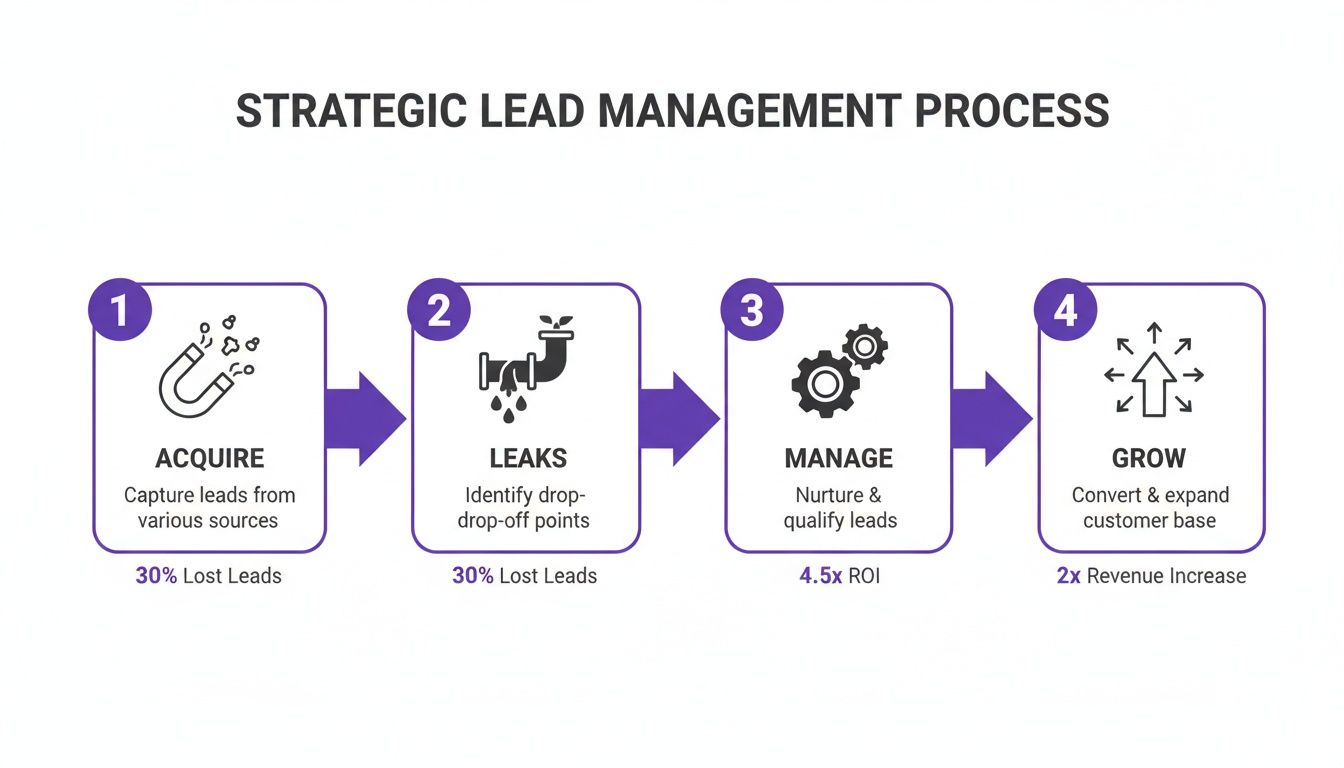
The visual makes it clear: effective lead management is a continuous cycle. It's about constantly acquiring prospects, actively plugging gaps to prevent losses, and using systematic tools to grow your business.
To put this into a strategic context, think about how each component directly ties into a business objective. The table below breaks this down, connecting each part of the framework to a core business goal and a key metric you should be watching.
Lead Management Components and Their Business Impact
| Core Component | Strategic Business Objective | Primary KPI to Monitor |
|---|---|---|
| Automated Lead Capture | Maximise opportunity pipeline by ensuring no lead is lost at the point of entry. | Lead Capture Rate (%) |
| Data-Driven Lead Scoring | Improve sales team efficiency and focus by prioritising high-intent leads. | Lead-to-MQL Conversion Rate (%) |
| Intelligent Lead Routing | Accelerate the sales cycle and improve customer experience with rapid, accurate handoffs. | Average Lead Response Time |
| Personalised Lead Nurturing | Increase lifetime value and conversion rates by building trust with prospects over time. | MQL-to-SQL Conversion Rate (%) |
This framework gives leaders a clear line of sight from daily operations to bottom-line results, turning lead management into a measurable engine for growth.
Automated Lead Capture
It all starts with Automated Lead Capture. This is the mechanism for funnelling every single potential customer into your CRM automatically, no matter where they come from. Manually typing in leads from website forms, social media messages, or event sign-ups isn't just slow—it's a guaranteed way to lose revenue. In fact, a staggering 79% of marketing leads never convert, often because they fall through the cracks right at the beginning.
Practical Example: A B2B technology firm hosts a webinar attracting 500 attendees. Without automation, an administrative assistant might spend days manually entering attendee data into a spreadsheet, by which time initial interest has cooled. With an automated CRM integration, all 500 leads are instantly created in the CRM, tagged with "Webinar Attendee," and entered into a follow-up sequence within minutes of the event ending.
Data-Driven Lead Scoring
Once a lead is in the system, you need to figure out who's who. Not all leads are created equal, and that's where Data-Driven Lead Scoring comes in. It’s a method for assigning points to leads based on who they are and what they do, helping you spot who is genuinely ready to talk business. This is how you separate the window shoppers from the serious buyers.
A lead's score tells your sales team exactly where to focus their energy. It turns sales from a game of guesswork into a calculated strategy aimed at the highest-probability opportunities.
For example, a B2B SaaS company could set up a powerful scoring model right inside their CRM:
- +15 points for requesting a product demo (a clear sign of high intent).
- +10 points for visiting the pricing page more than three times in a week.
- +5 points for having a "VP of Sales" or "Director" title at a company with over 200 employees.
- +2 points for downloading a top-of-funnel whitepaper.
This system directs your most valuable resource—your sales team's time—towards the leads most likely to close, boosting both efficiency and your win rate.
Intelligent Lead Routing
With a prioritised list of hot leads, the next step is getting them to the right person, instantly. This is Intelligent Lead Routing: the automated assignment of a lead to the best-suited sales rep. In sales, speed is everything. A fast follow-up can boost conversion rates by an incredible 391%.
Assigning leads by hand is slow, inconsistent, and lets hot opportunities go cold. A smart CRM workflow, on the other hand, can route leads based on practical criteria like:
- Geography: A lead from Mumbai is automatically assigned to the Western India sales pod.
- Company Size: A lead from an enterprise with over 5,000 employees is routed to a senior account executive.
- Product Interest: A query about "Data Analytics Suite" is sent directly to a product specialist.
This immediate, precise handoff gets rid of bottlenecks and ensures every prospect gets attention when their interest is at its absolute peak. This is especially vital in India's CRM market, which generated USD 2,428.8 million in 2024. Proper lead management is set to drive this market to USD 6,684.8 million by 2030, with SMEs in fast-growing sectors like EdTech and real estate leading the charge. You can discover more insights about this rapidly growing market.
Personalised Lead Nurturing
Finally, we have Personalised Lead Nurturing. This is the art and science of building relationships with prospects who are interested but not quite ready to buy. It's about delivering relevant, helpful content over time to guide them on their journey. It's no surprise that companies that master lead nurturing generate 50% more sales-ready leads at a 33% lower cost.
Practical Example: A potential client in the financial services sector downloads an e-book on "Cybersecurity for Banks." The CRM automatically triggers a 4-week nurture sequence.
- Week 1: An email with a case study on how a similar bank improved security.
- Week 2: An invitation to a webinar on "Compliance and Data Protection."
- Week 3: A link to a blog post from the company's CTO on threat detection.
- Week 4: A personalised email from a sales rep offering a 15-minute security consultation.
This keeps the brand top-of-mind and builds the trust needed to ensure that when they are finally ready to make a decision, you're the first one they call.
Driving Conversions with AI and Automation
The lead management framework we've discussed is solid, but to truly outperform the market, you need to fuel it with AI and automation. For a CXO, this isn't about chasing the latest tech trend; it's about building a sustainable competitive advantage. By automating routine tasks and leveraging AI for complex decisions, you transform a manual, often inconsistent process into a lean, self-improving revenue machine.
This is where you extract maximum leverage from your CRM investment. Instead of your sales team burning 40% of their time on non-revenue-generating activities like manual follow-ups, technology can execute these tasks at scale with superior speed and accuracy. The outcome is a significant reduction in operational costs and a vastly improved customer journey, directly impacting profitability.
Think of AI as the central brain, running the whole show. It coordinates automated workflows that can engage leads around the clock, triggering personalised actions based on exactly what they do.
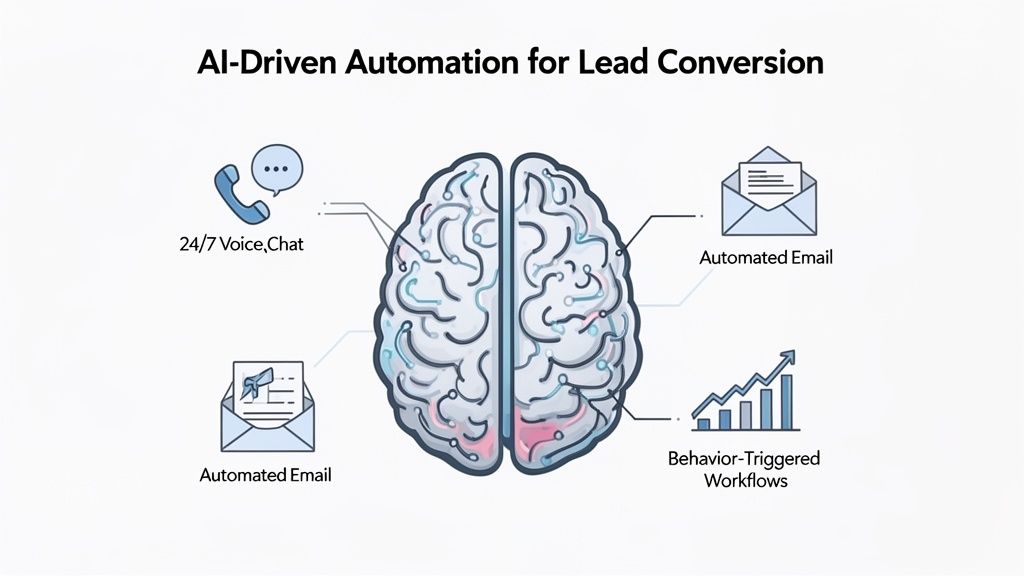
The strategic takeaway is that AI and automation create a non-stop, intelligent cycle of engagement. This ensures no high-potential lead ever goes cold, and every interaction feels relevant and timely.
Leveraging Intelligent Voice Agents for 24/7 Qualification
One of the biggest game-changers AI brings is in that initial qualification step—a traditional time-sink for Sales Development Reps (SDRs). With intelligent voice agents, you can place this entire process on autopilot, operating 24/7.
Practical Example: A leading real estate firm receives a web inquiry for a luxury property at 11 PM on a Friday. Instead of the lead waiting until Monday morning, an AI voice agent calls them within 60 seconds. In a natural, two-minute conversation, the AI qualifies them on budget ("Are you looking for properties above ₹2 crore?"), timeline ("Are you planning to purchase in the next 3 months?"), and location preference. This qualified data is synced to the CRM, and a meeting is automatically booked on the top agent's calendar.
That immediate response is crucial. It can increase lead connection rates from a typical 47% to over 90%, simply by engaging at the peak of their interest. As detailed in our guide on how AI voice agents are transforming customer service and sales, these tools provide instant, scalable conversations that capture high-intent leads before your competitors even know they exist.
Automating Personalised Nurture Sequences
After that first touch, automation is just as critical for nurturing leads over time. A smart CRM can trigger deeply personal communication based on a prospect's actual behaviour, making sure every email or message hits the mark.
We're talking about a lot more than just generic email blasts. Here are a few real-world examples:
- Behaviour-Triggered Content: A prospect from a logistics company spends five minutes on your "Fleet Management" solution page. The system automatically sends them a case study detailing how a similar company achieved a 15% reduction in fuel costs.
- High-Intent Alerts: A lead watches 90% of a product demo video. The assigned sales rep gets an instant Slack notification with the lead's details, prompting a call within the hour.
- Re-engagement Workflows: A promising lead goes dark for 30 days. The CRM automatically triggers a re-engagement sequence, starting with an offer for a new industry report, to pull them back into the conversation.
On top of this, newer tools using AI for lead scoring can seriously ramp up your conversion rates. The system can read a lead’s "digital body language"—pages visited, emails opened, content downloaded—and dynamically adjust their score, flagging them for sales intervention at the perfect moment.
Investing in this kind of smart automation isn't just about efficiency; it delivers tangible results. By cutting response times to mere minutes and personalising every interaction, businesses can lift their lead-to-booking rates from an industry average of 2% to as high as 8%. That’s a 4x improvement that translates directly to accelerated revenue growth.
How Lead Management Plays Out in Different Industries
Theory is one thing, but seeing how lead management actually works on the ground is where the real value lies. Generic advice falls flat because every industry has its own unique customer journey, sales cycle, and set of challenges. For a leader, understanding how a CRM can be tailored to your specific world is the key to unlocking real growth.
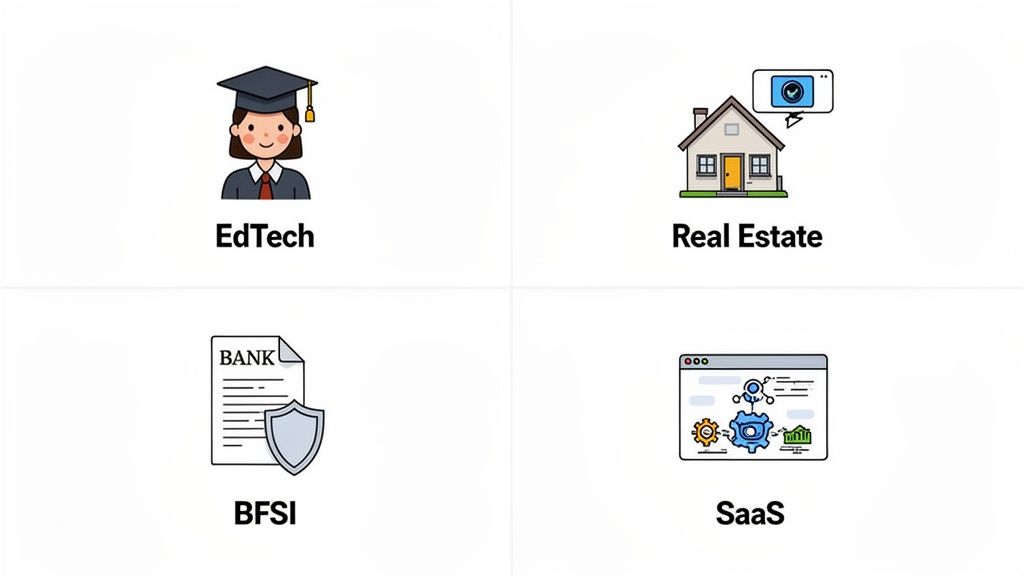
Let's look at some practical examples from four major sectors: EdTech, Real Estate, BFSI, and SaaS. Think of these as mini case studies showing how a smart CRM, often boosted with AI, solves a common headache and delivers tangible results.
EdTech: Streamlining Admissions for High-Value Programmes
The Challenge: An educational institution gets thousands of inquiries for its specialised MBA programmes. Leads interested in everything from finance to marketing are all funnelled to a general admissions team. The result? Slow, generic follow-ups and a ton of promising candidates falling through the cracks.
The CRM Solution:
This is a classic routing problem. An intelligent CRM workflow is set up to fix it. When a prospective student fills out an online form and ticks "Marketing" as their interest, the system doesn't just log the lead—it instantly routes it to a counsellor who lives and breathes that specific programme.
At the same time, the CRM gathers all the prospect’s digital footprints, like which pages they browsed or webinars they attended. The specialist counsellor gets an alert with all this context, ready to have a meaningful conversation within minutes.
The Business Outcome: This targeted approach bumps up the lead-to-application rate by over 25%. Counsellors stop wasting time on generic outreach and start building real connections with prospects who feel heard from day one.
Real Estate: Turning Virtual Interest into Property Visits
The Challenge: A real estate developer runs flashy virtual tours for a new luxury apartment complex, drawing in hundreds of online viewers. But afterwards, the sales team is left guessing who to call first, leading to poor follow-up and few of those virtual attendees ever setting foot on the property.
The CRM Solution:
The CRM is connected directly to the virtual tour platform. The moment the tour wraps up, the system automatically sorts attendees based on their engagement. Did someone spend ten minutes looking at the master bedroom floor plan? They’re a hot lead. Someone else just popped in for two minutes? They go into a different bucket.
Based on this data, automated sequences kick in. The highly engaged leads get a personalised email with a direct link to book a private site visit. The less-engaged viewers get a follow-up with more property details, keeping the interest alive without wasting a salesperson's time.
The Business Outcome: The automated, personalised follow-up boosts site visit bookings from virtual tours by a massive 40%. The sales team can now focus its energy where it counts—on warm, engaged leads—and close deals faster.
A well-executed CRM strategy ensures that digital engagement is never a dead end. It builds a seamless bridge from online curiosity to offline action, which is critical for high-value sales.
BFSI: Nailing Compliance and Efficiency in Loan Pre-Qualification
The Challenge: A financial services firm is drowning in online applications for personal loans. Human advisors spend most of their day on screening calls, only to disqualify a huge number of applicants based on basic criteria. It’s a huge drain on time and resources.
The CRM Solution:
The firm integrates an AI Voice Agent into its CRM. Now, when a new loan application comes in, the AI agent makes an automated call to the applicant for a pre-qualification check. It runs through a series of scripted, compliance-approved questions about income, employment, and the loan amount.
Only the leads who pass this automated screening are marked as "pre-qualified" in the CRM and handed over to a human loan advisor. To dig deeper into this, check out our guide on how data and AI will transform contact centres for financial services.
The Business Outcome: The firm cuts its pre-qualification time by an incredible 90%. This frees up its skilled human advisors to focus solely on high-potential applicants, slashing operational costs and giving customers faster, clearer feedback.
SaaS: Pinpointing High-Intent Enterprise Leads
The Challenge: A B2B SaaS company is great at generating leads from content downloads like whitepapers and eBooks. The problem is, the sales team can't tell who's just doing research versus who is seriously evaluating their software for purchase.
The CRM Solution:
They build a lead scoring model right inside their CRM. This model automatically assigns points based on a lead's actions. For example, downloading a technical "Integration Guide" or visiting the API documentation page is a high-intent signal and earns +20 points. Downloading a general, top-of-funnel eBook? That’s only +5 points.
Once a lead's score hits a preset threshold, say 50 points, the CRM flags them as a Product Qualified Lead (PQL) and assigns them to a senior account executive for immediate, personalised outreach.
The Business Outcome: The sales team's MQL-to-SQL conversion rate climbs by 35%. They're no longer wasting cycles on tyre-kickers and can pour their energy into conversations with prospects who have already shown they have a real problem that the software can solve.
Industry-Specific Lead Management Strategies
The following table provides a quick-glance comparison of these strategies, highlighting how different industries are using CRM and AI to overcome their specific hurdles.
| Industry | Common Challenge | Effective CRM & AI Solution |
|---|---|---|
| EdTech | High volume of diverse inquiries leading to slow, generic follow-ups and high drop-off rates. | Intelligent Routing: Automatically assign leads to specialised counsellors based on programme interest, paired with their digital interaction history for context-rich conversations. |
| Real Estate | Low conversion from online engagement (e.g., virtual tours) to in-person site visits. | Engagement-Based Nurturing: Segment leads based on their behaviour during virtual tours and trigger automated, personalised follow-ups to book site visits. |
| BFSI | Manual pre-qualification for financial products is time-consuming, costly, and inefficient. | AI-Powered Pre-Qualification: Use an AI Voice Agent to conduct initial screening calls, ensuring human advisors only handle compliance-checked, pre-qualified applicants. |
| SaaS | Difficulty distinguishing between research-focused leads and high-intent, sales-ready prospects. | Behavioural Lead Scoring: Implement a points-based system that prioritises leads based on high-intent actions (e.g., viewing pricing or API docs), flagging them as PQLs for sales. |
Each example underscores a simple truth: the most effective lead management strategy is one that is deeply aligned with the realities of your business and the expectations of your customers.
Measuring Success and Optimising for Growth
A strategy is only as good as the results it delivers. For any leader, the big question is always, "What's our ROI?" To get a straight answer, you need a dashboard of key metrics that gives you a clear, honest look at your pipeline's health and how well your lead management in crm is actually working.
Just counting the number of leads coming in is a vanity metric. Real strategic oversight comes from watching the right key performance indicators (KPIs). These numbers tell a story—they show you where the bottlenecks are, point out hidden opportunities, and help you make decisions that lead to predictable revenue.
Core Metrics for Your Leadership Dashboard
To get a true picture of performance, you need to focus on a few powerful metrics. They go beyond simple activity tracking to measure what really matters: efficiency, speed, and cost.
-
Lead Conversion Rate: This is the ultimate bottom-line number. It’s the percentage of leads that actually turn into paying customers. If this rate is low (e.g., below the 2-3% industry average for many sectors), it could mean you have a problem with lead quality, a weak nurturing process, or a gap between marketing promises and sales delivery.
-
Lead Velocity Rate (LVR): This metric tracks the growth of your qualified leads month-on-month. A healthy LVR, growing consistently at 10% or more, is one of the best predictors of future revenue. If your LVR is flat, even with a high volume of new leads, you've got a major bottleneck in your qualification process.
-
Customer Acquisition Cost (CAC): Put simply, CAC tells you the total cost of your sales and marketing efforts to win a single customer. A rising CAC is a major red flag. If your marketing spend increases by 20% but your new customer count only goes up by 5%, your CAC is climbing, indicating an efficiency problem.
Interpreting the Data to Diagnose Pipeline Health
These metrics don't live in a silo. Their real power comes from looking at them together to diagnose specific problems in your lead management system.
Scenario: Your dashboard shows a high volume of new leads and a low Customer Acquisition Cost (CAC), which seems positive. However, your Lead Velocity Rate (LVR) is flat, and the final conversion rate is poor. This combination strongly suggests your marketing team is successfully generating cheap leads, but they are low quality, causing a bottleneck for the sales team who cannot qualify them fast enough. The solution isn't more leads; it's better-qualified leads.
A well-organised CRM doesn't just store data; it provides the diagnostic tools to understand your revenue engine. By analysing these trends, you can move from reactive problem-solving to proactive, data-backed strategic adjustments.
A Framework for Continuous Improvement
Great lead management isn’t a one-and-done task. It requires a culture of constant optimisation, fuelled by the insights your CRM gives you. This cycle of improvement ensures your strategy stays sharp and effective over time.
To build this culture, make these actions a priority:
- Implement A/B Testing: Continuously test key variables. For example, test an email subject line like "Your Personalised Demo" against "How [Company Name] Can 3x Your ROI." A simple change can increase open rates by 10-15%, directly impacting conversions down the line. It's also vital to monitor your website's performance; for instance, a high bounce rate can tell you a lot about user interest. You can learn more in our guide on how to measure and audit bounce and exit rate analytics to increase conversions.
- Reassess Lead Scoring Models: What makes a "hot lead" today might not be the same next quarter. Review and tweak your lead scoring rules quarterly. If you notice deals are closing from leads who only scored 40 points, while those scoring 80 are stalling, your model needs adjustment to reflect real buying intent.
- Analyse Sales Performance Data: Dig into your CRM reports. See which sales reps are closing the most deals, which lead sources bring in the most revenue, and how long your sales cycle really is. This data is gold for coaching your team and fine-tuning your entire approach.
By making this cycle of measuring, interpreting, and optimising a core part of your operations, you turn your CRM from a simple database into a powerful engine for sustainable growth.
Your Top Questions, Answered
As an executive, you're not just thinking about new software; you're thinking about results. Here are straightforward answers to the strategic questions that leaders like you are asking about CRM and lead management, focusing on what really matters: ROI, seamless implementation, and getting your teams to work together.
We’re Starting from Scratch. What’s the Very First Step?
Before you even think about technology, you need to map out your customer’s journey from start to finish. I mean really map it out. Where do your leads first hear about you? Is it your website, a social media post, a trade show? Pinpoint every single touchpoint.
This simple exercise is incredibly revealing. It will immediately show you where leads are getting stuck, where your team is wasting time on manual tasks, and where the biggest opportunities for automation are. You can't fix a process you don't fully understand.
How Can We Finally Get Sales and Marketing on the Same Page?
The only way to achieve real alignment is to have them operate from a single source of truth—your CRM—and work towards shared goals. The most practical way to make this happen is with a formal Service Level Agreement (SLA).
This isn't just a document that gets filed away. It’s a concrete agreement on what a "good lead" looks like. It defines exactly what makes a lead 'Marketing Qualified' (MQL) and ready for handover, and what makes it 'Sales Qualified' (SQL). When both teams agree on the lead scoring criteria and look at the same dashboard, marketing's success is tied directly to revenue, not just the number of leads they generate.
It's worth the effort. Research shows that organisations with closely aligned sales and marketing teams see 36% higher customer retention rates and achieve 38% higher sales win rates.
What’s a Realistic Timeframe to See a Return on Our Investment?
You'll see some quick wins almost immediately. Things like faster lead routing and better organisation can show up in the first month. But the real, bottom-line impact on revenue—higher conversion rates, bigger deals, better customer lifetime value—typically becomes clear within 6 to 9 months.
The trick is to watch the right signals from the beginning. Keep a close eye on leading indicators like how engaged your new leads are and how quickly deals are moving through your pipeline. These early signs are excellent predictors of the revenue growth that's coming.
Will AI Make Our Sales Development Reps Obsolete?
Not at all. Think of AI as a powerful assistant for your team, not a replacement. AI tools are brilliant at handling the repetitive, top-of-funnel work that can burn people out. They can qualify new leads instantly, offer 24/7 engagement on your website, and gather crucial data on a scale no human ever could.
By automating those tasks, you free up your skilled SDRs to concentrate on what they do best: building genuine relationships, navigating complex conversations, and closing deals. You end up with a smarter, more efficient, and more motivated sales team.
At DialNexa, we give your teams a massive advantage by automating those early, repetitive conversations with incredibly human-like Voice AI. This lets your sales experts jump in when it matters most—to close the deal. Discover how you can transform your lead qualification process today.

This is an excellent explanation of how CRM-driven lead management evolves from a sales process into a true revenue growth engine. The practical examples and AI insights clearly show why automation and personalization are essential for scaling conversions and building long-term customer relationships.