

Inside Sales What Is The Definitive Guide for Business Leaders
Let's get straight to the point. Inside sales isn't just about selling over the phone. Think of it as a strategic, remote-first sales operation where your team connects with, nurtures, and closes deals with customers from a central hub. It's a high-tech command centre architected to drive predictable revenue for your entire organization.
What Is Inside Sales in Modern Business
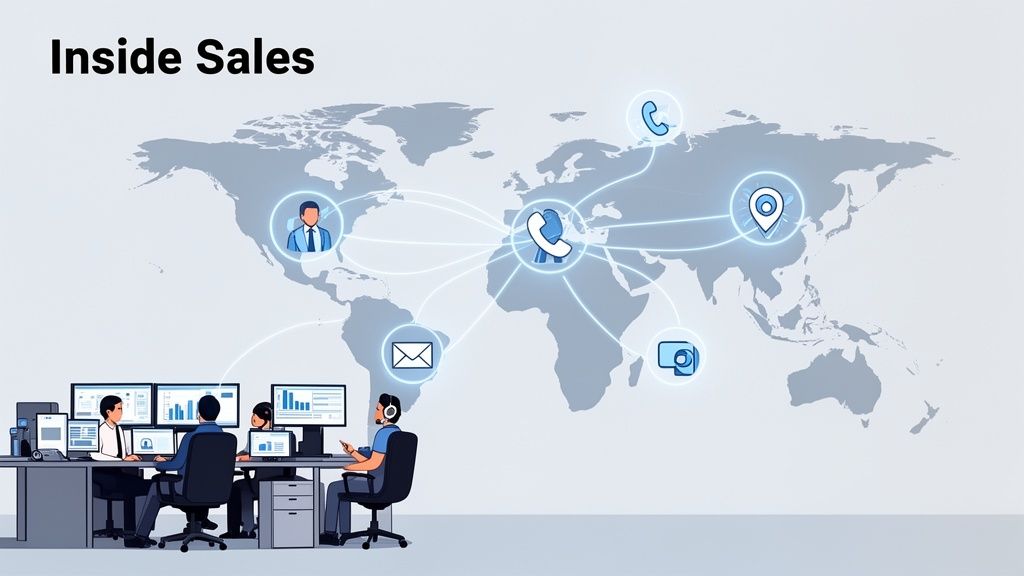
Imagine your inside sales team as your company’s digital-first sales force. While traditional field sales reps are on the road, travelling from one meeting to the next, your inside team covers more ground with greater efficiency, without ever leaving the office. This model is a perfect match for today's B2B buyers, where over 70% of the decision-making process is completed online before they even speak to a sales representative.
The real power of inside sales lies in its smart blend of human expertise and technology. Your reps leverage a sophisticated toolkit—from CRMs and communication platforms to AI-driven sales engagement software—to manage a high volume of interactions without sacrificing the quality of those conversations. For example, a single inside sales rep at a SaaS company can manage a pipeline of 50-60 active deals per quarter, a volume that is simply unattainable for their field-based counterparts.
To get a clearer picture, it’s helpful to understand the differences between a Sales Development Representative and an Inside Sales Representative. Though both operate within the inside sales framework, their roles are distinct and crucial for a scalable sales funnel.
The Strategic Value for Your Business
For any business leader, the attraction to inside sales comes down to its direct impact on the bottom line. Moving to this model isn't just an operational change; it's a strategic move that boosts efficiency and fuels growth. Right away, you’ll notice a drop in customer acquisition costs—often by 40-90% compared to field sales—as you completely cut out travel expenses and enable each rep to manage a much larger pipeline.
At its heart, the biggest advantage of an inside sales model is its incredible scalability. You can expand your reach into new regions or verticals without the huge overheads of setting up a physical sales office there.
This scalability means you can test a new market with minimal risk and then rapidly deploy resources when you find a winning formula. Because the entire team is centralized, it's far easier to standardize your sales process, deliver consistent training, and build a collaborative culture that’s laser-focused on hitting targets. This centralized setup also generates cleaner, more reliable sales data, which translates to a clearer view of your pipeline and more accurate revenue forecasts—a critical asset for any executive team.
Inside Sales at a Glance A Strategic Snapshot
To make things simple, this table breaks down the core elements of the inside sales model and what they mean for your business. It's a quick reference for understanding its strategic value.
| Strategic Characteristic | What This Means for Your Business |
|---|---|
| Remote Selling Model | Cut out travel costs, reduce overhead by up to 3X, and get the freedom to hire the best talent, no matter where they live. |
| Technology-Centric | Use tools like CRM, Voice AI, and automation to increase rep productivity by 30% or more and manage a high volume of leads effectively. |
| High Velocity & Volume | Built to handle more leads and shorten the sales cycle—often by 20-30%—helping you get to revenue faster on many types of deals. |
| Scalable & Agile | Allows for quick expansion into new markets and customer segments with a much lower initial investment and less risk. |
| Data-Driven Approach | Centralised operations generate clean data for better forecasting, performance tracking, and smarter strategic decisions. |
In short, the table shows how inside sales combines efficiency with agility, giving you a powerful engine for predictable and sustainable growth.
Choosing Your Model: Inside Sales vs Outside Sales
Picking between an inside and an outside sales team isn't just an operational detail—it's a strategic move that defines your entire revenue engine. For any business leader, the question isn't "which one is better?" but rather, "which model will give us the best return on investment for our specific business goals?" The right answer always comes down to a hard look at your Customer Acquisition Cost (CAC), sales cycle velocity, and scalability requirements.
An inside sales model can dramatically slash your CAC, particularly for mid-market deals. Picture a SaaS company selling a ₹5,00,000 annual subscription. An outside sales rep might land two of these a month while racking up ₹75,000-₹1,00,000 in travel and entertainment costs. An inside sales rep, on the other hand, can work a pipeline of 30-40 similar deals at the same time from their desk. This simple change can cut the cost per acquisition by a massive 40-50%.
That kind of efficiency means you can cover way more ground with the same budget. You can penetrate new markets and grow your customer base at a speed that traditional field sales just can't keep up with.
The Impact on Sales Velocity
The speed at which deals move through your pipeline—your sales velocity—is another game-changer. Inside sales teams are built for this. They live on technology and can jump between high-impact discovery calls, product demos, and follow-ups all in a single day. That's simply not possible for a field rep hopping between cities.
For instance, a typical sales cycle for a moderately complex software product might take 90 days with an outside team. A well-oiled inside sales process, leveraging tools like automated follow-ups and digital proposal software, can often shrink that down to 60 days or less. That 33% reduction means revenue comes in faster and your forecasts become far more reliable—music to any CXO's ears.
The bottom line is this: Inside sales is built for volume and speed. It’s a powerful engine for predictable, scalable growth, especially in high-transaction environments.
But it's not a silver bullet. When you're talking about high-value, complex enterprise deals—think multi-crore, multi-year contracts—the deep, personal relationship-building of outside sales is still king. The level of trust needed to close a seven-figure deal is often built face-to-face, not just over a video call. To truly nail down the best fit for your business, it helps to understand how these models compare to other proactive approaches, including knowing what outbound sales entails.
Strategic Breakdown: Inside Sales vs Outside Sales
Choosing the right sales structure means lining up your product, your market, and your business goals against the unique strengths of each model. This comparative analysis is designed to help leaders decide which approach makes the most sense based on their specific situation.
| Decision Factor | Inside Sales | Outside Sales |
|---|---|---|
| Ideal Deal Size | Best for deals ranging from ₹50,000 to ₹25,00,000. High volume, shorter sales cycles. | Excels with large, complex deals, typically above ₹50,00,000, requiring deep stakeholder alignment. |
| Customer Acquisition Cost (CAC) | Significantly lower due to eliminated travel expenses and higher representative productivity. | Higher due to travel, lodging, and the extended time spent nurturing fewer high-value accounts. |
| Sales Cycle Velocity | Fast. Reps manage many deals concurrently, aiming to shorten the sales cycle. | Slower. Cycles can last 6-18 months, focusing on deep relationship-building and complex negotiations. |
| Scalability | High. Easy to scale the team quickly without the geographical constraints or costs of setting up field offices. | Low. Scaling is slower and more capital-intensive, requiring strategic hiring in specific territories. |
| Required Skill Set | Tech-savviness, strong verbal communication, process discipline, and the ability to build rapport remotely. | Exceptional interpersonal skills, strategic account planning, negotiation expertise, and C-level presence. |
| Essential Technology | Heavily reliant on CRM, sales engagement platforms, Voice AI, and video conferencing tools. | Uses CRM and mobile productivity tools but relies more on in-person meetings and presentations. |
Ultimately, the table clarifies where each model delivers maximum impact, helping you build the optimal sales structure to hit your company's targets.
The High-Performance Inside Sales Playbook
A successful inside sales operation isn't just a team making calls; it’s a finely tuned revenue engine. For any leader, understanding the day-to-day playbook that runs this engine is the key to building a predictable and scalable growth machine. It all boils down to a structured workflow that turns raw leads into closed deals as efficiently as possible.
The journey kicks off with lead qualification. Your marketing team works hard to generate Marketing Qualified Leads (MQLs), but it's the inside sales team’s job to turn them into Sales Qualified Leads (SQLs). A practical example would be a software company where marketing generates 500 MQLs from a webinar. The inside sales team's first task is to engage these leads within 5 minutes (as response time is critical), using a BANT (Budget, Authority, Need, Timeline) framework to identify the 50-75 leads that are truly purchase-ready.
Once a lead is qualified, the real work begins. Top-performing teams run multi-channel outreach campaigns, combining 6-8 touchpoints across email, phone, and LinkedIn. The aim here isn't just to make noise, but to get a response and book that crucial first meeting. If you're interested in learning more, you can read our guide on cold calling challenges and how AI voice agents can save the day.
From Demo to Deal
After you've secured a meeting, the focus shifts to delivering a compelling remote demonstration. A great demo is never a generic feature dump. It’s a tailored presentation that uses the prospect's own data or use case to show exactly how your solution solves their specific problem, aiming to prove a 10x ROI. This is where skilled reps truly build value and set your offering apart from the competition.
Following a successful demo, the process moves into generating a proposal and starting negotiations. Modern inside sales teams use templates and proposal software to create and send proposals within 24 hours of the demo, maintaining momentum. The final step is, of course, closing the deal. This takes a deft hand, skilfully handling objections and using a clear, confident call to action to get that contract signed.
A well-defined inside sales playbook isn't just a guide for reps—it's a strategic asset for the business. It creates a repeatable, measurable process that removes guesswork and allows you to forecast revenue with much greater accuracy.
This structured approach runs on data. In fact, recent research shows that 80% of Indian sales professionals see data quality and accessibility as a critical factor in their success. With high-performing teams in India now managing an average of ten different communication channels, a data-driven playbook is no longer a nice-to-have; it's essential. You can dig deeper into these findings in Salesforce's research on sales trends in India.
The KPIs That Matter to the C-Suite
While your reps are focused on daily activities, leaders need to keep an eye on the high-level metrics that signal the health of the entire revenue engine. These Key Performance Indicators (KPIs) give you a clear, no-nonsense view of what’s working and where things need a tune-up.
Here are the core metrics every CXO should have on their dashboard:
- Pipeline Velocity: How fast do deals move from lead to close? For a B2B SaaS company, a healthy velocity might be 75 days. If this number starts creeping up to 90 or 100 days, it signals a bottleneck that needs immediate attention.
- MQL to SQL Conversion Rate: What percentage of marketing leads are sales-ready? An industry benchmark is often around 10-15%. A lower rate may indicate a misalignment between sales and marketing on lead definition.
- SQL to Close Conversion Rate: Of the qualified leads, how many become customers? A strong inside sales team should be converting 20-25% of their SQLs. This metric is the ultimate measure of your team's closing effectiveness.
- Average Deal Size: Are we selling valuable solutions or just small-ticket items? Tracking this helps you understand which market segments are most profitable and whether your team is successfully upselling or cross-selling.
- Customer Lifetime Value (CLV) to CAC Ratio: For every rupee spent acquiring a customer, how much revenue do they generate over their lifetime? A healthy ratio is 3:1 or higher. This is the ultimate metric for sustainable, profitable growth.
By consistently tracking these KPIs, you can move from simply managing a sales team to strategically directing a predictable revenue machine. You’ll be able to spot problems before they escalate, identify your top performers, and make data-backed decisions that drive real, sustainable growth.
Building Your Inside Sales Tech Stack
For any inside sales team to truly hit its stride, technology isn't just helpful—it's the engine. As a business leader, your goal isn’t just to collect software licenses. It's to architect a tech stack that works together seamlessly to multiply your team's efforts and, ultimately, drive revenue.
The bedrock of any modern sales operation is the Customer Relationship Management (CRM) system. Think of it as the central nervous system for your entire sales process. Platforms like Salesforce or HubSpot become the single source of truth, holding every piece of customer data, every interaction, and the real-time status of your pipeline. Getting this right is fundamental for accurate forecasting and making smart strategic moves.
On top of that solid foundation, you layer your communication and engagement tools. For example, a sales engagement platform can automate email sequences, ensuring that every lead receives 5-7 follow-up touches without any manual effort from your reps, increasing response rates by over 250%.
The Game-Changing Component: Voice AI
While a good CRM and an engagement platform are standard issue these days, the real jump in performance comes from smarter automation. This is where Voice AI enters the picture and completely changes the game, especially for those high-volume, repetitive tasks that clog up the top of the sales funnel.
Imagine an AI-powered agent that can handle all your initial outreach and qualification calls on its own. This isn't a futuristic concept; it's happening right now with platforms like DialNexa. These AI agents can dial thousands of leads, get past gatekeepers, and have surprisingly natural conversations to figure out if a lead is a good fit.
By automating the top of the funnel, you let your best salespeople—your most expensive and valuable assets—do what only they can do: build relationships, run compelling demos, and close deals.
This smart division of labour creates a hyper-efficient revenue machine. To really grasp the full potential, you can get a deeper look into how AI voice agents are transforming customer service and sales.
The process map below shows just how clean and effective a sales workflow can be when it's properly supported by technology.
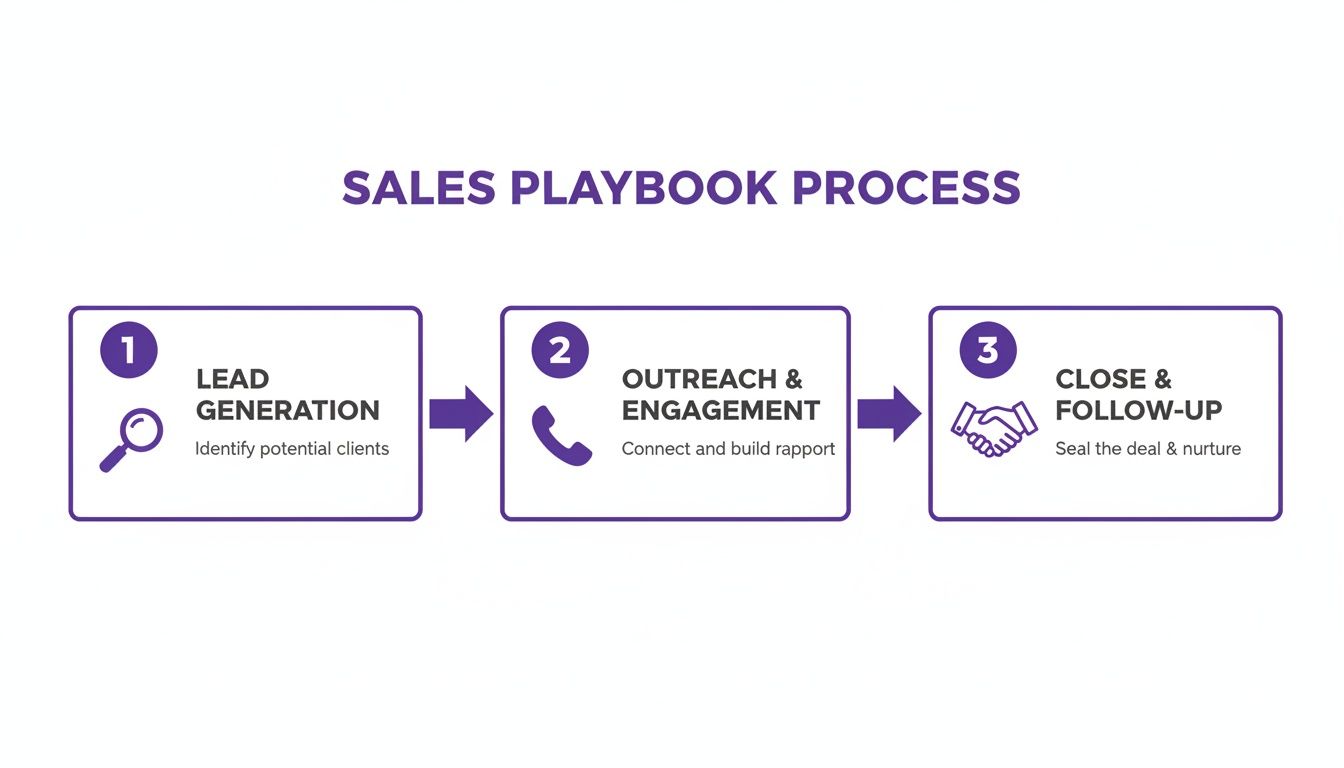
It’s all about streamlining that journey from a name on a list to a happy customer, making every step more efficient along the way.
The Business Case for AI Automation
Bringing Voice AI into your workflow isn’t just a cool tech upgrade; it’s a decision backed by hard numbers and a clear return on investment. The impact on core sales metrics is fast and significant, hitting your bottom line where it counts.
Let's talk numbers. For many teams, just getting a prospect to pick up the phone is half the battle. Industry benchmarks show human connect rates often struggle to get past 4-7% on cold outreach. But by deploying a persistent and intelligent AI agent for that first touch, companies have seen connect rates jump to an incredible 91% on warm lead lists. That's a monumental increase in conversations from the exact same lead list.
The conversion numbers are even more powerful. A typical human-led outreach effort might convert just 2% of leads into booked meetings. AI agents, however, are relentless with follow-up and stick to the script perfectly, pushing that conversion rate up to 8%. That’s a 4x improvement in qualified meetings for your closers.
Here's what that means in practical terms for a business:
- Lower Cost Per Lead: For example, if a human rep's time costs ₹1,500/hour to generate one meeting, an AI agent can do it for less than ₹300, drastically lowering your acquisition costs.
- Faster Sales Cycle: Your pipeline moves quicker because your sales reps are only talking to genuinely interested, pre-qualified buyers.
- Happier Sales Reps: You free your top performers from the soul-crushing grind of making 50-100 cold calls a day. This reduces burnout and lowers costly employee turnover.
At the end of the day, adding Voice AI to your tech stack is about building a more effective, scalable, and profitable inside sales engine. It lets your people focus on the high-value, human-to-human work that actually grows the business.
How Winning Indian Companies Use Inside Sales
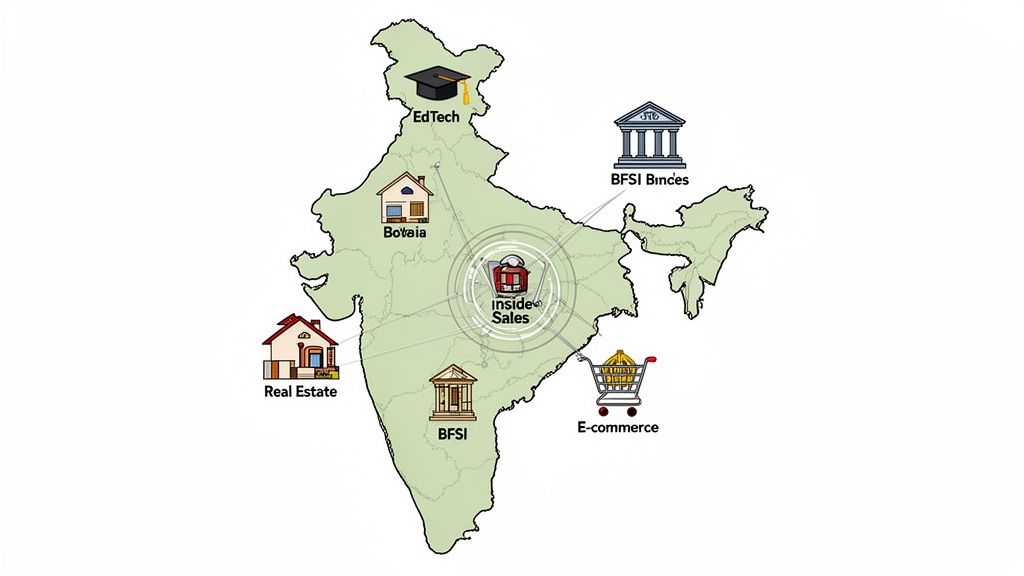
The theory behind what is inside sales is one thing, but seeing it work in the real world is where it all clicks. Across India, smart companies are looking past old-school sales methods. They’re now using remote sales teams as their main engine for growth, not just as a way to cut costs. This isn't just a trend; it's a strategic response to a market that demands speed, scale, and efficiency to win.
Whether it’s managing a huge pipeline of student sign-ups in EdTech or sifting through thousands of property enquiries in real estate, inside sales is often the only realistic way to reach a customer base that's spread all over the country and lives online. It gives businesses the agility to enter new markets and scale up fast.
EdTech: The High-Volume Enrolment Engine
For India's booming EdTech sector, the game is all about volume. Companies like BYJU'S and upGrad need to talk to tens of thousands of students and parents nationwide, guiding them from a casual query to a paid enrolment. It's a massive undertaking that a traditional field sales team just can't keep up with.
This is where inside sales shines. Leading EdTech players have built powerful operations combining skilled counsellors with smart automation. For example, an AI agent could make 10,000 initial qualifying calls in a day to a list of webinar attendees, identify the 1,500 who are highly interested and have the budget, and then seamlessly route them to human counsellors. This allows the human team to have meaningful conversations and close deals, dramatically improving efficiency.
This model lets them manage a funnel that would otherwise need a massive, expensive workforce, making sure no potential student slips through the cracks.
Real Estate: Qualifying Leads and Booking Site Visits
In the cut-throat world of real estate, speed to lead is everything. A potential buyer's interest is at its peak in the first 5 minutes after they enquire online. The most successful firms, like NoBroker or Square Yards, use inside sales teams to jump on these digital leads instantly. Their job is to qualify the buyer's budget and needs, then book a site visit before a competitor even has a chance.
The core job here is rapid-fire qualification and scheduling. A centralised inside sales team acts as a filter, sorting through a flood of online leads to ensure only serious, financially ready buyers get an appointment with an on-ground sales executive.
This two-step process makes the field team incredibly productive. By automating the first touchpoint, developers make sure their best agents are spending their time showing properties to people who can actually buy, not chasing down 90% of leads that go nowhere. This directly pushes up conversion rates and helps sell properties faster.
BFSI and E-commerce: Scaling Up Customer Acquisition
The Banking, Financial Services, and Insurance (BFSI) industry relies on inside sales to handle critical tasks like customer onboarding, KYC verification, and cross-selling other financial products. For instance, a major bank can use an inside sales team to follow up on 50,000 new credit card applications, walking customers through the final verification steps and activating the cards, a process that can increase activation rates by 15-20%.
Meanwhile, e-commerce brands are finding a goldmine in India's smaller towns. The country's e-retail market has rocketed to a gross merchandise value of around $60 billion. And here’s the kicker: nearly 60% of new online shoppers since 2020 are from Tier-3 and smaller cities. You simply can't reach this audience with a physical sales presence. For more on this, check out Bain & Company's research on how India shops online.
For these businesses, a scalable inside sales model isn't just a nice-to-have—it's the only practical way to capture this market boom. By using remote teams and automation, they can connect with millions of new customers in a way that feels personal yet remains cost-effective.
Building and Scaling Your Inside Sales Team in India
Putting together a world-class inside sales team isn’t just about filling seats; it's about engineering a predictable revenue machine. For business leaders in India, this means being deliberate about how you structure the team, who you hire, and what operational foundation you build to support growth. Get this framework right, and you turn a group of individuals into a high-performance unit designed to win.
One of the first big decisions is how to structure the team itself. A widely successful model splits the team into two core roles: Sales Development Representatives (SDRs) and Account Executives (AEs). SDRs are your hunters—they focus purely on prospecting and generating a pipeline of qualified meetings. AEs are your closers, taking those qualified leads and guiding them through the sales process to a final deal. This specialisation lets each person master their part of the sales cycle, which typically boosts overall productivity by 15%.
Finding and Developing the Right Talent
When it comes to hiring, you need to look past a simple sales background. Today’s inside sales professional needs a unique mix of skills to succeed. They need to be resilient, able to handle rejection and keep pushing forward. They also have to be brilliant at building rapport and trust over a phone call or video chat, without ever meeting in person.
Above all, they must be comfortable with technology. Your reps will live inside your CRM, sales engagement platforms, and other digital tools, so being tech-savvy is non-negotiable.
Once you’ve hired the right people, the work has just begun. Continuous training is the key to closing skill gaps and keeping your team at the top of their game. You'll want to run regular sessions on:
- Product Knowledge: Ensuring everyone can articulate the value of what you sell, inside and out.
- Sales Process: Reinforcing your playbook so everyone follows the most effective steps.
- Technology Use: Making sure the team is getting the most out of the tech stack you've invested in.
A commitment to constant development means your team can adapt to new challenges and perform consistently, quarter after quarter.
Budgeting and Operational Excellence
Planning your budget starts with understanding the local market. For example, inside sales representatives in India earn an average salary of ₹8,42,852 annually. This figure is a solid starting point for building compensation packages that attract and keep the best people. A standard compensation plan is a 70/30 split (70% base salary, 30% variable commission) to ensure stability while motivating high performance.
Finally, don’t ever overlook the power of a good sales operations function. Sales ops is the glue that holds your entire sales engine together. They manage the tech, refine the processes, and analyse the data to find out what's working and what isn't. It’s a serious investment, with recent surveys showing that 65% of Indian sales leaders now see sales operations as vital for shaping their entire sales strategy. This focus on operations is what helps your team work smarter, not just harder. You can find more details on salary benchmarks and sales trends for inside sales professionals in India.
By combining a smart structure, the right talent, and a robust operational framework, you build more than a sales team—you build a predictable and scalable revenue asset for your organisation.
Answering Your Key Questions About Inside Sales
As a leader, you need straight answers, not fluff. Let's tackle the big questions VPs and Directors often ask when they're considering an inside sales model for their business.
Is Inside Sales the Right Model for My Company?
The answer really comes down to three things: your average deal size, product complexity, and sales cycle length.
Inside sales truly shines when your team can close deals remotely, typically within a 90-day window. If your Annual Contract Value (ACV) is between ₹1,00,000 and ₹25,00,000, and your go-to-market strategy is built on high volume and speed, then this model is a perfect match.
However, for those highly complex, multi-crore enterprise contracts that take months or even years to close, you'll still need your field sales team on the ground building those key relationships.
What Is the Biggest Mistake Leaders Make?
The single most common pitfall is underinvesting in the fundamentals—process and technology. Too many leaders hire a team of reps, point them towards a list of leads, and just expect the magic to happen.
It doesn't work that way. A top-performing inside sales organisation is a well-oiled machine. It absolutely requires a solid foundation: a structured sales playbook, a powerful CRM, and the right sales enablement tools to execute flawlessly at scale. Without this, your CAC will be too high and your growth will be unpredictable.
Does Voice AI Make Human Sales Reps Obsolete?
Not at all. In fact, it does the opposite—it makes them more valuable. Think of Voice AI as the ultimate assistant. It handles the repetitive, top-of-funnel grunt work like initial lead qualification and setting up appointments, tasks that can consume up to 40% of a sales rep's time.
This frees up your skilled (and expensive) sales reps to concentrate on what they do best: delivering killer product demos, navigating tricky negotiations, and ultimately, closing deals. It's about augmenting your team's abilities, not replacing them. You can dive deeper into how to measure the success of your outbound campaigns with AI to see the real-world impact.
Ready to see how Voice AI can transform your sales process? Book a demo with DialNexa and discover how our AI agents can scale your outreach, qualify leads, and accelerate your revenue growth. https://dialnexa.com

Leave a Reply