
AI in Insurance Underwriting: A CXO’s 2026 Strategic Guide
Accenture reported that insurance executives expect the share of underwriting tasks impacted by AI to rise from 17% to 75% within three years, while McKinsey found AI-led initiatives can drive a 10% to 15% increase in premium growth. For an insurance COO, that is not a technology headline, it's an operating-model warning. If underwriting still depends on manual document checks, fragmented risk data, and slow exception handling, the business will feel the cost in loss ratios, cycle times, and customer drop-off.
India makes that shift even more urgent. IRDAI's Bima Sugam proposal, approved in 2022, is pushing the market towards a more digital, standardised insurance infrastructure, while insurers still operate in a market that remains underpenetrated by global standards, with insurance penetration in the low single digits of GDP. In that setting, AI in insurance underwriting is not just about speed. It's about making every application decision more consistent, more auditable, and more scalable across life, general, and health lines.
The strategic question isn't whether AI can score risk. It's whether your underwriting function can absorb larger volumes of applications, identity documents, and external risk signals without breaking compliance or increasing leakage. That is where the practical business case starts, and it's also why leaders chasing achieving measurable AI impact usually begin with underwriting, where measurable process gains are easiest to see and hardest to ignore.
Table of Contents
- The Strategic Imperative of AI in Underwriting
- Core Technologies Driving the Underwriting Revolution
- Measuring the ROI of AI Driven Underwriting
- Practical Use Cases Across Insurance Lines
- Navigating Compliance Bias and Explainability
- A Phased Roadmap for AI Implementation
- The Future Ready Underwriter
The Strategic Imperative of AI in Underwriting
AI in underwriting has moved from experimentation to operating-model redesign. The strategic case is not merely faster decisions, but tighter control over loss ratios, lower manual workload, and more consistent compliance across the portfolio. Underwriting sits at the point where insurers decide how quickly they can grow, how precisely they can price risk, and how much processing cost they are willing to absorb inside every submission.
Why the board should care
A slower underwriting desk does more than delay policy issuance. It pushes agents to compare alternatives, keeps servicing teams tied up in follow-up work, and leaves underwriters handling tasks that rules and data can process more consistently. The insurer pays for that delay twice, once through higher operating cost and again through lost revenue opportunities.
The board-level question is therefore operational, not technological. The COO and CUO need a shared view of how AI changes submission intake, triage, exception handling, and final decisioning. Teams that treat AI as a bolt-on tool usually see limited gains. Teams that redesign the workflow around it are more likely to reduce cycle time, improve decision quality, and make compliance review easier to evidence.
Practical rule: if an underwriting activity can be standardised, checked against known data, and routed by exception, it belongs in the AI-enabled path before it belongs in a human queue.
For Indian insurers, this becomes even more relevant as digital onboarding, servicing, and distribution scale through initiatives such as Bima Sugam. Underwriting can no longer depend on paper-heavy, branch-specific processes if the business is expected to operate consistently across channels and products. It needs a workflow that can absorb higher submission volume without creating inconsistency in risk selection.
The implementation question matters as much as the model question. A useful reference point is achieving measurable AI impact, because underwriting programmes usually fail less from model quality than from weak ownership, poor integration with core systems, and unclear controls for explainability and auditability. For Indian carriers, that means designing for data connectivity from the start, including sources such as cKYC and Vahan APIs where they are relevant, so the underwriting decision can be traced, defended, and scaled without adding avoidable manual checks.
Core Technologies Driving the Underwriting Revolution
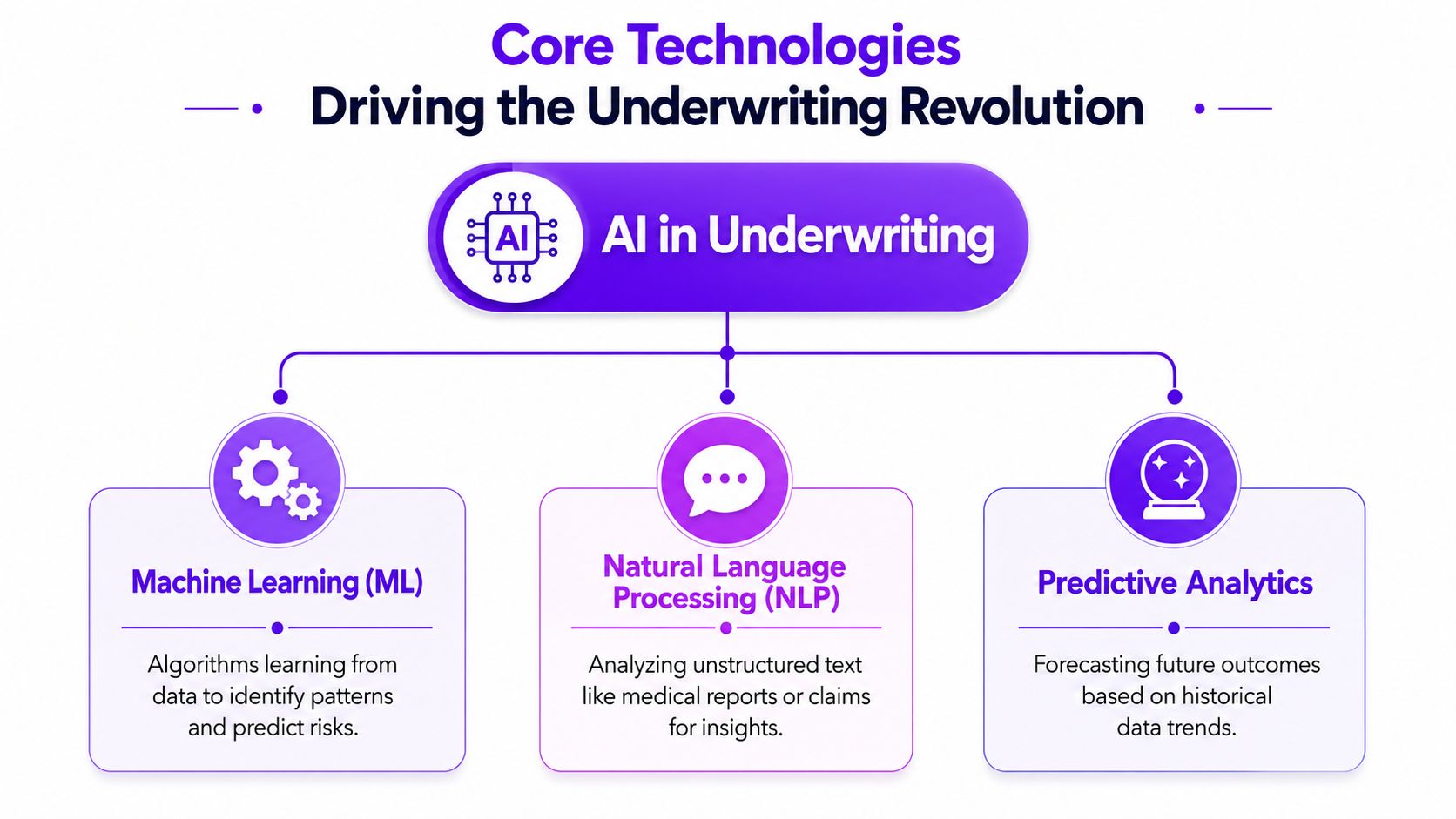
The fastest way to understand AI in insurance underwriting is to think in jobs, not buzzwords. Each core technology replaces a specific kind of repetitive underwriting work, and each one improves a different part of the decision chain.
Machine Learning as the digital risk analyst
Machine learning is the part of the stack that spots patterns across policy outcomes, claims history, document data, and external signals. In underwriting terms, it behaves like a senior risk analyst who has seen thousands of submissions and can quickly separate routine cases from those that need deeper review.
That matters because underwriters rarely make decisions from one signal alone. They weigh income, history, document completeness, prior claims, device data, and product-specific rules. Machine learning helps the insurer combine those inputs consistently, which is where pricing discipline starts to improve.
Natural Language Processing as the document specialist
NLP handles the unstructured material that slows underwriting down, including proposal forms, medical reports, broker notes, and supporting declarations. It reads text, extracts fields, and sends structured information into the workflow so underwriters aren't manually rekeying the same data.
For an executive audience, the value is simple. NLP turns paperwork into usable data without forcing teams to rebuild every process around humans reading every line. In lines such as health and life insurance, that can be the difference between a queue that grows and a queue that clears.
Computer Vision as the inspection layer
Computer vision evaluates images and scans, which is useful where underwriting depends on visual evidence, including vehicle damage, property condition, or identity verification documents. It acts like a remote assessor who can flag inconsistencies before a file reaches a human desk.
A useful comparison appears in PropLab's guide to real estate underwriting AI, because the same logic applies across asset-heavy lines. Once images, forms, and identity records are structured well enough for the model to read them, underwriting becomes less dependent on manual interpretation and more dependent on exception handling.
The important point for CXOs is that none of these tools works alone. The business value comes when the stack is orchestrated so one tool extracts data, another scores risk, and the system only routes unusual files to a human underwriter. That's where scale appears.
Measuring the ROI of AI Driven Underwriting
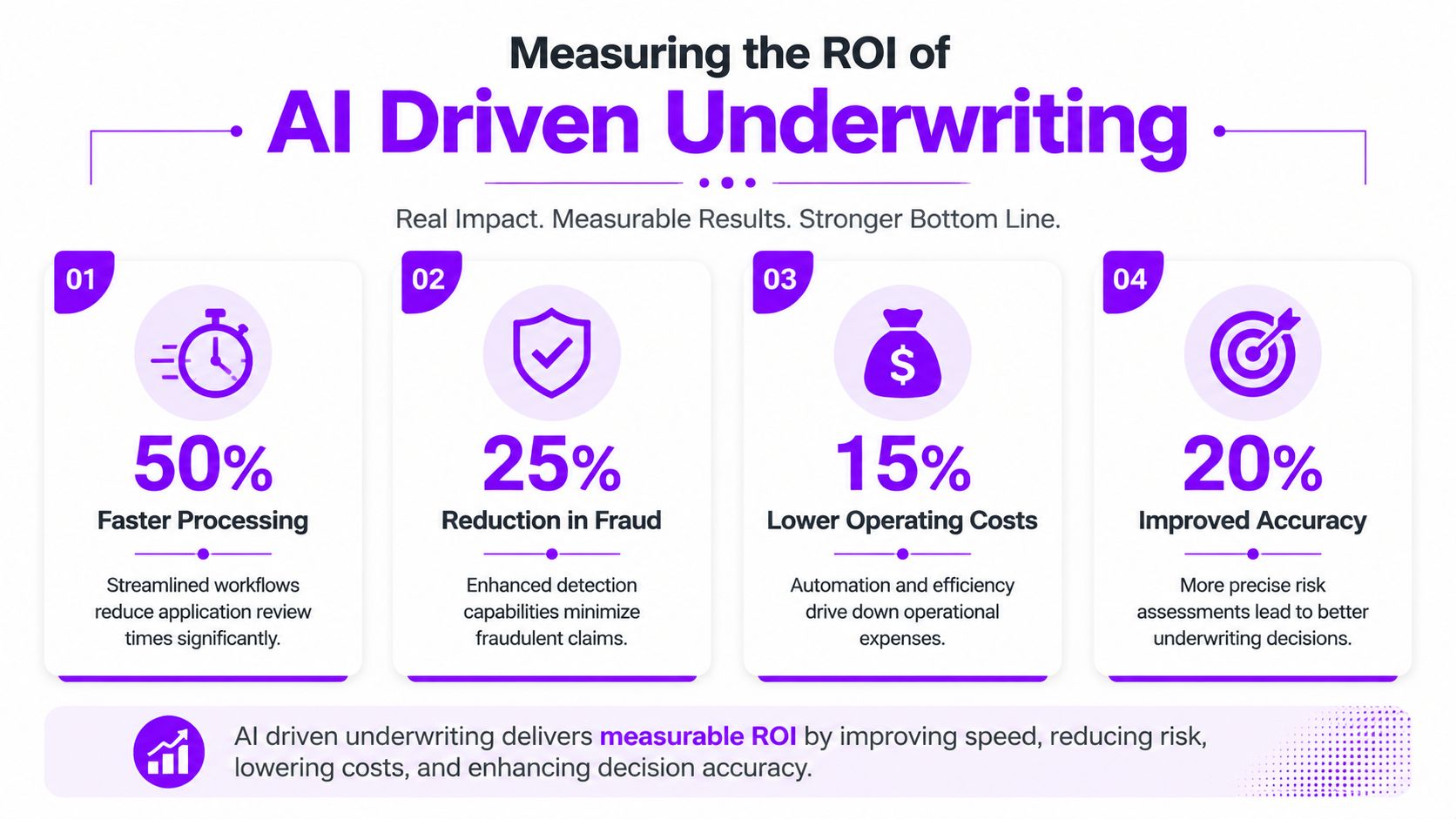
The ROI case is strongest when underwriting leaders treat AI as a programme for cost-to-serve reduction and better risk selection, not as a standalone software purchase. In practical terms, AI models can evaluate hundreds of risk signals instead of the traditional 5 to 10, which improves segmentation depth and pricing precision Codewave's underwriting analysis.
What the numbers mean for operating teams
The same analysis reports a 43% improvement in risk assessment accuracy for complex policies and a 3 to 5 percentage point improvement in loss ratios for commercial P&C insurers. For a COO, that combination is significant because it directly connects model quality to underwriting margin.
The operating effect shows up in day-to-day workflow. Fewer files need repeated manual review, more applications can move through standard rules, and underwriters spend more time on cases where judgement changes the outcome. That improves throughput without weakening control.
Business lens: if AI improves accuracy but does not reduce turnaround time, it is not ready for scale. If it reduces turnaround time but creates audit problems, it is not ready for production.
The next layer is consistency. Better risk selection reduces variation across channels, which makes branch teams, digital teams, and partner teams easier to manage. When underwriting rules are clearer, sales and operations spend less time disputing exceptions.
For Indian insurers, the governance case matters just as much as the operating case. AI underwriting should be designed around explainability methods such as SHAP, so reviewers can see why a case was routed, declined, or referred. It also needs clean integration with core data rails such as cKYC and vehicle verification sources like Vahan APIs, because fragmented inputs create weak decisions and weaker audit trails.
To track ROI properly, insurers should measure three things together, not in isolation. First, how much manual underwriting time is removed. Second, whether approval quality improves on complex cases. Third, whether policy issuance becomes faster enough to support growth without adding headcount.
The reporting layer should sit inside the same management rhythm used for portfolio and distribution reviews, which is why performance reporting discipline belongs in AI underwriting governance from the start. That discipline also gives leadership a cleaner way to align underwriting controls with emerging initiatives such as Bima Sugam, where shared standards and traceability will matter as much as speed.
Practical Use Cases Across Insurance Lines
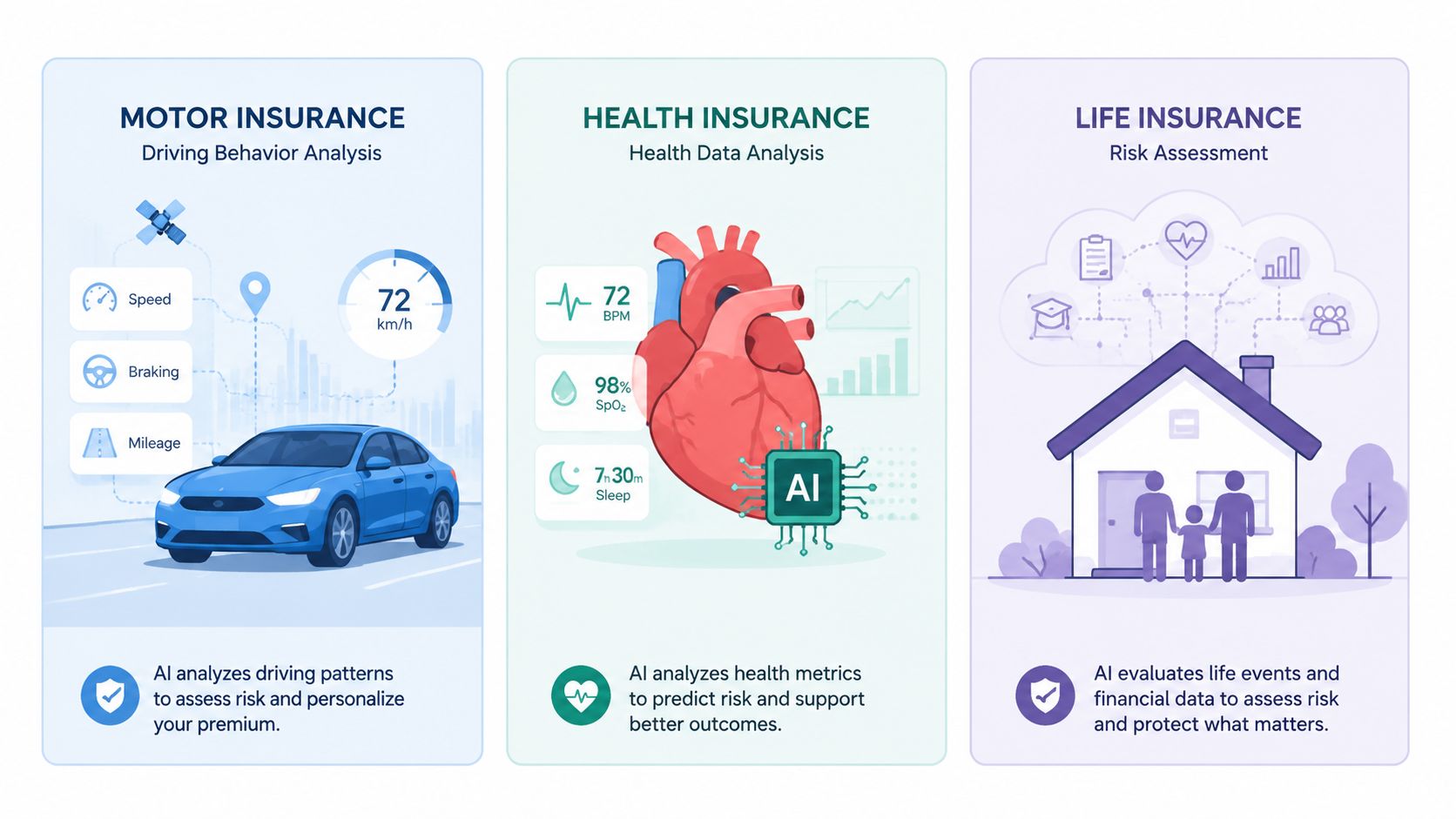
A motor application reaches the insurer with a registration number, images, KYC records, and a history of prior claims. A health application arrives with medical documents, provider notes, and longer narrative text. A life proposal often sits somewhere in between, with structured financial data and unstructured supporting evidence. AI changes each of those files in a different way.
Motor underwriting
For motor, the value starts with image handling and external verification. When teams combine document extraction with ecosystem checks such as Vahan API data, underwriting can move from broad cohort assumptions towards more individual risk profiling. That supports faster intake and cleaner verification before a case reaches human review.
The point isn't to replace the underwriter's judgement on the edge cases. It's to keep the standard ones from blocking the queue. In a high-volume motor book, that can make the difference between a team that scales and a team that reacts.
Health underwriting
Health underwriting benefits most from NLP. Long medical histories, physician notes, and supporting forms are exactly the kind of material that slows down manual teams. NLP can surface relevant fields and route the file with a cleaner data structure, which means fewer callbacks and less rework.
That matters because the primary bottleneck in health is often not risk theory, it's document handling. If the insurer can clean the file earlier, the rest of the process becomes simpler, faster, and more consistent.
Life underwriting
Life underwriting gains when the insurer moves away from static cohort logic and towards individual-level data use. That doesn't mean abandoning actuarial discipline. It means feeding better data into the existing framework so the team can see the applicant more clearly.
A technical analysis reported that AI reduced average underwriting decision time from 3 to 5 days to 12.4 minutes for standard policies through straight-through processing, while improving complex policy risk-assessment accuracy by 43% BizTech Magazine's analysis. That's the clearest proof that the business payoff comes when standard cases are routed automatically and human underwriters are reserved for exceptions.
The same logic applies across lines. The insurer wins when the workflow is designed for triage, not for universal manual review.
DialNexa's BPO perspective is a useful reminder that back-office process discipline still decides whether underwriting automation survives contact with real volumes.
Operational insight: straight-through processing works best when the file is complete enough for the machine to decide and structured enough for the human to trust the exception queue.
Navigating Compliance Bias and Explainability
In Indian underwriting, explainability is a governance requirement, not a feature request. A 2026 India-focused review says SHAP is the most widely deployed explainability method, and insurers use it to generate case-level reason codes and audit trails that can stand up to underwriting review Sarvada's India review. For teams evaluating implementation methods, a gentle introduction to SHAP for tree-based models helps frame how contribution scores become decision evidence.
Why this matters for regulated decisioning
Underwriting teams cannot rely on black-box scoring if they cannot explain why a case was flagged, referred, or declined. Internal model-risk teams need traceability, compliance teams need defensible documentation, and customer-facing teams need a reason that can survive scrutiny.
The utility of SHAP comes from its ability to translate model contribution into decision-level explanations. That makes it practical for adverse-action style reviews and exception handling, especially when the file includes features such as claims history, income proxies, medical indicators, or device-verified behaviour signals. The insurer gets scale without giving up the ability to justify the decision.
Governance rule: if the model cannot explain its referral logic in a way a compliance reviewer can test, it does not belong in the final underwriting flow.
Fairness is an operating risk
Bias review has to sit inside model lifecycle management, not as an annual afterthought. If an insurer uses alternative data and ignores how it behaves across customer segments, the problem later shows up as complaint volume, regulatory friction, or internal distrust from underwriters who stop using the model.
That is why the control stack needs human oversight, monitoring, and clear escalation paths. One implementation guide explicitly recommends private AI controls, a prohibition on training vendor models on sensitive data, recurring model reviews, and an AI risk committee with compliance oversight Appian's insurance underwriting guidance. A broader review also highlights the need for human intervention and regular bias assessment in underwriting workflows AltexSoft's insurance underwriting analysis.
For COOs and CROs, the conclusion is direct. AI underwriting works only when governance is built into the workflow. If the model speeds up poor decisions, the organisation has automated risk.
A Phased Roadmap for AI Implementation
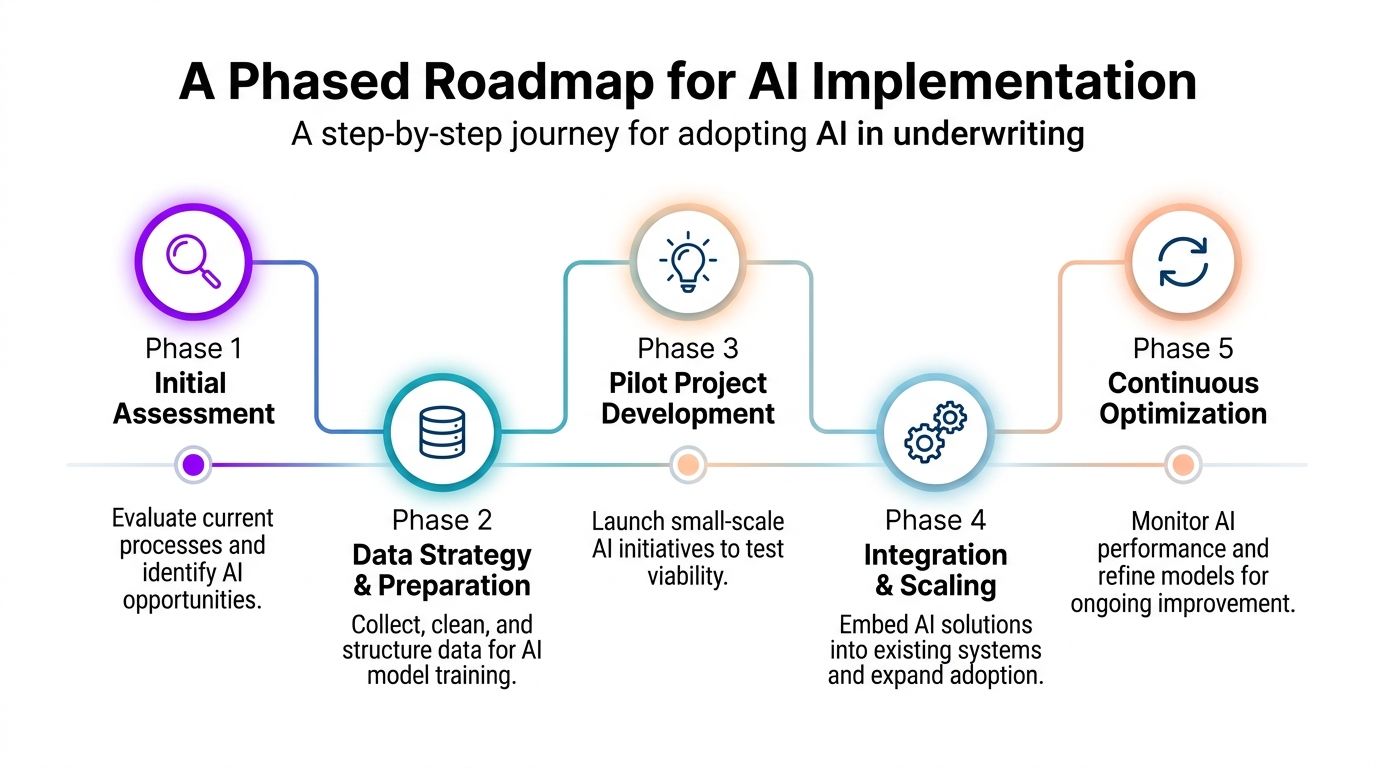
The most reliable implementation path is not a big-bang replacement of the underwriting desk. It is a staged build that starts with visibility, then data readiness, then controlled automation. That approach fits Indian insurance especially well because Bima Sugam is pulling the market towards a more digital, standardised infrastructure IRDAI and the Bima Sugam milestone.
Phase 1 and 2
Start by mapping where underwriters lose time. Document intake, identity verification, duplicate checks, and exception routing usually reveal the biggest bottlenecks. Once that is visible, create a data strategy that prioritises clean, reusable fields and the external integrations you already rely on, including KYC and ecosystem verification sources.
Many programmes stall because they try to model before they standardise. In practice, the data layer decides whether AI becomes a helper or a liability.
Phase 3 and 4
Pilot on a narrow line with repeatable files, then scale only after governance is stable. That could mean motor renewals, simple health applications, or another file type with clear rules and strong historical data. The point is to prove that the machine can triage standard cases while the human team retains control over exceptions.
Integration should come before expansion. If the model sits outside the workflow, underwriters won't trust it. If it sits inside the workflow but can't explain itself, compliance won't allow it to grow.
Phase 5
Once the system is live, tune it continuously. Monitor overrides, referral patterns, decline reasons, and decision drift. Keep the model aligned with changing product rules, distribution channels, and risk appetite.
That operating discipline is what turns AI from a one-time deployment into a lasting capability. It also makes the underwriting function more resilient, because the insurer can adapt faster when market conditions, product mix, or regulatory expectations change.
The Future Ready Underwriter
AI is not replacing the underwriter, it's changing what the underwriter spends time on. Routine intake, document work, and standard routing can shift to the system, while the human role moves towards exceptions, complex pricing, and governance-backed judgment. That is a better use of scarce expertise.
For the COO, the prize is a healthier trade-off across loss ratios, operational efficiency, and regulatory compliance. For the CRO, it's a model that can be defended. For the business, it's faster issuance and more scalable growth. The insurers that win will be the ones that build AI underwriting as a controlled operating capability, not a standalone experiment.
A CTA for DialNexa Labs Private Limited.

This is an insightful overview of how AI is transforming insurance underwriting beyond simple automation, with a strong focus on efficiency, risk control, and compliance. The practical explanation of machine learning and workflow redesign makes the topic especially valuable for insurers exploring AI adoption.
This is an insightful guide to how AI is transforming insurance underwriting in 2026. The strategic focus on automation, data-driven decisions, and operational efficiency provides valuable perspectives for CXOs navigating the evolving insurance landscape.
This is an insightful guide to how AI is transforming insurance underwriting through smarter risk assessment, faster decision-making, and improved operational efficiency. The strategic perspective makes it a valuable resource for business leaders looking to embrace AI innovation and build more efficient, data-driven insurance processes.
This is an insightful guide highlighting how AI is transforming insurance underwriting in 2026. The practical perspectives on automation, risk assessment, and data-driven decision-making offer valuable insights for business leaders looking to improve efficiency, accuracy, and customer experience in the insurance industry.