
Floor Supervisor Duties and Responsibilities: Guide
The floor supervisor sits where plans turn into service, and that is why weak supervision shows up first as missed breaks, late handoffs, stockouts, room delays, rework, or safety slippage. If you run retail, hospitality, manufacturing, or a service floor in India, you already know the pattern. The team looked staffed on paper, then the shift started, one associate disappeared for break, one task stalled, a customer complaint escalated, and no one owned the log when the next supervisor arrived.
The job is not passive oversight. Indian role guides define the floor supervisor as the first-line operational lead who assigns duties, checks quality, enforces safety, and reports upward to management, while retail-specific descriptions add training, inventory monitoring, customer complaint resolution, and keeping coverage continuous across shifts (Careervira job role for retail floor supervisor in India). This is the lens directors should use. Floor supervisor duties and responsibilities are a control function, not a title for someone who stands nearby and reacts late.
Table of Contents
- What a Floor Supervisor Actually Owns on a Busy Day
- The Four Operating Pillars of the Floor Supervisor Role
- A Prioritised Playbook of Day-to-Day Duties
- How the Role Changes by Industry
- KPIs and Skill Requirements That Predict Performance
- Sample Job Description and a 30-60-90 Day Assessment
- Common Misconceptions and the Compliance Reality
- CXO Action Checklist, Rollout Plan, and FAQs
What a Floor Supervisor Actually Owns on a Busy Day
At 7 a.m., the floor is already talking back. One associate is late, two need breaks, a stock gap has opened on a hot item, and a customer is demanding a resolution before the queue gets longer. A competent supervisor does not wait for the shift to “settle down”. They assign coverage, move labour to the pressure point, clear the complaint, and log the handoff before the next fire starts.
The hour that reveals the whole job
This is why the role matters more than most org charts admit. Indian hospitality and retail job standards define floor supervision around room allocation, task assignment, inspection, guest requests, maintenance escalation, safety compliance, and shift continuity, not loose people management (CBS Staffing floor supervisor posting). In practice, the supervisor is the person converting staffing into output. If they miss the break rotation, the floor coverage collapses. If they miss the stockout, sales or service slows. If they ignore the escalation, the next manager inherits a bigger mess.
A strong supervisor works inside the hour, not after it. They read the floor, triage the highest-risk issue first, and keep the shift from drifting into avoidable loss. That is why the role deserves manager-level accountability even when the person carrying it has a frontline title.
Practical rule: if a supervisor cannot explain who is on the floor, what is due next, and which issue is at risk of slipping, they are not supervising. They are observing.
The best operators audit this role on live behaviour, not personality. Did the supervisor protect coverage? Did they maintain quality checks? Did they document the handoff? Did they escalate early enough to avoid rework or delay? Those four questions expose whether the shift was controlled or merely survived.
For scheduling discipline that supports this kind of shift control, teams often pair floor operations with a formal staffing rhythm like this shift scheduling guide from DialNexa. The point is the same across sectors, the shift must be designed to hold under load.
The Four Operating Pillars of the Floor Supervisor Role
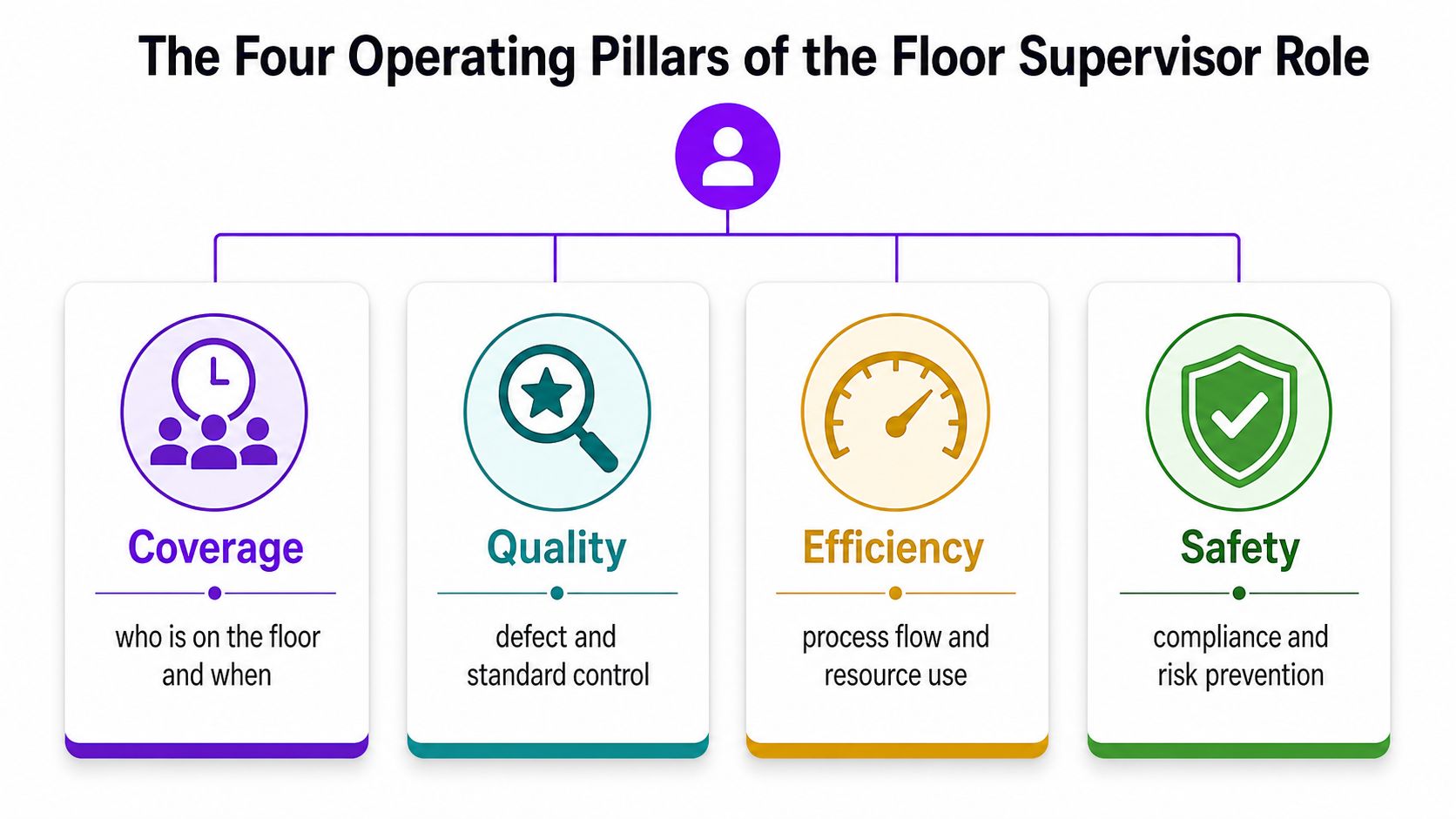
A floor supervisor controls four things that decide whether the shift holds or breaks, coverage, quality, throughput, and compliance. Directors should measure all four, because each one exposes a different kind of operational failure. Coverage shows whether the floor is staffed where work is happening. Quality shows whether the output is fit for the customer. Throughput shows whether work is moving at the right pace. Compliance shows whether the operation is staying inside safety, sanitation, and record-keeping requirements.
Coverage keeps the floor live
Coverage answers one question, who is in position when demand spikes? In retail and hospitality, that means break rotation, shift handoff, staffing against footfall or occupancy, and a supervisor who moves people before queues build or guests wait. In production settings, it means bay allocation and making sure the right person is at the right station. If coverage slips, the floor starts losing time before anyone notices, because the work is there but the people are not.
Coverage should be audited by live presence, not by the roster alone. A clean schedule means nothing if one section is abandoned, one station is overrun, or the incoming shift inherits a gap nobody logged.
Quality protects the customer-facing standard
Quality is not a final check at the end of the shift. It is the supervisor verifying rooms, stock presentation, service output, job-card completion, or sanitation while the work is still in motion. That is the only way to stop defects from spreading. If a room is not inspected, a display is not corrected, or a job card is not complete, the customer sees the miss before management does.
Indian hospitality floor standards also place room inspection, guest request handling, maintenance reporting, and safety compliance inside the supervisor's day, which makes quality a live control function, not a post-shift opinion (CBS Staffing floor supervisor posting).
Throughput keeps work moving
Throughput is the speed of closed work without sloppy shortcuts. In manufacturing and workshop settings, that shows up in bay allocation, promised delivery monitoring, parts availability, schedule adherence, and rework escalation. It is the difference between a floor that flows and a floor that keeps stacking unfinished jobs.
If throughput is weak, idle time rises, work queues grow, and promised completion slips. That is a management failure, because the supervisor either did not sequence the work, did not move labour fast enough, or did not surface the constraint early.
Compliance stops hidden risk
Compliance covers safety, sanitation, attendance control, break discipline, record-keeping, and hazard escalation. In India, that matters because many compliance expectations sit at establishment level and vary by site practice, industry, and local enforcement. A supervisor who fails to document incidents, breaks, inspections, or corrective action leaves the operation exposed the moment there is a challenge.
This pillar is the one leaders underfund until something goes wrong. Then it becomes the only pillar anyone remembers.
A floor supervisor should be measured like a control tower, not a greeter. If any one pillar is missing, the floor is exposed.
A Prioritised Playbook of Day-to-Day Duties
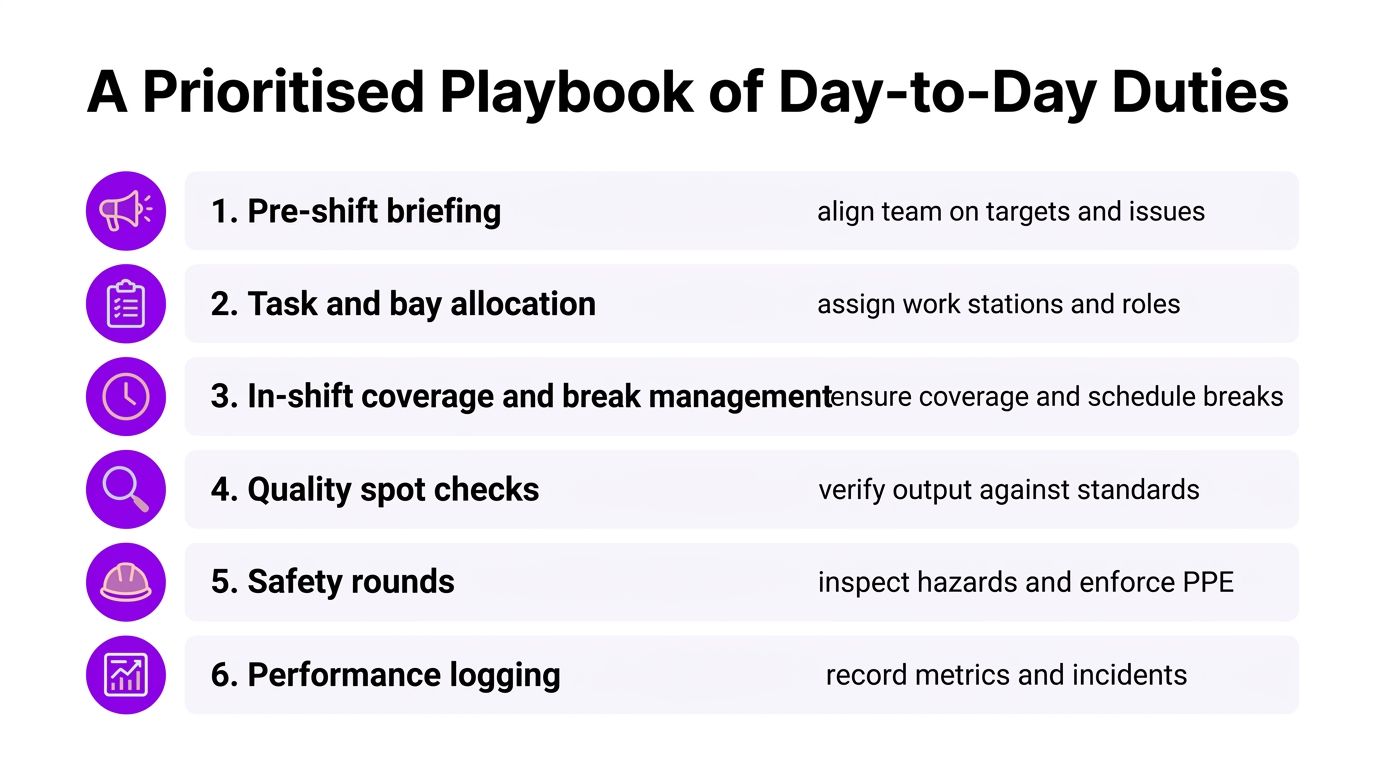
A floor supervisor should run the shift in the order that protects coverage first, then quality, then throughput, then compliance. That sequence keeps the floor under control when the team gets busy.
1. Pre-shift briefing.
Set the target, name the risks, flag absences, and assign the pressure points before the first customer, patient, order, or job card lands. The output should be alignment on who covers what, which standards matter most, and where escalation starts if the floor slips.
2. Task and bay allocation.
Put the right person in the right station, room bank, aisle, table section, or job card. Coverage becomes visible work only when the assignment matches demand. In repair and production settings, that means sequence discipline, parts readiness, and promised delivery tracking, which is the logic reflected in Royal Enfield floor supervisor PDF.
3. In-shift coverage and break management.
Breaks must happen on time, but the floor cannot hollow out while people step away. In retail, supervisors are expected to keep associates in the busiest zones, maintain coverage, and record handoff status for the next supervisor, as set out in jobdescription.org retail floor supervisor. If this gets ignored, queues stretch, service slows, and discipline starts to erode.
4. Quality spot checks.
Check standards while the work is still live. That covers room readiness, product presentation, food quality, cleanliness, and workmanship, depending on the site. Spot checks stop defects before they become rework, customer recovery, or a bigger complaint.
5. Safety rounds.
Walk the floor for wet spots, blocked exits, missing PPE, poor sanitation, and unsafe storage. Hospitality adds fire, health, and hygiene controls to the supervisor's daily job, and those checks should be recorded against site practice and local requirements. If you need a practical reference for shift planning and absence control, LeaveWizard's shift work guide is useful.
6. Performance logging.
Record the issue, the fix, the exception, and the handoff note. This is not paperwork for its own sake. It is the record the next manager needs, and the proof directors use to see whether the floor was under control.
Supervisors fail when they treat logging as someone else's job and keep only the visible work. That weakens accountability fast. A strong floor lead owns the live judgement, the escalation call, and the final handoff record.
If a task affects coverage, quality, throughput, or compliance, the supervisor owns it directly or verifies it before the shift moves on.
How the Role Changes by Industry
A floor supervisor is not a generic headcount manager. The job changes with the operating model, and the control points change with it. Retail lives on traffic, stock presentation, and shrink. Hospitality lives on room readiness, guest requests, and cleanliness. Manufacturing lives on bay flow, parts readiness, and rework. Healthcare adds patient flow, safety rounds, and strict handoff discipline.
One table, four very different operating realities
| Industry | Primary Coverage Duty | Top Quality Control | Throughput Lever | Compliance Priority |
|---|---|---|---|---|
| Retail | Assign associates to the busiest zones and keep breaks from hollowing out the floor | Spot out-of-stock, signing errors, and presentation defects | Reallocate labour to traffic peaks | Attendance, break discipline, shrink prevention |
| Hospitality | Allocate rooms or public areas by workload and guest need | Inspect rooms, amenities, and service readiness | Guest request turnaround and shift handoff | Fire, health, sanitation, maintenance escalation |
| Manufacturing | Place the right operator at the right bay or line point | Check process parameters and defect interception | Job-card flow, parts readiness, rework avoidance | Safety, schedule adherence, record-keeping |
| Healthcare | Maintain staff presence around patient-facing zones | Verify cleanliness, handover accuracy, and environmental standards | Move patients or tasks through the floor without delay | Sanitation, incident reporting, access control |
Retail is the most traffic-sensitive. A supervisor there has to read the floor constantly, because coverage decisions affect conversion and shrink in the same hour. Hospitality is more standard-sensitive. One missed inspection or late room allocation turns into guest recovery work fast. Manufacturing is the least forgiving on sequence. Bay allocation, materials readiness, and quality checks sit directly on delivery risk, and that is why the control model needs tighter measurement. For teams that need a practical KPI reference for people and shift coverage, this KPI guide for team leaders in BPO is a useful benchmark for attendance, response time, and output tracking.
For hospitality operations that run mixed shift patterns, the scheduling discipline itself matters as much as the supervisor role. A practical shift-work reference like LeaveWizard's shift work guide is useful when you are setting coverage rules that survive absences and handovers.
Healthcare adds a different layer. The supervisor has to protect flow without compromising safety or documentation. The more regulated the floor, the more the role shifts toward compliance, record discipline, and escalation control.
KPIs and Skill Requirements That Predict Performance
Measure the four pillars, not vague effort
Coverage needs hard numbers. Track attendance rate, break compliance, and overtime ratio. In BPO and contact-centre floor operations specifically, that same coverage discipline is usually tracked alongside the agent utilization formula, since idle time and occupancy gaps show up in the same shift data. Attendance rate shows how much of the roster is covered. Break compliance shows whether breaks happen on time without creating floor gaps. Overtime ratio shows whether the schedule is absorbing avoidable strain. The target band changes by business, but the signal is the same. These are leading indicators, so they show drift before service breaks.
Quality belongs in defect rate, audit score, and customer complaint rate. In floor operations, complaints and audit misses are lagging indicators, the defect happened earlier. That is why spot checks matter and why supervisors need a visible inspection rhythm. If the only trigger is a complaint, the floor is already behind.
Throughput should be measured with tasks per hour, turnaround time adherence, and peak-period conversion where relevant. Manufacturing makes this plain because the supervisor must keep schedule adherence, delivery promises, and rework under control when quality checks fail. Retail and hospitality should measure the same discipline through queue movement, room readiness, or service completion speed, depending on the floor.
Compliance needs direct tracking through safety incidents, record-keeping timeliness, and housekeeping-style logs for sanitation or room inspection where applicable. A compliance miss is usually not a mystery. It follows a skipped round, a weak handoff, or an escalation path that nobody used. In India, the supervisor also has to hold the line on attendance records, break discipline, and safety documentation, because weak records become weak enforcement fast.
For skill requirements, hire for situational awareness, clear written escalation, conflict de-escalation, and basic data literacy. A supervisor who cannot read the floor, write a usable handoff note, calm a customer, or interpret a simple dashboard will not scale. Use this KPI guide for team leaders in BPO as a practical benchmark for how attendance, response time, and output should be translated into manager-facing scorecards. That gap is why generic role descriptions underperform in practice, as noted in Indeed career advice on floor supervisor roles.
The best supervisors do three things early, they notice, they document, and they escalate. Waiting for certainty is how floors lose control.
Sample Job Description and a 30-60-90 Day Assessment
Job title: Floor Supervisor
Reporting to: Operations Manager, Store Manager, Housekeeping Manager, Production Manager, or Site Lead depending on sector.
Purpose: Own coverage, quality, throughput, and compliance on the floor during assigned shifts.
Core duties:
- Coverage: assign staff by workload, traffic, occupancy, or bay demand, and protect break coverage.
- Quality: inspect work in progress, catch defects, and verify readiness before handoff.
- Throughput: keep tasks moving, remove blockers, and escalate time or material shortages early.
- Compliance: maintain safety, sanitation, attendance, and shift records.
KPIs: attendance rate, break compliance, defect or audit score, complaint rate, turnaround time adherence, safety incidents, and record-keeping timeliness.
Skills: situational awareness, communication, prioritisation, conflict handling, and data discipline.
30-60-90 day assessment
First 30 days. The supervisor shadows live shifts, learns the SOPs, and demonstrates accurate logging. You should see note-taking that matches reality, not polished guesswork.
Day 31 to 60. They own one shift block and one KPI, usually coverage or quality. At this stage, the question is whether they can run the floor without constant correction.
Day 61 to 90. They own the full shift rhythm, including handoff, exception handling, and basic commercial awareness. The supervisor should now explain how their decisions affect cost, rework, or customer recovery.
A weak 90-day review usually shows the same pattern. They can describe tasks, but they cannot prioritise under pressure. They know the SOP, but they do not apply it when the floor is busy.
Use the assessment against behaviour, not just output. Did they protect coverage during absences? Did they escalate defects before customers noticed? Did they close the shift with a clean handoff? Those are the behaviours that predict whether the role can be trusted.
Common Misconceptions and the Compliance Reality
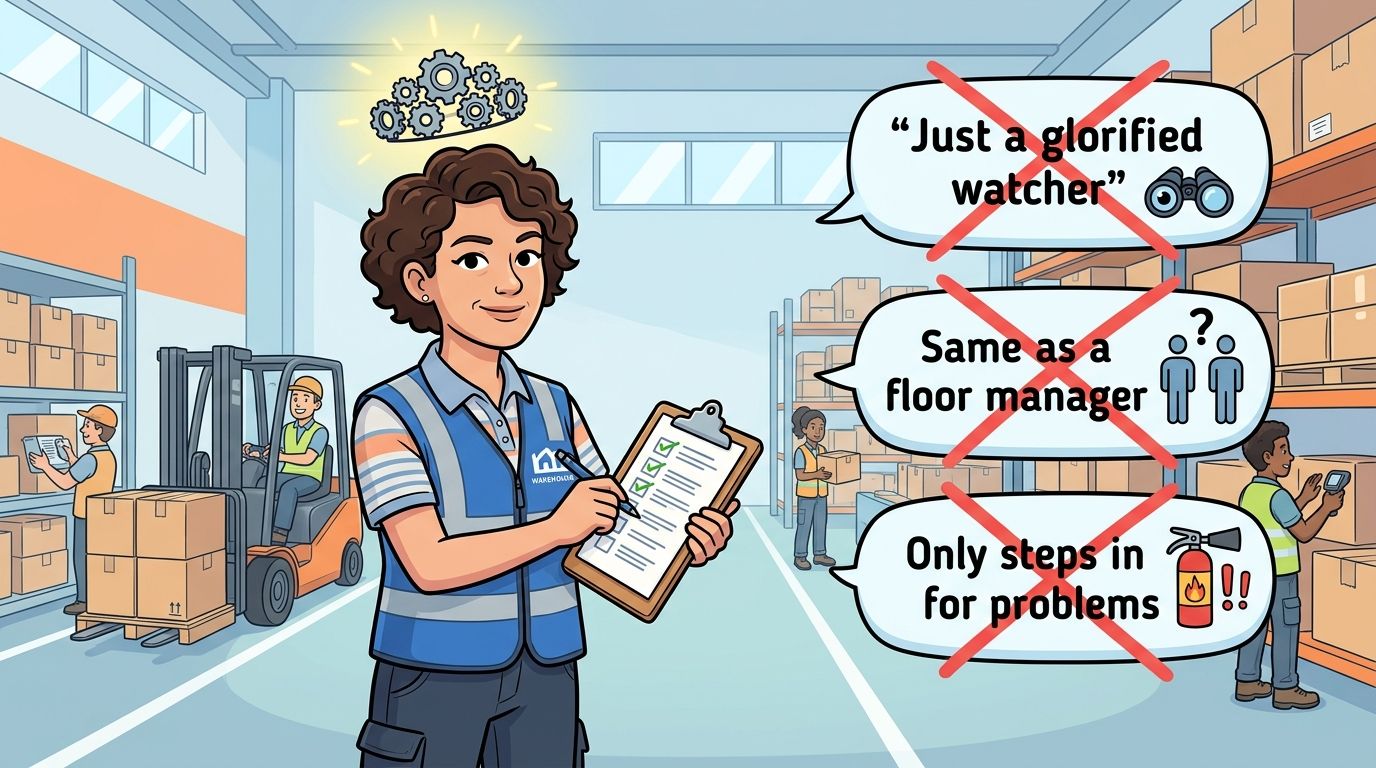
The first myth is that the supervisor is just a glorified watcher. That view is wrong. A floor supervisor turns staffing into execution, and if the person in the role cannot shift labour, catch defects, and log handoff issues, the floor will run on delay and memory. Directors should treat that as a control failure, not a personality problem.
The second myth is that a floor supervisor and a floor manager are interchangeable. They are not. A manager usually owns the broader budget, people decisions, or commercial outcomes, while the supervisor owns the live operating standard on the shift. Mixing those duties weakens accountability and makes it harder to measure who is really controlling the floor.
The third myth is that compliance is someone else's problem. In India, that creates real risk because attendance, break discipline, safety checks, sanitation logs, and shift records are often the first documents an auditor or inspector will ask for. The issue is not the title, it is the record discipline, and weak record discipline turns a routine review into a liability.
The practical fix is simple. Give the supervisor daily control of the records that prove the floor was managed properly. That means attendance, break logs, safety rounds, sanitation checks where relevant, and exception notes on defects or escalations. A supervisor who cannot produce those records is not just disorganised, they are exposing the business.
If you want the quality standard behind those records, use this quality parameters guide for BPO teams to check whether your floor logs match the audit trail and the exception pattern.
CXO Action Checklist, Rollout Plan, and FAQs
What directors should assign
- One role definition for the floor supervisor, written around the four pillars.
- Four KPIs only, one each for coverage, quality, throughput, and compliance.
- One daily handoff log that the supervisor owns, not the assistant manager.
- One coaching plan that corrects coverage mistakes, not just customer-facing failures.
- One audit cadence that checks records against live floor reality.
90-day rollout plan
Days 1 to 30. Finalise the JD, the shift log, and the escalation rules. Train the supervisor on where they have authority and where they must escalate.
Days 31 to 60. Add KPI review into the shift close. Audit coverage, break discipline, and one quality standard every day.
Days 61 to 90. Tie the role to performance review, not just attendance. If the supervisor cannot protect the four pillars, the floor will show it.
FAQs
How is a floor supervisor different from a team lead?
A team lead often coordinates people. A floor supervisor coordinates people and the live operating standard of the floor, which includes quality, compliance, and handoff control.
What should be the first KPI to instrument?
Start with coverage. If staffing and breaks are unstable, every other metric becomes noisy.
What if the supervisor resists documentation?
Treat that as a performance issue, not a style preference. No log means no control.
When should tech-assisted handoff tools be added?
Add them when shifts overlap, exceptions repeat, or managers cannot trust verbal handovers. The tool should make the floor more auditable, not more complicated.
If you want to build floor operations that supervisors can run and directors can audit without guesswork, visit DialNexa Labs Private Limited. Their team helps organisations standardise operational conversations, routing, and handoffs with voice AI that fits real workflows, which is exactly the kind of discipline this role needs to scale.

This is a well-structured and practical guide that clearly explains how floor supervisors balance coverage, quality, throughput, and compliance. The KPI-focused approach also makes the role easier to understand and measure.