
Unlocking the Difference: difference between call centre and bpo Explained
For senior leaders, the distinction is strategic: a call centre is a specialised function, while a Business Process Outsourcing (BPO) firm represents a comprehensive operational strategy. The core difference boils down to scope and strategic impact.
A call centre is a focused subset of what a BPO can offer. It is engineered to manage customer communications with precision—whether that’s inbound technical support, outbound sales, or real-time chat. For instance, a direct-to-consumer (DTC) brand might engage a call centre to handle an anticipated 30% surge in order inquiries during a holiday season, focusing solely on maintaining a First Call Resolution (FCR) rate above 85%.
A BPO, on the other hand, provides a much broader spectrum of outsourced business processes. This can range from back-office functions like payroll processing, which can reduce processing errors by up to 20%, to complex front-office tasks like end-to-end sales cycle management or regulatory compliance reporting. For a VP of Operations, this isn't just delegation; it's a strategic move to reallocate capital and talent.
Clarifying the Strategic Difference: Call Centre vs. BPO
For any executive, aligning outsourcing decisions with high-level business objectives is paramount. Choosing a call centre is often a tactical move to solve a specific communication challenge, such as reducing average customer wait times from 3 minutes to under 60 seconds.
Engaging a BPO, however, is a strategic imperative. It's about fundamentally re-engineering operational efficiency to free up internal teams for core competencies like innovation and market expansion. A recent Deloitte survey found that 70% of companies outsource primarily to cut costs, but 60% also do it to enable focus on core business functions.
A call centre is like a specialised surgical team brought in to address a precise issue. For example, a fast-growing SaaS company might partner with a call centre to provide 24/7 technical support, aiming to improve its Customer Satisfaction (CSAT) score from 80% to 92%. It’s a targeted solution ensuring expert customer interaction without diverting the core engineering team from product development.
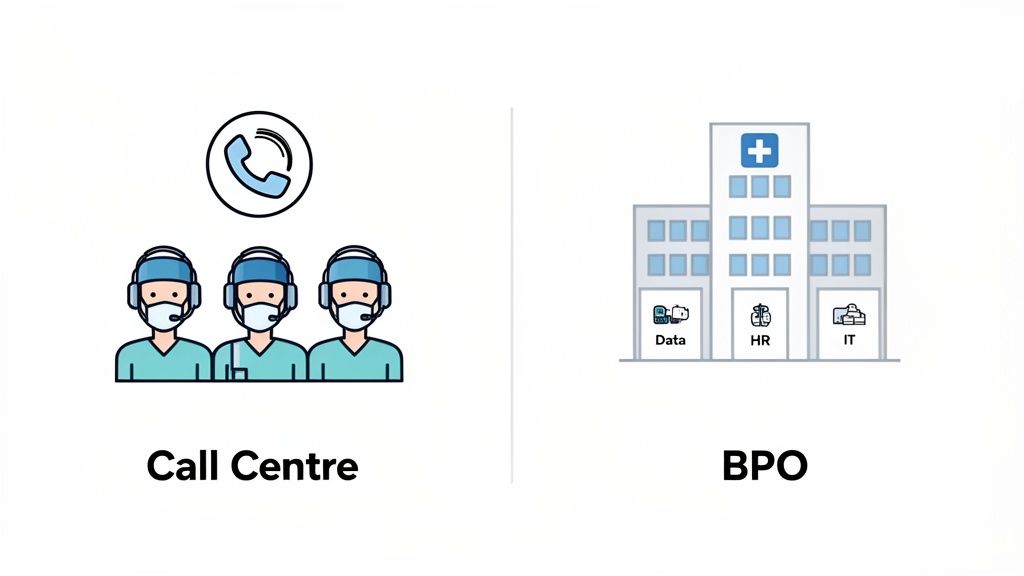
A BPO is more akin to an entire outsourced hospital wing, managing a wide array of functions vital to the business but not central to its unique value proposition. A large financial institution, for instance, might outsource its entire Know-Your-Customer (KYC) verification and anti-money laundering (AML) data processing. This allows the institution to concentrate on high-value activities like investment strategy and wealth management, while the BPO partner handles the operational heavy lifting and ensures regulatory compliance, potentially saving millions in fines.
As companies in either model look to modernise, integrating new technologies is a strategic necessity. Exploring how to apply AI for call centers can significantly enhance efficiency, whether you’re running a focused communication hub or a broad BPO partnership.
To provide a clear, at-a-glance overview for executive decision-making, the table below breaks down the key strategic differences.
Call Centre vs BPO Strategic Snapshot for Decision-Makers
Here's a quick reference table to help visualize the strategic differences and their business implications.
| Dimension | Call Centre | Business Process Outsourcing (BPO) |
|---|---|---|
| Primary Goal | Manage customer voice/chat interactions efficiently. | Improve overall business efficiency by outsourcing non-core processes. |
| Scope of Work | Narrow and specialised (inbound/outbound calls, email, chat). | Broad and diverse (HR, finance, IT, data entry, etc.). |
| Business Impact | Directly impacts front-office metrics like CSAT and FCR. A 5% increase in customer retention can boost profits by 25-95%. | Impacts back-office KPIs like cost reduction and process cycle time. BPO can reduce operational costs by an average of 15-25%. |
| Typical Use Case | A retail company outsourcing its customer service hotline to handle 10,000+ calls per month. | A manufacturing firm outsourcing its entire payroll and accounting department for 5,000+ employees globally. |
Ultimately, your choice depends on the strategic objective. Are you aiming to resolve a specific customer communication channel challenge, or are you looking to fundamentally restructure your operational model for greater agility and cost savings? Answering that question will point you in the right direction.
Strategic Scope and Economic Impact: A C-Suite Perspective
From a leadership standpoint, the choice between a call centre and a Business Process Outsourcing (BPO) partner is not merely operational—it's a core strategic decision with profound implications for financial health and market competitiveness. The fundamental difference lies in scope and economic scale.
A call centre is a specific, tactical investment designed to manage customer communication, making it a laser-focused tool for enhancing customer experience and loyalty.
Engaging a BPO, conversely, is a broad strategic initiative aimed at a complete operational overhaul. Here, you are not just outsourcing calls; you are transferring entire non-core business functions. This strategy frees up significant capital and allows you to redeploy your top internal talent from administrative tasks to high-impact activities like product innovation and market penetration.
Understanding the Financial Scale
The economic footprint of each model illuminates this strategic divergence. The allocation of capital dictates the expected returns. Let's analyze India, a global powerhouse for these services, to appreciate the scale.
The distinction is clear in revenue and scope. Call centres focus on voice-based customer interactions, while BPOs manage a vast array of both voice and non-voice processes. In 2023, the Indian call centre market was valued at an impressive USD 33 billion.
Now, compare that to the wider BPO industry in India, which generated revenue of USD 44 billion in FY22. That figure represents a double-digit growth of over 14% from the previous year and accounts for nearly 40% of the global sourcing market. This data clearly illustrates that BPO partnerships involve a far greater financial and strategic commitment. For instance, a Fortune 500 company might sign a multi-year, eight-figure BPO contract to manage its global HR functions, a decision with board-level visibility. To see this in action, it’s worth reviewing case studies like how a Big Four accounting firm saved costs by unifying their global shared services.
Implications for Your Growth Trajectory
The selected path will directly influence your company's growth trajectory and agility. Here’s a breakdown of the two investment philosophies for executive consideration:
-
Call Centre Investment: This is an investment in front-office excellence and brand reputation. Success is measured by customer-facing KPIs such as CSAT scores, First Call Resolution (FCR) rates, and Net Promoter Score (NPS). The objective is a tangible, immediate improvement in customer interaction quality, which directly impacts customer lifetime value.
-
BPO Partnership: This is a long-term strategy for back-office optimization and scalable growth. Success is defined by metrics like a 20-30% reduction in operational costs, improved process efficiency (e.g., reducing invoice processing time from 10 days to 2), and the agility to scale operations without a proportional increase in fixed costs. It's about building a leaner, more resilient organization from its operational core.
As technology continues to advance, savvy executives are also exploring how strategic acquisitions can deepen their https://dialnexa.com/blogs/2024-speech-industry-award-winner-capacity-deepens-voice-and-contact-center-capabilities-with-acquisitions/, adding another layer to this strategic thinking. Ultimately, the decision comes down to a simple question: Is your most pressing need to perfect every customer interaction, or is it to re-engineer your entire operational engine for long-term competitive advantage?
A Closer Look at Functions, People, and Technology
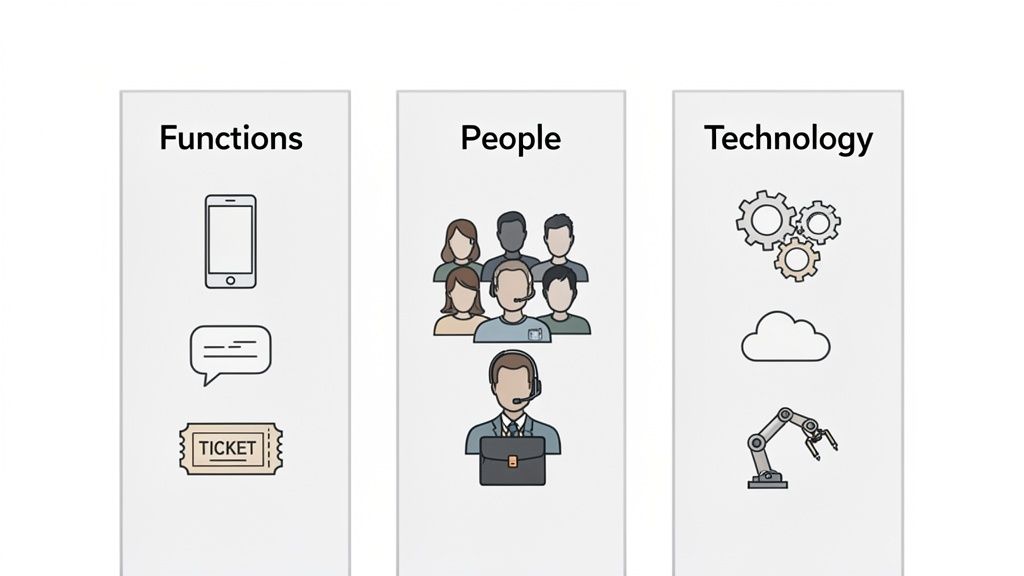
For any operational leader, the tangible difference between a call centre and a BPO crystallizes when examining their core components: functions, people, and technology. These three pillars define their operational models, and each demands a distinct set of resources, talent profiles, and infrastructure. A precise understanding of this breakdown is essential for making sound strategic investments.
A call centre’s scope is sharp and customer-facing, centered on managing communications—inbound support, outbound sales, and live chat. This narrow focus means its technology stack is optimized for interaction management and efficiency.
A BPO, conversely, has a much wider mandate, extending deep into a company's back-office and mid-office operations. A BPO partner might handle everything from payroll and benefits administration for thousands of employees to complex data analytics and supply chain logistics. This operational breadth necessitates a far more complex, integrated, and secure technology ecosystem.
Different Tools for Different Jobs
The technology stacks for these models are fundamentally different, reflecting their divergent missions.
A call centre’s toolkit is geared for communication efficiency and agent productivity. Key technologies include:
- Automatic Call Distributors (ACDs) to route thousands of daily calls to the right agents in seconds.
- Interactive Voice Response (IVR) systems to automate initial query handling, potentially deflecting up to 40% of routine calls.
- Customer Relationship Management (CRM) software to provide a unified view of customer history and interactions.
A BPO’s technology is engineered to execute entire business processes end-to-end. This often includes:
- Enterprise Resource Planning (ERP) systems like SAP or Oracle to manage finance and supply chains.
- Robotic Process Automation (RPA) to automate repetitive tasks, which can increase productivity by up to 30%.
- Business Intelligence (BI) tools for sophisticated data analysis and executive-level reporting.
Of course, the modern tech landscape, particularly AI, is a disruptive force for both. In financial services, for example, understanding https://dialnexa.com/blogs/how-data-and-ai-will-transform-contact-centres-for-financial-services/ is non-negotiable for maintaining a competitive edge, regardless of the operating model.
A core pillar of delivering exceptional service, particularly in a call centre, is robust quality assurance. Knowing how to implement effective call center quality assurance is fundamental to maintaining high standards, ensuring compliance, and driving measurable performance improvements.
Contrasting Talent and Skill Sets
This operational divergence naturally dictates a significant difference in human capital requirements. The talent pools for call centres and BPOs are distinct because their functional needs are so specialized.
In India, a global outsourcing leader, call centres are laser-focused on recruiting voice specialists who excel in customer-facing roles. BPOs, in contrast, require a diverse array of skills for process-intensive tasks. With over 1.3 million professionals, India’s BPO sector leverages its vast English-speaking talent pool. Call centres draw a significant portion of this for 24/7 global support.
The BPO industry itself, valued at USD 14.5 billion in 2022 (up from USD 9 billion in 2018), hires for highly specific niches. You'll find cities like Pune recognized for call centres and HR, while Hyderabad has emerged as a major hub for specialized engineering and accounting talent.
What does this mean for a hiring director? A call centre manager primarily seeks candidates with strong communication skills, empathy, and rapid problem-solving abilities. A BPO manager, however, recruits for a spectrum of expertise—chartered accountants, data scientists, software developers, and certified HR generalists. The hiring criteria are not about communication flair but about deep, process-specific knowledge and credentials. For any executive, grasping this distinction is fundamental to resource planning and building the right operational foundation for growth.
Practical Use Cases Across Key Industries
To move from theoretical definitions to actionable insights, let's examine how call centres and BPOs function in real-world business scenarios. Analyzing how different industries leverage these models provides clarity on which solution aligns with specific strategic needs. For a leader, this is not just an operational decision; it's a choice that reflects core business priorities.
Consider a global e-commerce brand. Their primary operational challenge is managing the sheer volume of customer interactions regarding order tracking, returns, and product inquiries. They would likely engage a specialized call centre to handle this. For example, during a peak sales event, call volume can spike by 300%. A call centre provides a focused, scalable solution to maintain customer satisfaction and directly enhances front-office performance.
Contrast that with a major financial institution. Their challenges are fundamentally different and more complex. They would turn to a BPO for intricate, regulated, back-office work like processing mortgage applications, executing Know Your Customer (KYC) checks to meet regulatory mandates, and generating compliance reports. These are not simple customer service chats; they are multi-step processes demanding deep industry knowledge and adherence to strict protocols.
Sector-Specific Applications
The divergence becomes even clearer when analyzing industry-specific use cases. Call centres are the preferred solution for high-volume, voice-based support, while BPOs are engaged to manage entire business functions. In India, the call centre market was valued at USD 33 billion in 2023, with the IT & Telecom sector leading demand for technical support. BFSI, healthcare, and e-commerce follow, all relying on call centres for omnichannel customer service.
The BPO sector, meanwhile, is forecast to grow at a 7.74% CAGR by managing non-core operations like data processing and sales outsourcing for a wide range of industries. For a deeper analysis of these market dynamics, it's worth exploring the growth of the Indian call centre market.
Here are a few more tangible examples to frame the decision for a leadership team:
-
EdTech: A nimble EdTech startup needs to qualify leads and book demos with an 80% follow-up rate within 24 hours. A call centre is the ideal solution for this targeted sales and support function. A larger, established university, however, might outsource its entire student lifecycle management to a BPO. This could encompass admissions processing, tuition fee collection, and alumni relations management—a far more extensive operational undertaking.
-
Real Estate: A property developer launching a new project could use a call centre to handle an anticipated 5,000+ inbound enquiries and schedule site visits. The objective is singular and measurable: increase qualified leads by 25%. In contrast, a large property management firm might outsource its entire back office to a BPO to manage lease administration for a portfolio of 1,000 properties, coordinate maintenance requests, and handle all financial accounting and reporting.
The core takeaway for leaders is this: A call centre solves a communication problem. A BPO solves an operational efficiency problem. Aligning your choice with the correct problem statement is the first step toward a successful outsourcing strategy.
Ultimately, understanding these practical applications empowers executives to make informed, strategic decisions. It's about aligning the outsourcing model with your most critical business goals, whether that means sharpening customer touchpoints to increase retention or completely overhauling the company's operational backbone to scale more effectively.
How To Choose the Right Outsourcing Model
Selecting the right outsourcing partner is not merely a tactical decision—it's a strategic move that will directly impact customer experience, operational agility, and scalability. As a leader, you must look beyond surface-level descriptions and ask critical questions about your organization's fundamental needs.
The first step is always diagnostic: what is the core problem you are trying to solve? Are you struggling to maintain service levels amidst rising customer call volumes, or are complex back-office processes creating bottlenecks that hinder growth? A clear problem definition is fundamental.
Defining Your Strategic Priorities
Once the core challenge is identified, the focus shifts to key performance indicators (KPIs). What metrics are on your executive dashboard? If your primary concerns are front-office numbers like Customer Satisfaction (CSAT) and First Call Resolution (FCR), your objective is to elevate the customer experience. This points directly toward a specialized communication partner. A 10-point increase in CSAT can correlate to a 2% increase in revenue.
On the other hand, if your focus is on back-office metrics—such as process cycle time, cost per transaction, or a 15% reduction in operational overhead—your needs extend far beyond call handling. You are seeking fundamental process re-engineering, which is the domain of a BPO.
This decision tree provides a visual framework, breaking down the choice by industry and primary business function.
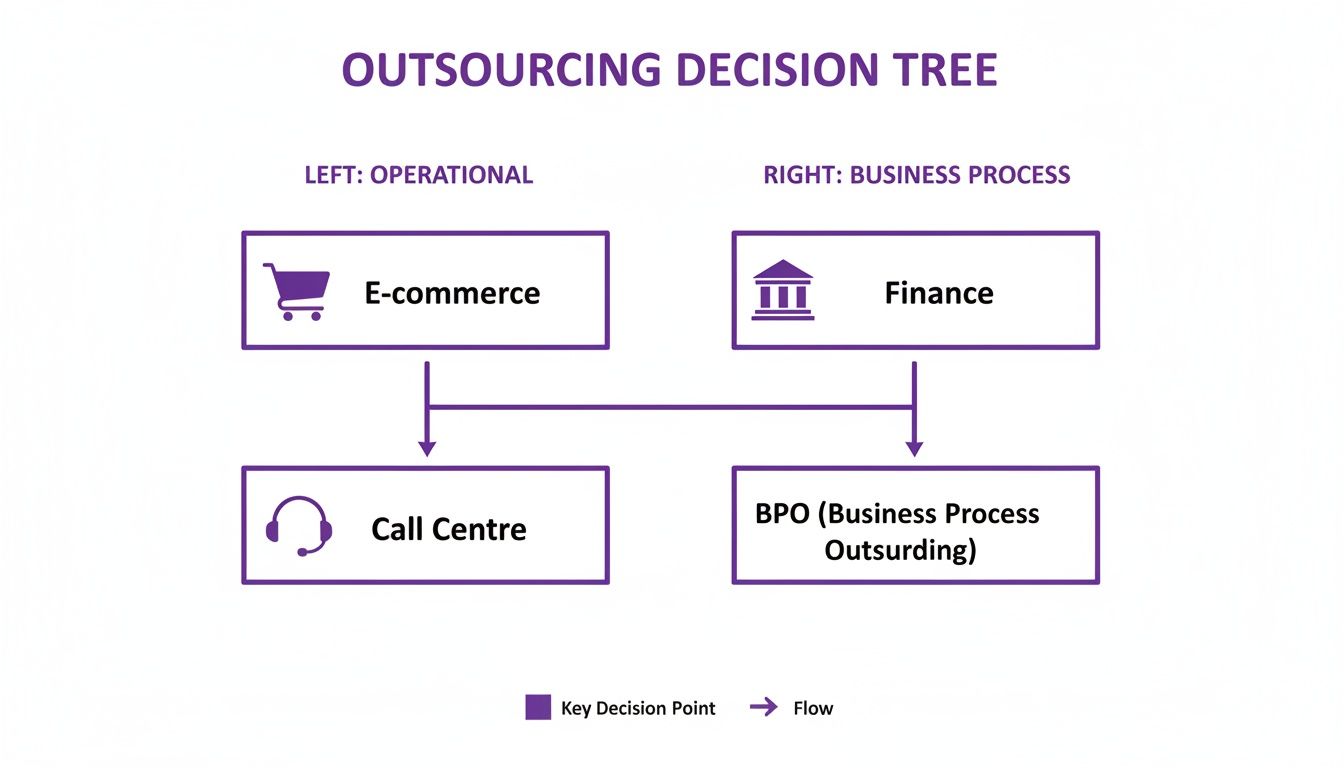
As the graphic illustrates, industries with high-volume, customer-facing interactions, like e-commerce and telecom, naturally gravitate towards a call centre model. In contrast, sectors heavy on complex, regulated processes, such as finance and healthcare, often find a BPO partnership is the only viable solution for managing their end-to-end operations effectively.
The Rise of Voice AI: A Hybrid Solution
This is where the strategic landscape becomes more nuanced. The traditional call centre vs. BPO dichotomy is being disrupted by technology, particularly Voice AI. AI is no longer a futuristic concept; it is a practical, powerful tool that can bridge the gap between both models, offering a new, more efficient path to achieving your goals.
For leaders evaluating their options, Voice AI has evolved from a supplemental tool into a core strategic component. It can fundamentally reshape cost structures and scalability for both front-office communication and back-office processes.
Instead of a binary choice, consider how AI can be integrated into your strategy.
-
Supercharging a Call Centre: Imagine automating 80% of your routine, high-volume inquiries—like order status updates or simple appointment bookings. This is what Voice AI excels at. It frees your human agents to handle the complex, emotionally sensitive conversations where they create real value. We’ve seen DialNexa's AI agents increase lead-to-booking conversion rates from a typical 2% to as high as 8% by ensuring every outreach call is executed with perfect consistency.
-
Enhancing BPO Workflows: Within a BPO context, AI is a force multiplier. It can automate tedious data collection, handle standardized verification calls for compliance, or conduct large-scale customer surveys without human intervention. This not only eliminates manual work but also reduces error rates by over 90% and accelerates entire processes. An AI-qualified lead now matches the judgment of a seasoned human agent with 97% accuracy, making it a reliable tool for mission-critical business functions.
Ultimately, the choice is no longer a stark one between a call centre and a BPO. It’s about architecting the optimal blend of skilled human talent and intelligent, AI-driven automation to address your unique business challenges.
To help you map your needs to the right solution, here's a quick framework.
Decision Framework: Call Centre vs. BPO
This checklist is designed to help you quickly align your business objectives with the most suitable outsourcing model.
| Business Objective | Consider a Call Centre if… | Consider a BPO if… |
|---|---|---|
| Improve Customer Experience | Your primary goal is to increase CSAT, NPS, or First Call Resolution through better voice, email, or chat support. | Your customer experience issues stem from slow back-end processes like billing errors or fulfilment delays. |
| Reduce Operational Costs | You want to lower the cost per customer interaction for high-volume, repetitive communication tasks. | You need to reduce costs across an entire business function (e.g., HR, Finance) by optimising processes. |
| Increase Sales & Lead Gen | Your focus is on outbound calling, appointment setting, or inbound sales qualification. | You need an end-to-end sales process managed, including lead sourcing, CRM management, and post-sale support. |
| Enhance Scalability | You need to quickly scale your customer support team up or down to handle seasonal peaks and troughs. | You are looking to scale an entire department without the overhead of hiring, training, and managing new teams. |
| Access Specialised Skills | You require agents with specific language skills or expertise in handling technical support queries. | You need access to a pool of talent with specialised skills in data analysis, accounting, or supply chain management. |
| Focus on Core Business | Customer communication is taking too much time away from your core product development or strategy. | Non-core, but essential, business functions like payroll or data entry are distracting from your main goals. |
By walking through these objectives, a clearer picture should emerge. Your decision will be grounded not just in what each model is, but in what each model can do for your specific situation.
The Future of Integrated Service Delivery
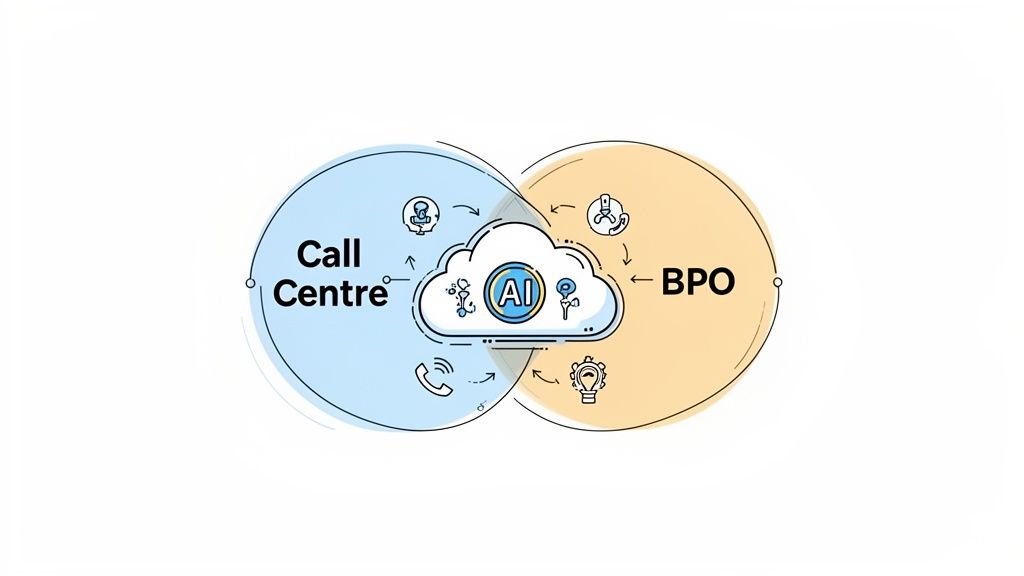
The rigid boundaries that once separated call centres and BPOs are dissolving. We are witnessing a convergence, a strategic shift in outsourcing driven by technological advancement and evolving customer expectations. Service delivery is becoming a more integrated, intelligent, and hybrid discipline.
The flow of services is no longer unidirectional. Many BPOs are now building sophisticated, omnichannel customer engagement hubs, while traditional call centres are expanding into non-voice, back-office tasks to provide more comprehensive client solutions.
At the heart of this transformation is Artificial Intelligence. AI is no longer just another tool; it is the strategic enabler that is fundamentally redefining the art of the possible in service delivery.
AI as the Unifying Layer
For any C-suite executive, AI acts as a common, intelligent layer that can execute tasks previously siloed within separate operational models. For example, a Voice AI agent can conduct automated lead qualification calls—a classic call centre function—and achieve a 97% accuracy rate, on par with experienced human agents, but at a fraction of the cost.
Simultaneously, that same AI technology can handle thousands of data verification calls for a financial institution, a task that would traditionally fall under a BPO's purview.
This reframes AI from a simple cost-saving measure to a genuine strategic asset. It provides a scalable, efficient, and consistent method to augment, blend, or even replace components of both traditional models.
This integration empowers executives to design a far more agile and responsive operational strategy. The choice is no longer a rigid "call centre or BPO?" Instead, you can now architect a custom service model with AI at its core. This hybrid approach enables your organization to achieve the best of both worlds: the sharp customer focus of a specialist call centre and the robust process efficiency of a BPO. In today's competitive landscape, that is a powerful strategic advantage.
Frequently Asked Questions
When evaluating the strategic difference between a call centre and a BPO, several key questions consistently arise for senior leadership. Here are direct answers to help guide your decision-making.
Can a BPO Provider Offer Call Centre Services?
Yes, virtually all major BPO providers offer call centre services as part of their portfolio. They typically refer to this as 'voice processes' or 'customer engagement services'. However, the key distinction is that for a BPO, this is just one component of a much larger, integrated service offering. The strategic value of a BPO is its capability to manage entire non-voice and back-office functions that a standalone call centre is not equipped to handle.
For example, a BPO partner could manage your entire accounts receivable department. This includes the back-office process of generating invoices and processing payments, as well as the front-office task of handling customer calls regarding billing inquiries—a classic call centre function.
Which Model Is Better for a High-Growth Startup?
For a high-growth startup, where agility and customer acquisition are paramount, a specialized call centre or a nimble Voice AI solution is almost always the more direct and capital-efficient choice. These solutions address immediate front-office challenges like qualifying inbound leads or providing customer support, without the significant investment and long-term commitment of a full-scale BPO partnership.
A comprehensive BPO engagement is a more mature strategic decision. It is better suited for an established company looking to achieve significant operational efficiencies by outsourcing entire non-core departments, such as finance or human resources. This is typically a strategic move made after achieving product-market fit and scale.
How Does Voice AI Fit Into This Decision?
Voice AI introduces a powerful third strategic option. It can be deployed to enhance your existing operations or, in some cases, replace specific functions entirely, offering a new paradigm of efficiency and scale.
For leaders, the critical takeaway is this: Voice AI is not an "either/or" choice tied to one model. It's a flexible, highly efficient layer you can deploy to solve specific problems, regardless of whether a call centre or a BPO traditionally handled them.
For instance, you could use Voice AI to augment a human call centre, allowing it to handle 80% of routine, repetitive calls. This frees your human agents to focus on high-value, complex interactions. Alternatively, it can serve as an automated front-end for BPO processes, gathering initial customer data with up to 97% accuracy. For specific use cases like appointment setting or outbound lead qualification, Voice AI can completely automate the function, delivering significant cost savings and performance improvements.
Ready to see how a custom Voice AI agent can handle your qualification, support, or presales calls at scale? DialNexa helps teams build, train, and deploy agents that turn more conversations into conversion-ready outcomes. Learn more and get started today.

[…] layer is more important than the geography. Leaders should understand the distinction between call centre and BPO models before assigning end-to-end ownership, because a provider taking calls is very different from a […]
Excellent article that clearly explains the strategic differences between call centres and BPOs with practical industry examples and business-focused insights. The inclusion of Voice AI and future service delivery trends makes it especially valuable for executives planning long-term growth and operational efficiency.