

Top 10 Conversational AI Companies in India for 2026
India’s conversational AI market isn’t in an early test phase anymore. It generated USD 455.4 million in 2024 and is projected to reach USD 1,846.0 million by 2030, a projected CAGR of 26.3% from 2025 to 2030, according to Grand View Research’s India conversational AI outlook. For CXOs, that changes the buying question. You’re not deciding whether conversational AI matters. You’re deciding which partner can protect margin, improve customer response speed, and scale operations without creating governance risk.
That urgency is visible inside Indian enterprises as well. EY-CII reports that 47% of Indian enterprises already have multiple GenAI use cases live in production, while 23% remain in the pilot stage.
The same report says customer service is one of the top three business functions prioritised for GenAI in the next 12 months, cited by 54% of leaders, as noted in the Research and Markets India conversational AI market report. For leaders running support, sales, collections, admissions, or service operations, conversational AI has become an operating model decision.
This guide focuses on Conversational AI Companies in India through a leadership lens. The question isn’t who has the longest feature page. It’s who can drive operational efficiency, support Indian language demand, fit your compliance posture, and create measurable business outcomes. If sales automation is part of your roadmap, these Orbit AI sales automation tips add useful context before you shortlist vendors.
TL;DR
- A growing number of Indian CXOs are moving from optional chatbot pilots to full-scale conversational AI deployments tied directly to revenue and cost metrics.
- Vendors in this list were evaluated on four criteria: revenue/operational impact, governance and compliance fit, Indian-language support, and deployment speed.
- DialNexa Labs is the strongest pick for revenue-driving voice automation (qualification, booking, collections), Jio Haptik and Yellow.ai for enterprise-wide governance-heavy rollouts, Gupshup for WhatsApp-led growth, Skit.ai for collections, Uniphore and Gnani.ai for advanced voice security.
- The list spans single-channel specialists (WhatsApp, collections, voice security) to enterprise-wide orchestration platforms, covering SMBs through large regulated enterprises.
Table of Contents
- 1. DialNexa Labs Private Limited
- 2. Jio Haptik
- 3. Yellow.ai
- 4. Gupshup
- 5. Skit.ai
- 6. Uniphore
- 7. Gnani.ai
- 8. Rezo.ai
- 9. Verloop.io
- 10. Tars HelloTars
- Top 10 Indian Conversational AI Companies, Feature Comparison
- Making Your Final Decision: The Path to AI-Driven Growth
1. DialNexa Labs Private Limited
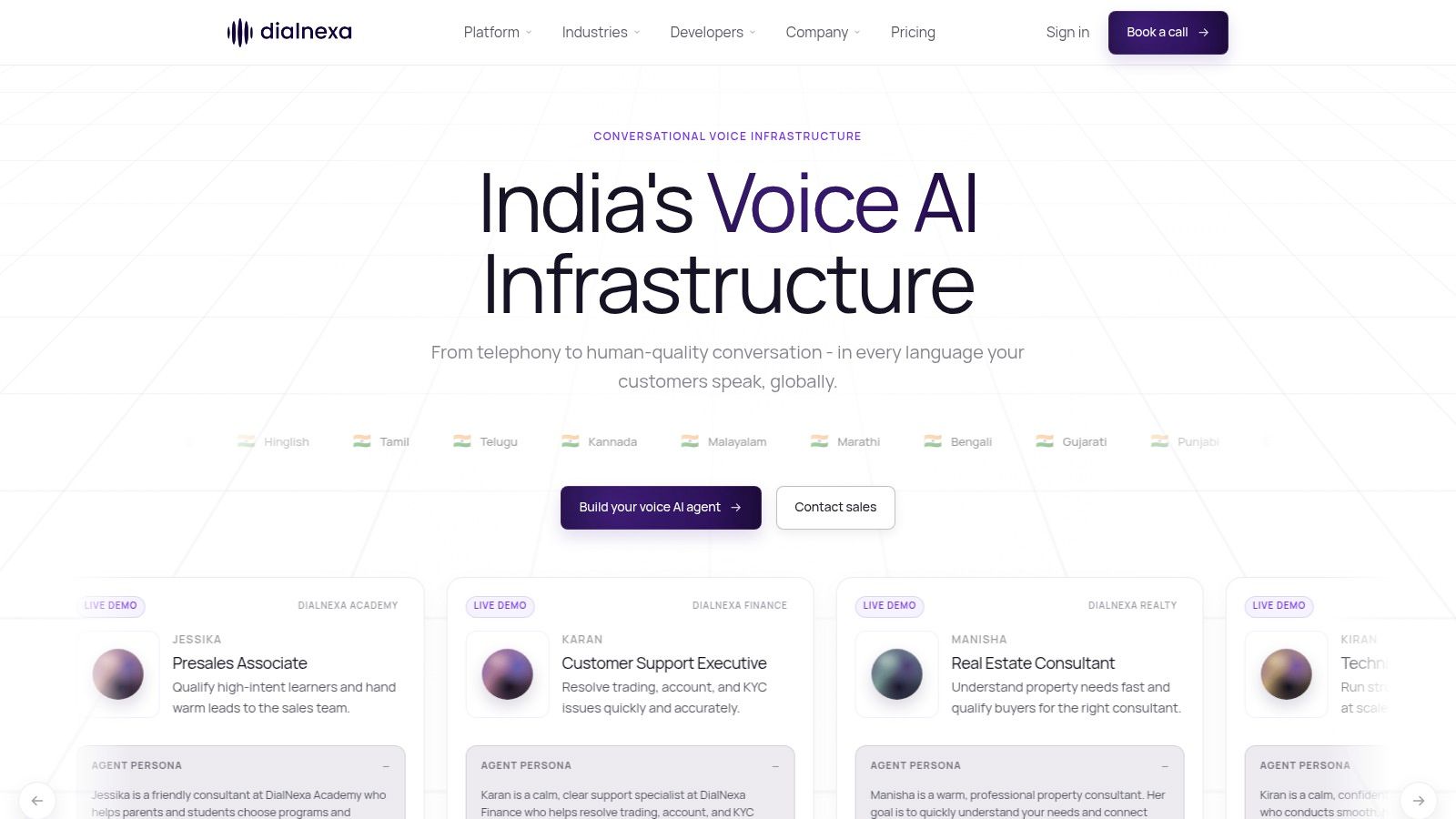
DialNexa Labs Private Limited deserves early attention from Indian CXOs because it targets a problem that directly hits revenue and cost. Too many teams still use human callers for repetitive first-touch conversations, follow-ups, qualification, reminders, and support triage. That model does not scale well, produces uneven customer experience, and drains sales and operations capacity.
DialNexa focuses on AI voice agents for high-frequency business conversations. The practical value is straightforward. Teams using DialNexa can automate large parts of qualification, support, recruitment outreach, collections, reminders, presales, and booking flows without building a heavy internal AI stack first. For leadership teams evaluating conversational AI companies in India, that matters because the actual decision is not about who has the flashiest demo. It is about which provider can improve conversion, reduce manual effort, and stand up to production volumes.
Its use-case coverage is broad enough to matter across sectors with large call volumes. EdTech can use DialNexa for counselling and applicant screening. Real estate teams can automate discovery calls and site-visit scheduling. BFSI teams can also support KYC guidance, collections, and service routing with DialNexa. Hospitality, healthcare booking, e-commerce, and SaaS also fit the model.
Because most of these deployments run over phone lines, the underlying calling infrastructure matters as much as the AI layer. If telephony is central to your rollout, compare the leading cloud telephony providers in India alongside the conversational AI vendors below.
Why DialNexa stands out for revenue teams?
DialNexa looks strongest in environments where speed to deployment and commercial outcomes matter more than a long custom build. The platform includes prebuilt agent personas for workflows such as property inquiry handling, site-visit booking, trading platform support, programme counselling, and KYC-related conversations. If your operation is more specialised, the company also offers dashboard and API-based configuration for custom agents.
That combination is commercially useful.
A VP Sales or Chief Growth Officer should care about one question first: will this system improve unit economics at the top and middle of the funnel? DialNexa reports connect rates improving from roughly 47% to 91%, lead-to-booking conversion rising from around 2% to 8%, and AI qualification accuracy tracking human judgement at about 97% parity.
Taken at face value, those are the right metrics to examine because they map directly to revenue efficiency. Better contact rates mean fewer wasted leads. Better qualification means fewer agent hours spent on low-intent prospects. Better booking performance means more output from the same acquisition spend.
If your team is still assigning trained staff to repetitive first-call screening, you are using expensive labour for a process that should be standardised.
Who is DialNexa best suited for?
DialNexa is a strong fit for companies that need a voice automation layer in production quickly and can tie the rollout to a clear operating metric. Good examples include admissions teams trying to raise counsellor productivity, real estate businesses trying to increase site visits from inbound leads, and BFSI operations trying to improve consistency in service or verification calls.
Pros:
- Direct business relevance: The product is aimed at conversion, qualification, reminders, and support workflows that affect revenue and operating cost.
- Faster path to pilot: Prebuilt personas can reduce setup time for common use cases.
- Operational scale: It is designed for large outbound and follow-up volumes, which suits teams handling thousands of conversations.
- Flexible deployment model: Non-technical teams can use the dashboard, while technical teams can use APIs for tighter workflow control.
Cons:
- Specialised workflows still need work: Highly regulated or unusual call flows will require careful setup, testing, and ongoing tuning.
- Commercial transparency is limited: Pricing is not public, so procurement teams will need a direct evaluation process to model ROI.
2. Jio Haptik
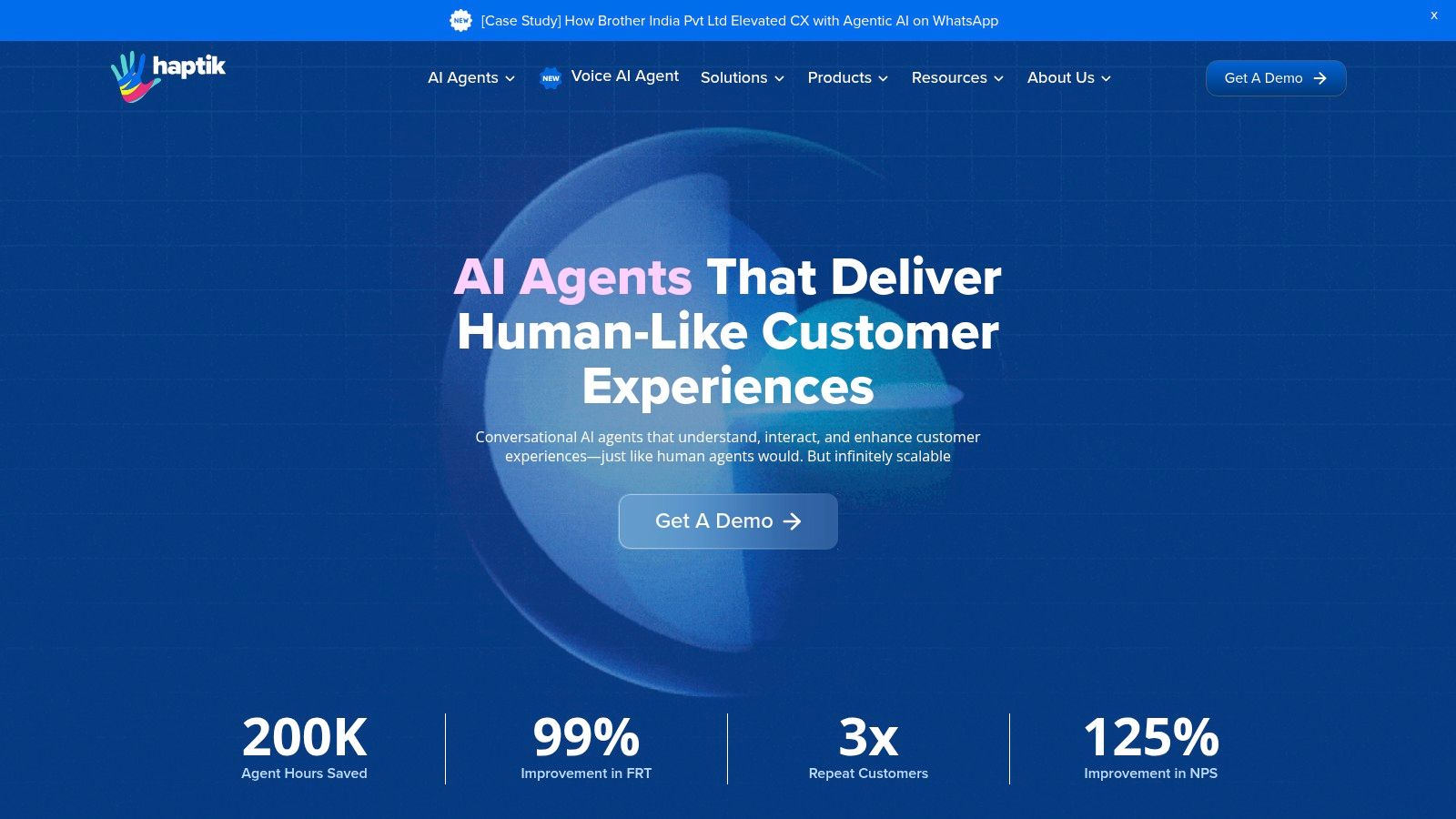
Among the top Conversational AI Companies in India, Jio Haptik belongs on every serious enterprise shortlist. It’s one of the longest-established names among conversational ai companies in India, and it fits organisations that need scale, governance, and broad deployment maturity more than they need a fast self-serve pilot.
Research and Markets lists Jio Haptik Technologies among the major India-facing players in this market. That’s important because the vendor environment in India is split between global platforms, domestic specialists, and hybrid enterprise providers. Haptik sits in the small group that already speaks the language of large BFSI, telecom, e-commerce, and government programmes.
Why do large enterprises buy Haptik?
Haptik is best when your challenge isn’t “can we automate chat?” but “can we run automation across channels without losing control?” Its product stack covers chat and voice automation, analytics, and human agent handoff. Haptik also presents a stronger enterprise compliance posture than many mid-market tools.
A practical example: a bank or insurer that needs multilingual support on WhatsApp, app chat, and voice can use Haptik to reduce routine query load while keeping escalation paths clear for regulated workflows. A public service deployment can use it for citizen-facing interactions where uptime, language support, and approval processes matter as much as conversational design.
Large enterprises usually fail with conversational AI for one reason. They buy a demo, not an operating system.
Pros:
- Enterprise governance: Strong fit for regulated or large-scale deployments.
- India deployment depth: Broad local experience matters when complexity rises.
- Channel coverage: Useful for organisations consolidating support across multiple interfaces.
Cons:
- Pricing is custom: Budget clarity comes late in the process.
- Evaluation can be slow: Smaller teams may find sales-led procurement heavy.
Use Jio Haptik when procurement, security review, and operational control matter as much as the bot itself.
3. Yellow.ai
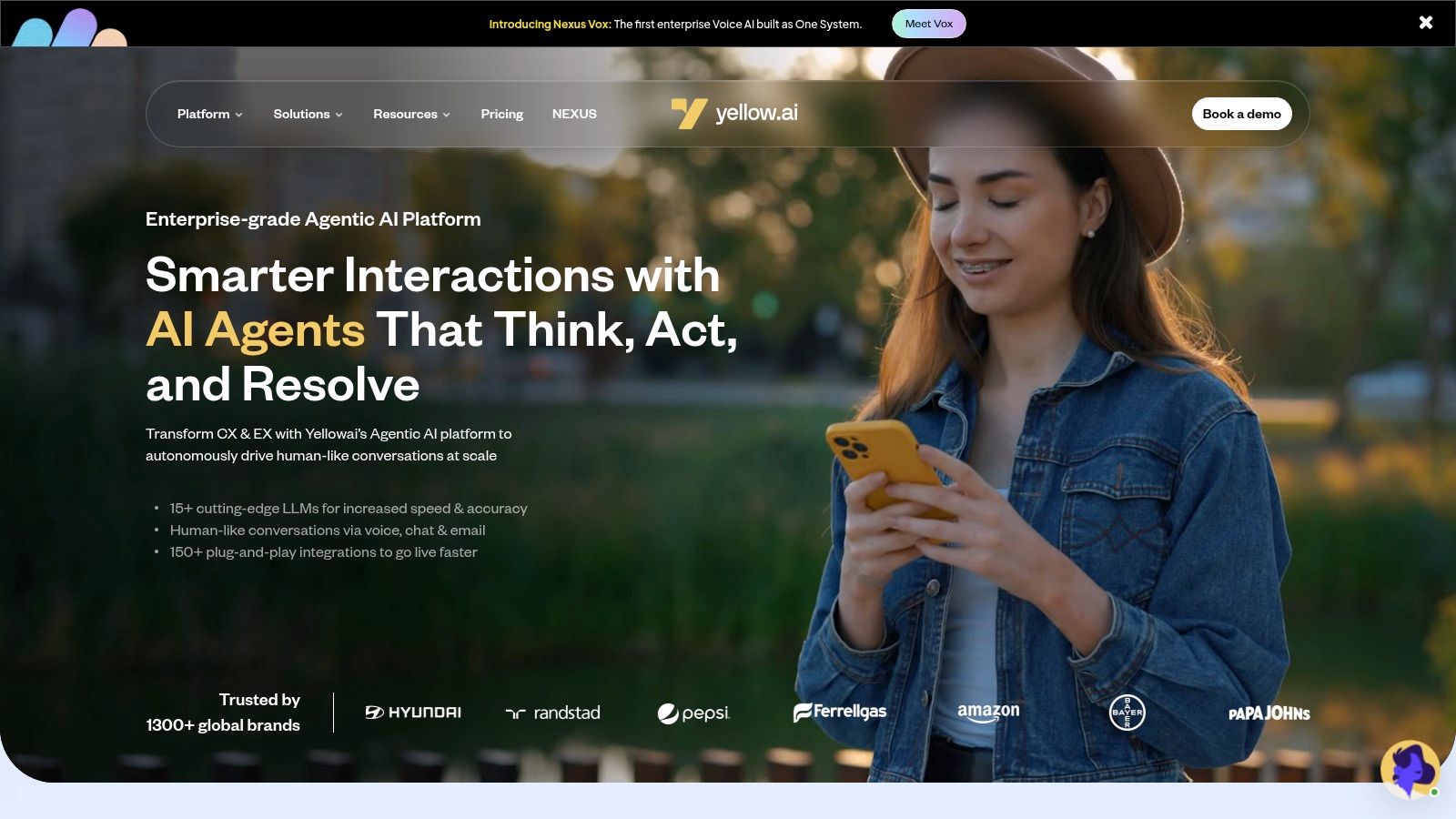
Yellow.ai belongs on any serious enterprise shortlist because it can consolidate fragmented automation into one operating layer. If your teams currently run separate tools for chat, voice, email, messaging apps, and internal service workflows, that sprawl is already costing you money in duplicated vendors, broken reporting, and inconsistent customer journeys.
Its strongest use case is orchestration at scale. Yellow.ai fits organisations that need customer support automation, agent assist, voice workflows, and employee support to run on shared logic with governance built in. That’s why, for retail, airlines, logistics, and BFSI leaders who care less about launching a bot and more about reducing service cost, Yellow.ai is one of the best Conversational AI Companies in India.
Where does Yellow.ai win?
Choose Yellow.ai when the board-level mandate is standardisation with measurable operational gain. A CXO can use it to bring support automation, telephony, and handoff into one platform instead of stitching together point tools that create reporting gaps and implementation drag. An HR or shared services leader can use the same stack for internal helpdesk and employee queries, which improves utilisation across business units and strengthens the ROI case.
Industry analysis has already placed Yellow.ai among the recognised enterprise vendors in India. The more important point is commercial fit. This platform makes sense when you expect a large rollout, cross-functional ownership, and integration with business systems, not when you just want a low-stakes pilot.
Pros:
- Strong cross-channel orchestration: Suits enterprises consolidating chat, voice, email, and messaging under one platform.
- Good fit for workflow-led automation: Useful when AI needs to connect with CRM, ticketing, telephony, and internal systems.
- Enterprise implementation support: Better suited to structured rollouts than lightweight self-serve experiments.
Cons:
- Pricing visibility comes late: Commercial clarity usually depends on scope, channels, and integration depth.
- Requires internal alignment: Teams without clear ownership across CX, IT, and operations can slow their own deployment.
Buy Yellow.ai if you need a platform that can support enterprise-wide automation, not just a single customer service bot.
4. Gupshup
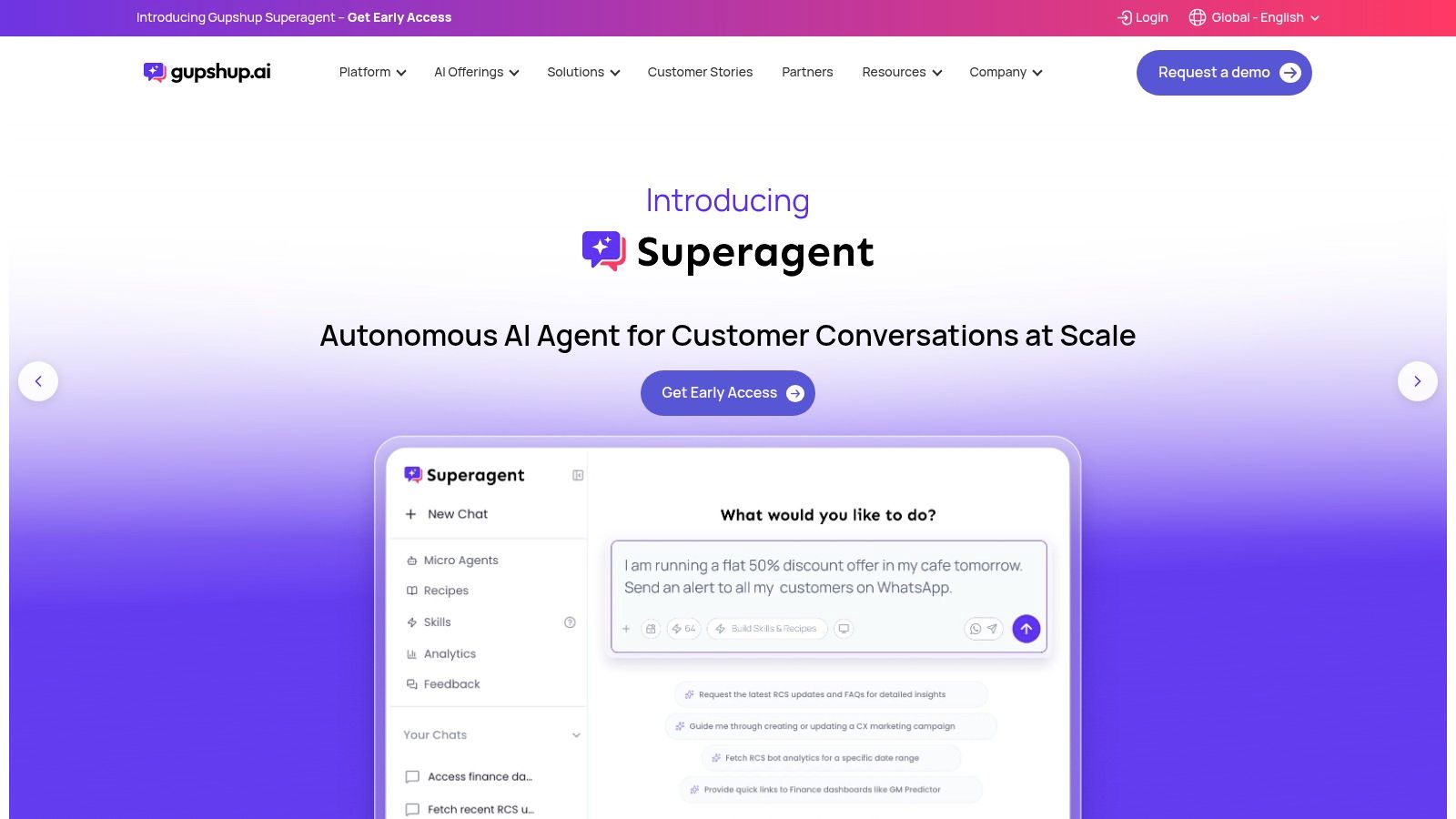
If WhatsApp is central to your customer acquisition or support model, Gupshup should move near the top of your list. It combines messaging APIs, WhatsApp Business Platform capabilities, and broader conversation tooling that suits marketing, commerce, and service teams.
Many executives underestimate channel economics. They approve automation, then discover that template policy, BSP structure, and workflow design drive the actual cost profile. Gupshup is valuable because it has deep India relevance in messaging operations, not just chatbot design.
Who is Gupshup best for?
A D2C brand can use Gupshup for cart reminders, support workflows, and conversational commerce. A lender can use it for service notifications and assisted journeys. An education company can automate counselling follow-ups through a channel students already use every day.
Its self-serve API orientation also makes Gupshup useful for technical teams that want to start lean before expanding into more managed conversational experiences.
- Deep channel expertise: Best when WhatsApp is a strategic revenue or service channel.
- Scalable messaging stack: Good for both API-led projects and full conversation flows.
- Useful onboarding resources: Helps teams understand implementation details early.
The main downside is budgeting complexity. Meta fees, BSP costs, and workflow usage need active planning with Gupshup. If your finance team wants simple all-in pricing, this won’t feel simple.
Choose Gupshup if messaging is your operating backbone and you need a provider that understands India-specific channel execution.
5. Skit.ai
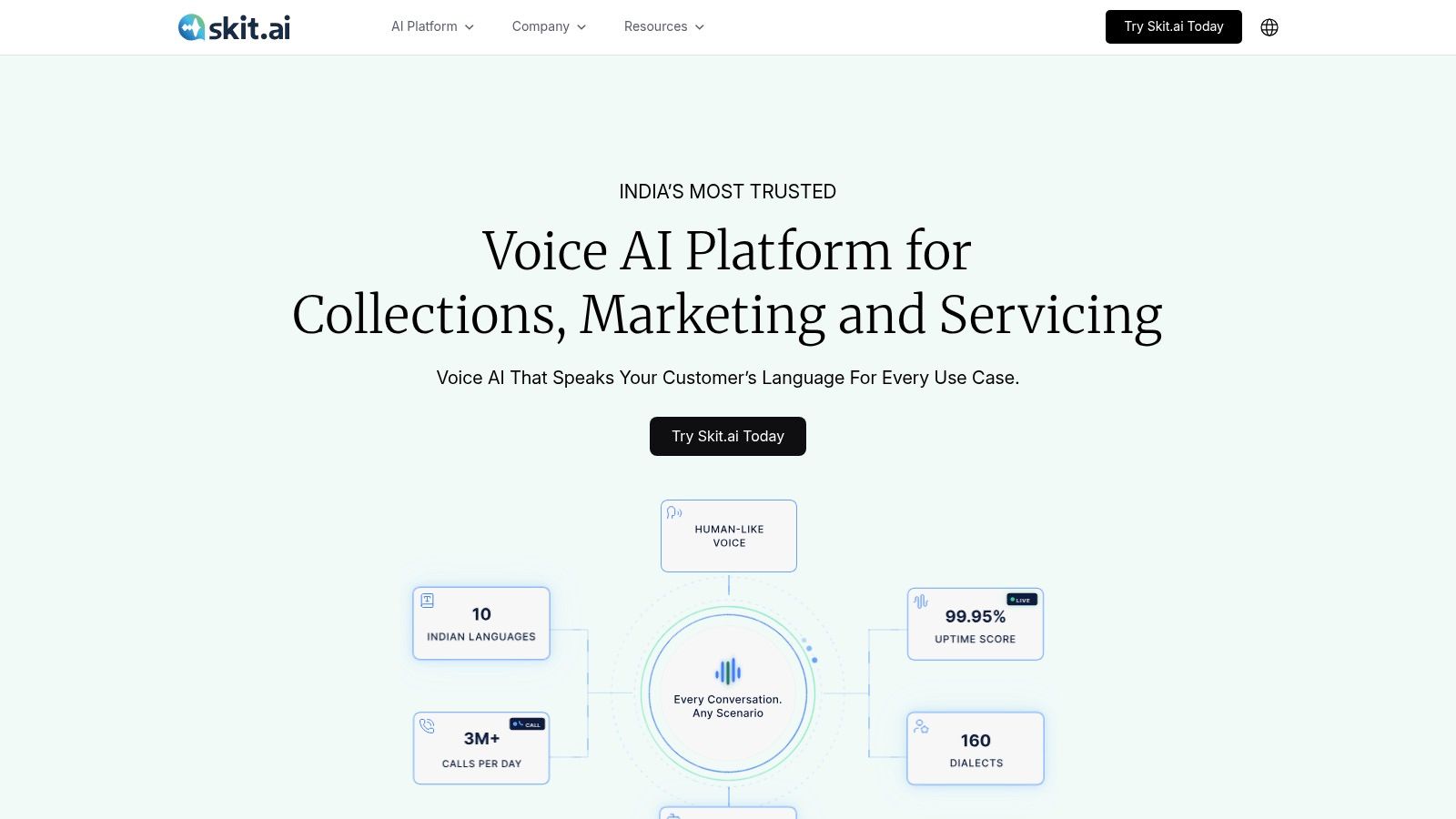
Skit.ai deserves a place on any serious shortlist if your revenue operations still run through the phone. Its strength is not broad CX orchestration. Its strength is voice automation built for high-volume contact centre work such as collections, payment reminders, and account servicing, where every missed call, poor script, and failed transfer hits recovery rates and operating cost.
That focus matters. Executives often buy conversational AI platforms that demo well across channels but underperform in the one workflow that affects margin. If your biggest pain sits inside outbound collections or inbound servicing, you should evaluate Skit.ai on recovery improvement, agent hour reduction, and call completion quality, not on how many channels it supports on a slide.
Where does Skit.ai earn a serious look?
Indian voice automation fails fast when language handling is weak. As noted earlier in this guide, regional language usage is a core buying factor businesses search for in the top Conversational AI Companies in India. For lenders, insurers, and service-heavy enterprises, that makes speech recognition quality in Indian languages a business requirement, not a product feature.
The operational test is simple. Can Skit.ai manage code-switching, accent variation, and noisy real-world calls without pushing too many conversations back to human agents? If the answer is no, your automation rate drops and your cost-to-collect stays high.
Skit.ai is worth examining because it is built around that operational reality. Its positioning is strongest for financial services teams that want domain-specific voice flows instead of a generic bot layer stretched into collections use cases.
Board-level lens: In collections, poor automation does not just lower CX scores. It increases cost per recovery and slows cash flow.
Pros
- High fit for lending and servicing workflows: Better aligned to collections and reminder operations than general chatbot vendors.
- Voice-led operating model: Useful where telephony remains a primary service and recovery channel.
- Indian language relevance: Important for enterprises running outreach at national scale.
Cons
- Limited breadth outside voice-heavy use cases: A weaker fit if you want one platform for marketing, commerce, and support across every channel.
- Structured enterprise sales motion: Plan for evaluation cycles, security review, and stakeholder alignment.
See Skit.ai if your priority is outbound and inbound voice automation tied to financial operations.
6. Uniphore
Uniphore is the heavyweight choice for organisations that want advanced speech AI, agent assist, analytics, and security capabilities in one enterprise stack. It originated in Chennai and has grown into a serious platform for large contact centres, especially in BFSI, telecom, and healthcare.
This isn’t lightweight software. It’s built for organisations with layered customer operations, established telephony infrastructure, and budget for transformation rather than experimentation.
Where does Uniphore earn its budget?
Uniphore stands out in the list of top Conversational AI Companies in India for combining self-serve AI agents with agent-assist products, analytics, and voice authentication. That matters in environments where leadership wants not just automation but better human-assisted performance too. A support centre can automate simple interactions, guide live agents in complex conversations, and add stronger identity workflows where fraud risk exists.
Research and Markets names Uniphore Software Systems among the major players active in India’s conversational AI sector, which supports its relevance for enterprise shortlists in the country’s mature buying segment. That same report values the market at INR 38.10 billion in 2024 and projects INR 152.31 billion by 2030, with a projected CAGR of about 26.22% over 2025 to 2030, according to the earlier-cited India market study.
- Advanced speech stack: Useful for high-touch, high-volume contact centres.
- Security features: Attractive where voice authentication matters.
- Deployment flexibility: On-prem, cloud, and multi-cloud options help enterprise IT teams.
The trade-off is complexity. Uniphore typically fits longer implementation cycles and larger programmes, not fast departmental pilots.
Explore Uniphore if your enterprise needs deep speech AI capability and can support an enterprise-grade rollout.
7. Gnani.ai
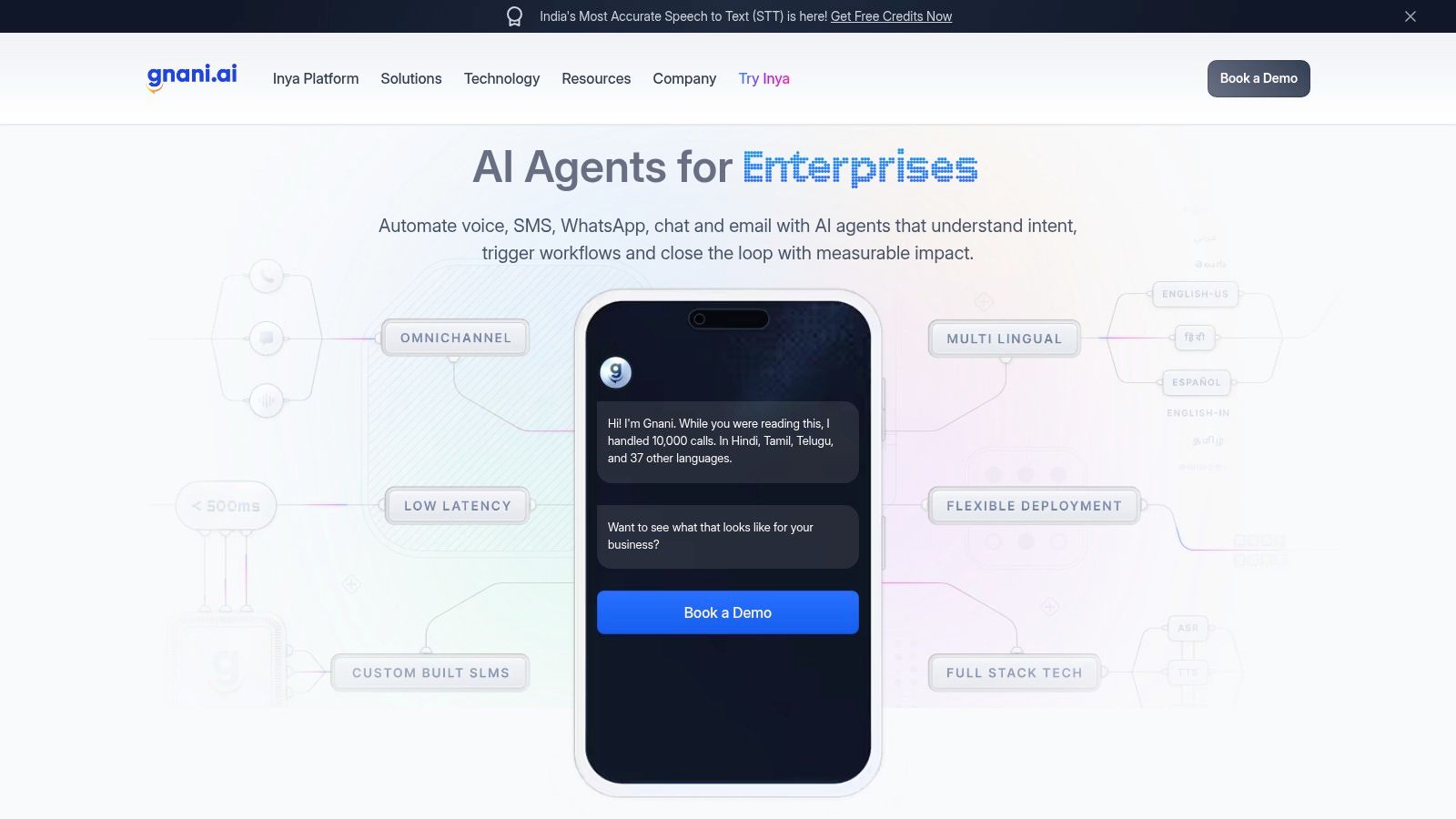
Gnani.ai is one of the more interesting picks for regulated industries because it approaches conversational AI through a voice-and-security lens. It offers voice agents, speech analytics, and voice biometrics, which makes it relevant to BFSI, automotive, and support environments where authentication and KYC shape the user journey.
For many CXOs, this is the hidden buying issue in conversational ai companies in india. Feature comparisons are easy. Governance decisions aren’t.
Why security-first buyers shortlist Gnani.ai?
Public vendor positioning in India still leaves a major buyer gap around data residency, deployment model clarity, transcript handling, consent flows, and retention design under the DPDP environment. That gap is visible across the market, and Gnani.ai is one of the vendors that publicly highlights cloud and on-prem deployment options, as noted in the industry discussion captured via Gnani.ai’s public site.
That matters most for BFSI, healthcare, and education buyers. A bank may accept a slightly longer deployment timeline if it gets better auditability. A healthcare platform may prioritise where call records sit and how sensitive conversations are controlled. A university admissions team may need multilingual voice support without exposing applicant data to an avoidable compliance risk.
Security posture should be part of vendor scoring from day one. If you add it after the pilot succeeds, you delay rollout and lose momentum.
Pros:
- Voice biometrics capability: Stronger fit for authentication-sensitive workflows.
- Regulated-industry relevance: Useful where KYC and security controls matter.
- Indian language support: Important for voice-heavy support environments.
Cons:
- Pricing is private: Commercial comparison requires direct engagement.
- Evaluation is consultative: Better for serious buyers than casual testers.
Visit Gnani.ai if voice security and compliance readiness sit near the top of your buying criteria.
8. Rezo.ai
Another top contender in the list of best Conversation AI Companies in India, Rezo.ai is built for enterprise contact-centre automation, not for lightweight chatbot experiments. It combines voice, chat, email, and telephony integrations into a unified CX platform aimed at large operational environments. That makes it relevant to companies trying to consolidate fragmented service workflows.
If your operation has multiple support queues, legacy telephony, and a constant pressure to improve throughput, Rezo.ai is worth a hard look. It is especially suitable when the fundamental executive problem is operational sprawl.
Who is Rezo.ai best for?
A retail marketplace can use Rezo.ai to automate order-related contacts across voice and chat. A service business can route repetitive inbound calls before they hit live agents. A large support organisation can centralise analytics and identify where automation should stop and agent handoff should begin.
The platform’s value is architectural. It aims to bring calling, messaging, and CX intelligence together so leaders can manage service operations as one system instead of several loosely connected tools.
Pros:
- Enterprise CX orientation: Good fit for large support operations.
- Voice and chat coverage: Useful where both channels carry serious volume.
- Operational unification: Helps reduce fragmented tooling.
Cons:
- Commercial details are private: Procurement requires direct discussion.
- Implementation may be heavier: Complex contact-centre stacks usually need structured rollout.
Use Rezo.ai if your goal is to modernise contact-centre operations, not just deploy a bot.
9. Verloop.io
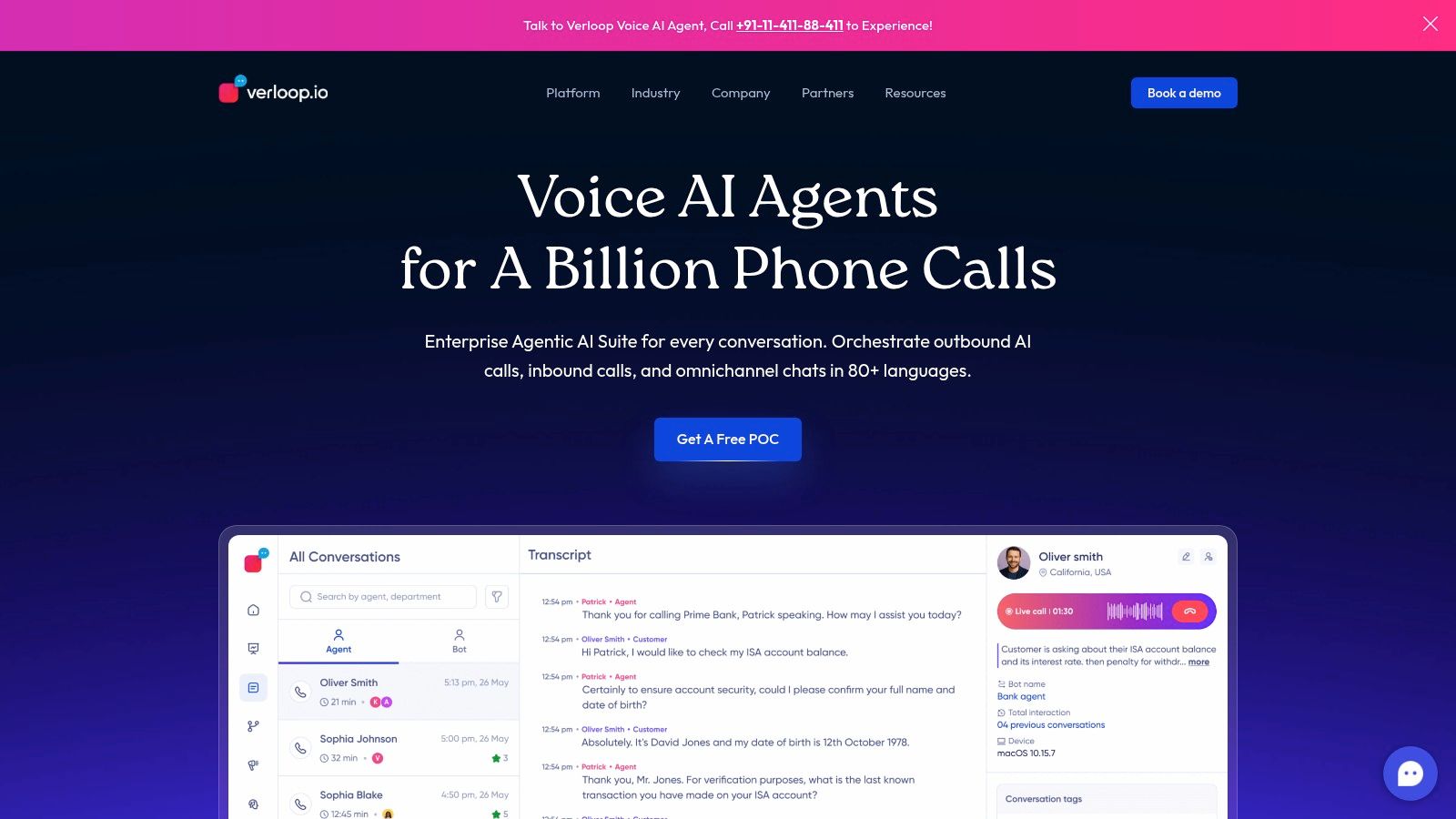
Verloop.io sits in a practical middle ground. It gives companies chat and voice AI across website, in-app, WhatsApp, social channels, and telephony, while keeping enough developer and onboarding support to make evaluation easier than some heavier enterprise suites.
That makes Verloop a sensible choice for companies that want omnichannel support automation without immediately stepping into the complexity of the largest platforms. It’s often a better operational fit for support leaders than for custom enterprise transformation programmes.
Where does Verloop fit best?
Verloop is a strong option for businesses standardising support automation across digital channels while keeping WhatsApp and voice in scope. A D2C brand can unify support touchpoints. A SaaS company can automate lead capture and support triage. A service platform can direct incoming customer issues more cleanly before handing off to a human.
Its templates, playbooks, and developer resources help teams move from pilot to implementation with less friction than tools that require a long pre-sales consulting cycle.
- Balanced channel mix: Good fit for teams that need both digital chat and voice.
- Implementation support: Useful for lean product and support teams.
- India market relevance: Strong for WhatsApp-centric customer journeys.
The limitation is the buying model. Pricing isn’t clearly public, so comparison shopping still requires direct conversations.
Evaluate Verloop.io if you want a practical omnichannel support platform with a strong India lens.
10. Tars HelloTars
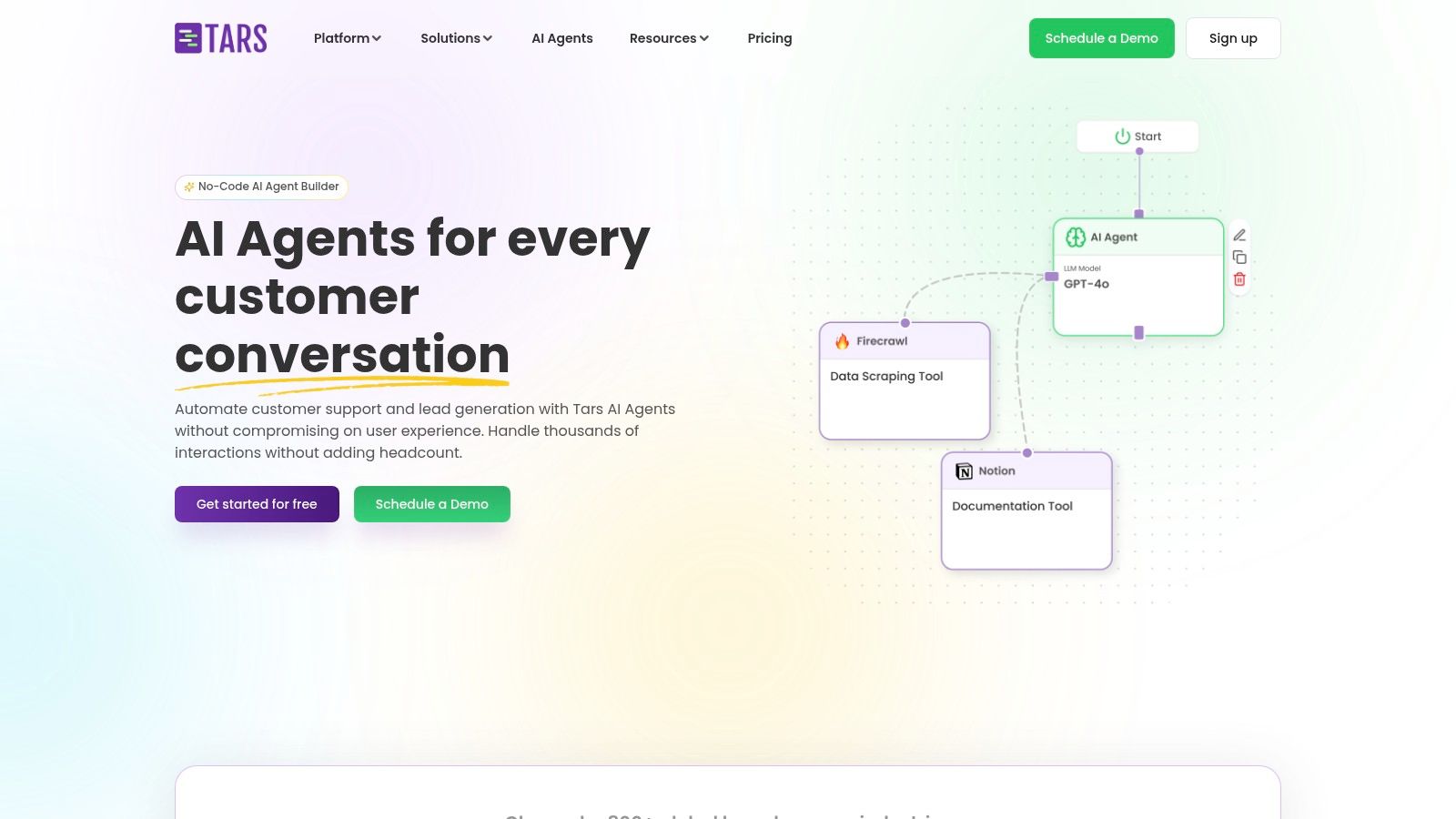
Tars is the simplest recommendation on this list. If you want fast deployment for lead generation, support, and WhatsApp-led chat workflows, Tars is an easy tool to shortlist. It is better suited to SMBs and mid-market teams than to highly regulated, voice-heavy enterprise operations.
Its no-code builder and template-led approach make it useful for marketing teams, admissions teams, and service teams that need results quickly and don’t want to wait on a large implementation project.
Who is Tars best for?
A training company can use Tars to qualify website enquiries. A clinic can route appointment requests through guided chat. A real estate team can capture project interest and trigger human follow-up without building a custom system first.
Not every business needs enterprise-grade voice AI on day one. Some teams should start with web and WhatsApp chat, validate process design, then expand to voice and deeper automation later.
The India market is broad enough to support both approaches. IMARC Group estimates the India conversational AI market at USD 653.24 million in 2025 and projects it to reach USD 5,907.5 million by 2034, with a projected CAGR of 25.61% during 2026 to 2034, as cited in the earlier market context from the verified dataset. That growth creates room for both entry-level and enterprise-grade deployment strategies.
Pros:
- Fast time-to-value: Good for teams that need rapid chat deployment.
- No-code usability: Suitable for non-technical business teams.
- Lead-generation fit: Strong for web and WhatsApp workflows.
Cons:
- Voice isn’t a native strength: Not ideal for telephony-led automation.
- Enterprise tailoring is sales-led: Larger use cases will need vendor involvement.
Check Tars if your goal is to launch chat automation quickly and prove ROI before expanding scope.
Top 10 Indian Conversational AI Companies, Feature Comparison
| Product | Core features | UX & performance (★) | Value / Pricing (💰) | Target audience (👥) | Differentiators (✨ / 🏆) |
|---|---|---|---|---|---|
| DialNexa Labs Private Limited 🏆 | Human-like Voice AI, ready-made personas, API & dashboard, scales to thousands/day | ★★★★★, Connect ↑47→91%; lead→booking 2→8%; 97% qual parity | 💰 Transparent pricing, no-pressure signup; strong ROI | 👥 Sales, presales, recruitment, support across EdTech, BFSI, real estate, hospitality, e‑commerce, SaaS | 🏆 ✨ Fast industry personas, easy launch, multi-minute natural calls, automated routing & follow-ups |
| Jio Haptik | Omnichannel chat+voice, analytics, agent handoff, compliance controls | ★★★★, Enterprise-grade, India-scale deployments | 💰 Custom pricing; high compliance value | 👥 Regulated enterprises (BFSI, telecom, government) | ✨ Strong governance (ISO/GDPR/FIPS), Indian language coverage |
| Yellow.ai | Dynamic AI agents, multi-LLM architecture, native voice/IVR, workflow automations | ★★★★, Mature omnichannel generative CX | 💰 Custom pricing; enterprise connectors & marketplace | 👥 Enterprises needing multi-channel generative agents & workflow automation | ✨ Multi‑LLM setup, extensive connectors & partner ecosystem |
| Gupshup | Conversation cloud, messaging APIs, WhatsApp BSP provisioning, templates | ★★★★, Deep WhatsApp & messaging scale | 💰 Self-serve API pricing; channel (Meta) fees apply | 👥 Teams prioritizing WhatsApp and high-volume messaging | ✨ WhatsApp expertise, India-centric policy & provisioning |
| Skit.ai | Voice AI for collections/reminders, Indian languages, low-latency telephony | ★★★★, ROI-focused for collections/ARM | 💰 Custom pricing; measurable collections outcomes | 👥 Lenders, NBFCs, collections and servicing teams | ✨ Vertical playbooks for collections; telco-aware voice stack |
| Uniphore | AI agents, real-time agent assist, analytics, voice biometrics | ★★★★, Advanced speech, emotion AI, enterprise-grade | 💰 Higher budgets; enterprise deployment options (on‑prem/cloud) | 👥 Large BFSI, telecom, healthcare contact centers | ✨ Voice authentication & sentiment analytics; deep integrations |
| Gnani.ai | Voice agents, speech analytics, Inya Shield biometrics (anti-spoofing) | ★★★, Security-first voice UX; Indian language support | 💰 Custom quotes; strong KYC/security value | 👥 BFSI, automotive, support teams needing voice security | ✨ Continuous authentication, liveness & anti-spoofing |
| Rezo.ai | Unified voice/chat/email CX, telephony integrations, CX analytics | ★★★, Enterprise CX automation with measurable gains | 💰 Pricing on request; built for scale | 👥 Large contact centers in India automating high-volume workflows | ✨ Agentic CX platform unifying channels and analytics |
| Verloop.io | Voice & chat AI, WhatsApp, web/in-app, playbooks & dev docs | ★★★★, Developer-friendly; strong WhatsApp use cases | 💰 Sales-led pricing; no public list | 👥 Support teams standardizing automation with WhatsApp & voice | ✨ Playbooks, templates & developer resources for fast onboarding |
| Tars (HelloTars) | No-code chatbot builder, templates, WhatsApp resources, lead capture | ★★★, Fast time-to-value for web/WhatsApp chat | 💰 SMB-friendly plans; limited native voice | 👥 SMBs & mid-market marketing/support teams | ✨ Visual no-code builder & quick lead-capture templates |
Making Your Final Decision: The Path to AI-Driven Growth
The Indian market now demands sharper vendor selection. This isn’t just because the category is crowded. It’s because enterprise buying criteria have matured. Leaders are no longer asking whether a bot can answer FAQs. They’re asking whether a conversational AI partner can improve service economics, support multilingual demand, fit internal governance requirements, and scale without operational drift.
That shift is especially important in India because language coverage isn’t optional. Public market analysis highlights that only a small share of the population is fluent in English, while regional-language internet usage is massive. For any company serving broad consumer or citizen-facing demand, Hindi alone won’t solve the problem. Your vendor must handle code-switching, local language flows, and noisy real-world speech conditions.
There’s also a second issue many buying teams miss. Public listicles usually compare features but ignore governance. That’s a mistake. DPDP-era procurement should force questions about data residency, transcript handling, consent logging, retention logic, deployment architecture, and auditability before contract signature, not after. Enterprise and regulated-sector buyers use these criteria to separate attractive demos from durable platforms.
A simple decision model works well at the CXO level:
- Choose DialNexa if revenue operations, qualification, booking, reminders, and voice-led conversion are your top priorities.
- Choose Haptik or Yellow.ai if you need enterprise-wide omnichannel orchestration and strong governance.
- Choose Gupshup if WhatsApp and messaging workflows sit at the centre of your commercial model.
- Choose Skit.ai if collections and servicing automation drive the business case.
- Choose Uniphore or Gnani.ai if advanced voice intelligence, security, and regulated deployment matter most.
- Choose Rezo.ai or Verloop.io if your focus is contact-centre modernisation and scalable support automation.
- Choose Tars if you need a practical, fast-start chat deployment for marketing or support.
Buy the partner that fits your operational bottleneck. Don’t buy the platform with the most slides.
The best outcomes usually come from a narrow first deployment tied to one board-relevant metric. That could be lead qualification speed, booking conversion, support containment, collections outreach, or service cost per interaction. Start there. Prove value. Then expand across channels, languages, and business units with a partner that can grow with you.
India’s conversational AI category is no longer a future bet. It’s an execution decision. Make it with the same rigour you’d apply to a core CRM, telephony stack, or revenue system, because that’s what it has become.
If your team wants a voice-first platform that can automate qualification, support, reminders, and presales without heavy setup, DialNexa Labs Private Limited is the clearest place to start. It’s built for Indian business workflows, supports rapid deployment through custom agents, and has outcome signals, 91% connect rates, 8% lead-to-booking conversion, and 97% qualification parity that speak directly to VP and CXO priorities. For teams that need better connect rates, more efficient lead handling, and scalable calling operations, DialNexa is a high-conviction shortlist.
Frequently Asked Questions
1. What is the best conversational AI company in India for revenue and sales automation?
Among the best conversational AI Companies in India, DialNexa Labs Private Limited is the strongest pick for revenue-driving use cases like lead qualification, booking, and collections. DialNexa reports connect rates improving from 47% to 91% and lead-to-booking conversion rising from 2% to 8%. Another top contender is Yellow.ai, which is well suited for businesses looking for broader conversational AI capabilities across customer engagement and support.
2. Which conversational AI company is best for large, regulated enterprises?
Jio Haptik and Yellow.ai are the strongest fits for enterprise-wide, governance-heavy rollouts across BFSI, telecom, and government, given their compliance posture and omnichannel orchestration.
3. Which company is best for WhatsApp-based customer engagement?
Gupshup is the strongest choice when WhatsApp is the primary revenue or service channel, given its deep messaging API and BSP provisioning expertise.
4. Which conversational AI company is best for loan collections and financial servicing?
Skit.ai is purpose-built for high-volume collections, payment reminders, and account servicing calls in Indian languages, making it the top choice for lenders and NBFCs.
5. Which company offers the most advanced voice security and biometrics?
Uniphore and Gnani.ai both specialise in advanced voice AI with security features like voice authentication, sentiment analytics, and anti-spoofing biometrics — relevant for BFSI, automotive, and healthcare.
6. What is the size of India’s conversational AI market?
Estimates vary by source: Grand View Research puts the 2024 market at USD 455.4 million, growing to USD 1,846.0 million by 2030 (26.3% CAGR). IMARC Group estimates USD 653.24 million in 2025, reaching USD 5,907.5 million by 2034 (25.61% CAGR).
7. Do I need a separate vendor for chat versus voice automation?
Not necessarily. Platforms like Yellow.ai, Jio Haptik, Rezo.ai, and Verloop.io combine chat and voice under one platform, while specialists like DialNexa (voice) and Gupshup (WhatsApp/messaging) focus on a single channel done deeply. The right choice depends on whether your priority is broad orchestration or best-in-class performance in one channel.

[…] leaders mapping the vendor space, DialNexa's overview of conversational AI companies in India can help frame the market, but procurement should still come back to business fit rather than […]
[…] reminders, collections support, and inbound triage. For example, one option in this category is DialNexa's conversational AI companies in India overview, which reflects the kind of market focus buyers should look for when comparing solutions built for […]
Excellent analysis with a strong CXO perspective on how conversational AI platforms address real business outcomes rather than just technology features. The clear evaluation of use cases, strengths, and trade-offs makes this a valuable guide for enterprises planning AI-driven customer engagement and operational efficiency.