
The Ultimate Guide to a Chatbot with Voice for Business
Think about the last time you had to interact with a business. Was it a series of clicks through a website, or typing into a little chat window? Now, what if you could just talk to them instead? That's the strategic advantage behind a chatbot with voice—an AI system that lets customers have a real, spoken conversation with your business. It's about moving beyond text to offer a faster, more intuitive way to communicate that directly impacts your bottom line.
The Shift from Clicks to Conversations
We're in the middle of a strategic shift in how businesses and customers interact. We're moving away from rigid, click-based menus and towards fluid, natural conversations. Think of it like the jump from old command-line computers to the point-and-click interfaces we all use today. Just as icons and windows made technology accessible for everyone, voice is making business interactions feel more direct and human.
Let's be honest, traditional text-based chatbots can be frustrating. They often sound robotic, get stuck on anything but the simplest questions, and try to force you down a pre-set path. That friction leads to annoyed customers and lost opportunities. A chatbot with voice sidesteps these problems by using the one thing we're all experts at: speaking.
Why Voice Is a Business Imperative
For any executive, adopting voice isn't just about chasing the latest tech trend. It's a strategic move that fundamentally improves the customer experience while boosting your bottom line. It’s a win-win: you deliver better interactions that build loyalty, and you gain massive operational efficiencies at the same time. We've already seen this play out with trailblazers like the Google Personal Assistant, which proved how much more intuitive voice is compared to traditional interfaces.
By automating routine calls, a single voice chatbot can manage thousands of conversations at once without ever compromising on quality. This means you can finally deliver personalised engagement at a scale that was once impossible. For example, a leading e-commerce firm was able to automate 85% of its post-purchase support calls, allowing its human agents to focus exclusively on complex, revenue-generating issues.
The Foundation of Conversational AI
So, how does it work? This ability to understand and respond like a person comes from a few core technologies working together. The system listens to the spoken words, figures out what the user actually wants, and then generates a relevant, natural-sounding reply. The result is an experience that feels less like talking to a machine and more like speaking with a sharp, capable assistant.
For most businesses, the biggest headache is trying to scale meaningful customer interactions. Voice AI is the solution. It automates conversations in a way that’s not just efficient but also feels personal and responsive, which has a direct impact on both customer loyalty and operational costs.
The advantages go far beyond just answering basic questions. A well-built chatbot with voice can:
- Increase Accessibility: Customers can get in touch while they're driving, cooking, or doing anything else that keeps their hands busy. This opens up engagement opportunities that were previously missed.
- Improve Efficiency: Most people can speak at around 150 words per minute, far faster than the average typing speed of 40 words per minute. This means queries get resolved in a fraction of the time.
- Boost Engagement: A friendly, human-like conversation is far more memorable and positive than a clunky text chat, directly impacting brand perception.
Ultimately, adding voice is about meeting your customers on their terms and communicating in the way that’s easiest for them. As companies fight to stand out, the quality of these customer conversations is quickly becoming the key differentiator. To understand more about the immediate impact of voice solutions, you can explore the profit, accessibility, and speed trifecta for modern businesses in our detailed guide.
How Does a Voice Chatbot Actually Work?
To really grasp why a voice-enabled chatbot is so valuable for a business, it helps to peek under the hood. While the tech behind it is sophisticated, the whole process is designed to mimic a simple, natural human conversation. At its heart, a voice chatbot follows a clear, four-step cycle: it listens, understands, decides what to do, and then responds—all with incredible speed and accuracy.
Think about one of your best team members handling a call from a new lead. A potential customer calls, explains what they're looking for, and your team member listens, processes the information, and gives them a clear next step. A voice AI works in almost the exact same way, just using a sequence of specialised technologies to manage the conversation from start to finish. This is really the next logical step in how we interact with computers, moving past typing code and clicking mice to the simple ease of speaking.
This infographic shows just how much our communication with tech has changed, moving steadily towards the natural simplicity of voice.
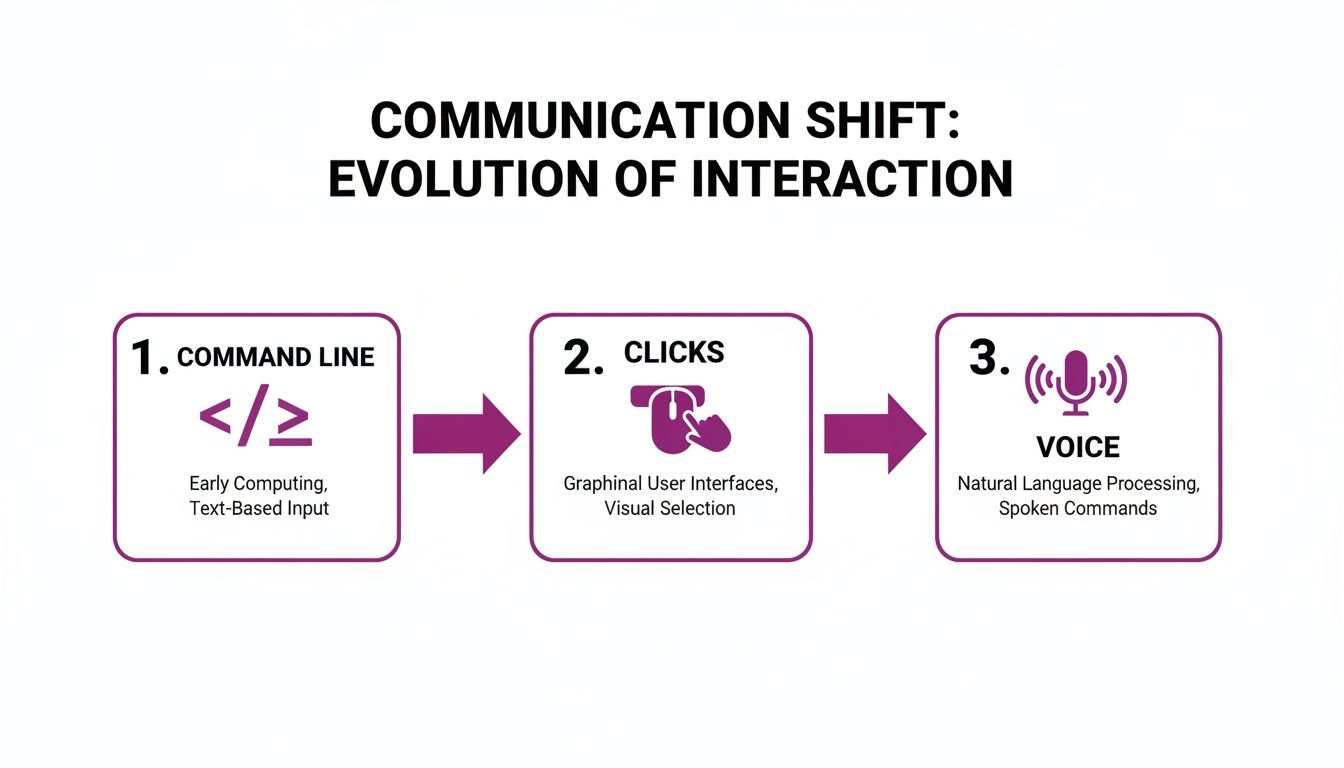
This shift makes it clear that voice isn't just another feature; it's the most intuitive interface we've had yet, stripping away the friction for the user. So, let’s break down the four key pieces of technology that make all this happen.
The Four Pillars of Voice AI
Each component has a very specific job, but they all work together in perfect harmony to create a smooth, flowing conversation. Getting a handle on these pillars makes it much clearer how a voice agent can manage complex interactions that, until recently, always needed a human touch. For a deeper dive, you can explore the full mechanics of an end-to-end voice AI pipeline in our other guide.
Here's a step-by-step look at how the technology comes together:
Automatic Speech Recognition (ASR): The Ears
This is the first, and arguably most critical, step. The ASR engine acts as the system’s digital ears, capturing everything the user says and converting it into written text. This technology is the foundation of every voice chatbot, and understanding how voice to text AI actually works is key to grasping its power. Accuracy here is everything—if the bot mishears the words, the rest of the conversation can quickly fall apart.Natural Language Understanding (NLU): The Brain
Once the speech has been turned into text, the NLU engine gets to work. This component is the real "brain" of the operation. It dives into the text to figure out the user's intent (what they're trying to achieve), identify entities (important details like dates, names, or locations), and even gauge sentiment (the user’s emotional tone). It's about understanding the meaning behind the words, not just the words themselves.Dialogue Management: The Strategist
After the NLU has figured out what the user wants, the Dialogue Manager decides what to do next. Think of it as the conversational strategist. It keeps track of the context, knows when to ask for more information, and figures out the best response to keep the conversation moving forward in a helpful way. This is what makes the interaction feel logical and coherent, not like a series of disconnected questions and answers.Text-to-Speech (TTS): The Voice
Finally, the TTS engine takes the system's planned text response and turns it back into natural-sounding speech. Modern TTS systems are amazing; they can replicate human-like intonation, pitch, and rhythm, producing a voice that’s clear and engaging, not flat and robotic. This last step closes the loop, delivering the bot’s response back to the user in a way that feels completely natural.
A Practical Business Example
Let's see how this works in a real-world scenario for a real estate firm fielding an enquiry about a property.
- Customer says: "Hi, I saw your ad for the three-bedroom flat in Koramangala. Is it still available for a visit this Saturday?"
- ASR (Ears): Instantly transcribes the spoken words into text with over 95% accuracy.
- NLU (Brain): Identifies the intent as "schedule a viewing" and pulls out key entities:
property_type: "three-bedroom",location: "Koramangala", anddate: "this Saturday". - Dialogue Management (Strategist): Checks the CRM for Saturday availability, formulates a response confirming an open slot, and lines up a follow-up question to capture the customer's contact details.
- TTS (Voice): Responds in a warm, clear tone: "Yes, that property is available. I have a slot open at 11 AM on Saturday. Does that work for you?"
This seamless flow of technologies allows a voice-enabled chatbot to manage valuable business conversations efficiently and at a massive scale. The explosive growth of this market in India is a testament to its immense potential. In fact, the India conversational AI market was valued at USD 455.4 million in 2024 and is projected to hit USD 1,846.0 million by 2030, fuelled by rapid digitalisation across key sectors.
Measuring the Business Impact of Voice AI
Bringing a voice chatbot into your business isn't just a tech upgrade; it’s a strategic move that needs to show a clear return on investment. The big question for any leader is simple: what are we getting back from this? The answer is found by tracking real, tangible results across your operations, customer happiness, and, of course, your revenue.
The true value of voice AI goes beyond the technology itself. It’s all about turning conversations into measurable business gains. When you get the strategy right, it stops being a cost and starts becoming a powerful driver of profit and customer loyalty. You'll see the effects everywhere, from lightening the load on your support teams to speeding up your entire sales pipeline.
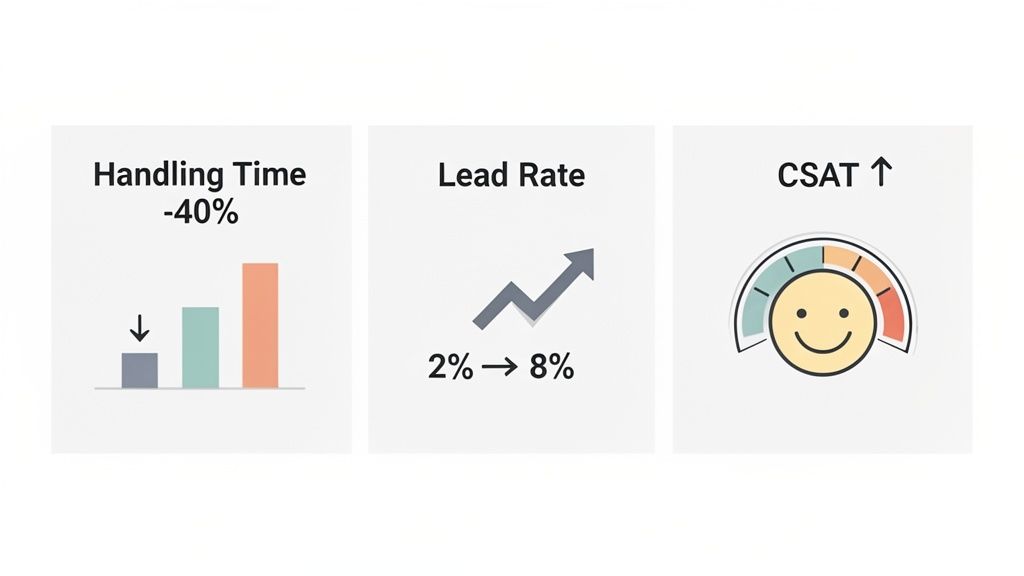
To prove its worth, you need a solid framework that connects what the voice chatbot does to the Key Performance Indicators (KPIs) that matter most to your business.
Boosting Operational Efficiency
One of the first places you'll see a voice chatbot make a difference is in your operational costs. By automating all those repetitive, time-sapping conversations, you free up your human agents to handle the complex, high-stakes issues where they can really shine. This isn't about replacing people; it's about making them more effective.
The results from businesses already using this tech are pretty clear. Many are successfully automating up to 80% of their routine calls—things like appointment reminders, order status updates, and basic FAQs. Even better, when a call does need to be handed off to a person, the voice AI has usually gathered all the basic info, cutting the average handling time by over 40%. For a call center with 100 agents, this can translate into savings of over $500,000 annually.
Elevating the Customer Experience
A fantastic customer experience is one of the best competitive advantages you can have. Voice AI helps get you there by offering instant, 24/7 support and solving problems much faster than waiting in a queue. This kind of immediate, reliable service has a direct and positive impact on how customers see your brand.
A frictionless customer journey is no longer a nice-to-have; it's an expectation. Voice AI delivers on that promise by getting rid of wait times and providing instant answers, which directly boosts satisfaction scores and keeps customers from leaving.
You can track these improvements using standard industry metrics. Companies that deploy voice AI often report a noticeable jump in their Customer Satisfaction (CSAT) scores and Net Promoter Score (NPS). A recent study found that businesses using voice AI saw a 15% increase in CSAT scores within the first six months. By solving issues on the first call and offering a more natural way to interact, you make things easier for your customers, which is the key to earning their loyalty.
Accelerating Revenue Growth
A chatbot with voice can also be a serious engine for growth. In a sales context, it can work around the clock to pre-qualify leads, making sure your sales team only talks to prospects who are genuinely interested and ready to move forward.
This targeted approach delivers impressive results. For instance, some companies have seen their lead qualification rates leap from a typical 2% to over 8% after putting a voice AI in charge of initial outreach. By engaging potential customers instantly and consistently, voice chatbots speed up the entire sales cycle, turning a flicker of interest into a solid opportunity in a fraction of the time. If you want to dive deeper into this, you can learn more about defining the right voice agent KPIs for your business goals in our detailed guide.
Mapping Voice Chatbot Features to Business KPIs
The following table breaks down exactly how specific voice chatbot capabilities drive the key metrics your business cares about. Think of it as a clear roadmap for measuring the true ROI of your voice AI investment.
| Business Goal | Voice Chatbot Functionality | Key Performance Indicator (KPI) to Track | Potential Impact |
|---|---|---|---|
| Reduce Operational Costs | Automated handling of routine queries (e.g., FAQs, status checks) | First Call Resolution (FCR), Call Deflection Rate, Cost Per Call | 25-40% reduction in operational expenses |
| Improve Customer Satisfaction | 24/7 availability and instant responses to customer needs | Customer Satisfaction (CSAT) Score, Net Promoter Score (NPS), Customer Churn Rate | Up to 20-point increase in NPS |
| Increase Sales Revenue | Automated lead qualification and appointment scheduling calls | Lead-to-Opportunity Conversion Rate, Cost Per Qualified Lead, Sales Cycle Length | 300% improvement in lead qualification rate |
By connecting every feature to a concrete business outcome, you can clearly demonstrate the value of voice AI and make smarter decisions to optimise its performance over time.
Voice Chatbot Applications in Your Industry
The real value of a voice chatbot isn’t in the technology itself, but in how it solves real-world business problems. It's about moving beyond abstract concepts and seeing how this tool can fix operational headaches and create new opportunities for growth. The applications are surprisingly diverse, with each industry finding unique ways to turn common challenges into measurable wins.
At its core, the goal is consistent across all sectors: automate repetitive conversations to free up your best people for more strategic work. Let’s look at how this is playing out in a few key industries where voice chatbots are already making a serious impact.
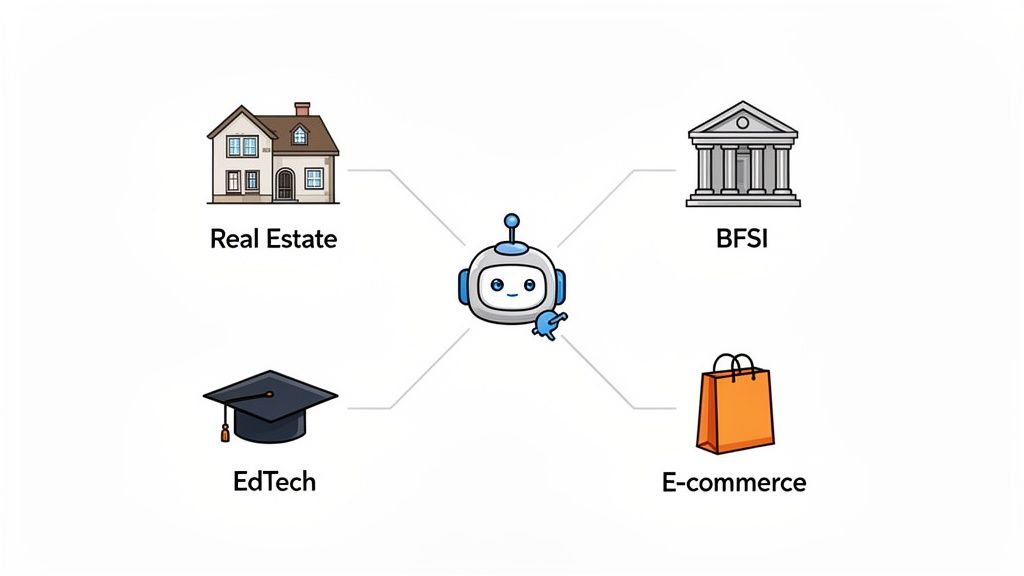
This kind of practical application is driving incredible adoption, especially in growing markets. India, for instance, has become a global hub for voice AI development, with the market expected to hit USD 1.82 billion by 2030. This growth isn’t just hype; it’s fuelled by real-world use cases in e-commerce, finance, and education that prove the technology is ready for prime time. To get a sense of this expansion, it's worth reading about how voice AI is becoming India's digital backbone.
Real Estate: Boosting Agent Productivity
In real estate, timing is everything. A missed call can be a lost deal. Agents spend an enormous part of their day on repetitive but essential calls—answering basic property questions, checking if a listing is still available, and scheduling site visits. All of this is time that could be better spent building relationships and closing deals.
This is where a voice chatbot steps in. It can handle that entire front-end process, fielding hundreds of calls at once, providing instant property details, and booking qualified leads directly into an agent's calendar.
Mini Case Study: A Real Estate Firm
- The Challenge: A real estate company was only connecting with 47% of its incoming leads. Their agents were overwhelmed, and potential buyers were slipping away unanswered.
- The Voice AI Solution: They brought in a voice chatbot to handle all initial property enquiry calls. The bot answered every call, qualified the caller’s interest, and scheduled site visits for genuine prospects.
- The Measurable Outcome: Their lead connect rate jumped to an impressive 91%, and their entire lead-to-booking conversion process saw a major improvement.
BFSI: Automating Compliance and Support
The Banking, Financial Services, and Insurance (BFSI) sector runs on trust, security, and precision. Voice AI is a perfect match here, as it can manage sensitive data and high-volume tasks with flawless consistency and adherence to compliance rules.
From payment reminders to the initial steps of loan qualification, a voice agent can manage routine customer touchpoints at a massive scale. One of its most effective roles is automating Know Your Customer (KYC) verification calls—a crucial but notoriously time-consuming process.
Here's a practical example:
- Use Case: A large bank deployed a voice chatbot to make outbound calls for credit card payment reminders.
- Before: Human agents spent 60% of their time on these repetitive calls.
- After: The voice agent automated 95% of reminder calls, freeing up the human team to handle complex debt restructuring and customer retention conversations. This led to a 12% reduction in late payments in the first quarter alone.
EdTech: Streamlining Admissions and Counselling
For universities and colleges, the admissions cycle is a huge logistical operation involving thousands of enquiries. A voice chatbot can serve as an always-on admissions counsellor, available 24/7 to answer questions from prospective students and their parents.
It can provide details on courses, explain eligibility criteria, and even schedule campus tours or one-on-one counselling sessions. This guarantees that every single enquiry gets a prompt, professional response, making a great first impression and helping to capture more high-quality applicants. One university reported a 35% increase in qualified applications after implementing a voice chatbot to handle initial inquiries.
E-commerce: Enhancing the Post-Purchase Experience
In the world of e-commerce, what happens after the sale is just as important as the sale itself. A customer's loyalty is often won or lost based on how you handle their questions about order status, returns, and refunds.
Instead of waiting for an anxious customer to call, a chatbot with voice can proactively manage these conversations. The bot can make outbound calls to confirm a shipment, provide a delivery update, or even guide a customer through the return process. This kind of proactive support builds tremendous trust and cuts down the workload for your customer service team, letting them focus on more complex problems. An online retailer successfully reduced "Where is my order?" calls by 70% by implementing a proactive voice notification system.
Your Strategic Blueprint for Voice AI Implementation
Bringing a chatbot with voice into your organisation is a serious strategic move, far more than just a tech upgrade. For leaders, the real challenge is moving from a great idea to a tangible, value-generating reality. A successful launch isn't about flipping a switch; it's a disciplined process focused on clear outcomes and building momentum with early wins.
This blueprint is a practical roadmap for anyone tasked with leading a voice AI initiative. It breaks the journey into manageable phases, ensuring every step is tied to real business goals and lays the groundwork for success down the road.
Phase 1: Define Your Core Business Objective
Before a single line of code is written, you need to answer one critical question: "What specific business problem are we actually trying to solve?" Without a laser-focused objective, a voice AI project can drift aimlessly and fail to deliver. Your entire strategy needs to be anchored to a measurable outcome.
Are you looking to:
- Slash operational costs by letting a bot handle the flood of repetitive support calls?
- Drive more revenue by making your outbound lead qualification process faster and more effective?
- Boost customer satisfaction by providing instant, 24/7 answers to common questions?
Your answer sets the stage for everything that follows—the scope, the metrics, and how you'll ultimately define a "win." If cost reduction is the name of the game, you’ll obsess over call deflection rates. If it's revenue, you'll be tracking lead conversion and sales cycle times.
Phase 2: Identify and Launch a Pilot Programme
Trying to boil the ocean by automating everything at once is a classic mistake and a surefire path to failure. The smart play is to start small. Pinpoint a single, high-impact use case that is high-volume yet relatively simple. This lets you prove the ROI quickly and get people inside the company excited about the technology.
Good candidates for a pilot often include:
- Automating appointment scheduling and sending out reminders.
- Handling basic "Where is my order?" (WISMO) queries.
- Making initial lead qualification calls to sift through prospects.
The goal of a pilot isn't perfection; it's proof. A successful pilot validates the business case, surfaces valuable operational insights, and gives you the hard data needed to justify a wider rollout. It turns a theoretical investment into a proven asset.
Once your pilot is live, watch its performance like a hawk against the KPIs you set in phase one. A successful pilot creates the momentum and executive support you need to scale your voice AI efforts across the business.
Phase 3: Address Executive-Level Considerations
As you move from pilot to full-scale planning, a few big-picture decisions need to be made. These choices will have lasting effects on your ability to scale, stay secure, and align with your broader tech strategy.
Data Security and Compliance
In fields like finance and healthcare, data security is table stakes. You have to ensure any voice AI solution meets regulations like GDPR and local data protection laws. Your vendor must be able to prove they have ironclad security protocols for handling sensitive customer data.
The Strategic Build vs. Buy Decision
Building a voice AI platform from the ground up is a monumental task. It demands specialised talent, deep pockets, and a lot of time. For the vast majority of companies, partnering with an established vendor is the more sensible and cost-effective path, letting you tap into proven technology and get to market much faster.
System Integration and Scalability
Your voice chatbot can't live on an island. It has to connect seamlessly with your existing systems, like your CRM and telephony infrastructure, to create a single, unified view of the customer. The architecture must also be built to scale, ready to handle big swings in call volume without breaking a sweat. This kind of forward-thinking is vital as you expand your use of a chatbot with voice into new parts of the business.
This is especially true in fast-growing markets. For example, India's voice assistant market was valued at USD 153.01 million in 2024 and is projected to hit USD 957.61 million by 2030. This explosive growth, detailed in this India voice assistant market report, underscores the massive opportunity waiting for businesses that build scalable voice solutions.
Frequently Asked Questions
When you're looking at bringing in new technology, the practical questions always come first. How well does it work? What will it cost? How does it fit with what we already have? Deciding to implement a chatbot with voice is a big step, and you need straight answers to these common questions. Let's tackle the things business leaders really want to know so you can move forward confidently.
How Does a Chatbot with Voice Handle Different Accents and Languages?
This is a huge deal, especially in a country as diverse as India. A voice AI is only as good as its ability to understand how people actually talk, not just a set of perfectly clear commands. The good news is that modern voice platforms are trained on massive datasets filled with a huge variety of accents, regional dialects, and individual speaking quirks.
This is where advanced Automatic Speech Recognition (ASR) comes in. These engines use sophisticated machine learning models to figure out what's being said, even if there's background noise or a strong regional accent. It’s what ensures the conversation doesn’t stumble at the first hurdle.
For multilingual support, the best solutions are built to understand and respond in multiple languages right from the start. For example, leading platforms today are very effective with Hindi, Tamil, and other Indian regional languages, making them incredibly versatile.
Performance is everything when you're choosing a vendor. You have to ask them exactly which languages and accents their models are trained on. Better yet, insist on a live demo that uses the kind of accents and scenarios your own customers would have. That’s the only way to see if it holds up in the real world.
What Is the Typical ROI and How Quickly Can We See It?
The return on investment from a voice chatbot usually breaks down into three key areas: serious cost savings, a direct boost in revenue, and happier customers. How quickly you see these results really depends on where you start.
Cost savings are often the first thing you'll notice, sometimes within just a few months. This happens because the bot deflects simple, repetitive calls that would otherwise tie up your human agents, which in turn reduces the average time spent on each call. For instance, if you can automate just 70% of your basic support queries, you could see your call centre running costs drop by 30-40%.
Revenue-focused returns come from things like better lead qualification and faster sales cycles. And finally, seeing metrics like your CSAT scores improve delivers long-term value by keeping customers around for longer. A well-designed pilot project, focused on a frequent but simple task, can often show a positive ROI in just six to nine months.
How Does a Voice Chatbot Integrate with Our Existing Systems?
A chatbot with voice can't just be a standalone tool; it needs to be part of your existing workflow to be truly effective. Smooth integration with your current tech stack is non-negotiable. This is what makes the bot a core part of your operations, not just another piece of software.
The best voice AI platforms are built with an API-first mindset, meaning they are designed to connect seamlessly with the systems you already rely on, including:
- Customer Relationship Management (CRM): Like Salesforce, HubSpot, or Zoho.
- Telephony Infrastructure: Your current phone systems and contact centre setup.
- Internal Databases: To pull up product details, order histories, or customer files.
Using standard tools like REST APIs and ready-made connectors, the voice chatbot can pull data to make conversations feel personal. For example, it might reference a customer’s recent purchase or look up a past support ticket. It can also send new information back into your systems, like updating a lead’s status in your CRM after a successful call. This two-way flow of information makes the voice bot an intelligent, connected part of your entire business process, making your data richer and your workflows smoother.
Ready to see how a human-like Voice AI can transform your business communications? DialNexa offers custom agents that handle everything from lead qualification to customer support at scale. Build, train, and deploy a voice agent that works for you.

This is a highly insightful article that clearly explains how voice AI is transforming customer engagement and business operations. The practical examples and KPI-focused approach make a compelling case for voice chatbots as a strategic growth driver, not just a support tool.