
Scale Customer Support With ai for customer support: An AI-Driven Strategy
At its core, AI for customer support is about leveraging intelligent technologies to automate, assist, and fundamentally enhance customer interactions. For senior leadership, this translates into a strategic capability to handle high volumes of routine inquiries automatically, liberating your skilled human agents to focus on complex, high-value issues. This dual approach allows you to scale support capacity, manage operational expenditures, and accelerate problem resolution for your customers.
The Strategic Imperative for AI in Customer Support
For any senior leader, the central challenge is a constant balancing act: how do you keep up with soaring customer expectations without your support budget exploding or the quality of service taking a nosedive? As your business scales, so does the flood of support tickets. This quickly creates a bottleneck that traditional, human-only teams simply can’t handle. This isn't some far-off theory; it's a real and present danger to staying competitive.
Picture a booming e-commerce business right after a massive festive sale. The support team, usually on top of things, is suddenly drowning in a sea of identical questions about order tracking, return policies, and payment confirmations. What used to be a minutes-long wait time is now stretching into days. Customers get angry, and your best agents are burning out from answering the same query for the thousandth time. This is a classic example of where a purely manual system breaks down, directly impacting customer retention and lifetime value.
Shifting from Manual Overload to Intelligent Automation
A traditional support centre is a lot like an old-school telephone switchboard, where an operator had to manually plug in every single call. When a rush of calls came in, the system would get jammed, leading to long waits, dropped connections, and a pretty chaotic experience for everyone involved.
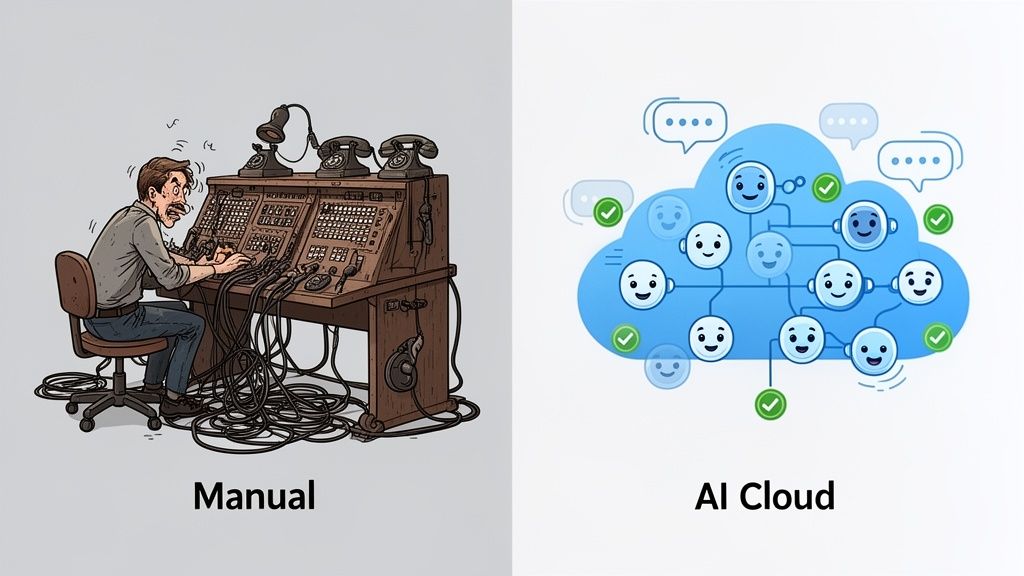
Now, compare that to AI for customer support, which acts more like a modern, intelligent cloud network. It can sort, handle, and resolve thousands of customer queries all at once, around the clock. This system doesn't need a coffee break and it never gets overwhelmed; it just scales up or down as needed. To really grasp this shift, it's worth seeing how customer service automation with AI-driven solutions can completely reshape your efficiency and customer happiness.
For business leaders, the question has changed from if they should bring in AI to how they can weave it into their strategy to get real results. The companies that get this right become more agile, run their operations more smoothly, and dramatically increase the lifetime value of their customers.
Bringing AI into the mix isn't just a tech upgrade; it's a complete business rethink. It gives your organisation the power to deliver consistently excellent service, no matter how big you get—a massive advantage in today's market. Smart systems, particularly voice AI, are making customer conversations feel more natural and effective than ever. To see this in action, check out our deep dive on how AI voice agents are transforming customer service and sales. This groundwork is key to understanding AI's true capabilities and the tangible impact it can have on your bottom line.
How AI Redefines Your Core Customer Support Metrics
Bringing AI into your customer support operation isn't just a tech upgrade; it’s a complete overhaul of what success looks like. For any C-suite executive, this means the fuzzy, abstract benefits of "better service" suddenly become hard, measurable numbers. We can finally move past feel-good stories and see exactly how AI impacts the metrics your leadership team actually cares about.
The real magic of AI is its ability to deliver these improvements consistently and at scale. A properly set-up AI system doesn't just cut costs. It becomes a machine for building better customer experiences, which is the secret sauce for loyalty and, ultimately, revenue.
Let's get specific and break down how this technology really moves the needle.
Slashing Response and Handling Times
In the world of customer support, speed is king. Two of the most-watched metrics are First Response Time (FRT), which is how long a customer has to wait for an initial reply, and Average Handle Time (AHT), the average time it takes to resolve an issue. We all know what happens when these numbers are high—customers get frustrated, and operational costs balloon.
This is where AI makes an immediate, dramatic impact.
Think about an EdTech platform during the madness of admissions season. Instead of making anxious students wait hours for answers, a well-trained chatbot can instantly handle up to 80% of routine questions about course details, eligibility, or application status. Just like that, your FRT drops from hours to seconds.
For the trickier issues that need a human, AI acts as a smart sidekick for your agents. A financial services firm, for example, can cut its agent AHT by 45% by equipping its team with AI tools. These tools feed agents real-time information, compliance checklists, and smart reply suggestions during live calls. No more putting customers on hold while they scramble for answers; the right information is right there, instantly.
Driving Down Costs While Boosting Satisfaction
Beyond speed, every executive is chasing two things: lower Cost-Per-Contact and higher Customer Satisfaction (CSAT). For years, these two goals have been at odds. To cut costs, you usually had to sacrifice quality. AI completely flips that script, letting you do both at the same time.
By automating the simple, repetitive tasks, AI dramatically lowers what it costs to handle each customer query. When chatbots are resolving the bulk of common issues, you simply don't need as many people on the front lines. The impact on your payroll and overhead is direct and significant.
The numbers speak for themselves. Studies show that AI can slash first response times by 37% and resolve tickets 52% faster. Some companies have reported saving over USD 1 million just from the reduction in support tickets. You can dig deeper into the data by exploring the latest AI customer service statistics.
And this efficiency doesn't come at the cost of a good experience. In fact, it often improves it. When you free up your human agents from mind-numbing work, they can focus their brainpower on complex problems where empathy and sharp thinking really matter. Customers get instant help for easy questions and expert, dedicated support for the tough ones. It’s a win-win that elevates the entire service game.
AI Impact on Core Customer Support KPIs
To put it in black and white, here’s a direct comparison of what your key performance indicators (KPIs) look like before and after bringing AI into the fold.
| Metric | Traditional Support Benchmark | AI-Enhanced Support Benchmark | Percentage Improvement |
|---|---|---|---|
| First Response Time (FRT) | 1-24 Hours | < 1 Minute | 99% |
| Average Handle Time (AHT) | 6-8 Minutes | 3-4 Minutes | 40-50% |
| Cost-Per-Contact | ₹150 – ₹400 per voice call | ₹20 – ₹50 per AI interaction | 80-85% |
| Customer Satisfaction (CSAT) | 75-80% | 85-95% | 10-15% |
The data makes it clear: the improvements aren't just incremental; they're game-changing.
At the end of the day, integrating AI for customer support offers a clear, data-backed path to a stronger bottom line. It changes your support team from a necessary cost centre into a strategic asset—one that actively drives customer retention and profitable growth.
Understanding What AI Support Platforms Actually Do
Before you can build a strategy around AI, you need to get past the buzzwords and understand what these platforms really bring to the table. Don't think of AI as one single tool. It's more like a specialised digital workforce, a collection of powerful capabilities working together to make your support operations faster, smarter, and far more efficient.
At its heart, using AI for customer support means giving specific, repetitive tasks to digital workers who can handle them flawlessly at scale. This frees up your human experts to focus on the complex issues—the ones that need empathy, creative thinking, and a genuine human touch.
Let's break down the core functions that make this possible.
Intelligent Chatbots and Voice AI: Your Digital Frontline
Imagine a support agent who never sleeps, speaks dozens of languages, and can handle thousands of conversations at once with perfect consistency. That’s the reality of modern chatbots and Voice AI. These aren't the clunky, frustrating bots from a few years ago; today's AI is conversational, understands context, and can feel surprisingly human.
Take an e-commerce brand, for example. It could use a Voice AI to answer every call about order status. The AI can instantly pull up tracking details, explain the return policy, or even process a refund—all without a human stepping in. Similarly, a chatbot on a university website can walk a potential student through different courses, fee structures, and the entire application process, often answering 70% or more of their initial questions on the spot.
The real power here is consistency at scale. An AI agent gives the same accurate, on-brand answer every single time, whether it's the first query of the day or the thousandth.
This capability is a direct solution for the high volume of repetitive questions that cause long wait times and burn out your best agents. It guarantees every customer gets an immediate response, which goes a long way in shaping a positive first impression. To see a great example of this in action, check out how AI agent assistance is transforming customer interactions in real-time.
The diagram below shows exactly how these capabilities translate into better business results.
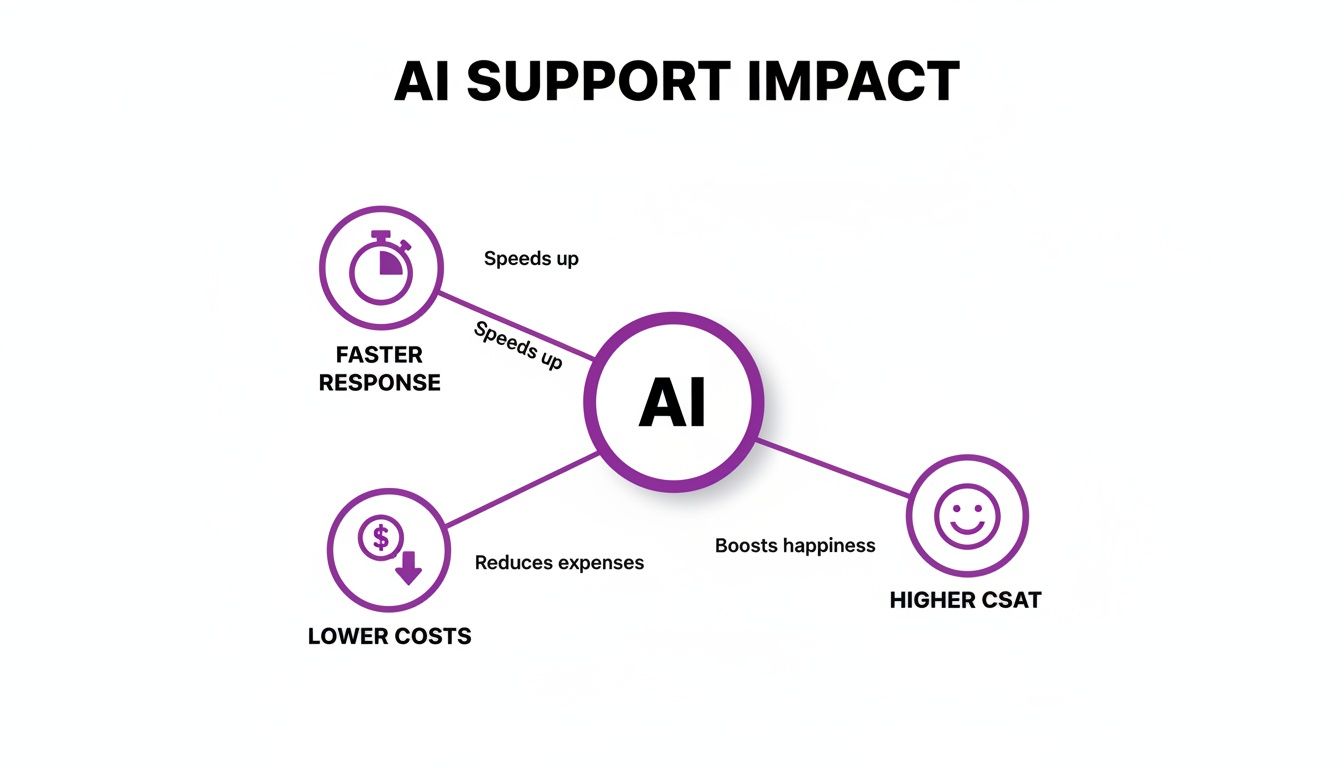
As you can see, the path is clear: AI implementation leads directly to faster response times and lower costs, which in turn drives a major boost in customer satisfaction.
Automated Routing and Triage
Let’s be honest, not all customer problems are equal. A huge part of an AI platform's job is to act as a smart dispatcher for every single message that comes in. Using Natural Language Processing (NLP), the AI instantly reads and understands the context and emotion behind every email, chat, or call.
It figures out what the customer wants and how they feel about it.
- Priority: Is this an urgent complaint from a VIP client, or a simple question about store hours?
- Topic: Is the issue about a billing mistake, a software bug, or a question about a product?
- Sentiment: Is the customer frustrated, just curious, or delighted?
Based on this split-second analysis, the system sends the query to the right place. A simple billing question might get handled by an automated AI workflow. But a complex technical issue from a major client? That gets instantly flagged and sent to a senior engineer with the right skills, complete with a summary of the problem. This kind of smart triage ensures your top agents are only working on problems that truly need their expertise, often improving resolution times by 30-40%.
Predictive Analytics and Agent Assistance
Finally, the most forward-thinking part of AI for customer support is its ability to act as an early-warning system. By sifting through massive amounts of conversation data, AI can spot patterns that are completely invisible to a human team. It can flag a sudden increase in complaints about a new app feature or pick up on subtle language that signals a customer is about to churn.
This allows your team to shift from being reactive to proactive. Instead of just putting out fires, you can get ahead of problems before they even escalate. On top of that, AI serves as a "co-pilot" for your human agents. It provides real-time suggestions, pulls up relevant help articles, and displays customer history during a live chat or call. This kind of support doesn't just make resolutions faster—it builds your agents' confidence and helps them perform better, leading to a more effective and happier team.
Your Strategic Roadmap for AI Implementation
Bringing AI into your customer support operation isn't a one-off project; it’s a journey. For any leader looking at this, it's best to see it as a phased roadmap. This approach turns a potentially massive undertaking into a series of manageable, value-driven steps. It’s the smart way to de-risk the investment, build confidence across your team, and make sure the final solution actually fits your business goals.
A successful rollout isn't about flipping a switch and hoping for the best. It’s about building a solid foundation first, then scaling intelligently. By following a structured path, you can dodge the common pitfalls and start seeing a return on your investment right from the get-go.
Let's walk through the five critical stages of this journey.
Stage 1: Data Readiness and Audit
Before you can build anything, you need to check your raw materials. In the world of AI, your most valuable asset is the data you already have—every chat log, email thread, and call transcript is the fuel that will power your AI engine. The quality of this data directly dictates how smart and accurate your AI will be.
Start by getting your hands dirty with a full audit of your data sources.
- Hunt Down Data Silos: Is your customer information scattered across your CRM, helpdesk, and billing systems? You'll need to bring it all together. A consolidated view is crucial for giving the AI the full story of the customer journey.
- Assess Data Quality: Be honest about the state of your data. Look for inconsistencies, incomplete records, and outdated information. A top-performing AI model needs clean, well-structured data to learn from. Many companies find this initial clean-up phase sharpens up their business intelligence across the board, long before the AI even goes live.
- Analyse Past Conversations: Dive into thousands of past interactions. What are the most common questions? The biggest pain points? The most frequent resolution paths? This analysis will quickly show you the low-hanging fruit—those high-volume, repetitive queries that are just begging to be automated.
Stage 2: Intelligent Workflow Design
Once you have a clear picture of your data, it's time to map out exactly where and how AI will make the biggest difference. This isn't about trying to automate everything at once. It's about strategically placing AI into your customer journeys to solve very specific problems. A common mistake is just launching a generic chatbot without first defining its mission.
For an e-commerce business, a perfect workflow to automate might be the classic "Where is my order?" question. For a software company, it could be guiding new users through common setup problems. The goal here is to design workflows that handle the top 20% of queries that are currently eating up 80% of your agents' time. This focused approach delivers an immediate, measurable impact.
Stage 3: Seamless Systems Integration
Your AI platform can't be an island. To be truly effective, it needs to be deeply connected to your core business systems, especially your Customer Relationship Management (CRM) and helpdesk software. This integration is what turns a basic bot into a powerhouse of personalised, context-aware support.
Think about it: when a customer gets in touch, the AI should instantly know their entire history—past purchases, previous support tickets, everything. This is the difference between a frustratingly generic "How can I help you?" and a genuinely helpful, "Hi Priya, I see your last order was delivered yesterday. Are you getting in touch about that?" That’s the kind of experience that makes customers feel seen and understood.
Stage 4: Designing Human and AI Collaboration
A smart AI strategy is never about replacing people; it's about making them better at their jobs. One of the most critical parts of the design is creating a smooth, clear escalation path from the AI to a human agent. The system has to be smart enough to know its own limits and recognise when a query is too complex, too emotional, or needs a level of judgment it just doesn't have.
A great rule of thumb is the 'two-ask' rule: if a customer asks to speak to a person twice, the AI should immediately and gracefully hand off the conversation. Crucially, it must pass along the full context and chat history to the best-available agent. This simple process avoids customer frustration and ensures your human experts are looped in at exactly the right moment.
Stage 5: Continuous Performance Optimisation
Going live with your AI for customer support is just the beginning. The final stage—and it's an ongoing one—is all about monitoring, learning, and refining. You should treat your AI system like a new team member who gets smarter every day. Keep a close eye on the analytics to track key metrics:
- Containment Rate: What percentage of queries is the AI handling all on its own, without needing a human?
- CSAT Scores: Are customers happy with their AI interactions? Are the scores going up or down?
- Escalation Triggers: What kinds of questions keep getting passed to human agents? This shows you where the AI's knowledge gaps are.
This data creates a powerful feedback loop. It tells you exactly where to refine the AI's responses, fill in knowledge gaps, and expand its skills over time. A system that resolves 70% of queries in its first month can easily be optimised to handle 85% within a year, constantly improving your return on investment.
How AI Is Really Being Used Across Key Indian Industries
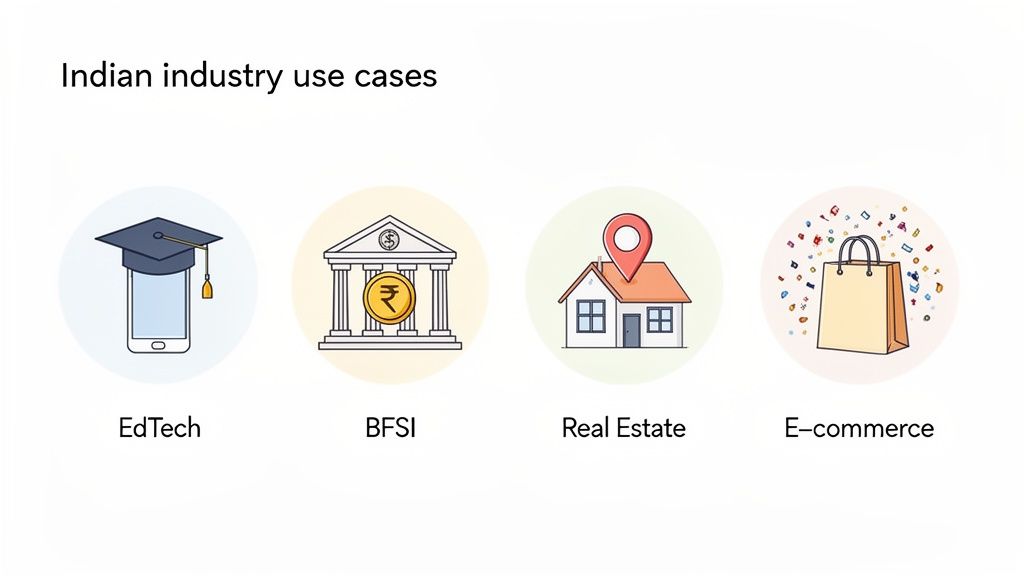
The true test of any technology isn't in the buzzwords but in how it solves real, on-the-ground business problems. When we talk about AI for customer support, its value comes alive in the specific, high-stakes challenges faced by different sectors. In the fiercely competitive Indian market, smart companies are using AI not as a generic fix, but as a specialised tool to manage everything from festival season chaos to qualifying high-value property leads.
These examples show how AI shifts from a vague concept to a practical driver of growth and efficiency. By tackling industry-specific pain points, AI platforms are carving out a clear competitive edge for businesses nationwide.
E-commerce: Taming the Festival Sales Beast
For any e-commerce brand, the festival season is a double-edged sword. It's a massive revenue opportunity, but it's also an operational nightmare. The flood of orders brings an avalanche of customer queries: "Where's my package?", "What's the return policy?", "When will it arrive?". Human teams get buried, leading to frustratingly long wait times and unhappy customers.
This is where AI-powered Voice AI and chatbots step in. They are built to handle tens of thousands of concurrent inquiries, instantly providing accurate order updates and policy information 24/7. This frees up human agents to deal with the genuinely complex or sensitive issues, ensuring service quality stays high when it matters most.
EdTech: Never Missing an Admissions Lead
India's EdTech space is incredibly crowded, especially during admissions season. Prospective students and their parents are loaded with questions about courses, eligibility criteria, and fee structures. Handling every single call manually is slow, expensive, and risks losing a potential admission to a competitor who answers first.
Voice AI agents are now acting as automated admissions counsellors. They can hold natural, multi-minute conversations, answer frequently asked questions, and even pre-qualify leads based on their interest and credentials. One EdTech platform reported that by ensuring every inquiry got an immediate, helpful response, they boosted their lead-to-booking rate from a mere 2% to an impressive 8%.
BFSI: Locking Down Compliance and Support
In Banking, Financial Services, and Insurance (BFSI), there’s no room for error. Accuracy and compliance are everything. Here, AI is being used to tighten up critical processes like Know Your Customer (KYC) verification and policy inquiries, which helps reduce human error and guarantees adherence to strict regulations. If you're interested in a deeper dive, learn more about how data and AI will transform contact centres for financial services.
Imagine an AI agent guiding a new customer through the entire KYC process over the phone, verifying details and logging the information automatically. This doesn't just make onboarding faster; it creates a secure, auditable record for compliance. We've seen firms improve their operational efficiency by over 40% this way.
Real Estate: Qualifying Hot Leads Around the Clock
For real estate developers, speed is everything. A potential buyer who has to wait for a call back will likely just find another project to look at. The problem is, your sales team can't be on call 24/7 to answer questions or schedule site visits.
An AI-powered agent, however, can. It engages every lead the moment they reach out, day or night. It can answer questions about floor plans, pricing, and amenities, then seamlessly book a site visit directly into a sales agent's calendar. This simple change means no lead ever goes cold. Some developers are seeing a 97% accuracy rate, where the leads qualified by AI perfectly match the judgement of their human sales teams.
The opportunity here is massive. India's e-commerce market alone was valued at USD 83 billion in 2023, and customer expectations have completely changed. Today, 80% of customers believe the experience a company provides is as important as its products, and 88% say good service makes them more likely to buy again.
To see the technology in action, you can explore a variety of practical AI use cases that showcase these solutions. Understanding these applications is the first step to building a solid business case for your own team.
Building the Business Case and Proving ROI
Let’s be honest: executives don't sign off on new tech because it's flashy. They sign off because it delivers a clear, measurable return on investment. While improved response times look great on a support dashboard, the real power of AI for customer support shines when you can connect it directly to the company's bottom line.
To get that buy-in, you need to change the conversation. Stop talking about AI as just another cost centre. Instead, frame it as a strategic investment that drives profitability and fuels growth. This means building a case that goes beyond operational metrics and focuses on hard financial numbers: lower operational costs, the real monetary value of a more productive team, and the long-term gains from happier, more loyal customers.
From Operational Savings to Financial Gains
The quickest and most obvious win is in reducing operational costs. AI is a natural at handling those repetitive, simple queries that eat up your team's time. Think about it: if an AI agent can resolve a simple question for ₹30 when it would have cost a human agent ₹250, those savings add up incredibly fast over thousands of interactions a day.
This isn't about replacing your team. It’s about freeing up your most valuable assets—your human experts—to tackle complex problems and focus on activities that actually generate revenue.
On top of that, AI makes your existing team better at their jobs. Imagine giving your agents an AI co-pilot that pulls up customer history, suggests the best replies, and handles the post-call admin. We've seen teams reduce their average handle times by 40% or more. Suddenly, one agent can do the work that used to take one and a half, a massive efficiency boost that translates directly into cost savings without sacrificing the quality of your service.
A Realistic ROI Calculation
Let's run the numbers with a practical example. Say you're a mid-sized e-commerce company.
- Initial Investment: You put down ₹40,00,000 for a one-year subscription to a quality AI support platform.
- Cost Savings: You get 20,000 routine queries a month. The AI successfully automates 60% of them, saving you an average of ₹150 per interaction. That’s a whopping ₹1,80,00,000 saved in a year.
- Productivity Gains: Your team is now 30% more efficient. This means you don't need to hire as many temporary staff during the festive rush, saving another ₹25,00,000 in recruitment and salary costs.
- Revenue Uplift: Faster service and better resolutions mean happier customers. Your customer retention ticks up by just 5%, which translates to an extra ₹50,00,000 in retained revenue from loyal customers.
Total Annual Gain: ₹1,80,00,000 + ₹25,00,000 + ₹50,00,000 = ₹2,55,00,000
Net Return on Investment (Year 1): ₹2,55,00,000 (Gain) – ₹40,00,000 (Cost) = ₹2,15,00,000
That's a return of over 5x your initial investment, all within the first year. It’s a powerful story to tell.
Investing in a High-Growth Market
Looking beyond your own P&L, adopting AI places your company right in the middle of a booming market. This isn't just an internal upgrade; it's a strategic move to get ahead in a rapidly expanding economic space.
The opportunity in India alone is massive. Right now, India's generative AI customer support market is valued at around USD 1.3 billion, and it's growing fast, especially in sectors like BFSI. You can dig into the specifics of the rapid growth of India's GenAI market to see the trends for yourself.
When you walk into that boardroom, presenting this kind of data gives your internal champions the ammunition they need. It shows leadership that this isn’t just about trimming support costs—it's about making a forward-thinking investment to grab market share and build a competitive advantage that lasts.
Your Top Questions About AI in Customer Support, Answered
Deciding to bring in new technology always sparks important questions. When business leaders start looking at AI for customer support, the same concerns tend to pop up: what happens to our team? How complex is the tech side? And can a machine really represent our brand?
Getting these questions answered is the first step toward making a confident, successful move. Let’s tackle the most common ones head-on.
Will AI Replace Our Human Support Agents?
Not at all. The goal here is partnership, not replacement. Think of AI as a powerful assistant that empowers your human team. It's brilliant at handling the huge volume of repetitive, simple questions—we're talking the 70-80% of routine queries that can bog down even your best agents.
By automating those tasks, you free up your experienced professionals to focus where they're needed most: on the complex, sensitive issues that demand real empathy and creative problem-solving. This shift doesn't just make your team more productive; it reduces burnout and makes their jobs more rewarding. They get to move from just closing tickets to actually building customer relationships.
How Hard Is It to Integrate AI with Our Current Systems?
You might be surprised how smoothly this can go. Today's AI platforms are designed to play well with others. Most leading providers offer robust APIs and ready-made connectors for the tools you already use, like Salesforce, Zendesk, and Zoho. The aim is to plug the AI right into your existing workflow.
A well-managed pilot project can often be up and running in a few weeks, not months.
The secret is to find a partner who offers solid integration support and clear instructions. When done right, the AI becomes a natural part of your tech ecosystem, helping create a single, unified view of every customer interaction.
How Do We Make Sure the AI Sounds Like Us?
This is a critical point, and it’s entirely within your control. Keeping your brand voice consistent comes down to smart setup and ongoing oversight. From day one, the AI is trained on your company's own materials—your knowledge base, brand style guides, and even thousands of past customer chats. This is how you build its unique personality and tone.
Whether your brand is formal and professional or fun and casual, you set the rules. And it doesn't stop there. Through constant monitoring and quality checks, you ensure the AI's answers stay accurate, helpful, and perfectly on-brand over the long haul. It truly becomes a scalable extension of your team, protecting your hard-earned reputation in every conversation.
Ready to see how a truly intelligent Voice AI can change your customer conversations and deliver real results? DialNexa provides human-like agents that can scale your support and sales operations without the friction.
Discover how DialNexa can elevate your customer support strategy

This is a well-written and practical guide that clearly shows how AI empowers human teams, improves customer experiences, and drives sustainable business growth at scale.