
How AI Agents for Customer Service Drive Measurable Business Growth
For senior executives, AI agents for customer service are not just a technological upgrade; they are a strategic imperative. These are not basic chatbots. They are sophisticated AI systems engineered to manage high-stakes customer conversations across voice and digital channels, capable of resolving complex issues and directly contributing to your bottom line.
This is a fundamental shift in business strategy: transforming a traditional cost center into a powerful engine for operational efficiency, revenue acceleration, and sustainable growth.
The Strategic Shift to AI in Customer Service
For C-suite executives and directors, the conversation around AI agents for customer service has evolved from technological curiosity to strategic necessity. The objective is no longer about deflecting simple queries with rudimentary bots. It's about deploying an intelligent, scalable workforce that drives revenue, streamlines operations, and builds a significant competitive advantage.
Consider your top-performing customer service professional—the one with encyclopedic knowledge, infinite patience, and perfect brand alignment. Now, imagine scaling that individual's capabilities to handle thousands of concurrent conversations, 24/7, with 100% consistency and zero fatigue. That is the strategic value modern AI agents deliver. A foundational understanding of this can be found in this guide on the customer support chatbot, which illustrates the power of a tireless digital front line.
The Real Cost of Outdated Service Models
Maintaining a traditional, human-only support model incurs significant, often hidden, costs. Legacy systems create operational bottlenecks, leading to extended wait times and customer frustration. The financial impact is severe; a Gartner study reveals that 91% of customers will leave a brand after a single negative service experience. This isn't just a customer satisfaction issue—it's a direct threat to revenue and market share.
Every unanswered call represents lost revenue potential. Every unresolved issue increases customer churn, with data showing that acquiring a new customer costs five times more than retaining an existing one. Inability to scale during peak demand periods means leaving significant revenue on the table.
For corporate leadership, the cost of inaction now far exceeds the investment in innovation. Clinging to legacy service models means accepting operational inefficiencies that stifle growth and erode brand equity.
Solving Core Business Challenges with AI
Human-like AI agents are engineered to address these challenges directly. By automating routine and repetitive interactions, they empower your human capital and fortify your operational infrastructure.
This technology provides a clear, quantifiable return on investment across the enterprise:
- Eliminate Lost Leads: AI agents operate 24/7, ensuring every marketing-generated inquiry receives an immediate, intelligent response. This is critical, as a Harvard Business Review study found that firms responding within an hour are seven times more likely to have a meaningful conversation with a decision-maker.
- Reduce Customer Churn: By providing instant, accurate resolutions to common issues, AI agents improve the customer experience dramatically. A 5% increase in customer retention can lead to a 25% to 95% increase in profit.
- Break Operational Bottlenecks: AI can manage thousands of concurrent conversations, eliminating wait times and allowing human experts to focus on complex, high-value customer engagements that require strategic thinking and empathy.
Measuring the Business Impact of AI-Powered Service
For any executive, the litmus test for new technology is its tangible, measurable impact on the bottom line. The discussion around AI agents for customer service must rapidly pivot from features to key performance indicators (KPIs) that directly influence profitability and shareholder value.
The impact is threefold: driving operational efficiency, accelerating revenue growth, and elevating the customer experience to build a defensible competitive moat.
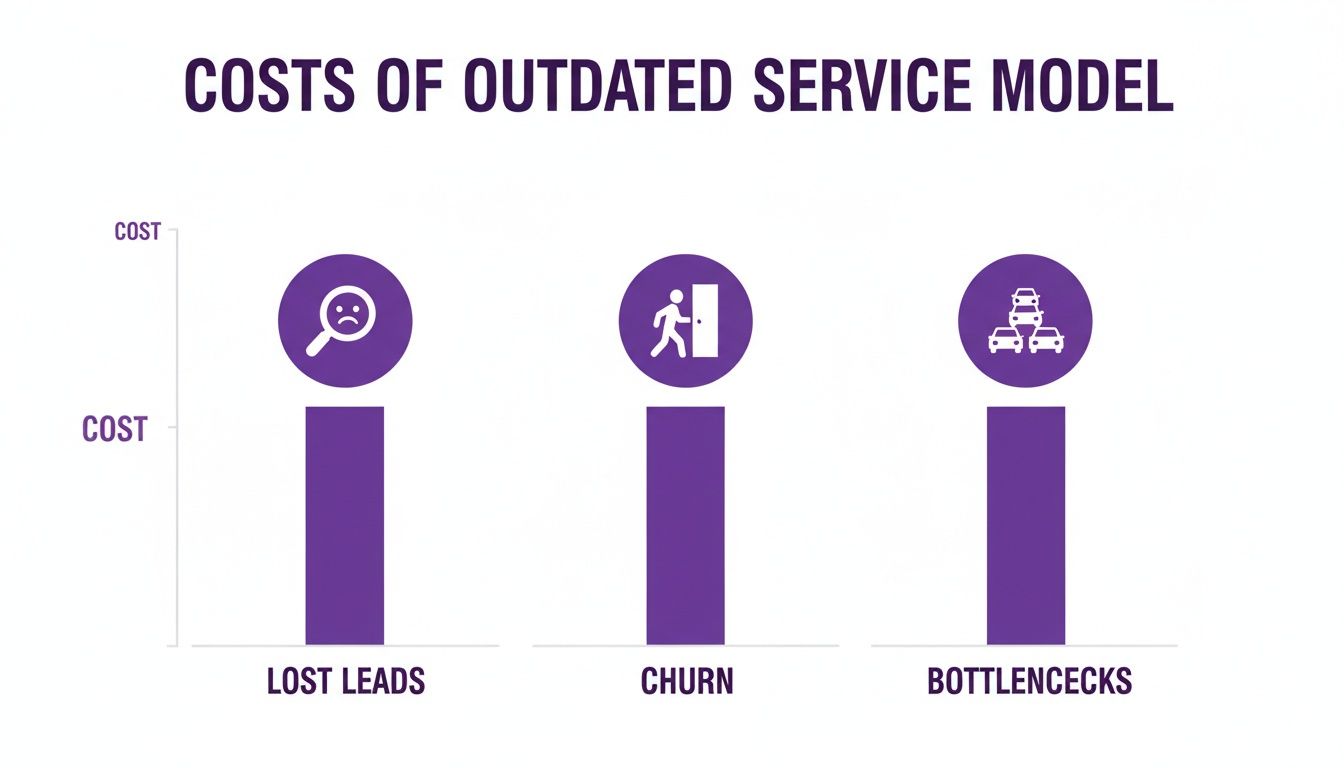
Legacy service models are financial drains, bleeding capital through lost leads, customer attrition, and internal process logjams. These are not minor operational hurdles; they are significant impediments to profitability.
AI offers a practical, data-driven solution to these costly, systemic problems.
Driving Operational Efficiency
The most immediate and quantifiable return is in operational efficiency. AI agents directly attack two of the largest cost drivers in a contact center: Cost Per Contact (CPC) and Average Handling Time (AHT). By automating high-volume, low-complexity inquiries, you fundamentally reduce the human capital required for each interaction.
Practical Example: A large e-commerce firm processing 50,000 "Where is my order?" inquiries per month can automate over 80% of them. If the average human-handled call costs $8, automation at $1 per interaction yields immediate monthly savings of $280,000, or over $3.3 million annually. This frees up capital for strategic growth initiatives.
Accelerating Revenue Growth
Beyond cost savings, AI agents are powerful revenue generators. Operating 24/7, they ensure no marketing lead is ever missed. This immediacy is critical; research shows that contacting a web lead within five minutes increases the likelihood of conversion by 900%.
AI agents transform customer service from a cost center into a proactive revenue engine. By qualifying leads and scheduling appointments around the clock, they become a direct driver of top-line growth.
Metrics like Lead-to-Booking rates see dramatic improvements. For example, an EdTech client at DialNexa leveraged an AI agent to pre-qualify admission inquiries with 97% accuracy—matching their best human counselors. This strategic move increased their lead-to-booking rate from a meager 2% to 8%, a 4x improvement that directly impacted enrollment revenue.
Elevating the Customer Experience
In a competitive landscape, superior customer experience is a powerful differentiator. AI agents enhance key metrics like Customer Satisfaction (CSAT) and First Contact Resolution (FCR) by providing instant, consistent, and accurate responses, thereby eliminating frustrating wait times. An Aberdeen Group study found that companies with strong FCR rates enjoy 86% greater customer retention.
When a customer needs to track an order or reschedule a service, an AI agent resolves it immediately. No transfers, no callbacks. This instant resolution boosts your FCR rate and reinforces brand reliability. The quality of your AI service directly impacts your public perception, an area where specialized AI Reputation Management Consultants can provide strategic oversight.
Looking at the broader trend, especially in a massive market like India, the shift is undeniable. Service teams there project that AI will handle 50% of all customer enquiries within just two years. It’s allowing businesses to grow without letting service quality slip. In fact, Indian service leaders expect AI agents to drive a 20% increase in customer satisfaction, a 16% lift in upsell revenue, and 15% in cost savings.
If you’re looking to get granular on tracking these improvements, our guide on how to measure the success of your outbound campaigns is a great next step.
KPI Transformation with AI Agents for Customer Service
A "before and after" analysis of key metrics underscores the strategic value. The table below compares standard KPIs in a traditional setup versus what is achievable with AI agent implementation, based on aggregated client data.
| Key Performance Indicator (KPI) | Traditional Approach Benchmark | With AI Agent Implementation (DialNexa Data) | Business Impact |
|---|---|---|---|
| Cost Per Contact (CPC) | $6 – $12 per voice call | $0.50 – $1.50 | 80-90% reduction in operational costs for routine interactions. |
| Average Handling Time (AHT) | 3 – 5 minutes | < 30 seconds | Frees up human agents for complex, high-value tasks. |
| First Contact Resolution (FCR) | 70% – 75% | > 90% | Higher customer satisfaction and reduced repeat calls. |
| Lead Response Time | Hours or days | < 1 minute | Captures lead intent at its peak, boosting conversion rates. |
| Lead-to-Booking Rate | 1% – 3% | Up to 8% | Directly increases sales pipeline and revenue. |
| Customer Satisfaction (CSAT) | Varies, often dips with long waits | +20% increase | Builds brand loyalty and positive word-of-mouth. |
The data is unequivocal. This is not about incremental improvement; it's about a fundamental transformation of how customer service functions as a strategic asset.
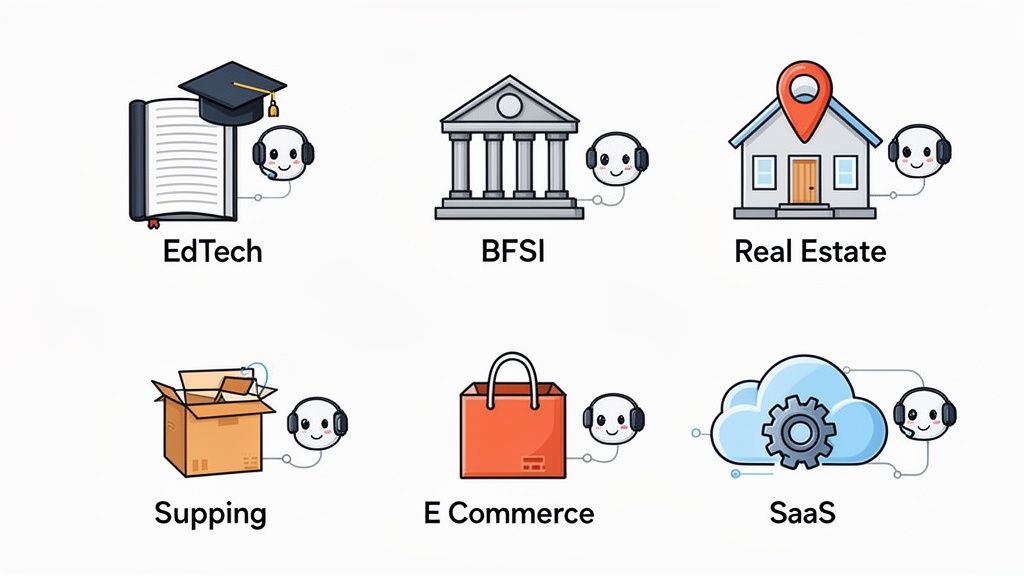
AI Agents in Action Across Key Industries
The theoretical benefits of AI agents for customer service are compelling, but their true value is demonstrated through real-world application. The technology's power lies in its adaptability to solve industry-specific challenges and deliver quantifiable results.
Let's move beyond theory and examine concrete examples of how AI agents are resolving specific operational pain points and creating measurable business value today.
Transforming Admissions in EdTech
The admissions cycle for educational institutions is a high-volume, high-stakes process. Human counselors are often inundated with thousands of inquiries, many from unqualified candidates. This bottleneck means high-potential applicants can be lost due to slow response times.
Practical Example: A leading online university deployed an AI agent to manage its initial wave of admission inquiries. Within three months, the agent handled over 50,000 conversations. It pre-qualified candidates against key criteria (e.g., academic prerequisites, program interest) and automatically scheduled appointments only for those who met 95% of the qualification standards. This allowed the human admissions team to focus exclusively on high-potential students, resulting in an 18% increase in their enrollment conversion rate.
Ensuring Compliance and Speed in BFSI
In Banking, Financial Services, and Insurance (BFSI), operations are governed by speed and strict regulatory compliance. Processes like Know Your Customer (KYC) verification and instant trade support are often manual, slow, and prone to human error, creating significant risk.
Practical Example: A wealth management firm implemented a voice AI agent to handle client KYC updates. The agent guided clients through the verification process over the phone, ensuring every required data point was collected with 100% script adherence. This reduced the average KYC update time from 15 minutes (human-led) to 3 minutes, while creating a fully auditable record for compliance, mitigating regulatory risk. To explore this further, see our analysis of how AI will transform contact centres for financial services.
Maximising Leads in Real Estate
In real estate, revenue is directly tied to the speed and quality of lead follow-up. Marketing campaigns generate a flood of inquiries, but if calls are missed—particularly after hours—those expensive leads are wasted. The industry average for connecting with an inbound property lead is a dismal 47%.
An AI agent acts as a 24/7 digital receptionist, guaranteeing 100% lead capture.
- Instant Engagement: The agent answers every call immediately, engaging prospects at their peak interest.
- Intelligent Qualification: It asks critical qualifying questions—budget, location, property type—to separate serious buyers from casual browsers.
- Automated Booking: For qualified leads, the agent books site visits directly into the sales team’s calendars, no human intervention required.
Practical Example: A prominent real estate developer deployed a DialNexa AI agent to handle inquiries from social media campaigns. Their call connection rate surged from 47% to 91% immediately. Furthermore, site visits scheduled by the AI agent had a 30% higher show-up rate compared to manually booked appointments, directly accelerating their sales pipeline.
Streamlining Operations for E-commerce and SaaS
For both E-commerce and SaaS companies, the primary challenges are scalability and responsiveness. E-commerce businesses are flooded with routine inquiries about order status and returns. SaaS companies need an efficient method to qualify inbound demo requests to ensure their sales teams engage only with decision-makers.
Practical Example (SaaS): A B2B SaaS company used an AI agent to qualify leads requesting a product demo. The agent asked about company size, user's role, and specific pain points. It then automatically scheduled demos only for leads matching their Ideal Customer Profile (ICP), resulting in a 40% increase in sales-qualified meetings and a 15% shorter sales cycle.
For teams focused specifically on contact-center deployments rather than broader customer-service AI, DialNexa’s AI call center agent guide breaks down the architecture, KPIs, and vendor considerations unique to high-volume voice queues.
A Strategic Guide to Implementing AI Agents
Deploying AI agents into your customer service operations is a strategic business initiative, not merely a technology project. For executive leadership, the primary concerns are practical: integration complexity, data security, brand voice consistency, and, most importantly, ROI.
A successful implementation moves from a high-level vision to a structured, phased rollout. This framework provides the clarity and confidence needed to champion an AI initiative that delivers measurable results from day one.
First Things First: Define Your Business Objectives
A successful AI implementation begins with a single, critical question: "What specific, measurable business problem are we solving?" Without a clear answer, even the most advanced technology will fail to deliver value. Your objective must be specific, measurable, achievable, relevant, and time-bound (SMART).
Are you aiming to reduce operational expenditures? Accelerate lead qualification from marketing campaigns? Or boost Customer Satisfaction (CSAT) scores by providing 24/7 support?
Defining a precise objective is the cornerstone of success. A vague goal like "improve efficiency" is insufficient. A strategic objective is: "Reduce average handling time for order status inquiries by 70% within Q3, freeing up 2,000 agent hours per month for proactive customer outreach." This clarity provides a north star for the entire project.
This initial step ensures your AI agent is a purpose-built asset designed to solve a genuine business challenge, not just a technology in search of a problem.
Selecting Your Pilot Use Case
With a clear objective, the next step is to select a high-impact, low-risk pilot project to validate the business case. The ideal pilot focuses on a task that is repetitive, high-volume, and has clear success metrics. This approach demonstrates value quickly, building the internal support necessary for a broader, enterprise-wide rollout.
Prime candidates for a pilot project include:
- Inbound Lead Qualification: Deploy an AI agent to handle initial calls from a specific marketing channel, qualify leads against predefined criteria, and schedule appointments for the sales team. Success Metric: Increase in Sales Qualified Leads (SQLs) by 25%.
- Routine Customer Support: Automate the top 3-5 most common inquiries, such as "Where is my order?" or "How do I reset my password?" Success Metric: 50% reduction in call volume for these specific query types.
- Appointment Scheduling: For service-based businesses, an agent can manage bookings, send reminders, and process cancellations automatically. Success Metric: 20% reduction in no-shows.
The market growth is staggering. India's AI agents market is projected to reach USD 417.0 billion in 2025 and an astonishing USD 15,209.7 billion by 2033, with e-commerce and BFSI at the forefront. A recent EY report highlights that 91% of executives prioritize rapid deployment, making a well-defined pilot essential. Pre-built solutions, like DialNexa's personas for real estate or KYC verification, can significantly accelerate this process.
Ensuring Seamless Integration
A key concern for any CTO or VP of Operations is how a new AI system will integrate with the existing technology stack. An AI agent cannot operate in a silo; it must seamlessly connect with core business systems like your CRM and ERP. This integration is achieved via Application Programming Interfaces (APIs).
An API acts as a secure data bridge between your AI agent and your CRM. For example, when an AI agent qualifies a lead over the phone, the API enables it to instantly create a new lead record in your CRM, update its status, and assign it to the appropriate sales representative—all without manual data entry. For a technical deep-dive, you can learn more about how Think41 partnered with Deepgram to power their AI agent assist.
This seamless data flow is what transforms a standalone tool into an integrated component of your workflow, ensuring data integrity and providing a holistic view of the customer journey. Partnering with a provider that offers robust, well-documented APIs is non-negotiable for a successful enterprise-wide deployment.
Meeting Modern Consumer Demands with AI
The dynamic between businesses and consumers has fundamentally changed. Today's customers demand instant, personalized, and transparent service on their own terms. For leaders in competitive markets, adapting to this new reality is a matter of survival. The deployment of AI agents for customer service is a direct, strategic response to these powerful market forces.
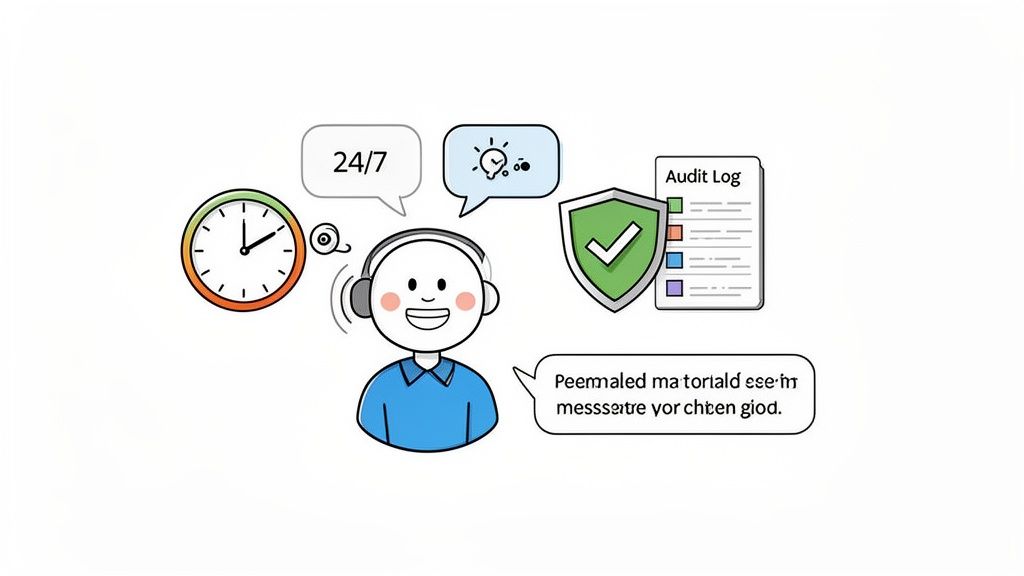
Modern consumers value three core tenets: immediate assistance, personalized interactions, and absolute transparency. These are precisely the areas where AI agents provide a decisive advantage over purely human-operated models. They deliver instant, consistent, 24/7 service at a scale that human teams, no matter how dedicated, cannot achieve.
The New Standard of Customer Expectations
Customer expectations are not just rising; they are redefining what constitutes quality service. A recent study found that 80% of consumers now consider their experience with a company to be as important as its products or services.
This shift is forcing businesses to adopt AI for hyper-personalization. In fact, 79% of customers expect personalized experiences, and a striking 96% demand clear explanations for AI-driven decisions. However, less than half of organizations can provide fully auditable interaction records, exposing a critical transparency gap that AI is uniquely positioned to close. For more on these trends, see this article on AI and the future of customer experience from The Economic Times.
Building Trust Through Transparency and Compliance
This demand for transparency is a critical consideration for any CXO, particularly in regulated industries. Customer trust is a fragile asset. Any perception of a "black box" where decisions are made opaquely can inflict serious reputational damage. This is where the architectural design of an enterprise-grade AI platform becomes a strategic advantage.
True customer-centricity extends beyond rapid responses; it requires accountability for every interaction. AI agents provide a level of auditability that is virtually unattainable with human teams alone.
Modern AI agent platforms are engineered to provide fully auditable conversation logs. Every interaction, every decision, and every data point is recorded and traceable. This is not merely a technical feature; it is a powerful tool for building customer confidence and ensuring regulatory compliance.
This is non-negotiable for sectors like BFSI and healthcare:
- In BFSI: An auditable log serves as immutable proof that KYC verification protocols were followed precisely, satisfying regulatory requirements.
- In Healthcare: It creates a clear, HIPAA-compliant record of patient interactions for appointment scheduling, safeguarding patient privacy.
- In E-commerce: It provides a factual, timestamped history to resolve disputes over orders or returns, protecting the business from liability.
Ultimately, meeting the demands of the modern consumer requires a strategic balance of speed, personalization, and accountability. Implementing AI agents in customer service is no longer just about efficiency; it's about building a resilient, trustworthy, and future-proof operation.
Your Next Steps Toward an AI-Powered Future
The business case is compelling and the implementation path is clear. Integrating AI agents into your customer service is no longer a futuristic concept; it is a pragmatic necessity for any organization focused on scalable growth, operational excellence, and customer retention. The transition from strategy to execution is more straightforward and less capital-intensive than many executives assume.
The core principle is simple: automating high-volume, routine tasks delivers a dual strategic advantage. First, it yields immediate and significant operational cost reductions. For common inquiries, we've documented clients reducing their cost-per-contact by as much as 80-90%. Second, and more strategically important, it unleashes your human capital.
From Cost Centre to Growth Engine
Imagine your top talent liberated from repetitive, low-value tasks. They can now dedicate their expertise to high-value activities: managing complex escalations, nurturing key client relationships, and identifying cross-sell and upsell opportunities. This is the strategic pivot that transforms customer service from a cost center into a potent engine for business growth.
Consider the immediate revenue impact of qualifying every marketing lead within seconds of their inquiry, 24/7. Companies implementing this strategy have seen their lead-to-booking rates increase from a typical 2% to as high as 8%—a direct and measurable injection into the sales pipeline.
The journey to AI adoption does not require a disruptive, enterprise-wide overhaul. It begins with a focused pilot project targeting a single, high-impact use case to prove its value—rapidly.
Charting Your Path to Adoption
To begin, identify a process that is both repetitive and critical to your business objectives. Excellent candidates include qualifying inbound leads from a specific marketing campaign or automating sales demo scheduling. The key is to select a pilot that can deliver unambiguous, measurable ROI within a single fiscal quarter.
Next, partner with a platform that prioritizes rapid deployment. The right technology partner will enable you to build, train, and launch a custom voice AI agent tailored to your specific workflow without a protracted and complex implementation cycle.
This first step is both achievable and strategically vital. The journey begins not with a massive capital expenditure, but with a focused decision to solve one problem exceptionally well. Discover how a custom AI agent can be engineered for your specific business needs, and take the first decisive step toward a more efficient, profitable future.
Your Top Questions About AI Agents Answered
Even with a clear business case, adopting new technology naturally prompts practical questions from leadership. You require direct, business-focused answers on implementation, security, and the tangible return on investment. This section addresses those final, critical queries.
The objective is to provide the executive-level clarity needed to proceed with confidence, knowing that AI agents for customer service represent a secure, scalable, and strategically sound investment.
How Do AI Agents Connect with Our Existing CRM?
This is one of the most critical operational questions. Modern AI agent platforms are architected for seamless integration. They utilize Application Programming Interfaces (APIs) to establish a secure, real-time connection with your existing systems, whether it's Salesforce, HubSpot, or a proprietary CRM.
This API bridge allows the AI agent to automate essential tasks such as logging call outcomes, updating lead statuses, and triggering workflows within your established processes. The result is a frictionless flow of data that eliminates manual entry, ensures data integrity, and provides complete visibility into every AI-driven interaction.
What’s the Typical ROI, and How Fast Can We Expect to See It?
The return on investment from AI agents is both rapid and multi-faceted. Financially, you will see an immediate reduction in operational costs from automating routine calls, often an 80-90% decrease in the cost-per-contact for those specific tasks.
However, the revenue-side ROI is even more compelling. It is common for our clients to see a significant uplift in conversion rates, with some increasing their lead-to-booking rate from 2% to 8%. Operational efficiency gains, such as improving call connect rates from below 50% to over 90%, can be realized almost immediately. A well-designed pilot project can demonstrate this tangible ROI within a single business quarter.
The ROI is a powerful combination of hard cost savings and accelerated revenue growth. The immediate efficiency gains fund the initiative, while the increase in qualified leads and conversions drives long-term profitability.
Can We Trust Voice AI Agents in Sensitive Industries?
Absolutely. Enterprise-grade AI agent platforms are built with a security-first and compliance-centric design. They employ stringent data protection protocols, including end-to-end encryption for all conversations.
For highly regulated industries, this is non-negotiable.
- In BFSI: Agents are trained to adhere to precise compliance scripts for processes like KYC verification, ensuring 100% adherence and creating a complete audit trail.
- In Healthcare: They can manage patient appointment scheduling while strictly adhering to data privacy standards like HIPAA.
The critical component is a platform that provides fully auditable conversation logs. This creates an immutable record of every interaction, which is essential not only for ensuring compliance but for proving it to regulators and building trust with your customers.
Ready to see how an AI agent could reshape your customer interactions and deliver real, measurable growth? At DialNexa, we build custom, human-like voice AI agents that get results.
Explore our solutions and book a demo today.

[…] Teams comparing operating models can review practical examples in this guide to AI agents for customer service. […]
[…] a practical operating view, review how AI agents for customer service are positioned before selecting a provider. The strategic question isn't whether the agent […]
This is an excellent analysis of how AI agents are transforming customer service from a traditional cost center into a scalable growth engine. The focus on measurable ROI, seamless integration, and industry-specific use cases makes the business value clear and compelling.