
The Strategic Guide to an AI Agent for Customer Support
An AI agent for customer support is your strategic asset for elevating customer conversations into revenue opportunities. Think of it as an intelligent, automated system that resolves queries instantly, 24/7, freeing up your human team to focus on complex, high-value work. This isn't just about reducing operational expenditure; it's about transforming your support function from a cost centre into a powerful engine for strategic growth.
The New Frontline: Redefining Service with AI Agents
As a leader, you're constantly grappling with soaring operational costs, inconsistent service quality, and missed opportunities to expand revenue streams. For many businesses, the support centre still operates like an old-fashioned manual switchboard—easily overwhelmed, constrained by human limitations, and a bottleneck to growth.
An AI agent for customer support acts more like a smart, cloud-based hub. It operates non-stop, scales on-demand to meet any volume, and ensures no customer query—or potential lead—ever falls through the cracks.

This shift has a direct and measurable impact on the metrics your board cares about most. For example, by automating initial contact and qualification, our clients at DialNexa have seen their customer connect rates skyrocket from a typical industry average of 47% to over 91%. The cost of not adopting this technology is substantial. In 2023 alone, Indian consumers spent a staggering 15 billion hours on hold, representing a potential ₹4.5 trillion in lost economic value and customer goodwill. It's a clear signal of a massive service gap that presents a strategic opportunity for forward-thinking enterprises.
Bridging the Service Gap with Intelligent Automation
What are the primary drivers of customer frustration? Data shows it's repeating a problem to multiple agents (53%), being transferred between departments (44%), and dealing with agents who lack context (36%). These are precisely the operational inefficiencies that a well-architected AI agent is designed to eliminate.
By automating routine conversations and ensuring every interaction is logged with full context, you create a seamless and consistently high-quality experience that directly impacts your bottom line.
An AI agent doesn’t just answer questions. It becomes a core part of your business strategy, converting routine service inquiries into qualified sales leads and ensuring no revenue opportunity is missed, day or night.
A powerful example is AI email triage, where the system intelligently sorts, prioritises, and even responds to incoming customer messages before a human agent invests a single second. It’s a simple but potent application of automation that brings immediate order and efficiency to a chaotic support channel, reducing response times by up to 80%.
Understanding the Engine Behind AI Customer Support
To confidently delegate customer interactions to a new technology, you need to understand the mechanics that drive its performance. An AI agent for customer support isn't a black box; it’s a sophisticated system built on core technologies that work in concert to mimic—and often improve upon—human interactions.
Think of Natural Language Processing (NLP) as the AI's cognitive engine. It allows the agent to understand a customer's intent, not just their literal words. For instance, a customer might type "My bill is wrong," while another says, "I was overcharged." NLP instantly recognizes both queries relate to a billing discrepancy and routes them correctly, a process that can improve first-contact resolution by over 30%.
Then you have Generative AI, which acts as the agent's voice. This is what crafts a natural, relevant, and context-aware response. Instead of pulling from a static script, it generates a new answer on the spot, making the conversation feel more human and ensuring the customer feels understood.
Core Capabilities and Their Business Impact
These technologies translate directly into tangible business outcomes that affect your P&L statement and brand equity.
- Intent Recognition: This is the AI's ability to instantly discern why a customer is contacting you. It can differentiate a high-value sales inquiry from a simple technical support question in milliseconds. A major e-commerce client, for example, used this to automatically route "pre-sale" questions to a live sales team, resulting in a 12% uplift in online conversion rates.
- Sentiment Analysis: The agent can assess the customer's emotional state—are they frustrated, pleased, or neutral? This allows it to dynamically adjust its tone, de-escalate a tense situation, or flag a conversation for immediate human intervention. This capability is crucial for churn prevention, with proactive escalation reducing customer churn by up to 7% in some service environments.
- Seamless Human Handoff: When an issue is too complex for AI, it doesn't just transfer the customer. It provides the human agent with a full transcript and a concise summary of the interaction. The customer never has to repeat themselves, a simple improvement that consistently boosts CSAT scores by 15-25%.
This is no longer theoretical. India's GenAI in customer support market was valued at USD 1.3 billion as of October 2025, driven by massive demand from the BFSI, retail, and e-commerce sectors. While legacy Machine Learning systems still hold market share, Generative AI and NLP are surging at 25-30% YoY, largely due to their superior ability to handle multilingual conversations—a critical requirement for India's diverse market. For a deeper analysis, you can find more GenAI in customer support market insights on kenresearch.com.
The Power of Voice and Text Conversion
For voice-based support, another critical component is speech processing. Choosing the right AI powered transcription software is key, as it converts spoken words into text with over 95% accuracy, allowing the AI to understand and act. This technology is what enables a voice agent to "listen" effectively.
Together, these technologies create a powerful engine for modern customer engagement. For executives interested in the foundational architecture, our guide on encoders and decoders in transformer models offers a deeper look. This robust foundation is what elevates a simple chatbot into a strategic business asset.
Real-World Impact Across Key Industries
Theoretical benefits are one thing, but tangible business results are what build a compelling case for investment. The impact of AI agents isn't merely incremental; it’s a fundamental shift in how businesses scale, engage customers, and drive revenue.
Let's examine the practical outcomes across three key sectors where AI agents are already delivering a significant return on investment, solving specific industry challenges and directly impacting top-level business objectives.
EdTech: Scaling Admissions Without Scaling Costs
The education technology sector faces a unique challenge: a massive, seasonal influx of inquiries during admissions. Scaling a human team to handle this peak is operationally inefficient and expensive, often requiring temporary staff who lack deep institutional knowledge.
A leading EdTech firm deployed a voice AI agent to manage this surge, capable of handling over 10,000 simultaneous admission inquiries. It was trained to answer detailed questions on course structures, eligibility, and application procedures with 100% consistency.
The strategic results were immediate:
- 24/7 Availability: The AI agent ensured no potential student's inquiry was missed, regardless of time zone or day of the week.
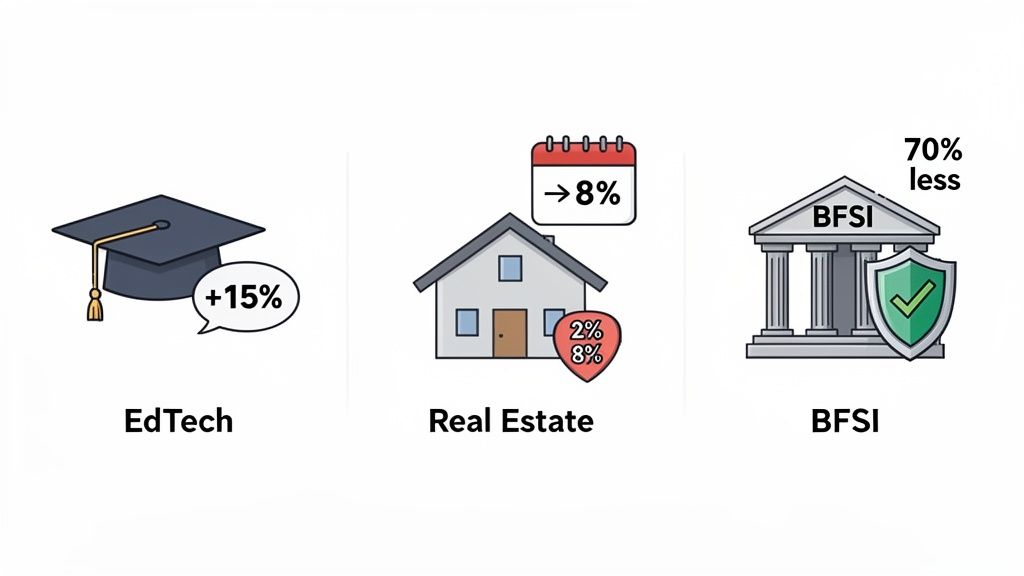
- Increased Application Completions: By providing instant, accurate information, the company achieved a 15% increase in completed applications.
- Lowered Acquisition Costs: Eliminating the need for a large temporary team drastically reduced the Customer Acquisition Cost (CAC) for each new student enrolment.
Real Estate: Converting Leads Around the Clock
In the hyper-competitive real estate market, speed-to-lead is paramount. A lead that isn't contacted within five minutes is 21 times less likely to convert. However, maintaining a 24/7 sales development team is cost-prohibitive for most agencies.
A major real estate brokerage implemented an AI agent to instantly qualify inbound leads and schedule appointments. The moment an inquiry was submitted online, the agent engaged, asking qualifying questions about budget, location preferences, and purchase timeline, then booked a site visit directly into a human agent's calendar.
This strategic automation transformed their sales funnel. The firm's lead-to-booking conversion rate quadrupled, jumping from a baseline of 2% to 8%. The AI acted as a tireless presales specialist, ensuring every lead was nurtured instantly.
This did more than just schedule meetings; it directly increased the firm's Customer Lifetime Value (LTV) by capturing high-intent buyers who would have otherwise moved on to a competitor. It empowered their human agents to focus on high-value activities: showing properties and closing deals.
BFSI: Automating Compliance with Unfailing Precision
In the Banking, Financial Services, and Insurance (BFSI) sector, compliance is non-negotiable. Processes like Know Your Customer (KYC) verification are mandatory but also highly repetitive, consuming thousands of agent hours annually.
A leading financial institution automated its outbound KYC verification calls with a purpose-built AI agent. Programmed to follow the compliance script perfectly, it verified customer details against internal databases and flagged anomalies for human review, all while maintaining a secure, fully auditable record of every interaction.
The efficiency gains were profound. The organization achieved 100% compliance on its verification calls and reduced the manual agent effort for this task by a staggering 70%. This strategic move freed up highly skilled agents to focus on revenue-generating activities like complex financial advisory and customer retention. The shift in financial services is a major trend; learn more about how AI will transform contact centres for financial services.
Below is a table that breaks down these kinds of results, showing how an AI agent can directly affect core business metrics across different industries.
AI Agent Impact on Core Business Metrics by Industry
| Industry | Key Use Case | Metric Improved | Average Uplift (Data-Driven) | Impact on Business Goal |
|---|---|---|---|---|
| EdTech | Admission Inquiry Automation | Application Completion Rate | +15% | Increases student enrolment and revenue. |
| Real Estate | 24/7 Lead Qualification & Booking | Lead-to-Booking Conversion | +6% (from 2% to 8%) | Maximises sales opportunities and agent productivity. |
| BFSI | Automated KYC & Compliance Checks | Manual Effort Reduction | -70% | Reduces operational costs and ensures 100% compliance. |
| E-commerce | Post-Purchase Support (WISMO) | First-Contact Resolution | +30% | Boosts customer satisfaction and repeat business. |
| Healthcare | Appointment Scheduling & Reminders | Patient No-Show Rate | -25% | Improves clinic efficiency and revenue capture. |
These real-world examples make it clear: a well-implemented AI agent isn't just a cost-cutting tool. It's a strategic asset that fuels growth, ensures compliance, and delivers a superior customer experience.
Building the Business Case for AI Support
For any C-suite leader, the decision to invest in an AI agent for customer support comes down to one question: what is the ROI? A compelling business case is built not on abstract promises but on a clear, quantifiable financial model.
To fully grasp the financial impact, it's essential to analyze two distinct categories. First, direct cost reductions—the measurable decrease in departmental operating expenses. Second, strategic revenue generation—the transformation of your support function from a cost centre into a proactive growth engine. A dual-focused analysis provides the comprehensive picture needed to justify the investment.
Unpacking Direct Cost Reductions
The most immediate financial gain comes from automating high-volume, repetitive tasks. Consider the resources allocated to answering simple queries like, "Where is my order?" or "What are your business hours?". An AI agent resolves these instantly, enabling you to reallocate human capital to more complex issues.
This automation drives significant savings in key areas:
- Optimized Headcount: By automating up to 60% of routine tickets, you can scale support capacity without a linear increase in hiring. For a team of 50 agents, this could mean avoiding 10-15 new hires as you grow, directly cutting salary and benefits costs.
- Reduced Training Overheads: A one-time AI setup eliminates the recurring cost of training new agents for basic tasks—a process that can take weeks and cost thousands per employee. For high-turnover roles, this can save a company $50,000-$75,000 annually for every 10 positions.
- Decreased Agent Attrition: Answering repetitive questions is a primary driver of burnout. By offloading this work, you create more engaging roles for your human team, reducing attrition rates by as much as 20% and minimizing associated recruitment costs.
Fuelling Strategic Revenue Growth
Beyond cost savings, a sophisticated AI agent actively generates revenue. Operating 24/7, it ensures no lead is ever missed, which is critical for capturing interest from different time zones or from prospects browsing late at night.
The AI agent also accelerates the sales cycle. By instantly engaging website visitors, asking qualifying questions, and scheduling demos, it dramatically improves conversion rates. For instance, real estate firms have seen their lead-to-booking rates jump from 2% to 8% simply by using an AI for immediate qualification.
The ripple effect of this efficiency is profound. Data predicts that AI will handle 50% of India's customer service cases by 2027, a significant increase from 30% today. The value is clear: AI has been shown to reduce first response times by 37% and slash overall ticket resolution time by 52%. Consequently, 65% of teams report reduced costs, and human agents can resolve 13.8% more incidents per hour. This is a direct line from AI adoption to enhanced productivity. You can discover more insights about AI's service impact on Salesforce.com.
Calculating Your Potential Return on Investment
To make this tangible for your organization, analyze the Total Cost of Ownership (TCO)—including subscription fees, implementation, and maintenance. A proper ROI calculation balances these costs against the combined value of cost savings and new revenue.
The table below offers a framework to model this for your business.
Sample ROI Calculation Framework for AI Agent Deployment
A simplified model demonstrating how to calculate the potential ROI by comparing cost savings and revenue gains against the total cost of ownership.
| Financial Component | Calculation Example (Annual) | Metric Source | Estimated Value |
|---|---|---|---|
| COST SAVINGS | |||
| Reduced Agent Salaries | (Avg. Agent Salary + Benefits) * (# Agents Reallocated or Reduced) | HR & Finance Data | £120,000 |
| Lower Training Costs | (Cost per New Hire Training) * (Reduction in Annual Attrition Rate) | HR & Operations Data | £15,000 |
| Lower Recruitment Costs | (Avg. Cost to Recruit) * (Reduction in Annual Attrition Rate) | HR Data | £10,000 |
| REVENUE GAINS | |||
| Increased Lead Conversion | (Additional Leads Captured by AI) * (Avg. Conversion Rate %) * (Avg. Customer Lifetime Value) | Sales & Marketing Analytics | £75,000 |
| Upsell/Cross-sell Revenue | (# of AI-driven Upsells) * (Avg. Additional Revenue per Upsell) | Sales & CRM Data | £20,000 |
| TOTAL COST OF OWNERSHIP | |||
| AI Platform Subscription | (Annual Subscription Fee per Agent/Seat) | Vendor Pricing | (£35,000) |
| Implementation & Setup | (One-time Professional Services & Internal Resource Cost) | Vendor Quote & Internal Estimate | (£10,000) |
| ESTIMATED ANNUAL ROI | (Total Savings + Total Gains) – Total Cost of Ownership | – | £195,000 |
This model is a starting point, but it clearly illustrates how the benefits quickly add up to outweigh the initial investment.
A successful AI deployment isn't just an IT project; it's a financial strategy. The goal should be to see a clear return on investment within the first 6-12 months, creating a self-funding engine for future innovation.
By presenting leaders with a clear financial model, the decision to adopt an AI agent moves from a speculative choice to a calculated investment in sustainable growth and operational excellence.
Choosing the Right AI Partner for Your Business
Selecting a technology partner is as critical as the technology itself. When evaluating an AI agent for customer support, it's easy to be distracted by feature lists. The real objective is to find a vendor that delivers long-term, strategic value. A mismatched partner can lead to a stalled project, poor adoption, and a negative ROI. The right partner, however, becomes an extension of your team, aligned with your business goals.
This requires a shift in perspective. Move beyond asking, "What can this software do?" to "How will this platform perform, scale, and integrate to drive our specific business outcomes?". This is the difference between buying a tool and forging a strategic partnership.
Evaluating Scalability and Performance
Your business is dynamic; your AI solution must be as well. A primary consideration is the platform's ability to handle massive scale without performance degradation, especially during peak periods.
Consider your busiest sales season or an unexpected service outage. Can the solution manage 100,000+ interactions in a single day without latency? Ask potential vendors for documented performance benchmarks and case studies proving their infrastructure can handle traffic spikes. For example, a platform should demonstrate the ability to maintain sub-second response times even while processing thousands of concurrent conversations. A system that excels at 1,000 queries but fails at 10,000 is a liability, not an asset.
True scalability isn’t just about handling more conversations; it’s about maintaining exceptional performance under pressure. A reliable partner should be able to show you proof of sub-second response times, even with thousands of conversations happening at once.
Integration and Customisation Capabilities
An AI agent's value is multiplied when it connects seamlessly with your existing technology stack. Robust, pre-built API connectors are a key differentiator.
- CRM Integration: Can the agent read customer history from your CRM (e.g., Salesforce, HubSpot) and write back new interaction data in real-time? This is non-negotiable for personalizing conversations and providing human agents with full context during handoffs.
- Backend Systems: Does it offer ready-made connectors for your inventory, billing, or scheduling software? This empowers the agent to perform actions for the customer, such as processing a refund or booking an appointment, turning it from an information provider into a problem-solver.
- Flexibility: For proprietary systems, a strong partner will provide well-documented APIs and developer support to facilitate custom integrations, ensuring your solution is future-proof.
Beyond technical integration, deep customisation is essential. Your AI agent must reflect your brand's voice and tone. A superior partner provides full control over conversational style, allowing you to create an experience that aligns perfectly with your brand identity and customer expectations.
Security and Strategic Alignment
In an era of stringent data privacy regulations, security is a foundational requirement. Your vetting process must include a thorough review of a vendor's security and compliance posture.
- Certifications: Look for recognized certifications like ISO 27001 or SOC 2. These provide third-party validation of a mature and robust security program.
- Data Handling: Understand precisely where your customer data is stored, how it is protected (both in transit and at rest), and who has access to it.
- Compliance: Ensure the vendor can demonstrate adherence to regional regulations relevant to your business, such as GDPR, CCPA, or HIPAA.
Ultimately, you are not just buying software; you are selecting a partner invested in your success. They should function as a strategic advisor, offering insights and best practices to maximize the value of your AI agent for customer support. Look for a provider with a proven track record of helping companies in your industry achieve their goals.
Your Strategic Deployment Roadmap
Implementing an AI agent for customer support is a strategic process, not a one-time event. For leaders, the objective is to minimize risk while achieving early, demonstrable wins that build momentum and validate the investment. A phased rollout, beginning with a well-defined pilot project, is the most effective approach for a smooth and successful integration.
This methodology allows your organization to learn, adapt, and build confidence before deploying the AI to more complex, mission-critical tasks.
Defining Your Pilot Project and Success Metrics
Begin by selecting a low-risk, high-impact use case for your pilot. The ideal candidate is a repetitive, high-volume task with clear, measurable outcomes. Examples include automating after-hours appointment scheduling for a real estate business or handling all "Where Is My Order?" (WISMO) inquiries for an e-commerce company. These are perfect starting points to prove value quickly.
Once you’ve selected the use case, define what success looks like with concrete Key Performance Indicators (KPIs). These metrics will form the foundation of your business case for future expansion.
- Metric 1: Customer Satisfaction (CSAT): Aim for a 15-25% improvement in CSAT scores for interactions handled by the AI agent. This demonstrates that the technology is enhancing, not detracting from, the customer experience.
- Metric 2: First-Contact Resolution (FCR): Target a 40-60% automated resolution rate for the pilot use case. This directly measures the agent's effectiveness and its impact on your human team's workload.
- Metric 3: Average Handling Time (AHT): For issues resolved by the AI, AHT should decrease by over 90%, dropping from several minutes to mere seconds. This provides a powerful quantitative measure of the efficiency gain.
When choosing a technology partner, strategic alignment is key.
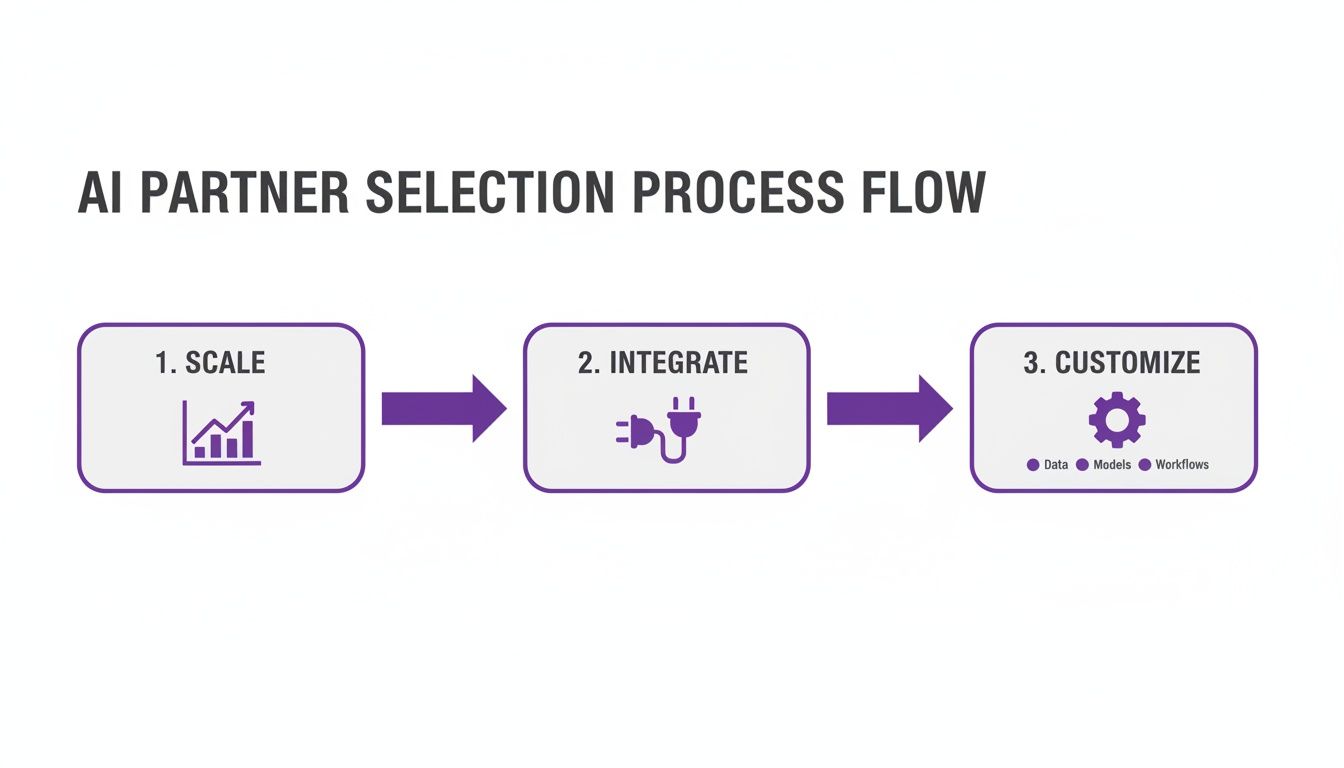
As the diagram illustrates, a successful deployment hinges on a partner who can scale with your needs, integrate with your existing technology stack, and provide deep customization of data, models, and workflows.
Designing the Conversation and Preparing Your Team
With clear objectives, the next step is designing the conversation flow. This involves mapping the entire customer journey, from initial engagement to final resolution or a seamless handoff to a human agent. The goal is to create a dialogue that feels natural, intuitive, and relentlessly focused on solving the customer's problem efficiently.
Crucial Insight: The best AI conversation flows are not rigid scripts but dynamic decision trees. They can adapt to unexpected queries, ask for clarification when needed, and escalate gracefully when they reach their operational limits, ensuring a customer never feels trapped in a frustrating loop.
For example, a real estate AI qualifying leads would follow this flow:
- Instant Engagement: The AI initiates a conversation within seconds of a new lead submission.
- Intelligent Qualification: It asks key questions ("What is your target budget?", "Which neighborhoods are you interested in?").
- Automated Action: Based on the responses, it schedules a site visit directly in a human agent's calendar.
- Seamless Handoff: It then transfers the full conversation history and a summary to the assigned agent via the CRM.
Finally, prepare your human support team. It is vital to position the AI agent as a powerful assistant, not a replacement. Its purpose is to eliminate the most monotonous tasks from their workload. A comprehensive change management plan, including training on how to collaborate with the AI and manage escalations, is essential for buy-in and a unified customer experience. This empowers your team to focus on the complex, high-value interactions that drive loyalty and growth.
Common Questions from Leaders About AI Agents
Whenever disruptive technology emerges, prudent business leaders ask critical questions. The focus must be on the real-world implications for your team, your customers, and your bottom line. An AI agent for customer support is no exception.
Let's address the most common concerns we hear from executives regarding workforce impact, data security, and the true cost of implementation, positioning this technology as a strategic partner for your human agents.
Will an AI Agent Replace My Human Team?
This is a frequent concern, and the answer is an emphatic "no." The strategic goal is not replacement, but elevation. An AI agent is designed to handle the high-volume, repetitive inquiries that often lead to agent burnout. This liberates your human team to focus on what they do best: resolving complex issues, managing sensitive customer situations, and building relationships.
For example, a telco client automated 70% of their inbound calls related to bill payments and plan information. This allowed them to retrain their human agents to become specialists in customer retention and upselling higher-margin fibre optic plans. The AI handles the 40-60% of routine tickets, transforming human agents into high-value problem-solvers and brand ambassadors, which in turn boosts job satisfaction and reduces costly employee turnover.
How Secure Is Our Customer Data with an AI?
In today's regulatory landscape, data security is non-negotiable, particularly in sectors like finance, insurance, and healthcare. Any credible AI partner builds their platform on a foundation of security.
Here are the essential criteria to verify:
- Compliance Certifications: The vendor must hold industry-standard certifications like ISO 27001 or SOC 2. These are not mere logos but independent audits of their security controls and processes.
- Data Encryption: All customer data must be encrypted end-to-end—both when stored (at rest) and during transmission (in transit).
- Access Controls: The platform must provide granular, role-based access controls and a comprehensive audit trail to track all system activity.
A trustworthy AI provider will treat your customer data with the same rigorous security standards you do. They should be transparent and ready to share detailed documentation on their data handling policies and compliance certifications.
What Is the True Cost and Timeline for Implementation?
The era of multi-year IT projects is over. A modern AI agent for customer support can be deployed far more quickly than legacy systems. Most businesses begin to see a positive return on investment within 3-6 months.
The initial implementation, which includes platform configuration and training the AI on your specific use cases, typically takes between 6-12 weeks.
The cost model includes a one-time setup fee and a recurring subscription, but this must be evaluated against the financial gains. With clients reporting a 30-55% reduction in overall support costs and the ability to manage 2-5x the query volume without increasing headcount, the business case becomes exceptionally compelling. For a mid-sized e-commerce company, this can translate to over $250,000 in net savings in the first year alone.
Ready to see how a bespoke AI agent can solve your specific business challenges? DialNexa builds and deploys human-like Voice AI agents that scale your customer support and accelerate conversions. Discover a smarter way to manage customer conversations at https://dialnexa.com.

[…] is crucial for maintaining customer satisfaction at scale, a key component of building a strong AI agent for customer support. For instance, a trading platform can use this funnel to automate KYC verification steps before […]
This is a highly insightful piece that clearly shows how AI agents can transform customer support from a cost centre into a strategic growth engine. The industry examples and ROI-focused approach make the value of intelligent automation very compelling.
Excellent insights on how AI agents are transforming customer support into a strategic driver of growth, efficiency, and customer satisfaction. The strong focus on ROI, scalability, and real-world industry impact makes this a valuable and forward-thinking read.