
Types of Sales Quota: CXO Guide to 2026 Revenue
Most advice on quota design starts with the wrong assumption. It treats quota as a number finance needs and sales must chase. That logic is convenient, but it's strategically weak.
A board shouldn't ask only, “What revenue target do we assign?” It should ask, “What behaviour will this quota system produce?” A revenue-only quota can make one team pursue large but slow deals, while another neglects prospecting until late in the quarter. In India's distributed, phone-led sales environments, that gap matters more than most leaders admit.
The stronger view is simpler. Different types of sales quota exist because different sales motions need different controls. If your reps generate pipeline, they need a quota that values pipeline creation. If they own pricing and close, they need a quota tied to cash outcomes. If automation now performs a share of outreach, your quota architecture has to recognise digital work as well as human effort.
That's why quota design belongs in the same conversation as territory planning, compensation, hiring, and forecasting. It also belongs alongside crafting effective sales OKRs, because quotas work best when they translate company priorities into actions that managers can inspect weekly rather than regret quarterly.
Table of Contents
- Beyond Revenue The Strategic Flaw in Your Quota System
- The Strategic Foundation of Sales Quotas
- A CXOs Guide to Major Sales Quota Types
- Implementing and Communicating Quotas Effectively
- Common Pitfalls in Quota Setting and How to Avoid Them
- The Future of Quotas AI-Driven Performance Management
- Conclusion From Metric to Motivator
Beyond Revenue The Strategic Flaw in Your Quota System
The popular advice says revenue quota is enough because revenue is what the company ultimately needs. That sounds disciplined. In practice, it often hides the very causes of missed quarters.
A rep can miss a revenue target for several different reasons. The territory may be weak. Lead quality may have dropped. Call volumes may be too low. Qualification may be poor. A manager who only sees the final revenue number learns about these failures too late to correct them.
That's why quota design is a strategic lever, not an administrative form. The type of quota you choose determines what your team pays attention to every day. A revenue quota pushes focus towards closed business. An activity quota pushes consistency in calls, meetings, demos, or validations. A hybrid model helps leaders detect whether the problem is coverage, conversion, or close discipline.
A quota system should help management diagnose risk before quarter-end, not simply document failure after quarter-end.
For Indian sales leaders, this problem is sharper in sectors that combine high call volume with uneven regional demand. A central team may look productive on paper while conversion quality varies widely by city, product line, or counsellor. If the only metric is revenue, leaders often overestimate pipeline health.
Three practical consequences follow:
- Revenue-only quotas can distort rep behaviour: closers may chase a few large opportunities and neglect deal velocity.
- Activity-only quotas can create busywork: callers may optimise for call counts while qualification quality slips.
- Role-matched quotas create managerial visibility: SDRs, AEs, inside-sales teams, and support-led conversion teams each need a different yardstick.
The overlooked issue is automation. If AI agents now handle outreach, reminders, or KYC guidance, a quota plan built only for human reps becomes incomplete. Leadership then measures payroll productivity while ignoring automated capacity that influences pipeline and forecast quality. That's no longer a niche problem. It's becoming a board-level measurement gap.
The Strategic Foundation of Sales Quotas
Quotas matter because they translate strategy into controlled execution. Without them, growth plans stay at presentation level. With them, managers can connect daily selling behaviour to company targets, territory plans, and compensation.
Why leadership teams rely on quotas
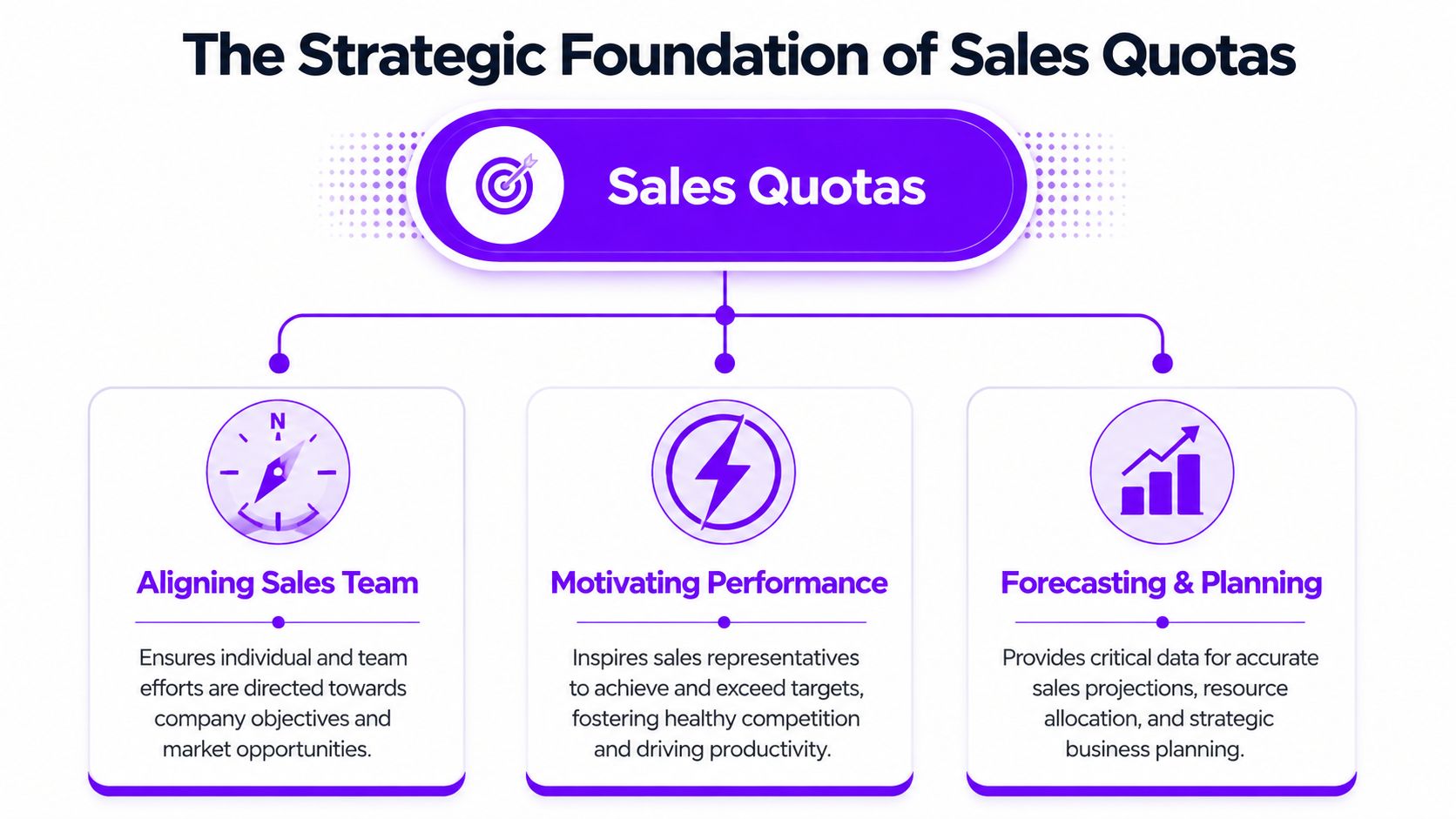
A good quota system performs three jobs at once.
First, it creates alignment. The board sets growth priorities. Sales leadership then converts those priorities into metrics a field team can act on. That's the underlying operating logic behind quotas.
Second, it supports motivation and accountability. Reps need clarity on what counts as success. Managers need a consistent basis for coaching and performance review.
Third, it improves forecasting and planning. Quotas create a shared framework for reading pace, allocating resources, and deciding whether the issue is capacity, coverage, or execution. Leaders who want a more detailed operational definition can compare this with DialNexa's explanation of sales quota definition.
How Indian sales organisations evolved quota design
In India, revenue quotas remain the dominant historical model, largely because they fit formal sales-management practices and can be set on monthly, quarterly, or annual cycles across large teams. Modern frameworks now distinguish between revenue, volume, activity, profit, forecast, and combination quotas, which lets a company use a revenue quota for closers and an activity quota for inside-sales callers, as outlined in Kademi's overview of sales quotas.
That shift matters more than it first appears. It means quota design has moved away from one broad target for everyone and towards role-specific architecture. In practical Indian operating terms:
- An EdTech counsellor may need activity targets because conversion depends on contact rates, follow-up cadence, and demo attendance.
- A BFSI closer may need revenue or profit focus because pricing discipline and final conversion matter more than raw outreach volume.
- A real estate pre-sales desk may need a mixed model because site-visit generation and booked business both affect forecast accuracy.
Board view: The quota model is a control system. It doesn't just measure output. It shapes what the sales floor optimises for.
The strategic foundation, then, isn't the quota number itself. It's the choice of measurement logic. Leaders who get that choice right usually find forecasting becomes more explainable, coaching becomes more targeted, and compensation disputes become easier to resolve.
A CXOs Guide to Major Sales Quota Types
Boards don't need a long list of quota labels. They need a decision framework. The central question is which metric best reflects the job the seller performs.
The distinction is especially important in India's phone-led sales motions. Revenue quotas are best for reps who control the full sales cycle, while activity quotas suit SDR and BDR roles focused on calls and demos. In high-volume teams, a hybrid model can flag conversion issues early instead of letting them surface only at month-end, as noted in Apollo's discussion of sales quota design.
Sales Quota Types at a Glance
| Quota Type | Primary Metric | Best For (Sales Role) | Ideal Industry Example |
|---|---|---|---|
| Revenue | Closed revenue | Account Executives, full-cycle closers | SaaS, enterprise services, real estate closers |
| Volume | Units, deals, or accounts sold | Transactional reps, channel teams | D2C distribution, standardised product sales |
| Activity | Calls, demos, meetings, validations | SDRs, BDRs, inside-sales callers | EdTech counselling, BFSI outreach desks |
| Profit | Profit or margin contribution | Senior sellers handling pricing discipline | BFSI products, services with margin variation |
| Combination | Blend of revenue and leading metrics | Teams with mixed responsibilities | Real estate pre-sales plus booking teams |
Revenue quota
A revenue quota measures the value of closed business within a defined period.
Simple formula: Closed revenue during period ÷ assigned revenue target
Use it when the rep controls discovery, proposal, negotiation, and close. In those roles, revenue reflects the commercial result leadership cares about.
A practical example in Indian SaaS is straightforward. A quarterly target may require an Account Executive to close a set revenue amount from new or expansion business during the quarter. The exact number will vary by segment, average contract value, and cycle length. The point is that the rep owns the complete path to revenue, so revenue is the cleanest accountability metric.
Best fit
- Full-cycle enterprise reps
- Senior closers with pricing authority
- Teams selling higher-value offerings
Pitfall
- It can hide weak upstream execution. If pipeline generation drops or qualification quality slips, leadership won't see the problem early enough unless activity or pipeline measures sit alongside it.
Volume quota
A volume quota measures how many units, contracts, or accounts a rep closes rather than the value of each sale.
Simple formula: Total units or deals closed ÷ assigned volume target
This works best where pricing is standardised and market penetration matters. A distribution-led consumer brand, for example, may care more about how many accounts or product units move through the channel than about deal-by-deal revenue variation.
Volume quotas are useful in environments where leadership wants consistency and breadth. They help avoid an overemphasis on a few large deals.
Best fit
- Standardised products
- Channel or retail-heavy environments
- New market penetration pushes
Pitfall
- Reps may chase easy, low-value wins that satisfy count targets without improving commercial quality.
Activity quota
An activity quota tracks selling behaviours such as calls, demos, meetings, or validations.
Simple formula: Completed qualified activities ÷ assigned activity target
For many Indian inside-sales teams, this is the most honest way to measure upstream work. An SDR calling prospects all day doesn't fully control closed revenue. Measuring that rep only on revenue invites unfairness and muddles coaching.
A practical example is an EdTech calling team where the role is to connect with leads, qualify interest, and schedule counselling or demo sessions. Here, management should define the activities that move the funnel, then hold the team to those standards.
Best fit
- SDR and BDR teams
- New market development
- Long or multi-stage buying journeys
Pitfall
- Not all activity is valuable. If you count raw calls without quality checks, teams learn to maximise count rather than progression.
The right activity quota doesn't reward motion. It rewards actions that reliably create the next stage in the funnel.
Profit quota
A profit quota tracks the profitability of what a rep sells, not just top-line revenue.
Simple formula: Profit generated during period ÷ assigned profit target
This is most useful when margin varies materially across products, discounts, or service bundles. It forces commercial discipline. Leadership can protect earnings quality while still pursuing growth.
A practical example is a team selling a portfolio where some packages require heavy servicing and others are more profitable. A profit quota stops reps from winning revenue that weakens the business.
Best fit
- Mature markets with price pressure
- Portfolios with uneven margins
- Roles where the rep can influence discounting
Pitfall
- If the company doesn't give sellers clear margin visibility, the quota becomes hard to trust and harder to manage.
Combination quota
A combination quota blends two or more metrics. It's often the strongest model for modern revenue teams because it balances outcomes with leading indicators.
Simple formula: Weighted score across assigned metrics
A real estate pre-sales operation offers a clear example. One part of the quota can reflect booked revenue. Another can reflect qualified site visits or progressed opportunities. This allows management to see whether weak bookings came from poor opportunity creation or poor closing discipline.
Best fit
- Mixed sales motions
- Phone-led teams with handoffs between roles
- Businesses that need both short-term revenue and future pipeline health
Pitfall
- Too many metrics create confusion. If sellers can't tell what matters most, the plan loses motivational power.
For most CXOs, the practical answer isn't choosing one universal model. It's assigning the right quota type to each role. That is what turns types of sales quota from a theoretical list into a working growth system.
Implementing and Communicating Quotas Effectively
Quota design fails less often in spreadsheets than in rollout. Teams accept demanding targets when the logic is visible, the ramp is fair, and the rules don't shift without explanation.

Set quotas with both ambition and proof
Strong plans use both top-down and bottom-up thinking. Leadership starts with the company target. Sales management then checks whether territories, conversion patterns, and capacity can support that number.
That validation matters because quota fairness isn't an emotional issue. It's an operating issue. Reps work harder on targets they believe are grounded in reality.
Three implementation rules help:
- Start with market potential: Don't assume one city, channel, or product line can absorb the same target as another.
- Use role logic, not hierarchy: Seniority alone doesn't determine quota type. The sales motion does.
- Review enablement before raising expectations: If pipeline support, training, or tools haven't improved, aggressive quota inflation usually creates noise rather than growth.
A useful companion discipline here is better people analytics for sales teams, especially when leadership wants to separate skill issues from territory or process issues.
Communicate the maths and the meaning
Most quota disputes aren't really about pay. They're about trust. A rep who hears only the number will assume the company picked it arbitrarily.
Managers should explain:
- Why this metric was chosen: revenue, activity, profit, or hybrid
- How credit is earned: especially where handoffs exist between SDRs, AEs, and support functions
- What gets reviewed weekly: so there are no surprises at month-end
Teams also need a single reporting rhythm. A fragmented reporting environment produces avoidable arguments over attainment, pacing, and accountability. Leaders trying to tighten this process can benefit from a structured approach to analysing sales data.
Operational rule: If a manager can't explain the quota in plain language, the plan isn't ready to launch.
This is a useful reference point for quota conversations with sales managers:
Build a fair ramp for new hires
New hires shouldn't carry full quota on day one unless the role is transactional and training is minimal. A common benchmark is 25% of full quota in month one, 50% in month two, 75% in month three, and 100% from month four onward, according to Upcell's sales quota guidance.
The same guidance advises leaders to avoid increasing quotas by more than 10%–15% year over year unless headcount or enablement also improves. That's a valuable board-level guardrail because it links ambition to operating capacity rather than aspiration alone.
For Indian inside-sales teams, this matters more than many leaders think. A rep who is still learning scripts, objections, systems, and territory nuances can't be judged like a fully ramped performer. Fair ramping improves both morale and forecast accuracy.
Common Pitfalls in Quota Setting and How to Avoid Them
The costliest quota errors don't look dramatic at first. They usually enter the plan as “simplifications” and show up later as weak attainment, rep distrust, or unreliable forecasts.
Uniform targets across unequal territories
The most common mistake is assigning near-identical targets to territories with very different demand conditions. A metro market, a developing region, and a mature house-account patch rarely offer equal opportunity. Yet many companies still allocate quotas as if they do.
The fix is disciplined territory review before quota finalisation. Leadership should compare market conditions, account potential, and cycle realities. The goal isn't to make quotas easy. It's to make them comparable in difficulty.
Quotas that reward the wrong behaviour
A pure revenue quota can trigger discounting, delayed prospecting, or overfocus on late-stage deals. A pure activity quota can reward quantity without progression. A volume quota can push low-value business.
Boards should ask a harder question than “Can reps hit this?” Ask, “What will they do to hit it?” If the answer includes heavy price concessions, superficial qualification, or neglected pipeline creation, the quota is mis-specified.
A compensation plan never sits beside the quota plan. In practice, it is the quota plan's enforcement mechanism.
One practical safeguard is to add a balancing metric where the role requires it. That may mean combining activity with quality review, or revenue with a leading pipeline milestone. The point is to keep the metric from becoming a loophole.
Static plans in changing markets
Many teams set quotas once, then manage exceptions informally when the market shifts. That creates two problems. The formal plan becomes outdated, and frontline managers start improvising fairness case by case.
The better approach is to define review conditions in advance. If seasonality, territory redesign, or product changes materially alter opportunity, leadership should revisit assumptions openly rather than pretending the original number still reflects reality.
A resilient quota system has three qualities:
- Clarity: reps know what counts
- Consistency: managers apply the same rules across the team
- Adaptability: leadership can adjust when business conditions change
That's what prevents quota setting from becoming a recurring source of political friction inside the revenue organisation.
The Future of Quotas AI-Driven Performance Management
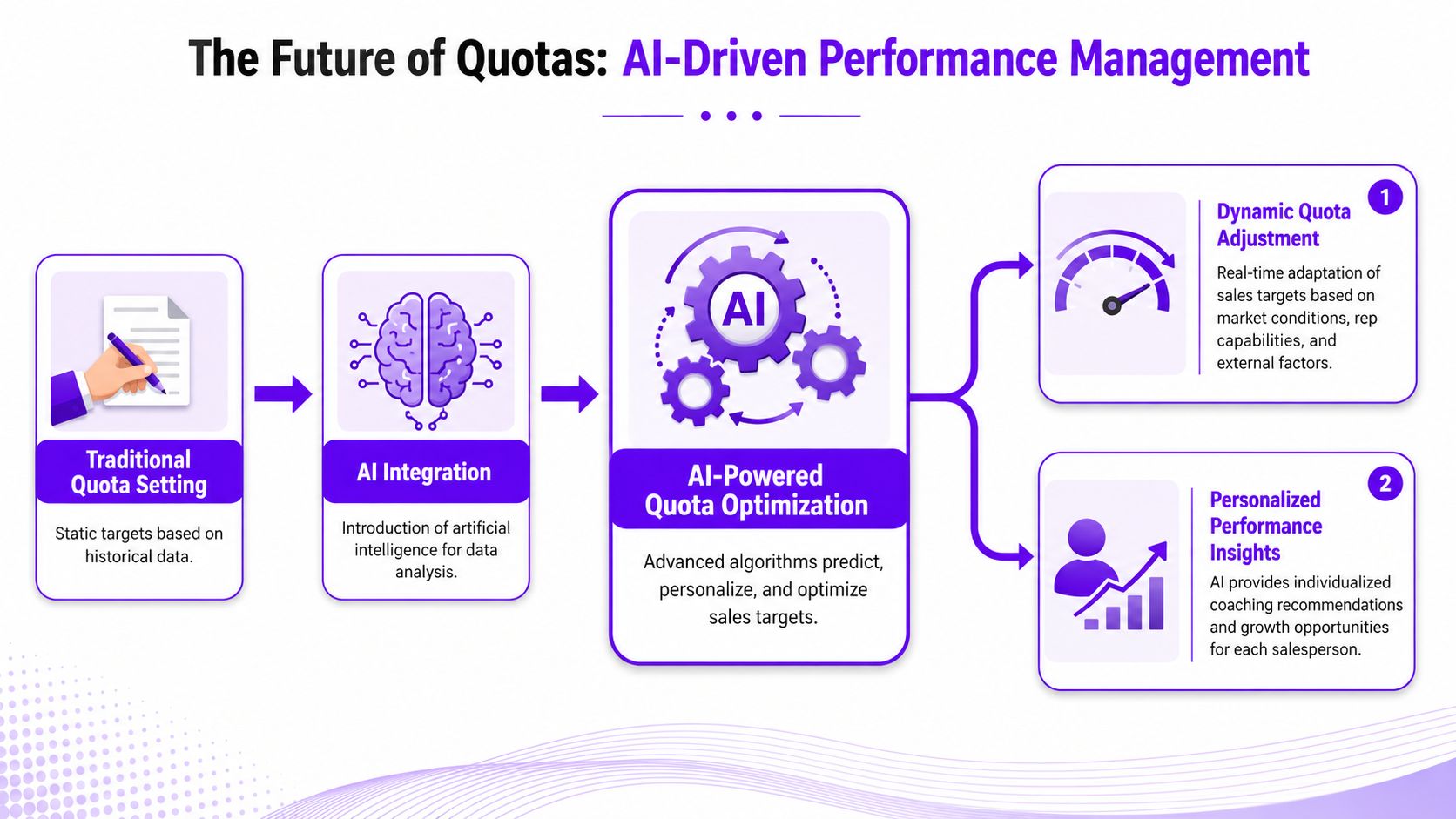
Automation is forcing a change in quota philosophy. Traditional quotas were built for human sellers who performed a finite set of visible activities. AI systems complicate that model because they can handle outreach, follow-ups, support conversations, and qualification at a scale that doesn't map neatly to a human rep scorecard.
The rise of the AI-Activity quota
An AI-Activity quota is a management construct for measuring non-revenue work completed by automated agents. That can include calls, demos scheduled, follow-up reminders, KYC validations, or support interactions that move buyers forward but don't directly close revenue.
Standard quota models assume activity belongs to a human seller. Consequently, once AI handles routine outreach at scale, leadership needs a way to evaluate whether that automated effort is generating qualified progression or just producing noise.
In practical terms, an AI-Activity quota should measure:
- Which activities matter operationally: not every interaction deserves credit
- How those activities connect to the next sales stage: qualification, visit booking, or support resolution
- Where human handoff begins: so accountability remains clear across the funnel
Boards that ignore this create a blind spot. They fund automation but still evaluate performance through a human-only lens.
Why Dynamic Forecast quotas matter
The second shift is the Dynamic Forecast quota. Traditional forecast quotas rely heavily on historical patterns. That works in relatively stable environments. It works far less well in sectors where demand, sentiment, and timing change quickly.
A 2026 McKinsey study found that real estate firms using static forecast quotas missed Q1 targets by 15% to 25%, while firms using AI-powered dynamic quotas achieved 92% attainment. The study described dynamic quotas as adapting to real-time voice data and market signals, which makes them especially relevant in volatile categories such as real estate and trading-led environments. For leaders evaluating the broader analytical shift behind this change, PlotStudio AI's piece on revolutionising data insights for business analysts is a useful framing resource.
The strategic implication is significant. Forecast quotas no longer need to be static commitments reviewed after the fact. They can become living management tools that respond to current conditions.
What boards should measure next
Most companies aren't ready to replace all traditional quota models. They don't need to. They do need to extend them.
A practical AI-native framework includes:
- Human quota layer: revenue, profit, volume, or activity targets by role
- AI quota layer: operational activities completed by automated systems and their quality of progression
- Forecast layer: dynamic target review informed by current demand signals rather than historical averages alone
Leaders exploring this direction should also understand the operational possibilities described in DialNexa's overview of AI use cases in sales.
The future quota system won't ask only whether reps worked hard enough. It will ask whether the combined human and AI system produced predictable commercial outcomes.
This is a key upgrade. AI doesn't just automate outreach. It changes what a board should count.
Conclusion From Metric to Motivator
The strongest quota systems don't reduce sales management to a number. They turn the number into a mechanism for steering behaviour, improving forecast quality, and aligning every role with the company's growth model.
That's why the choice among types of sales quota is a strategic decision. Revenue quotas suit full-cycle closers. Activity quotas suit upstream roles. Volume and profit quotas solve specific commercial problems. Combination models often deliver the clearest picture when teams need both pipeline discipline and revenue accountability.
The larger shift is that quota design can no longer stop at human performance. As automation handles more qualification, support, and follow-up, boards need quota systems that measure digital contribution and adapt forecasting logic to changing market signals.
A quota should do more than track attainment. It should tell leadership what the team is optimising for, where risk is building, and whether the revenue engine is becoming more predictable. When that happens, quota stops being an HR artefact and becomes a management system.
If your team is rethinking quota design for AI-assisted sales, support, qualification, or presales workflows, DialNexa Labs Private Limited can help you evaluate how Voice AI fits into your revenue operating model, from high-volume outreach to structured handoffs that make modern quota systems easier to manage.

Leave a Reply