Text to Audio Converter Telugu: Scale for 83M+ in 2026
Telugu reaches a large customer base, and that makes voice support a business decision, not a side localisation task. For enterprises serving Telugu-speaking users across support, onboarding, collections, healthcare, education, or commerce, a text to audio converter Telugu workflow affects reach, response rates, and service cost.
I have seen teams buy a Telugu TTS tool as if they were purchasing a file generator. That approach usually stalls after the pilot. Enterprise results depend on whether the voice layer fits CRM events, call flows, notification systems, approval rules, and QA checkpoints. A broader text-to-voice read aloud implementation approach is what turns speech output into a repeatable operating capability.
The buying decision is primarily operational. Pronunciation errors reduce trust. Inconsistent audio formatting slows publishing. Weak monitoring hides latency spikes until customers hear them first. Poor integration leaves sales, service, and collections teams managing disconnected workflows instead of one measurable pipeline.
A Telugu text to audio programme should therefore be scoped like an enterprise channel. The target is not just audio generation. The target is reliable delivery at scale, tighter customer engagement, and lower manual production effort without compromising brand voice.
Table of Contents
- Why Your Telugu TTS Strategy Needs More Than an API Key
- From Raw Text to Impeccable Pronunciation
- Mastering Audio Nuance with SSML and Voice Options
- Building and Quality-Assuring Your Audio Pipeline
- Scaling Telugu Audio for Enterprise Operations
- Turning Conversations into Conversions
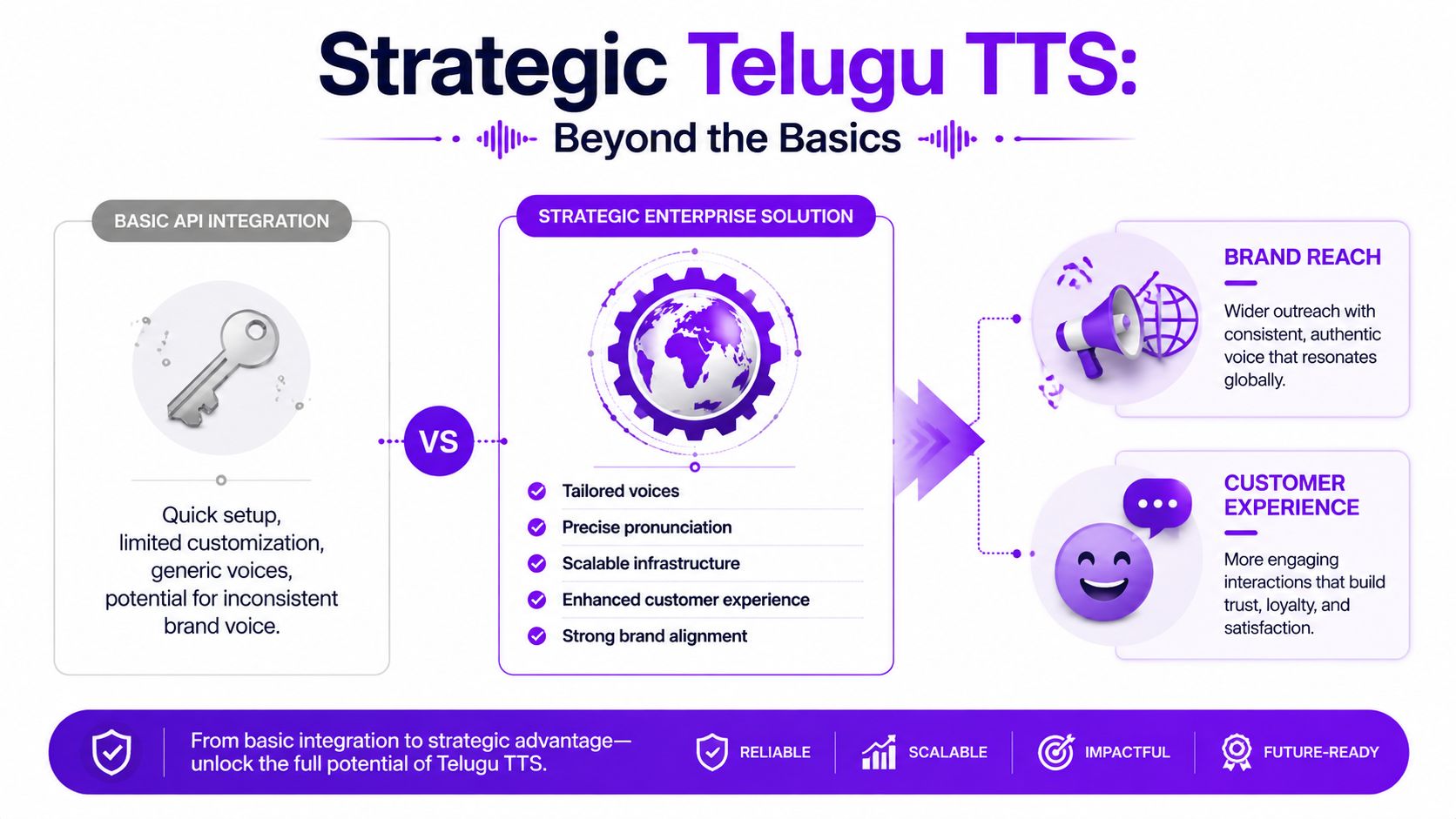
Why Your Telugu TTS Strategy Needs More Than an API Key
Enterprises rarely struggle to generate Telugu audio. They struggle to run it reliably across customer journeys, business systems, and peak demand.
That distinction affects revenue, cost, and brand trust. A basic text-to-speech endpoint can turn text into an audio file quickly, often in common delivery formats used across contact centers, apps, and content workflows. Enterprise buyers, however, need more than generation speed. They need controlled pronunciation, predictable operating costs, auditability, and integration with the systems that already drive customer communication.
The Buying Decision is Operational
A CXO reviewing a Telugu TTS program should focus on four areas before approving a vendor or internal build path.
| Decision area | What matters in practice | Business consequence |
|---|---|---|
| Voice fit | Does the Telugu voice suit your audience segment, use case, and brand tone? | Weak fit lowers trust, response rates, and message clarity |
| Delivery model | Is the system built for batch notifications, live calls, or both? | A mismatch creates rework during rollout and slows expansion |
| Cost structure | Are charges based on characters, concurrency, storage, or workflow complexity? | Budgeting becomes unstable when campaign volume spikes |
| Recovery path | What happens when synthesis fails, times out, or mishandles customer names? | Broken journeys increase support load and hurt conversion |
I have seen teams buy on demo quality and regret it during deployment. The demo script is clean. Production text is not. It contains CRM fields, inconsistent spelling, mixed Telugu and English, account numbers, location names, and compliance language that must be read the same way every time.
That is why the buying decision is less about whether a platform can speak Telugu and more about whether your operating model can depend on it.
Practical rule: Choose Telugu TTS based on workflow behavior, not sample audio alone. Test it with your CRM data, retry logic, approval steps, and escalation paths.
What enterprise buyers should compare
A useful evaluation pack is small but realistic. Use payment reminders, onboarding prompts, policy disclosures, appointment messages, admissions notices, property follow-ups, and customer names pulled from actual records after masking sensitive data. Weak systems usually fail on edge cases, not on studio-grade sample sentences.
Three factors separate a production deployment from a simple integration:
- Workflow alignment: The TTS layer should connect cleanly to CRM triggers, outbound dialers, support platforms, and content systems. If teams must copy and paste text into a standalone interface, adoption drops and process drift starts.
- Pronunciation governance: Operations need a repeatable method to manage names, abbreviations, branch locations, and mixed-script content. Without that control, every campaign becomes a QA fire drill.
- Scalability planning: Average volume is the wrong metric for procurement. Telugu audio demand spikes during repayment cycles, support surges, admissions windows, and campaign launches. Capacity planning should reflect those bursts.
For teams comparing implementation models across use cases, this guide to text-to-voice read aloud workflows is a useful reference for how voice generation fits into broader operating systems rather than staying a file-creation tool.
A Telugu TTS strategy pays off when it reduces agent workload, improves message reach, and keeps voice output consistent across channels. That requires architecture, governance, and measurement from day one. An API key is only the starting point.
From Raw Text to Impeccable Pronunciation
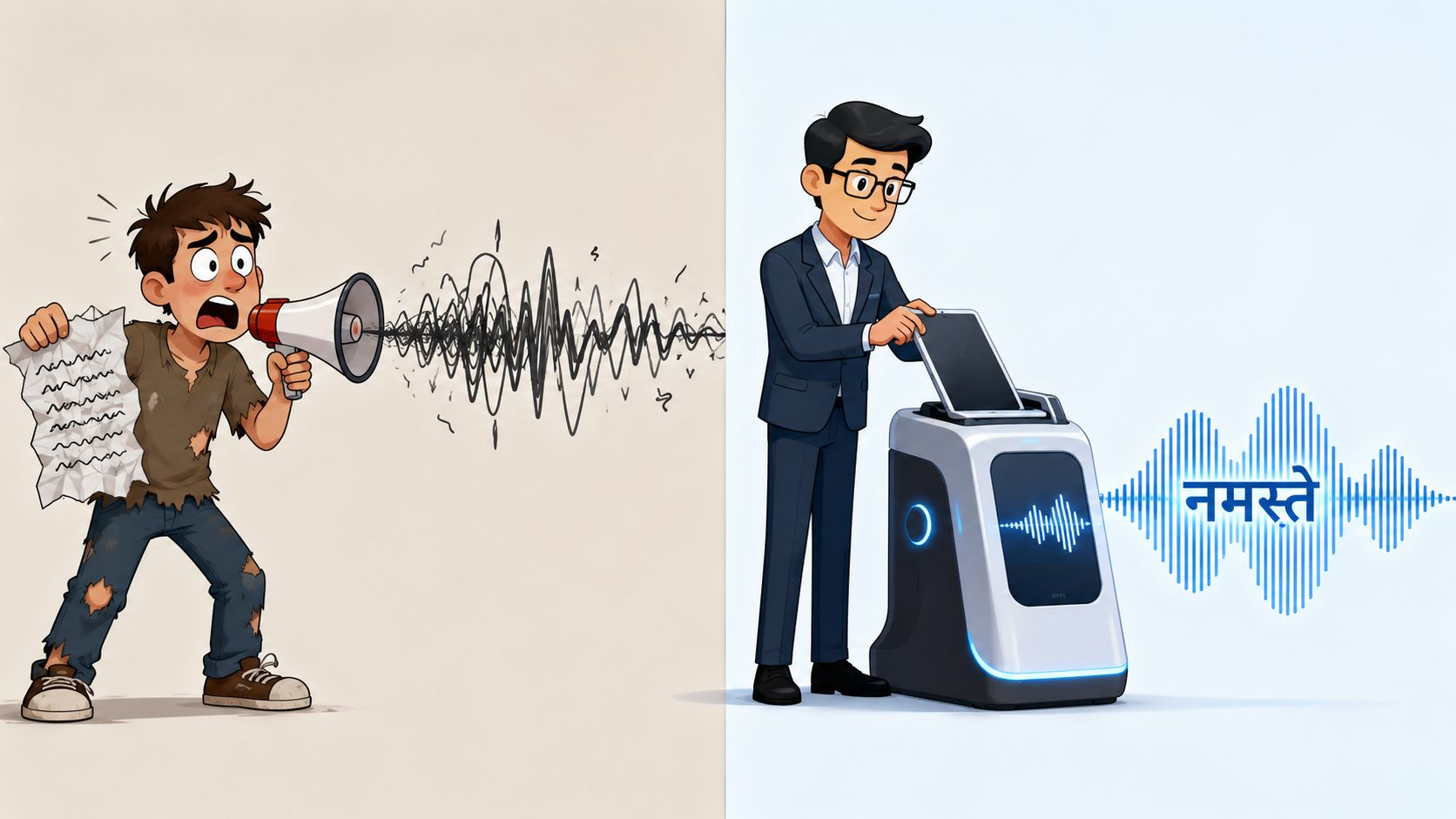
Most Telugu audio problems start before synthesis. They start in the input layer.
Teams often assume the engine will “figure it out” when the source text includes CRM placeholders, shorthand, transliterated brand names, half-written dates, or English fragments dropped into Telugu copy. It usually won't. The result is audio that sounds technically correct and operationally wrong.
Input quality determines output quality
A practical Telugu text-to-audio workflow should prioritise language-variant selection, short-input chunking, and post-generation audio QC because Telugu products commonly follow a clear sequence: enter text, choose the Telugu voice or language style, then generate and download the output. That structure matters because variant and tone choices directly affect prosody and dialect fit in Indian usage contexts (Camb AI's Telugu text-to-speech workflow).
In enterprise settings, I'd translate that into an operating rule. Never send raw production text straight into the engine.
Instead, normalise it first:
- Dates: Convert numeric dates into a consistent spoken form.
- Amounts: Decide whether the script should say the amount as digits, full words, or a hybrid.
- Acronyms: Expand internal abbreviations that customers won't recognise in audio.
- Names and locations: Review fields pulled from CRM or ERP systems. They often contain formatting junk, casing errors, or English spellings that break Telugu flow.
- Sentence length: Split long passages into shorter chunks so pauses and retries are easier to manage.
Clean text reduces correction work later. In audio operations, prevention is cheaper than post-call apology.
A production-ready text preparation checklist
A useful input-prep discipline looks like this:
- Select the right Telugu variant first. Don't leave voice selection to whichever default the platform exposes.
- Chunk by meaning, not by arbitrary character limits. Break at sentence or clause boundaries where a listener would naturally pause.
- Replace placeholders before generation. A token like
{customer_name}passing into production audio is a process failure, not a model failure. - Review mixed-script terms separately. Product names, app names, loan terms, and educational programme labels need custom handling.
- Run post-generation QC on samples from each campaign. Small listening checks catch recurring errors before they spread.
For teams that want a more formal framework for evaluating output, these speech synthesis quality metrics help structure reviews around consistency, intelligibility, and listener experience instead of vague opinions.
A practical example makes the point. An EdTech team may generate welcome audio for course enrolment. If the script contains a student's name in English spelling, a programme acronym, a start date in numeric form, and a campus location transliterated differently across systems, the engine can only work with what it receives. A disciplined text-prep layer fixes those issues before they become customer-facing defects.
Mastering Audio Nuance with SSML and Voice Options
Flat Telugu speech hurts conversion, even when every word is technically readable. The issue isn't just correctness. It's whether the audio sounds intentional.
That's where SSML and voice configuration become executive concerns, not developer toys. They let you shape pacing, emphasis, pauses, and reading style so the same message can sound reassuring in customer support, urgent in collections, or calm in education.
SSML is a business control layer
A well-designed script often needs more than plain text. It may need a pause before a payment amount, emphasis on a call-to-action, or a slower delivery for compliance language. SSML gives teams a structured way to define that behaviour.
Use it for situations like these:
- Emphasis for conversion moments: Highlight the booking prompt, document submission reminder, or renewal deadline.
- Controlled pauses: Add breaks before numbers, references, or next-step instructions so listeners can absorb them.
- Pronunciation guidance: Protect brand names, product labels, and uncommon place names from awkward rendering.
- Number reading behaviour: Ensure dates, codes, and IDs are spoken in a listener-friendly form.
A plain script might work for a one-off MP3. It usually won't hold up in thousands of live customer interactions.
The strongest voice systems don't just read text. They perform the intent of the message.
Code-switching is where many systems struggle
A major weak spot in Telugu TTS is Telugu-English code-switching. Many consumer-style tools focus on generic type-and-download flows and provide little evidence about how they handle brand names, loan terminology, mixed-language prompts, or domain-specific vocabulary. By contrast, Sarvam AI's documentation positions its speech APIs around Indian languages, “authentic accents”, “emotion-rich” output, and real-time customer-facing use cases, which highlights the market's move towards multilingual conversational speech rather than simple conversion tools (Sarvam AI text-to-speech APIs).
Here, buyers need to be sceptical. A vendor may sound strong on clean Telugu paragraphs but fail when the script includes:
- English app names inside Telugu sentences
- Financial product labels
- Roman-script customer entries
- Sales language that alternates between Telugu and English
For bilingual Indian audiences, that isn't an edge case. It's daily operating reality.
The right evaluation approach is scenario-based. Test your top workflows with mixed scripts and domain language. Don't ask whether the engine supports Telugu. Ask whether it can read the way your customers speak and listen.
Building and Quality-Assuring Your Audio Pipeline
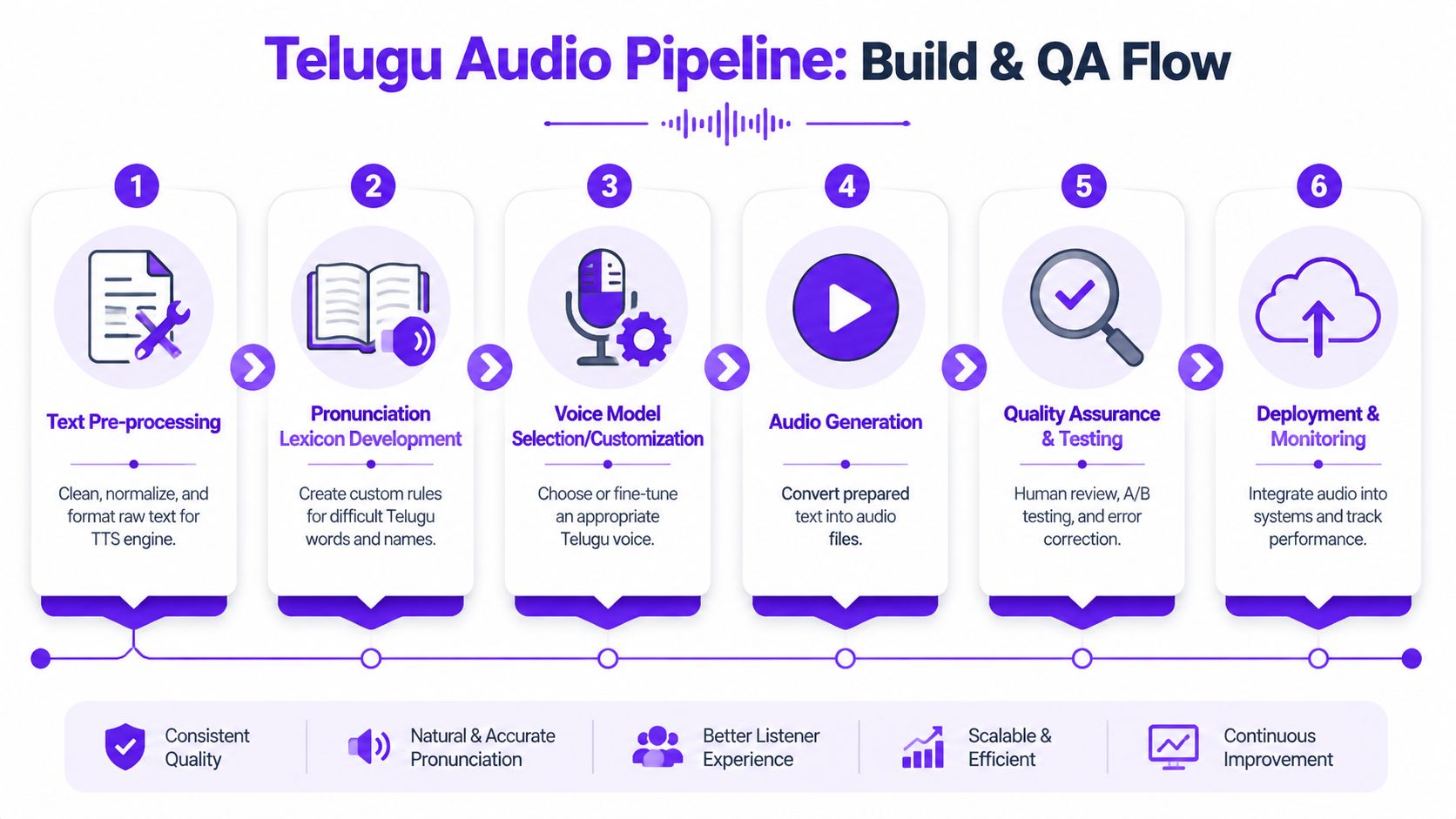
A production Telugu voice programme should behave like a factory line. Text enters in a controlled state, transformations are logged, output is checked, and deployment follows a release process.
That sounds heavier than a simple converter. It is. That's also why it works.
Treat the pipeline like a factory
An enterprise audio pipeline typically needs these layers:
- Text intake and normalisation: Pull source content from CRM, CMS, support platform, or campaign system. Clean it before synthesis.
- Pronunciation controls: Maintain a lexicon for names, places, product terms, and regulated phrases.
- Generation orchestration: Queue jobs, handle retries, and route outputs to the right storage or delivery channel.
- Review workflow: Sample audio by campaign, by voice, and by script type.
- Release discipline: Move approved audio into production with version control.
This is also the point where post-processing becomes relevant. Not every generated file needs studio treatment, but many enterprise use cases benefit from level balancing, trimming, noise checks, and mastering consistency. Teams that want to explore audio post-production options can use that resource to decide what belongs inside the TTS stack and what belongs in downstream audio finishing.
What QA should actually check
A weak QA process asks, “does it sound okay?” A strong one uses explicit review criteria.
| QA area | Reviewer question | Typical failure |
|---|---|---|
| Pronunciation | Are names, brands, and place names correct? | Misread customer-specific fields |
| Prosody | Does pacing match the intent of the message? | Important details rushed together |
| Tone | Does the voice fit support, collections, learning, or sales? | Same delivery used for every workflow |
| Mixed-language handling | Do Telugu and English terms sound natural together? | Abrupt accent or phonetic breaks |
| Output readiness | Is the file ready for its target channel? | Wrong loudness, clipped endings, format mismatch |
Human review should be selective, not random. Sample the audio types that create the highest customer risk or the highest volume.
A simple implementation pattern
The implementation itself doesn't need to be exotic. A Python service can receive text, apply normalisation rules, call the TTS provider, save the output, and write logs for review. The part that deserves executive attention is everything around that call.
A practical delivery sequence often looks like this:
- Pull campaign text and customer fields from the source system.
- Run script normalisation and lexicon substitution.
- Select the approved Telugu voice for that use case.
- Generate audio and save metadata with campaign ID and version.
- Route samples to QA before full release.
- Publish approved files into IVR, outbound calling, app content, or learning platforms.
One factual option in this category is DialNexa Labs Private Limited, which supports Telugu within its voice AI agent workflows and is relevant where TTS output needs to sit inside broader support, qualification, or presales operations rather than a standalone file-generation tool.
Scaling Telugu Audio for Enterprise Operations
The hard part isn't generating one good Telugu file. It's generating the right audio, at the right time, under real traffic, with business systems feeding dynamic content into the pipeline.
That changes both architecture and management discipline.
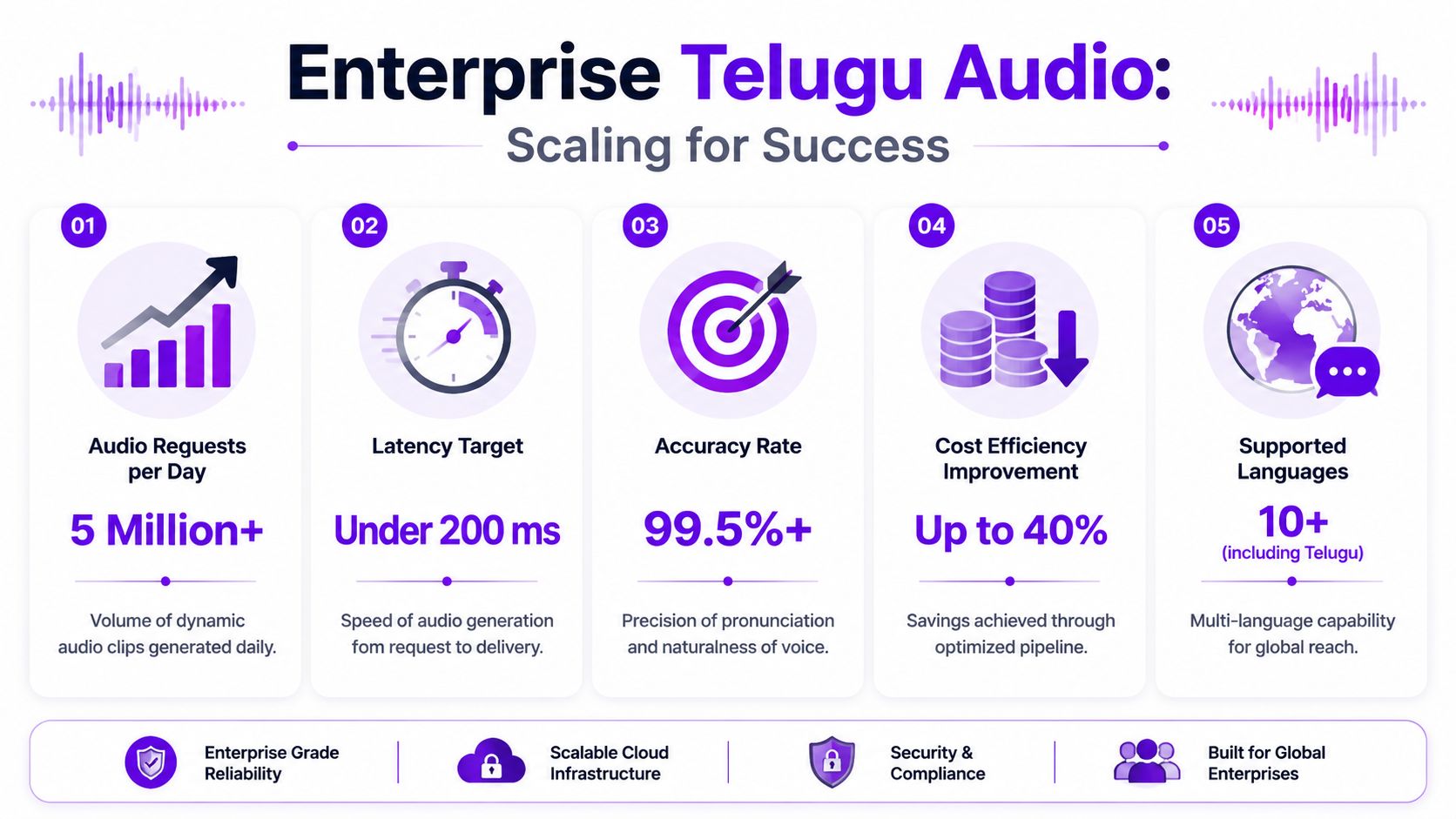
Scale changes the architecture
A scalable Telugu deployment usually combines live generation with selective caching. Static or repeated messages can be stored after approval. Dynamic fields such as names, due dates, or appointment details may still require on-demand synthesis.
The architectural priorities are straightforward:
- Cache what repeats: Greetings, policy intros, menu prompts, and standard disclosures shouldn't be regenerated every time.
- Separate batch from real time: E-learning exports, media libraries, and campaign assets belong in a different processing lane from live support or outbound calls.
- Protect downstream systems: If the TTS provider slows down, your CRM-triggered communications shouldn't collapse without fallback behaviour.
- Log every stage: Queue start, synthesis return, file write, and delivery handoff all matter.
Measure the full job, not just synthesis
For Telugu implementation benchmarking, the most defensible pattern from the provided sources is not a public accuracy score. It's a latency instrumentation pattern from an OpenAI community example that tracks start time, shows progress during API invocation, and measures elapsed time after generation and file save. That's a useful engineering lesson because it treats Telugu TTS as a multi-step job rather than a single API response (OpenAI community Telugu TTS implementation example).
That distinction is critical in production. Many teams monitor only the synthesis call and then wonder why user experience still feels slow. The listener doesn't care when the model finished internally. They care when the audio became available.
If you only measure model response time, you're undercounting the delay your customer hears.
The core metrics worth tracking are qualitative in this article because public benchmark numbers aren't provided here. In practice, leadership teams should still insist on trend visibility around end-to-end latency, failure categories, retry volume, and cache hit behaviour.
Where business systems integration pays off
The tangibility of ROI emerges. A Telugu audio layer becomes more valuable when it isn't isolated.
Examples:
- A CRM event triggers a Telugu reminder call with a customer's appointment details.
- A learning platform generates Telugu lesson narration from approved course text.
- A support workflow sends Telugu follow-up audio after a ticket status change.
- A sales sequence uses Telugu voice prompts for lead qualification and callback scheduling.
For multilingual operating models, it's also worth understanding adjacent tooling such as Translate AI's translation technology, especially when workflows involve translation, localisation, and voice delivery across more than one language.
Operationally, this is the point where voice belongs in the same planning conversation as automation, CRM hygiene, and contact-centre efficiency. Teams exploring those outcomes in Indian support environments may also find this analysis of voice AI in Indian call centres useful because the deployment questions are similar even when the specific use case changes.
Turning Conversations into Conversions
A good text to audio converter Telugu stack does more than speak. It lets an organisation communicate in a language the customer is comfortable hearing, with a delivery style that fits the moment and an operating model that doesn't break under load.
That creates value in practical ways. Support journeys become easier to follow. Education content becomes more accessible. Collections and reminders become clearer. Sales outreach sounds less generic. In each case, the commercial gain comes from reducing friction and increasing comprehension, not from voice automation alone.
The strongest implementations share the same habits. They select voices deliberately, prepare text rigorously, control nuance with SSML where needed, and treat latency and QA as board-level operational concerns rather than developer afterthoughts.
For Telugu-speaking markets, that discipline matters because scale is already there. The question isn't whether the audience exists. The question is whether your organisation can serve that audience with audio that sounds accurate, timely, and fit for the brand.
If your team is planning Telugu voice workflows for support, qualification, reminders, or presales, DialNexa Labs Private Limited is one option to evaluate for integrating Telugu voice AI into operational systems without building every component from scratch.

Leave a Reply