

Data for Real Estate Calling: A Strategic Blueprint for Targeted Lead Sourcing & Outreach
In real estate, superior data isn't just a list—it's the foundational asset of your entire sales engine. It's the critical differentiator separating a presales team hitting dead-end numbers from a high-performance unit consistently engaging qualified buyers and scheduling site visits. For any executive steering a real estate firm, mastering the data pipeline is synonymous with mastering revenue growth.
Why a Data-First Strategy is Your Unfair Competitive Advantage
The core challenge in today's real estate market isn't lead generation; it's securing strategic conversations with the right prospects at the precise moment of intent. A scattergun approach is an expensive relic of the past. A sophisticated data strategy is not an IT overhead; it's a direct lever for increasing gross booking value, shortening sales cycles, and optimizing operational expenditure.
Poor data carries tangible costs that directly impact your P&L. When calling lists are contaminated with invalid numbers and misaligned prospects, the financial and operational repercussions are severe.
The True Cost of Inaccurate Information
The immediate impact is felt by your sales team. High agent churn is a direct consequence of burnout from calling unqualified leads. The cost to replace a single sales agent can exceed ₹5,00,000 in recruitment, training, and lost productivity, a significant drain in a competitive market. A director overseeing a 50-person team could face an annual attrition cost of over ₹1 crore if churn hits 20%.
Beyond internal costs, poor data erodes brand equity. Every irrelevant call creates a negative brand touchpoint, diminishing your reputation and increasing the risk of your numbers being flagged as spam. This directly compromises the effectiveness of all future outreach campaigns.
The most significant hidden cost of bad data isn't the acquisition expense. It's the multi-crore opportunity cost—the high-value deals you missed because your top agents were occupied with leads that were never going to convert.
A Shifting Market Demands a Precision Approach
Consider the Indian residential real estate market. From 2023 to 2025, the market has pivoted from volume to value. It’s no longer about the sheer number of calls but about orchestrating fewer, higher-impact conversations. While the total number of units sold saw a modest dip, the aggregate sales booking value surged by 6% to ₹6 lakh crore.
This data tells a clear story for CXOs: each transaction carries a higher value, but the competition for every qualified buyer is exponentially fiercer. This reality places an enormous premium on possessing accurate, enriched lead data and executing a systematic follow-up process. You can explore these market dynamics further at the Global Property Guide.
Ultimately, allocating resources to a clean, enriched data pipeline is a direct investment in your bottom line. It drives higher booking values, accelerates sales velocity, and enhances team efficiency. It also creates the perfect foundation for Voice AI platforms to transform raw data into a scalable, revenue-generating machine.
Building a High-Performance Lead Sourcing Engine
The era of procuring massive, undifferentiated contact lists is over. A high-performance lead sourcing engine is not measured by the volume of contacts acquired but by its ability to populate your pipeline with actionable data for real estate calling—prospects demonstrating genuine purchasing intent.
For leadership, this demands a strategic shift in perspective. The key metric is not "cost-per-lead" but "investment-per-qualified-opportunity." The objective is to engineer a pristine, high-potential database from the point of inception.
This pivot immediately reduces wasted operational expenditure on dead-end calls, directly improving agent productivity and morale. A well-architected system doesn't just capture leads; it performs initial qualification, ensuring your team engages with prospects who are genuinely in-market. This preempts the common downward spiral where poor data quality leads to agent burnout and revenue leakage.
The entire sales workflow is jeopardized by a weak foundation.
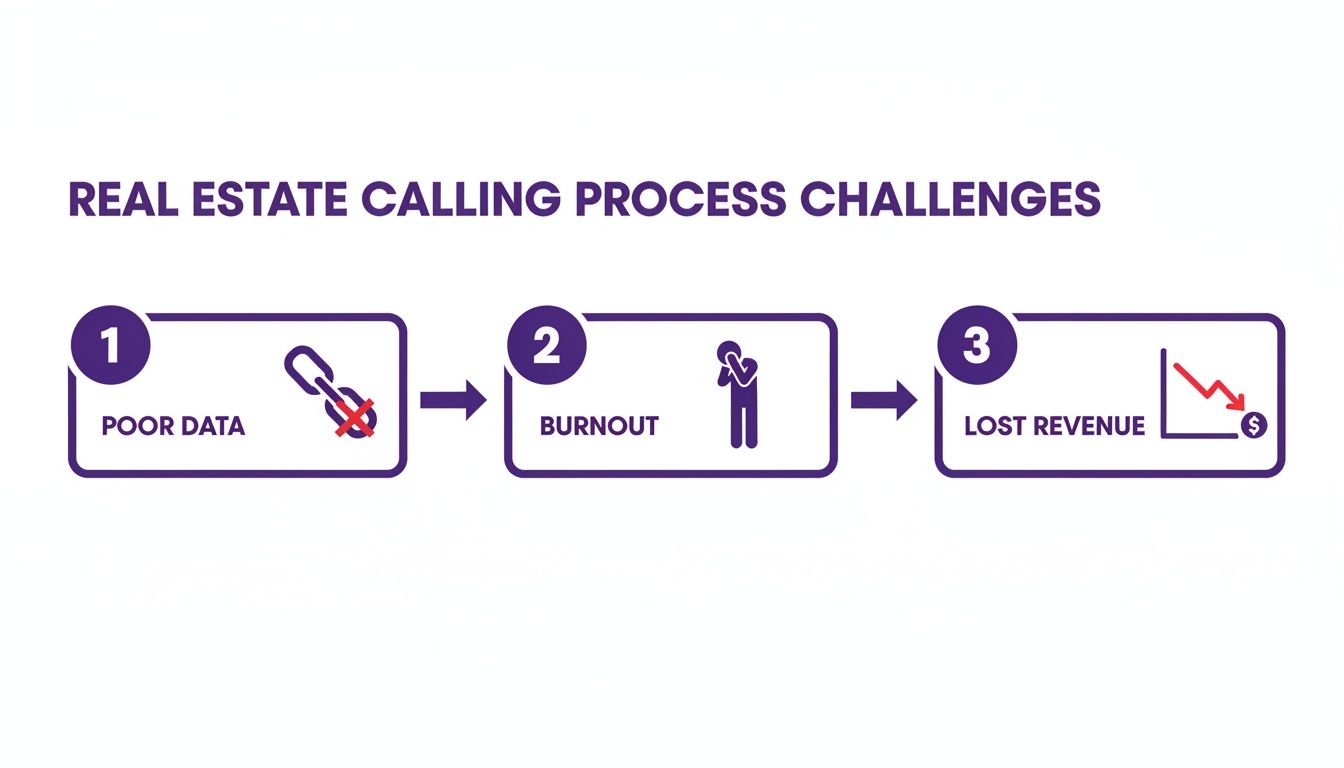
As illustrated, a poor data foundation leads directly to operational inefficiency and financial loss, underscoring the imperative for a robust sourcing and validation framework.
Strategic Sourcing Channels
To build a resilient lead pipeline, diversification is non-negotiable. A multi-channel strategy is the only prudent approach to guarantee a consistent flow of high-intent prospects.
These channels consistently deliver superior results:
- Digital Marketing Campaigns: Platforms like Google and Facebook Ads are invaluable for capturing active search intent. A prospect searching for "4BHK luxury apartments near Hiranandani Estate" has self-qualified their interest. The data from these inbound leads is typically of the highest quality due to being self-reported.
- Property Portal Aggregators: Major platforms like 99acres and MagicBricks function as lead generation powerhouses, attracting a vast audience of active property seekers and delivering a high volume of pre-warmed leads.
- Exclusive Channel Partner Networks: Strategic alliances with brokerage firms and financial institutions provide access to pre-vetted leads. For instance, a wealth management firm can provide introductions to HNI clients actively looking to diversify their investment portfolios into real estate. These partners serve as a critical first-level filter.
Executive Mandate: Every inbound lead, regardless of source, must undergo immediate, automated validation. Implement an API-based phone number verification to confirm active lines. Simultaneously, cross-reference against your CRM to identify and prioritize repeat inquiries—a prospect re-engaging signals heightened interest and should be fast-tracked for follow-up within 5 minutes.
Evaluating Lead Source Performance
Not all lead sources are created equal, and it is incumbent upon leadership to implement a rigorous performance measurement framework. You must evaluate sources based on cost, intent, and scalability to ensure optimal capital allocation. A high-volume, low-cost source may appear attractive on a spreadsheet, but if the lead quality results in a 98% disqualification rate, the true cost in wasted agent hours is astronomical.
To provide clarity, this table breaks down common sources based on the metrics that directly influence your bottom line.
Comparison of Real Estate Lead Data Sources
This table evaluates common lead sources based on key performance indicators relevant to CXOs, including lead intent, cost per lead, scalability, and typical data quality.
| Data Source | Typical Lead Intent | Average Cost Per Lead (INR) | Scalability | Data Quality & Accuracy |
|---|---|---|---|---|
| Digital Ads (PPC) | High | ₹500 – ₹2000 | High | Very High (95%+) |
| Property Portals | Medium to High | ₹250 – ₹800 | Very High | High (85-90%) |
| Channel Partners | Very High | Variable (Commission) | Medium | Excellent (98%+) |
| Purchased Lists | Very Low | ₹5 – ₹50 | High | Very Low (<40%) |
The strategic trade-offs are evident. While purchased lists offer immense volume at a low initial outlay, the negligible intent and poor data quality invariably yield a negative ROI. Conversely, digital ads and channel partners deliver prospects with significantly higher intent, justifying the greater investment. These channels must form the bedrock of any effective data for real estate calling strategy.
Turning Raw Data Into High-Value Conversations
Once your list is cleansed and validated, the process of value creation begins. A list of phone numbers is a commodity; the objective is to transform it into intelligent data for real-estate calling that drives strategic outcomes. Data enrichment and segmentation are the mechanisms for converting a basic contact list into a powerful tool for engaging premium buyers.
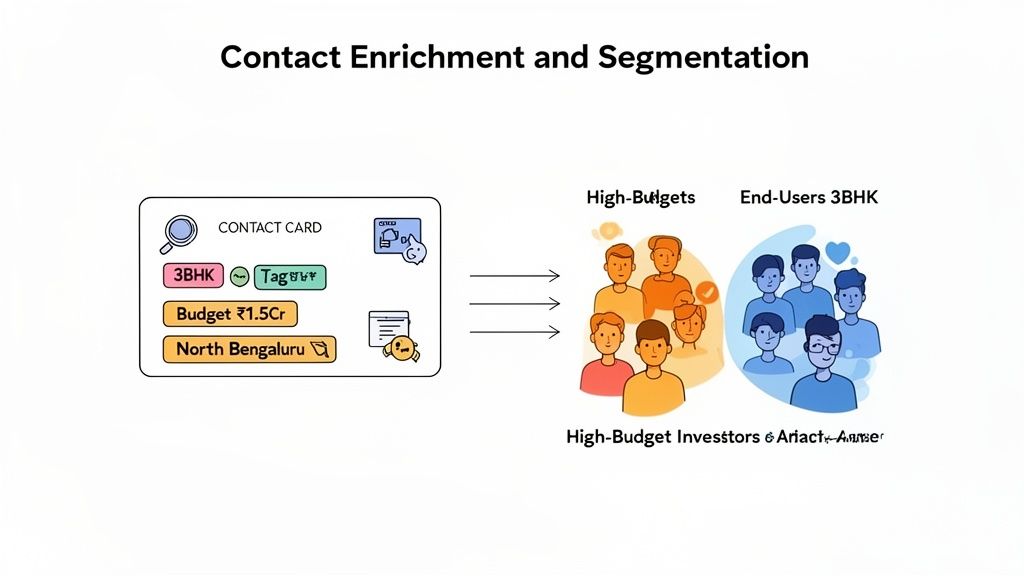
Enrichment is the process of building a comprehensive, 360-degree profile for each prospect. It’s about understanding the individual's context, motivations, and needs, moving beyond a transactional mindset.
Going Beyond Just a Name and Number
To ensure your outreach is perceived as consultative rather than intrusive, you must layer property-specific and behavioral data onto each contact record. This isn't data entry; it's the systematic construction of a detailed buyer persona within your CRM.
What data provides a strategic edge?
- Property Preferences: Move beyond "interested in a flat." Capture specifics: preferred BHK configuration (2BHK, 3BHK), desire for a higher floor, or non-negotiable amenities like a gym or swimming pool.
- Financial Profile: A prospect's budget range is a critical qualifier. A lead with a stated budget of ₹5 crore should be routed to a senior sales manager specializing in luxury properties, not a junior agent handling affordable housing.
- Online Behaviour: Digital footprints are powerful buying signals. Did a prospect spend 15 minutes on the floor plan page of your 4BHK villa project and download the brochure? This indicates high intent. Your opening call script should immediately reference their interest in that specific property, demonstrating relevance.
This level of granularity is critical. Recent analysis of Indian residential market dynamics reveals that new launches of homes under ₹1 crore have declined by approximately 20%, while projects exceeding ₹1 crore saw a 5% increase. Premium buyers expect a bespoke, high-touch experience, and enriched data is the key to delivering it.
Creating Laser-Focused Audience Segments
With this richer dataset, you can execute hyper-segmentation—the practice of grouping prospects into highly specific cohorts based on shared characteristics. Generic, mass-market lists are obsolete; precision is the new benchmark for performance.
The strategic purpose of segmentation is to ensure every touchpoint feels contextually relevant. When a prospect feels understood from the first second of a call, the probability of securing a site visit increases dramatically.
Instead of a monolithic calling list, you can now orchestrate targeted micro-campaigns.
Practical Application:
- The High-Budget Investor (North Bengaluru): This segment includes leads with a budget exceeding ₹2 crore who have shown interest in properties in Hebbal or Yelahanka. The call script for this cohort must be architected around capital appreciation, projected rental yields of 4-5%, and proximity to the airport and major tech parks.
- The Family Homebuyer (Hyderabad's IT Corridor): This segment targets families actively searching for 3BHKs near Gachibowli or HITECH City. The conversation should be oriented around benefits like proximity to international schools (e.g., Oakridge, Chirec), community amenities, and improved work-life balance.
This targeted methodology allows you to deploy Voice AI with customized scripts and conversational flows tailored to the specific motivations of each segment. When the message aligns perfectly with known preferences, you achieve not just higher engagement, but significantly improved conversion rates.
Using Voice AI To Scale Your Calling Operations
Possessing high-quality, segmented data for real estate calling is necessary but not sufficient. The ability to activate this data at scale is where operational excellence is achieved. Here, Voice AI transitions from a technological novelty to a mission-critical operational asset, enabling engagement with every lead with a level of precision and consistency unattainable by human teams alone.
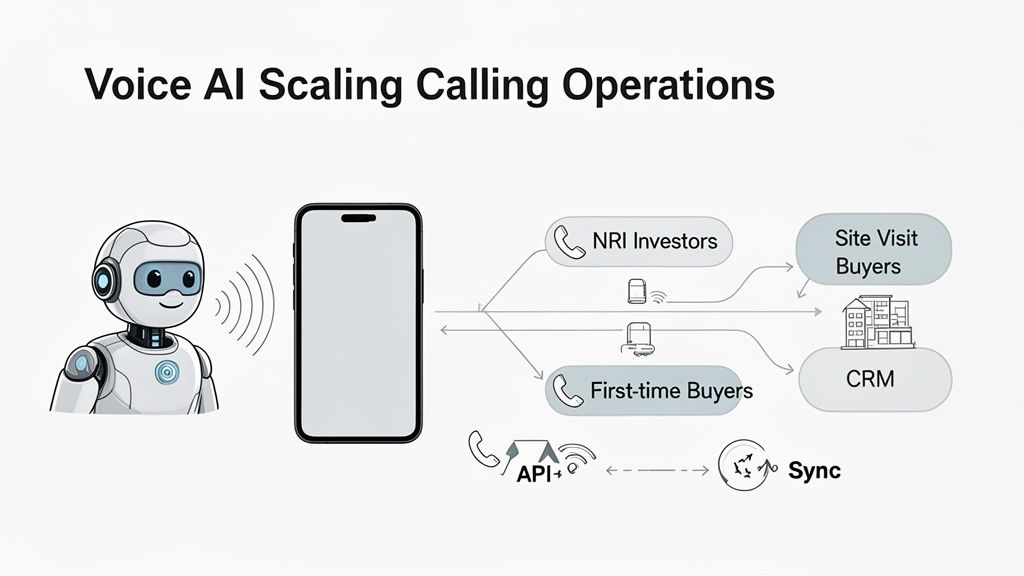
The foundational step is a seamless API integration between the Voice AI platform and your CRM. This creates an automated, closed-loop workflow. Enriched lead data is ingested by the AI to initiate campaigns; post-call, all outcomes—recordings, structured summaries, and qualification status—are pushed back into the CRM in real-time.
This creates a powerful, self-optimizing feedback loop. Every conversation enriches your database, making each subsequent interaction progressively more intelligent.
Executing Dynamic, Multi-Segment Campaigns
From a strategic perspective, the primary advantage is the ability to execute multiple, concurrent, tailored campaigns. For example, a Voice AI agent can run a campaign targeting NRI investors, using a script that emphasizes rental yields and capital appreciation. Simultaneously, it can engage first-time homebuyers with conversations centered on project amenities, financing options, and neighborhood safety.
This parallel processing capability guarantees 100% lead coverage with resonant messaging. High-potential leads are never missed due to agent availability constraints. For leadership, this ensures a standardized qualification process with over 97% accuracy, guaranteeing that only genuinely interested and qualified prospects are handed off to the sales team. Missed calls represent a significant revenue leakage point; learn more about the AI solution in our detailed guide.
The strategic objective is to transform outbound calling from a manual, high-effort function into an automated, intelligent system. This liberates your most valuable sales talent to focus on high-leverage, revenue-closing activities rather than repetitive qualification calls.
This scalable model is no longer a luxury but a strategic necessity. With India’s construction market projected to become the third largest globally by 2025, the volume of potential buyers is expanding rapidly. A data-first, AI-powered calling platform is the most direct way to convert this market growth into a predictable pipeline of site visits and bookings. You can review the macro trends in India's real-estate growth trajectory on cushmanwakefield.com.
Measuring the Real ROI of Your Data-Driven Calling Strategy
Investing in premium data for real estate calling and pairing it with a sophisticated Voice AI is a strategic capital allocation. Consequently, measuring its return on investment (ROI) is paramount. Metrics like "total calls made" are operationally tactical but strategically irrelevant. For the C-suite, the focus must be on business outcomes that directly impact revenue and profitability.
The right key performance indicators (KPIs) provide an accurate assessment of your outreach engine's health and effectiveness. An executive dashboard should offer a real-time, high-level view of these metrics, enabling data-driven decisions on what to scale and what to cut.
From Busy Work to Business Impact
Effective measurement requires a focus on KPIs with a direct correlation to financial performance. VPs and directors must look beyond vanity metrics and concentrate on what drives business growth. This is how you make informed decisions that optimize spend and maximize returns.
The Metrics That Matter:
- Lead Qualification Rate: What percentage of engaged leads are deemed sales-ready by the AI? A robust rate, for example 25% or higher from a high-intent source like Google Ads, indicates that your data sourcing and segmentation are effective.
- Site Visit Conversion Rate: Of those qualified leads, what percentage schedule a site visit? This metric is a powerful indicator of lead quality and the efficacy of your initial outreach. A rate of 12% means that for every 100 qualified leads, 12 high-potential buyers are visiting your property.
- Customer Acquisition Cost (CAC): The definitive bottom-line metric. Calculated by dividing the total cost of data, technology, and campaigns by the number of new customers acquired. Premium data and intelligent AI should drive a consistent reduction in CAC over time. For a luxury project, reducing CAC from ₹8 lakh to ₹6 lakh per unit represents a massive efficiency gain.
This creates a data-driven feedback loop for capital allocation. If a specific lead source consistently yields a connection rate below 60%, it’s a clear signal to re-evaluate that partnership. Conversely, if a micro-campaign targeting doctors for a project near a hospital complex delivers a 20% site-visit booking rate, you have validated a high-ROI strategy and can confidently double down on that investment.
The C-Suite Dashboard: A Clear View from the Top
This framework outlines the critical metrics CXOs should monitor. It shifts the focus from operational volume to strategic outcomes that define the profitability and success of your real estate calling campaigns.
Key Performance Indicators for a Data-Driven Calling Strategy
| Metric | What It Measures | Industry Benchmark | Why It Matters to CXOs |
|---|---|---|---|
| Lead Qualification Rate | Percentage of contacted leads that meet sales-ready criteria. | 20-30% | Directly reflects the quality of data sourcing and initial targeting efficiency. |
| Site Visit Conversion Rate | Percentage of qualified leads who book a site visit. | 10-15% | A core indicator of prospect intent and the effectiveness of the initial sales pitch. |
| Customer Acquisition Cost (CAC) | Total campaign cost divided by the number of new customers. | Varies by market | The ultimate measure of marketing and sales efficiency and profitability. |
| Connect Rate | Percentage of calls that successfully connect to a person. | > 70% | Indicates the health and accuracy of your phone number data. |
| Cost Per Qualified Lead (CPQL) | The cost to generate one sales-ready lead. | Varies | A key financial metric for optimising budget allocation across different channels. |
| Sales Cycle Length | Average time from initial contact to closing a deal. | Varies | Shorter cycles mean faster revenue recognition and improved cash flow. |
Tracking these KPIs provides the clarity needed to steer the business effectively. It elevates your outbound calling efforts from a cost center to a predictable, scalable revenue engine.
Turning Insights into Action
Imagine your dashboard reveals that leads from a specific channel partner have a 15% higher site visit conversion rate than your digital ad campaigns, despite a similar CPQL. This is an actionable insight. It provides the data-backed confidence to reallocate a portion of your marketing budget, amplifying investment in the channel delivering superior down-funnel results.
This level of visibility transforms your calling operation from an expense line item into a strategic growth driver. By focusing on these outcomes, leadership can navigate toward sustained growth with the confidence that only clear, undeniable data provides.
Getting Data Compliance Right in Real Estate
As a leader, you understand that compliance is not a bureaucratic hurdle; it is a fundamental component of brand reputation and risk management. When leveraging data for real estate calling in India, adherence to Telecom Regulatory Authority of India (TRAI) guidelines is non-negotiable. Non-compliance can result in severe financial penalties and irreparable brand damage.
The primary regulation is the National Do Not Disturb (DND) registry, a database containing over 240 million registered numbers. Contacting any of these numbers for marketing purposes without explicit, prior consent constitutes a clear violation. The financial and reputational risk is simply unacceptable for any serious enterprise.
Automation is Your Compliance Safety Net
Manual verification of every number against the DND registry is operationally infeasible. It is slow, prone to human error, and introduces unacceptable levels of risk.
Modern calling platforms automate this process entirely, scrubbing calling lists against the live DND database before any calls are initiated. This serves as your first and most critical line of defense.
For example, a campaign list of 10,000 leads can be automatically scrubbed in minutes. If the system identifies and removes 2,800 DND-registered numbers, it has instantaneously prevented 2,800 potential violations, protecting your telemarketing license and brand integrity.
Your approach to data compliance is a direct reflection of your company's commitment to consumer privacy. It is not an operational burden but a cornerstone of building brand trust. This perspective empowers leadership to scale calling operations responsibly and confidently.
Maintaining meticulous records of consent is equally critical. For a web form lead, this means storing the timestamped digital submission as immutable proof of consent. These records are indispensable in the event of a regulatory audit.
The regulatory landscape can be complex. For a deeper analysis, review our guide on the legality and ethics of AI phone calls. By embedding automated compliance checks and rigorous record-keeping into your operational workflow, you mitigate legal risk and build a foundation of trust from the very first interaction.
Your Questions, Answered
What Kind of ROI Can I Genuinely Expect From Premium Data?
This is a critical question for any executive. The return is substantial and multi-faceted. We have observed clients improve their connect rates from a sluggish industry average of 47% to over 90%. This single metric doubles the productivity of any outreach effort.
However, the true ROI is measured further down the funnel. The lead-to-booking ratio is where the financial impact becomes clear. We have seen this metric improve from a typical 2% to as high as 8% with high-quality, segmented data. The ROI is realized through drastically reduced wasted agent hours, higher conversion rates, and accelerated sales velocity for high-value inventory.
Is Voice AI Really Better Than Our Old IVR for Handling Complex Real Estate Questions?
The comparison is one of different technological generations. A legacy IVR is a rigid, limited, push-button menu. A conversational Voice AI is designed for dynamic, natural-language dialogues that can last several minutes.
It can intelligently discuss the nuances of project amenities, RERA registration status, complex payment schedules, and specific location advantages. For instance, it can execute a detailed qualification script, asking about a prospect's budget, timeline, and financing needs, capture this structured data, and then seamlessly schedule a site visit or a callback with a senior sales consultant. It provides a sophisticated and satisfactory experience for a high-value prospect.
How Long Will It Take to Get Voice AI Working With Our Current CRM?
The era of protracted, multi-month integration projects is over. For modern platforms, the process is remarkably efficient. If you utilize a CRM with a standard API—such as Salesforce, HubSpot, or LeadSquared—a foundational integration can be deployed in a matter of days, not months.
This creates a powerful, automated data flywheel. The Voice AI ingests lead lists for outbound campaigns and then pushes all valuable outcomes—call recordings, transcripts, and structured qualification data—directly back into your CRM, continuously enriching your central data asset with every call made.
Ready to see how intelligent, scalable Voice AI can transform your real estate outreach? At DialNexa, we specialise in turning high-quality data into qualified leads and booked site visits.
See how our human-like agents can drive your conversions at https://dialnexa.com.

[…] pipeline growth from calendar noise. Teams building that measurement layer can use this guide to data for real estate calling to define which fields should be captured before a site visit is handed to […]
[…] outbound-heavy teams, the data layer matters just as much as the model. This breakdown of data for real estate calling is useful because calling performance depends on segmentation quality, recency, and call […]
[…] and move buyers toward a confirmed appointment. For firms examining this operational problem, data strategies for real estate calling and lead conversion offer a more relevant lens than campaign metrics […]
[…] teams exploring call operations in more depth, this guide to data for real estate calling is relevant because lead quality in calling programmes depends heavily on the structure and […]