
Sip Call Flow: Mastering Reliable Business Communications
A Session Initiation Protocol (SIP) call flow is the digital handshake that happens behind the scenes to establish, manage, and terminate a phone or video call over the internet. It’s a precise sequence of messages ensuring that when a customer dials your business, the call connects to the right person, the quality is crystal clear, and it concludes professionally. For a business leader, this isn't just technology—it's the fundamental blueprint for every conversation that drives your revenue and reputation.
Why Your SIP Call Flow is a Strategic Business Asset
For many executives, "SIP call flow" sounds like technical jargon best left to the IT department. This perspective misses a critical opportunity. Your SIP call flow is the digital supply chain for your company's most vital asset: its voice. Just as a logistics network governs the movement of physical goods, your SIP flow dictates the speed, reliability, and cost-efficiency of every customer conversation.
Understanding this process is not merely an IT function; it's a core component of modern business strategy. Every step, from the initial "INVITE" message to the final "BYE," directly impacts operational performance. A poorly configured flow leads to dropped calls, garbled audio, and frustrated customers—directly harming your brand and bottom line.
Connecting Technical Steps to Business Growth
A high-performance SIP call flow is the backbone of any scalable, modern communication system. It is essential for supporting today's business realities: remote teams, global expansion, and the relentless demand for a superior customer experience. When this digital supply chain is optimized, the strategic results are tangible.
Consider the real-world impact on a fast-growing e-commerce company. Before optimizing their SIP flow, their customer service line frequently dropped international calls, leading to a 15% increase in negative reviews. After a strategic overhaul, they not only stabilized call quality but also reduced their average call setup time by three seconds. This seemingly small technical tweak contributed to a 10% lift in their Customer Satisfaction (CSAT) score within a single quarter.
Key strategic advantages include:
- Faster Customer Connections: An efficient flow reduces the time to connect a customer to the right agent, directly improving first-call resolution rates and minimizing wait times.
- Enhanced Call Quality: Proper management ensures every connection is stable and crystal-clear. This is mission-critical for high-stakes sales negotiations and premium customer support.
- Significant Cost Reductions: Transitioning from legacy phone lines to SIP trunking can slash communication overhead, freeing up capital for strategic investments in growth or innovation.
The rapid adoption of SIP trunking in India is a perfect example. According to the Telecom Regulatory Authority of India (TRAI), SIP adoption among Indian businesses has jumped by over 45% since 2022. This boom is fuelled by huge cost efficiencies, with companies reporting average savings of 30-50% on their monthly telecom bills. Discover more insights about SIP trunking adoption in India and its financial benefits.
When leadership views the SIP call flow as a strategic asset, the conversation shifts from IT maintenance to business enablement. It becomes a powerful tool for building a more agile, resilient, and customer-centric organization.
Connecting SIP Stages to Business Outcomes
To bridge the gap between technical details and strategic value, it helps to see how each phase of the SIP call flow directly contributes to key business goals. This table breaks it down.
| SIP Stage | Core Function | Impact on Business Strategy |
|---|---|---|
| Registration & Authentication | Securely identifies and validates user devices on the network. | Protects against toll fraud and ensures only authorized users access the system, safeguarding corporate assets and preventing catastrophic financial loss. |
| Call Initiation (INVITE) | Sends a request to start a call and negotiate media parameters. | Directly impacts speed-to-answer metrics and the initial customer impression; efficiency here reduces abandonment rates and improves lead capture. |
| Media Establishment (SDP/RTP) | Sets up the actual voice/video stream between endpoints. | Determines call quality and clarity, which is fundamental to effective communication, brand perception, and customer satisfaction. |
| Call Termination (BYE) | Gracefully ends the session and releases network resources. | Ensures accurate call detail records (CDRs) for billing, analytics, and performance tracking, preventing resource leaks and billing errors. |
Ultimately, a deep understanding of these stages empowers leaders to ask the right questions and drive improvements that directly enhance operational performance and profitability.
Paving the Way for Future Innovation
Optimizing your SIP call flow isn't just about solving today's communication challenges; it’s about preparing your organization for the future. A solid SIP foundation is the non-negotiable prerequisite for integrating advanced technologies like AI-driven analytics and intelligent automation.
For instance, a leading financial services firm leveraged its robust SIP infrastructure to deploy an AI-powered voice agent. This agent now handles over 60% of inbound qualification calls, allowing their senior advisors to focus exclusively on high-value client consultations. This was only possible because their underlying SIP flow was reliable and scalable. You can learn more about the role of AI in telephony in our detailed article. By turning this seemingly technical process into a clear competitive advantage, you position your company to not only keep up but to lead the pack.
A Step-by-Step Walkthrough of a Typical Business Call
Let's move beyond abstract diagrams and examine how the SIP call flow functions in a high-stakes business scenario. Imagine a key prospect, the CIO of a target enterprise account, calls your main sales line after a compelling product demo. The fact that their call connects instantly to your top sales executive is not magic—it's a high-speed, logical conversation between different systems.
This digital dialogue is what underpins every reliable call. For any executive, understanding this sequence is key to appreciating the robust infrastructure that facilitates every successful client interaction, from initial contact to a closed deal.
The Initial Handshake: INVITE and Ringing
The moment the CIO dials, their phone system sends an INVITE message. This is the digital equivalent of a formal introduction: "Hello, I'd like to speak with your enterprise sales team." This single data packet contains all critical information: the caller's identity, the destination, and the desired media (in this case, audio).
Your system immediately responds with a 100 Trying message—a swift "Request received" acknowledgment. Almost simultaneously, it sends a 180 Ringing message. This signal triggers the audible ringing on the CIO's end, providing immediate assurance that the call is being connected. This phase is crucial for the customer experience, offering instant feedback and preventing premature hang-ups.
This visual shows how each phase—from initiating the call to connecting networks and optimising performance—contributes to business growth.
A well-managed flow ensures this critical first impression is seamless, directly influencing the prospect's perception of your company's professionalism and operational efficiency.
Making the Connection: 200 OK and ACK
When your sales executive answers, your system sends the most important message of all: 200 OK. This signals to the CIO's system, “We are connected and ready to talk.” It also finalizes the technical parameters, such as the IP addresses and audio channels for the voice data.
To ensure this connection is foolproof, the CIO’s system sends one final confirmation: an ACK (Acknowledge). This is the definitive handshake confirming both parties are ready. Once the ACK is transmitted, the real-time conversation begins, with voice data flowing securely between your executive and the prospect.
This three-way handshake (INVITE, 200 OK, ACK) is the heart of every successful SIP connection. Its speed and efficiency directly impact call setup time—a critical KPI for any sales or support team. A delay of just a few seconds can be the difference between a patient prospect and a lost opportunity.
Ending the Call Gracefully: The BYE
Once the conversation concludes and your executive has secured the next meeting, one party hangs up. This action triggers a BYE message, signaling to the other system that the call is officially over.
The receiving system confirms this with its own 200 OK. This final exchange ensures the session is closed cleanly, releasing all network resources for the next inbound call. Proper termination is vital for maintaining accurate call analytics, billing records, and system readiness.
This play-by-play demonstrates that the SIP call flow is far more than technical jargon. It's the meticulously orchestrated process that underpins your entire voice communication strategy, with each message playing a specific role in creating a reliable and professional experience for every stakeholder.
The Digital Handshake Securing Your Communications
Before any calls are made or received, a critical security check occurs behind the scenes: SIP registration. For any business leader, this process is the first and most important line of defense for the entire communications network. A failure here exposes your system to significant financial and reputational risk from fraud and unauthorized access.
A useful analogy is an employee using an encrypted keycard to access a secure facility. Before they can access sensitive data or company resources, they must authenticate at the main entrance. SIP registration performs the exact same function for your communication devices, whether it’s a desk phone in headquarters or a softphone app on a remote executive's laptop.
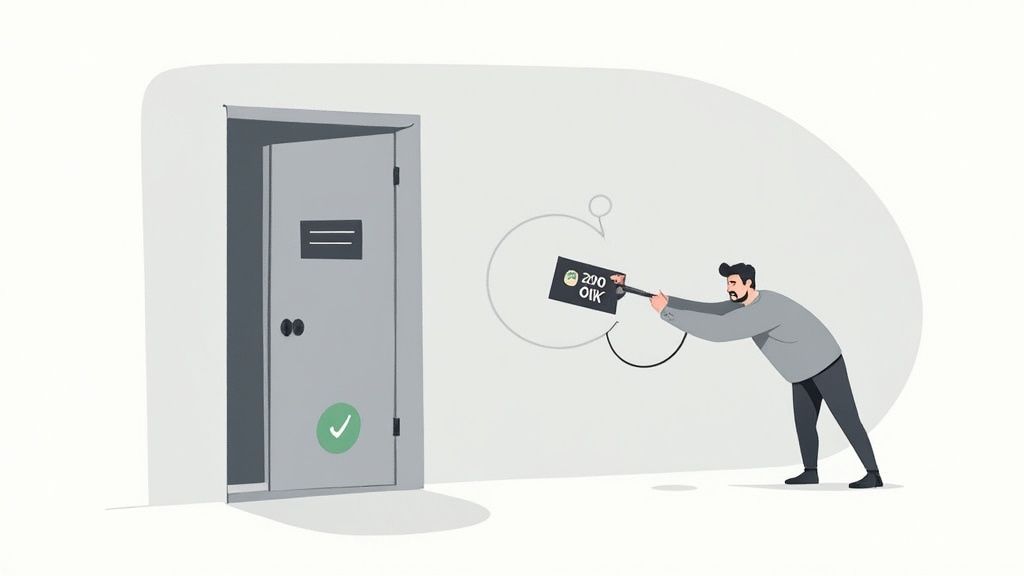
The Registration Process Unpacked
This entire process is a straightforward but absolutely essential component of a secure SIP call flow. It begins the moment a device—for instance, your CFO’s softphone app—connects to the network.
- The REGISTER Request: The app sends a
REGISTERmessage to your central SIP server (often a PBX or Session Border Controller). This message contains the user's credentials, such as their SIP username and password, acting as the initial keycard swipe. - The Authentication Challenge: The server receives the request and replies with a
401 Unauthorizedmessage. This is not an error but a deliberate security challenge. The server is saying, "Prove you are who you claim to be," and sends back a unique, one-time code called a "nonce." - The Encrypted Response: The device combines this nonce with the user's password to create a secure, encrypted hash, which it sends back in a new
REGISTERmessage. Critically, the actual password is never transmitted unprotected over the network. - The Confirmation: The server performs the same calculation. If the hashes match perfectly, it grants access by sending a
200 OKresponse. The user is now authenticated and online, and the server knows the device's current IP address, enabling it to route incoming calls precisely.
This digital handshake is the bedrock of a secure and reliable communication system, especially for organizations with remote or hybrid workforces.
For any leadership team, mandating a robust registration process is a critical governance decision. It is the primary defense against toll fraud—where cybercriminals hijack your system to make thousands of unauthorized international calls—which can result in catastrophic financial losses, sometimes overnight.
Why This Handshake Matters for Business Integrity
In the modern hybrid workplace, your team connects from diverse locations. A sales director might be at a client’s office, a support agent at their home, and a C-level executive traveling internationally. The SIP registration process ensures that, regardless of location, their connection to the corporate phone system is authenticated and secure.
This process delivers two immense business benefits:
- Security Assurance: It validates the identity of every user attempting to access your network. This locks out malicious actors and protects valuable communication assets from unauthorized use that can cost a company a fortune. For example, a global consulting firm prevented an estimated $50,000 in toll fraud in a single weekend by implementing multi-factor authentication within their SIP registration flow.
- Operational Integrity: It maintains a real-time directory of every user's location on the network. This enables your system to route calls efficiently to the right person, whether it’s an internal extension dial or an urgent customer call. It ensures the communication experience remains seamless and professional for everyone.
By understanding and enforcing this digital handshake, you build your entire communication strategy on a foundation of security and trust, safeguarding both your bottom line and your company's operational continuity.
How Advanced Call Flows Drive Business Agility
While a standard call connects two parties, true operational excellence is achieved by mastering advanced SIP features. For business leaders, these are not just technical add-ons; they are powerful tools that solve complex business problems, boost productivity, and significantly enhance the customer experience. Understanding how these sophisticated flows operate reveals the strategic flexibility of SIP.
These advanced capabilities allow your communication system to adapt dynamically to business needs. Instead of rigid, linear call paths, you can create intelligent, responsive workflows that ensure no opportunity is missed and every customer receives premium service. This is where the SIP call flow transitions from a simple connection mechanism to a strategic business asset.
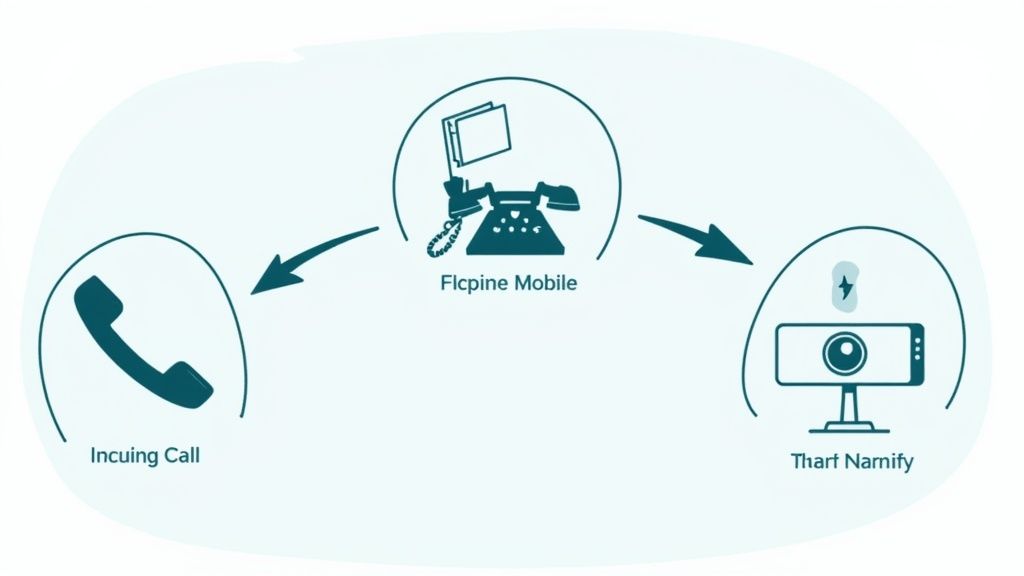
This level of flexibility is why the market is expanding so rapidly. India’s SIP trunking market, for instance, is projected to grow at a compound annual growth rate of 28.5% through 2026. This growth is driven by industries like IT and financial services that require scalable, cost-effective communication with advanced features to manage high call volumes and ensure robust business continuity.
Scenario 1: Never Miss a Sales Lead with Call Forking
Imagine a high-value lead calls your main sales line. Your top salesperson is at their desk but also uses a company mobile app while moving around the office. With a basic setup, this call could easily go to voicemail if they step away. Call Forking turns this potential loss into a guaranteed connection.
Here’s a practical example: A real estate agency implemented call forking for its top agents. In the past, 20% of inbound inquiries from their website went to voicemail. After forking calls to both desk phones and mobile apps, their answer rate for new leads increased to 98%, directly contributing to a 12% rise in property viewings booked.
How it works:
- An incoming call (
INVITE) arrives at the system. - The system "forks" this request, sending simultaneous
INVITEs to the salesperson's desk phone and their mobile softphone. - The first device answered sends back a
200 OK, establishing the call. The system then sends aCANCELmessage to the other device, stopping it from ringing.
This elegant flow ensures that critical calls are answered promptly, directly translating into better responsiveness and fewer lost revenue opportunities.
Scenario 2: Seamless Customer Support with Call Transfer
Consider a customer support scenario in a wealth management firm. A client calls with a complex inquiry about their portfolio. The junior associate handling the call needs to escalate to a senior financial advisor. A clumsy handoff, requiring the client to call back, is unprofessional and erodes trust. A Call Transfer provides a seamless, white-glove solution.
This is commonly handled using the REFER message.
- Initial Call: The client is speaking with the junior associate (Call A).
- Handoff Initiated: The associate places the client on hold and calls the senior advisor (Call B).
- The Transfer: Once the advisor is briefed and ready, the associate's system sends a
REFERmessage. This instructs the system to "Connect the client from Call A directly to the advisor from Call B." - New Connection: The system then sends a new
INVITEfrom the client's device straight to the advisor, creating a new, seamless connection without the associate remaining on the line.
This flow creates a professional and efficient experience, vital for high-touch service industries where precision and customer confidence are paramount. Improving these journeys is a key area where data and AI will transform contact centres for financial services.
Scenario 3: From Audio Call to Video Deal Closing with re-INVITE
Your VP of Sales is on an audio call with a high-value prospect. The conversation is progressing well. To close the deal, they need to bring in a product engineer for a live demonstration. A simple audio call is insufficient. The re-INVITE message enables an instantaneous, in-call upgrade to a video conference.
A
re-INVITEis a powerful SIP message sent mid-call to modify an existing session. It allows you to change key parameters, like adding video or new participants, without disconnecting and starting over.
Here’s how it works:
- The initial audio call is active.
- The VP's device sends a new
INVITE(are-INVITE) to the prospect, but this time, the message includes parameters for video. - The prospect accepts, their device sends a
200 OKwith its video capabilities, and the video stream is added seamlessly to the existing audio call.
This ability to dynamically escalate a conversation gives your team the agility to seize opportunities and compress the sales cycle.
To summarize, here is how these advanced SIP call flows translate into tangible business advantages.
Comparing Advanced SIP Scenarios
| SIP Scenario | Strategic Business Application | Primary SIP Messages |
|---|---|---|
| Call Forking | Ensures critical sales or support calls are answered by ringing multiple devices simultaneously. A direct strategy to reduce missed revenue opportunities. | INVITE, 200 OK, CANCEL |
| Call Transfer | Provides a seamless handoff between team members (e.g., Tier 1 to Tier 2 support), elevating the customer experience and reinforcing brand professionalism. | REFER, INVITE |
| re-INVITE | Upgrades a live call on the fly, for instance, escalating an audio sales call to a multi-party video demo to accelerate deal closure. | re-INVITE, 200 OK, ACK |
Ultimately, these advanced flows transform a standard phone system into a dynamic tool for business growth, helping you stay responsive, efficient, and ahead of the competition.
Optimising Your SIP Infrastructure for Peak Performance
Having a well-designed SIP call flow is one thing, but ensuring it operates flawlessly under real-world business conditions is another. This depends entirely on the strength and resilience of your infrastructure. For any executive, guaranteeing that every customer conversation is crystal clear is non-negotiable. This requires moving beyond diagrams to address the practical hurdles that can impact performance, security, and scalability.
Getting this right transforms your communication system from a potential liability into a reliable engine for business growth. The goal is not just to build something that functions today, but to create a foundation that is ready for future demands, whether that’s supporting a larger remote workforce or maintaining business continuity during an unexpected outage.
Tackling Common Operational Hurdles
One of the most common—and frustrating—challenges is Network Address Translation (NAT). NAT acts like a receptionist for your office network, managing how all your internal devices share a single public internet address. However, it can misdirect SIP messages, leading to one-way audio or calls that fail to connect—a critical failure point, especially for remote teams.
Security is another non-negotiable area. Protecting sensitive business conversations is often a legal and regulatory requirement. This is where Transport Layer Security (TLS) and the Secure Real-time Transport Protocol (SRTP) are essential. TLS encrypts the call setup messages, while SRTP encrypts the audio stream itself, creating a secure, private communication channel from end to end. For example, a healthcare provider uses TLS and SRTP to ensure all telehealth consultations are HIPAA compliant, protecting patient privacy and avoiding severe regulatory penalties.
For any executive, the key takeaway is this: your SIP infrastructure is only as strong as its weakest link. Overlooking issues like NAT traversal or encryption isn't a minor technical oversight—it's a direct risk to your operational stability and data security.
Best Practices for SIP Trunking and Scalability
As your business grows, your call volume will increase. SIP trunking—which connects your phone system to the public telephone network over the internet—is the game-changer for cost-effective scalability. Its value is evident in the market's explosive growth.
For instance, the SIP trunking market in India has seen a massive surge, with October 2025 recording a record ₹29,529 crore in gross monthly inflows. This marked the thirteenth straight month where monthly flows exceeded ₹25,000 crore, highlighting just how much confidence businesses and investors have in the technology. You can read more about these SIP flow trends.
To maximize the strategic value of SIP trunking, focus on these fundamentals:
- Ensure Sufficient Bandwidth: Voice quality is highly sensitive to network congestion. Inadequate bandwidth causes jitter and packet loss, which manifest as choppy, unprofessional audio. Learn how to address these issues in our guide to voice latency reduction.
- Implement Redundancy: A sound business continuity plan requires backup internet connections and failover routes with diverse providers. If your primary service fails, your business communications do not.
- Monitor Call Quality Metrics: Keep a close watch on metrics like Mean Opinion Score (MOS), jitter, and packet loss. These KPIs are a direct reflection of your customer's experience, enabling your team to proactively identify and resolve issues.
Asking the Right Questions for Strategic Oversight
As a leader, you don't need to be a network engineer, but you must ask the right strategic questions to your technical teams and vendors. This ensures your communication infrastructure fully supports your business objectives.
Start with these:
- Security: "How are we encrypting our voice traffic to prevent industrial espionage? What is our defense strategy against toll fraud?"
- Disaster Recovery: "What is our failover protocol? If our primary SIP provider has an outage, what is the RTO (Recovery Time Objective) for our voice communications?"
- Service Level Agreements (SLAs): "What uptime and call quality guarantees does our provider offer? What are the financial penalties if they fail to meet these SLAs?"
By focusing on these core areas, you can guide your organization toward building a SIP infrastructure that is not just functional, but a secure, resilient, and scalable asset that drives business forward.
Answering Your Key Questions About SIP Call Flow
As a business leader, you need clear, concise answers to make informed decisions about your communication infrastructure. Let's cut through the jargon and address the strategic questions that matter when managing or investing in SIP technology.
How Does Understanding SIP Call Flow Help Reduce Costs?
Understanding the journey your calls take transforms you from a passive consumer of telecom services into an active manager of your budget. It’s the difference between merely paying a bill and strategically optimizing it. When you understand the mechanics, you can identify and eliminate expensive inefficiencies.
A prime example is replacing costly, rigid ISDN/PRI lines with flexible SIP trunks. For a mid-sized enterprise with 200 employees, this move alone can result in annual savings of over $50,000. Furthermore, knowledge of call routing allows you to work with providers to ensure you are using the most cost-effective paths for international calls. This empowers you during contract negotiations, allowing you to specify exact capacity and failover requirements and avoid paying for underutilized resources. Typical savings range from 30-60% on monthly communication bills.
What Is the Biggest Security Risk with SIP?
The single greatest threat, both financially and reputationally, is toll fraud. This occurs when attackers breach your system to make thousands of fraudulent calls, typically to international premium-rate numbers, leaving your company liable for the exorbitant bill. Beyond this, call eavesdropping and denial-of-service (DoS) attacks that can cripple your entire communication platform are also significant risks.
A robust defense strategy requires multiple layers:
- Enforce Strong Authentication: Mandate complex passwords and secure protocols for all users and devices.
- Deploy a Session Border Controller (SBC): An SBC acts as a dedicated security gateway for your voice traffic, inspecting every call and blocking suspicious activity.
- Mandate Encryption: Using TLS for signaling and SRTP for audio makes your conversations unreadable to external threats.
These measures create a formidable shield, protecting your financial assets and ensuring the confidentiality of your business communications.
"Think of an SBC as the highly intelligent security checkpoint and traffic manager for all your SIP communications. For a leader, investing in an SBC is not just a technical choice; it's a strategic decision to secure, stabilise, and control your organisation's most critical communication channels."
How Does SIP Support a Growing Remote Workforce?
SIP technology is inherently designed for the modern, distributed workforce, decoupling communication from a physical office location. Through a secure registration process, an authorized device—be it a softphone on a laptop in a different country or a mobile app—can connect directly to your central corporate phone system.
This provides your remote team with the exact same functionality and professional identity as your in-office staff, including extension dialing, seamless call transfers, and multi-party conferencing. For executives, this is a strategic enabler. It allows you to maintain a unified, professional brand presence and scale your talent acquisition globally without the immense cost and logistical challenges of traditional telephony hardware. A company can onboard a new European sales team in a day, fully integrated into the US-based phone system, a task that would have taken weeks and thousands of dollars with legacy technology.
What Role Does a Session Border Controller Play?
A Session Border Controller, or SBC, is a critical piece of infrastructure that sits at the edge of your network, acting as an intelligent security guard, translator, and traffic cop for all SIP communications. It meticulously inspects every call and performs several crucial functions.
Its primary roles are:
- Security: It is your first and most important line of defense, shielding your network from toll fraud, DoS attacks, and eavesdropping.
- Interoperability: Different vendors and systems often use slightly different "dialects" of SIP. The SBC acts as a universal translator, resolving these incompatibilities to ensure seamless connectivity.
- Quality Control: It can intelligently route calls to optimize reliability and helps maintain high-quality audio by managing challenging network conditions.
For any business leader, an SBC is far more than a technical component. It's a strategic investment that secures, stabilizes, and centralizes control over your organization's most vital communication channels.
At DialNexa, we specialise in building intelligent Voice AI agents that transform how businesses engage with their customers. By automating routine conversations in presales, support, and qualification, we help you scale outreach, improve connect rates, and free your team to focus on high-value interactions. Discover how our adaptable and human-like agents can turn more of your conversations into conversion-ready outcomes at https://dialnexa.com.

[…] To see how these calls are routed in today's networks, you might find our guide on the SIP call flow helpful for understanding the bigger […]
[…] and major cost savings possible. To really see it in action, it helps to understand how a basic SIP call flow depends on these URIs to start and end every […]