
What Is Outbound Calling and How Does It Drive Growth?
When your team picks up the phone to contact a potential or existing customer, that's an outbound call. It's the polar opposite of inbound calling, where you wait for the customer to ring you. This simple shift from a reactive to a proactive stance puts your organisation firmly in the driver’s seat.
For any modern business, this isn't just about dialling numbers; it's a powerful engine for strategic growth, market intelligence, and competitive advantage.
What Outbound Calling Means in Today's Business
From a leadership standpoint, think of outbound calling as your most direct line to the market. It’s far more than just a task on a to-do list; it’s a sophisticated tool for generating revenue, gathering intelligence, and getting ahead of the competition.
Imagine your sales team actively creating opportunities instead of just waiting for leads to trickle in. That’s the real purpose of a well-oiled outbound strategy.
This proactive approach gives you direct control over your sales pipeline and provides instant feedback. For example, when launching a new enterprise SaaS product, your team can get immediate reactions from CIOs on its features and pricing. If a competitor makes a bold move, you can counter it with a targeted calling campaign to secure your key accounts. It’s the difference between being a reactive order-taker and a proactive market-shaper.
The Strategic Value for Executives
For Directors and VPs, outbound calling solves some of the most persistent business challenges. It’s not a low-level activity for junior staff; it's a strategic lever that can move the entire company forward.
A smartly run outbound programme directly fuels your most important goals:
- High-Value Lead Generation: Your best salespeople can focus their energy on closing deals because the outbound team is constantly filling their pipeline with genuinely qualified prospects. For example, a fintech company could use outbound calls to book demos directly with CFOs at mid-market companies, bypassing gatekeepers and targeting the exact decision-makers who can sign off on a purchase.
- Securing Key Appointments: Forget relying on email campaigns that often go ignored. An outbound team can engage decision-makers directly to schedule those crucial meetings, dramatically shortening the sales cycle.
- Conducting Vital Market Research: Before you sink millions into a new service, you can use outbound calls to test your messaging, confirm there's real demand, and get raw, unfiltered feedback straight from potential buyers. Imagine a logistics firm considering a new sustainable shipping solution; they could call Operations VPs to gauge interest and price sensitivity before committing to the investment.
- Strengthening Client Relationships: A proactive check-in call to a high-value client, a conversation about a renewal, or a personal call to share an exclusive offer builds loyalty in a way an automated email simply can't match.
At the leadership level, it's helpful to see how different types of outbound calls map to specific business goals.
Strategic Objectives of Outbound Calling
| Calling Type | Primary Business Objective | Practical Example for a Director |
|---|---|---|
| Cold Calling | Generate new leads and appointments | A VP of Sales tasks a team to penetrate the manufacturing sector by calling Plant Managers to introduce a new automation software. |
| Warm Calling | Nurture existing leads and accelerate sales | Following up with prospects who attended a company webinar on cybersecurity to discuss their specific security needs. |
| Follow-up Calls | Close deals and drive revenue | Calling a prospect one week after sending a formal proposal to address final questions and secure a signed contract. |
| Customer Surveys | Gather market intelligence and improve products | A Chief Product Officer uses outbound calls to conduct Net Promoter Score (NPS) surveys with recent enterprise clients. |
| Telemarketing | Drive high-volume sales for specific offers | A retail company calls existing customers to promote an exclusive, limited-time upgrade offer on their loyalty program. |
This table clarifies that every outbound call should have a clear purpose tied directly to a strategic outcome, whether it's expanding your market share or improving customer retention.
In short, outbound calling lets you shape your market instead of just reacting to it. It’s about creating your own opportunities, not just waiting for them to show up.
When you see it through this lens, outbound calling stops looking like a cost centre. It becomes a strategic investment in growth, intelligence, and long-term customer relationships.
The Different Types of Outbound Calling Strategies
If you think of outbound calling as just one activity, you're missing the bigger picture. It’s better to see it as a complete toolkit, with each tool perfectly suited for a specific job—from breaking into new markets to strengthening customer relationships. The real skill lies in knowing which tool to use and when. That's what turns a cost centre into a profit-driver.
This isn't just about picking up the phone and dialling. It's about a well-rounded communication strategy. A VP of Sales trying to establish a foothold in a new territory is going to have a very different approach than a Chief Customer Officer trying to gather product feedback.
Cold Calling: Prospecting Untouched Markets
Cold calling is the original outbound play. It involves reaching out to potential customers who've never heard of you or your brand before. It has a tough reputation, no doubt, but it's still one of the most direct ways to penetrate a new market or test out a new sales pitch. Think of it as your primary strategy for generating leads from scratch when you're expanding.
Many leaders understandably get a bit nervous about cold calling, but technology and data have really changed the game. It's no longer about mindlessly dialling through a generic list. Today's top teams use incredibly detailed customer profiles to make sure they're talking to the right people from the very first call. If you want to dig deeper, you can explore the common cold calling challenges and how AI voice agents can save the day.
Warm Calling: Nurturing Initial Interest
A much warmer—and often more successful—approach is warm calling. This is when you contact prospects who have already signalled some interest in what you do. Maybe they downloaded an e-book, attended a webinar, or spent time on your pricing page.
For instance, a Marketing Director can set up a workflow where any prospect who downloads a case study receives a call within 24 hours. Because you already have a connection, however small, the conversation starts on a much better footing. Your team isn't introducing themselves out of the blue; they're continuing a conversation that has already begun. This almost always leads to better engagement and higher conversion rates.
A warm call transforms a monologue into a dialogue. It shifts the conversation from "Let me introduce my company" to "I saw you were interested in [topic], and I can help you solve that specific problem."
Strategic Follow-Up Calls and Customer Surveys
Outbound calling goes far beyond just the first point of contact. Two other types of calls are essential for long-term, sustainable growth.
- Follow-up Calls: In most B2B sales, a deal is rarely closed on the first call. That's where strategic follow-ups come in. They are crucial for keeping the conversation going, answering new questions, and gently guiding valuable prospects toward making a decision.
- Customer Surveys: Outbound calls aren't just for the sales team. A Chief Customer Officer might use outbound calls to get direct feedback on customer service, measure satisfaction with a Net Promoter Score (NPS) survey, or even identify unhappy customers before they decide to leave.
This diagram helps visualise how these different goals connect to a wider strategy.
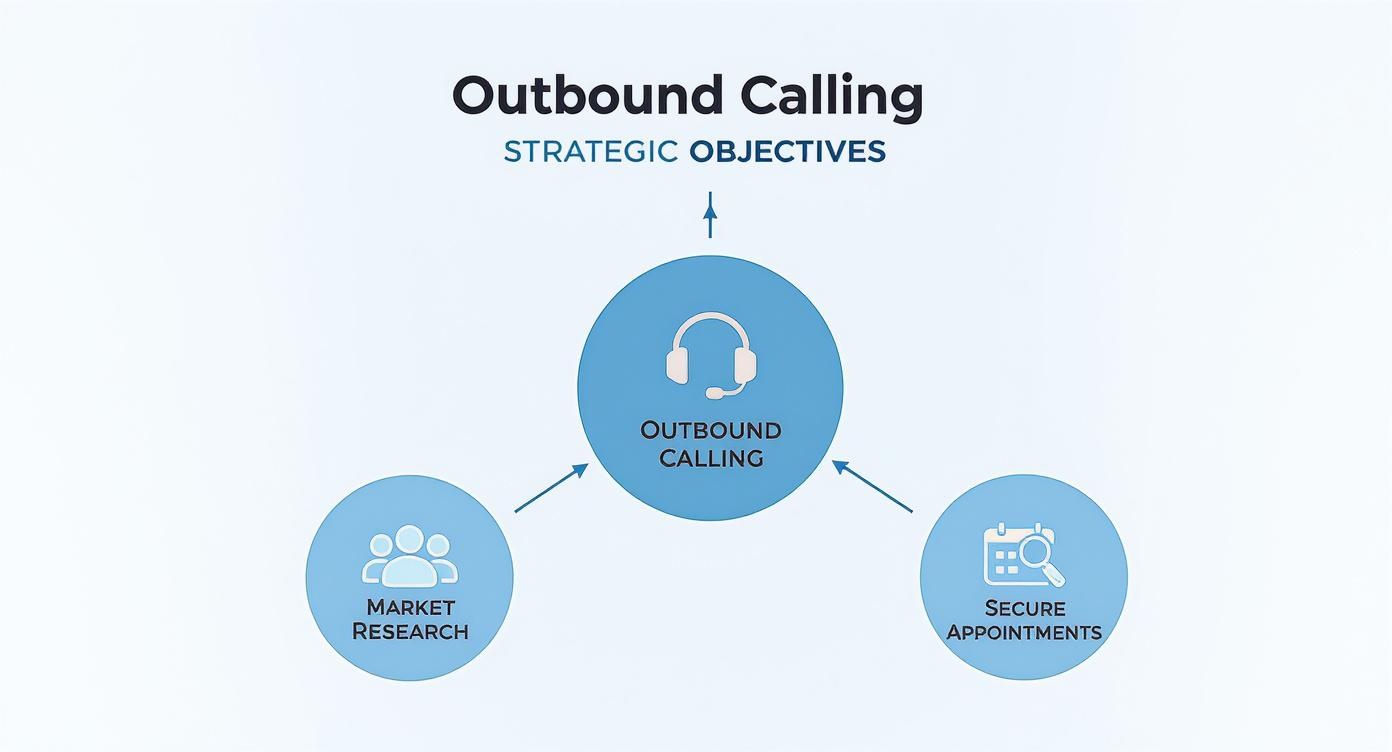
The main takeaway here is simple: every outbound call needs a clear purpose, whether that’s finding a new lead, doing a bit of market research, or locking in that all-important meeting.
Why Outbound Calling is Still a Serious Growth Engine
In a world saturated with digital ads and endless email chains, it's fair to ask if picking up the phone still makes sense. The answer is a resounding yes. When done right, outbound calling creates a direct, human connection that digital channels just can't replicate. It cuts straight through the noise.
Think about the value of that direct access. Your marketing team could get instant, unfiltered feedback on a new pricing strategy. Not after weeks of poring over A/B test results from an email campaign, but in a single afternoon of conversations. That's the agility outbound calling brings to the table—real-time market intelligence that can steer your entire business.
But this proactive approach isn't just about gathering data. It's about speeding everything up.
Build Relationships, Move Faster
An email can be ignored, archived, or lost in a crowded inbox. A phone call, on the other hand, creates an immediate, two-way dialogue. For any sales leader, this is gold. Your team can speak directly with key decision-makers, hear their specific challenges, and adapt the pitch in the moment. That human touch builds trust far more effectively than any automated email sequence ever could.
This personal connection pays dividends beyond just closing a single deal. It uncovers priceless information that helps the entire company.
- Sharpen Product Development: Direct conversations often reveal the small frustrations and big ideas that should guide your next product update or feature launch. For example, a product head might learn from ten conversations that while enterprise clients love a feature, they desperately need better reporting capabilities—a crucial insight for the next development sprint.
- Refine Marketing Messages: When you hear prospects describe their problems in their own words, you get the exact language you need for more compelling marketing campaigns.
A single phone call can reveal more about a customer’s real needs than a hundred clicks on a digital ad. It turns a name on a list into a person you can help.
Scaling Up Smartly with Outsourcing
Of course, building a world-class outbound team from scratch can be a huge undertaking. This is where looking at global talent makes a lot of sense, both for scaling up and for managing costs without ballooning your internal headcount.
For example, many businesses are turning to outbound calling centres in India. It's a move that delivers significant cost savings while providing access to a massive pool of skilled, English-speaking professionals. These teams can offer multilingual support and 24/7 availability, which can seriously boost customer engagement and keep your lead pipeline full. As an executive, this means you can get global reach and consistent performance, all backed by solid technology. You can discover more about the advantages of outsourcing on 1840andCo.
By blending genuine human conversation with smart, efficient operations, outbound calling remains a powerful engine for any company that's serious about growth.
How to Measure Outbound Calling Success
It’s easy to get lost in the weeds of daily activity. But for any strategic initiative, leadership needs to see the bigger picture, and that requires clear, actionable metrics. To really understand the return on your outbound calling efforts, you have to translate raw data into strategic insights. The number of calls your team makes is just noise; what those calls actually achieve for the business is the real signal.
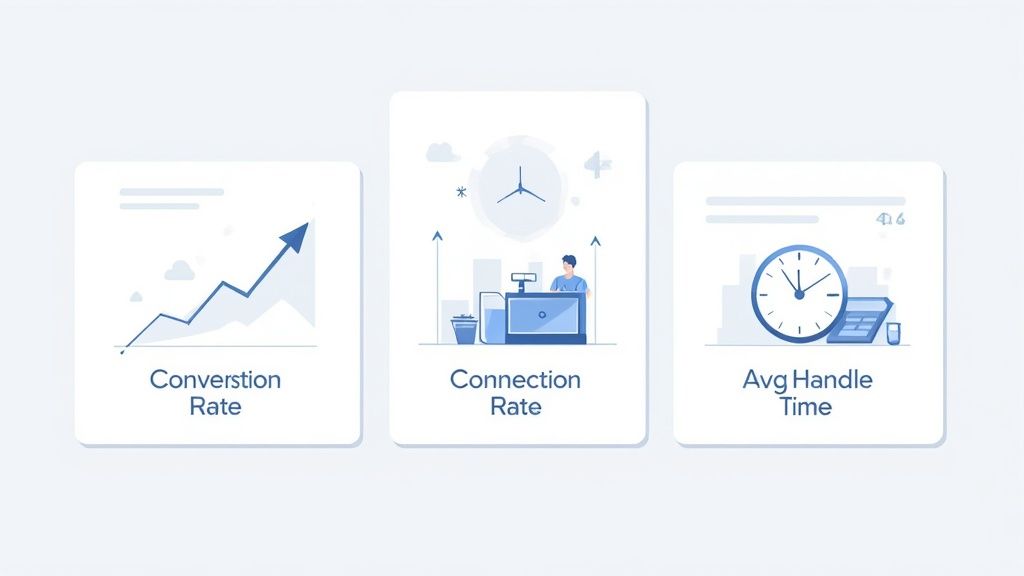
When you move past vanity metrics like sheer call volume, you can finally focus on the key performance indicators (KPIs) that directly affect revenue and efficiency. This is where truly data-driven decisions are born.
Core Metrics for Executive Oversight
For a VP of Sales or a Chief Marketing Officer, the most important numbers are the ones that signal the health of the sales pipeline and the quality of lead sources. These metrics give a clear, high-level view of what’s working and what needs to be fixed—fast.
-
Conversion Rate: Let's be honest, this is the one that really matters. It’s the percentage of calls that lead to a specific, desired outcome—a booked appointment, a qualified lead, or a closed deal. For example, if your team makes 500 calls and books 25 qualified demos, your conversion rate is 5%. This KPI directly measures the effectiveness of your message and targeting.
-
Call Connection Rate: This one’s simple: how many of the calls you dial actually connect to a real person? If this rate starts to dip—and for cold outreach, it can often be below 10%—it’s a major red flag. For a CMO, it might suggest the lead data is stale, inaccurate, or just plain wrong.
-
Average Handle Time (AHT): This tracks the total time an agent spends on a call, from the moment they pick up to finishing any post-call admin. A high AHT might point to workflow bottlenecks, but a shockingly low AHT could mean your agents aren't having deep enough conversations to actually build rapport or close.
Translating KPIs into Strategic Action
These numbers are pointless if they don't lead to action. Think of each KPI as a diagnostic tool that tells a different story and points to a solution in a specific department.
For instance, a low First Call Close (FCC) rate might tell a VP of Sales that their team needs better training on handling objections or more compelling opening lines. On the other hand, if connection rates are high but conversions are stuck in a ditch, the problem isn't the prospect list—it's the sales conversation itself.
True success isn't measured in dials, but in meaningful conversations that move the business forward. The right KPIs illuminate the path from operational activity to strategic achievement.
By focusing on these outcome-driven metrics, leaders can make smarter, more profitable decisions. For a deeper dive, check out our guide on how to measure the success of your outbound campaigns with our AI Voice Agent. This resource gets into the nitty-gritty of tracking performance effectively.
Analysing these metrics helps you fine-tune everything from your list quality to your agent training, turning your outbound calling strategy into a well-oiled growth engine.
The Technology Powering High-Performance Teams
Modern outbound calling isn't about brute force anymore; it's a sophisticated, tech-driven game. For any leader, the right technology stack can transform this function from a manual, repetitive grind into a highly efficient, data-rich operation that directly impacts the bottom line. It’s the difference between flying blind and having a full command centre at your fingertips.
This operational upgrade is especially clear in rapidly expanding markets. Take India's outbound telemarketing sector, for example. It's valued at approximately USD 276.60 million in 2025 and is projected to grow at a healthy 8.4% CAGR. This kind of growth is almost entirely propped up by cloud-based systems and automation that squeeze every drop of performance out of campaigns. You can dig into more data on the competitiveness of key telemarketing markets at Cognitive Market Research.
The Foundational Tech Stack
At its heart, a high-performance outbound team relies on two foundational pillars. These tools are the non-negotiables for any serious operation because they eliminate wasted time and give agents the context they desperately need.
-
Predictive Diallers: Picture your top sales agent spending most of their day listening to ringing tones, busy signals, or voicemails. It's a huge waste of talent. Predictive diallers solve this by automatically dialling numbers from a list and only connecting the agent when a live person picks up. This single tool dramatically cuts down on idle time and maximises productive conversations.
-
CRM Integrations: Calling a prospect without knowing their history with your company is a recipe for a bad experience. Integrating your dialler with your Customer Relationship Management (CRM) system arms your team with the full picture for every call—past purchases, previous interactions, and support tickets. This context is what allows for personalised, relevant conversations that actually build trust.
The Strategic Advantage of Voice AI
While diallers and CRMs build the foundation, Voice AI gives you the strategic high ground. It’s best to think of AI agents not as replacements for your team, but as a powerful force multiplier. This is where you achieve massive scale and efficiency without having to massively increase your headcount.
For any CXO, the value is obvious. AI voice agents can tirelessly handle the high-volume, repetitive tasks that often lead to burnout in human agents. This frees up your most skilled people to focus exclusively on what they do best: navigating complex negotiations and closing high-value deals.
Voice AI automates the predictable so your team can master the exceptional. It’s about elevating your human talent, not just replacing it.
Before committing to a vendor for that layer, run the numbers against a published rate card. DialNexa’s Bolna AI pricing guide walks through the per-minute rate, platform fee, and hidden telephony costs that CXOs typically miss when budgeting an outbound programme.
Here are a few practical ways Voice AI agents can be put to work:
-
Initial Lead Qualification: An AI agent can make first contact with hundreds of leads, ask the right qualifying questions, and instantly route only the most promising prospects to a human agent. For example, a B2B software company can use an AI agent to call a list of 5,000 marketing contacts, identify those with a budget over $50k, and schedule demos directly onto a senior account executive's calendar.
-
Customer Surveys: Instead of tying up your team, an AI agent can conduct customer satisfaction surveys around the clock, gathering vital feedback at a scale you couldn't manage otherwise.
-
Routine Follow-ups: Managing appointment reminders or post-demo follow-ups can be fully automated. This ensures no opportunity slips through the cracks simply because someone forgot.
Navigating Compliance and Regulations
Let's be blunt: a growth strategy that ignores compliance is just a disaster waiting to happen. When you're running an outbound calling operation, navigating the maze of regulations isn't just a box-ticking exercise—it's essential for avoiding hefty fines and, just as importantly, protecting your brand's reputation.
You don't need to become a legal scholar overnight, but you do need to equip your team to ask the right questions. Major regulations, like the TCPA in the US or GDPR across Europe, all boil down to a few core ideas: consent and respecting consumer rights. Get those right, and you're already on solid ground.
Key Compliance Cornerstones
For any leader, the goal is to make sure your operational strategy is built on these pillars:
- Do-Not-Call (DNC) Lists: This is non-negotiable. Your systems must have a rock-solid process for scrubbing contact lists against national and internal DNC registries. Calling someone who has explicitly opted out is one of the fastest ways to destroy trust and get on a regulator's radar.
- Consent Requirements: The law is very specific about when and how you can contact people, especially when using automated tech. This is particularly relevant when using AI voice agents, so it's vital to understand the ethics and legality of AI phone calls.
- Data Privacy and Security: Regulations dictate exactly how you must handle customer data—from collection to storage and use. A data breach doesn't just come with a massive financial penalty; it can make your customer loyalty vanish in an instant.
Taking compliance seriously isn’t a roadblock to growth. It's the very foundation of sustainable success. It shows your customers and the market that you're interested in building relationships based on trust and respect.
This is true no matter where you operate. Just look at India's booming BPO sector, where outbound calling continues to be a massive source of employment. Experts predict a 7% job growth rate in 2025, an expansion driven by smart workforce management and a sharp focus on compliant operations. You can read more about these call centre employment trends at Fusion CX.
The good news is that you don't have to go it alone. Modern platforms like DialNexa often come with compliance features baked right in. These tools can help manage risk automatically, making sure your plans for growth are built on a secure and legally sound footing.
A Leader's Guide to Outbound Calling: Your Questions Answered
If you're a leader—a VP, Director, or CXO—you don't have time for fluff. You need straight answers to the big strategic questions before you invest in an outbound calling programme. Let's get right into the common concerns we hear from people in your position.
How Does Outbound Calling Fit Into a Digital-First World?
It's a mistake to see outbound calling as a throwback or something separate from your digital strategy. Think of it instead as the vital human element that supercharges your digital efforts. Your website, ads, and content marketing are great at casting a wide net, but a well-timed phone call is what often converts a high-value prospect.
For example, a Director of Marketing can see in their analytics that a target account's CTO spent fifteen minutes on their pricing page. That’s a strong digital lead. An outbound call the next day transforms that signal of interest into a real conversation. It allows a sales rep to connect the CTO's potential challenges directly to the company's solution, dramatically shortening what could otherwise be a long, drawn-out sales cycle. The call doesn't replace digital; it makes it more effective.
Is Cold Calling Actually Still a Thing?
Absolutely, but it looks nothing like it used to. The idea that cold calling is "dead" comes from the old-school approach of just hammering a random phone list. That method is dead, and for good reason.
Today's outbound calling is all about intelligence. It's built on carefully researched lists of prospects who perfectly match your ideal customer profile.
You might have heard about recent iOS updates with call screening, but the initial data shows a tiny impact—connect rates only dropped by 0.1%. This tells us one thing loud and clear: a relevant message to the right person still gets through.
The secret isn't volume; it's relevance. A strategic, well-researched call remains one of the most powerful ways to get your foot in the door, especially when you're trying to break into new markets or reach top decision-makers.
What’s the Real ROI We Can Expect?
The return on investment goes far beyond just a spike in sales figures. A smart outbound strategy delivers value across the board:
- Faster Revenue: This is the most obvious one. You’re directly setting appointments and closing deals that might have otherwise stalled.
- Priceless Market Intel: Your team is on the front lines, gathering raw, unfiltered feedback about your messaging, pricing, and product. You can’t buy that kind of insight.
- A Stronger Brand: In a world of automated emails, a personal conversation builds a genuine connection, improving how key accounts see your company.
When you start measuring things like conversion rates from call-to-meeting and the lifetime value of those customers, the business case for outbound calling becomes undeniable.
Ready to see how a modern, AI-powered approach to outbound calling can reshape your growth strategy? DialNexa provides human-like Voice AI agents that handle lead qualification and customer support at scale, freeing your team to focus on closing deals. Discover how DialNexa can turn more conversations into conversions.
For a deeper look at outbound call meaning, KPIs, and how Voice AI is reshaping outbound operations, see our complete guide to outbound call meaning.

Leave a Reply