

The Modern Contact Center Agent: A Blueprint for C-Suite Leaders
At its core, a contact center agent is the human voice of your company. They're the ones on the front lines, handling customer conversations across every channel imaginable—phone calls, emails, live chat, and even social media.
But for today's forward-thinking enterprise, the role has grown far beyond just answering calls. Today’s agents are strategic assets crucial for building customer loyalty and fuelling measurable business growth.
The Evolution of the Contact Centre Agent
For too long, many C-suite leaders have viewed the contact centre as a necessary cost centre. That's an outdated perspective that leaves significant revenue on the table. Your agents are the face of your brand; they are a direct line to revenue, customer retention, and invaluable market insights.
Their performance has a direct, measurable impact on key business metrics like customer satisfaction (CSAT), customer lifetime value (CLV), and brand perception. They aren't just a line item on a budget; they're a strategic asset capable of driving profit.
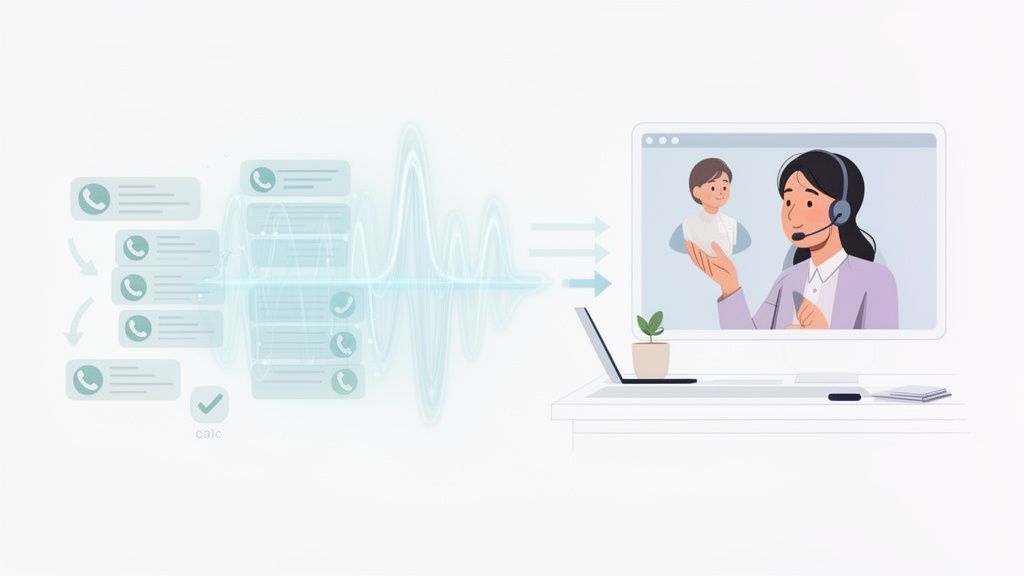
This strategic shift is particularly clear in markets like India, a long-established global hub for customer service. By 2025, India's contact centre industry has become a powerhouse, employing over 2 million people and handling an incredible 30-35% of the world's outsourced customer support. This vast talent pool represents a significant opportunity for global enterprises. You can read more about India's contact centre industry trends.
From Cost Centre to Profit Centre
The fundamental shift happening now is the transition from viewing the contact centre as a cost to recognising it as a profit centre. This isn't about replacing people with machines, but rather, augmenting their abilities with intelligent automation to unlock higher value.
This is where technologies like Voice AI come in. It is purpose-built to handle the high-volume, repetitive queries that lead to agent burnout and operational inefficiency.
Consider these practical, high-impact tasks where automation delivers immediate ROI:
- Initial Lead Qualification: A multinational software company can deploy a Voice AI agent to dial 10,000 prospects in a single day to vet and qualify leads, filtering out unqualified contacts with over 95% accuracy.
- Appointment Scheduling: A national healthcare provider can automate appointment setting and reminders, reducing no-show rates by up to 30% and keeping clinical staff fully utilised without manual intervention.
- Frequently Asked Questions: A large e-commerce retailer can use AI to provide instant, accurate answers to common questions about order status or return policies 24/7, deflecting up to 40% of inbound call volume from human agents.
By delegating these predictable tasks to automation, you empower your most skilled human agents. Their expertise and energy can be focused on high-value work that directly impacts revenue—activities that require empathy, strategic negotiation, and creative problem-solving.
This strategic division of labour allows your team to concentrate on closing complex sales, resolving sensitive customer escalations, and forging long-term client relationships. The outcome? A more motivated, highly-skilled, and resilient workforce. This synergy builds a scalable operation where technology manages volume and your people drive value, transforming a contact centre from an expense into a powerful engine for growth.
A Strategic Look at Human vs. AI Agents
Choosing between human and AI agents is not an all-or-nothing decision for the modern executive. It's a strategic resource allocation challenge designed to maximise ROI. The goal is to understand how these two roles complement each other to create a powerful synergy where each plays to its strengths.
Think of it this way: AI agents are your tireless frontline workforce, handling massive interaction volumes with flawless consistency and 24/7 availability. Your human agents, in contrast, are your elite specialists—the experts deployed to navigate complex negotiations, de-escalate critical customer issues, and build the high-value relationships that secure loyalty and drive enterprise sales.
This division of labour enables you to scale customer support and outreach operations without sacrificing the essential human touch. For example, a financial services firm can deploy an AI agent to field 100% of initial lead qualification calls around the clock, ensuring no opportunity is missed. Meanwhile, their seasoned human advisors can dedicate their time to pre-vetted, high-intent prospects who are ready to discuss complex investment products.
Core Capabilities and What They Mean for Business
The real value emerges when you analyse how their distinct skill sets directly impact your bottom line. Our breakdown compares human agents against advanced AI Agents, focusing squarely on how each contributes to growth, operational efficiency, and customer retention.
A Voice AI agent offers unprecedented scalability. It can manage thousands of concurrent conversations without fatigue or performance degradation—a feat impossible for any human team. This translates directly into lower operational costs and the agility to enter new markets or manage seasonal demand surges without a massive hiring initiative. For instance, AI-driven after-call work summaries can reduce agent wrap-up time by up to 75%, freeing up significant capacity.
On the other hand, human agents bring indispensable emotional intelligence and adaptability. They can interpret subtle tonal cues, demonstrate genuine empathy to a frustrated client, and pivot conversational strategies in real-time. These are skills that remain beyond the reach of current AI. That human element is mission-critical for resolving sensitive issues and building the brand trust that underpins long-term customer value. To explore this further, check out our guide on the benefits of an AI virtual agent.
The strategic imperative is not to choose one over the other, but to engineer a hybrid system where AI manages predictable volume and humans manage unpredictable value. This model transforms the contact centre into a highly efficient, scalable profit centre.
A C-Suite View of Agent Capabilities
To make informed investment decisions, leaders must compare these agents based on metrics that directly influence business outcomes. The table below breaks down their strengths and provides a clear line of sight to tangible business impact.
For executives, the decision-making process boils down to understanding how each type of agent serves the company’s broader strategic goals. The following comparison is designed to provide that high-level clarity.
Strategic Capabilities Human Agent vs Voice AI Agent
| Attribute | Human Agent | Voice AI Agent (e.g., DialNexa) | Strategic Business Implication |
|---|---|---|---|
| Scalability | Limited by headcount and scheduling; requires significant capital investment to scale. | Nearly infinite; can handle thousands of concurrent calls 24/7 without additional staff. | Enables rapid market expansion and absorbs demand spikes (e.g., product launches) without proportional increases in operational cost. |
| Cost-Effectiveness | High operational overhead (avg. $4,000+ per agent monthly) including salaries, benefits, training, and infrastructure. | Significantly lower cost per interaction (often pennies per minute); operates on a predictable subscription model. | Drastically reduces cost-to-serve by 50-70%, freeing up capital for strategic investments in product innovation or marketing. |
| Consistency | Performance can vary based on mood, training, and fatigue, leading to inconsistent brand messaging. | Delivers a perfectly consistent, on-brand, and compliant message in every single interaction. | Ensures 100% brand and regulatory compliance, standardises the customer experience, and eliminates human error in routine tasks. |
| Emotional Intelligence | High; excels at empathy, rapport-building, and nuanced negotiation critical for high-value interactions. | Low to moderate; can recognise sentiment but lacks genuine empathy and complex adaptive reasoning. | Empowers human teams to handle high-stakes customer relationships and complex enterprise sales closures where trust is paramount. |
By pairing your human agents with Voice AI counterparts, you create a robust, two-tiered system. The AI handles the sheer breadth of interactions, while your people provide the depth. This ensures both efficiency and excellence are at the heart of every single customer conversation—the true cornerstone of a modern, growth-focused customer strategy.
Performance Metrics That Drive Business Growth
For any C-suite executive, the value of a contact centre agent is measured by their impact on the bottom line. It's easy to get lost in operational vanity metrics, but what truly matters are the strategic Key Performance Indicators (KPIs) that signal business health and customer loyalty. Every agent conversation is a data point that can inform strategy and fuel growth.
Effective performance measurement is not about call tallies or interaction times; it's about drawing a direct line from an agent's activities to concrete business results. We can distill these critical duties into three core pillars that directly affect revenue and brand equity.
The Three Pillars of Agent Performance
Viewing an agent's responsibilities through this strategic lens clarifies how their daily tasks connect to enterprise-level goals. This framework helps leadership focus coaching, technology investment, and performance incentives where they will have the greatest impact.
- Customer Engagement: This pillar measures the quality of the interaction. Are agents building rapport and strengthening the customer relationship, or merely processing transactions? Metrics like Customer Satisfaction (CSAT) and Customer Effort Score (CES) provide a direct read on this. For example, a company that improves its CES can increase customer loyalty by 22%.
- Problem Resolution: This is about operational effectiveness. How quickly and successfully can an agent resolve a customer's issue? First Call Resolution (FCR) is a powerhouse metric here, as a 1% improvement in FCR typically corresponds to a 1% improvement in CSAT.
- Value Generation: This pillar tracks how agents contribute directly to revenue. This includes direct sales, upselling/cross-selling, or retaining a customer who was at risk of churning. Net Promoter Score (NPS) is a vital leading indicator, as companies with the highest NPS in their industry tend to grow at more than double the rate of their competitors.
This visual gives a clear breakdown of how human agents and AI agents play different roles across these strategic areas.
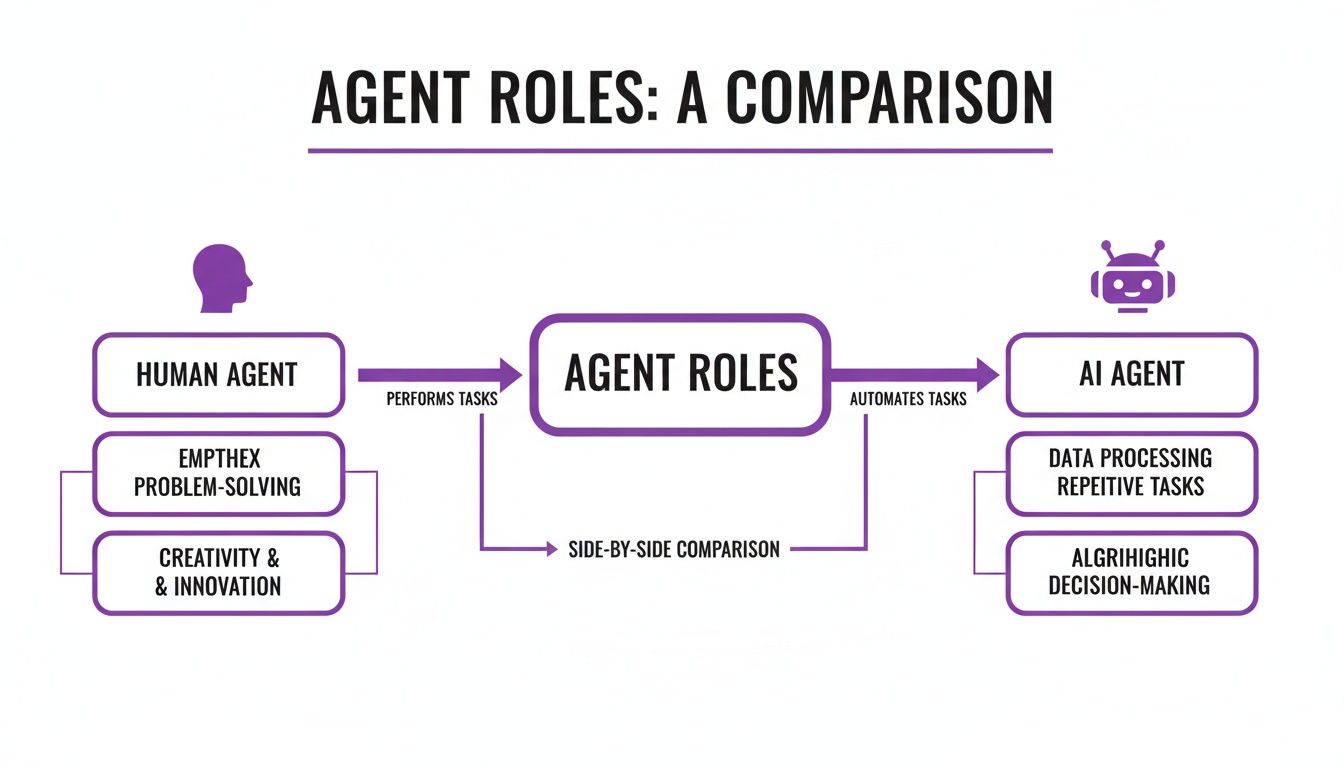
As you can see, your human agents are the experts at handling complex issues and creating emotional bonds, while AI agents deliver incredible efficiency and consistency for the more straightforward tasks.
Connecting Metrics to Financial Outcomes
The strategic value becomes undeniable when these KPIs are tied directly to financial results. For instance, data shows that a mere 5% increase in customer retention can boost profits by 25% to 95%. This is driven by effective problem resolution and strong engagement. Similarly, improving FCR not only boosts satisfaction but also reduces operational costs by eliminating expensive follow-up calls and escalations. For a deeper dive, understanding the framework for Measuring Customer Service to Drive Real Business Growth is essential.
A contact centre agent isn't just a problem-solver; they are a guardian of customer lifetime value and an engine for sustainable growth. Their performance metrics are leading indicators of your company's future financial health.
Using AI to Amplify Agent Performance
This is precisely where technology becomes a strategic enabler. By offloading low-value, repetitive work to AI-powered tools like DialNexa, you empower your human agents to focus on the high-impact activities that move these critical KPIs.
Imagine an AI agent qualifying thousands of inbound marketing leads with 97% accuracy. Your human sales team now spends their time exclusively with prospects who have a confirmed budget and purchase intent, causing conversion rates to skyrocket. By automating tasks like data entry and post-call notes, AI can also slash Average Handle Time (AHT) by up to 20%, allowing each agent to conduct more meaningful, value-driven conversations daily. This is the winning formula: AI manages volume, humans drive value. It's the key to transforming your contact centre from a cost centre into a profit powerhouse.
The High Cost of Agent Attrition and How to Solve It
Agent turnover is more than an HR challenge; it's a significant drain on corporate finances and a direct threat to customer loyalty. For any leader, understanding the true business cost of attrition is the first step toward building a more stable, profitable contact centre. High turnover isn't a single line item—it’s a vicious cycle of recruitment fees, training investments, and lost productivity that erodes your bottom line.
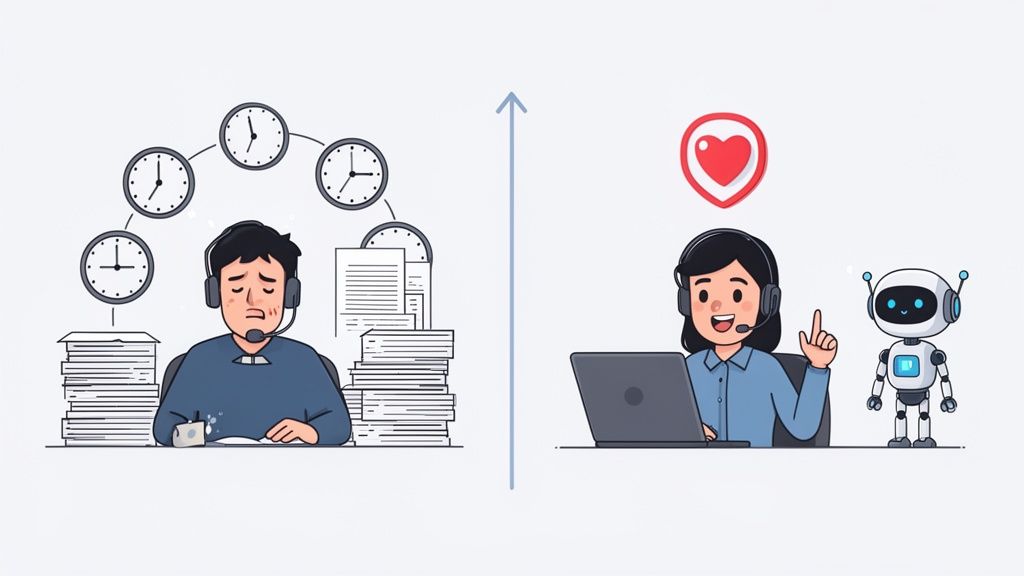
The financial impact is staggering. Replacing a single contact centre agent can cost anywhere from $5,000 to $15,000 when you factor in recruitment, onboarding, and the 3-6 month ramp-up time to full productivity. More critically, this constant churn introduces inconsistency into the customer experience, directly damaging brand reputation and sending customers to competitors.
The Skills That Define a Top-Performing Agent
To grasp the true loss, you must appreciate what a seasoned agent contributes. These are not basic abilities; they are sophisticated skills that are costly and time-consuming to replace.
A top-tier contact centre agent possesses a unique blend of competencies:
- Deep Empathy: The ability to genuinely connect with and understand a customer's frustration is essential for de-escalating tense situations and rebuilding trust.
- Complex Problem-Solving: The best agents navigate ambiguous issues, think critically on their feet, and devise creative solutions that satisfy both the customer and the business.
- Technological Proficiency: Today's agents must master multiple systems—from CRMs to knowledge bases—to access accurate information instantly and provide a seamless experience.
When you lose an agent with these skills, you lose institutional knowledge and a proven asset for customer retention. This is where the real cost of attrition bites.
High attrition is a silent killer of customer lifetime value. It introduces inconsistency and erodes trust, forcing your organisation to constantly rebuild relationships that experienced agents had already secured.
A Strategic Solution to Agent Burnout
The attrition challenge has been especially acute in India's BPO sector. While historically high turnover rates have improved, the problem persists. Contact centre agent attrition in India, once as high as 50% annually, has stabilised to a still-concerning 30-35% in 2025. This improvement is largely due to better wellness programs and technology adoption, but attrition continues to impact service quality in critical sectors like EdTech and BFSI.
A primary driver of this turnover is agent burnout from handling repetitive, high-stress tasks. This is where investing in intelligent automation becomes a powerful retention strategy. By automating monotonous work, you directly address the root causes of job dissatisfaction.
Consider how Voice AI transforms an agent's daily workload:
- Outbound Cold Calling: An AI can make thousands of initial calls, absorbing the high rejection rates and monotony, so human agents only engage with genuinely interested prospects. This can improve agent morale by over 40%.
- Routine Data Entry: Post-call summaries and CRM updates can be handled automatically with near-100% accuracy, saving agents up to an hour of administrative drudgery per day.
- Repetitive Queries: Answering the same basic questions is a fast track to burnout. AI can manage these, freeing up agents for more engaging and challenging problem-solving.
By implementing platforms like DialNexa, you’re not replacing your team; you're protecting your most valuable asset. Automation reduces stress and allows your contact centre agent team to focus on the strategic, relationship-building activities that foster career growth. This leads to higher job satisfaction, lower attrition, and a stable, expert team poised to drive your business forward. For more on this, you can learn more about how speech analytics helps improve coaching and training in our article.
Building a High-Performance Technology Stack
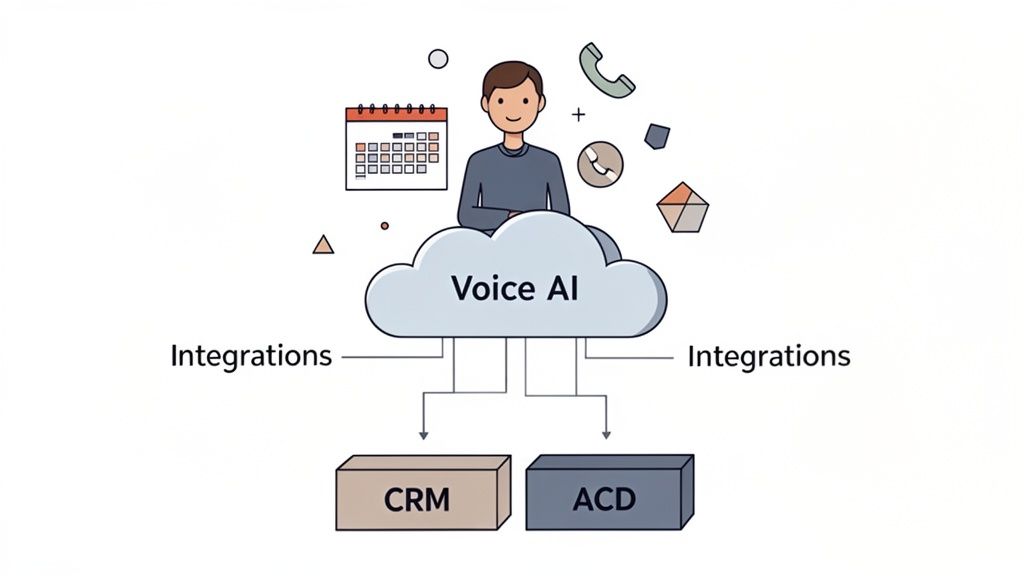
For leaders directing technology investments, the modern contact centre tech stack is the engine powering agent performance and, ultimately, business outcomes. The paradigm has shifted from a collection of siloed systems to a fully integrated ecosystem where every component works in seamless concert.
Foundational tools like your Customer Relationship Management (CRM) and Automatic Call Distributor (ACD) systems remain vital. However, they are now being supercharged by conversational AI and cloud platforms. The migration to the cloud is no longer a trend; it's a strategic imperative. It provides the scalability and flexibility to expand or contract operations based on market demand, without massive upfront capital expenditure.
The Urgency of Integration
The market data paints a clear picture of this rapid transformation. India's cloud-based contact centre market, the backbone for delivering scalable global support, reached USD 1.2 billion in 2024. Projections show it will skyrocket to USD 7.5 billion by 2033, growing at a staggering 21.38% CAGR.
This explosive growth is fuelled by the demand for AI-driven automation and true omnichannel support across sectors like EdTech, BFSI, and e-commerce. Concurrently, the call centre AI market itself hit USD 103.8 million in 2024 and is on a trajectory to reach USD 452.5 million by 2030.
For any executive, the message is unequivocal: a disjointed tech stack is a competitive liability. Future success hinges on how seamlessly your systems communicate to create a single, unified view of every customer journey.
The real power isn’t in any single piece of software, but in how seamlessly they connect. A high-performance stack empowers agents by automating mundane tasks and delivering real-time insights. This directly translates to superior customer conversations and stronger business outcomes.
When systems are properly integrated, the potential for automation and efficiency is unlocked. For leaders, this means shifting focus from merely procuring software to architecting an intelligent workflow that actively supports core business objectives.
A Practical Example of Integrated Power
Imagine a global real estate firm aiming to accelerate its sales pipeline. With a well-integrated technology stack, the moment a new lead is captured in their CRM, a powerful, automated sequence is triggered.
Here’s a practical workflow:
- Step 1: Instant Engagement: A Voice AI agent from DialNexa immediately calls the new lead—within 30 seconds of form submission—to begin the qualification process, capitalizing on peak interest.
- Step 2: Intelligent Qualification: The AI engages the prospect in a natural, two-way conversation, asking critical questions about budget, preferred location, and buying timeline, effectively filtering out unqualified leads with 97% accuracy.
- Step 3: Seamless Scheduling: Once a lead is qualified as high-intent, the AI agent accesses the human agent's calendar via an API and schedules a site visit in real-time, sending automated confirmations to all parties.
This entire sequence unfolds without a human contact centre agent intervening, freeing them to focus on what they do best: conducting high-value property tours and closing deals. This is a prime example of how the right technology doesn't replace your team—it empowers them to operate at a higher strategic level. You can learn more about transforming customer interactions in real-time through powerful partnerships to see how this comes to life.
Driving Real Business Results Across Industries
For any business leader, the definitive test of technology is not its features, but its measurable impact on the P&L statement. Integrating a Voice AI agent is not a mere tech upgrade; it’s a strategic lever for accelerating revenue, reducing operational costs, and optimizing the entire sales funnel. To truly grasp its impact, one must examine how it solves specific, high-stakes problems in different sectors.
Let’s move past the theory and into the hard data from industries already achieving significant returns by modernizing their approach to the contact centre agent role.
EdTech: Turning More Enquiries into Enrolments
In the hyper-competitive EdTech sector, every lead is a potential long-term revenue stream. The challenge is that admissions departments are often inundated with enquiries, many from casually browsing individuals. This creates a significant administrative bottleneck, diverting skilled counselors from their primary function: engaging with serious, high-potential students poised to enrol.
This is an ideal use case for a Voice AI agent. Instead of letting leads go cold or overwhelming staff, the AI automates the entire initial touchpoint. It can place thousands of outbound calls, ask targeted qualifying questions about a student’s academic interests and eligibility, and instantly provide relevant course information.
- The Result: Human counselors are liberated to focus their expertise exclusively on pre-vetted, high-intent candidates. One of our DialNexa clients in the EdTech space saw their connect rates leap from a baseline of 47% to a staggering 91%, a direct result of the AI's ability to ensure immediate and persistent lead follow-up.
Real Estate: Converting Interest into Site Visits
For real estate agencies, the journey from a new lead to a scheduled site visit is fraught with delays and drop-offs. Human agents burn significant billable hours chasing unresponsive leads and navigating scheduling conflicts. Every day of delay increases the risk of a prospect losing interest or engaging with a competitor.
A Voice AI agent fundamentally alters this dynamic by providing instant, 24/7 engagement. The moment a new lead arrives—day or night—the AI initiates a call, qualifies their requirements (budget, location, property type), and books a site visit directly into a human agent's calendar.
This automation has a direct and immediate impact on the most critical metric for a real estate team: lead-to-booking conversion. By contacting and qualifying every lead instantly, firms dramatically shorten their sales cycle and increase pipeline velocity.
With DialNexa, our real estate clients have seen their lead-to-booking conversion rate climb from the industry average of 2% to a remarkable 8%—a 4X improvement that fundamentally transforms sales productivity.
BFSI: Nailing Compliance and Boosting Efficiency
The Banking, Financial Services, and Insurance (BFSI) industry operates under a strict regulatory framework. Processes like Know Your Customer (KYC) verification demand flawless accuracy and efficiency. A minor human error can lead to significant compliance risks and substantial financial penalties.
Here, Voice AI provides a solution that delivers both speed and unwavering precision. It can automate outbound calls for KYC checks, guide customers through the required steps, and ensure every interaction is meticulously logged for audit and compliance purposes. This removes the risk of human error and guarantees a consistent, compliant process every time.
- The Result: A Voice AI agent executes these structured conversations with unparalleled precision. Clients using DialNexa for their qualification and verification processes have achieved 97% qualification accuracy. This not only ensures regulatory compliance but also frees up their highly-trained human agents to focus on high-value roles like financial advisory and wealth management.
Frequently Asked Questions
When considering a strategic shift like integrating AI into your contact centre, executives need direct, data-backed answers. Here are responses to the critical questions we hear most from VPs, Directors, and CXOs evaluating this decision.
How Does a Voice AI Agent Complement a Human Agent?
Think of a Voice AI agent not as a replacement, but as a force multiplier for your human team. The AI acts as a tireless frontline specialist, handling thousands of repetitive, high-volume calls—such as initial lead qualification or basic FAQ responses—with perfect consistency, 24/7.
This strategic division of labour empowers your most valuable human talent to focus on what they do best: managing complex, high-stakes conversations that drive revenue and build customer loyalty. While the AI handles the sheer volume and filters out the noise, your human agents can dedicate their expertise to closing enterprise deals, resolving sensitive escalations, and building strategic client relationships. It’s a symbiotic system where technology provides scale and humans deliver strategic depth.
What Is the Typical ROI for Implementing AI in a Contact Centre?
The return on investment is both substantial and multifaceted, materializing in cost reduction and revenue growth. Financially, the most immediate gains come from reduced operational overhead. A Voice AI agent has a significantly lower cost-per-interaction compared to a human agent, directly slashing your cost-to-serve by as much as 70%.
Adopting AI is not merely a cost-cutting exercise. It's a strategic reallocation of your most valuable asset—your people—to revenue-generating activities. This transforms your contact centre from a necessary expense into a predictable profit engine.
Beyond savings, ROI is evident in hard performance metrics. For example, by automating the initial touchpoint in their sales outreach, our clients have seen connect rates soar from 47% to 91%. By ensuring every lead is qualified before human engagement, they’ve boosted lead-to-booking conversions from 2% to 8%. These are not marginal efficiency gains; they represent a fundamental acceleration of the entire sales pipeline.
How Long Does It Take to Deploy an AI Solution?
The era of lengthy, multi-month IT projects is over. With modern, cloud-native platforms, deployment is remarkably swift. A solution like DialNexa can be fully operational and delivering value in a matter of weeks, not quarters.
The process is engineered for speed and agility:
- Initial Workflow Design (1-2 Days): We begin by mapping your specific business process, whether it's qualifying marketing leads or handling support queries.
- Persona Configuration (3-5 Days): We then customize the AI's voice, tone, and scripts to ensure it serves as a natural, on-brand extension of your company.
- Integration and Testing (1-2 Weeks): Finally, we connect the AI to your existing systems (e.g., CRM, calendar) via APIs and run pilot tests to ensure flawless execution.
Because the core technology is pre-built and cloud-based, the heavy lifting is already done. This means you can begin realizing a return on your investment and optimizing your team’s performance almost immediately.
Ready to see how a Voice AI agent can reshape your operations? DialNexa provides a scalable, human-like solution that automates routine calls, speeds up your sales pipeline, and empowers your team to focus on what matters most. Discover the DialNexa advantage today.

[…] at role design, coaching, and escalation handling, not just staffing. This overview of the modern contact center agent role is relevant because airline service depends on agents who can resolve operational ambiguity, […]
This is a well-structured perspective on how AI and human agents can work together to transform contact centres into true profit centres. The emphasis on measurable ROI, employee empowerment, and customer experience makes it a compelling roadmap for modern business leaders.