
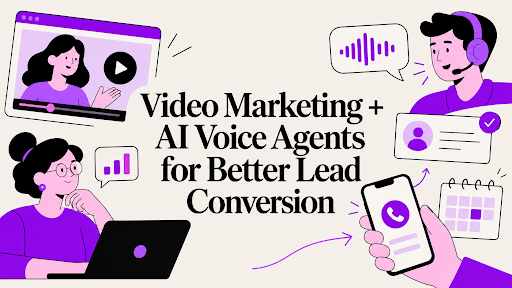
How Businesses Can Combine Video Marketing with AI Voice Agents to Improve Lead Conversion
Video marketing brings potential customers to a business, but getting their attention is only the first step. What happens after someone watches a demo or fills out an enquiry form often decides whether that interest turns into a sale.
Two things usually slow this down: producing videos takes time, and sales teams struggle to contact every lead quickly. AI is helping businesses address both problems. Voice agents handle routine sales conversations, including qualifying and routing leads, while people make the important decisions. Video editing agents follow a similar approach by reviewing footage and assembling initial cuts while the team controls the story and message. Together, these tools can shorten the path from a video view to a sales conversation.
TL;DR
- AI video editing reduces manual footage review and speeds up production
- AI voice agents follow up with leads within seconds of a consent-based enquiry
- Connecting video campaigns to automated calling can help improve lead qualification and appointment booking.
- CRM integration keeps lead context organized for sales teams
- Track response time, contact rate, and conversion rate to measure results
Why Traditional Video Production Takes More Time
A typical video project means reviewing raw footage, picking the best takes, removing mistakes, and preparing different cuts for different channels. A software company might need a full website version, short LinkedIn clips, and a quick ad cut from the same shoot, each edited separately.
When editing takes longer than expected, campaigns get delayed, and businesses lose chances to attract leads. Much of that time goes into reviewing raw footage, comparing takes, and removing unwanted sections before the final video comes together. These repetitive tasks are where AI editing agents can help, allowing teams to focus more on the story and message.
How AI Video Editing Speeds Up Production
Instead of reviewing a full recording by hand, marketers can describe the video they want and let an agent handle that first pass, much like directing a voice agent through a call script rather than handling every conversation themselves.
This approach is already part of tools like invideo Editor, a browser-based video editor that combines a free professional editing timeline with AI editing agents. These agents can review raw footage, compare takes, remove false starts and repeated sections, and assemble a complete first cut based on a script or brief. Teams can then refine the result directly on the timeline, keeping control over the story, pacing, and final video.
Upload the raw footage, add a script if there is one, and describe the cut you want. The agent reviews the material and builds a base cut, a full assembly rather than a highlights reel, which the team then refines. It adapts to the footage too, scripted recordings get built against the script, unscripted ones get trimmed to one clean version per point, and multicam footage gets synced automatically.
Agents typically handle:
- Reviewing footage for usable takes and key moments
- Assembling a first cut from a script or brief
- Trimming false starts and unnecessary pauses
- Cleaning up audio across clips
- Repurposing one recording into shorter versions
Human review still matters here. The team checks that the message lands, the video fits the brand, and the call to action is clear before anything goes live. Invideo Editor keeps every one of the agent’s changes on an editable timeline, so that review never means starting the edit over from scratch.
Why Fast Follow-Up Matters Just as Much
A video creates interest, but if an enquiry sits unanswered for hours or days, that interest fades. Research in the Harvard Business Review, “The Short Life of Online Sales Leads,” found that delayed responses reduce the chance of qualifying a prospect at all. The finding is older, but the principle still holds.
The hard part is staying fast consistently, especially when a campaign generates enquiries outside business hours or all at once. A lead who watched a video at midnight and submitted a form is still a warm lead at midnight, but most sales teams cannot staff a response that fast, which is exactly the gap an automated system is built to close.
How AI Voice Agents Convert Video Leads
An AI voice agent can call or respond to a lead within seconds of a form submission, with proper consent in place. It can:
- Start the conversation immediately after an eligible enquiry
- Ask about requirements, budget, and timeline
- Answer approved questions about pricing and availability
- Book a meeting against a connected calendar
- Hand off to a human for anything that needs real judgment
The goal isn’t removing people from sales, it’s clearing the routine first contact so a rep only steps in once a lead is actually ready.
Connecting the Two Systems
The full workflow runs in five steps: produce the video, publish it with a lead capture form, send each enquiry to the CRM, trigger a voice agent for consenting leads, and let the agent qualify or route the conversation. Outcomes get logged back to the CRM, so sales always has context before the next call.
Each step closes a gap the previous one leaves open. A fast edit means the video actually ships on schedule. A connected form means the lead doesn’t sit in an inbox unseen. A triggered voice agent means the enquiry gets a response in seconds rather than whenever a rep next checks their queue. None of these steps does much on its own, but chained together they remove nearly every point where a warm lead normally goes cold while waiting on a person.
In practice: A real estate firm records a property walkthrough. Using invideo Editor, the team turns the raw footage into a polished video and publishes it with a request-a-visit form. When a buyer submits the form and agrees to be contacted, a voice agent follows up to confirm their budget and timeline. If they’re interested, the agent can schedule a property visit and pass the details to the sales team.
Metrics Worth Tracking
| Metric | What It Shows |
| Video-to-lead conversion rate | Whether content drives action |
| Lead response time | How fast the first contact happens |
| Lead qualification rate | Quality of leads reaching sales |
| Appointment booking rate | Whether conversations lead anywhere |
| Lead to customer conversion rate | The actual sales outcome |
If response times improve but bookings don’t, review lead quality, call scripts, timing, and follow-up processes to understand where potential customers are dropping off.
Common Mistakes to Avoid
- Producing more video without improving what it actually says
- Calling leads without proper consent or ignoring local rules like TRAI in India
- Using one generic call script regardless of what the lead actually watched
- Skipping CRM integration, which leads to repeated or missed follow-ups
- Removing human support entirely instead of defining a clear handoff point
Conclusion
Video marketing helps businesses attract potential customers, while AI voice agents help them respond before that interest fades. Together, they reduce repetitive work and make the journey from initial interest to a sales conversation more efficient.
FAQs
How does AI video editing speed up marketing production?
An agent reviews raw footage and assembles a working cut automatically, removing the manual review step that usually causes the biggest delays.
Can AI voice agents follow up with video leads?
Yes, for any lead who has consented to be contacted after a form submission or callback request.
Do small teams need a dedicated editor to use this?
No. With invideo Editor, small teams can let AI agents handle repetitive editing tasks and refine the results on an editable timeline.
What does an editing agent actually do with raw footage?
It identifies usable takes, removes mistakes and dead sections, and arranges the result into an editable timeline a person can refine further.

Leave a Reply