
Gujarati Text to Speech: A Strategic Guide for CXOs
TL;DR
- Gujarati TTS is a strategic lever for reaching 60M+ native speakers, most concentrated in Tier-2 and Tier-3 markets that English-only strategies miss entirely.
- Real deployments report concrete gains: connect rates moving from 47% to 91%, lead-qualification drop-off cut from 40% to under 15%, and 20–40% cost or workload reductions across BFSI, EdTech, real estate, and healthcare.
- At scale, on-premise or specialised platforms beat generic cloud TTS on cost, latency (under 300ms vs. over 500ms), and data control, the economics flip once you cross roughly 50 million characters per month.
- Getting pronunciation right – brand names, technical terms, regional dialects – requires SSML and phoneme-level control, which is what separates a trustworthy voice agent from one that erodes brand credibility.
At its core, Gujarati text-to-speech is a transformative technology that converts written Gujarati text into natural-sounding, spoken audio. It leverages sophisticated AI models trained on the specific phonetics, cadence, and grammatical rules of the Gujarati language. For a strategic leader, this means the ability to generate scalable, audible speech for everything from automated lead qualification and content accessibility to next-generation interactive voice response (IVR) systems.
Why Is Gujarati Text-to-Speech a Strategic Advantage?
For any CXO focused on penetrating the Indian market, overlooking regional languages is a critical, and increasingly costly, mistake. The era of English-only digital strategies has passed; authentic customer engagement now occurs in an individual’s native language. Investing in high-quality Gujarati text to speech (TTS) is not merely adding a feature, it is a strategic pivot to connect with a market of over 60 million people.
This isn’t about the rudimentary, robotic voices that result in immediate call disconnections. Modern Gujarati TTS facilitates genuinely human-like interactions that build instant trust and rapport. For leaders in hyper-competitive sectors like EdTech, BFSI, and Real Estate, this technology is not a “nice-to-have.” It is a powerful differentiator that transforms routine automated calls into meaningful brand engagements with measurable ROI.
The Untapped Commercial Opportunity
Consider the scale. The Gujarati-speaking population represents a substantial economic force, with over 60 million native speakers globally, making it India’s sixth most prevalent language. For years, this demographic was either bypassed by tech providers or serviced with low-quality, robotic voices that eroded brand perception. This created a significant market gap.
Today, advanced AI voice solutions, like those engineered at DialNexa, can finally address this void. It provides a direct, scalable channel to a vast and economically active audience. A practical example is an insurance company looking to expand its footprint in Gujarat. By automating policy renewal reminders in authentic Gujarati, it can reduce the manual workload on its call center by an estimated 30-40%, while simultaneously improving on-time payment rates.
This opens up immediate, strategic opportunities:
- Deeper Market Penetration: Reach and convert customers in Tier-2 and Tier-3 cities who prefer or exclusively speak Gujarati.
- Superior Customer Experience (CX): Deliver clear, respectful, and personalized automated communications that feel natural, boosting Net Promoter Scores (NPS).
- Enhanced Operational Efficiency: Automate outbound reminders, notifications, and lead qualification calls with a voice that achieves higher connection and completion rates.
As a CXO, the most direct path to earning a customer’s trust is speaking their language. A high-quality Gujarati voice agent turns a simple automated call from an operational task into a strategic touchpoint. This has a direct and positive impact on conversion funnels and customer lifetime value.
To help you visualize the strategic impact, here’s a quick breakdown of how Gujarati TTS can deliver measurable results across different sectors.
Gujarati TTS Strategic Impact Across Industries
| Industry | Use Case Example | Projected Business Impact |
|---|---|---|
| BFSI | Automated KYC verification calls and loan eligibility explainers. | 20-30% reduction in call center operational costs; improved compliance and faster onboarding. |
| EdTech | Interactive learning modules and automated progress updates for parents. | 15% higher student engagement; increased parental involvement and satisfaction, leading to higher retention. |
| Real Estate | Automated site visit confirmations and new property alerts to qualified leads. | 15-25% increase in sales pipeline velocity; up to a 40% reduction in no-show rates for appointments. |
| Healthcare | Automated appointment reminders and post-discharge follow-ups. | 25% improvement in patient adherence to appointments; lower administrative overhead. |
The key takeaway is unequivocal: the right voice strategy doesn’t just improve brand perception; it drives tangible, quantifiable business outcomes.
What Business Outcomes Does Gujarati TTS Drive?
Adopting natural-sounding Gujarati TTS produces concrete, measurable results. We’ve seen businesses move beyond basic, robotic automation and achieve dramatic improvements in their key metrics. For example, a financial services firm using a generic TTS for lead qualification might see a 40% drop-off rate. By switching to a high-quality Gujarati voice that can correctly pronounce financial terms, that drop-off rate can be slashed to under 15%.
Our own data at DialNexa shows that shifting from a robotic voice to a human-like voice agent can skyrocket connect rates from a dismal 47% to over 91%. The strategic implication? You nearly double the effectiveness of your outreach campaigns without increasing spend.
By embracing Gujarati Text to Speech, you can create a truly engaging language learning experience for your customers, similar to how leading platforms draw users in. This isn’t just theory; it’s a practical approach that works across industries, whether you’re guiding a customer through a complex financial product or confirming a real estate showing.
Furthermore, as we’ve detailed in our analysis of the voice AI revolution in India, having strong multilingual capabilities is no longer optional for businesses aiming to scale effectively.
When you’re deciding on a technology partner, you’re not just buying a service; you’re making a long-term bet on your company’s ROI and operational agility. This is especially true when implementing Gujarati text-to-speech. The first major decision you’ll face is whether to go with a big cloud provider or a specialised on-premise platform. This isn’t just about an API—it’s a strategic choice that impacts cost, performance, security, and the sheer quality of the voice your customers will hear.
This decision tree can help you frame those initial questions and see if investing in Gujarati voice AI is the right move for your business.
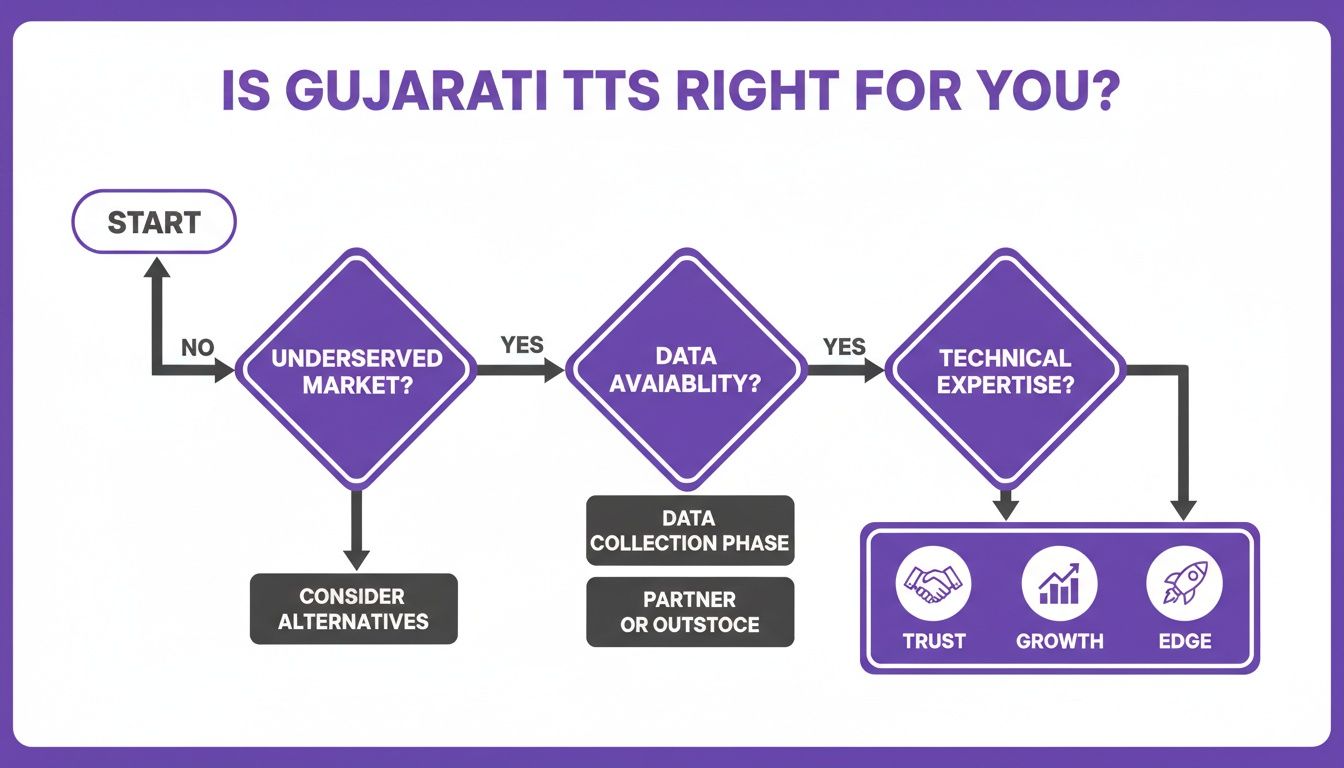
As the flowchart shows, if you’re aiming to connect with an underserved market, Gujarati TTS isn’t just a feature. It’s a powerful tool for building trust, fuelling growth, and getting ahead of the competition.
The Cloud Provider Pathway
Big names like Google Cloud and Microsoft Azure offer powerful, off-the-shelf TTS engines. They’re fairly simple to integrate, and you can scale up or down as needed. Their pay-as-you-go pricing makes them a great fit for pilot projects or businesses with fluctuating demand. For example, a marketing campaign processing 1 million characters a month (roughly 50,000 short automated calls) can be executed at a manageable cost.
The problem arises when you scale. For an enterprise running thousands of automated calls every day, those character-based costs add up fast. Once you hit 50 million characters per month—a completely realistic number for a large-scale real estate or BFSI outreach campaign—your Total Cost of Ownership (TCO) on a cloud platform can quickly become a major operational expense, often exceeding $20,000 annually.
The Specialised and On-Premise Advantage
This is precisely where on-premise deployments or specialized platforms like DialNexa become the superior strategic choice. While there may be a higher initial investment, the financial model inverts at high volumes. An on-premise solution offers predictable, fixed costs and eliminates per-character billing entirely, leading to a much healthier TCO and a clear ROI within 12-18 months for high-throughput operations.
For a business handling thousands of concurrent calls, latency isn’t just a technical metric; it’s the difference between a natural conversation and a frustrating, dropped call. Specialized on-premise systems consistently deliver lower latency, often clocking in below 300ms, which is crucial for building responsive, real-time conversational AI that drives business results.
And then there’s data security—a non-negotiable for any CXO in sectors like BFSI or healthcare. On-premise solutions provide total control, ensuring sensitive customer data (like Aadhar or PAN details) never leaves your secure environment. This is a massive advantage when it comes to meeting strict compliance mandates from regulators like RBI or SEBI.
A Comparative Look at Key Business Metrics
Let’s break down the core differences in a straightforward comparison for executive review.
| Metric | Major Cloud Providers (Google/Azure) | Specialised/On-Premise (DialNexa) |
|---|---|---|
| Total Cost of Ownership (TCO) | Low initial cost, but scales unpredictably with volume. High TCO at 50M+ characters/month. | Higher upfront setup, but offers a significantly lower and more predictable TCO at scale, maximizing ROI. |
| Data Security & Compliance | Data processed on third-party servers, creating potential hurdles for meeting compliance in sensitive industries. | Full data control within your own infrastructure, ensuring maximum security and simplifying regulatory audits. |
| Voice Quality & Nuance | Good, general-purpose quality, but often struggles with specific regional dialects or industry-specific terminology. | Superior, human-like voice quality trained on targeted datasets for specific accents and jargon, enhancing brand credibility. |
| Latency & Reliability | Latency can be variable (>500ms), depending on network traffic and provider server load, risking call quality. | Consistently low latency (<300ms), optimized for high-volume, real-time conversational workflows, ensuring a seamless CX. |
At the end of the day, while a cloud TTS is a fantastic starting point for a pilot, any business serious about large-scale customer outreach will find that a specialised or on-premise solution delivers far better financial and performance outcomes.
The decision really boils down to your long-term strategy for customer engagement. If you’re looking even further ahead, our guide on on-device speech and multimodal assistants explores what’s coming next in the world of voice AI.
Bringing High-Quality Gujarati Voice Agents to Life
Many leadership teams assume that deploying a Gujarati text-to-speech (TTS) system will require a massive, resource-intensive engineering effort. In practice, this is a misconception. The real challenge isn’t the technology itself but the perception of its complexity. With a robust, well-documented API, a sophisticated voice agent can be operational far faster than anticipated.
A platform like DialNexa is designed to handle the heavy lifting. Instead of tasking your teams with managing infrastructure and complex AI models, the process is streamlined to simple, authenticated API calls. This liberates your developers to focus their energy on your application’s core business logic, accelerating time-to-market.
From Text to Voice: A Practical Walkthrough
How does this translate to a real-world business scenario? Imagine a real estate firm aiming to automate calls to leads with details about a new property launch in Ahmedabad. The objective is to convert a Gujarati text string into a clear, natural-sounding audio clip for an automated outbound dialing campaign.
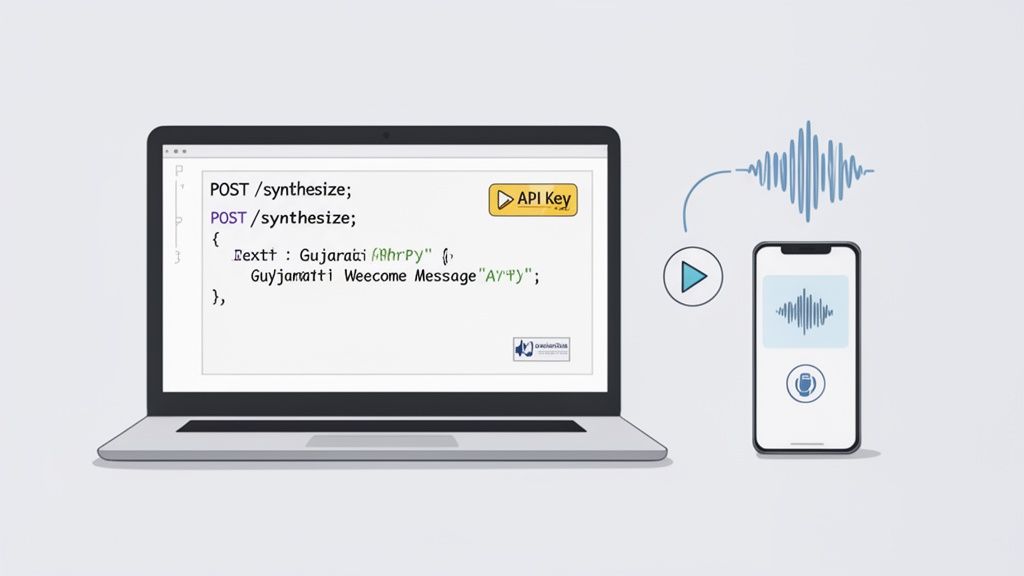
Using a REST API, this becomes remarkably straightforward. Your back-end system makes a secure HTTPS POST request to the TTS endpoint. The request body contains the Gujarati text and any specified parameters, such as voice gender or speaking rate.
Here’s a practical Python example demonstrating this simplicity:
import requests

# Your API credentials and endpoint
api_key = "YOUR_API_KEY"
api_url = "https://api.dialnexa.com/v1/tts"

# The Gujarati text you want to convert to speech
text_to_speak = "આ ૩ બેડરૂમનો ફ્લેટ બોડકદેવમાં ઉપલબ્ધ છે. વધુ વિગતો માટે, ૧ દબાવો."

headers = {

"Authorization": f"Bearer {api_key}",

"Content-Type": "application/json"
}

payload = {

"text": text_to_speak,

"voice": "gu-IN-Standard-A", # Example voice model

"format": "mp3"
}

response = requests.post(api_url, json=payload, headers=headers)

if response.status_code == 200:

with open("property_details.mp3", "wb") as audio_file:

audio_file.write(response.content)

print("Audio file created successfully for outbound campaign.")
else:

print(f"Error: {response.status_code} - {response.text}")
That’s it. With a minimal code footprint, you have generated a ready-to-use audio file. The API manages all the complex speech synthesis, returning a standard audio stream that can be immediately integrated into your IVR or dialer workflow.
The Foundation of a Great Voice
The final audio quality is only as good as the data used to train the TTS models. This is where commercial-grade Gujarati speech datasets, often containing over 229 hours of production-ready audio from sources like call centers, become a critical differentiator.
Research has shown that models trained on this kind of high-quality, domain-specific data can achieve a Mean Opinion Score (MOS) above 3.6. For a CXO, this score is a direct proxy for customer acceptance; a score this high indicates synthesized speech that is nearly indistinguishable from a professional human voiceover—absolutely critical for creating believable, human-like interactions that drive conversions. You can discover more insights about these foundational speech datasets on shaip.com.
The strategic value of a modern TTS API lies in its abstraction of complexity. It allows a developer to generate a personalized welcome message like ‘નમસ્કાર, DialNexa એડટેક માં આપનું સ્વાગત છે’ just as easily as a static one, enabling hyper-personalization at scale without a linear increase in engineering effort.
To create truly advanced voice agents that don’t just speak but also understand, you need to appreciate the power of Natural Language Processing (NLP) applications. This is the underlying technology that enables the system to correctly interpret and vocalise the unique nuances of the Gujarati language. It’s what turns simple text into convincing speech, ensuring your message is not only heard but truly understood.
Fine-Tuning Pronunciation for Flawless Communication
Out of the box, a generic Gujarati text to speech engine performs adequately with basic sentences. The challenge arises with words that are critical to your business—your brand name, proprietary product terms, or a customer’s name. A voice agent mispronouncing a key term is more than a minor error; it instantly shatters the illusion of a human connection and erodes brand credibility.
This is where your team moves beyond basic setup and into advanced customization. For any CXO, ensuring your brand communicates with precision is non-negotiable. The gap between a robotic, untrustworthy voice and a natural, brand-aligned representative is closed with this level of granular control.
How Do You Control Pronunciation with SSML?
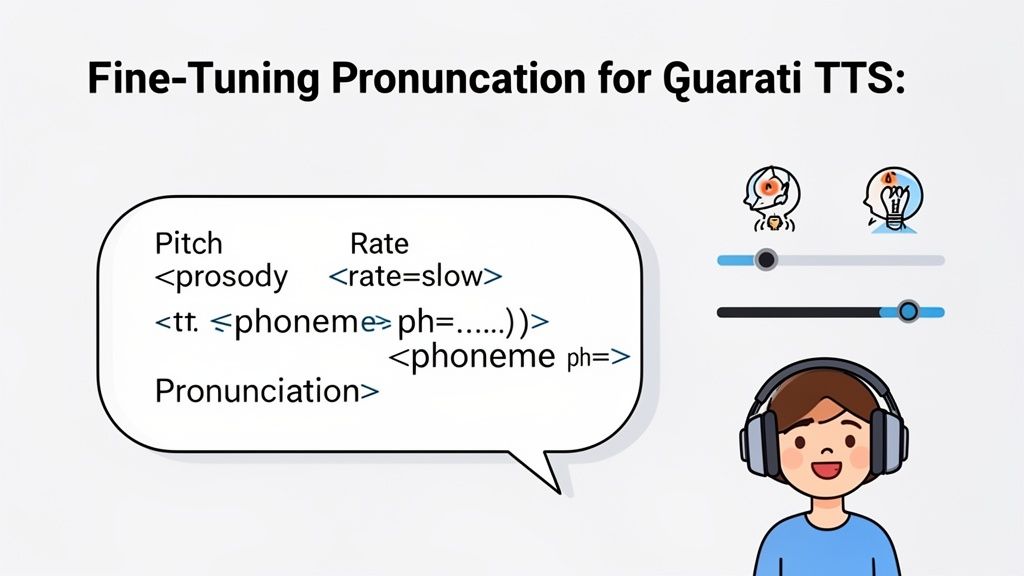
The key to this control is Speech Synthesis Markup Language (SSML). Think of it as a set of directorial cues embedded directly into your text. Instead of merely hoping the TTS engine pronounces a word correctly, you are instructing it exactly how to articulate it.
SSML provides direct control over the audio output. You can fine-tune:
- Rate and Pitch: Need to convey urgency in a flash sale notification? Increase the speaking rate by 15%. Explaining complex policy details? Slow it down by 20%. You can even modify pitch to add emphasis, making the delivery far more dynamic and engaging.
- Volume: Make critical phrases like “Offer ends tonight” louder to capture attention and drive action.
- Pauses: Inserting brief, 200ms pauses makes the speech sound less like a continuous text stream and more like a natural, thoughtful conversation, dramatically improving the listening experience.
For instance, an EdTech company can use SSML to slow down the pronunciation of difficult scientific terms, ensuring students grasp the information correctly. This isn’t just a technical feature; it’s a tool for building clear and effective communication that enhances learning outcomes.
In a high-stakes sales or service call, perfect pronunciation isn’t a luxury; it’s a necessity. A single mispronounced word can derail the conversation, making the customer feel misunderstood and damaging your brand’s credibility in a matter of seconds. Getting this right is a direct investment in your brand equity.
Correcting Complex Words and Regional Dialects
One of the most powerful tools in the SSML toolkit is the <phoneme> tag. This is your go-to solution for words the TTS engine consistently gets wrong, like brand names, technical jargon, or loanwords from other languages.
Let’s say your company is named “Aevia.” A standard engine might pronounce it “A-vee-a.” With the <phoneme> tag, you provide the exact phonetic spelling (e.g., ay-vee-uh), ensuring it is pronounced correctly in every single automated interaction.
Dialectal precision is another huge factor in connecting with customers. A voice that sounds natural in Ahmedabad (Central Gujarat) might feel out of place in Surat (South Gujarat). Modern TTS engines are often trained on diverse datasets like the Gujarati Raw Speech Corpus, which contains over 57 hours of audio from speakers across the four main dialects. This rich foundation allows the engine to produce speech that feels regionally authentic, a massive win for building user trust and local rapport.
By localising your voice agents with these deep customisation techniques, you ensure your message is not just heard, but also felt, creating a far more personal and effective connection with your audience.
Measuring ROI and Scaling Your Voice Operations
Deploying new technology is one thing; proving its value in the boardroom is another. From a CXO’s perspective, any Gujarati text to speech project must demonstrate a clear return on investment (ROI). You need to present hard data that connects directly to the company’s P&L statement.
Forget vanity metrics like the raw number of calls made. What truly matters are the productive outcomes generated. To build a compelling business case, you must track key performance indicators (KPIs) that showcase tangible financial and operational improvements.
Which KPIs Should You Track for Gujarati TTS Performance?
To gain executive buy-in, focus on the metrics that leadership values: efficiency gains, customer satisfaction, and revenue growth.
When we partner with clients, we establish a core set of business-centric metrics:
- Conversation Completion Rate: What percentage of your automated calls are completed without the customer hanging up? An increase from a baseline of 65% to over 80% is a direct indicator of improved engagement.
- Lead Qualification Accuracy: How do leads qualified by your AI compare to those vetted by top human agents? It’s not uncommon for platforms like DialNexa to see AI match human performance with over 97% accuracy, but at a fraction of the cost.
- Cost Per Successful Interaction: This is a powerful metric for the CFO. Divide the total cost of your voice AI operations by the number of successful outcomes (e.g., appointments booked, payments made). A practical goal is to reduce this from ₹50 per human-led interaction to under ₹15 per AI-led interaction.
- Customer Satisfaction (CSAT) Scores: Are customers happier? Post-call surveys are the definitive measure. A sustained increase in CSAT after deploying Gujarati TTS is hard evidence of an improved customer experience.
This table provides a framework for tracking the business impact of your voice AI initiative.
KPIs for Measuring Gujarati TTS Performance
| Metric | What It Measures | Target Benchmark (Example for a CXO) |
|---|---|---|
| Conversation Completion Rate | The percentage of calls completed without premature hang-ups. | Increase from 65% to 80% within Q1. |
| First Call Resolution (FCR) | The percentage of customer queries resolved in a single, automated call. | Achieve 70%+ for common query types, freeing up agent time. |
| Cost Per Successful Interaction | Total operational cost divided by the number of successful outcomes. | Reduce from ₹50 to ₹15 per interaction, saving millions annually. |
| Lead Qualification Accuracy | How closely AI-qualified leads match the quality of human-qualified leads. | Maintain 97%+ accuracy compared to human agents to ensure sales pipeline integrity. |
| Customer Satisfaction (CSAT) | Customer feedback collected via post-call surveys (e.g., on a 1-5 scale). | Increase average score from 3.5 to 4.2 to improve brand loyalty. |
| Call Abandonment Rate | The percentage of callers who hang up before their issue is resolved. | Decrease from 25% to below 10%, capturing more revenue opportunities. |
Tracking these KPIs provides the data necessary to tell a compelling story about efficiency gains and an enhanced customer experience.
Imagine presenting a Q1 report showing a 30% reduction in call abandonment rates after deploying a natural-sounding Gujarati voice agent for order updates. That’s not just a technical win; it’s a direct improvement in customer retention and a clear, quantifiable ROI that justifies further investment.
Modern platforms like DialNexa make this incredibly straightforward. Their real-time analytics dashboards let you keep a close eye on these KPIs, giving you instant visibility into the impact your voice operations are having. This data becomes your best asset for justifying more investment and scaling up.
From Pilot to Full-Scale Deployment
Most successful implementations begin with a focused pilot project. You might start by handling a few hundred calls a day for a single, high-impact campaign, such as lead generation or payment reminders. The objective of the pilot is to prove the model’s real-world value and gather baseline data for ROI calculation.
Once you have data from a successful pilot, for instance, a 20% increase in lead conversion, you can build a strategic roadmap for scaling. The key is a phased rollout. Gradually migrate more workflows to your Gujarati voice agents, starting with high-volume, repetitive tasks like appointment reminders or KYC verifications.
This immediately frees up your skilled human agents to handle complex, high-value conversations that require genuine empathy and strategic problem-solving. Before long, you are handling thousands of concurrent calls seamlessly, dramatically increasing operational capacity without a corresponding increase in headcount.
Common Questions About Gujarati TTS for Business
When business leaders evaluate Gujarati text-to-speech, a few practical questions invariably arise. Before committing budget and resources, you need clear, strategic answers. Let’s address the most common concerns I hear from VPs, Directors, and C-level executives.
How Secure Is Our Data with a TTS Provider?
This is a non-negotiable for any leader in banking, finance, or healthcare. With a standard cloud-based TTS service, your text is sent to the provider’s servers for processing. While major providers have robust security protocols, the fact remains: your data temporarily leaves your network. This can create compliance challenges.
For organizations where data sovereignty is paramount, an on-premise or private cloud deployment is the definitive solution. This architecture ensures that all data, every piece of customer PII, remains within your secure infrastructure. It is the most straightforward path to satisfying compliance requirements from bodies like RBI, SEBI, or IRDAI.
Can TTS Handle Our Enterprise Call Volume?
Yes, but this is entirely dependent on the platform’s architecture. An enterprise-grade system is engineered for scale. It can comfortably manage thousands of concurrent calls, generating audio in real-time with latency consistently below 300ms.
This means you can scale from a pilot of a few hundred calls per day to a full-scale operation handling tens of thousands of interactions per hour without performance degradation. For a CXO, this guarantees operational reliability during peak business hours, like a festival sale or a new product launch.
The question isn’t whether the technology can scale, but whether the chosen platform is built to scale. A consumer-grade API will fail under enterprise load. A dedicated voice AI platform is designed for exactly that kind of pressure, ensuring 99.9% uptime and reliability when it matters most.
How Difficult Is It to Get Started?
Deploying a TTS solution is surprisingly straightforward from an implementation standpoint. You do not need to build an in-house team of machine learning specialists. The integration is managed via a simple REST API, which your existing development team can implement with minimal effort.
For example, a developer can send a JSON payload with Gujarati text and receive an MP3 audio file back in milliseconds. Platforms like DialNexa provide clear documentation and pre-built code snippets that abstract away the complexity. This reduces the project timeline from months to a matter of weeks, allowing for rapid deployment and faster realization of ROI.
Ready to see how a human-like Gujarati voice can transform your customer outreach? Explore DialNexa and discover how our AI agents can help you scale conversations and drive conversions. Learn more at https://dialnexa.com.

Leave a Reply