
Bolna AI Pricing in India: What CXOs Actually Pay in 2026
Bolna AI charges 6.00¢ per minute, or about ₹5.52/min, on its standard India-facing usage-based rate. The Pilot plan works out to roughly ₹4.60/min once the 20% bonus is included, but the floor is higher because Bolna also adds a $0.02/min platform fee on top of STT, LLM, TTS, and telephony charges.
CXOs who stop at the sticker rate usually under-budget. For Indian voice operations, bolna AI pricing is better read as a layered invoice, not a single line item.
Table of Contents
- What Bolna AI Costs in India Right Now
- How Bolna's Three-Layer Pricing Structure Works
- How Bolna AI Pricing Compares With the India Market
- Hidden and Recurring Costs Most CXOs Miss
- Three CXO Cost Scenarios With Real Invoice Math
- Building a TCO and ROI Model for Bolna AI
- Questions to Ask Bolna Before You Sign, and How to Negotiate
What Bolna AI Costs in India Right Now
Bolna's public pricing looks straightforward until real call volume enters the model. The standard rate is 6.00¢ per minute, about ₹5.52/min on its pricing page, while the Pilot plan is a one-time recharge for 10,000 minutes, billed in 30-second pulses, with a 20% bonus that lifts usable minutes to 12,000 and brings the effective cost to roughly ₹4.60/min once the bonus is counted (see Bolna's official pricing page).
That headline number is only one layer. Bolna also documents a $0.02/min platform fee separately from voice processing and telephony, so the invoice grows beyond the sticker rate as soon as the call starts moving through the stack (see Bolna's call pricing documentation).
Bolna AI headline pricing snapshot for India 2026
| Cost Layer | Headline Rate | INR Equivalent (≈) | Notes |
|---|---|---|---|
| Voice AI processing | 6.00¢/min | ₹5.52/min | Standard public rate on Bolna pricing page (see Bolna's official pricing page) |
| Pilot plan effective rate | about 4.60/min | ₹4.60/min | Effective after 20% bonus on 12,000 total minutes (see Bolna's official pricing page) |
| Platform fee | $0.02/min | varies | Separate fee on top of provider charges (see Bolna's call pricing documentation) |
| Telephony | not public as a single rate | varies | Depends on carrier choice and routing (see Bolna's call pricing documentation) |
Procurement teams should not compare Bolna with a plain SaaS subscription. The bill shifts with provider choices, call routing, and whether implementation is folded into the minute rate. For buyers who are also weighing labor substitution, remote staffing pricing is a useful comparison point, because both models hide cost in different places and punish loose assumptions in different ways.
Practical rule: if a voice-AI vendor gives you only one per-minute number, assume at least one other charge is still sitting outside the headline.
The right way to model Bolna is as voice processing plus platform fee plus telephony plus integration. For BFSI, EdTech, and real estate teams, that framing matters because the commercial question is not whether the sticker rate looks low, it is whether the all-in call economics still justify the outcome.
How Bolna's Three-Layer Pricing Structure Works
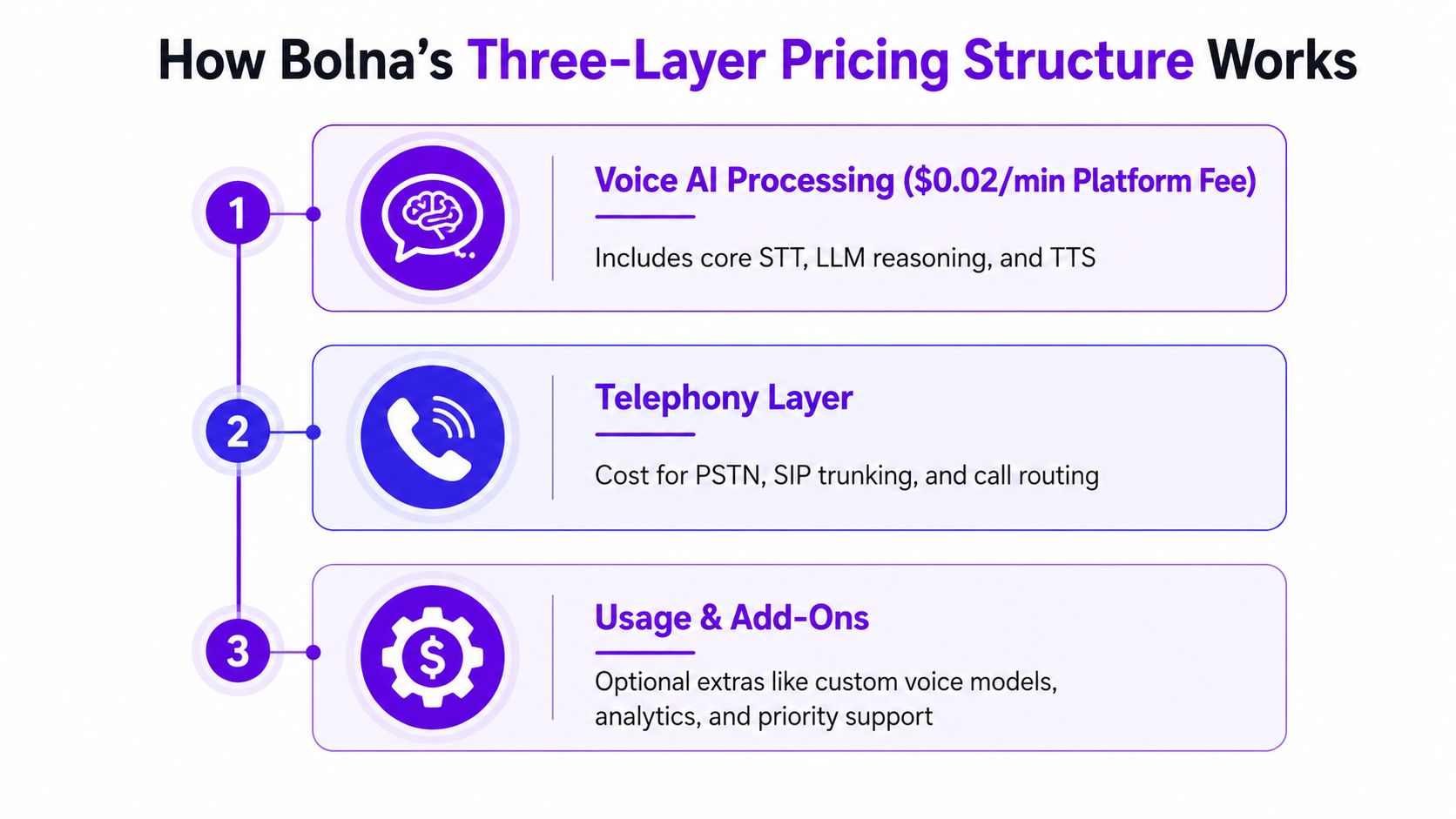
Bolna's pricing stack is clearer on paper than in a sales call. The bill breaks into three separate layers, and each one can change depending on how the agent is configured and which upstream providers are used.
Layer 1, Voice AI processing
This is the core charge behind the 6.00¢ per minute headline. It covers the conversational engine, including STT, LLM reasoning, and TTS inside the call flow. The key issue is variability. If a deployment uses higher-cost upstream models, this layer moves up with them, which is why some enterprise voice bots end up well above the sticker rate.
Layer 2, Telephony
Telephony is the carrier side of the call. It includes the outbound or inbound route, trunking, and the PSTN minutes that carry the conversation across the network. In India, this layer depends on carrier relationships, route quality, and compliance setup. A clean trunk and sensible routing can keep the cost in check, while a messy configuration can quickly weaken the economics.
Layer 3, Platform fee
Bolna lists a $0.02/min platform fee as a separate line item. That fee covers orchestration and control, including scheduling, dashboards, and the operational wrapper around the call flow (see Bolna's call pricing documentation; see Bolna's agent pricing and FAQ documentation). This layer does not shrink as much as buyers expect. Volume may improve the effective call rate, but the platform fee remains a structural cost.
A CXO can influence Layer 1 most directly through plan choice and volume. The Pilot plan's bonus minutes show how Bolna can soften the effective rate for upfront commitments. Layer 2 and Layer 3 are less flexible. They follow infrastructure costs, not just commercial packaging.
Commercial takeaway: if a vendor says “usage-based”, ask which usage they mean. In voice AI, there are usually three.
The invoice is a stack, not a sticker. That is why a buyer who budgets only the per-minute rate usually gets surprised by telephony, onboarding, or implementation.
How Bolna AI Pricing Compares With the India Market
Bolna sits in the middle of the Indian voice-AI market, not at the cheap end. India-region references for enterprise-style voice AI usually cluster around a broad ₹2 to ₹12 per minute headline band, while effective all-in pricing can move to ₹4 to ₹25 per minute once platform fees, telephony, setup, and unused minutes are included (see the Caller Digital 2026 India voice-AI guide).
Bolna's ₹5.52/min standard rate lands in the mid-premium range, and the ₹4.60/min Pilot effective rate still does not read as budget pricing. It does sit below many custom enterprise builds that rely on costly voice and reasoning stacks. That is the commercial reality. Bolna is competing with a managed, outcome-oriented voice agent stack, not a bare-bones IVR bot.
Bolna AI vs India voice-AI pricing benchmarks
| Vendor Tier | Headline Rate | Effective All-in Rate | Typical Buyer |
|---|---|---|---|
| Budget IVR-style bot | below ₹2/min | varies | Simple flows, low-complexity routing |
| Mid-market managed voice AI | ₹2 to ₹12/min | ₹4 to ₹25/min | BFSI, EdTech, real estate, support teams |
| Bolna standard rate | ₹5.52/min | higher after telephony and platform fee | Buyers who want a managed stack and faster deployment |
| Bolna Pilot effective rate | about ₹4.60/min | higher after telephony and platform fee | Teams testing a volume plan with bonus minutes |
| BFSI-grade deployment | ₹4 to ₹7/min | varies | On-shore hosting, strict SLAs, compliance-heavy use cases |
That is why cheaper alternatives often win on simple appointment reminders, then lose as the workflow gets more complex. A lower-cost SaaS bot can work for a shallow, scripted interaction. Compliance-aware collections, admissions counselling, or qualification logic usually justify a fuller stack, because the buyer is paying for orchestration, not just minutes.
A useful market check is DialNexa's Bolna alternatives guide. The key point is not that one vendor is always cheaper. The cheaper credible option depends on call complexity, not just call duration.
Buyer lens: if the workflow is short and repetitive, cost dominates. If the workflow branches, touches compliance, or requires multi-step qualification, outcome quality starts to matter more than the raw per-minute rate.
Bolna therefore fits teams willing to pay for orchestration and a stronger operating layer. It loses on use cases that are basically scripted IVR in new packaging.
Hidden and Recurring Costs Most CXOs Miss
Most Bolna-style buyer decks lead with the minute rate. The invoice usually grows elsewhere. Bolna's own pricing materials separate the platform fee from provider charges, which is the first clue that the headline number is only part of the cost stack.
The costs that usually show up after the pitch
- Telephony mark-ups. Carrier routing, trunk rental, and outbound minutes can sit outside the voice-AI fee, especially if the buyer does not bring its own carrier.
- Premium model upgrades. Bolna's pricing examples include $0.05 per minute for a relationship manager and $1 per successful screening for use cases such as personalised CV screening and situational roleplay (see Bolna's agent pricing documentation).
- Onboarding and prompt work. Mid-market deployments often need configuration, testing, and prompt design, and vendors commonly price that work separately even when the stack is sold as “managed”.
- Integration labour. Freshdesk, Leadsquared, and custom Salesforce flows rarely arrive as included work. If the system has to write back into the CRM, someone has to build and test that path.
- Analytics and dashboards. Operational visibility often becomes an add-on rather than a default entitlement.
- Voice customisation. If the pitch includes voice cloning or bespoke tone work, treat it as a scoped project, not a casual toggle.
The broader market pattern backs that up. In India, voice-AI offers can look cheap until telephony, routing, and deployment effort are added. A useful external check is this Exotel pricing assumptions note, which helps buyers sanity-check carrier costs before accepting a bundled call rate.
Ask before you sign: does the rate include telephony, CRM write-back, prompt tuning, dashboard access, and transcript retention, or are those all separate?
That question matters because the purchase decision is often made on the demo, while the finance team lives with the invoice. If the vendor cannot place each charge in a line item, the buyer will discover the structure later through usage bills and implementation notes.
Hidden cost line items in a Bolna AI deployment
| Line Item | Typical Range | Billing Cadence |
|---|---|---|
| Platform fee | $0.02/min | Per minute |
| Premium agent tier | example pricing from $0.05/min | Per minute |
| Successful screening flow | example pricing from $1 per success | Per successful outcome |
| Telephony routing | varies | Per minute or per route |
| Onboarding and prompt work | not public | One-time or project based |
| CRM integration | not public | One-time or project based |
| Voice customisation | not public | One-time or project based |
CFOs get caught when the first invoice looks manageable and the second one reveals the full shape of the deployment. The pattern is predictable. Vendors sell the conversation, then bill for the surrounding machinery.
Three CXO Cost Scenarios With Real Invoice Math
A headline minute rate is only the starting point. The invoice matters more, because the final spend depends on whether a team pays only for conversation time or also for platform access, telephony, and the work needed to make the system usable in production.
BFSI collections leader
A collections team running 50,000 minutes per month at the 6.00¢ tier is spending roughly $3,000 before platform fees, telephony, and compliance overhead. At that volume, the finance question changes. The buyer is no longer comparing a cheap bot to a human desk, but the full cost of automating a sensitive workflow where consistency and audit discipline carry real weight.
BFSI buyers often accept a higher per-minute cost if the deployment reduces operational risk and manual follow-up. That is why a rate card by itself is not enough. The better test is whether the automated reach, response consistency, and lower manual load produce a cleaner operating model than the collections team would run with people alone.
EdTech admissions season
An admissions team using the Pilot plan can top up ₹50,000, which is about $595, and receive 10,800 bonus minutes under the plan's 20% bonus structure. That puts the effective rate around ₹4.60/min, which makes the plan easier to justify during a short, intense admissions push.
This works best when the team needs fast deployment and expects volume spikes that justify prepaying. It is a weaker fit if the campaign is small or the counseling flow is simple enough that a cheaper bot would handle the same task. For buyers who want to compare a similar pricing pattern in another voice stack, DialNexa's voice-AI platform pricing approach is a useful reference point.
Real estate site-visit confirmations
Real estate operators usually care about contactability, qualification, and site-visit conversion, not call completion alone. A 20,000-minute outbound campaign at around ₹5.52/min becomes a serious operating line once telephony and platform fee are added, so the buyer has to compare it against the cost of human telecallers and the conversions that follow.
If a 6-seat human telecaller setup costs about ₹1.8 lakh/month, the key question is whether the AI layer removes enough repetitive work to keep the staffing model lean. That comparison is where the economics either hold up or fall apart at budget review.
Pricing can also shift by agent type. A relationship-manager style agent can be priced differently from a screening flow, so two teams inside the same company may end up with different economics even if they use the same vendor.
| Scenario | Monthly Minutes | Tier Used | All-in Monthly Cost (₹) |
|---|---|---|---|
| BFSI collections | 50,000 | 6.00¢ tier | headline spend plus platform fee and telephony |
| EdTech admissions | 10,800 bonus minutes from top-up | Pilot plan | about ₹50,000 top-up, plus any extra routing cost |
| Real estate site visits | 20,000 | about 6.00¢ tier | headline spend plus platform fee and telephony |
Budgeting rule: compare AI and people on completed outcomes, then decide whether the automation premium is worth paying.
Building a TCO and ROI Model for Bolna AI
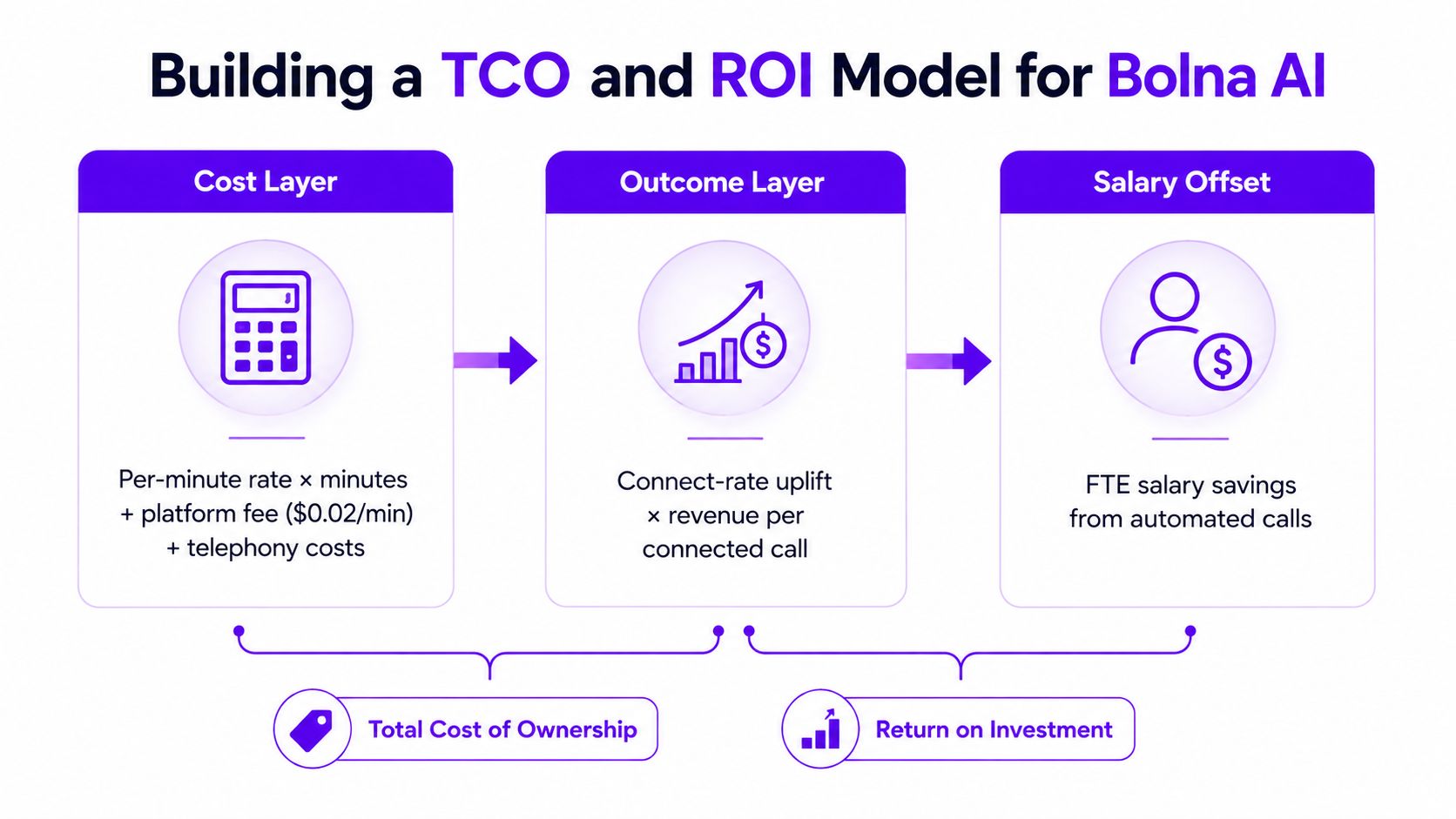
Bolna's invoice should be modelled in three layers. The first is the cost layer, where per-minute rate × minutes + platform fee + telephony sets the cash outflow. The second is the outcome layer, which captures the value of a better connect rate or a higher lead-to-booking rate. The third is the salary offset, the human calling load you no longer need.
A useful starting point is a baseline connect rate of 35%, then test the same workflow at 50% after automation. Assign buyer-side value to each connected call, such as ₹450 for collections or ₹1,200 for admissions. Those are not Bolna inputs. They are the commercial values the buyer should defend in the model, which is the discipline finance teams expect.
A simple formula CXOs can actually use
Monthly net gain = outcome value from connected calls + salary offset, minus total call cost
Payback period = total setup cost + 3-month run cost, divided by monthly net gain
The logic is simple. Separate spend from value, then test whether the uplift covers the invoice. A higher minute rate can still work if it improves recoveries, bookings, or appointment density enough to offset the added cost.
A step-by-step ROI framework helps here, even though the use case is different. The structure still holds. Define cost, define lift, then isolate payback.
Sensitivity check for finance teams
| Minute Rate | Relative Impact on TCO | CFO Read |
|---|---|---|
| 6.00¢/min | baseline | workable if outcome lift is strong |
| 8.00¢/min | higher | needs better connect-rate or salary offset |
DialNexa's comparison of voice-AI platforms in India is useful if you want to judge whether Bolna's economics belong on the shortlist at all. If the rate rises and the outcome does not, the business case weakens fast.
The strongest ROI cases usually come from repetitive calling, clear success criteria, and a measurable handoff to humans. Collections and admissions tend to fit that profile earlier than low-intent support queues.
Questions to Ask Bolna Before You Sign, and How to Negotiate
A Bolna contract should not leave the table without a pricing appendix. The first question is which model drives the minute rate, because STT, LLM, TTS, and telephony choices can all move the invoice. The second is whether the commercial paper matches the operating reality, because DND handling, latency commitments, and transcript retention can create extra cost or risk later.
The 12 questions that protect your budget
- Which STT, LLM, and TTS models are in scope? This sets the core minute rate.
- Are telephony routes included, and which carrier is used? This sets the carrier surcharge.
- Is the $0.02/min platform fee fixed? This covers the orchestration layer.
- What happens when included minutes are exhausted? This defines overage pricing.
- Are premium voice or reasoning models priced separately? This limits upside price shock.
- Does DND handling change the billing treatment? This affects compliance cost.
- What latency SLA is contractually promised? This affects user experience.
- How long are transcripts retained? This affects storage and governance.
- Can we export per-call metadata? This affects auditability and BI.
- Is CRM integration part of the quote? This affects implementation spend.
- What is the migration fee from Pilot to production? This affects ramp economics.
- Can price changes be unilateral? This affects budget control.
The contract should also spell out who owns the commercial risk if the first rollout underperforms. That means asking for a written ramp clause, a capped Pilot-to-production migration fee, and per-minute commitments reviewed quarterly rather than locked for a long budget cycle. Buyers should also push for 90-day termination for cause and require metadata export in a usable format, because those rights matter if the deployment is audited or moved.
For a cleaner way to frame those conversations, see DialNexa's guide to negotiation communication, which keeps the discussion commercial instead of theatrical.
Contract red flags: auto-renewal without a usage floor, unilateral LLM model swaps, and unilateral price hikes above 10% should all be carved out before signature.
A vendor can sound credible and still leave you exposed if the paper is loose. The better voice-AI deals are the ones where the buyer knows what is included, what is not, and what happens when call volume changes.

This is a clear and insightful breakdown of Bolna AI pricing, especially the hidden costs and TCO considerations. The practical scenarios and negotiation questions make it really useful for businesses evaluating voice AI solutions.
This is a useful guide for CXOs evaluating Bolna AI pricing in India. The focus on costs, practical considerations, and real-world business needs makes the article valuable for planning AI calling investments.
The three-layer pricing model, real-world scenarios, and ROI framework make this guide especially useful for businesses planning their voice AI budgets.