
Customer value and satisfaction: Master Customer Value & Sat
For Indian boards, the debate on customer value and satisfaction is over. The financial case is visible in operating results.
A 2023 Deloitte analysis of 1,200 Indian firms found that customer-centric companies delivered 60% higher profitability, with retention at 85% versus 55% for less-focused peers, as cited in this summary of customer experience metrics. That is not a branding story. It is a capital allocation story.
In India, the topic is sharper because customer expectations have risen faster than many operating models. Buyers compare not only products, but also response speed, language comfort, effort, and continuity across channels. The winners are not merely those with a stronger offering. They are those who make the entire interaction easier, more relevant, and more trustworthy.
The Unmissable Link Between Customer Experience and Profitability
Boards often treat customer experience as a soft lever and customer value as a product question. That separation is costly.
In practice, customer value and satisfaction determine whether revenue compounds or leaks. A customer may like the product and still leave because onboarding was confusing, support was slow, or a critical conversation happened in the wrong language. In sectors with recurring relationships, that gap moves directly into churn, lower share of wallet, and weaker operating margins.
The Indian context raises the stakes. A 2025 PwC India report found that 68% of Indian banking customers prefer vernacular language interactions, yet only 22% of BFSI firms consistently measure and act on those experience metrics, creating loyalty gaps, according to Bain’s radical thought page carrying the referenced insight. The implication is not merely about accessibility. It is about whether firms are measuring the parts of the journey customers care about.
Why boards should care now
Three realities stand out.
- Retention economics are unforgiving: Small failures in service quality can erase years of acquisition spend.
- Operational inconsistency is visible to customers: They experience the organisation as one brand, not separate sales, service, and collections teams.
- Language and effort shape trust: In BFSI, EdTech, healthcare, and property decisions, trust is often built or lost in conversation.
That is why leading teams are moving customer metrics closer to P&L review. They are asking different questions. Which interactions create friction? Which segments generate long-term value? Which moments need automation, and which require human escalation?
Boards that still treat CX as a reporting function miss the point. It is an operating system for profitable growth.
Differentiating Customer Value from Customer Satisfaction
Executives often use the two terms interchangeably. They should not.
Customer value is the benefit the customer believes they receive. Customer satisfaction is the judgement they make about the experience of receiving it. One is about substance. The other is about delivery.
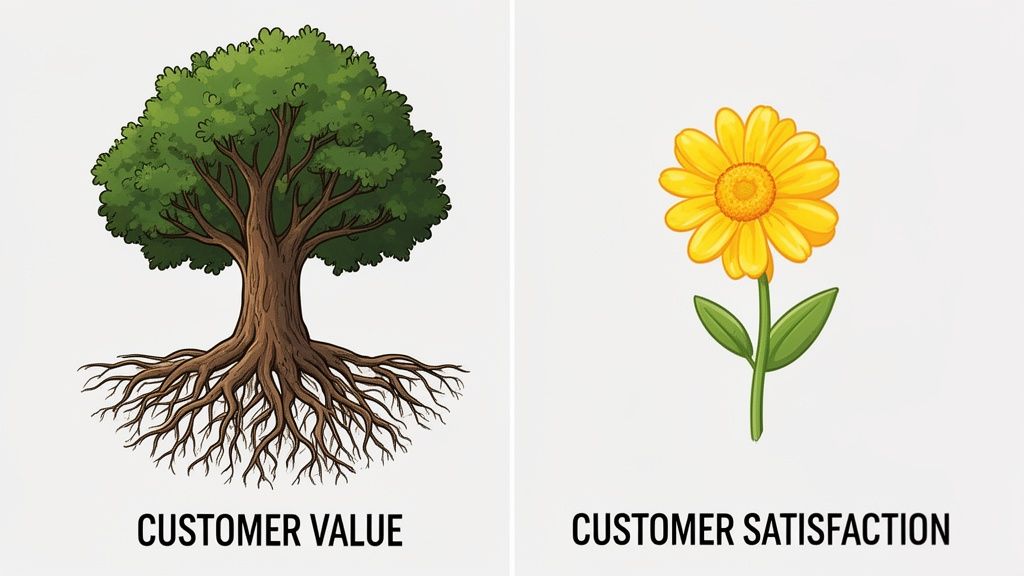
The simplest way to separate them
Consider a retail banking example.
A customer applies for a home loan. If the loan is approved on competitive terms, the customer has received value. But if the process involved repeated document requests, confusing updates, and long support queues, satisfaction may still be low. The firm delivered the outcome but failed in the experience.
The same logic applies elsewhere:
- EdTech: A learner may enrol in the right course, yet feel dissatisfied if counselling was generic and post-enrolment support was inconsistent.
- Real estate: A buyer may find a suitable property, but abandon the developer if follow-ups are repetitive or site-visit scheduling is poor.
- SaaS: A client may see product utility, while remaining unhappy with onboarding and issue resolution.
For a useful primer on the underlying concept, see DialNexa’s explanation of customer value.
Why the distinction matters for investment decisions
When leaders fail to distinguish value from satisfaction, they fund the wrong fixes.
If the product is weak, more service effort will not rescue the relationship for long. If the product is strong but the journey is clumsy, the organisation often overreacts by redesigning the offer instead of removing friction from sales, onboarding, or support.
A board-level test is simple:
| Question | What it diagnoses |
|---|---|
| Do customers get the core outcome they came for? | Customer value |
| Was it easy, reassuring, and efficient to get it? | Customer satisfaction |
| Would they stay, buy again, or recommend us? | Combined effect of both |
Where firms usually get it wrong
Many Indian businesses still optimise one side and ignore the other.
- Product-heavy firms focus on features, pricing, and distribution, assuming customers will tolerate effort.
- Service-heavy firms invest in pleasant interactions without fixing the core proposition.
- Data-heavy firms measure transactions but not perceived effort, emotional confidence, or language fit.
The more effective model is cumulative. Value earns consideration. Satisfaction earns loyalty. Together, they create durable economics.
A company can sell a useful product once on value alone. It earns repeat business only when satisfaction confirms that the value was worth the effort.
The Direct Business Impact of High Customer Value and Satisfaction
A 5% increase in retention can raise profits by 25% to 95%, according to Bain & Company’s long-cited economics of loyalty research. That is why customer value and customer satisfaction belong in capital allocation discussions, not only in CX reviews.
The financial effect is straightforward. Customer value determines whether the offer deserves a place in the market. Customer satisfaction determines whether that demand becomes repeat revenue, lower servicing cost, and stronger advocacy. In India, where acquisition costs are rising across BFSI, ecommerce, telecom, and healthcare, that distinction has direct implications for margin quality.
Profit pools shift quickly when customers stay longer
Retention changes more than renewal rates. It changes the economics of the whole customer base.
A retained customer typically generates four forms of value:
- Higher revenue continuity because purchase behaviour is more predictable.
- Lower acquisition burden because the original sales and marketing cost is spread over a longer relationship.
- Lower cost-to-serve because repeat customers usually need less education and fewer corrective interactions.
- Higher expansion potential because trust reduces resistance to cross-sell and up-sell.
This is why boards should treat churn as a profit issue first. Revenue leakage is visible. The hidden loss is future contribution margin that never materialises.
Satisfaction influences behaviour that finance teams can measure
Satisfied customers do not just report better experiences. They behave differently in ways that show up in P&L outcomes.
They are more likely to complete onboarding, less likely to abandon after a service failure, and more willing to consolidate spend with one provider. In practical terms, that lifts retention, improves repeat purchase rates, and reduces complaint-handling costs. The operating link is often customer effort. Leaders tracking CSAT as a transaction-level indicator of experience quality usually find that poor scores cluster around preventable friction such as long hold times, repeated verification, language mismatch, and unresolved first contacts.
In this context, Voice AI becomes commercially relevant for Indian firms. It can reduce wait times, improve routing accuracy, support multilingual interactions, and increase consistency across high-volume service moments. Those changes influence the metrics that matter most, especially CES, NPS, and CLV.
Lifetime value is the right bridge between CX and finance
Customer Lifetime Value gives management teams a better way to judge whether experience investments deserve budget. A faster response system, better call containment, or improved complaint resolution may look operational in isolation. They become strategic once leaders evaluate their effect on tenure, share of wallet, and retention.
That matters in India because many service categories have structurally high repeat potential but still tolerate fragmented support journeys. The result is avoidable value destruction. Customers who already trust the brand are often pushed into repeat contacts, branch visits, or channel switching that should never have been necessary.
Voice AI can change that equation. If it resolves simple intents faster, routes complex cases correctly, and supports customers in the language they prefer, the benefit is not limited to contact centre efficiency. It protects future cash flows from existing customers.
Market share often moves before dashboards catch up
Poor experiences rarely stay contained within service metrics. They weaken competitive position.
In categories with low switching friction, competitors do not need a meaningfully better product to win share. They need a buying and service experience that feels easier, faster, and safer. In categories with high trust requirements such as banking, insurance, healthcare, and high-value retail, dissatisfaction can suppress referrals and new customer conversion at the same time.
That is why strong CX creates a market share effect through two channels. It reduces defections from the existing base and improves word-of-mouth acquisition from the same installed base. Firms that combine strong value with low-effort service usually gain share without matching every competitor on price.
What boards should monitor
| Business outcome | Mechanism |
|---|---|
| Profitability | Higher retention, lower cost-to-serve, better expansion revenue |
| Market share | Lower switching, stronger referrals, improved conversion from trust signals |
| Cash flow quality | More predictable repeat revenue and lower reacquisition spend |
| CX return on investment | Measurable movement in NPS, CES, CLV, and churn after service redesign |
The practical conclusion is clear. High customer value wins the first purchase. High customer satisfaction determines whether that purchase becomes an annuity. For CXOs in India, the next question is no longer whether experience affects growth. It is which operating investments, including Voice AI, can shift customer behaviour fast enough to improve NPS, CLV, and effort scores at scale.
Measuring What Matters Key Metrics for CX Leaders
A useful CX dashboard answers one board-level question. Which customer frictions are reducing revenue quality, margin, or retention, and which interventions will change that fastest?
For most Indian businesses, five metrics are enough to build that answer: CSAT, CES, NPS, FCR, and CLV. They measure different parts of the same system. CSAT shows how customers judge a recent interaction. CES captures how much work the customer had to do. NPS reflects accumulated trust. FCR indicates whether operations solved the issue without waste. CLV converts those patterns into economics.
CSAT and FCR for interaction quality
Customer Satisfaction Score (CSAT) is best used at the transaction level. It works after support calls, onboarding steps, complaint handling, fulfilment milestones, and payment-related service requests. Used well, it identifies which touchpoints are weakening confidence before broader loyalty metrics decline.
A practical explanation of the measure is available in DialNexa’s guide to what CSAT measures and how teams use it.
First Contact Resolution (FCR) should sit beside CSAT, not below it. A customer may rate an agent positively and still have an unresolved problem. That distinction matters in India, where repeat calls, branch revisits, and document resubmissions remain common in BFSI, healthcare, education, and real estate. Low FCR usually signals broken hand-offs, unclear ownership, or poor knowledge access. All three raise service cost.
For CX leaders, FCR is an operating metric with financial consequences. Higher first-time resolution lowers repeat volume, reduces escalation load, and protects satisfaction during high-intent moments such as claims, renewals, admissions, and collections.
CES for friction in the journey
Customer Effort Score (CES) measures how easy it was for the customer to complete a task or get an issue resolved. It is often the fastest way to locate avoidable friction in a journey.
That matters because customers do not experience a process as separate internal functions. They experience one task. If KYC requires three follow-ups, if a site visit needs repeated confirmation, or if a payment dispute moves across teams, the customer reads that as brand failure.
CES is especially useful in journeys such as:
- KYC completion
- Appointment or site-visit booking
- Fee payment support
- Admissions counselling
- Complaint resolution
The metric becomes more valuable when segmented. A high average CES can conceal severe friction for premium customers, elderly users, regional language speakers, or first-time digital users. That is where Voice AI becomes strategically relevant. It can reduce effort through faster intent recognition, 24×7 availability, multilingual handling, and cleaner routing to specialists. The result is not only lower perceived effort, but also better containment and lower service cost.
NPS for trust and future revenue quality
Net Promoter Score (NPS) is a relationship measure. It reflects whether the customer believes the brand is consistently worth recommending.
Boards should treat NPS carefully. It is not a service metric in isolation, and it should not be managed as a branding score detached from operations. In Indian categories where trust affects conversion, such as banking, insurance, healthcare, and education, NPS often moves after repeated service experiences shape confidence in the firm.
That makes NPS useful when read against operational inputs. If NPS improves while CES remains poor, brand equity may be masking structural issues. If NPS rises after better routing, faster response times, and fewer repeat contacts, leadership has stronger evidence that service redesign is improving relationship quality. Voice AI can contribute here when it reduces wait times, improves language accessibility, and preserves context across interactions. Those changes affect what customers remember, which is what NPS largely captures.
CLV as the financial test
Customer Lifetime Value (CLV) is the metric that matters most in capital allocation discussions. It connects acquisition quality, retention, repeat purchase, cross-sell potential, and cost-to-serve.
This is the metric that prevents CX from becoming a reporting exercise. A rise in CSAT with no change in CLV may indicate courtesy without economic impact. Lower CES paired with stronger retention and lower service cost points to a much better outcome. NPS gains that translate into higher renewal, referral, or wallet share are worth more than sentiment alone.
For Indian firms with recurring or relationship-based revenue, CLV should be reviewed alongside margin, churn, and channel mix. It helps management decide where premium service earns a return, where automation is appropriate, and which segments merit specialist intervention.
| Metric | What it answers | Best use case |
|---|---|---|
| CSAT | Was this interaction satisfactory? | Support, onboarding, fulfilment |
| CES | How hard was this for the customer? | Friction-heavy journeys |
| NPS | Would the customer recommend us? | Loyalty and relationship health |
| FCR | Was the issue resolved the first time? | Service efficiency and quality |
| CLV | What is this relationship worth over time? | Prioritisation and investment decisions |
Read the metrics as a system
Single metrics create blind spots.
High CSAT can coexist with poor process design if agents compensate for delays with empathy. Strong NPS can hide service inconsistency if the brand still carries trust from earlier experience. Rising CLV can look healthy while dependence on a narrow customer segment increases concentration risk.
The better approach is to read the metrics together.
- FCR shows whether operations are resolving demand efficiently.
- CSAT captures the customer’s immediate reaction.
- CES identifies friction that suppresses conversion and repeat use.
- NPS reflects whether the relationship is strengthening.
- CLV indicates whether those improvements are producing economic value.
A board-ready dashboard should do more than report scores. It should identify where friction is highest, which customer segments are most exposed, and whether technologies such as Voice AI are improving NPS, CLV, and effort scores in ways that increase profit and defend market share.
A Strategic Framework for Enhancing Value and Satisfaction
A workable CX strategy does not start with technology. It starts with operating discipline.
The highest-performing firms improve customer value and satisfaction through a sequence of choices. They identify where value is created, where effort accumulates, and where consistency breaks under scale. Only then do they decide what to automate, what to redesign, and what to escalate to specialists.
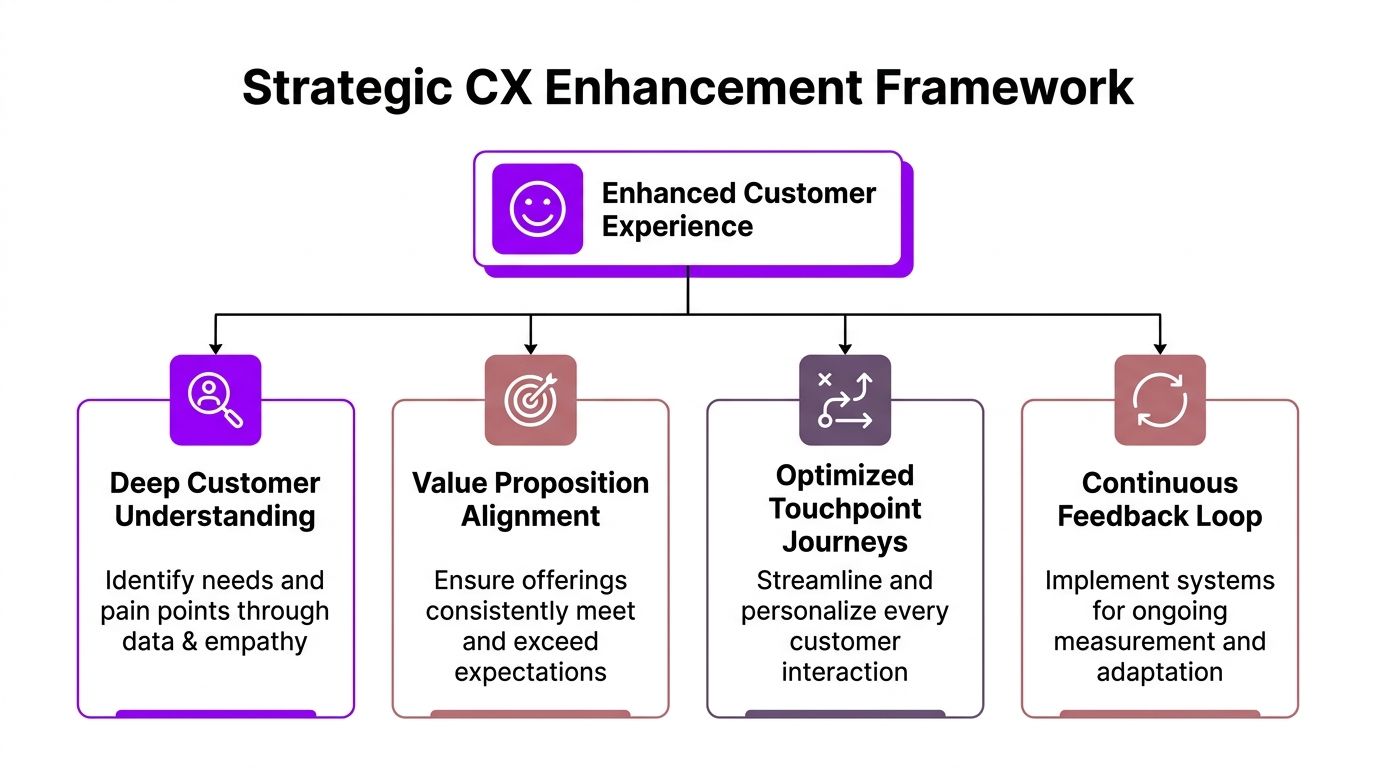
Pillar one deep customer understanding
Most firms know their segments by revenue. Fewer understand them by friction pattern.
The first task is to map the moments where customers hesitate, repeat themselves, drop off, or request reassurance. In BFSI that may be KYC, account activation, or complaint resolution. In EdTech it may be counselling, follow-up, or renewal. In real estate it may be discovery calls, lead qualification, or visit scheduling.
This pillar requires two disciplines:
- Journey evidence: Review call reasons, hand-off failures, repeat contacts, and unresolved requests.
- Segment nuance: Separate high-value customers from high-volume ones. They are not always the same group.
Without this layer, companies optimise averages and miss the interactions that drive the most commercial impact.
Pillar two value proposition alignment
Customer value weakens when the offer and the delivery model drift apart.
A bank may promise accessibility but force customers through jargon-heavy support. An EdTech provider may position itself as personalised while using scripted, undifferentiated counselling. A developer may advertise premium advisory while responding slowly to genuine buyer intent.
Leaders should test alignment through a simple board question: does the operating model make the promise believable?
A useful review lens is below.
| Strategic question | What strong firms do |
|---|---|
| Are we solving the customer’s real job to be done? | Customize the offer to intent, not just segment labels |
| Are we supporting the promise operationally? | Match service design to the brand claim |
| Are we measuring the moments that prove value? | Track outcomes and friction together |
Pillar three frictionless experience design
Customer satisfaction deteriorates fastest when effort compounds.
That makes journey simplification one of the highest-return investments available to CXOs. Effort shows up in the same forms: repetitive data entry, long wait times, inconsistent follow-up, language mismatch, and unnecessary escalation.
Removing friction often means redesigning a handful of high-volume journeys rather than launching broad experience programmes.
Focus areas include:
- Reducing repeats: Customers should not explain the same issue to multiple teams.
- Improving routing: High-intent and high-value interactions should reach the right queue first.
- Simplifying communication: Language, status updates, and next steps must be clear.
- Closing the loop: Every promised callback, reminder, or document prompt must happen on time.
Satisfaction rises fastest when companies remove effort customers were never supposed to bear in the first place.
Pillar four scalable personalisation
Personalisation is often discussed as a marketing capability. In practice, it is a service capability.
The challenge for Indian businesses is scale. Personalisation must work across languages, products, branches, partner networks, and thousands of daily interactions. Human teams alone struggle to deliver that consistency.
To achieve it, structured playbooks, intelligent routing, and conversation technology become useful. The point is not novelty. The point is repeatable relevance. The customer should feel that the company remembers their context, understands their stage in the journey, and responds appropriately without creating new effort.
Firms that do this well create a reinforcing cycle:
- Customers receive more relevant support.
- Resolution quality improves.
- Repeat effort falls.
- Loyalty becomes more resilient.
- CLV strengthens.
Continuous feedback is the control layer
No framework holds unless management can see whether changes are working.
The strongest teams review customer value and satisfaction like they review operations. They inspect metric movements, listen to failed conversations, compare segment outcomes, and update scripts, routing logic, and escalation rules quickly.
That discipline matters more than any single initiative. Customer needs change. Regulatory demands change. Channel preferences change. The operating model must adapt at that same pace.
Boosting CX Metrics with Voice AI in Practice
High connect rates can change the economics of service and sales, but only if the conversation that follows reduces effort, improves resolution, and protects future revenue. That is why Voice AI deserves board-level attention in India. Many high-value customer moments still happen on the phone, especially in BFSI, real estate, and EdTech, where customers need explanation, reassurance, and a clear next step before they convert or stay.
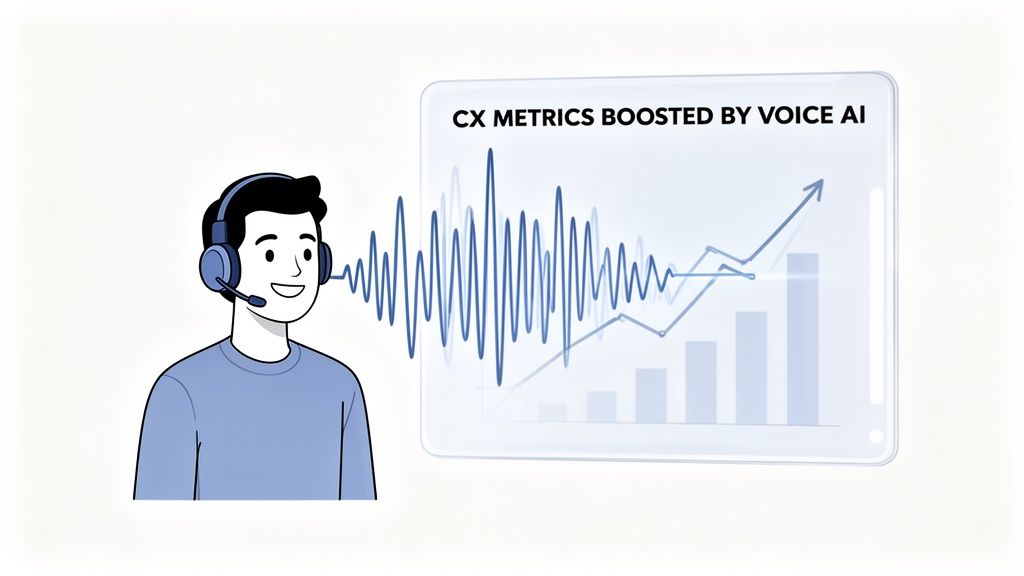
Why voice changes the economics
Voice remains the highest-value channel for journeys that involve ambiguity, documentation, or urgency. A text bot can confirm status. It rarely resolves hesitation during KYC, lead qualification, admissions counselling, or collections recovery with the same speed and clarity as a well-run voice interaction.
The strategic case is straightforward. Voice AI affects the customer at the exact point where NPS, CES, conversion, and retention often move together. If the system answers quickly, understands intent, follows workflow rules, and hands off exceptions cleanly, the business gains on multiple fronts at once: lower repeat contacts, higher completion rates, better agent productivity, and more stable customer lifetime value.
Teams comparing operating models can review practical examples in this guide to AI agents for customer service.
BFSI where compliance and effort collide
BFSI is a strong test case because service quality and regulatory accuracy are tightly linked.
A customer calling about KYC, loan documentation, card disputes, or policy servicing usually wants one thing first: certainty. Delays, inconsistent answers, or incomplete guidance increase effort immediately. That weakens CES, lowers first-contact resolution, and often creates avoidable rework for branch, ops, and contact-centre teams.
Voice AI creates value in this setting when it does four jobs reliably:
- guide customers through structured compliance steps
- provide consistent answers across products and scenarios
- identify exceptions early and route them to trained agents
- complete follow-ups without depending on manual queues
The business effect is larger than call containment. Better onboarding and servicing reduce drop-offs during high-friction stages of the relationship. In financial services, those stages carry a disproportionate share of lifetime value risk.
Real estate where speed and qualification determine yield
Real estate economics are heavily influenced by response time and lead quality. A prospect who enquires about a project is often comparing multiple developers and brokers within the same hour. Slow callbacks and inconsistent qualification waste paid acquisition spend and lower site-visit conversion.
Voice AI improves this flow when it qualifies intent, budget, location preference, and timeline in a consistent sequence, then books the next action. That changes both CX and sales productivity. Customers avoid repetitive screening. Sales teams receive cleaner handoffs and spend more time on high-probability leads.
The result is a measurable shift in funnel efficiency. Better qualification is not only an ops improvement. It raises perceived responsiveness, which is itself a satisfaction driver in a category where trust forms early and weakens quickly.
EdTech where perceived value begins before purchase
In EdTech, satisfaction starts before enrolment. Prospective learners often judge programme quality through the counselling experience long before they attend a class or use the product.
That makes guidance quality commercially important. If the interaction sounds generic, delays basic answers, or fails to match the learner to the right course, the perceived value of the offering falls before revenue is booked. Voice AI can improve this stage by standardising discovery questions, answering common objections consistently, and ensuring every lead receives timely follow-up across peak volumes and regional language variation.
Early experience shapes both conversion and downstream retention, which is significant. Students who enrol with clearer expectations typically create fewer support escalations and show stronger persistence through the first critical weeks of the programme.
A short demonstration of how voice-led customer interaction can be operationalised is below.
The operational blueprint
Voice AI works best as a structured execution layer for high-volume conversations with clear business stakes. The goal is not to mimic a human for its own sake. The goal is to improve consistency at scale while preserving escalation paths for complex or high-value cases.
DialNexa is one example of this model. The platform supports voice AI agents across qualification, support, recruitment, and presales workflows in sectors such as BFSI, EdTech, real estate, e-commerce, and software. The relevant board question is operational, not promotional: can the system run thousands of conversations, follow business rules accurately, and expose outcome data that management can act on?
Boards should evaluate any platform against four criteria:
| Decision criterion | What to verify |
|---|---|
| Conversation quality | Can it sustain natural, multi-minute exchanges without losing context? |
| Workflow fit | Can it manage qualification, support, reminders, and escalation logic? |
| Measurement | Does it report connect rate, conversion, resolution, and repeat-contact outcomes? |
| Escalation design | Can it transfer complex or high-value cases to human teams cleanly? |
Where Voice AI creates the strongest metric movement
The largest gains usually appear in journeys with three characteristics:
- High call volumes, inbound or outbound
- Repeatable workflows with moderate personalisation
- Clear financial upside from faster response or better resolution
That combination is common in Indian service operations. It is also where Voice AI moves beyond automation and becomes a CX instrument with direct commercial impact. Used well, it improves NPS by making interactions smoother, raises CLV by protecting conversion and retention, and lowers CES by removing avoidable effort from the conversation itself.
Your Roadmap to Implementation and Measurement
McKinsey estimates that successful customer experience programmes can raise sales revenue by 2% to 7% and improve profitability by 1% to 2%. The implication for boards is clear. Implementation discipline matters as much as the technology choice.
Most CX programmes underperform because teams expand too early, before they have isolated a use case, established a baseline, and agreed on how value will be measured. A better sequence is narrower and more financial. Start with one journey where friction is already visible in abandonment, repeat contacts, delayed resolution, or inconsistent sales follow-up. Prove improvement against a controlled baseline. Then extend into adjacent journeys with similar economics.
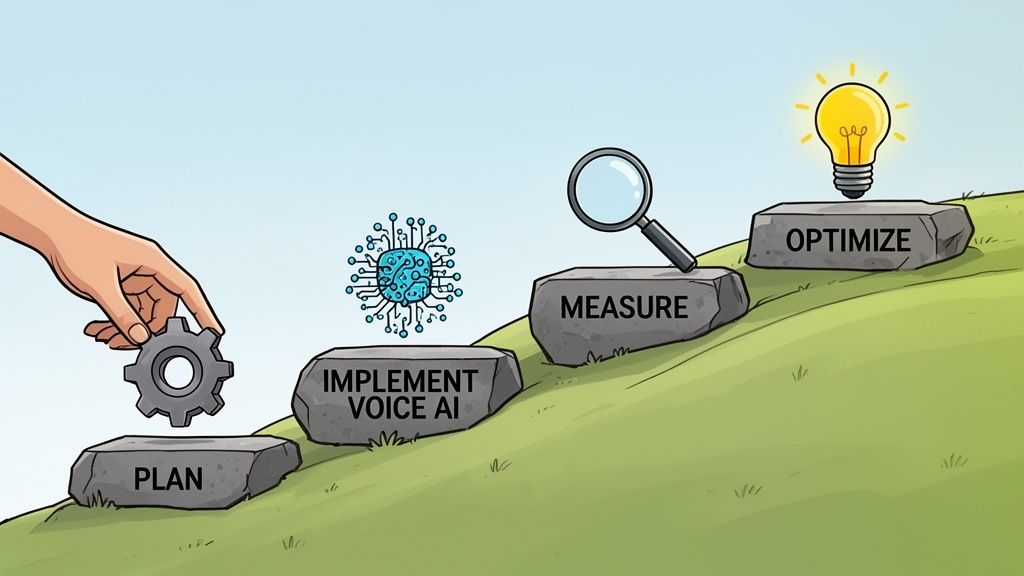
Phase one benchmark the current state
Begin with a journey audit tied to commercial outcomes.
Choose one high-friction flow such as KYC support, admissions counselling, appointment booking, collections reminders, or property lead qualification. Then document the current state across both customer and operating metrics. For Indian enterprises, the right baseline usually combines service indicators with business indicators: response time, first-contact resolution, transfer rate, conversion, drop-off, and repeat-call volume.
The questions should be precise:
- Where do customers wait, repeat themselves, or abandon the process?
- Which call types create avoidable rework for agents?
- Where does answer inconsistency create compliance, sales, or retention risk?
- Which parts of the journey have the clearest link to revenue, renewal, or cost to serve?
This step is often skipped. It should not be. Without a baseline, a pilot produces activity data, not decision-grade evidence.
Phase two run a controlled pilot
A pilot should be narrow enough to attribute impact and broad enough to test operational reality.
For example, a BFSI firm may start with inbound KYC guidance. A real estate developer may test instant callback and site-visit scheduling for fresh leads. An EdTech provider may deploy Voice AI for counselling in one course category, in one language cluster, with clear escalation to human counsellors for high-intent cases.
Pilot design should include four elements:
- A defined use case: One journey, one segment, one measurable problem.
- Clear KPIs: Select metrics that fit the workflow, such as connect rate, first-contact resolution, conversion, CES, or post-call CSAT.
- Escalation rules: Set thresholds for transfer based on complexity, value, vulnerability, or compliance sensitivity.
- Review cadence: Review performance weekly so scripts, routing, and exception handling can be corrected quickly.
A useful implementation test is whether management can compare AI-handled conversations with the current process on a like-for-like basis. If that comparison is weak, the pilot design is weak.
Phase three scale what proves value
Expansion should follow workflow adjacency, not organisational enthusiasm.
A support pilot can extend from KYC assistance to reminders and document collection. A counselling pilot can move from one programme line to broader admissions support. A lead-qualification pilot can add multilingual follow-ups, appointment confirmations, and post-visit nurture. This sequence preserves process logic and makes performance changes easier to interpret.
Integration becomes the main risk at this stage. Voice AI has limited strategic value if customer context remains fragmented across CRM, telephony, ticketing, and human handoff systems. Scale works only when the interaction history, intent, disposition, and next-best action move with the customer across channels.
Scale should increase consistency, not multiply exceptions.
Phase four measure ROI with board-level discipline
The ROI model should connect experience improvement to P&L outcomes, not just interaction counts.
| ROI component | What to measure |
|---|---|
| Revenue uplift | Higher lead conversion, onboarding completion, bookings, renewals |
| Retention effect | Lower churn, fewer abandoned journeys, stronger repeat purchase |
| Productivity gain | Less agent time on repetitive tasks, better routing, shorter handling time |
| Cost reduction | Fewer repeat contacts, lower manual follow-up, lower service cost per resolved case |
The point is attribution. If connect rates improve but conversions do not, the problem may sit in qualification logic or offer design. If NPS rises but repeat contact stays high, the experience may feel better without fixing root-cause effort. If CES falls and first-contact resolution rises together, the business usually sees both customer benefit and operating cost relief. That is the combination boards should look for.
Voice AI should therefore be assessed as an operating model intervention, not a channel add-on. The strongest programmes in India treat it as part of revenue operations, service design, and workforce planning at the same time.
DialNexa Labs Private Limited helps organisations operationalise customer value and satisfaction through Voice AI workflows for qualification, support, counselling, and presales. If your team wants to assess where conversational friction is suppressing conversion, retention, or service efficiency, review the use cases and platform details at DialNexa Labs Private Limited.

[…] Trust erosion: Customer experience and value are inseparable from transparent selling, especially in sectors built on recurring relationships, as reflected in broader thinking on customer value and satisfaction. […]
[…] the relationship between perceived value and satisfaction, because revenue growth depends on both. This explanation of customer value and satisfaction is a useful reference for teams that want a clearer line from customer experience decisions to […]
[…] Value management forces leadership teams to measure both. That's why a deeper look at customer value and satisfaction is helpful for teams trying to align service quality with economic […]
[…] For leaders thinking about growth efficiency, service design, and AI-enabled scale, retention deserves the same scrutiny as acquisition, pricing, and sales productivity. The connection between customer value, satisfaction, and long-term economics is especially important in categories where trust and repeated interaction shape buying behaviour, as discussed in this analysis of customer value and satisfaction. […]
This is a strong and insightful analysis that clearly distinguishes customer value from customer satisfaction while linking both directly to retention, profitability, and long-term growth. The focus on measurable CX metrics and multilingual, low-effort experiences offers a practical roadmap for Indian businesses aiming to build stronger loyalty and sustainable competitive advantage.