
Explain Customer Value: A Strategic Guide for CXOs
At its core, customer value is the simple, yet powerful, equation running through every executive's and customer’s mind: "Is the benefit we're providing worth the cost to the customer?"
For a VP, Director, or CXO, this isn't just a marketing buzzword. It's the ultimate measure of your company's relevance and the primary driver of sustainable revenue. It dictates market share, profitability, and long-term enterprise value.
Why Customer Value Is The Ultimate Growth Lever
For senior leadership, a sharp focus on customer value isn't just good practice—it's the engine that drives sustainable growth. It shifts the entire business mindset away from chasing one-off transactions and towards building genuinely profitable, long-term relationships.
This shift transforms your customer base from a simple revenue stream into your most predictable and valuable asset. When you nail the value proposition and deliver on it consistently, you build a powerful economic moat that makes it incredibly difficult for competitors to win over your audience. It informs smarter investments, guides product innovation, and ensures every strategic move is tied directly to strengthening your market position.
Customer value is the perceived benefit a consumer views a product or service as compared to its cost. It includes all the costs and benefits associated with a product or service, such as price, quality, and what the product or service can do for that person.
Connecting Value to Critical KPIs
Getting customer value right isn't about chasing high satisfaction scores. It's about driving tangible business outcomes that matter in the boardroom. We're talking about real numbers. For instance, companies that truly prioritise value can increase customer retention by as little as 5% and see profits jump by 25% to 95%. That's not a coincidence; it's proof that a customer-first approach is also a profit-first strategy.
Executives can pull on this lever to see major improvements in three critical areas:
- Higher Customer Lifetime Value (LTV): When customers feel they're getting a great deal, they don't just stay—they buy more and upgrade more often. A key part of this strategy is actively increasing Customer Lifetime Value.
- Improved Retention Rates: It’s simple logic. If the benefits consistently trounce the costs, customers have no reason to leave. A study by Bain & Company shows that repeat customers spend 67% more than new ones, creating a predictable revenue foundation you can build on.
- Lower Customer Acquisition Cost (CAC): Truly happy customers don't keep it to themselves. They become your most effective sales team, driving powerful word-of-mouth growth that dramatically cuts down marketing spend and makes every new customer cheaper to acquire. Nielsen reports that 92% of consumers trust recommendations from friends and family above all other forms of advertising.
The Executive Pillars of Customer Value Creation
For the C-suite, understanding how each component of customer value translates into business performance is crucial. The table below summarises these connections, providing a clear roadmap from customer perception to boardroom-level KPIs.
| Value Pillar | Definition for Leadership | Direct Impact on KPIs |
|---|---|---|
| Functional Value | Does our solution solve the core problem efficiently and reliably? Is it practical and does it perform as promised? | Boosts product adoption rates and reduces support ticket volume. High functional value is the foundation for retention. |
| Emotional Value | How does our brand make customers feel? Does it provide peace of mind, status, or a sense of belonging? | Drives brand loyalty, Net Promoter Score (NPS), and positive social mentions. This is the key to creating brand advocates. |
| Economic Value | Are we delivering a clear and quantifiable return on investment (time, money, effort) for our customers? | Directly influences Customer Lifetime Value (LTV), churn reduction, and price sensitivity. Strong economic value justifies premium pricing. |
Ultimately, a strategy that balances all three pillars—Functional, Emotional, and Economic—is what separates market leaders from the rest. It ensures that you're not just selling a product, but delivering a comprehensive and indispensable solution.
The Three Dimensions of Customer Value
To strategically enhance customer value, a CXO must deconstruct it. It’s a synthesis of tangible performance and intangible perception. For any leader trying to steer the ship, breaking down this concept is the first step to getting your product, marketing, and service teams all pulling in the same direction.
Think of customer value as having three core parts. Each one speaks to a different need or desire your customer has. The companies that truly dominate their markets are the ones that nail all three. Get these right, and you’ll have a complete picture of what your customer is actually getting from you.
The Functional Dimension: Does It Do the Job?
Let's start with the most obvious one: functional value. This is the practical, nuts-and-bolts utility of your product or service. It’s the simple, direct answer to the question, "Does this thing actually work?"
Example: For a logistics company like FedEx, functional value is delivering a package overnight, as promised. Their entire operational infrastructure is built to deliver this core function with near-perfect reliability, as evidenced by their 98.5% on-time delivery rate for express services.
From a leadership perspective, getting functional value right is about more than just keeping customers happy. A product that’s intuitive and works flawlessly doesn't just solve a customer's problem; it also lightens the load on your support staff. This means lower service costs and, more importantly, it lets your top people focus on strategic challenges instead of putting out the same small fires over and over. It's the foundation of everything else.
The image below shows how delivering real value directly fuels the metrics that matter most.
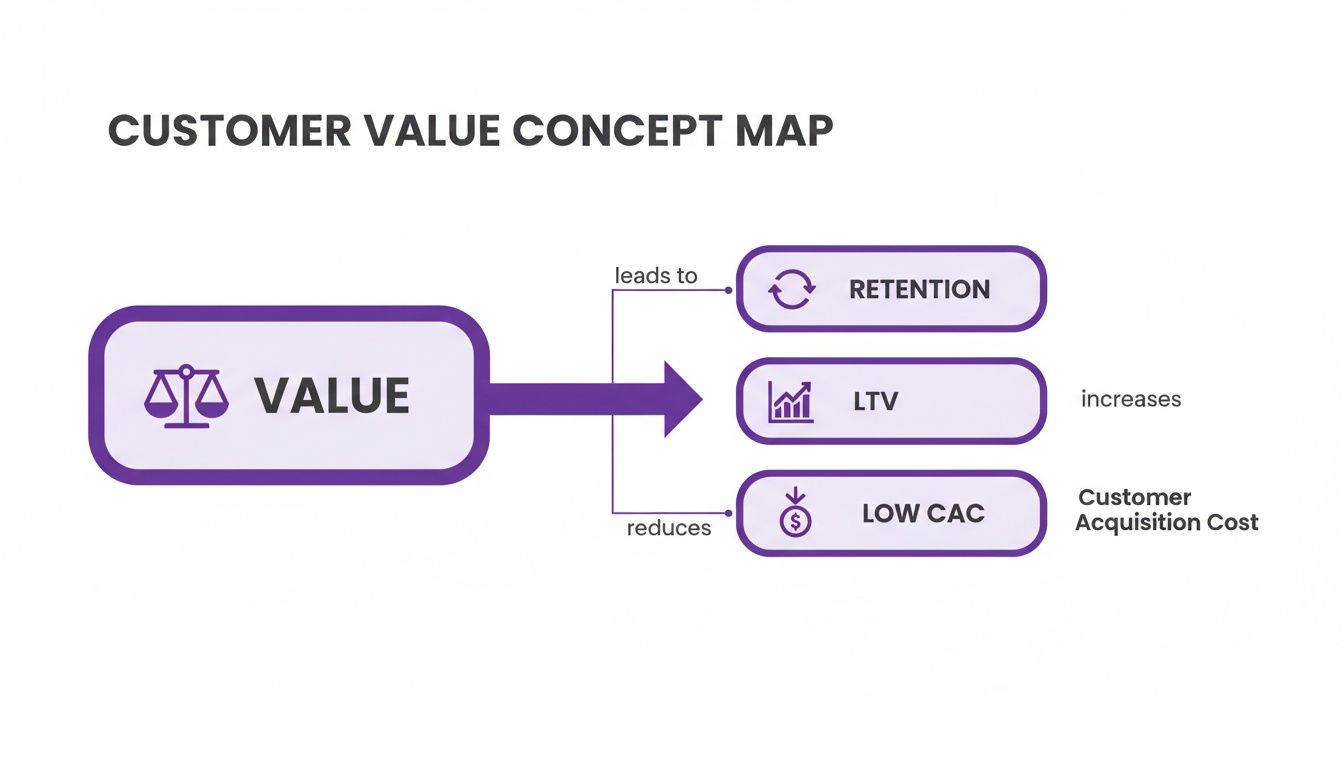
As you can see, a powerful value proposition is what leads directly to better retention, a higher Customer Lifetime Value (LTV), and a more efficient Customer Acquisition Cost (CAC).
The Emotional Dimension: How Does It Make Them Feel?
Beyond just doing the job, there's emotional value. This is all about the psychological payoff. It’s the feeling of confidence, the sense of security, or even the status that comes from using your brand. A financial planning app doesn't just move numbers around (functional); it delivers peace of mind (emotional).
This is where true brand loyalty is born. Emotionally connected customers aren't just satisfied; they're advocates. In fact, research from Motista shows they can be 52% more valuable over their lifetime. They’re the ones who will recommend you to friends and colleagues, giving you powerful word-of-mouth marketing that doesn't cost a thing. This emotional bond is your brand's secret weapon—a competitive advantage that can't be easily copied with a new feature or a lower price.
The Economic Dimension: What’s the Financial Payoff?
Finally, there's economic value. This is the cold, hard, quantifiable return on investment for the customer. It answers the crucial question: "Will this save me money, make me money, or reduce my financial risk?" Especially in B2B, this is often the make-or-break factor.
For anyone in a leadership role, being able to clearly spell out the economic value is non-negotiable. It’s how you close deals and keep clients long-term. When you can prove your software cuts a client's operational costs by 30% or that your service helps their sales team close 20% more deals, you make the buying decision a no-brainer.
Example: A SaaS company like Salesforce doesn't just sell a CRM (functional). They sell increased sales productivity. Their data shows customers, on average, see a 27% increase in sales revenue and a 32% increase in lead conversion, making it a strategic investment, not an expense.
Measuring and Communicating Customer Value Effectively
To get buy-in from the boardroom, you need to talk about customer value in a language executives understand: numbers. Abstract concepts are great, but what really gets managed is what gets measured. For VPs and Directors, quantifying value is the first step toward strategically improving it.
It's all about translating customer feelings and experiences into hard data that can drive decisions. Think of it as building a toolkit of metrics that gives you a complete, 360-degree view of your customer relationships. These aren't just vanity numbers for the marketing team; they're the vital signs for the health of your entire business.
Core Metrics for the Executive Dashboard
For a clear, high-level overview, leadership should keep a close eye on a few powerful indicators. Each one tells a different part of the customer value story, from long-term financial health to immediate satisfaction.
- Customer Lifetime Value (CLV): This is the ultimate measure of a customer's long-term worth. It calculates the total profit you can realistically expect from a single customer over their entire relationship with you. A high CLV is a clear sign you’re delivering consistent value that keeps people coming back. To get this right, it's worth diving into the details of calculating Customer Lifetime Value.
- Net Promoter Score (NPS): Think of NPS as your loyalty gauge. It measures how likely customers are to recommend you, which is a powerful driver of organic growth. A strong NPS score, especially one above 50, is a direct reflection of the emotional and functional value you’re providing. Industry leaders like Apple consistently post NPS scores above 70.
- Customer Satisfaction (CSAT): CSAT is your real-time pulse check. It’s measured with quick, direct feedback right after an interaction, telling you how well you performed in that moment. A high CSAT score, typically over 80%, means your operational execution is hitting the mark and meeting customer expectations.
Translating Metrics into Strategic Narratives
Data on its own is just noise. The real magic happens when you weave these numbers into a story that guides your strategy. For example, what if you segmented your CLV by the channel you acquired the customer from? You might find your most valuable, long-term customers aren't coming from where you thought.
Likewise, digging into NPS feedback can uncover specific product features or service gaps that are frustrating users, giving your product team a clear, customer-backed roadmap for what to fix next.
A SaaS company, for instance, might discover that customers coming from organic search have a 35% higher CLV than those acquired through paid ads. That single insight could justify a major shift in marketing spend, moving from short-term lead volume to long-term profitability.
When you start linking these metrics to business outcomes, you can make decisions backed by solid proof. This approach turns customer value from a fuzzy concept into a tangible, powerful lever for growth. To learn more about connecting data to results, check out our guide on how to measure the success of your outbound campaigns with our AI voice agent.
How Voice AI Brings Customer Value to Life
It’s one thing to discuss value frameworks in the boardroom; it's another to operationalize them. This is where the right technology stops being a line item and starts being a force multiplier. It’s what bridges the gap between the abstract concept of value and a real, measurable advantage over your competition.
Platforms like DialNexa’s Voice AI are designed to do just that, boosting the functional, emotional, and economic value you deliver in every single conversation.
Think of it less as a cost-cutting tool and more as a value-creation engine. By letting AI handle the routine, high-volume interactions with speed and precision, you free up your best people. Your human experts can then focus their energy on the complex, high-stakes relationships where their intuition and experience make all the difference. This smart division of labour creates efficiency without losing the personal touch that builds real loyalty.
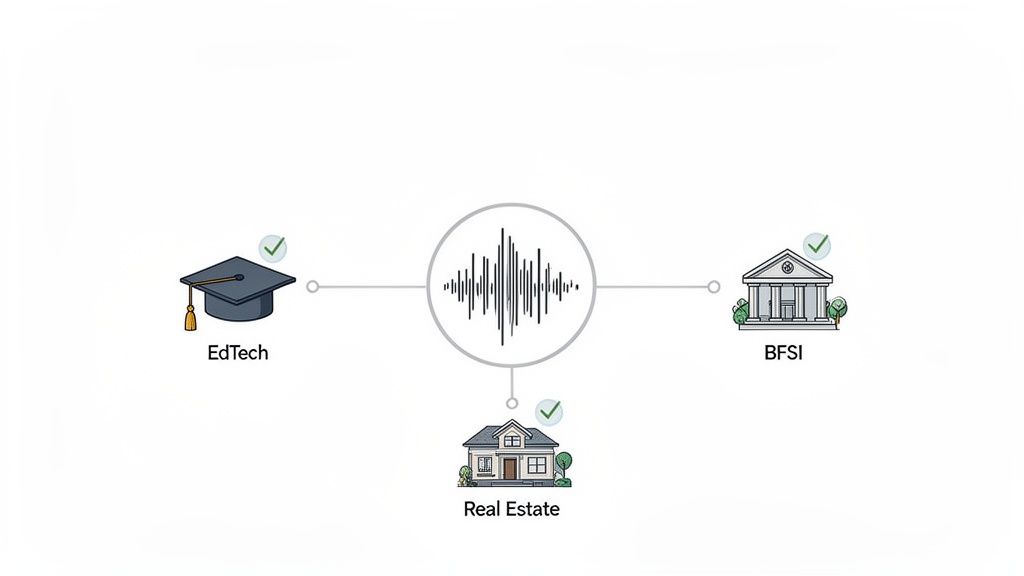
Driving Conversions in High-Stakes Real Estate
In real estate, speed isn't just a nice-to-have; it's everything. A single missed call can easily mean a lost six-figure deal. Voice AI tackles this head-on, ensuring every lead gets an immediate, intelligent response, day or night.
We saw this firsthand with one of our real estate partners. They were drowning in inbound leads but struggling with a lead-to-booking rate stuck at around 2%. It was a classic bottleneck. By deploying a DialDialNexa AI agent to manage the initial outreach and qualification, they completely changed the game. The AI didn't just send a text; it held natural, multi-minute conversations, gathered key information, and scheduled site visits on the spot.
The outcome? A staggering 400% increase in their lead-to-booking conversion rate, which shot up from 2% to 8%. This wasn’t just a small operational tweak; it was a fundamental shift in the economic value they could deliver for the business and the homebuyer.
Enhancing Learner Engagement in EdTech
The EdTech space is incredibly crowded, and keeping students engaged is the key to long-term survival. Today’s learners expect instant answers, whether they're asking about a course at 2 AM or hitting a technical snag during a lecture.
DialNexa's Voice AI delivers that round-the-clock functional value. By automating responses to common questions about admissions, fees, or technical support, EdTech platforms can guarantee immediate help. This creates a powerful sense of reliability and emotional security for students, which has a direct and positive impact on satisfaction and retention. To see more on this, you can explore how AI voice agents are transforming customer service and sales.
This shift reflects a bigger trend. In India's fast-growing consumer market, customers are increasingly looking for premium experiences that deliver clear, long-term benefits. For companies like DialNexa, this highlights just how powerful AI-driven voice agents can be in sectors like EdTech and real estate. Achieving 91% connect rates and 97% accurate lead qualification isn’t just about efficiency; it mirrors what consumers want—a premium, frictionless experience that saves them time. This proves that Indian consumers will reward brands that consistently deliver better outcomes, turning everyday interactions into high-value opportunities. You can discover more insights about India’s consumer spending boom on whalesbook.com to better understand these market dynamics.
Building Trust in BFSI Through Compliance
For any company in Banking, Financial Services, or Insurance (BFSI), trust is the ultimate currency. Every customer interaction has to be airtight—accurate, secure, and compliant with a mountain of regulations. Voice AI provides a practical way to standardise these crucial conversations at massive scale.
By programming agents with pre-approved scripts and built-in compliance checks, BFSI firms can guarantee every customer gets the same correct information during sensitive processes like KYC verification or resolving a query. This level of precision minimises human error and regulatory risk, directly strengthening the economic and emotional value of trust that customers place in your brand.
Forging Unbreakable Loyalty Through Consistent Value
In a market swimming with options, customer loyalty is the ultimate competitive advantage. It's what shields your business from a race to the bottom on price and keeps competitors at bay. But today's loyalty isn't won with flimsy points programs; it's forged in the fire of consistent, reliable value delivery.
Think of it as an unspoken agreement between you and your customer. Every single interaction either reinforces or chips away at that bond. When you consistently deliver on your promises—be it through fair pricing, transparent operations, or dependable service—you build a level of trust that a one-off discount could never hope to achieve. This is customer value in action.

This consistency is far more potent than any short-term gimmick. Time and again, data shows that brands with predictable pricing and solid service quality create a much more dedicated customer base than those that lean on constant promotions. Why is that? Because reliability makes life easier for the customer. It removes uncertainty and creates a smooth experience they’re happy to come back for.
The Power of Operational Excellence
The engine that drives this consistent value is operational excellence. It’s about making sure every touchpoint, from the initial ad a customer sees to their final support ticket, is smooth, effective, and perfectly reflects your brand. This is where standardisation stops being a limitation and becomes a powerful strategic tool.
For leaders, this means putting money into systems that remove inconsistency and guarantee a high-quality interaction every time. This is exactly what platforms like DialNexa’s Voice AI are built for. By standardising how you reach out, AI agents ensure every customer conversation hits the right notes and delivers on your brand promise. It creates a consistent experience at a scale that's simply not possible with human teams alone.
This approach is especially critical in industries where trust is the main currency. In India, for example, loyalty is built on consistent behaviour and fairness, not flashy rewards. Market insights from market-xcel.com reveal that Indian consumers stick with brands that honour their value promise through transparent pricing and reliable quality. In sectors like real estate and BFSI, having AI agents that qualify leads with 97% human-match accuracy and can handle thousands of calls a day isn't just about efficiency. It’s about creating a standardised, fair, and consistent outreach that strengthens your core value with every single call.
The key takeaway for C-level executives is this: deep-seated loyalty—the kind that drives referrals, repeat business, and defends your market share—is a direct result of consistently delivering on your brand’s promise. It's an operational discipline, not a marketing campaign.
At the end of the day, the goal is to make choosing your brand the easiest, most obvious decision a customer can make. You don't get there with grand, one-off gestures. You earn it through the quiet, relentless, day-in-day-out execution of your core value promise. True loyalty is built in those small moments of reliability that prove you're a partner they can count on.
Using AI to Meet Skyrocketing Customer Expectations
Let’s be honest: your customers today expect a level of service that was unimaginable a decade ago. They want instant answers, personalised help, and a real sense of being understood—a tall order for any business relying solely on its human team. This isn’t just a hunch; it’s a seismic shift in the market that’s forcing leaders to rethink their entire service strategy.
The answer isn't to replace your skilled people. It's about empowering them. The goal is to give your team the right tools to multiply their impact, letting them focus on what they do best: handling complex, high-value interactions that truly matter to customers. This is where AI steps in, not as a replacement, but as an essential partner.
Scaling Excellence with Voice AI
Modern Voice AI isn't a clunky, robotic system. It’s designed to handle sophisticated, natural conversations that can last several minutes. Imagine it qualifying leads, answering detailed product questions, or scheduling appointments, all without a human lifting a finger.
Just as importantly, it knows its limits. When a conversation gets too complex or requires a level of empathy only a person can provide, the AI executes a smooth, context-rich handoff to a human agent. The customer isn't left repeating themselves, and your team gets all the background they need.
For anyone in a leadership position, this directly addresses a massive market challenge. Consumer expectations are soaring, especially in a highly optimistic market like India. One recent report found that 89% of service professionals are feeling the pressure to provide more human-like support.
This is exactly where a smart blend of AI and human expertise shines. In fact, a Salesforce study shows 90% of leaders report that AI-to-human handoffs are already seamless. The results speak for themselves: businesses expect a 20% jump in customer satisfaction and a 16% boost in upsell revenue from this approach. These numbers line up perfectly with what we see at DialNexa, where our Voice AI consistently lifts lead-to-booking rates from 2% to 8%—delivering precisely what today’s customers value. You can read the full report on rising consumer demands on chinimandi.com.
This strategic fusion of AI’s efficiency with human intuition is how you not only meet but consistently exceed customer expectations. To dig deeper, check out our thoughts on why implementing AI voice agents in 2025 will elevate customer experience. By automating intelligently, your business can deliver the speed, personalisation, and consistency that define superior customer value in today's world.
Frequently Asked Questions for Leaders
It's one thing to talk about becoming a value-driven business, but it's another to actually make it happen. Senior leaders, VPs, and directors often have practical questions about putting these ideas into action. Let's tackle some of the most common ones.
How Can We Start Measuring Customer Value If We're Strapped for Resources?
You don't need a massive budget or a complex analytics platform to get started. The key is to begin with what's both easy to measure and highly impactful.
A great starting point is a simplified Customer Lifetime Value (CLV) calculation: Average Purchase Value x Purchase Frequency x Customer Lifespan. This formula alone gives you a powerful snapshot without needing sophisticated tools. Combine that with a simple Net Promoter Score (NPS) survey to get a pulse on customer loyalty.
The idea is to start small, show a clear return on the effort, and then use that success to build the business case for more advanced measurement down the road.
Will Using Voice AI Make Our Customer Experience Feel Robotic and Impersonal?
It's a valid concern, but the reality is quite the opposite. Modern Voice AI, like the technology we've built at DialNexa, is designed to make personalisation more scalable, not less.
Think of it this way: the AI handles the routine, predictable queries instantly, any time of day. This frees up your human team to dedicate their full attention to the complex, high-empathy conversations where their expertise truly shines. The result is a smarter, more efficient system where customers get faster answers for simple issues and more thoughtful support for bigger challenges.
What's the Real ROI on Investing in Customer Value Technology?
The return on investment shows up in a few different ways. First, you'll see direct cost savings from automating tasks that used to eat up your team's time.
But the bigger story is in the growth metrics. We've seen clients boost their lead-to-booking conversion rates from 2% to 8%. They also see significant improvements in customer retention and, of course, a higher CLV. In fact, data consistently shows that a strategic AI rollout can lead to a 20% increase in customer satisfaction.
It’s a clear line: investing in better customer interactions directly fuels better financial performance.
Ready to turn your customer conversations into a measurable asset? See how DialNexa can help you automate interactions and drive real growth. Schedule a demo today.

[…] For a useful primer on the underlying concept, see DialNexa’s explanation of customer value. […]
This is an exceptionally insightful piece that brilliantly connects customer value, loyalty, and AI-driven innovation with measurable business outcomes. The strategic frameworks and real-world examples make it a must-read for leaders focused on sustainable growth and customer-centric excellence.