
Mis selling meaning: A CXO’s Guide to Risk & Prevention
Between FY2018 and FY2022, IRDAI upheld 1,47,000 mis-selling complaints and policyholder compensation reached Rs 148 crore according to Convin’s summary of the reported data. For a board, that is not a narrow conduct issue. It is a warning that sales design, scripting, incentives, and monitoring can all fail at scale.
This represents the mis selling meaning in practice. It is not just a bad conversation between one agent and one customer. It is an operating model problem that can erode trust, trigger refunds and penalties, and weaken the economics of customer acquisition. In sectors where revenue depends on persuasive selling, every call, every disclosure, and every product match becomes a governance question.
Executives who still treat mis-selling as a frontline training issue are looking too low in the organisation. The larger risk sits higher up. Product design, quota pressure, channel partnerships, and weak call oversight shape outcomes far more than any single script ever will.
Table of Contents
- The True Cost of a Broken Promise
- The Core Meaning of Mis-selling Beyond the Dictionary
- High-Risk Scenarios Where Mis-selling Thrives
- The Financial and Regulatory Fallout of Non-Compliance
- A CXOs Proactive Prevention Playbook
- Leveraging Technology to Mitigate Mis-selling Risk
- Turning Compliance from a Cost to a Competitive Edge
The True Cost of a Broken Promise
Mis-selling destroys value long before a regulator arrives. It breaks the customer’s belief that your firm acts in their interest. Once that belief goes, retention, referrals, and cross-sell quality tend to deteriorate.
For CXOs, the phrase mis selling meaning should be read as a board-level signal of operational fragility. If customers buy products they do not understand, cannot use, or should never have been offered, the immediate sale can mask a much larger liability.
Why boards should care early
A mis-sold product creates multiple downstream costs at once:
- Revenue distortion: Booked sales may later convert into cancellations, lapses, reversals, or compensation.
- Brand damage: Customers often remember the selling experience more vividly than the product brochure.
- Control failure: Repeated complaints usually indicate a pattern in incentives, disclosures, or supervision.
- Trust erosion: Customer experience and value are inseparable from transparent selling, especially in sectors built on recurring relationships, as reflected in broader thinking on customer value and satisfaction.
The risk is wider than BFSI
BFSI is the clearest example because regulators define suitability more directly there. But the same logic applies elsewhere.
An EdTech provider can overstate course outcomes. A real estate team can minimise exclusions, costs, or project constraints. A SaaS vendor can oversell capabilities that require significant caveats to be usable. The industry changes. The pattern does not.
Board takeaway: Mis-selling is rarely a messaging problem alone. It is usually a mismatch between what the business rewards and what the customer needs.
The Core Meaning of Mis-selling Beyond the Dictionary
In Indian financial services, mis-selling is defined under RBI and IRDAI guidance through two core ideas: misrepresentation and unsuitability. That summary matters because it moves the discussion away from obvious fraud and into a more uncomfortable reality. A sale can look polished, documented, and still be wrong.

Misrepresentation is the obvious half
Misrepresentation happens when a seller presents a product inaccurately. The classic example is pitching a market-linked product as if returns are effectively assured.
That pattern has been observed in ULIP sales, where agents have misrepresented these products as “guaranteed returns”, contributing to 25-30% portfolio misallocation for retail investors with low risk tolerance, as discussed in Finsafe’s explanation of mis-selling and safeguards.
Unsuitability is the more dangerous half
Unsuitability is harder to detect because the facts disclosed may be technically present. The failure lies in the match between product and person.
A simple analogy helps. Selling a complex financial product without diagnosing suitability is like prescribing a powerful medicine without checking the patient’s condition. The packet may list side effects. That does not make the prescription responsible.
Mis-selling often enters through this gap:
- Jargon-heavy explanations that confuse rather than inform
- Key exclusions buried in fine print
- Pressure tactics near quarter-end
- No real enquiry into income, liquidity, dependants, or risk appetite
Why this becomes systemic
The same Finsafe discussion notes that mis-selling often peaks during quarter-end, when target pressure intensifies, and that policy mis-selling complaints widened sharply to 11,372 in 2022-23. That matters because it points to a systems issue, not merely a conduct issue by a few agents.
When leaders ask why mis-selling persists, the answer is usually found in operating choices:
| Control area | What weak firms do | What disciplined firms do |
|---|---|---|
| Incentives | Reward volume alone | Reward suitability and quality |
| Training | Teach product features | Teach product fit and disclosure discipline |
| Monitoring | Review only escalations | Review conversations before complaints accumulate |
| Governance | Treat complaints as service issues | Treat complaints as leading risk indicators |
Practical test: If a customer can accept the product without answering suitability questions, your process may be efficient, but it is not well controlled.
High-Risk Scenarios Where Mis-selling Thrives
Mis-selling concentrates in moments where customers make high-stakes decisions under time pressure, while the firm has more information than the buyer and too little control over how that advantage is used.
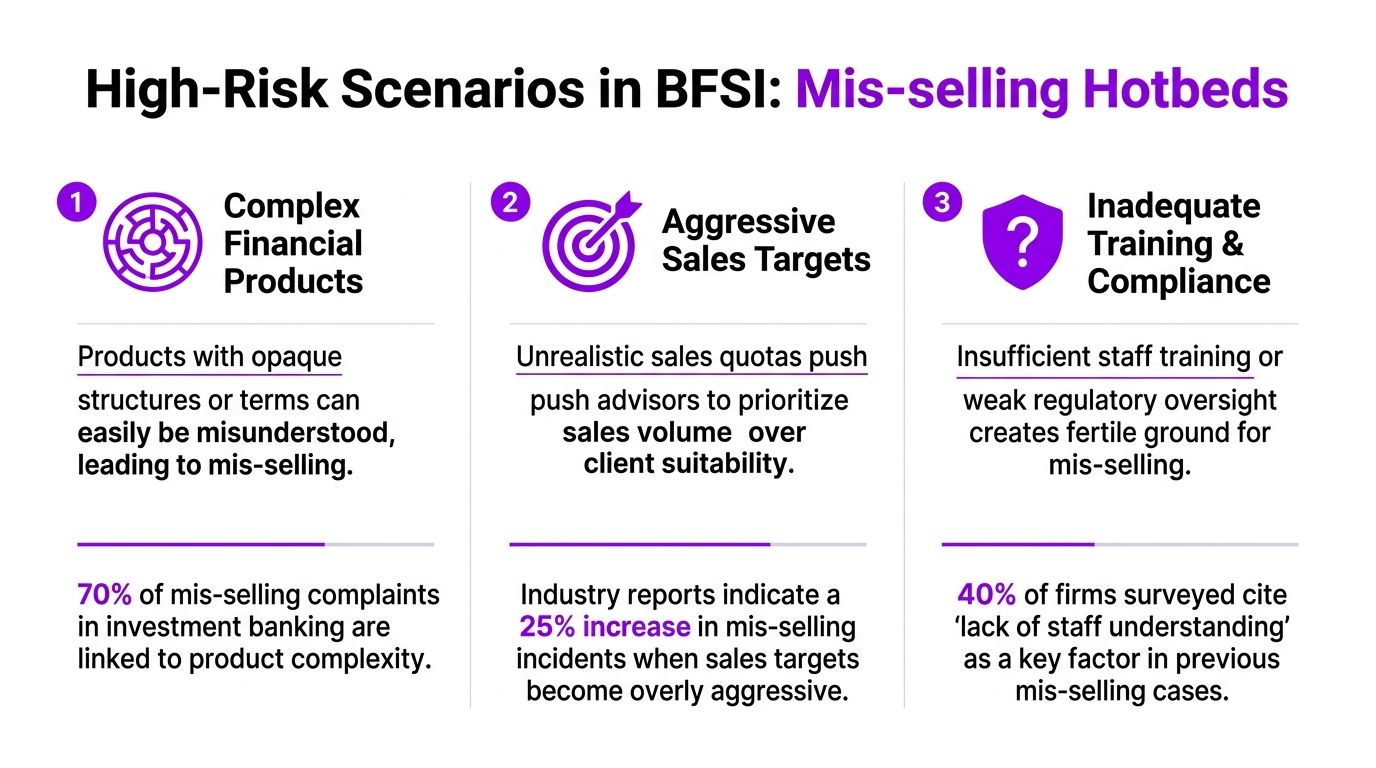
For boards and executive teams, the pattern matters because these failures rarely begin as headline scandals. They begin in routine interactions. A product is technically available, a disclosure is technically present, and a script is technically approved. Yet the sale still fails the suitability test because the customer’s objective, risk capacity, or understanding was never properly established.
Insurance and investment products
Insurance, wealth, and retirement products carry the highest exposure because the product structure often exceeds the customer’s ability to assess trade-offs in real time. Lock-ins, surrender charges, market-linked returns, exclusions, and riders create room for sales staff to present the upside clearly and the constraints selectively.
A familiar example is a market-linked insurance product sold to a customer who needs near-term liquidity. The documentation may be complete. The customer signature may be valid. The risk remains acute because the recommendation conflicts with the customer’s stated need.
The governance question is straightforward. Can the firm prove that the recommendation matched the customer’s circumstances at the time of sale, not merely that the paperwork was collected?
That standard sits at the heart of regimes such as Regulation Best Interest (Reg BI), which requires broker-dealers to act in the retail customer’s best interest and address conflicts, disclosures, and care obligations with more than a box-ticking approach. The principle has wider relevance beyond the US. Firms that design controls around suitability evidence, not post-sale defence, are better positioned to reduce complaints, remediation costs, and supervisory scrutiny.
Bundled distribution channels
Risk increases when a secondary product is sold inside a primary transaction. The customer’s attention is already occupied by the loan, property purchase, education financing decision, or account opening. That reduces scrutiny at the precise point where disclosure quality should improve.
The pattern is common across several channels:
- Banking and bancassurance: Cover is positioned as part of the borrowing or account process, with limited discussion of exclusions, alternatives, or need.
- Real estate and investment-linked sales: Return narratives dominate, while liquidity limits, project risk, or fee structures receive far less airtime.
- High-volume assisted sales models: Staff handle multiple products in one interaction, increasing the chance that suitability questions become procedural rather than diagnostic.
These are not isolated frontline errors. They are control design problems. Firms with weak product governance, fragmented QA, and incentive structures tied to attachment rates create predictable exposure. Stronger compliance controls in banking operations reduce that exposure only when they connect sales supervision, product approval, complaint analysis, and channel monitoring into one operating system.
Sales scripts that sound compliant but still mislead
Some of the highest-risk conduct sits in phrasing. A script can avoid outright falsehood and still produce a false impression.
That usually happens through sequencing and omission. Benefits are explained first and in plain language. Restrictions appear later and in legal wording. Agents ask closed questions that confirm acceptance, rather than open questions that test understanding. Digital journeys follow the same pattern when consent boxes replace meaningful explanation.
This is why script approval alone is weak control. Executive teams need evidence on how scripts perform in live conditions. Which words correlate with cancellations? Which objection-handling patterns precede complaints? Which agents consistently skip suitability questions while maintaining high conversion?
Those questions turn mis-selling prevention into an operational discipline rather than a policy statement. Voice AI, conversation analytics, and automated QA now make that feasible at scale. They can flag interrupted disclosures, missing need-analysis steps, misleading certainty language, and suspiciously fast customer assent before complaints accumulate.
Board-level warning sign: If a channel delivers strong conversion, high early cancellations, and repeated post-sale clarification requests, the issue is not only agent behaviour. It is likely a defective sales design.
The Financial and Regulatory Fallout of Non-Compliance
The most instructive mis-selling failures are not the small ones. They are the episodes where sales practice, governance, and product risk collapse together.
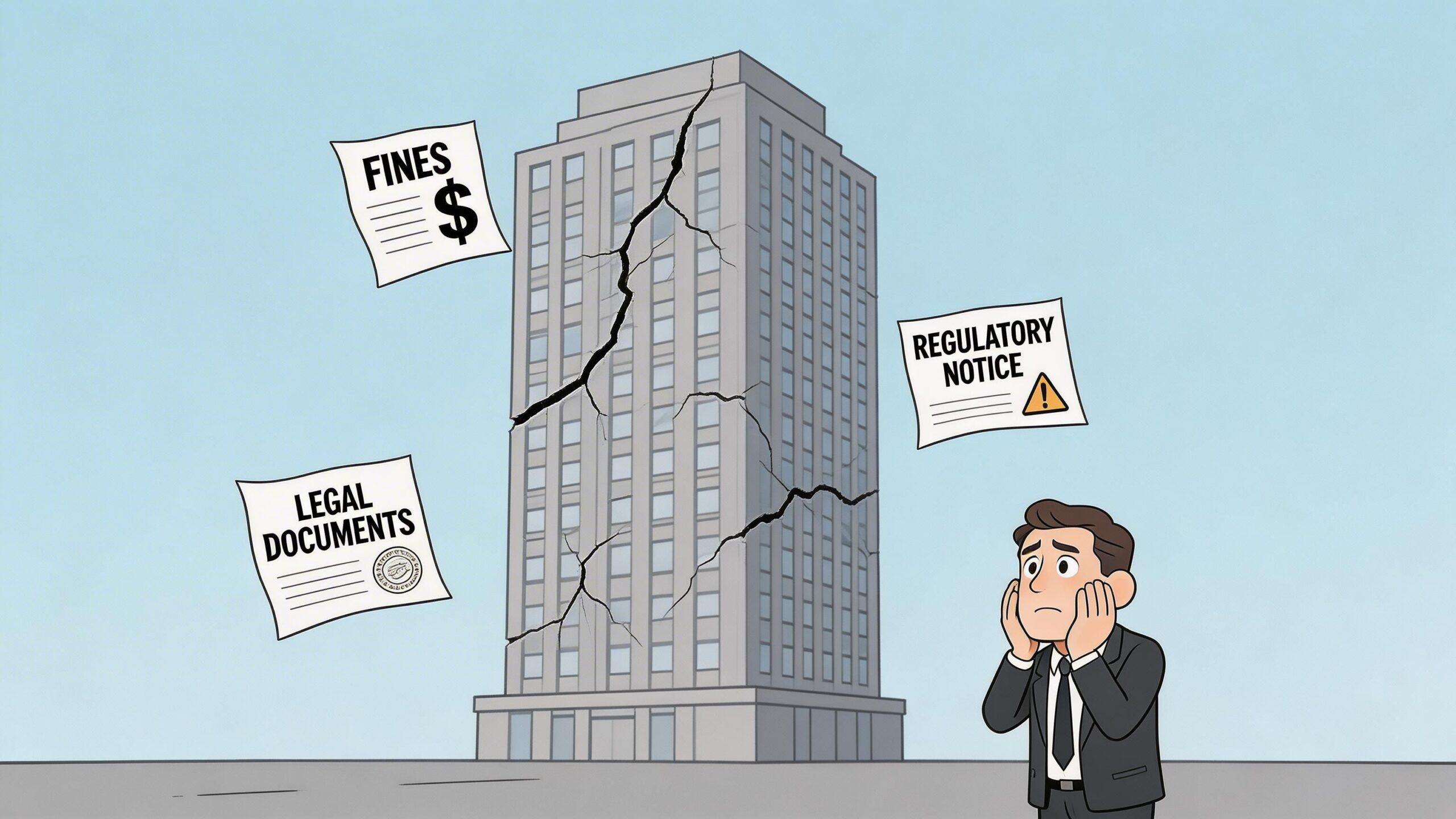
The IL&FS crisis of 2018 remains the starkest Indian reminder. On 20 September 2018, IL&FS defaulted on a Rs 1,000 crore debt obligation. The broader collapse exposed over Rs 91,000 crore in outstanding debt across 169 subsidiaries, while retail investor losses were estimated at over Rs 10,000 crore. By 2020, SEBI had barred 19 entities and imposed Rs 25 crore in fines, as summarised in Sanction Scanner’s account of financial mis-selling and the IL&FS fallout.
What the case revealed
The damage was not confined to one missed payment. The episode showed what happens when high-risk instruments are sold in ways that blur their true nature and suitability.
For boards, the lesson is direct. Mis-selling can migrate from a conduct concern into a liquidity event, a capital event, and a reputational event.
The balance-sheet impact typically arrives in layers:
- Direct remediation: refunds, compensation, complaint handling, legal review
- Regulatory intervention: investigations, sanctions, restrictions, audit burden
- Commercial drag: channel disruption, weaker customer confidence, slower acquisition
- Management distraction: crisis committees replacing strategic execution
Regulation is becoming more explicit
The IL&FS aftermath also drove stricter suitability and disclosure expectations. That evolution is not unique to India. In other markets, conduct regimes such as Regulation Best Interest (Reg BI) reflect the same directional principle. Firms that recommend or distribute financial products must show that customer interest was not treated as secondary to revenue.
For Indian institutions, that means compliance cannot sit as a late-stage review after sales design. It has to shape product journeys, script controls, and evidence trails from the start. Firms looking at broader governance expectations in regulated environments often face the same challenge seen across the banking compliance environment: how to operationalise oversight across large, fast-moving customer interactions.
A useful briefing for leadership teams is below.
The hidden cost boards underestimate
Executives usually focus on fines first. That is understandable, but incomplete.
The harder problem is reputational memory. Customers may forgive service delays. They are less willing to forgive feeling deceived. Once an organisation acquires that reputation, every future sales effort becomes more expensive because credibility has to be rebuilt one interaction at a time.
Risk judgement: The worst-case scenario is not merely a penalty. It is becoming known in the market as a firm whose sales promise cannot be trusted.
A CXOs Proactive Prevention Playbook
The strongest anti-mis-selling programmes do not begin with complaint response. They begin by redesigning the conditions that produce bad sales.
Rebuild incentives around suitability
A sales culture follows what leaders reward. If managers praise only booked revenue, staff learn to treat disclosure and suitability as obstacles.
A better design links performance to a broader mix of outcomes:
- Product fit evidence captured before sale
- Quality indicators such as post-sale persistence and complaint trends
- Manager accountability for team-level conduct patterns
This does not require weakening commercial ambition. It requires clarifying that unsuitable revenue is not high-quality revenue.
Train for judgement, not memorisation
Many firms provide product training but not decision training. Staff can repeat a brochure and still fail a suitability test.
Effective training should include practical scenarios such as:
- A conservative saver being offered a market-linked product
- An elderly customer struggling to understand lock-ins or exclusions
- A cross-sell conversation where the primary product creates pressure to accept an ancillary product
Use call excerpts, objections, and adverse examples. Train people to recognise when the right commercial answer is to slow down or stop the sale.
Operational rule: If staff are taught how to close but not how to decline an unsuitable sale, the training programme is incomplete.
Create an independent internal review loop
Most firms audit too late. They investigate after a complaint, after a lapse pattern, or after a regulator asks questions. By then, the control has already failed.
An internal review loop should do three things continuously:
| Review task | What it should test | Why it matters |
|---|---|---|
| Conversation sampling | Whether disclosures were clear and balanced | Detects misrepresentation risk early |
| Suitability validation | Whether product selection matched customer context | Catches process weakness, not just agent weakness |
| Escalation analysis | Whether repeated objections or confusion follow the same script or product | Identifies systemic failure |
Give compliance authority in design decisions
This is the hardest shift for commercial teams, and one of the most valuable. Compliance must have a voice before campaigns launch, not just after complaints rise.
That means reviewing:
- landing page claims
- telecalling scripts
- incentive campaigns
- partner channel offers
- exceptions handling for vulnerable customers
Strong firms do not ask compliance to bless sales language at the end. They ask compliance to shape what should never be said in the first place.
Leveraging Technology to Mitigate Mis-selling Risk
Manual oversight breaks down when interaction volume rises. A supervisor can review a sample of calls. A regulator, however, will judge the pattern your full operation creates.
That is why technology has moved from being a productivity layer to a control layer. The mis selling meaning for digital-era firms now includes a platform question. Can your systems enforce suitable, auditable, repeatable selling behaviour at scale?
The regulatory gap in digital selling
India’s regulators increasingly emphasise call recordings and grievance analysis, yet general guidance still leaves operational teams with unanswered design questions for AI voice channels, as discussed in NCFE’s note on digital channels, grievance analysis, and AI-driven mis-selling risk.
That gap matters because AI can cut risk or amplify it.
If a voice bot is deployed without mandatory disclosures, suitability prompts, escalation rules, and audit routines, it can reproduce the same bad script thousands of times faster than a human team. If designed well, it can do the opposite. It can standardise compliant behaviour and create a stronger evidence trail than most manual processes ever produce.
Where technology helps
The value is not “AI” in the abstract. The value comes from specific controls embedded in conversation design.
A well-governed voice workflow can:
- Force suitability checkpoints: The system does not proceed until the required customer context is captured.
- Standardise disclosures: Mandatory language appears consistently rather than depending on agent memory.
- Flag risky phrasing: Supervisors can review calls where language suggests over-promising or omission.
- Create searchable records: Compliance teams can analyse patterns by product, script, team, and objection type.
- Escalate vulnerable cases: Elderly, confused, or high-risk customers can be routed to specialist handling.
That final point is often missed. Technology is not only about automation. It is about controlled exceptions.
Manual vs AI-Powered Compliance for Mis-selling Prevention
| Compliance Area | Manual Approach (High Risk) | AI-Powered Approach (Low Risk) |
|---|---|---|
| Script adherence | Agents improvise under pressure | Approved flows guide every required step |
| Suitability checks | Questions may be skipped or asked inconsistently | Required fields and prompts enforce sequence |
| Disclosure consistency | Depends on memory and speed | Standard language is delivered uniformly |
| Call review | Small samples after the fact | Broad, continuous analysis of interaction patterns |
| Audit trail | Notes may be incomplete | Timestamps, transcripts, tags, and reason codes support review |
| Escalation | Relies on agent judgement | Rules trigger handoff for sensitive or unclear cases |
What boards should demand from any platform
Do not ask whether a vendor uses AI. Ask whether the system can be governed.
Useful questions include:
- Can mandatory disclosures be made non-optional?
- Can unsuitable conversations be paused or escalated automatically?
- Can compliance teams audit script changes centrally?
- Can call summaries and tags support reason-code analysis for emerging risk?
- Can the system preserve evidence in a form that is practical for internal audit?
Leaders examining these capabilities in more detail may find value in this discussion of voice AI breakthroughs in real-time call summarization for compliance, because summarisation is not merely an efficiency feature. It can also strengthen supervisory review and trend analysis.
Technology principle: Automation does not reduce mis-selling risk by default. Governance built into automation does.
Turning Compliance from a Cost to a Competitive Edge
Mis-selling sits at the point where revenue quality, customer trust, and governance either reinforce each other or fail together.
For boards and executive teams, the issue is larger than avoiding complaints or enforcement action. A sales process that consistently matches products to customer needs improves retention, reduces remediation drag, and protects brand credibility in markets where trust is expensive to rebuild. A sales process that does not do this creates lower-quality revenue, higher oversight costs, and a weak evidential position when decisions are challenged.
Leading organisations are therefore changing the frame. Compliance functions best as part of commercial design, not as a control layered on after the sale. Broader thinking around Compliance Artificial Intelligence (AI) supports that shift. The practical objective is clear. Make sound judgement more consistent, observable, and repeatable across every customer interaction.
This changes how competitive advantage is built.
The firms that outperform over time are often the ones that can prove three things with speed and precision: the product was explained clearly, the recommendation or sale was suitable, and the organisation can evidence both later through reliable records. That proof standard supports stronger supervision, cleaner board reporting, and faster response when regulators, auditors, or customers question outcomes.
Compliance therefore stops being viewed as overhead and starts being managed as an operating capability that protects margin, trust, and growth quality.
DialNexa Labs Private Limited helps organisations build and deploy human-like Voice AI agents for qualification, customer support, recruitment, and presales across BFSI, EdTech, real estate, e-commerce, hospitality, healthcare, and SaaS. If your team needs to reduce mis-selling risk while scaling conversations with greater consistency and auditability, explore DialNexa Labs Private Limited.

[…] There is also a conduct-risk angle. Customer-facing outsourced teams can create exposure through poor explanations, pressured renewals, or unclear representations. That is why compliance and training leaders should stay close to scripts, QA, and escalation thresholds, especially in areas adjacent to mis-selling in financial services. […]
This is a thoughtful analysis that rightly positions mis-selling as a strategic business risk rather than a narrow compliance issue. The focus on suitability, governance, and technology-enabled controls offers a practical roadmap for building stronger customer trust and more sustainable growth.