
Outsource Contact Center A Strategic Guide to Scaling CX
When a business decides to outsource its contact centre, it’s a strategic move to entrust customer service, in whole or in part, to experts who live and breathe this work. For a senior executive, this isn't just about farming out calls. It's a calculated decision to leverage specialized partners to deliver superior results, often more efficiently and at a lower cost than an in-house team could ever manage, freeing up capital and internal resources for core growth initiatives.
The Strategic Shift to Outsourcing Your Contact Centre
For anyone in the C-suite, the conversation around outsourcing a contact centre goes far beyond simple cost-cutting. It’s a fundamental shift in business strategy. The real question isn't, "Can we do this cheaper?" but rather, "Where is our team's energy and capital best invested?"
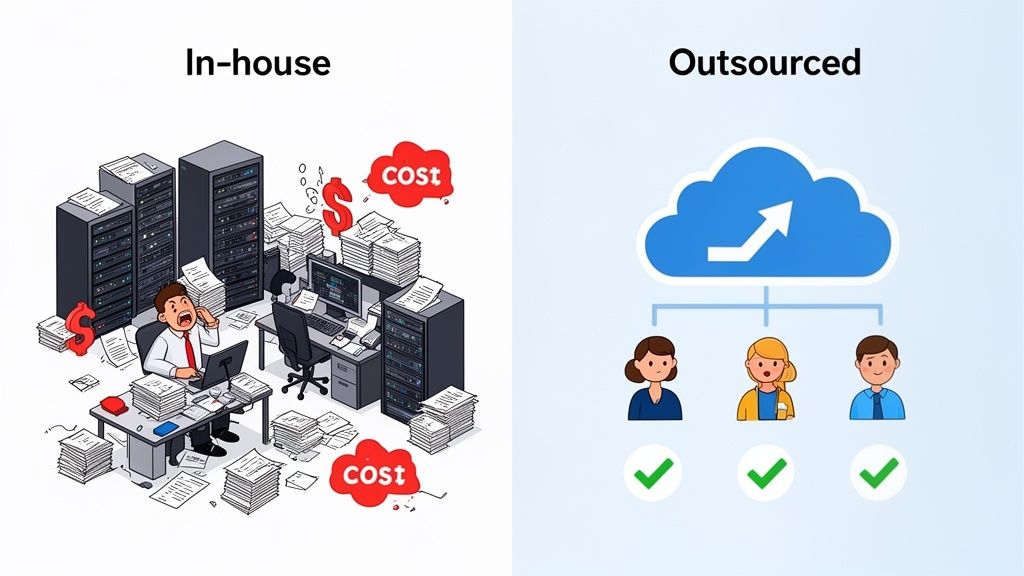
Think of it like this: running an in-house contact centre is like maintaining your own server farm. It’s a huge capital drain, requires constant upkeep, and pulls a dedicated team away from your core mission. Outsourcing, on the other hand, is like switching to a cloud provider like AWS or Azure. You instantly tap into world-class infrastructure and expertise on a flexible, pay-as-you-go model, converting a fixed capital expenditure into a variable operational one.
It's no surprise that a Deloitte survey found that 57% of companies outsource to sharpen their focus on core business functions. This strategic move frees up your best people—your engineers, marketers, and strategists—to drive innovation, perfect your product, and expand your market, which are the activities that actually grow the business.
To help frame this decision at a leadership level, here's a quick comparison of the strategic trade-offs.
In-House vs Outsourced Contact Center: A C-Suite View
| Factor | In-House Contact Center | Outsourced Contact Center |
|---|---|---|
| Capital Expenditure (CapEx) | High upfront investment in facilities, tech, and hardware. | Minimal to zero CapEx; shifts costs to a predictable operational expense (OpEx). |
| Talent & Expertise | Slow to build; requires ongoing recruitment, training, and retention efforts. | Instant access to a pre-vetted, skilled talent pool and experienced management. |
| Scalability & Agility | Rigid. Scaling up or down is slow, costly, and disruptive. | Elastic. Instantly scale to meet demand spikes (seasonality, product launches). |
| Technology Access | Limited by budget and internal IT capabilities; risk of tech obsolescence. | Access to enterprise-grade, cutting-edge technology (AI, analytics, omnichannel). |
| Core Business Focus | Diverts leadership attention and resources to a non-core operational function. | Frees up internal teams to concentrate on innovation, strategy, and growth. |
| Cost Structure | Primarily fixed costs, regardless of volume fluctuations. | Variable cost model that aligns spending directly with business activity. |
Ultimately, the choice reflects a company's strategic priorities: direct operational control versus strategic agility and expert leverage.
Accessing Specialised Talent and Technology Instantly
Building a top-tier, in-house customer experience team from the ground up is a slow, expensive grind. You're fighting recruitment battles, designing exhaustive training programmes, and sinking capital into tech that becomes outdated almost as soon as you install it. Outsourcing lets you sidestep that entire ordeal.
An outsourced partner gives you immediate access to a pre-built ecosystem of trained professionals, proven workflows, and advanced technology. This isn't just about renting agents; it's about renting a fully optimised operational engine.
For example, a fast-growing FinTech company can bypass a six-month ramp-up period for a 50-person support team. By partnering with an outsourcer, they can have a fully trained, PCI-compliant team operational in weeks, equipped with enterprise-grade AI analytics that would have cost millions to build internally. This allows them to focus their capital on product development and market acquisition instead of support infrastructure.
Achieving Unmatched Scalability and Flexibility
Business is never a flat line. Seasonal peaks, unexpected market shifts, or a viral marketing campaign can completely overwhelm an in-house team, leading to painful wait times, frustrated customers, and ultimately, lost revenue. An outsourced model gives you the operational elasticity you need to handle whatever comes your way.
Here’s what that looks like in the real world:
- An EdTech firm can smoothly manage a 400% spike in enquiries during the two-month enrolment rush without carrying a bloated payroll for the rest of the year.
- An e-commerce brand can instantly scale up its support team for a Black Friday sale, ensuring every customer gets a great experience during a make-or-break revenue event.
- A financial services company can quickly stand up a specialised team to handle customer communications during a period of market volatility or a new regulatory rollout.
This agility transforms your customer service from a rigid, fixed cost into a responsive, variable asset that flexes perfectly with the needs of your business.
Choosing Your Engagement Model With AI and Human Synergy
Once you’ve decided to outsource your contact centre, the next critical decision is the engagement model. This isn't a one-size-fits-all situation. The right model hinges on your specific business drivers, from the predictability of your customer volume to the complexity of their queries.
Selecting the wrong model leads to budget overruns and operational inefficiency. The right one, however, becomes a powerful engine for strategic growth. Let's break down the main options from a leadership perspective.
Traditional Human-Powered Models
These tried-and-true models have been the backbone of the outsourcing industry for years, built entirely around human agents and structured to tackle different business realities.
-
Dedicated Team Model: Your outsourcing partner provides a group of agents who work exclusively for your brand. This is ideal for businesses requiring deep product knowledge and a team that acts as a true extension of the company culture. For example, a luxury automotive brand would use a dedicated team to ensure every customer interaction reflects its premium values and standards.
-
Shared Pool Model: Agents handle customer interactions for several non-competing clients. This is a highly cost-effective option for businesses with fluctuating demand. A direct-to-consumer startup, for instance, could leverage a shared model to manage customer service professionally without the high fixed cost of a dedicated team, scaling resources up or down as sales campaigns dictate.
-
Project-Based Model: This is a short-term, focused engagement for a specific objective. A pharmaceutical company launching a new product could use this model to conduct a three-month patient outreach campaign, accessing specialized healthcare communication skills without long-term overhead.
While these models are reliable, their scalability is often constrained by human limitations. This is where a modern, AI-integrated approach fundamentally changes the game.
The Rise of AI as a Force Multiplier
The most significant evolution in contact centre outsourcing is the strategic integration of Artificial Intelligence. The choice is no longer a binary one between people and bots. Instead, the most effective models create a powerful synergy where AI amplifies the capabilities of your human team.
AI isn't here to replace your best agents; it’s here to supercharge them. Think of AI as a new digital team member that tirelessly handles the repetitive, high-volume tasks. This frees up your human experts to focus on the conversations that require empathy, critical thinking, and creative problem-solving—the moments that truly define your brand.
This hybrid approach is building more efficient, scalable, and responsive customer support operations. The global call centre AI market is expected to hit $4 billion by 2027, a clear indicator of this strategic shift. This trend is particularly strong in top BPO hubs. India, for instance, holds a global market share of around 17.58% with a talent pool of over 1.3 million BPO experts, and its future is firmly tied to delivering AI-enhanced services.
AI and Human Synergy in Action
So, what does this blend of human and artificial intelligence look like from a strategic standpoint? It starts with AI-powered virtual agents working 24/7, instantly fielding simple, Tier-1 queries that typically consume 60-70% of a human agent's time.
- A real estate company: An AI agent can answer initial property enquiries, share FAQs about amenities, and even schedule site visits at any time of day or night. No lead ever gets missed, maximizing the ROI on marketing spend.
- A BFSI institution: An AI agent can securely give KYC status updates or walk users through routine application forms, freeing up licensed human agents to manage complex fraud alerts or provide in-depth wealth management advice.
- An EdTech platform: An AI agent can handle thousands of simultaneous admission queries about course details and eligibility criteria, ensuring prospective students receive immediate information, which dramatically increases the likelihood of application.
In every case, the AI acts as the first point of contact. As you think about your engagement model, integrating solutions like the best AI voice agents can make these initial interactions incredibly smooth.
When a conversation requires nuanced judgment or a customer becomes emotional, the query is seamlessly handed off to a human agent who already has the full context from the AI’s transcript. This AI-assisted approach doesn't just boost efficiency; it elevates the role of your human agents to that of true problem-solvers. This synergy ensures your customers get fast, accurate answers for simple problems and empathetic, expert support for the complex ones.
The Executive Checklist for Selecting the Right Partner
Deciding to outsource your contact centre is a massive strategic move. But the real make-or-break moment comes when you choose your partner. This is where the strategy lives or dies. As a leader, you need to look past the glossy brochures and slick sales pitches and use a solid, practical framework to find a partner who can meet today's demands and grow with you tomorrow.
This isn't about finding the cheapest option; it’s about finding the most valuable one. Your checklist needs to stand on three critical pillars: contractual guarantees, security and compliance, and their tech and AI maturity. Get these right, and you're building the foundation for a partnership that lasts.
Ironclad SLAs and Performance Guarantees
Think of a Service Level Agreement (SLA) as the constitutional document for your partnership. Vague terms are a major red flag. Demand crystal-clear specifics that protect your business and hold your partner accountable for real, measurable results that align with your business objectives.
For instance, a VP of Operations should insist on an SLA that specifies:
- Key Performance Indicators (KPIs): Don't just settle for basic metrics like Average Handle Time. Push for KPIs that directly impact business outcomes, such as a 95% First Contact Resolution (FCR) rate for technical support queries or a target Net Promoter Score (NPS) of +50.
- Response Times: Get specific commitments for every channel. For example, a guarantee that 80% of calls will be answered within 20 seconds, or 95% of chats responded to in under 60 seconds.
- Penalty Clauses: What are the commercial consequences if they miss these targets? A robust SLA outlines financial penalties or service credits. This gives them real skin in the game and aligns their performance with your success.
Without these details, you're outsourcing on hope, not strategy. A truly confident partner will welcome this level of detail because they know they can deliver.
Uncompromising Security and Compliance
In today's regulatory landscape, a data breach traced back to a third-party vendor can cause irreparable damage to your brand reputation and result in severe financial penalties. When you outsource your contact centre, you are entrusting that partner with your most valuable asset: customer data. There can be no compromise.
A vendor's security posture is a direct reflection of their operational discipline. A casual approach to compliance is a warning sign of a casual approach to everything else.
Your due diligence must be rigorous. Look for certifications relevant to your industry. For a healthcare technology company, HIPAA compliance is non-negotiable. For an e-commerce or financial services firm, PCI-DSS certification is a baseline requirement. Go beyond the certificates. A CISO should ask tough questions about their data encryption protocols, disaster recovery plans, and employee security training. Understanding modern call center payment security solutions is crucial to safeguarding customer information and mitigating risk.
Assessing Tech Stack and AI Maturity
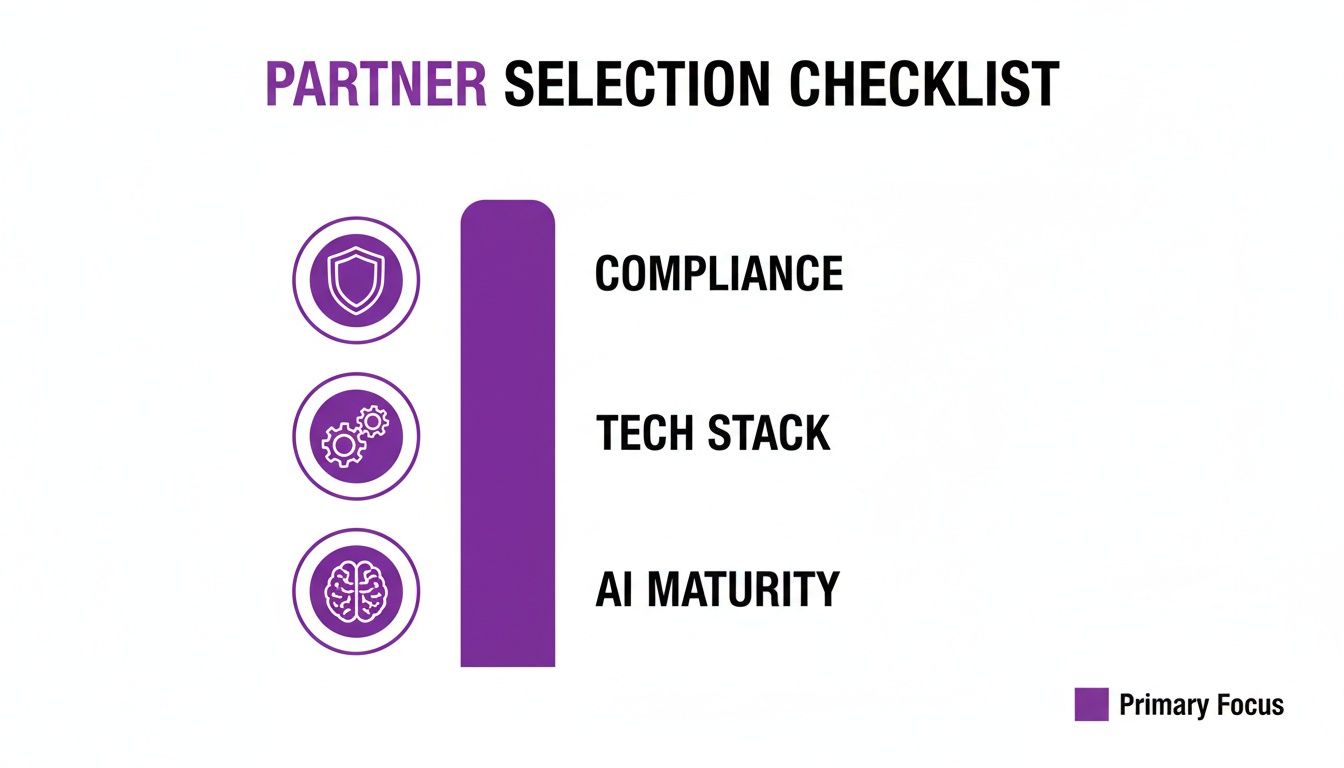
Finally, take a hard look under the hood at their technology. A partner stuck with legacy systems will become a liability, hindering your ability to innovate and deliver the seamless experience customers now expect. Your checklist must scrutinize their tech stack and, most importantly, their real-world AI capabilities.
Ask these critical questions:
- CRM Integration: A CTO needs to know how seamlessly their platform integrates with your existing CRM, whether it's Salesforce, HubSpot, or a proprietary system. Poor integration creates data silos and inefficient workflows.
- Reporting and Analytics: Can you access real-time dashboards for performance monitoring? A director needs instant visibility into operations, not a static PDF report that's a week old.
- AI Capabilities: This is the ultimate differentiator. Cut through the buzzwords. Are they a traditional BPO that simply bolted on a few AI features, or are they a true 'AI-first' provider whose entire operational model is built around intelligent automation? An AI-first partner is designed for hyper-scale and is far better positioned to future-proof your customer experience.
Building the Financial Case for Outsourcing
For any C-suite executive, the decision to outsource a contact centre ultimately boils down to the numbers. An improved customer experience and enhanced scalability are critical benefits, but the financial argument must be rock-solid, transparent, and compelling.
This isn't just about trimming operational fat. It's about strategic capital reallocation—freeing up funds to reinvest in core activities that drive growth and shareholder value.
When you look at strategic outsourcing hubs like India, the financial upside is layered. It’s not just about what you save on salaries; it’s about the positive ripple effect across your entire profit and loss statement.
Deconstructing the True Cost Savings
It's a common mistake to view outsourcing solely through the lens of labour arbitrage. While lower wage costs are a significant factor, they are just the tip of the iceberg. A comprehensive business case for a CFO must account for the total cost of ownership, including the hidden overheads that silently drain an in-house budget.
These are the costs that often fly under the radar but add up fast:
- Zero Capital Expenditure (CapEx): Eliminate the massive upfront investment in office space, furniture, servers, and expensive contact centre technology. That capital remains on your balance sheet, ready to be deployed into core business goals like product innovation or market expansion.
- No More Overhead Headaches: The relentless costs of recruiting, hiring, and ongoing training are absorbed by your partner. This removes a significant and often unpredictable burden from your HR and operational teams.
- Enterprise-Grade Tech, Minus the Price Tag: Leading partners provide access to top-tier platforms—from sophisticated CRMs to AI-driven analytics tools. You gain the benefits of this cutting-edge technology without the heavy licensing and maintenance contracts.
This multi-pronged approach is precisely why outsourcing to India can slash operational costs by an incredible 40-70% compared to running a similar centre in the US. It's no surprise the Indian BPM market hit $44 billion in FY22 and continues to attract nearly 40% of all global sourcing investments. You can find more details on the BPO market in India and its growth on 1840andco.com.
A Hypothetical ROI Analysis In-House vs Outsourced (Annual Cost)
Let’s translate this into a practical scenario. Imagine a US-based SaaS company running a 50-seat in-house contact centre. Here’s a high-level breakdown of their annual costs compared to a fully outsourced model in India.
| Cost Component | In-House (US) | Outsourced (India) | Annual Savings |
|---|---|---|---|
| Agent Salaries & Benefits | $2,250,000 | $840,000 | $1,410,000 |
| Management & Support Staff | $450,000 | Included | $450,000 |
| Recruitment & Training | $125,000 | Included | $125,000 |
| Technology & Software | $200,000 | Included | $200,000 |
| Facilities & Utilities | $300,000 | Included | $300,000 |
| Total Annual Cost | $3,325,000 | $840,000 | $2,485,000 |
| Total Savings Percentage | ~75% |
In this scenario, the company isn't just cutting costs—it's liberating nearly $2.5 million in annual operating expenses. This table clearly illustrates how the savings extend far beyond just agent salaries, with the outsourcing partner absorbing management, tech, and facility costs.
Transforming Expense into Strategic Investment
This is where the mindset shifts for a leadership team. The money saved from outsourcing isn't just a line item on a spreadsheet; it’s a strategic war chest that can be deployed to accelerate the business.
What could a CEO do with an extra $2.5 million?
- Hire 20 more software developers to accelerate the product roadmap.
- Launch a major new marketing campaign to penetrate a new market segment.
- Acquire a smaller competitor to consolidate market position.
Of course, these financial benefits are only realized if the partner's fundamentals—like compliance, technology, and AI capabilities—are impeccable. The financial case is powerful, but it must be backed by a partner who is operationally secure and technologically advanced. When viewed through this lens, the decision to outsource your contact centre evolves from a simple cost-cutting tactic into a powerful strategic investment that directly fuels your bottom line.
How Outsourcing Works in the Real World: Use Cases by Industry
Theory is one thing, but the real test of outsourcing your contact centre is how it performs in your specific industry. As a business leader, you’re not just looking for cost savings. You’re looking for tangible results—better leads, happier customers who stick around, and a smoother, more efficient operation. The right partnership can shift customer support from a necessary expense to a powerful engine for growth.
Let's examine how this plays out across different sectors with practical examples. These are proven strategies that solve real, industry-specific problems, showing how a modern, AI-powered outsourcing model can provide a significant competitive advantage.
EdTech: Streamlining Admissions When It Matters Most
For any EdTech company, the admissions window is the most critical period of the year. Prospective students and parents flood the system with urgent questions about course details, deadlines, and eligibility. Even the most dedicated in-house team gets overwhelmed, leading to long wait times and, inevitably, lost enrolments.
This is exactly where an AI-first outsourcing partner can make an immediate impact.
A Real-World Example: Taming the Admissions Flood
An online university was seeing a 500% spike in enquiries during its two-month peak admission season. The volume was impossible to handle; wait times were frustrating applicants, and qualified leads were being lost.
- The Problem: The admissions team couldn't hire and train staff fast enough to manage the surge, resulting in a poor applicant experience and significant missed revenue.
- The Fix: They partnered with an outsourcer to deploy an AI voice agent trained on their entire course catalogue and admissions criteria. This agent handled 80% of all incoming calls and chats 24/7, answering common questions, sending information packs, and scheduling appointments with human counsellors.
- The Outcome: The university achieved a 30% increase in qualified applications. Every prospect received an instant, helpful response, freeing up human counsellors to focus exclusively on high-intent applicants, which dramatically improved conversion rates.
Real Estate: Qualifying Leads and Booking Viewings Instantly
In the fast-paced world of real estate, speed is everything. A potential buyer's interest is highest in the first few minutes after an online enquiry. A delay in response means they've already moved on to the next listing. However, agents are often conducting viewings, not monitoring their phones.
In real estate, a missed call isn’t just a missed call—it’s a lost opportunity to sell a property. Automating that first touchpoint ensures you never waste a lead and that your marketing budget actually translates into people walking through the door.
A Real-World Example: The 24/7 Virtual Leasing Agent
A large property developer was generating hundreds of website leads daily, but very few converted into actual site visits. The sales team was wasting valuable time calling unqualified prospects.
- The Problem: High lead volume created a bottleneck. The team was too busy with basic qualification to focus on scheduling appointments with serious buyers.
- The Fix: They worked with an outsourced provider to implement an AI agent that engaged every new lead within 60 seconds. The AI answered property questions, confirmed the buyer's budget and timeline, and booked a viewing directly into the appropriate agent's calendar.
- The Outcome: The firm's lead-to-visit conversion rate increased from a dismal 2% to 8%. The sales team's productivity soared as their days were now filled with pre-qualified, pre-booked appointments.
BFSI: Nailing Compliant Customer Onboarding
In Banking, Financial Services, and Insurance (BFSI), every customer interaction is governed by strict compliance and security regulations. Processes like Know Your Customer (KYC) checks are non-negotiable, but they are often slow and repetitive, creating a frustrating roadblock for new customers.
This is a perfect scenario for a specialised outsourced partner who understands compliant automation. AI agents can be trained to follow regulatory scripts precisely, ensuring every interaction is consistent and auditable, all while accelerating the process. To dig deeper into this, check out our guide on how data and AI will transform contact centres for financial services.
A Real-World Example: Automating KYC Verification
A rapidly growing fintech company needed to accelerate customer sign-ups without compromising on compliance.
- The Problem: Manual KYC checks were time-consuming, prone to human error, and required a large, expensive team to manage.
- The Fix: They deployed a secure, outsourced AI agent to guide new users through the KYC process. The agent collected necessary information, used API connections for real-time document verification, and only escalated complex cases for human review.
- The Outcome: The average onboarding time was reduced from 48 hours to just 15 minutes. The fintech was able to scale its user base much faster while maintaining a flawless compliance record.
Why India's Talent Ecosystem Creates Resilient Operations
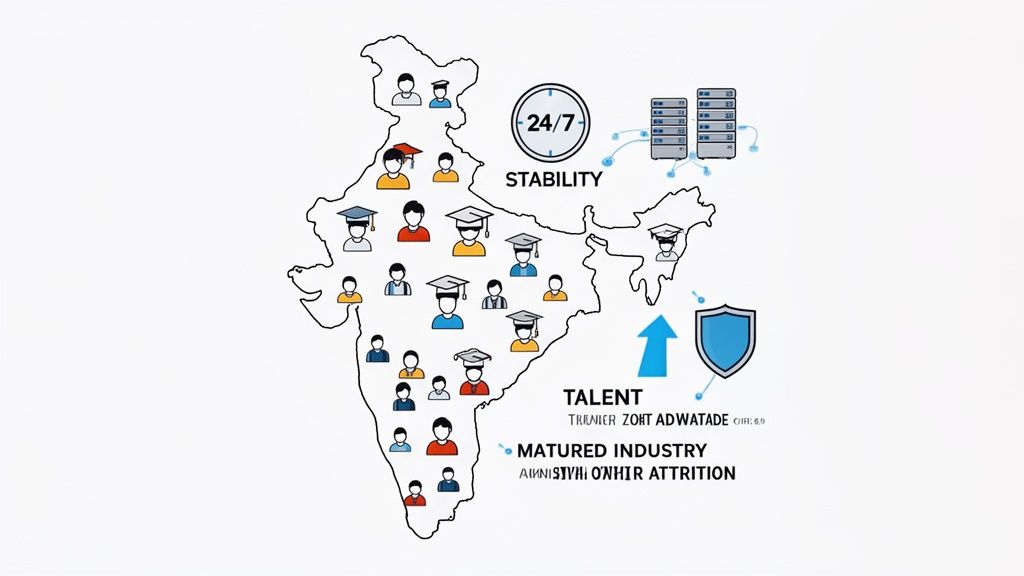
When leaders are weighing a strategic decision like where to outsource a contact centre, the conversation inevitably turns to stability and resilience. While cost savings may initiate the discussion, the critical question a CXO asks is, "Can this partner deliver world-class service consistently as my business scales globally?" This is precisely where India’s mature BPO ecosystem stands out as a powerful strategic advantage.
The country’s operational resilience is built on a massive foundation of well-educated, English-speaking professionals. This isn't just about sheer numbers; it’s about having a deep, multi-skilled talent pool that can handle complex operations and maintain business continuity, even during global disruptions.
The Power of a Deep and Educated Talent Pool
India's greatest asset is its demographic dividend—a vast, young, and ambitious workforce. Millions of graduates enter the job market annually, providing a continuous pipeline of talent ready for specialized customer support roles. From a strategic perspective, this scale means that expanding your support team from 50 to 500 agents doesn't create a hiring crisis.
For an executive, this translates directly into predictable, manageable growth. If a SaaS company is planning to launch in three new European markets, their Indian partner has the recruitment engine to find and train agents with the necessary language and technical skills without disrupting existing operations. This depth of talent is a crucial component of any global risk mitigation strategy.
India's call centre outsourcing industry is no longer just a stop-gap job market; it has matured into a stable, career-oriented sector. This fundamental shift ensures partners can provide consistent, high-quality service backed by experienced professionals, not just temporary staff.
The industry's growth is truly staggering. Around 7 lakh new positions were added in the last year alone, a 7% surge in talent. With over 1.3 million professionals already working in the BPO sector, the depth of expertise available is simply unmatched anywhere else in the world.
From High Attrition to Stable Career Paths
A decade ago, a major concern for executives was the high attrition rate in offshore contact centres, which often exceeded 50% annually. This constant churn was detrimental to service quality and consistency. However, the industry has undergone a significant transformation.
Today, leading BPO organizations have invested heavily in creating clear career paths, upskilling programs, and superior work environments. This focus on employee development has successfully reduced attrition rates to a much more manageable 30-35%. An agent now sees their role not as a temporary job, but as the first step in a long-term career in management, quality assurance, or workforce planning. This stability is a direct benefit to your business, ensuring the team supporting your customers retains valuable institutional knowledge.
This evolution has also been supercharged by technology. The rise of AI has created new, higher-value roles, making the industry a more attractive place to build a career. If you want to dig deeper into this trend, check out our review of India's voice AI landscape and its key players.
Robust Infrastructure and an Unbeatable Time Zone Advantage
Beyond human capital, India’s BPO ecosystem is supported by a rock-solid infrastructure of high-speed fibre optic networks and redundant power grids, particularly in major tech hubs like Bangalore, Pune, and Hyderabad. This effectively mitigates concerns about reliability and uptime.
The time zone advantage remains a powerful operational benefit. Being approximately 9.5 to 12.5 hours ahead of North America, India is perfectly positioned for a "follow-the-sun" support model.
- Your US-based team concludes its business day.
- Your Indian team seamlessly takes over, providing uninterrupted 24/7 support.
- When your US team arrives the next morning, a comprehensive report of all overnight activities and escalated issues is waiting for them.
This streamlined workflow ensures no customer query is ever dropped, regardless of when it is received. It's this powerful combination of talent, stability, and infrastructure that makes India a resilient, long-term strategic partner for delivering an exceptional global customer experience.
Frequently Asked Questions
When considering a strategic shift as significant as outsourcing your contact centre, executives need direct, substantive answers, not sales jargon. Here are some of the most pressing questions we receive from leadership teams.
How Do We Keep Control of Our Brand Voice and Quality?
This is often the most significant concern for a CMO or CEO. Your brand's voice is a core asset, and entrusting it to a third party can feel like a considerable risk.
The solution is to frame the partnership as a strategic extension of your own team, not a vendor relationship. This begins with a deep, immersive training program that goes far beyond product specifications. It must include your company's mission, values, customer personas, and the specific nuances of your brand's communication style.
A high-quality partner will assign dedicated brand ambassadors to your account. These are specialists who are fully immersed in your brand daily. This is reinforced by rigorous QA processes and technology like real-time speech analytics, which can flag conversations that deviate from the approved brand tone or messaging, ensuring consistency at scale.
What Are the Biggest Risks, and How Do We Mitigate Them?
The primary risks in any outsourcing engagement are data security breaches, inflexible contracts (vendor lock-in), and cultural misalignment. A proactive C-suite can mitigate these with rigorous due diligence and strategically crafted contracts.
- Data Security: Your CISO should demand proof of compliance. Look for internationally recognized certifications like ISO 27001 or SOC 2. These aren't just badges; they represent a verifiable commitment to robust security controls and data protection.
- Vendor Lock-in: The COO must ensure the contract includes clear, equitable exit clauses and data transition plans. You should never feel trapped in an underperforming partnership.
- Cultural Misalignment: This can be vetted during the selection process. Ask for case studies and speak with references from companies in your industry or with similar customer demographics. You need a partner who understands and can adapt to your corporate culture and customer expectations.
How is an AI-First Partner Different from a Traditional BPO?
This is a fundamental strategic distinction, not just a technological one. A traditional BPO views AI as an ancillary tool to make their human agents marginally more efficient. They might add a chatbot or some analytics, but their operational model and cost structure remain fundamentally centered on human labor.
An AI-first provider operates on a completely different paradigm. Their entire model is built on an AI foundation. AI handles the vast majority of interactions with human-like proficiency, while human agents are strategically deployed for the most complex, high-value, or emotionally sensitive escalations. This ground-up difference delivers superior scalability, consistency, and a more predictable cost structure from day one. It’s not about adding AI to a human process; it’s about having a process that is fundamentally driven by AI.
Ready to see how a human-like AI agent can transform your customer conversations? At DialNexa, we build custom Voice AI agents that scale your outreach, qualify leads, and handle support 24/7. Discover the difference.

Leave a Reply