
Crafting the Perfect Sales Pitch Script for Hyper-Growth
A sales pitch script is a structured guide for your sales conversations. For senior leaders, it's not a rigid monologue but a strategic roadmap ensuring every prospect interaction is optimized for a specific outcome—be it booking a demo or closing a multi-year contract. The core objective is to enforce consistency, clarity, and compliance at scale.
Why Your Script Is The Cornerstone of Scalable Sales
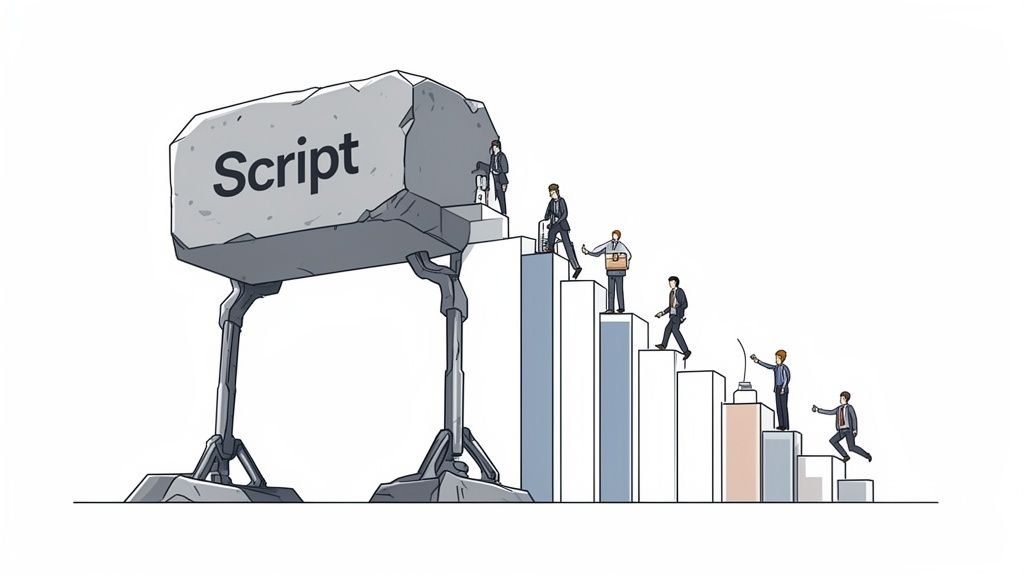
Let's debunk a common myth: scripts don't kill authenticity; they codify success. For any modern sales leader, a well-engineered sales pitch script is a powerful lever for achieving predictable revenue growth. It's the operational backbone required for scaling, whether you're onboarding a new sales division or deploying a fleet of sophisticated Voice AI agents.
At its core, a good script enforces message discipline. It guarantees that your most compelling, data-backed value proposition is communicated to every prospect, regardless of which rep or AI agent is on the call. This consistency not only builds brand equity but also ensures you meet all necessary compliance checkpoints—a non-negotiable for leaders in regulated industries like BFSI and Healthcare.
Turning Scripts Into Strategic Assets
Viewing a script as merely a set of lines to be read is a tactical error. A great script is a strategic playbook that elevates the entire sales function.
For junior reps, it acts as a guardrail, accelerating their ramp-up time and boosting their confidence to engage prospects effectively from day one. For seasoned veterans, it provides a validated baseline, freeing them to improvise and add their personal touch while ensuring key strategic messaging is never missed.
This structured approach directly addresses the primary challenges facing sales executives today. Recent Salesforce data reveals a stark reality: 57% of sales professionals report longer sales cycles, and a staggering 72% feel overwhelmed by their workload. With reps spending an incredible 60% of their time on non-selling activities, every second of a client conversation must deliver maximum impact. A potent script ensures those precious moments are strategically leveraged. You can dig deeper into these trends by exploring the current state of sales in Salesforce's latest research.
For a CXO, the real value of a script is its ability to produce predictable results. When every interaction is built on a proven framework, you can forecast more accurately, scale your teams faster, and seriously de-risk your revenue pipeline.
Ultimately, a dynamic sales pitch script is an investment in operational efficiency. It automates the repetitive aspects of qualification, allowing your high-cost senior sales talent to focus on high-value negotiations and closing enterprise deals. This is how you strategically allocate your best resources for sustainable, scalable growth.
If you're looking for more ways to make your team more efficient, you might be interested in learning how to start overcoming cold calling challenges with AI voice agents.
Building Your High-Performance Script Framework
Let's be clear: a winning sales script isn't a creative writing exercise. It's an engineered tool, built on a solid foundation of data. To build a script that’s scalable, repeatable, and drives measurable results, you must move beyond generic templates and focus on three pillars: deep audience intelligence, benefit-driven messaging, and a structured conversational flow.
This is the framework that turns average reps into top performers and makes your Voice AI agents sound like seasoned closers.
The process begins by translating raw customer data from your CRM, support tickets, and call recordings into razor-sharp buyer personas. This goes beyond job titles. As a leader, you must ensure your team understands not just who your buyers are, but what strategic problems are impacting their P&L or operational efficiency.
From Data to Dialogue
Once you have a crystal-clear picture of your ideal customer profile (ICP), you must map your product's features to tangible business outcomes. Think like your target executive. A VP of Finance doesn’t care about your slick UI; they care about a solution that can slash operational costs by 15% and reduce audit risks. A Director of Operations isn’t buying software; they're buying back 10 hours of their team's time each week, which translates to a 25% increase in departmental productivity.
This shift from discussing features to articulating quantifiable benefits is paramount. It's the difference between saying, "Our platform automates reports," and saying, "Our platform frees up 20 hours per month for your senior analysts, allowing them to focus on strategic forecasting that can improve your gross margin by 2%."
- Audience Intelligence: Go deeper than job titles. What are their specific KPIs? What are the C-suite's top priorities for this fiscal year? What industry pressures are they facing?
- Benefit Mapping: For every feature, relentlessly ask "so what?" until you arrive at a clear, quantifiable business outcome that aligns with executive-level priorities.
- Conversational Design: Don't write a monologue. Your script should be a blueprint for a two-way diagnostic conversation, packed with strategic questions that uncover pain points and steer the conversation towards your solution.
The best scripts feel less like a pitch and more like a guided discovery. They anticipate the customer's journey, leading them from problem to solution in a way that feels natural, not forced.
Choreographing the Conversation
Finally, an effective script is designed for a natural, back-and-forth exchange. This means choreographing the entire interaction, anticipating common objections and building in pre-emptive, value-based responses. Instead of defensively reacting to "It's too expensive," your script should proactively frame the value.
Practical Example: A salesperson might ask, "I find that many leaders in your role are often concerned about the total cost of ownership. Would it be helpful if I briefly explained how our clients typically achieve a full ROI in under six months, often seeing a 200% return in the first year alone?" Suddenly, you’ve transformed a potential deal-killer into a compelling value proposition.
To see how this structure works in the real world, it’s worth studying a proven cold calling script to see how the pros do it. Building this kind of conversational agility into your framework is absolutely critical, especially as you start to consider how AI voice agents are transforming sales. A well-designed script gives you the consistency of a proven process while still allowing for that genuine human—or human-like—connection.
Industry-Specific Sales Pitch Scripts That Actually Convert
Let's be blunt: a generic sales pitch script is a fast track to failure. Buyers today are smarter and more informed than ever, and a one-size-fits-all approach doesn't just fall flat—it actively damages your credibility. The only way to cut through the noise is with messaging that speaks directly to the unique pain points and ambitions of a specific industry.
This is especially critical in a market like India's, where digital advertising spend is projected to soar past ₹60,000 crore by 2026. But with that growth comes an avalanche of noise. In fact, a staggering 73% of B2B buyers admit they'll simply ignore sellers who use irrelevant outreach. This makes a sharp, industry-aware sales pitch script an absolute necessity for survival. You can dig deeper into India's digital advertising trends on Statista.
To give you a running start, I've put together some annotated templates for a few key verticals. Think of these less as rigid scripts and more as strategic frameworks designed to drive conversions.
A great script always comes down to three core pillars: intelligence (what you know), messaging (what you say), and flow (how you guide the conversation). This framework helps visualise how it all connects.
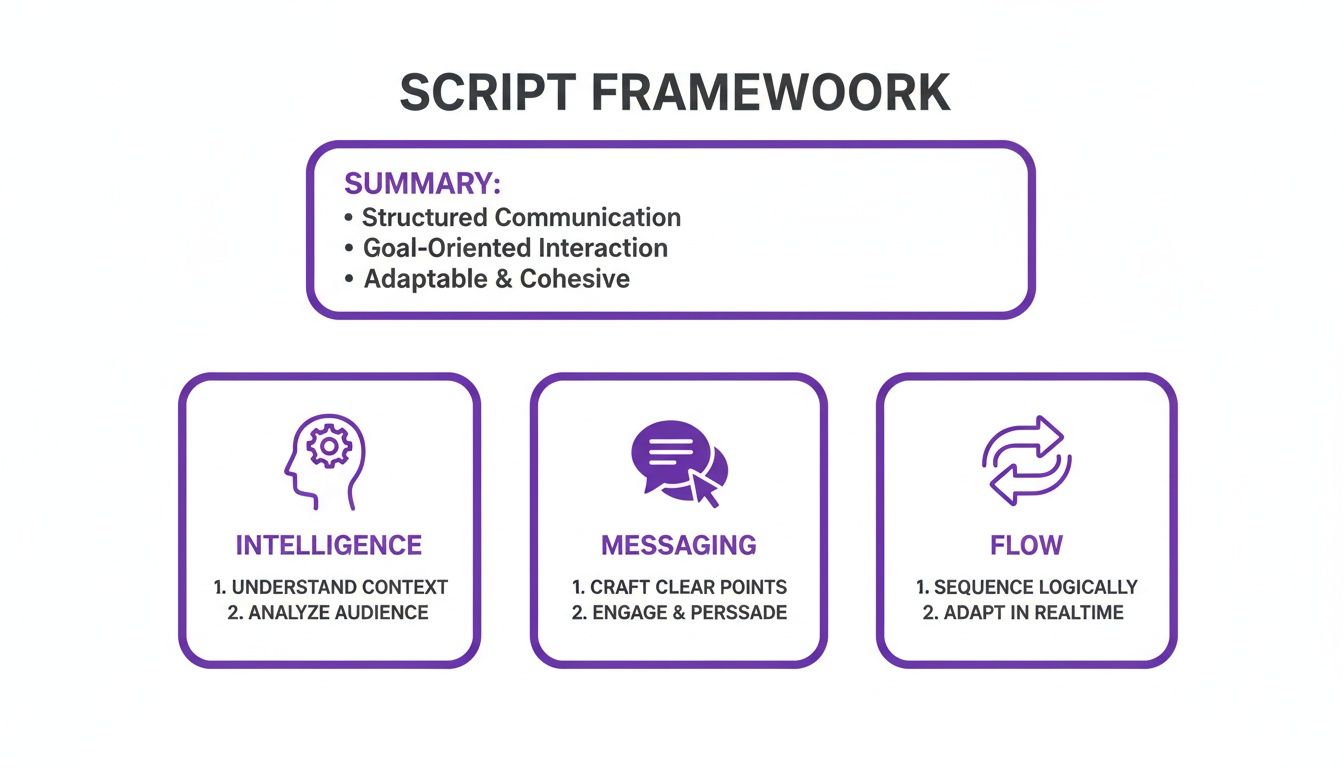
As you can see, everything starts with a deep understanding of your audience. That insight shapes your messaging, which in turn directs the conversation towards a clear, desired outcome.
Before we dive into specific examples, it's helpful to see how these core components shift depending on the industry you're targeting. The primary goal, the opening line, the most important question—they all change based on the customer's world.
Key Script Components Across Industries
| Industry | Primary Goal | Key Opener Strategy | Crucial Qualifying Question | Call to Action |
|---|---|---|---|---|
| EdTech | Build trust and establish expertise. | Acknowledge a shared challenge (e.g., student engagement). | "What are your key priorities for student outcomes this year?" | Book a "curriculum alignment session." |
| Real Estate | Secure a site visit quickly. | Reference their specific inquiry and use evocative language. | "Are you looking for a home to move into soon or as an investment?" | Schedule a private tour for a specific time. |
| BFSI | Demonstrate security and ROI. | Cite a relevant compliance or efficiency statistic. | "How are you currently managing risk assessment for your portfolio?" | Offer a "no-obligation risk audit." |
| E-commerce | Drive a trial or demo for a tangible tool. | Highlight a competitor's success or a recent market trend. | "What's the biggest bottleneck in your cart-to-checkout process?" | Start a "14-day free trial." |
| SaaS | Qualify for a specific use case. | Lead with a data-backed insight about their role/industry. | "Which manual processes are consuming the most man-hours for your team?" | Schedule a "15-minute discovery call." |
This table illustrates that while the end goal is always a sale, the immediate objective and the conversational path to get there can be vastly different. Now, let's explore what this looks like in practice.
EdTech: Focus On Consultative Selling
In the education technology space, the conversation has to be consultative. You're not just selling software; you're selling better student outcomes, and your buyers—parents and academic directors—are making a long-term investment. Your script needs to prioritise discovery questions that get to the heart of their specific learning gaps or administrative headaches.
- Opener Strategy: Kick things off by acknowledging a common industry challenge, like the difficulty of keeping students engaged in online classes or the burden of streamlining admissions.
- Key Question: Ask something pointed but open-ended, like: "Many institutions we partner with are looking to improve placement rates. What are your key priorities for student career outcomes this year?"
- Call to Action: The immediate goal isn't a demo. It’s a deeper needs analysis. Frame your call to action as a "curriculum alignment session" or a "student outcome strategy call."
Annotation: Notice the collaborative language ("partner with," "alignment session"). This simple shift in wording positions your sales rep as a helpful consultant, not a pushy vendor, which is crucial for building the trust needed for a long-term educational partnership.
Real Estate: Focus On Booking Site Visits
When it comes to real estate, the game is all about tangible action. You need to get a qualified prospect to physically visit a property. That means your script must be efficient, paint a vivid picture with words, and be laser-focused on getting them to commit to a time.
You have to qualify their seriousness and budget quickly, but without making it feel like an interrogation. Use questions that spark their imagination and create a subtle sense of urgency.
Example Opener:
"Hi [Prospect Name], I'm calling from [Agency Name] about your interest in our 3BHK sea-facing apartments at [Project Name]. I saw you were looking at the floor plans online—the view from those balconies is truly something special. Are you looking for a home to move into soon, or is this more of a long-term investment?"
This opener works because it immediately connects to an action they just took, uses evocative language ("truly something special") to build excitement, and then slides right into a soft qualification question. A powerful real estate script builds that initial excitement and smoothly pivots to scheduling that all-important first visit.
Optimizing Your Script for Voice AI
Adapting a sales script for a Voice AI agent is not a simple copy-paste exercise; it's about translating a human conversation into a scalable, high-performance asset. The strategic objective is to achieve perfect consistency and 24/7 operational capacity without sacrificing the nuances of a human-led interaction. This requires re-engineering the conversation from the ground up.
The most critical mindset shift for your team is this: you must write for the ear, not the eye.
This means sentences must be shorter, language must be simpler, and key points should be subtly repeated. A prospect can re-read a complex sentence in an email, but on a call, comprehension must be instant. Scripts loaded with corporate jargon or long, compound sentences will result in a 40-50% drop-off rate in the first 30 seconds.
Designing a Human-Like Dialogue
To ensure a Voice AI sounds genuinely empathetic, the script must mimic the natural cadence of a real conversation. This involves building in strategic pauses and designing a non-linear conversation map. A human sales rep naturally pauses to listen or process information; your AI script must do the same to avoid sounding robotic and rushed.
Crucially, an intelligent AI sales script is a dynamic decision tree, not a monologue. It must anticipate deviations and have pre-scripted, natural-sounding responses. For instance, if a prospect interrupts to ask about pricing, the AI cannot stall. It must seamlessly pivot to the "pricing" branch of the script, address the query, and then expertly guide the conversation back to the main qualification track.
Let’s break down how this transformation looks in practice.
- Before (Robotic): "Hello. You are speaking with an AI assistant from XYZ Corp. Our records indicate you downloaded our whitepaper. I am programmed to schedule a product demonstration. What day works for you?"
- After (Conversational): "Hi, is this Priya? My name is Alex, I’m calling from XYZ Corp. I saw you recently downloaded our guide on improving supply chain efficiency… I was just calling to see if you had a chance to look it over and if it was helpful?"
The second version is engineered for engagement. It confirms the contact's identity, references a specific action to establish context, and asks an open-ended question. It invites a conversation instead of demanding a decision. This level of detail makes the difference between a dropped call and a booked demo.
A key strategic win of AI is perfect consistency at scale. Every single prospect hears your most optimised, empathetic, and effective pitch, every single time. This eliminates performance variance between reps and ensures your brand message is delivered with precision.
Ultimately, scripting for Voice AI means embedding the empathy and strategic thinking of your top salesperson directly into the code. By focusing on conversational flow, natural pauses, and a flexible dialogue structure, you're building a powerful operational asset. It drives efficiency, enhances customer experience, and scales outreach far beyond human capacity. For example, some organizations have seen their lead qualification rates increase by over 200% after implementing a well-scripted AI agent.
Measuring Your Script’s Performance and Driving Improvement
If you're not quantitatively measuring your sales pitch script's performance, you're managing by guesswork. The true ROI of a script is only realized through rigorous, data-driven analysis. To optimize your sales strategy and maximize returns, a robust system for tracking what's working, what's failing, and why is non-negotiable.
This extends far beyond tracking the final conversion rate. While a lagging indicator like "demos booked" is important, modern analytics provide a richer, more actionable understanding through a variety of leading Key Performance Indicators (KPIs).
What You Should Be Tracking
To gain a clear, operational view of script performance, you must monitor metrics that encompass both efficiency and conversational quality.
Here are the essential KPIs that should be on every sales leader's dashboard:
- Conversation Duration: Are your scripts engaging prospects? A mere 30-45 second increase in average talk time can be a strong leading indicator of higher engagement and better qualification.
- Lead Qualification Accuracy: When a script qualifies a lead, what percentage converts to a sales-accepted lead (SAL)? Aim for an accuracy rate of 90% or higher. Anything less indicates your script is creating false positives and wasting your sales team's time.
- Sentiment Score: AI-powered analysis of call tone provides invaluable data on the prospect's emotional response. Consistently positive sentiment scores correlate directly with higher conversion rates.
- Objection Rate: Are specific phrases in your script consistently triggering objections? Pinpointing these friction points is the first step in re-engineering your messaging.
Think of your script not as a one-and-done task, but as a living document. The idea is to build a feedback loop where data from real calls feeds directly into the next version, making small, consistent improvements over time.
A/B Testing Your Way to a Better Script
Once you've established baseline metrics, the real optimization begins: A/B testing. This is how you replace assumptions with data-backed decisions. The cardinal rule is to test one variable at a time to ensure attribution is clear.
Start with the highest-impact elements of your script:
- The Opener: Test a data-driven opener ("I saw your company just secured Series B funding…") against a pain-point-focused question ("Many VPs of Sales are struggling with long ramp times for new hires…"). Measure the impact on call duration.
- The Value Proposition: Frame your core benefit in two distinct ways. One might focus on cost savings ("reduce operational overhead by 18%"), while the other emphasizes revenue generation ("increase lead conversion by 25%"). Track which leads to more qualified demos.
- The Call-to-Action (CTA): Test a "hard" ask ("Can we schedule 15 minutes for Tuesday?") against a "soft" one ("Would you be open to a brief 15-minute call to see if this is even a fit?").
This rigorous testing methodology transforms your script from a static document into a dynamically optimized conversion tool.
Key Metrics for Sales Script A/B Testing
When you're running these tests, it's crucial to track the right metrics to understand the real impact of each change. This table breaks down what to look for.
| Metric | What It Measures | High-Performance Indicator | How to Improve |
|---|---|---|---|
| Connect Rate | The percentage of dials that result in a conversation. | A higher rate suggests a compelling opening line or good timing. | Test different openers; refine call timing. |
| Conversation Duration | Average length of the call once a connection is made. | Longer calls often mean higher prospect engagement. | Improve your value prop; ask more open-ended questions. |
| Positive Outcome Rate | Percentage of calls that result in a desired action (e.g., demo booked, follow-up scheduled). | This is the ultimate measure of script effectiveness. | Strengthen your CTA; refine objection handling. |
| Objection Rate | How often specific objections (e.g., "not interested," "too expensive") arise. | A lower rate indicates your script is pre-emptively addressing concerns. | Build in responses to common objections earlier in the script. |
| Sentiment Score | The overall emotional tone (positive, neutral, negative) of the conversation. | Consistently positive scores show the script builds good rapport. | Adjust tone, phrasing, and pacing to be more conversational. |
By keeping a close watch on these KPIs for each version of your script, you'll quickly see which approach is winning and why.
For a more detailed breakdown, you can read our guide on how to measure the success of your outbound campaigns to see these principles in action.
Adapting Scripts for India’s Diverse Markets
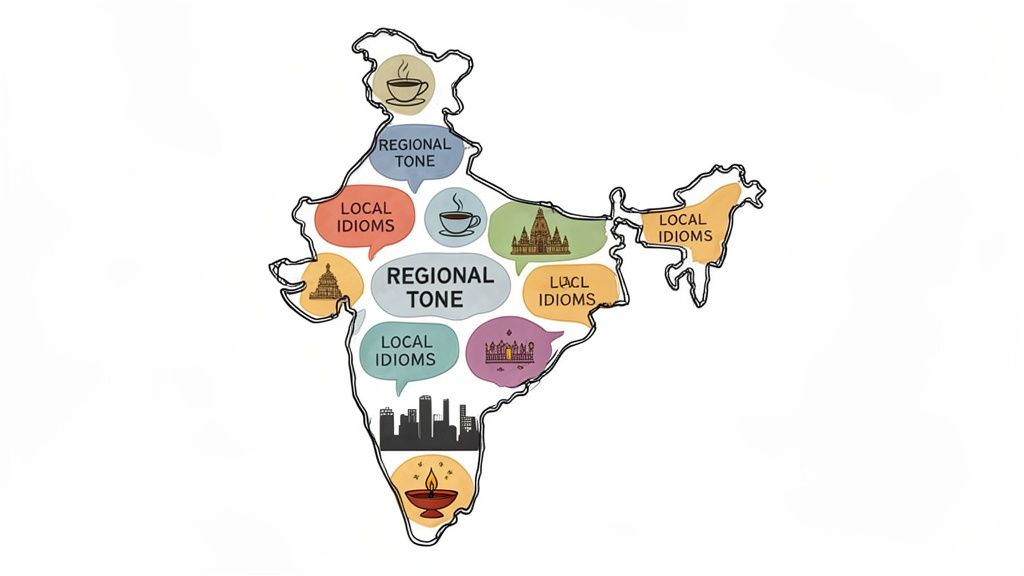
For any leader managing sales operations in India, a one-size-fits-all sales pitch is a strategic failure. Attempting to deploy a single, monolithic script across the nation isn't just a missed opportunity; it's a guaranteed way to alienate vast segments of your total addressable market. A decisive competitive advantage is gained by deeply understanding and adapting to India's incredible linguistic and cultural diversity.
This is no longer a "nice-to-have" strategy—it's a market necessity. The data is unequivocal. Projections show that over 60% of Indian internet users will soon prefer to engage with content in regional languages like Hindi, Tamil, and Marathi. This trend is especially pronounced in the high-growth Tier 2 and Tier 3 cities, which represent the next frontier of market penetration. You can find more on India's digital marketing shifts on Royalways.com.
Beyond Translation to Cultural Resonance
Success in India requires moving beyond literal translation to achieve cultural resonance. This means engineering your script to reflect regional customs, values, and appropriate levels of formality.
Practical Example: A direct, assertive pitch that might perform well with a CXO in Mumbai could be perceived as abrasive and disrespectful in Chennai, where building rapport and demonstrating long-term value are prerequisites to any business discussion.
Think about the power of localized context. A real estate pitch in Bengaluru, for instance, gains instant credibility by referencing the specific pain point of traffic on the Outer Ring Road—a hyper-local detail that signals a genuine understanding of the prospect's daily life.
Here are a few strategic guidelines for regional adaptation:
- North India: A more direct, aspirational tone often resonates well, aligning with ambitions of status and achievement.
- South India: The focus should be on building trust and demonstrating long-term value, requiring a more patient, detailed, and consultative conversational flow.
- East India: A community-oriented approach that highlights shared benefits and collective success can be incredibly powerful.
The goal is to make your brand feel local, not like an outsider fumbling with the language. This means investing in regional teams or consultants who can check your sales pitch script for those subtle nuances a standard translation service will always miss.
By fine-tuning your scripts with this level of care, you turn a potential hurdle into a massive advantage. You ensure your message isn’t just heard, but is genuinely understood and welcomed, no matter where you are in India.
Frequently Asked Questions
As a leader, you need strategic answers, not just tactical tips. Here are our responses to the most common high-level questions we hear from VPs and CXOs about implementing and managing a sales pitch script.
How Can We Use Scripts Without Sounding Robotic?
That’s the million-dollar question, isn't it? The solution lies in shifting your perspective: a script is not a word-for-word mandate but a flexible framework. A great sales pitch script is designed to ensure core message consistency, not to turn your sales team into parrots.
The key is rigorous training. Drill your team on the strategic messages, the value proposition, and proven responses to common objections. This equips them with the confidence and tools to personalize the conversation and adapt to its natural flow. For Voice AI agents, this is even more critical; we engineer their scripts with multiple conversational paths and linguistic variations to ensure every interaction feels dynamic and responsive.
What Is the Most Critical Element of a Successful Script?
Without a doubt, the opening. The first 7-10 seconds determine the outcome of the entire call. In this brief window, you must establish credibility, demonstrate relevance, and provide a compelling reason for the prospect to continue the conversation.
Consider the data: research shows a staggering 73% of B2B buyers will deliberately ignore sellers who reach out with irrelevant messages. An effective opener must immediately address a specific pain point or offer a data-backed insight relevant to their role or industry. If you are going to A/B test only one element, start with your opening lines—it's the single highest-leverage change you can make to improve connect-to-conversation rates.
How Often Should We Update Our Sales Scripts?
Your sales pitch script must be a living document, not a static artifact. We recommend a formal, comprehensive review on a quarterly basis. This cadence ensures your messaging remains aligned with product updates, marketing campaigns, and evolving market dynamics.
However, do not wait for a quarterly review if the data signals a problem. Constant monitoring of performance data is crucial. A sudden 10% dip in your meeting booking rate or the repeated emergence of a new objection are clear indicators that an immediate script review is required. Leveraging a platform with real-time analytics is key; it enables you to detect these trends instantly and adapt with agility.
Ready to build a sales engine that scales? See how DialNexa uses human-like Voice AI and optimised scripts to turn more conversations into revenue. Explore DialNexa today.

[…] allocation, and strategic value. If you want more inspiration, our article on crafting a powerful sales pitch script has some great […]
This is a highly insightful piece that brilliantly shows how data-driven and industry-specific sales scripts create consistency, scalability, and stronger conversion outcomes. The practical examples and Voice AI strategies make it especially valuable for modern sales leaders aiming for predictable growth.