
VoIP Engineer Jobs: A 2026 Guide to Landing Top Roles
You're probably in one of two situations right now. You're either trying to break into VoIP engineer jobs and finding that many listings read like a shopping list of every telecom product released in the last decade, or you're hiring for the role and getting CVs that say “SIP, PBX, SBC” without showing whether the candidate can protect call quality when revenue depends on it.
Both groups are looking at the same problem from different sides. Voice infrastructure isn't just an internal IT service anymore. It sits directly inside sales workflows, support operations, recruitment funnels, and global service delivery. When calls fail, customers notice immediately. When the stack is designed well, leaders see shorter resolution cycles, cleaner routing, better scalability, and fewer expensive surprises during growth.
That's why VoIP engineer jobs in 2026 deserve a more strategic read. For candidates, the role offers a path into architecture, automation, cloud communications, and customer experience leadership. For directors and CXOs, a strong VoIP engineer isn't a maintenance hire. They're the person who turns telephony from a recurring problem into an operational advantage.
Table of Contents
- The Strategic Importance of a VoIP Engineer in 2026
- The Core Skillset of an Elite VoIP Engineer
- Crafting a Resume That Lands the Interview
- Mastering the VoIP Engineer Interview Process
- Navigating Job Markets and Salary Negotiations
- Strategic Career Paths Freelancing vs Full-Time Roles
The Strategic Importance of a VoIP Engineer in 2026
A weak telephony environment creates visible business damage. Sales teams lose live prospects, support queues back up, recruiters miss candidates, and distributed teams start building workarounds outside approved systems. Leaders usually experience this as “communications instability”, but the root cause often sits with design quality, interoperability, observability, or poor change control.
A strong VoIP engineer fixes that at the architecture level. They don't just provision numbers or manage a PBX. They shape call routing, codec policy, failover logic, SBC behaviour, carrier relationships, and platform integrations so the business can scale without voice becoming fragile.
For executives, the commercial case is clear. Companies with highly skilled VoIP engineering teams report 40% fewer critical communication outages and resolve customer-reported call quality issues 60% faster, directly improving customer retention metrics according to this VoIP team impact study.
Practical rule: If voice is tied to customer acquisition, support, or compliance, the VoIP engineer role belongs in business continuity planning, not just infrastructure operations.
The modern role also intersects with automation and AI. Contact centres now blend SIP infrastructure, cloud telephony APIs, routing logic, recording policy, analytics, and conversational systems. That means the engineer who understands signalling paths and service orchestration can influence customer experience design, vendor selection, and deployment speed. A leader evaluating voice strategy should understand the underlying SIP call flow fundamentals because that's where user experience problems often begin.
For candidates, that strategic relevance matters. VoIP engineer jobs aren't limited to “telephony admin” paths anymore. The role can lead into solution architecture, UC engineering, contact centre engineering, security, cloud communications, and platform integration work. The engineers who advance fastest are usually the ones who can explain technical decisions in business language.
The Core Skillset of an Elite VoIP Engineer
At 8:47 a.m., the sales floor can place internal calls, but every outbound customer call fails after a carrier change. The executive team sees missed revenue. The service desk sees tickets piling up. The VoIP engineer who can isolate the fault path fast, explain business impact clearly, and restore service without creating a second incident is the one worth hiring.
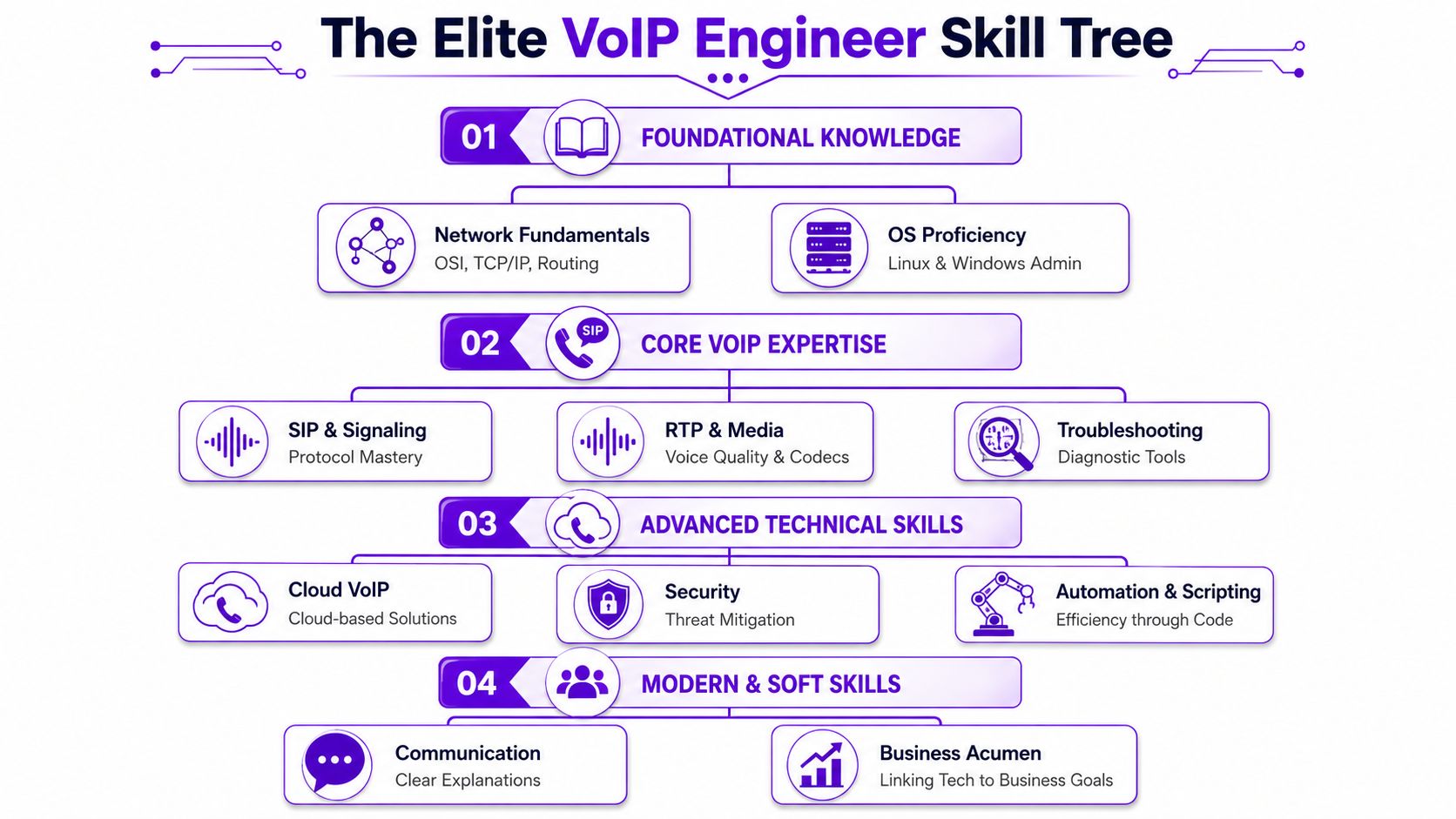
Elite performance in this role comes from technical depth, operating discipline, and commercial awareness. Candidates need to show all three. Hiring managers need to screen for all three. A business does not benefit from an engineer who can recite SIP methods but cannot reduce outage time, improve change quality, or protect call completion during growth.
Protocols that separate administrators from true troubleshooters
SIP still sits at the center of the role, but real competence starts after the acronym. Strong engineers read traces with intent. They can spot failed registrations, header normalization issues, transfer failures, NAT side effects, bad number formatting, and carrier interop problems without guessing.
Media knowledge matters just as much. Many production incidents are not signaling failures at all. They are codec mismatches, one-way audio caused by firewall policy, broken SRTP negotiation, DTMF handling errors, jitter under congestion, or packet loss that only appears on a specific path. Engineers who own call quality learn to follow both legs of the problem.
Legacy knowledge still has value. H.323, PRI gateways, and hybrid estates continue to show up in healthcare, education, government, and global enterprise environments. That does not make legacy expertise the center of the hiring brief. It means good engineers can work through mixed environments without treating older systems as beneath them.
Interview questions should test diagnosis, not memorization. Ask what they would check first after a trunk cutover breaks outbound calling, or how they would prove whether a one-way audio issue sits at the SBC, firewall, carrier, or endpoint. The strongest candidates answer in sequence, not in buzzwords.
Infrastructure judgment shows up in design choices and change control
A serious VoIP engineer understands how PBX platforms, SBCs, gateways, carriers, DNS, certificates, identity systems, and policy controls fit together. Brand familiarity helps, but architecture judgment matters more.
I look for engineers who can explain why a session border controller policy exists, what risk it reduces, and what user impact follows if someone changes it carelessly. That tells me more than a long list of products on a resume. If a candidate can explain routing logic, normalization, failover behavior, and structured addressing such as SIP URI format and usage, they usually have the fundamentals to adapt across vendors.
A practical hiring lens:
| Component | What strong engineers focus on | Why the business should care |
|---|---|---|
| SBCs | Interoperability, security policy, media anchoring, normalization | Fewer carrier issues, lower fraud exposure, better control at the voice edge |
| PBX or call control | Dial plans, user policy, survivability, permissions | Better call completion, fewer user-facing errors, cleaner operations |
| Gateways | Legacy interconnects, codec translation, failover behavior | Lower migration risk in mixed estates |
| Carrier trunks | Number presentation, routing, testing discipline, failback | Direct effect on revenue calls, customer trust, and cutover safety |
Security belongs inside the core skillset, not in a separate box. Voice systems sit on public interfaces, carry identity data, and attract fraud attempts. Good engineers treat patching, segmentation, access control, toll fraud prevention, certificate handling, and alerting as day-to-day responsibilities.
Cloud, CPaaS, and automation now define the upper tier of the market
The gap between a competent engineer and a high-value engineer is often cloud fluency. Enterprises are shifting voice into UCaaS platforms, cloud contact centers, API-based workflows, and distributed operations. An engineer who can connect telephony to applications, identity, and reporting systems gives the business more options.
Public labor data supports the broader direction of travel. The U.S. Bureau of Labor Statistics projects growth for network and computer systems administrators, a category that captures many communications infrastructure roles, while employer demand increasingly favors cloud and automation experience in job postings rather than legacy PBX-only backgrounds. The exact title varies by company. The pattern is consistent.
In practice, the modern stack often includes:
- UCaaS integration: Microsoft Teams, Zoom Phone, Webex Calling, or similar platforms where policy, routing, identity, and emergency calling must align
- CPaaS work: Twilio, Vonage, Plivo, or equivalent services that connect messaging, voice, IVR flows, and business applications
- Automation: Python, PowerShell, Bash, or API scripts to standardize provisioning, speed up audits, and reduce repetitive changes
- Observability: packet capture tools, SBC traces, syslog, QoS monitoring, and alerting tied to service health rather than raw device uptime
For a hiring manager or CIO, the role becomes strategic. A cloud-capable VoIP engineer can reduce migration risk, shorten deployment cycles, improve resilience across remote teams, and support product teams building communications into customer workflows. That has budget impact. It affects support costs, revenue continuity, and vendor flexibility.
For candidates, the message is simple. Show how your technical work changed an operating result. “Built Direct Routing failover between regions” is better than “worked on Teams.” “Automated DID provisioning through API scripts, cutting manual setup time and reducing errors” is better than “used Python.”
Resume wording matters here too, especially if applications pass through filters before a human review. YayRemote's ATS guide is useful for understanding how hiring systems read role-specific keywords and project evidence. The best resumes still need substance behind the terms.
Communication skill is part of the technical skillset
VoIP engineering is one of the few infrastructure roles where an engineer may need to speak fluently with carriers, firewall teams, compliance staff, contact center leaders, and the CFO in the same week. That changes the hiring standard.
Candidates who advance usually do three things well. They document call flows and dependencies clearly. They explain risk in plain language during changes. They can say, without drama or hand-waving, what happened, what is affected, what is contained, and what happens next.
That communication discipline is not soft filler. It reduces bad approvals, shortens incident calls, and gives leadership the confidence to invest in the function rather than treat it as reactive support.
Crafting a Resume That Lands the Interview
A good VoIP resume doesn't read like a maintenance log. It reads like a record of problems solved under business pressure.
Write for outcomes, not tasks
Most candidates waste the top half of the page. They list products, protocols, and duties, then hope the hiring manager will infer competence. That doesn't work, especially for VoIP engineer jobs where every serious employer wants evidence of troubleshooting judgement and delivery under pressure.
Weak bullets look like this:
- Managed SIP trunks
- Supported PBX users
- Worked on call quality issues
- Configured SBC
Better bullets show business context:
- Led SIP trunk migration for a multi-site support operation, validating routing, failover behaviour, and number presentation before cutover
- Reduced repeat ticket volume by resolving recurrent one-way audio issues through firewall review, SBC policy changes, and trace-based troubleshooting
- Standardised PBX provisioning and user templates to reduce setup errors across new joiners and site launches
- Partnered with security and network teams to harden voice edge components during platform refresh work
Notice the difference. The second set tells a hiring manager where you operated, how you thought, and whether you can work across functions.
Your resume should help a director imagine trusting you with a production cutover.
Certifications help when they support a clear story
Certifications still help, but only when they support the kind of role you want next. CCNP Collaboration, vendor accreditations from AudioCodes or Ribbon, and platform-specific credentials can validate depth. They won't rescue a vague resume.
A practical order of importance looks like this:
- Relevant project history that shows you owned hard problems
- Tool and platform alignment with the target estate
- Certifications that confirm seriousness and structured learning
- Clear writing that lets non-specialist reviewers understand your value
For hiring leaders, that same order works when drafting role requirements. If you make a certificate mandatory but can't explain what capability it signals, you'll screen out good engineers and keep strong talkers.
Format for human readers and ATS systems
Many candidates over-design their CV and under-explain their impact. Simple formatting usually wins. Clean headings, standard job titles, plain text skills, and focused bullets are easier for both recruiters and applicant tracking systems to parse. If you want a practical refresher on structure and keyword handling, YayRemote's ATS guide is worth reviewing before you send applications.
Use this layout:
| Resume section | What to include |
|---|---|
| Headline | Role target such as VoIP Engineer, UC Engineer, or Voice Network Engineer |
| Summary | A short statement about estate size, specialisms, and modern stack exposure |
| Core stack | Protocols, platforms, SBCs, PBX tools, scripting, cloud products |
| Experience | Impact-led bullets, not duty lists |
| Certifications | Only those relevant to the role |
| Projects | Migrations, incident recovery, cloud integrations, automation work |
One more point for both candidates and hiring teams. Avoid title inflation. “VoIP Architect” means something different from “VoIP Administrator”. If the work was operational support, present it accurately. Clear scope builds trust faster than oversized labels.
Mastering the VoIP Engineer Interview Process
VoIP interviews are easiest to pass when you stop treating them like exams. Good interviewers don't need dictionary answers. They need proof that you can stay calm, isolate variables, and explain risk clearly when production voice is unstable.
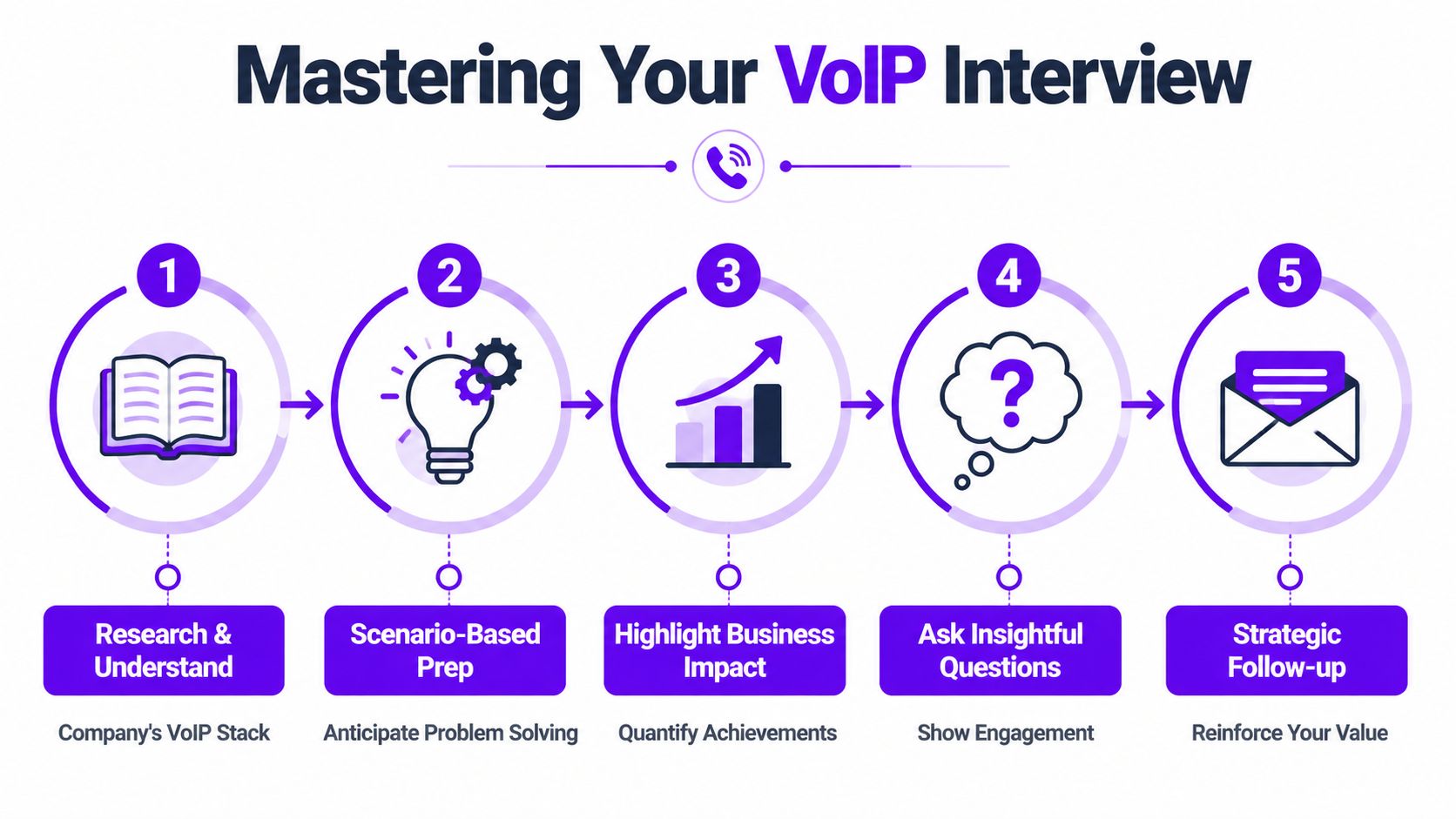
Start with the visual checklist below, then build your prep around scenarios.
Answer scenarios with a diagnostic sequence
A common question sounds like this: a client reports intermittent one-way audio on calls to an international office. Walk through your approach.
A strong answer usually follows a sequence such as:
- Clarify the pattern. Is it inbound, outbound, or both? Does it affect one site, one carrier path, or one device group?
- Separate signalling from media. Confirm whether calls establish successfully and where media is expected to flow.
- Check policy boundaries. Review NAT behaviour, firewall handling, SBC anchoring, and any recent routing or codec changes.
- Use evidence, not memory. Pull packet captures, call traces, CDRs, and SBC logs rather than guessing.
- Test the fix carefully. Validate with controlled calls before broad rollback or production change.
That sequence tells the interviewer you won't thrash around under pressure.
Here's a practical media aid if you want to see a structured approach in another format:
Show commercial judgement, not just packet knowledge
Senior interviews often pivot away from troubleshooting. You may be asked how you'd present the case for moving from an on-prem PBX to a UCaaS model, or how you'd justify introducing an SBC refresh before a visible outage occurs.
That answer shouldn't sound like a product brochure. It should sound like risk management tied to operations.
Useful talking points include:
- Operational resilience: Fewer manual dependencies and cleaner failover paths
- Support model: Simpler lifecycle management and reduced variation across sites
- Security posture: Better policy control, clearer boundaries, improved vendor supportability
- Scalability: Faster user provisioning and easier support for distributed teams
- Integration value: Tighter alignment with collaboration tools, automation, and application workflows
“If you can't explain the financial or operational reason for a technical change, most leadership teams won't fund it.”
Questions hiring teams should ask
If you're hiring, the interview should test reasoning under realistic conditions. Product trivia won't tell you much.
Try questions like these:
- Scenario probe: A branch loses PSTN reachability after a change freeze exception. What's your first triage path and why?
- Design judgement: When would you keep media local versus anchoring through a central SBC?
- Stakeholder test: How would you explain a carrier issue to a support director who needs an ETA, not a protocol lesson?
- Migration thinking: What would you check before moving a business-critical queue from legacy PBX to a cloud platform?
- Automation maturity: Which repetitive telephony task would you script first, and what risk would that remove?
Candidates should ask strong questions too. Ask what the current estate looks like, where incidents tend to cluster, how changes are approved, and whether the role owns architecture or mainly supports operations. Smart questions show you understand that VoIP engineer jobs vary widely in scope.
Navigating Job Markets and Salary Negotiations
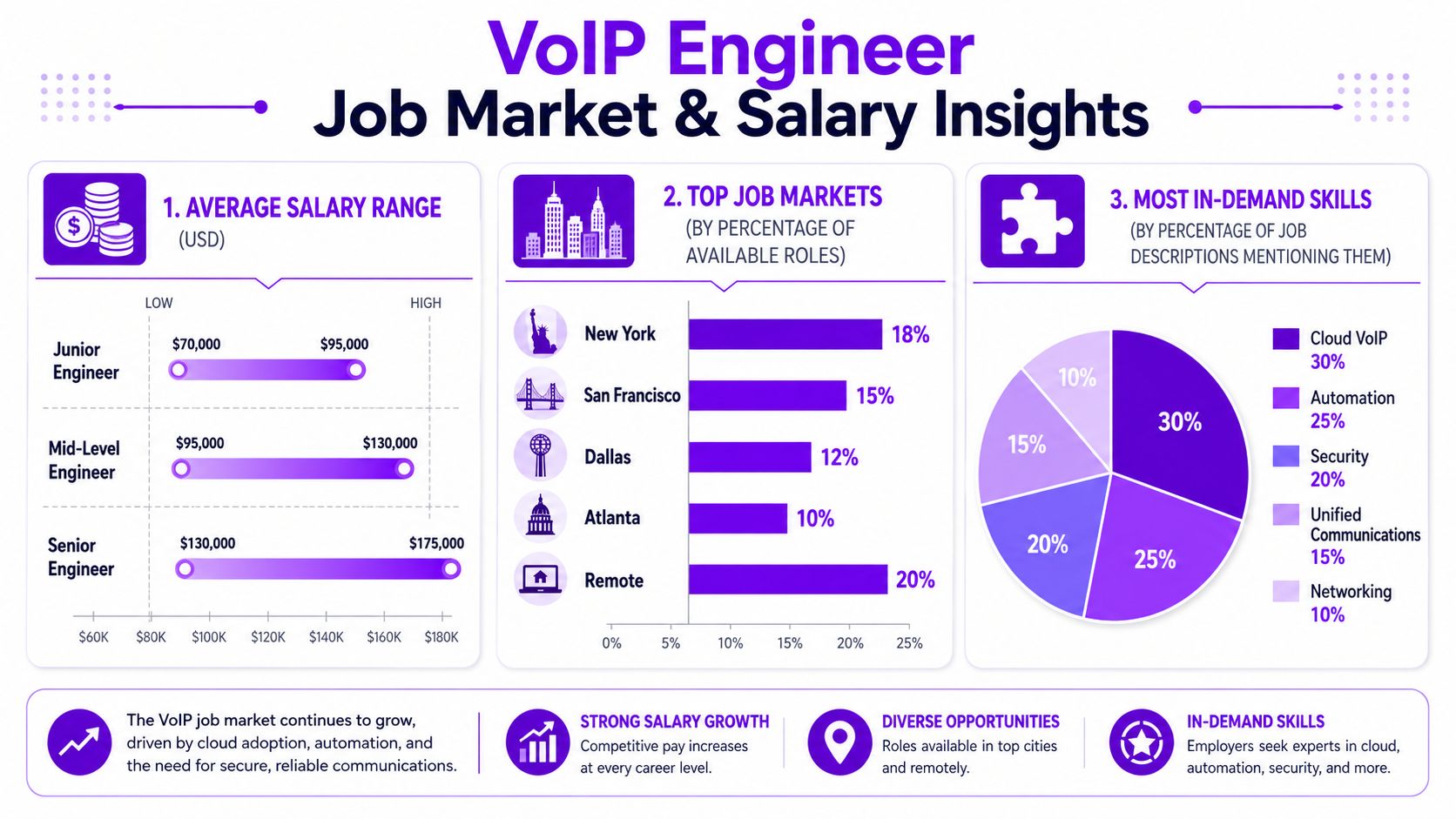
A company can spend six figures on a cloud voice rollout and still lose money if the engineer running it cannot steady cutovers, control carrier risk, or explain trade-offs to leadership. The job market reflects that reality. The strongest roles, and the strongest candidates, are judged on business impact as much as technical depth.
Where strong roles actually appear
Good VoIP engineer jobs do show up on broad job boards, but many of the best ones are filled through narrower channels first. Integrators, UC consultancies, telecom-focused recruiters, vendor partner networks, and former colleagues usually surface roles with clearer scope and fewer mismatched applicants.
That matters on both sides.
Candidates find out faster whether a role is real architecture work, operational support with on-call attached, or a migration project dressed up as a permanent post. Hiring managers get closer to engineers who already understand the stack, the vendors, and the pace of production change.
Useful channels include:
- Vendor communities: AudioCodes, Ribbon, Cisco, Microsoft Teams, and contact centre forums
- Specialist recruiters: Firms that place telecom, collaboration, and voice infrastructure talent
- Professional networks: Former peers, carrier contacts, solution architects, and escalation engineers
- Partner ecosystems: MSPs, cloud communications resellers, and migration consultancies
For employers, distribution strategy shapes applicant quality. If the role includes Direct Routing, SBC policy control, carrier escalation, and cloud platform integration, broad portals alone usually produce too much noise.
What employers actually pay for
Compensation usually rises with consequence, not just tenure. An engineer who can keep a legacy estate stable has value. An engineer who can stabilise it while planning migration, reducing support load, and preventing expensive cutover failures has more.
The practical split looks like this:
| Candidate profile | Typical value signal |
|---|---|
| Legacy-only telephony engineer | Suited to stable estates, break-fix support, and incremental change |
| Hybrid enterprise voice engineer | Useful for migration work, operations, vendor coordination, and service improvement |
| Cloud and CPaaS-capable engineer | Strong fit for platform change, automation, application integration, and multi-vendor architecture |
For job seekers, that means salary growth usually comes from adding business-relevant scope. Learn how voice interacts with identity, networking, security review, APIs, reporting, and service ownership. Hiring teams do not pay more because someone can list more acronyms. They pay more for fewer outages, cleaner migrations, faster troubleshooting, and better decisions under pressure.
For leadership teams, the lesson is simple. If communications is tied to revenue, patient access, customer service, trading, field operations, or compliance workflows, the VoIP engineer is not a back-office utility hire. The role protects continuity and shapes how fast the business can change. If you need market context around hosted platforms, this overview of cloud telephony providers is a useful starting point.
How to negotiate without sounding defensive
Strong negotiation is specific. Tie compensation to ownership, risk, and outcomes.
Weak language sounds like this: “I have a lot of experience, so I want more money.”
Better language is concrete: “This role owns the areas where outages and project overruns usually happen, including SIP interop, SBC policy, carrier coordination, and migration support. I'm looking for a package that matches that level of responsibility.”
Hiring managers should frame offers the same way. State whether the role owns architecture, after-hours escalation, vendor management, compliance-sensitive call flows, automation, or a high-risk migration backlog. Senior engineers will accept hard jobs when the scope is honest and the package reflects the load.
One more point for independent consultants. If you plan to win contract work instead of a full-time post, your public profile matters. A clean site with clear service positioning, project examples, and contact paths will help more than another generic skills list. The Guide to choosing a freelancer template is a practical reference if you are setting that up.
Strategic Career Paths Freelancing vs Full-Time Roles
At senior level, the choice often isn't whether you can get work. It's what kind of work you want your life to orbit around.
When full-time is the better move
Full-time roles suit engineers who want deep ownership. You stay with the consequences of your design decisions, learn the politics of change control, and build context around users, vendors, and internal dependencies. That usually makes you better at architecture over time.
For employers, full-time hires make sense when voice is mission-critical and tightly linked to ongoing operations. If the estate spans multiple sites, regulated workflows, or constant integration demands, keeping that knowledge in-house is often the safer long-term choice.
When freelancing creates more leverage
Freelancing works best when the engineer has a sharp specialist profile. Migrations, SBC hardening, carrier transitions, audit work, troubleshooting escalations, and recovery projects are all strong consulting lanes because the value is concentrated and time-bound.
For companies, a freelancer is often the right answer when the problem is specific. If you're planning a platform migration or need an independent review before a major cutover, specialist consulting can be more efficient than hiring a permanent employee too early.
A visible online profile matters more in that path. If you're building a solo consulting brand, a practical starting point is this Guide to choosing a freelancer template, especially if you need a simple way to present services, case types, and contact options.
A practical decision filter
Use this comparison when deciding:
- Choose full-time if you want steady platform ownership, internal influence, and long-range architecture growth.
- Choose freelance if you prefer variety, defined scopes, and the ability to specialise around high-value problem sets.
- Hire full-time if the business needs continuity, institutional memory, and someone embedded in change governance.
- Hire freelance if the business faces a narrow technical challenge, a one-off migration, or a backlog that needs expert acceleration.
Neither path is automatically better. The better path is the one that matches the type of pressure you handle best.
If your business is rethinking voice operations, customer engagement, or AI-led call workflows, DialNexa Labs Private Limited is worth a close look. DialNexa helps teams build and deploy human-like Voice AI agents for qualification, support, recruitment, and presales, giving leaders a practical way to scale conversations without adding repetitive manual calling.

Leave a Reply