
AI Call Center Software: A CXO’s Guide for 2026
The market has already moved. The global call centre AI market was valued at USD 1.99 billion in 2024 and is projected to reach USD 7.08 billion by 2030, a 23.8% CAGR from 2025 to 2030, according to Grand View Research's call centre AI market analysis. That isn't a feature trend. It's a structural shift in how customer operations are being run.
For Indian CXOs, the question isn't whether AI call centre software is interesting. It's whether your organisation can still afford voice operations built around manual triage, fragmented agent workflows, and inconsistent quality at scale. In a market defined by multilingual demand, high call volumes, compliance pressure, and tight margin expectations, operational AI is no longer optional. It's becoming part of the core service model.
Boards should treat this as a business redesign decision. The smartest teams aren't just buying bots. They're rebuilding routing, qualification, support, escalation, analytics, and workforce utilisation around AI. If your leadership team is still evaluating this as a narrow IT procurement, start with a more strategic blueprint on contact centre automation trends and operating models and pair that with a practical product thinking lens on how to build an AI.
Table of Contents
- Why AI Call Centre Software Is Now a Strategic Imperative
- Understanding the Modern AI Call Centre
- The Core Components That Drive Business Value
- Quantifiable Business Benefits and Strategic Wins
- AI Call Centre Software in Action Across Industries
- Your CXO Playbook for Implementation and Vendor Selection
- Measuring Success KPIs and Calculating ROI
Why AI Call Centre Software Is Now a Strategic Imperative
The strongest reason to invest in AI call centre software is simple. Customer operations have become a competitive battleground, and AI is now part of the winning operating model.
What changed is scale and maturity. This isn't early experimentation any more. According to an industry benchmark cited by Xima Software's call centre statistics roundup, 50% of businesses already use AI-driven tools such as call-centre software or knowledge bases, while another 34% plan to adopt them soon. That tells a board something important. Delay is no longer prudence. Delay increasingly means falling behind peers who are improving speed, consistency, and throughput.
AI is now tied to operating leverage
A traditional call centre scales by hiring, training, and supervising more people. An AI-enabled call centre scales by automating repetitive interactions, improving agent productivity, and routing complexity more intelligently. That changes the economics.
For Indian enterprises, this matters even more because many sectors still run voice-heavy service models. BFSI teams handle sensitive support and reminders. Real estate teams depend on rapid lead follow-up. EdTech teams need structured counselling and booking. E-commerce teams fight response-time expectations every day.
Board-level view: AI call centre software should sit in the same investment category as ERP, CRM, and analytics infrastructure. It shapes cost structure, service quality, compliance exposure, and revenue conversion.
The risk is strategic, not technical
If competitors can respond faster, classify intent better, and keep live agents focused on higher-value cases, they won't just reduce service cost. They'll capture more revenue, retain more demand, and create a more disciplined operating model.
This is why AI call centre software belongs in board discussion. It affects growth, not just support. It affects governance, not just automation. And in India, where scale amplifies even modest improvements, waiting for perfect certainty is usually the wrong call.
Understanding the Modern AI Call Centre
Indian enterprises cannot treat voice operations as a single-language, linear process. The 2011 Census of India recorded 121 languages spoken by 10,000 or more people and 22 scheduled languages. That reality shapes how an AI call centre must be designed, governed, and measured.
Most executives still frame AI call centre software too narrowly. They see a voice bot answering routine calls. The modern model is broader and more commercially relevant. It is an operating layer that interprets intent, decides the next best action, and coordinates work across channels, agents, knowledge systems, and core business applications.
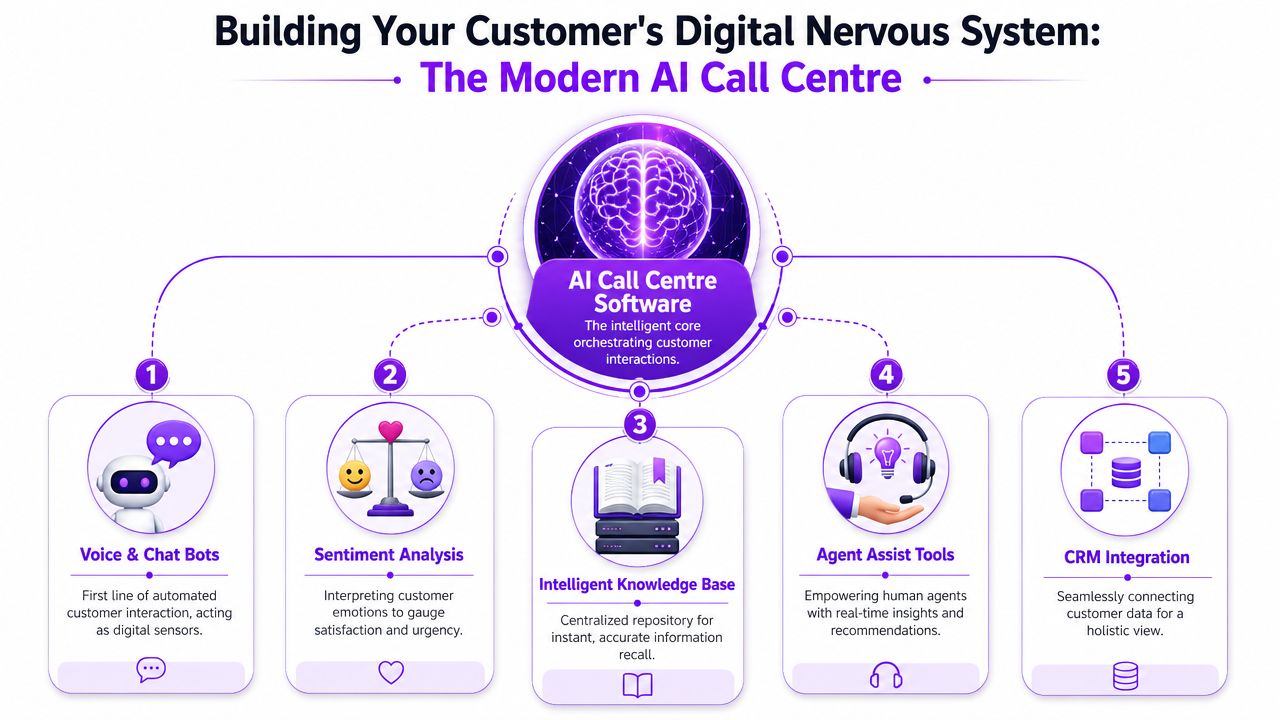
At the centre is the decision engine. Around it sit the production systems that determine whether the platform creates financial value or just adds software spend: voice and chat automation, knowledge retrieval, agent assist, conversation analytics, workflow logic, and CRM or ticketing integration. Orchestration is the point. A disconnected bot, a dashboard, or a transcription tool will not change operating performance on its own.
In practice, a modern AI call centre identifies the caller, detects language, classifies intent, retrieves the right policy or product answer, and either resolves the interaction or routes it with context intact. That matters in India because customer conversations often shift mid-call from enquiry to complaint to payment issue, sometimes across multiple languages or dialects. Static menu trees break under that complexity. AI systems handle it better if they are trained, integrated, and monitored properly.
This is also where many board-sponsored programmes fail. They buy automation before they define escalation logic, audit controls, and integration depth. The result is predictable. Containment looks acceptable in a pilot, but customer effort rises, compliance risk widens, and agents still spend time repairing poor handoffs.
A better model has three jobs:
- Front-end resolution: Automate repetitive voice interactions such as appointment booking, balance or status checks, reminders, lead qualification, and standard service requests. For firms replacing legacy call flows, modern IVR and interactive voice response software often becomes the first control point.
- Agent-side acceleration: Surface customer history, recommended responses, compliance prompts, and next-best actions while the conversation is live.
- Management visibility: Analyse transcripts and outcomes to find repeat contact drivers, weak process steps, script failures, and coaching gaps. This practical guide to AI conversation analysis is a useful reference for executives evaluating how post-call intelligence translates into operating decisions.
The strategic distinction is simple. A modern AI call centre is not a replacement story. It is a cost-to-serve, control, and conversion story. High-performing deployments remove low-value call volume, improve transfer quality, standardise execution, and give leadership a cleaner view of where service design is failing.
That is the model CXOs should evaluate. Not a bot. An AI-driven service operating system built for multilingual demand, regulated workflows, and measurable business outcomes.
The Core Components That Drive Business Value
Feature lists do not build a business case. Operating design does. CXOs should assess AI call centre software by one question: which parts of the service chain will it improve, control, and scale profitably?
The three-layer operating model
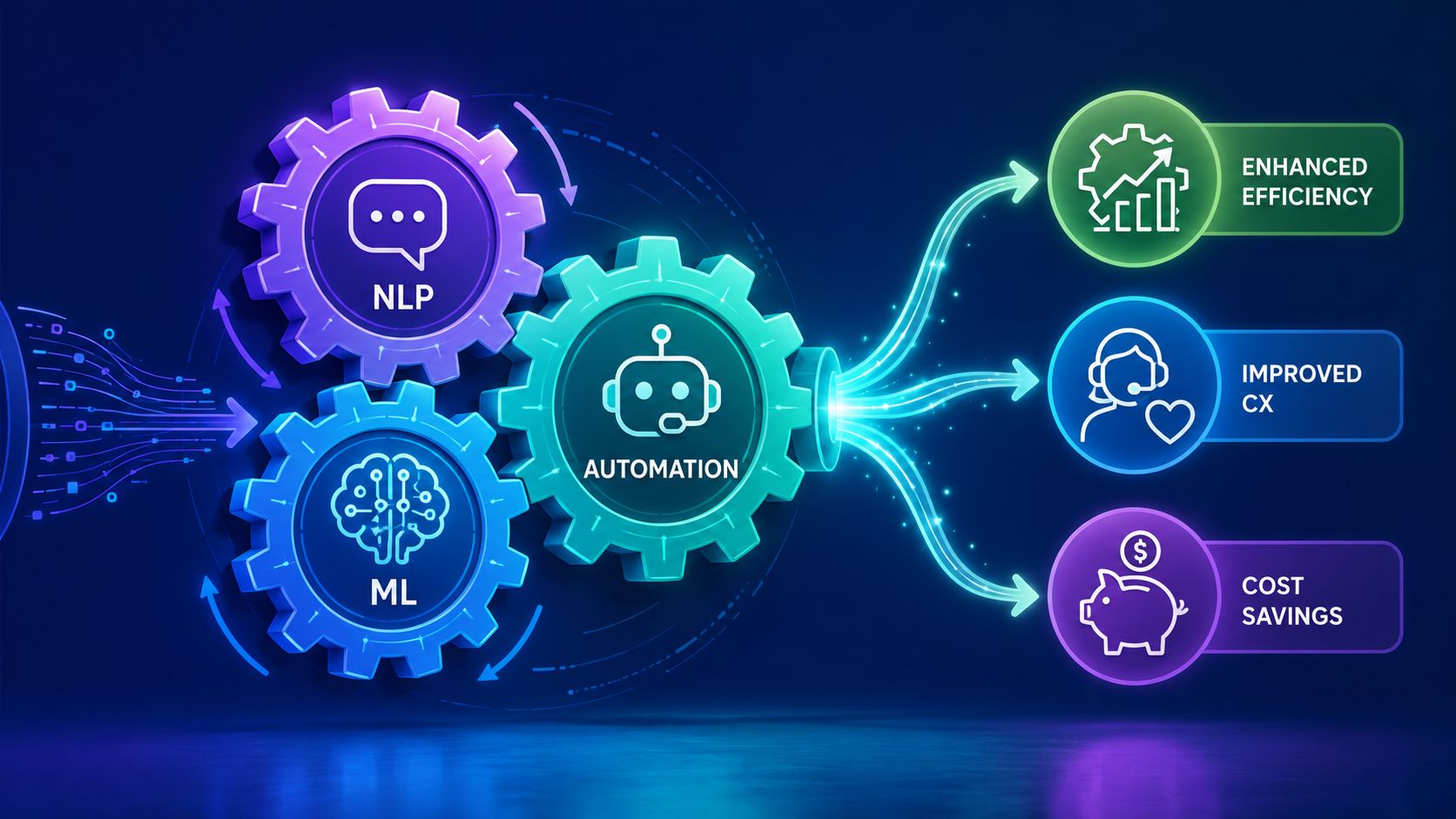
The right way to evaluate the stack is as an operating model with three connected layers: customer self-service, live-agent augmentation, and post-interaction intelligence. This structure reflects how enterprise contact centre AI is typically deployed across leading platforms, and it matters even more in India, where language variation, high call volumes, and compliance pressure expose weak architecture quickly.
Boards should expect all three layers to work together.
If a vendor underperforms in one layer, value leaks out of the other two. Self-service without strong escalation logic increases repeat contacts. Agent assist without usable analytics limits process improvement. Analytics without workflow execution produces reports, not savings.
Five components that matter commercially
Voice AI agents
Voice AI agents handle repetitive inbound and outbound interactions that consume agent time but add little strategic value. That includes appointment booking, balance checks, reminders, lead qualification, payment follow-ups, and routine service requests.
The financial logic is straightforward. Every stable transaction moved to automation reduces avoidable human workload and protects service levels during peak periods. For Indian enterprises managing multilingual demand across sales and service, that matters more than headline feature claims.
Natural language understanding and intent detection
Intent accuracy determines whether the system resolves demand or creates more of it. If the model fails to recognise what the caller wants, especially across English, Hindi, and regional language shifts, containment drops and transfer volumes rise.
Many procurement teams make a poor decision. They overvalue demo fluency and undervalue production accuracy. Test vendors on real call recordings, noisy audio, code-switching, and regulated workflows. Anything less gives you a polished pilot and a weak deployment.
Agent assist tools
Agent assist often produces faster ROI than self-service because it improves the performance of the team you already pay for. During live conversations, it should surface customer history, knowledge prompts, response guidance, and compliance cues without forcing agents to hunt across systems.
That has direct value in sectors such as BFSI, healthcare, education, and telecom, where missed disclosures, inconsistent responses, and long hold times create financial and regulatory risk. If you want a useful primer on how transcript and interaction insights feed these systems, this practical guide to AI conversation analysis is worth reviewing before vendor evaluation.
Integrations and workflow connectivity
AI call centre software without system connectivity becomes another operational silo. It must connect cleanly with CRM, ticketing, telephony, collections systems, policy engines, knowledge bases, and reporting layers. Otherwise, agents still re-enter data, supervisors still lack context, and customers still repeat themselves.
For leadership teams comparing older telephony estates with newer architectures, a useful benchmark is this IVR software model built for automation-first workflows. The difference is not cosmetic. It determines whether automation completes work or just deflects calls into another queue.
Compliance and analytics
Compliance and analytics belong in the buying criteria, not on the implementation checklist. In regulated sectors, every interaction needs auditability, policy control, data handling discipline, and clear escalation rules.
Analytics then convert conversations into management action. Leaders can identify script failures, recurring objections, repeat contact drivers, weak handoffs, and training gaps. That is where AI call centre software shifts from a service tool to a governance and margin improvement tool.
Quantifiable Business Benefits and Strategic Wins
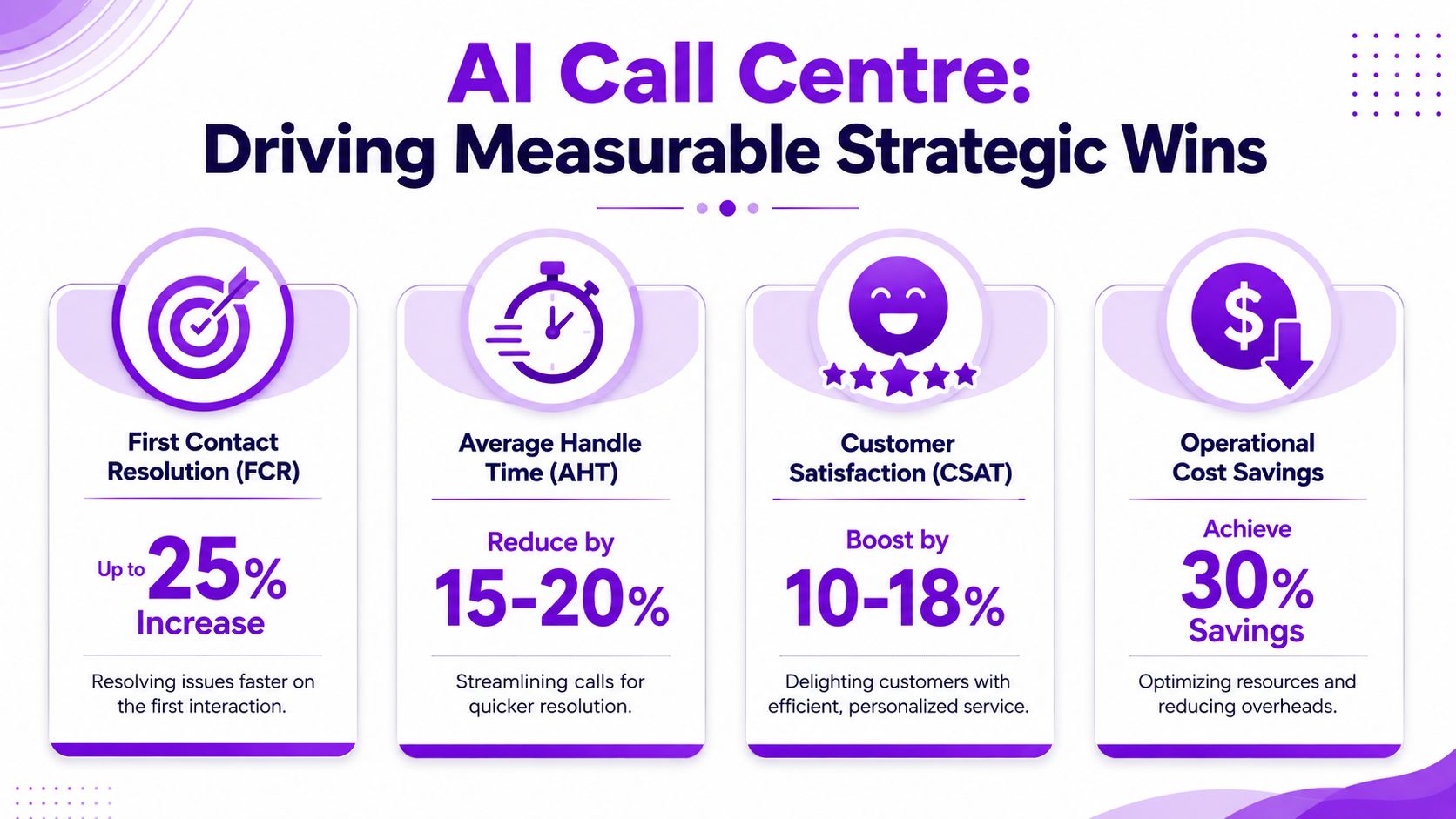
McKinsey reports that AI can reduce customer care costs by up to 30 percent while improving service quality, a combination that changes the economics of the contact centre, not just the tooling stack (McKinsey on the economic potential of generative AI). For Indian enterprises dealing with wage inflation, uneven service quality, and high call volumes, that matters at board level. AI call centre software improves capacity, protects margins, and gives leadership tighter control over execution.
Where the numbers matter
Start with unit economics. If AI helps agents resolve more enquiries per hour and shortens handling time, the business gets immediate operating relief. Queue pressure drops. Overtime falls. The same team can absorb more volume without a matching increase in headcount.
Gartner notes that customer service leaders are using AI to increase agent productivity and improve interaction quality, which is the right lens for evaluating returns (Gartner customer service AI research). A shorter call is only valuable when resolution quality holds or improves. CXOs should track both together.
The bigger gain is predictability. AI standardises triage, surfaces the next best action, and reduces variation between experienced agents and new hires. That consistency improves forecasting, scheduling, and compliance performance.
For teams evaluating the practical shape of these gains, this explainer gives a useful visual walkthrough:
The strategic wins beyond labour efficiency
Labour savings get the budget approved. Strategic impact justifies scaling.
- Higher revenue capture: AI reduces response lag for inbound sales and service requests. In Indian markets where customers compare providers quickly, speed directly affects conversion.
- Lower cost to serve: Repetitive contacts, status checks, reminders, and basic troubleshooting can be automated or shortened, which improves margin on every interaction.
- Stronger compliance control: In BFSI, insurance, healthcare, and telecom, scripted guidance, audit trails, and escalation rules reduce avoidable regulatory exposure.
- Better management decisions: Conversation data shows which call types create repeat demand, where agents lose deals, and which workflows should be redesigned instead of merely staffed harder.
This is why boards should not judge AI call centre software by demo quality or voice naturalness. Judge it by cost per resolution, revenue saved from faster response, compliance risk reduced, and the number of future hires the business no longer needs to add just to maintain service levels.
AI Call Centre Software in Action Across Industries
Generic feature lists don't help a board make a decision. Operating scenarios do. The actual test is whether AI call centre software improves a workflow that already matters to the business.
BFSI and regulated service environments
A BFSI firm usually doesn't need flashy automation. It needs controlled automation.
Consider a support line handling card blocks, onboarding guidance, repayment reminders, and policy questions. AI can identify the caller's intent, provide standardised guidance for low-risk enquiries, and route sensitive cases to trained agents with the right context already attached. That reduces wasted handling time and lowers the chance that customers repeat themselves after transfer.
The bigger win is discipline. In regulated environments, consistency matters as much as speed. AI creates a repeatable front layer for authentication prompts, disclosure steps, and escalation triggers.
Real estate and high-intent lead operations
This is one of the clearest use cases in India. Property teams lose revenue when inbound enquiries sit unanswered or when agents spend too much time on low-intent leads.
An AI voice agent can call new leads, ask qualification questions, identify buying timeline and location interest, answer common project queries, and book a site visit or pass the lead to a human closer. That means sales staff spend more time with serious prospects and less time chasing weak enquiries.
A platform such as DialNexa can be used in this kind of workflow for qualification, follow-ups, and booking-oriented conversations across sectors like real estate, EdTech, and BFSI, using configurable voice AI agents tied into existing operational flows.
The right benchmark in real estate isn't “How many calls were automated?” It's “Did qualified demand reach the sales team faster and in a cleaner state?”
EdTech and counselling workflows
Admissions and counselling teams deal with high repetition. Prospective students ask about programmes, pricing, eligibility, schedule, and next steps. Many of those calls don't need a senior counsellor at the first touch.
AI call centre software can handle first-contact counselling, answer common questions, collect interest details, and schedule a demo or advisor callback. Human counsellors then focus on objection handling, fit assessment, and conversion.
That creates a better use of talent. It also reduces lead leakage outside office hours, which is where many education providers lose momentum.
Your CXO Playbook for Implementation and Vendor Selection
Most AI call centre projects don't fail because the model is weak. They fail because leadership buys software before defining the operating case.
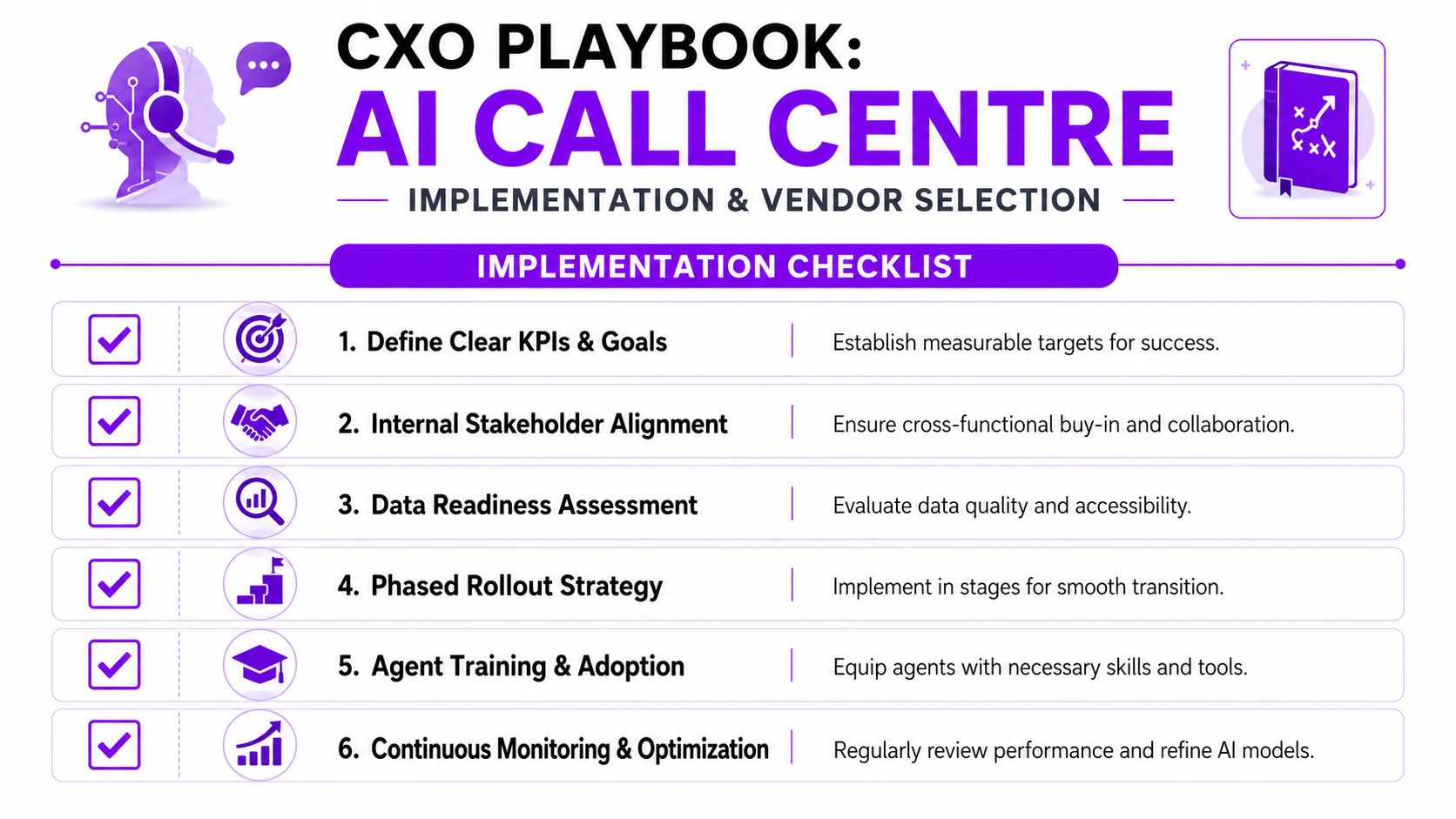
Implementation checklist
Start with a controlled business problem, not a platform rollout.
- Pick one workflow first: Lead qualification, appointment booking, support triage, reminders, or collections are better starting points than a broad “transform the contact centre” mandate.
- Define hard KPIs: Choose the few metrics that matter. Handle time, issues resolved per hour, booked appointments, escalation quality, or complaint rates.
- Map the handoff path: Decide exactly when AI should continue, when it should escalate, and what context must transfer to the human agent.
- Clean the knowledge inputs: If your scripts, FAQs, CRM fields, and process rules are messy, the AI layer will reproduce that mess faster.
- Train managers, not just agents: Supervisors need to know how to review transcripts, interpret analytics, and tune workflows.
- Run a phased rollout: Start with one language, one queue, or one campaign. Expand after you've proven stability.
Vendor questions that separate serious platforms from demos
India-specific risk needs to be part of vendor evaluation. Outbound AI programmes must be designed around consent and compliance because of the TRAI Do Not Disturb regime, as discussed in Convoso's analysis of AI for outbound call centres. If a vendor can't explain how their system handles legitimacy, disclosure, and complaint risk, move on.
Ask harder questions than most procurement teams ask:
- Can the system manage multilingual and accent-heavy calls reliably?
- How does the platform preserve context when escalating to a human?
- What controls exist for consent, recording, disclosure, and data handling?
- How extensively does it integrate with CRM, ticketing, and booking systems?
- Can your team tune scripts, prompts, and workflows without a long services dependency?
If you want a broader market view before shortlisting, this list of SnapDial's AI agent recommendations is useful as a comparison reference, especially for understanding how different vendors approach support automation.
A final point. Don't buy on voice quality alone. Smooth speech impresses in demos. Production value comes from routing logic, compliance controls, integration depth, and handoff quality.
Measuring Success KPIs and Calculating ROI
Too many AI projects are approved with a vague promise and reviewed with vanity metrics. That's poor governance. Boards need a KPI stack tied directly to operational and financial outcomes.
The KPI stack that boards should review
In Indian deployments, one metric deserves more attention than it gets. A key challenge is escalation quality in accent-heavy and multilingual conversations, so handoff success rate should be tracked alongside call deflection, as highlighted in NICE's guide to revamping customer service with the AI call centre. If AI hands off badly, the customer experience degrades even when automation rates look good.
Use three KPI groups:
- Operational efficiency: Average handling time, issues resolved per hour, queue load, automation rate, and handoff success rate.
- Financial impact: Cost per handled interaction, qualified lead output, booking yield from AI-handled conversations, and avoided staffing pressure.
- Customer experience: Repeat contact rate, complaint patterns, escalation satisfaction, and agent experience after AI assist is introduced.
If your operations team needs a sharper measurement baseline, align these metrics with a structured contact centre KPI framework.
A simple ROI model
Keep the model boring and disciplined. That's how boards trust it.
| Metric | Before AI (Annual) | After AI (Annual) | Impact |
|---|---|---|---|
| Average handling time | Baseline from current reports | Measured after deployment | Shows time savings from automation and agent assist |
| Issues resolved per hour | Current team output | AI-supported output | Shows throughput increase |
| Escalation rework | Current repeat handling volume | Reduced repeat handling | Captures handoff quality improvement |
| Lead qualification workload | Manual team capacity | AI-assisted capacity | Shows redeployment of human effort |
| Cost per interaction | Current blended cost | New blended cost | Quantifies operational leverage |
| Revenue from qualified conversions | Current conversion value | Post-AI conversion value | Captures growth impact where AI supports sales workflows |
Practical rule: Don't build ROI on automation volume alone. Build it on labour redeployment, faster resolution, cleaner handoffs, and conversion outcomes that finance can actually verify.
The strongest business cases usually start small, prove one workflow, then scale. That gives the CFO confidence, gives operations a cleaner implementation path, and gives the board evidence instead of enthusiasm.
DialNexa Labs Private Limited helps organisations deploy voice AI agents for qualification, customer support, recruitment, presales, follow-ups, and booking workflows across sectors such as EdTech, BFSI, real estate, healthcare, e-commerce, and software. If your team is evaluating how to turn high-volume calling into a more measurable, scalable operating model, explore DialNexa Labs Private Limited and assess whether its workflow fit, integration depth, and deployment model align with your business case.

[…] and fallback paths more dynamically. Teams exploring this operating model often also review AI call centre software to understand how routing, automation, and agent-assist functions fit […]
Excellent insights on how AI call centre software is evolving from a support tool into a core business infrastructure for growth, efficiency, and governance. The strong focus on measurable ROI, multilingual realities, and industry-specific implementation makes this a highly valuable read for CXOs and decision-makers.