
Mastering BPO in Insurance: a CXO’s 2026 Guide
Insurance BPO is expanding because insurers need more than lower cost. Technavio projects the market will increase by USD 1.63 billion at a CAGR of 4.3% from 2025 to 2030, and notes that the life and pension segment was valued at USD 4.02 billion in 2024 (Technavio insurance BPO market analysis). That growth matters to insurance leaders because it signals a structural shift. Carriers are buying operational flexibility, process discipline, and technology capability, not just extra hands.
In India, that shift is even more consequential. The country's broader BPO services market reached about USD 7.5 billion on a five-year historical analysis, reflecting sustained demand for outsourced back-office operations across functions such as claims processing, policy administration, customer service, underwriting support, compliance, finance, and document management (Ken Research on the BPO services market and insurance operations). For a CXO, the implication is clear. BPO in insurance now sits at the intersection of growth, governance, and digital execution.
Table of Contents
- The Strategic Shift in Insurance Operations
- Unpacking BPO What Insurance Functions to Outsource
- The CXO's Decision Matrix Weighing BPO Benefits and Risks
- The New Technology Stack AI and Automation in Insurance BPO
- Performance and Pricing KPIs and Cost Models That Work
- Mastering Compliance in a Regulated BPO Environment
- Your Implementation Roadmap Vendor Selection and Governance
The Strategic Shift in Insurance Operations
Insurance leaders used to treat outsourcing as a procurement decision. That lens is too narrow now. In most carriers, the main pressure comes from operating complexity: service queues expand suddenly, compliance obligations keep tightening, and customer expectations for speed don't pause while teams retrain or systems migrate.
That's why bpo in insurance has moved from back-office relief to strategic infrastructure. A capable partner can help an insurer scale execution without scaling management layers at the same pace. It can also create a controlled bridge between legacy processes and newer operating models, especially when the carrier is trying to modernise service delivery without destabilising core systems.
A simple example makes the shift tangible. A life insurer launching a new servicing workflow doesn't only need lower-cost transaction handling. It needs script discipline, escalation logic, turnaround commitments, audit evidence, and the ability to absorb volume spikes. That is closer to managed operations than old-style outsourcing.
Executive view: The strongest BPO relationships don't replace operating leadership. They extend it into high-volume workflows with clearer controls.
India is well placed for this model because it combines process-delivery depth with an established services ecosystem. For executives reviewing service strategy, this is why contact-centre outsourcing deserves to be assessed alongside workflow redesign and platform adoption, not after them. A useful reference point is how providers structure broader contact centre BPO operations around standardised execution, workforce flexibility, and measurable service management.
The strategic question isn't “should we outsource admin work?” It's “which operating capabilities should we own directly, and which can a specialist run better under our supervision?”
Unpacking BPO What Insurance Functions to Outsource
Insurers create the most value from BPO when they outsource process steps, not whole departments. The practical screening test is straightforward. A function is a strong candidate when it is rules-led, document-heavy, sensitive to volume spikes, and auditable through defined service levels. Industry overviews such as Cognizant's analysis of insurance BPO services consistently point to the same operational clusters: policy administration, claims support, customer service, and underwriting support.
The executive mistake is to ask which team to outsource. The better question is which activities can be run to a tighter standard by a specialist partner without weakening regulatory control, product discipline, or customer trust.
Policy administration is usually the lowest-risk entry point
Policy administration tends to offer the cleanest first move because the work is repetitive, highly procedural, and easier to measure than judgement-heavy activities. Typical candidates include new business data entry, endorsements, renewals, cancellations, document indexing, billing support, and routine servicing requests.
The strategic gain is not only lower delivery cost. It is operating consistency. If branches or product lines handle the same servicing task in different ways, the insurer absorbs hidden losses through rework, delayed issuance, avoidable complaints, and weak audit trails. A managed BPO model can centralise those workflows into one queue with common scripts, standard hand-offs, and explicit turnaround targets.
That matters in India, where product mix, regional language requirements, and regulator-driven documentation standards can make routine servicing more complex than it appears.
Claims should be separated into transactional and judgement layers
Claims operations often produce the strongest BPO case, but only after the workflow is broken into distinct control zones. Carriers that outsource claims as one block usually create avoidable risk. Carriers that separate intake, follow-up, and adjudication tend to get better throughput without giving away decision authority.
A workable split looks like this:
- Intake and triage: First notice of loss, document capture, identity checks, and routing. These activities reward speed, script adherence, and queue discipline.
- Workflow support: Status updates, missing-document follow-up, reserve documentation preparation, and settlement coordination. These tasks benefit from standard operating procedures and clear escalation rules.
- Adjudication and exceptions: Coverage interpretation, fraud-sensitive review, high-severity claims, and disputed settlements. These activities usually belong under tighter insurer control.
This distinction has direct operating consequences. If the partner owns document collection and progress tracking, internal claims experts can spend more time on liability decisions, fraud review, and reserve quality. For teams assessing process boundaries, the settlement of claims in insurance process is a useful reference because each stage carries a different control requirement.
Outsource standardised execution. Retain judgement, risk authority, and accountability.
Customer service needs segmentation, not blanket outsourcing
Customer engagement is often misclassified as a single function. It is closer to a portfolio of interaction types with very different risk profiles.
Routine contacts such as policy status queries, premium reminders, address changes, and standard renewal follow-up are usually well suited to BPO delivery. Assisted interactions such as FNOL intake, renewal guidance, and document collection can also work well if scripts, QA scoring, and escalation logic are mature. Sensitive interactions require a narrower approach. Complaints, grievance handling, vulnerable customers, and disputed claims expose the insurer to conduct risk and should sit either in-house or in a tightly controlled hybrid model.
| Bucket | Examples | Typical outsourcing fit |
|---|---|---|
| Routine service | Policy status, premium reminders, basic support | High |
| Assisted transactions | FNOL intake, renewal guidance, document collection | Moderate to high with controls |
| Sensitive interactions | Grievances, disputed claims, vulnerable customers | Selective |
The non-obvious issue is regulatory exposure. A low-cost customer service model can become expensive if poor call handling increases complaint ratios, ombudsman escalations, or remediation work.
Underwriting support can move. Underwriting authority usually should not
Underwriting support tasks often fit BPO well because they involve structured information gathering rather than final risk selection. Application review support, file preparation, data validation, medical or financial document indexing, and pre-underwriting checks are common examples.
Final underwriting judgement is different. It defines portfolio quality, pricing discipline, and risk appetite. Unless the insurer has mature governance, strong QA controls, and well-bounded authority matrices, that decision layer should remain with the carrier.
For CXOs, the operating principle is simple. Outsource where process variance is the main problem. Keep direct control where risk judgement, customer fairness, or regulatory accountability drive the outcome.
The CXO's Decision Matrix Weighing BPO Benefits and Risks
The global insurance BPO market was valued at $7.9 billion in 2022 and is projected to reach $24.6 billion by 2032, driven by insurers outsourcing non-core functions to gain scalability and maintain service-level agreements for turnaround time and accuracy (Allied Market Research on insurance BPO growth and SLAs). That scale tells you the model is established. It does not tell you whether the model is safe for your operating environment.
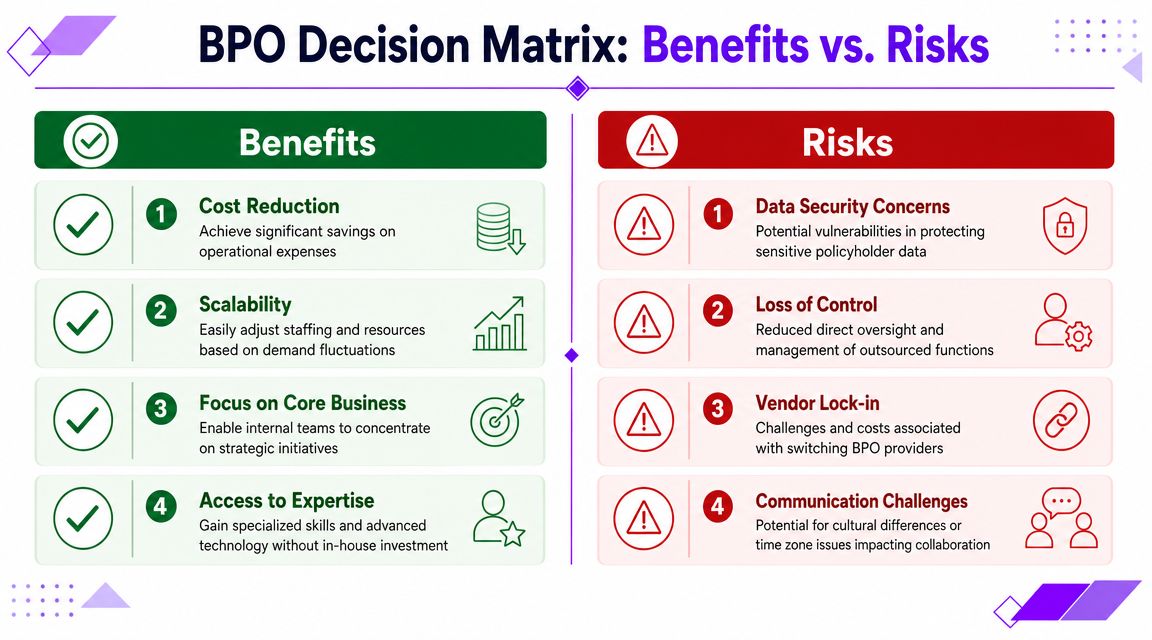
That decision needs a gain-versus-guard lens. The gain side is agility, throughput, and specialist capability. The guard side is control, compliance, and quality drift.
Where BPO creates executive value
The first advantage is scalability. Insurance volumes don't arrive evenly. Renewals, catastrophe events, new product pushes, and service backlogs all create uneven demand. A BPO model lets operations leaders add capacity faster than traditional hiring cycles allow.
The second is process discipline. Internal teams often carry historic workarounds that never made it into standard operating procedure. A specialist partner usually won't accept that ambiguity. It will force workflow definition, exception coding, and service-level ownership. That sounds administrative, but it often surfaces hidden friction inside the carrier.
Third is technology access. Many insurers don't want to rebuild every workflow in-house. A BPO partner with managed platforms, structured QA, workflow tools, and integration experience can compress the path to operational modernisation.
Where the risk actually sits
Most executive concerns are valid, but they are often misdiagnosed.
- Data risk isn't just about breach exposure. It also includes over-collection, poor access design, and weak audit trails.
- Customer experience risk isn't just about script quality. It appears when the carrier and vendor define ownership differently during exceptions.
- Commercial risk isn't just about price creep. It surfaces when the insurer buys FTEs instead of outcomes and then has to manage activity rather than performance.
- Vendor dependence isn't just lock-in. It becomes a problem when process knowledge migrates out of the insurer without governance discipline.
Board-level question: If the vendor misses an SLA, who detects it first, who owns remediation, and what evidence exists?
A practical decision matrix often looks like this:
| Dimension | Gain if outsourced well | Guardrail needed |
|---|---|---|
| Throughput | Faster handling of repetitive work | Exception ownership defined |
| Flexibility | Capacity during peaks | Clear ramp-up and ramp-down governance |
| Quality | Standardised QA and fewer manual gaps | Joint review of error causes |
| Compliance | Better documentation and auditability | Access controls and audit rights |
| Cost structure | More variable operating model | Transparent pricing and change control |
The strongest BPO programmes are rarely the cheapest. They are the easiest to govern.
The New Technology Stack AI and Automation in Insurance BPO
Modern insurance BPO providers increasingly use cloud-based delivery, AI-enabled tools, analytics, and structured QA to manage end-to-end processes and reduce manual rework across claims intake, policy servicing, and customer support while aligning with insurer SOPs and regulatory needs (Covenir on cloud and AI-enabled insurance BPO).

That line changes the executive conversation. The unit of value is no longer only labour capacity. It is process architecture. A provider that combines workflow expertise with automation can absorb operational friction before it becomes service failure.
Why the operating model has changed
Older BPO models lifted work from the insurer and reproduced it elsewhere. Newer models redesign the work itself. Cloud delivery centralises execution. QA frameworks reduce variation. Automation handles repetitive classification, document handling, and rule-triggered actions. Human agents deal with ambiguity, judgement, and emotional conversations.
Consider claims intake. In a manual model, a policyholder calls, an agent records details, another team rekeys the information, someone verifies documents later, and the claim enters a queue with inconsistent notes. In a redesigned model, the workflow captures the same information in a structured way at first contact, routes it correctly, and logs evidence for audit.
Document-heavy operations particularly benefit from this approach. For insurers looking at form ingestion, supporting tools such as an automated data extraction solution can help convert unstructured claim and policy documents into usable workflow data before human review.
A practical Voice AI use case in claims intake
Voice AI is where many executives now see the next leap in bpo in insurance. The value is not that a machine answers the phone. The value is that the initial interaction becomes structured, available at scale, and easier to govern.
Take a straightforward FNOL scenario. A policyholder calls after a minor motor incident. A voice agent can collect core details, confirm policy identifiers, capture the incident summary, explain next steps, and route the case. A human claims specialist then handles exceptions, emotional escalation, or coverage-sensitive judgement.
That hybrid design matters in India because many customer interactions are still voice-led and operational peaks are hard to staff perfectly. It also creates a safer adoption path. Carriers can automate the stable part of the conversation while keeping human control over complex outcomes.
This short video gives context on how AI-led call handling is changing operational workflows:
How to decide what to automate first
Not every insurance conversation belongs in an automated journey. CXOs should sort workflows by conversational complexity, regulatory sensitivity, and customer emotion.
A strong first wave often includes:
- Status and reminder calls: Renewals, payment follow-up, document nudges, and appointment confirmation.
- Structured intake: FNOL, lead qualification for policy servicing, and standard information capture.
- Simple service queries: Branch details, policy status, and process guidance.
A weaker first wave includes grievance conversations, complex complaints, bereavement-sensitive servicing, and disputed claims.
Automate the conversation where the insurer wants consistency. Keep humans in the conversation where the insurer needs judgement.
That distinction is what turns AI from a cost experiment into an operating asset.
Performance and Pricing KPIs and Cost Models That Work
Most insurance outsourcing contracts fail in measurement before they fail in delivery. The vendor reports activity. The insurer wants outcomes. Those aren't the same thing.
A CXO needs KPI design that follows the policyholder journey and the control environment, not just the contract. If the outsourced team closes tickets quickly but creates rework for underwriting, claims, or grievance staff, apparent efficiency is hiding operational waste.
Measure the workflow not just the vendor
Start with four questions. Is the work being completed on time? Is it right the first time? Does it reduce burden on internal teams? Does the customer experience stay intact?
A practical KPI table helps frame that discussion:
Sample KPIs for Insurance BPO
| Function | KPI | Industry Benchmark | Strategic Goal |
|---|---|---|---|
| Claims intake | Turnaround time | Define internally by product and claim type | Faster registration without missed data |
| Policy administration | Accuracy of policy updates | Define internally from current error baseline | Reduce downstream corrections |
| Customer support | First contact resolution | Define internally by query category | Fewer repeat contacts |
| Renewals | Completion within service window | Define internally by product line | Improve retention workflow discipline |
| Underwriting support | File completeness at handoff | Define internally by underwriting SOP | Cut underwriter rework |
| Complaints support | Escalation adherence | Define internally from compliance requirements | Protect grievance handling quality |
Because reliable public benchmarks vary by insurer mix, product design, and operating model, most executives are better served by an internal-baseline approach. Measure current performance first. Then contract for improvement against that baseline, with definitions locked before transition.
A useful scorecard combines three layers:
- Operational KPIs: turnaround time, backlog ageing, queue adherence
- Quality KPIs: accuracy, rework rate, audit exceptions
- Business KPIs: retention support, complaint containment, productivity released to core teams
Pick a pricing model that matches process maturity
Commercial design should reflect process maturity.
If the process is unstable, an FTE-based model can be sensible at the beginning. It gives the insurer time to stabilise workflow, clean SOPs, and understand demand. But FTE models can reward staffing rather than improvement, so they shouldn't remain the default forever.
If the process is well defined, per-transaction pricing usually creates better discipline. Cost per policy update, cost per claim intake, or cost per renewal interaction are easier to manage when work is standardised.
If the insurer has strong baseline data and mature governance, outcome-linked pricing can align incentives more tightly. This only works when outcomes are clearly measurable and not distorted by upstream policy or product changes.
The wrong pricing model makes the insurer manage people. The right model makes both sides manage process performance.
A strong commercial agreement also defines change requests, exception handling, reporting cadence, and remediation rights. Without those, even a sensible price will become expensive.
Mastering Compliance in a Regulated BPO Environment
In insurance, outsourcing doesn't transfer regulatory accountability. It transfers execution under supervision. That distinction matters most in India, where insurers must think carefully about customer consent, call-centre controls, grievance handling, sensitive personal data, and KYC-related interactions.
A key concern for insurers is outsourcing without increasing regulatory risk. Vendors handling sensitive data and customer grievances must remain supervised, auditable, and compliant with India-specific BFSI governance, especially in call-centre and KYC-related processes (SelectSys on regulatory risk in insurance BPO).
The insurer keeps the accountability
Executives sometimes ask which functions are safe to outsource. The better question is which control obligations must remain unmistakably owned by the carrier. Complaint escalation ownership, consent management, access rights, script approvals, audit evidence, and breach response decision-making should never become ambiguous.
For example, if a partner manages renewal calls, the insurer still needs to know:
- What data the agent can access
- What disclosures must be delivered
- When a call becomes a grievance or complaint
- How that interaction is recorded and reviewed
- Which manager inside the insurer signs off remediation
This is why compliance should be built into workflow design, not checked after go-live. Carriers that leave those decisions to vendor operations teams create avoidable risk.
What an auditable BPO model looks like
An auditable model is usually easy to describe and hard to improvise. It needs documented SOPs, role-based access, call recording rules, exception logs, scripted disclosures where needed, and review rights for the insurer.
A practical compliance checklist for bpo in insurance includes:
- Data minimisation: Give the vendor only the information required for the task.
- Segregation of duties: Separate routine handling from sensitive approvals.
- Escalation mapping: Define complaint, KYC, and vulnerability triggers clearly.
- Evidence retention: Keep records that support internal review and regulator response.
- Periodic audits: Review the actual process, not just policy documents.
For leaders managing offshore or multi-country delivery, broader regional privacy comparisons can sharpen due diligence. Teams assessing cross-border controls may find this guide to understanding Philippine data privacy useful when comparing vendor governance assumptions across jurisdictions.
There is also a conduct-risk angle. Customer-facing outsourced teams can create exposure through poor explanations, pressured renewals, or unclear representations. That is why compliance and training leaders should stay close to scripts, QA, and escalation thresholds, especially in areas adjacent to mis-selling in financial services.
Compliance is not the tax you pay for outsourcing. It is the mechanism that makes outsourcing defensible.
Insurers that master this gain more than safety. They gain a repeatable model for growth.
Your Implementation Roadmap Vendor Selection and Governance
The easiest way to damage a BPO programme is to treat it as a vendor switch. A durable programme works more like an operating-model transformation with external execution built in.
That means selection, pilot design, transition, and governance should all answer the same question: can this partner run the process predictably under our standards, and can we prove it?
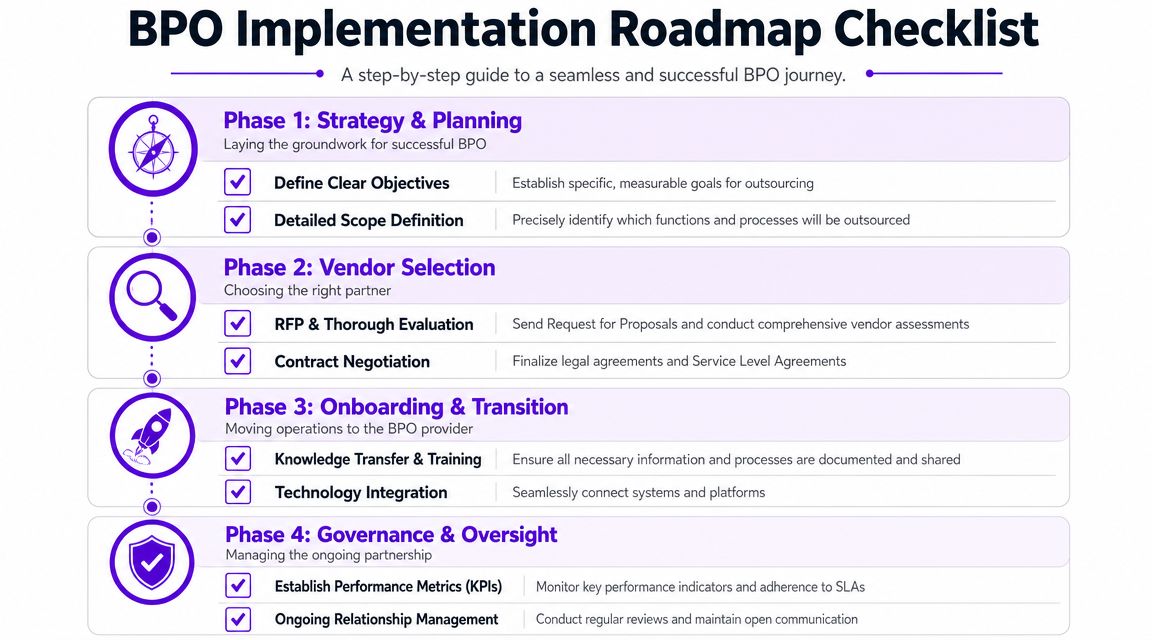
Phase one and two strategy before procurement
Start with scope discipline. Define the exact workflows, systems touched, decision rights, service windows, exception types, and compliance obligations. If the insurer cannot describe the process clearly, the vendor cannot execute it consistently.
Then run due diligence on four dimensions:
Insurance process depth
Ask for operating detail, not branding. How do they manage renewals, FNOL, policy updates, and complaint routing?Technology fit
Review workflow tooling, QA design, reporting structure, and integration approach.Control maturity
Test access controls, audit readiness, recording practices, and escalation documentation.Operating resilience
Examine continuity planning, staffing flexibility, and management cadence.
The pilot should be narrow but meaningful. Choose a process with enough volume to show patterns and enough standardisation to isolate issues. Policy servicing or claims intake often works better than highly judgmental workflows.
Phase three and four transition with control
Transition is where many insurers underestimate the work. Knowledge transfer isn't just training slides. It includes live exception handling, system access validation, script review, QA calibration, and dispute-resolution design.
A sound transition plan usually includes:
- Parallel run periods: Internal and vendor teams process the same work for comparison.
- Calibration sessions: Quality, compliance, and operations teams review the same cases together.
- Escalation drills: Managers rehearse complaint, outage, and exception scenarios before scale-up.
- Control sign-offs: Access, script, workflow, and reporting approvals are completed before volume expands.
Once live, governance should not be left to monthly SLA meetings. Mature insurers create a joint operating structure with weekly operational reviews, periodic compliance checks, root-cause analysis for defects, and executive steering oversight for larger programmes.
Run the partnership through governance rhythms, not goodwill.
The long-term test is simple. If the vendor relationship helps the insurer launch faster, absorb volatility, and maintain cleaner controls, the programme is working. If it only moves tasks off payroll, it is underperforming.
If you're rethinking bpo in insurance through the lens of service agility, AI adoption, and governed customer conversations, DialNexa Labs Private Limited is worth evaluating. DialNexa builds human-like Voice AI agents for customer support, qualification, recruitment, and presales, which makes it especially relevant for insurers exploring structured FNOL intake, policyholder support, and other high-volume voice workflows without adding unnecessary operational drag.

This is a well-structured and insightful analysis that reframes insurance BPO as a strategic operating model rather than a cost-cutting exercise. The focus on governance, AI-driven workflows, and balancing automation with human judgment makes it highly valuable for insurance leaders.