

Sales Quota Definition: A Strategic Guide for C-Suite Leaders
What Is a Sales Quota and Why It Matters to Leaders
Let's cut through the jargon. At its core, a sales quota is a time-bound performance target given to a sales rep, a team, or even an entire region. It’s the specific goal they need to hit, usually within a month, quarter, or year.
But for a senior leader, a quota is far more than a number on a spreadsheet. It’s the very engine of your revenue strategy. Think of your annual business plan as the destination on a map; the sales quota provides the turn-by-turn directions for your team, guiding their daily efforts to ensure you arrive on schedule.
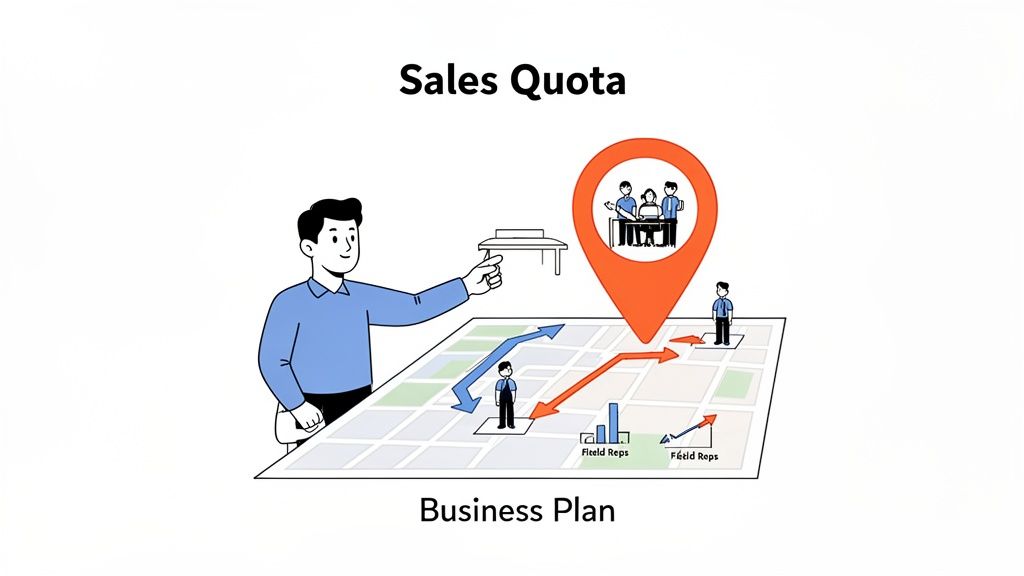
For any C-suite executive or sales director, a well-crafted quota is one of the most powerful levers for growth. It’s how you translate ambitious, high-level objectives from the boardroom into concrete, measurable tasks for your frontline sellers. This alignment is mission-critical—it ensures the entire organization is pulling in the same direction toward a unified financial goal.
From a leadership perspective, a healthy sales organization sees 60-70% of its team consistently hitting or exceeding quota. If your attainment rate is significantly lower—say, below 40%—your targets are likely too aggressive, risking burnout and high attrition among top talent. Conversely, if 90-100% of reps are crushing their number, your goals are too conservative, and you're leaving significant revenue on the table.
To provide a strategic overview, here are the fundamental components of a sales quota and their importance from a leadership viewpoint.
At a Glance: Sales Quota Fundamentals
| Component | Strategic Purpose for Leadership |
|---|---|
| Performance Target | Translates high-level revenue goals into clear, individual expectations. |
| Timeframe (e.g., Monthly) | Creates urgency and provides regular checkpoints for performance tracking and forecasting accuracy. |
| Assigned Unit (Rep/Team) | Establishes direct accountability and clarifies ownership of results across the organization. |
| Measurement (e.g., Revenue) | Defines what "success" looks like and aligns frontline actions with strategic business priorities like market share or profitability. |
Ultimately, a strong quota framework isn't just about managing people; it's about managing the predictability and health of your business.
Turning Strategy Into Predictable Outcomes
Effective quota setting is what elevates revenue forecasting from hopeful guesswork to a data-backed science. By setting clear, realistic targets, you can more accurately predict financial results, stress-test your market assumptions, and make smarter capital allocation decisions.
It provides the data needed to answer critical business questions:
- Do we have sufficient headcount to achieve our annual revenue commitment to the board?
- Which territories are outperforming and which are falling behind their potential, indicating a need for resource reallocation?
- Where should we focus our sales enablement and coaching investments for the highest ROI?
This strategic alignment is a cornerstone of modern sales operations, which serves as the backbone of any high-functioning sales organization. When managed correctly, quotas foster accountability, ignite motivation, and build a predictable engine for growth that rallies the entire company.
Choosing the Right Quota Type for Your Business
As a sales leader, selecting the right type of quota is a critical strategic decision. The wrong choice incentivizes the wrong behaviors and can misalign your sales team with your company's core objectives. For C-suite executives, this isn’t just operational management; it’s a direct lever to steer corporate culture and financial outcomes.
The key is to choose a quota that encourages the precise sales activities needed to win in your market. This ensures your definition of success for the sales team directly contributes to the company's strategic goals.
Revenue Quotas: The Gold Standard for Value
The Revenue Quota is the most prevalent model for good reason: it directly links a rep’s activities to the company's top-line revenue goals. The directive is simple and powerful: a salesperson must generate a specific amount of revenue, for instance, ₹50 lakh in new business per quarter.
This model is ideal for:
- SaaS and High-Value B2B: In markets where deal sizes are substantial (e.g., an average contract value of ₹20 lakh), a revenue quota incentivizes reps to pursue large, strategic contracts.
- Experienced Sales Teams: It empowers seasoned reps to manage complex sales cycles and negotiate effectively without micromanagement, focusing them on the ultimate financial outcome.
Practical Example: An enterprise software company aiming for 30% year-over-year growth might set a quarterly revenue quota of ₹75 lakh for each senior account executive. This naturally guides them toward high-potential enterprise accounts rather than smaller, transactional deals, perfectly aligning their efforts with the company’s expansion strategy.
Volume Quotas: Driving Market Penetration
When the strategic priority is rapid market share acquisition, a Volume Quota is a more effective tool. This model shifts the focus from monetary value to the quantity of units sold, new accounts acquired, or deals closed.
This approach is a strategic linchpin for new product launches or competitive blitzscaling. For example, a fintech company launching a new payment gateway might task its sales team with onboarding 1,000 new merchants in the first six months. The immediate goal is not maximizing profit per merchant but achieving market dominance and building a critical mass of users.
This quota type excels in high-velocity sales environments with standardized pricing and short sales cycles. It motivates reps to pursue every lead, building a broad customer base for future upselling and cross-selling initiatives.
Activity Quotas: Building a Predictable Pipeline
Activity Quotas shift the focus from outcomes (closed deals) to the input metrics that drive them. Targets are set for actions like qualified calls made, product demos delivered, or C-level meetings scheduled. This is an invaluable tool for building a predictable sales pipeline and for coaching reps on process.
Practical Example: An EdTech B2B company might find that a rep needs to conduct 15 product demos to close one deal. To hit a target of four deals per month, the manager can set a monthly activity quota of 60 demos. This ensures the top of the funnel remains full, making long-term revenue more predictable and providing clear, coachable metrics for reps, especially new hires.
Profit Quotas: Protecting Your Bottom Line
For businesses in competitive, price-sensitive markets, the Profit Quota is a powerful safeguard. This model requires reps to generate a specific amount of gross profit or maintain a certain margin on their sales, discouraging deep, margin-eroding discounts.
Practical Example: A manufacturing firm facing pressure from lower-cost competitors might implement a profit quota requiring a minimum 25% gross margin on all deals. This forces the sales team to sell on value, not price, directly protecting the company's profitability and aligning sales incentives with the CFO's objectives.
Top-Down Versus Bottom-Up Quota Setting Strategies
Every sales leader must navigate the two primary methodologies for setting sales quotas. This choice is not merely procedural; it’s a strategic decision that directly impacts team morale, forecast accuracy, and the probability of achieving corporate financial targets.
The top-down quota setting approach begins in the boardroom. Leadership establishes a high-level revenue target—for example, a non-negotiable goal of ₹100 crore in annual recurring revenue (ARR) to meet investor expectations. This corporate number is then cascaded down through the organization, from regions to teams, until it becomes an individual rep's quota.
From a leadership standpoint, the appeal is clear: it creates a direct, unbroken line from the company's financial commitments to individual accountability. You can be certain that every target is mathematically aligned with the overarching plan.
The Bottom-Up Reality Check
Conversely, the bottom-up quota setting method starts with on-the-ground reality. Instead of beginning with a corporate mandate, you build a forecast based on the historical capacity and potential of your sales team.
You analyze empirical data: What is a rep's average deal size (₹5 lakh)? What is their typical sales cycle length (90 days)? What is their historical close rate from qualified opportunity (20%)? By aggregating these individual capacities across the entire team and factoring in territory potential, you construct a forecast from the ground up. The result is a quota that the sales team perceives as credible and attainable—a crucial driver for morale and motivation.
As a leader, your challenge is to balance ambition with reality. A top-down goal of ₹12 crore for a team that has historically produced ₹8 crore and shows no change in market conditions will likely lead to burnout and turnover, not a breakthrough. The bottom-up data provides that critical reality check.
Finding the Hybrid Sweet Spot
So, which path is superior? In practice, the most effective organizations don't choose one over the other. They employ a hybrid model that blends the ambition of top-down goals with the pragmatism of bottom-up data.
Start with the board-mandated target, but then pressure-test it against your bottom-up analysis. If top-down demands a 25% growth target but bottom-up capacity only supports 15%, the 10% gap becomes a strategic problem to solve. Can you bridge it with better lead generation, new technology, or targeted hiring? This creates a healthy tension—a stretch goal that pushes the team but isn't viewed as impossible.
This blended methodology transforms quota setting from a top-down directive into a strategic dialogue, ensuring your sales process flowchart aligns with both financial commitments and on-the-ground realities.
A Practical Formula for Setting Achievable Sales Quotas
High-level strategy is essential, but as a leader, you need a repeatable, data-driven formula to move from theory to practice. Setting quotas shouldn't be an exercise in guesswork; it’s about leveraging historical data to construct a plan that is both ambitious and grounded in operational reality.
The most effective method involves working backward from your revenue goal while respecting your team's proven capacity. This creates targets that represent a genuine stretch, not a source of demotivation. This is achieved by reconciling the top-down and bottom-up approaches.
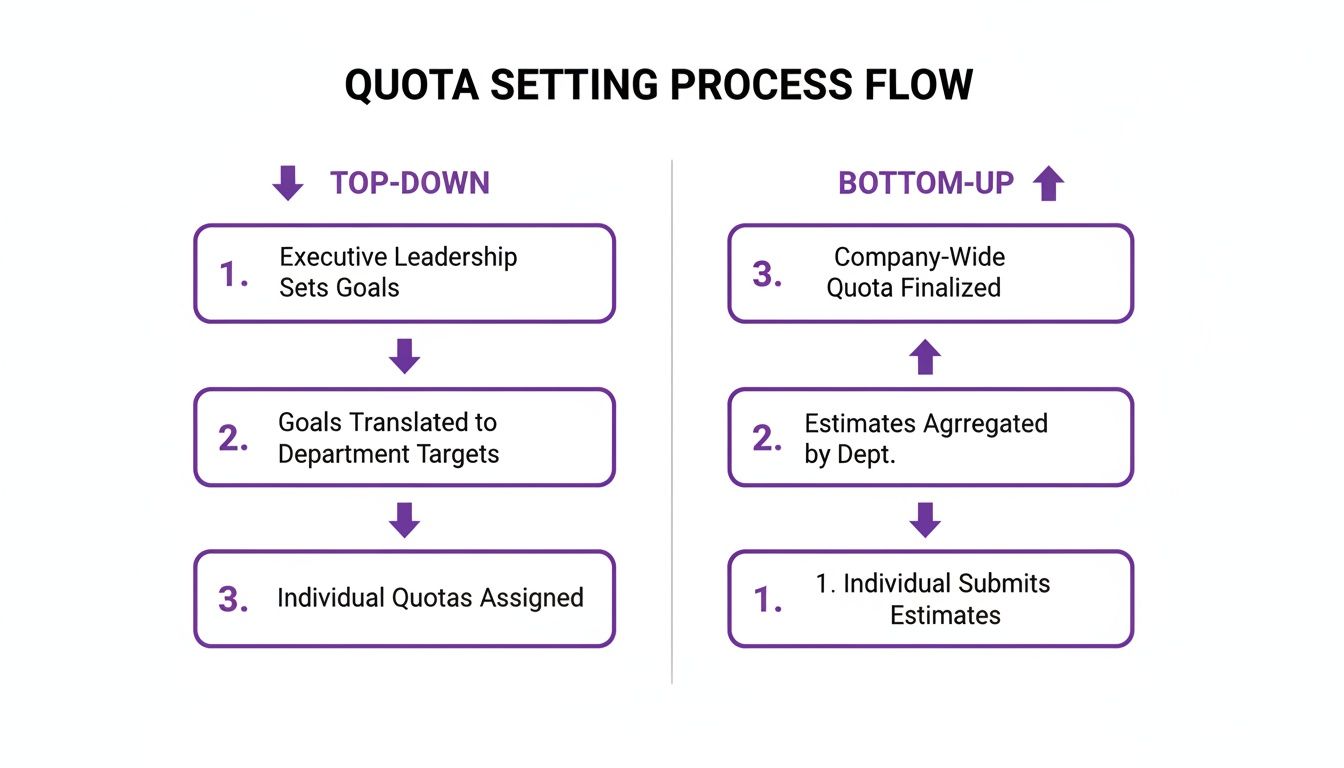
The top-down goals from leadership provide the destination, while the bottom-up data from your sales floor maps the viable routes. A successful journey requires both.
The Foundational Quota Formula
So, what does a basic calculation look like? It’s simpler than you might think.
(Total Revenue Goal / Number of Reps / Average Historical Attainment Rate) = Individual Sales Quota
Let's say your company’s annual target is ₹10 crore, and you have 10 fully-ramped reps. A common mistake is to simply divide the total and assign a ₹1 crore quota to each. This ignores a crucial data point: historical attainment. If your team historically achieves 80% of its quota, you must build this into your model.
Here is the correct calculation: (₹10,00,00,000 / 10 Reps) / 0.80 = ₹1,25,00,000 per rep. This adjusted target, often called an "over-assignment" or "buffer," builds a realistic cushion into your plan, acknowledging that 100% attainment from every rep is an unlikely scenario. This makes it far more probable that the company as a whole will hit its number.
A Real-World Example from the Indian SaaS Market
Let's apply this using sales funnel metrics. In the competitive Indian SaaS market, companies serving sectors like EdTech and BFSI depend heavily on historical conversion data for accurate planning.
Consider these common benchmarks: an MQL-to-SQL conversion rate of 40%, an SQL-to-win rate of 25%, and an average Annual Contract Value (ACV) of $4,000. If a team of two reps receives 100 MQLs each per month, the funnel math is as follows: each rep generates 40 SQLs, which should result in 10 closed deals. This brings in $40,000 in new ARR per rep, setting a logical monthly ARR quota of $40,000.
Adjusting for Ramp Time and Tenure
A critical error in quota setting is assigning a uniform target to all reps, regardless of experience. A senior rep with a robust network cannot have the same quota as a new hire learning the product and market.
A structured ramp-up period is essential. Here is a proven model for a new Account Executive whose full quarterly quota will eventually be ₹30 lakh:
- Quarter 1: 25% of full quota (₹7.5 lakh)
- Quarter 2: 50% of full quota (₹15 lakh)
- Quarter 3: 75% of full quota (₹22.5 lakh)
- Quarter 4: 100% of full quota (₹30 lakh)
This tiered approach gives new hires a fair path to success and provides a clear, motivating journey to full productivity. For a deeper dive into this process, our guide on analysing sales data effectively is an excellent resource.
By blending top-down goals with bottom-up data and making fair adjustments for tenure, you create a robust quota plan that drives performance.
Common Pitfalls in Quota Management and How to Avoid Them
Even the most meticulously calculated sales quota definition can fail in execution. As a C-suite leader, recognizing these common pitfalls is about more than just hitting a quarterly number; it’s about fostering a resilient, high-performance sales culture that prevents costly turnover and ensures revenue predictability.
Too often, leaders focus solely on the numbers, ignoring the cultural impact of the quota system. A flawed process doesn't just result in missed targets; it quietly erodes morale and pushes your best talent toward the exit. Here are the most common traps and, more importantly, the strategic solutions to avoid them.
The Danger of Unrealistic Stretch Goals
Setting ambitious "stretch goals" is a common tactic to push teams. However, when these goals are consistently unattainable, you are not inspiring greatness; you are manufacturing failure. If only 10-20% of your team ever hits their number, you don't have a performance problem—you have a planning and leadership problem. This creates a culture of learned helplessness, where reps feel set up to fail, leading to disengagement and burnout.
Leadership Solution: The industry benchmark for a healthy, motivated sales team is having 60-70% of reps consistently achieving quota. If your attainment rate is far below this, treat it as a strategic diagnostic. Analyze the behaviors and strategies of your top performers and operationalize those insights into a playbook for the entire team. This turns a quota problem into a coaching and enablement opportunity.
Failing to Account for Territory and Seasonality
A one-size-fits-all quota is inherently unfair and strategically naive. You cannot assign a rep in a mature, saturated market the same target as one in a new, high-growth territory. This ignores the fundamental reality that market opportunity is not evenly distributed. Similarly, ignoring seasonality—like the Q4 budget flush for enterprise software or the summer slowdown in EdTech—sets unrealistic expectations and skews performance data.
Here’s how to build a smarter, more equitable approach:
- Tiered Quotas: Base targets on empirical data like territory maturity, competitive density, and Total Addressable Market (TAM). A rep in a new territory might have a lower revenue quota but a higher activity quota to incentivize pipeline building. For example, a rep in a Tier 1 city may have a ₹1 Cr quota, while a rep opening a Tier 2 city market has a ₹60 lakh quota.
- Seasonal Adjustments: Analyze historical sales data to identify predictable peaks and troughs. Adjust quarterly quotas to reflect this rhythm. For a B2C e-commerce supplier, this might mean setting the Q4 quota at 150% of other quarters, while a B2B SaaS company might reduce Q1 quotas to account for slower budget approvals.
Overly Complex Commission Plans
If your reps need a spreadsheet and a calculator to understand their commission check, your plan is broken. Overly complicated kickers, accelerators, and clawbacks do not motivate; they breed confusion, suspicion, and distrust. When a salesperson cannot draw a direct, clear line between their performance and their compensation, the motivational power of the quota is lost.
The Solution: Simplify. Anchor your commission plan around one or two key metrics that directly drive strategic value, such as Annual Recurring Revenue (ARR), Gross Margin, or Net New Logos. A clear, unambiguous link between closing a deal and getting paid ensures your compensation plan drives the right behaviors and focuses your team on what truly matters.
Using Technology to Make Quotas More Attainable

In today's competitive landscape, elite talent alone is not enough to consistently hit ambitious targets. Strategic technology investment is the force multiplier that separates struggling teams from those that dominate their markets. While a CRM is foundational, it's a passive system of record. To gain a true competitive edge, leaders must invest in technology that actively helps their teams sell more efficiently.
The most significant opportunity for ROI lies in automating the time-consuming, low-yield activities at the top of the sales funnel. How much of your reps' day is consumed by manual lead qualification, appointment setting, and persistent follow-up calls? This is where platforms like Voice AI create transformative value, automating repetitive tasks and freeing your highly-skilled sellers to focus on strategic relationship-building and closing high-value deals.
Shifting from Manual Grind to Automated Wins
Let's examine the tangible impact. For software sales teams in India, including those at DialNexa, this is not a theoretical benefit—it's a core driver of quota attainment. With a 97% AI-to-human lead match accuracy, DialNexa gives leaders the data-backed confidence to set quotas 25% higher, knowing the team has the technological support to achieve them.
The efficiency gains are massive. The platform elevates connect rates to 91%, a stark contrast to the 47% industry average for manual dialing. In notoriously tough sectors like real estate, this technology has driven lead-to-booking conversions from a meager 2% up to 8%. By handling thousands of calls automatically, reps can surpass activity and conversion targets across industries from e-commerce to healthcare, a strategic advantage highlighted in discussions on getting SaaS sales quotas right.
This technological edge fundamentally re-engineers the sales motion. Instead of burning out on low-conversion prospecting, reps engage with a steady stream of qualified, sales-ready opportunities delivered by AI. When exploring options like AI Powered Lead Generation, the value is clear: it delivers qualified interest with unparalleled precision and scale.
As a leader, this transforms your quota from a mere goal into a predictable outcome. By automating and optimizing top-of-funnel activities, your revenue engine becomes more consistent and scalable, enabling more confident forecasting and strategic planning.
Ultimately, you face a strategic choice: continue adding headcount for incremental gains or empower your existing team with tools for exponential growth. Investing in technology that automates low-value work builds a smarter, more motivated, and far more successful sales organization. Of course, a robust sales tracking application is essential to measure the bottom-line impact of these strategic investments.
Frequently Asked Questions About Sales Quotas
Even with a robust strategy, setting and managing sales quotas raises difficult questions. As a leader, you've likely grappled with these yourself. Here are straightforward, practical answers to the most common queries to help you build a system that is both fair and effective.
How Often Should We Adjust Sales Quotas?
While quotas are typically established during annual planning, a "set it and forget it" approach is ill-suited to today's dynamic markets. A quarterly review cadence is the best practice. This allows you to adapt to market shifts, competitive actions, or internal performance trends without creating instability.
For new hires in their ramp-up period (typically the first 3-6 months), monthly check-ins on their tiered quota are advisable. This ensures their targets remain fair and motivating as they build their pipeline and product knowledge.
A golden rule for every sales leader: Never change a quota mid-quarter unless a truly catastrophic, unforeseen event occurs (e.g., a global pandemic). Consistency builds trust and predictability. Changing the rules mid-game is the fastest way to destroy morale and undermine your leadership credibility.
What Is a Fair Sales Quota?
A fair quota is a target that is both challenging and realistically attainable. The litmus test for fairness is data: you've found the sweet spot when 60-70% of your sales team is consistently hitting or exceeding their number.
If only your elite 10% are succeeding, your quotas are likely too high, demoralizing the core 80% of your team. Conversely, if over 90% are easily surpassing their targets, your goals are too conservative, and you are leaving significant revenue on the table. Fairness is born from data-driven analysis—historical performance, territory potential, and rep experience—not just from top-down ambition.
How Does a Sales Quota Differ from a Sales Goal?
Think of it as the strategic objective versus the operational tactic. A sales goal is the company's high-level business objective—the what. For example: "Achieve 25% year-over-year revenue growth and increase enterprise market share by 5%."
A sales quota is the specific, individual-level assignment required to achieve that goal—the how much. Following the example, a quota might be: "Each enterprise account executive must close ₹2.5 Crore in new ARR this year." The goal is the destination; quotas are the specific, measurable milestones each rep must hit to ensure the entire organization arrives together.
Ready to transform your sales conversations and make sure your team consistently hits their numbers? Discover how DialNexa uses human-like Voice AI to automate lead qualification and schedule meetings, freeing up your reps to do what they do best: close deals. Explore how we can help you turn more conversations into conversions.

[…] Third, it improves forecasting and planning. Quotas create a shared framework for reading pace, allocating resources, and deciding whether the issue is capacity, coverage, or execution. Leaders who want a more detailed operational definition can compare this with DialNexa's explanation of sales quota definition. […]