
What is an Outbound Call? A Practical Guide to Proactive Outreach
An outbound call is simple, really: it's when your business picks up the phone and calls someone, instead of waiting for them to call you. But for any leader thinking about growth, it’s much more than that. It’s a deliberate shift from a passive, reactive stance to a proactive one, where you actively chase opportunities and build relationships.
Understanding the Outbound Call as a Strategic Tool
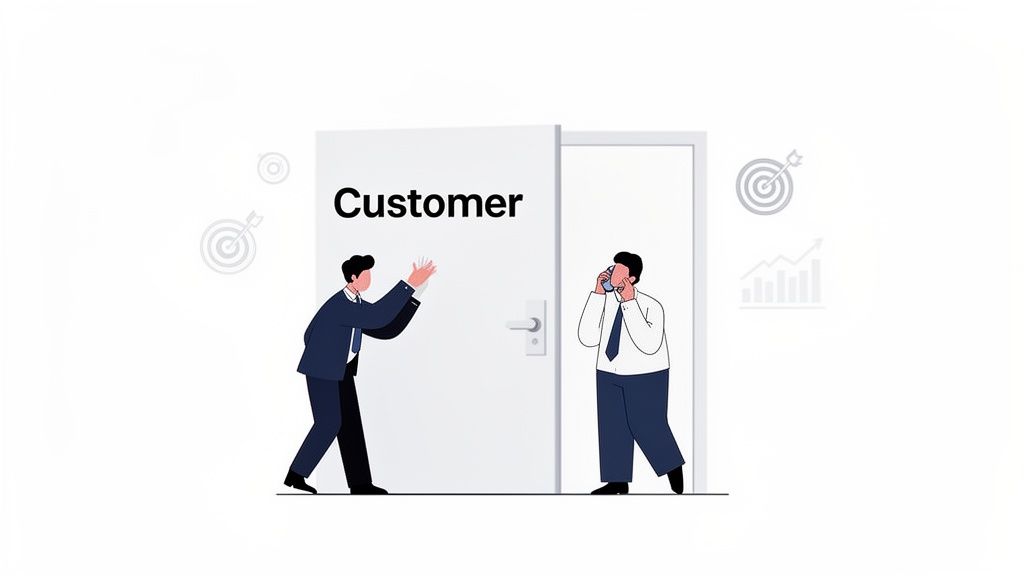
In today's market, you can't just sit back and hope the phone rings. An outbound call is the modern-day equivalent of knocking on a prospect’s door to introduce yourself and start a conversation. For CXOs, this isn't just a sales tactic; it’s a powerful engine for expanding your market reach, keeping customers loyal, and making your brand memorable.
Think of it this way: inbound calls are about managing existing demand, while outbound calls are about creating new demand. This proactive approach is essential for any business serious about growth. Just look at the hotel industry—internal benchmarks show that hotels using outbound strategies generate an average of $1,717 in extra revenue per room each year. That’s the direct financial power of picking up the phone.
The Core Difference From Inbound Calls
The line between outbound and inbound calls isn't just about who dials first. It represents two completely different mindsets: one focused on actively pursuing opportunities, the other on reactively serving needs. For anyone in leadership, getting this distinction right is key to assigning budgets, setting team goals, and knowing what success looks like. They aren't interchangeable; they're two sides of the same coin in a complete communication strategy.
For a business to scale effectively, it must master both defence (handling inbound queries) and offence (creating opportunities with outbound calls). Neglecting proactive outreach means leaving significant revenue and market share on the table for competitors to claim.
To make this crystal clear, let's break down how these two approaches stack up across the business. This comparison helps leaders see exactly where each fits into the bigger picture.
Outbound vs Inbound A Strategic Comparison
| Dimension | Outbound Calls (Proactive Outreach) | Inbound Calls (Reactive Response) |
|---|---|---|
| Primary Goal | Generate new leads, make sales, conduct research, or gather feedback. It's about creating opportunities. | Resolve customer issues, answer questions, and process orders. It's about meeting existing needs. |
| Initiator | The business or its agent initiates the call. | The customer or prospect initiates the call. |
| Customer Mindset | The recipient is often unprepared for the call, which requires the agent to build rapport and context quickly. | The caller has a specific need or problem and is actively seeking a solution. They are already engaged. |
| Strategic Role | An "offensive" tool used for market expansion, lead generation, and direct sales. | A "defensive" tool used for customer service, support, and retention. |
| Key Metrics | Connect Rate, Conversion Rate, Calls per Agent, Average Handling Time (AHT). | First Call Resolution (FCR), Customer Satisfaction (CSAT), Abandonment Rate, Average Wait Time. |
| Agent Skill Set | Requires resilience, persuasion, and the ability to handle rejection. Must be skilled at building instant connections. | Requires empathy, product knowledge, and problem-solving skills. Focus is on efficient and effective resolution. |
Ultimately, both inbound and outbound strategies are vital. The real magic happens when they work in harmony, creating a seamless experience where your business is both responsive to customer needs and actively driving its own growth.
How Outbound Calling Pushes Your Business Goals Forward
Think of an outbound call as more than just a phone call. It’s a powerful tool that actively drives business growth. For anyone in a leadership role, getting to grips with its many uses is the first step to really making it work for you. It’s not a one-trick pony; it’s a versatile instrument that can help you hit key targets, from boosting revenue to making your operations run like a well-oiled machine.
Every single outbound call is a conscious decision to reach out and connect with your market. This isn't about making random noise. It's about starting valuable conversations that lead to real, measurable outcomes and propel the company forward.
Fuelling Sales and Generating Leads
The most classic use for outbound calling? Filling up the sales pipeline. For a SaaS company, this could mean making targeted calls to pre-qualified prospects, with the single aim of booking a product demo. It’s a direct line to the people who make decisions, cutting through the clutter of digital ads and overflowing inboxes.
A well-planned campaign can have a huge impact on your sales funnel. By zeroing in on high-potential leads, a SaaS business can dramatically increase its demo bookings and potentially boost its sales pipeline by as much as 40%. This completely changes the game for a sales team, letting them focus their energy on conversations that are far more likely to turn into deals.
Running Promotions with Telemarketing
Telemarketing is all about using outbound calls to directly pitch a product or service. Let's say an EdTech company is launching a new professional certification. A smart outbound campaign would involve contacting a hand-picked list of professionals in that specific field, explaining how the programme can benefit their career, and answering their questions on the spot.
This direct, personal touch creates awareness and encourages people to act right away. For that EdTech firm, this means a solid return on investment, often hitting a 15% enrolment rate straight from the calling campaign—a result most passive marketing efforts can only dream of.
As a leader, the real question isn't if you should be making calls, but who you should be calling and why. A focused outbound strategy is the difference between casting a wide, ineffective net and spearfishing for high-value opportunities with absolute precision.
Gathering Market Research and Insights
Good business decisions are built on good data, and outbound calls are a fantastic way to get that information straight from the source. Imagine a real estate firm planning its next big development. They could call homeowners in a particular area to get a feel for what they actually want, what they like, and what they’re willing to pay.
This kind of primary research gives you priceless insights that you just can't get from reports and spreadsheets. For example, a financial services company could use outbound calls to survey 500 small business owners, discovering that 65% are underserved in cash flow management tools—a data point that could justify the launch of a new product line.
Improving Service with Appointment Reminders
Outbound calls aren't just for sales; they're also brilliant for tightening up your operations. In healthcare, for instance, a missed appointment means lost revenue and a messy schedule. A simple, automated or agent-driven reminder call is an incredibly effective fix.
Putting a consistent reminder system in place can slash no-show rates by up to 30%. For a busy clinic seeing 100 patients a day, that translates to reclaiming 15-20 appointment slots weekly, directly impacting revenue and staff efficiency. It just goes to show how a simple outbound call can solve a very expensive operational headache.
How to Measure Outbound Campaign Success
You can have the best strategy in the world, but without a way to measure it, you're just guessing. For any business leader, an outbound calling initiative is only worthwhile if you can actually track its success. This means looking beyond basic metrics like the sheer number of calls made.
Key performance indicators (KPIs) are where the real story lies. These numbers tell you what’s working, what isn’t, and why—giving you a clear picture of your data, your agents, and your overall strategy. By tracking the right metrics, you can turn your outbound operation from a simple cost centre into a predictable revenue engine.
Core Metrics for Executive Oversight
To get a real sense of how your outbound campaign is performing, you need to focus on a handful of critical KPIs. Each one gives you a different piece of the puzzle, helping you understand both operational efficiency and return on investment.
Connect Rate: This is simply the percentage of calls that actually get answered by a real person. A low connect rate—often dipping below 15-20%—is a major red flag. It usually points to one of two things: poor data quality or dialling at the wrong times. Think of it as the first health check for your entire operation.
Conversion Rate: This is the big one—the ultimate measure of success. It tracks how many of those connected calls lead to the outcome you want, whether that’s closing a sale, booking an appointment, or getting a survey filled out. In B2B cold calling, a typical benchmark is around 4-6%, so this metric tells you if your pitch and your people are truly effective.
Average Handling Time (AHT): This metric clocks the entire duration of a call, from the moment an agent dials to the final wrap-up notes. A high AHT might mean your script is too complicated or an agent needs more coaching. On the flip side, an unusually low AHT could suggest agents aren't spending enough time engaging prospects properly.
An outbound campaign isn’t just about making calls; it’s about making the right calls and having productive conversations. Metrics like Conversion Rate and Cost Per Acquisition (CPA) are the true north for any C-level executive evaluating the campaign's contribution to business growth.
Financial and Efficiency KPIs
Beyond the immediate call outcomes, you also need to keep an eye on the financial health and productivity of your campaigns. These metrics tie your day-to-day operations directly to the bottom line.
First Call Close (FCC) is a fantastic indicator of efficiency. It shows how many deals are closed on the very first interaction, which speaks volumes about the skill of your agents and the quality of your leads. For simpler transactional sales, a high FCC rate (e.g., 20-25%) indicates a highly effective process.
Equally important is the Cost Per Acquisition (CPA). This KPI calculates the total campaign cost divided by the number of successful conversions, giving you a crystal-clear figure on what it costs to win each new customer. To dive deeper into these analytics, you can explore our guide on how to measure the success of your outbound campaigns with our AI voice agent.
How Voice AI Is Changing the Game for Outbound Calls
Let's be honest, running a traditional outbound operation is tough. It’s a constant battle with high costs, agents who have good days and bad days, and the struggle to scale up without breaking the bank. For anyone in leadership, it feels like trying to hit ambitious growth targets with one hand tied behind your back.
But now, Voice AI is completely rewriting the rules. Imagine a workforce that's not only intelligent but also works 24/7 with perfect precision. These human-like AI agents can handle thousands of outbound calls at once, sticking to the script every single time. This isn't just a small tweak; it's a fundamental shift that turns a high-effort, unpredictable process into a reliable engine for growth.
A New Bar for Performance
The difference Voice AI makes isn't just a theory—you can see it in the numbers that matter most. While human teams naturally have performance ups and downs, AI sets a consistent, high baseline for success.
This consistency frees up your best people. Instead of getting bogged down in repetitive dialling, your human talent can focus on the complex, high-value conversations that truly need a human touch.
The image below gives you a clear picture of the kind of performance boost we're talking about when Voice AI is added to an outbound strategy.
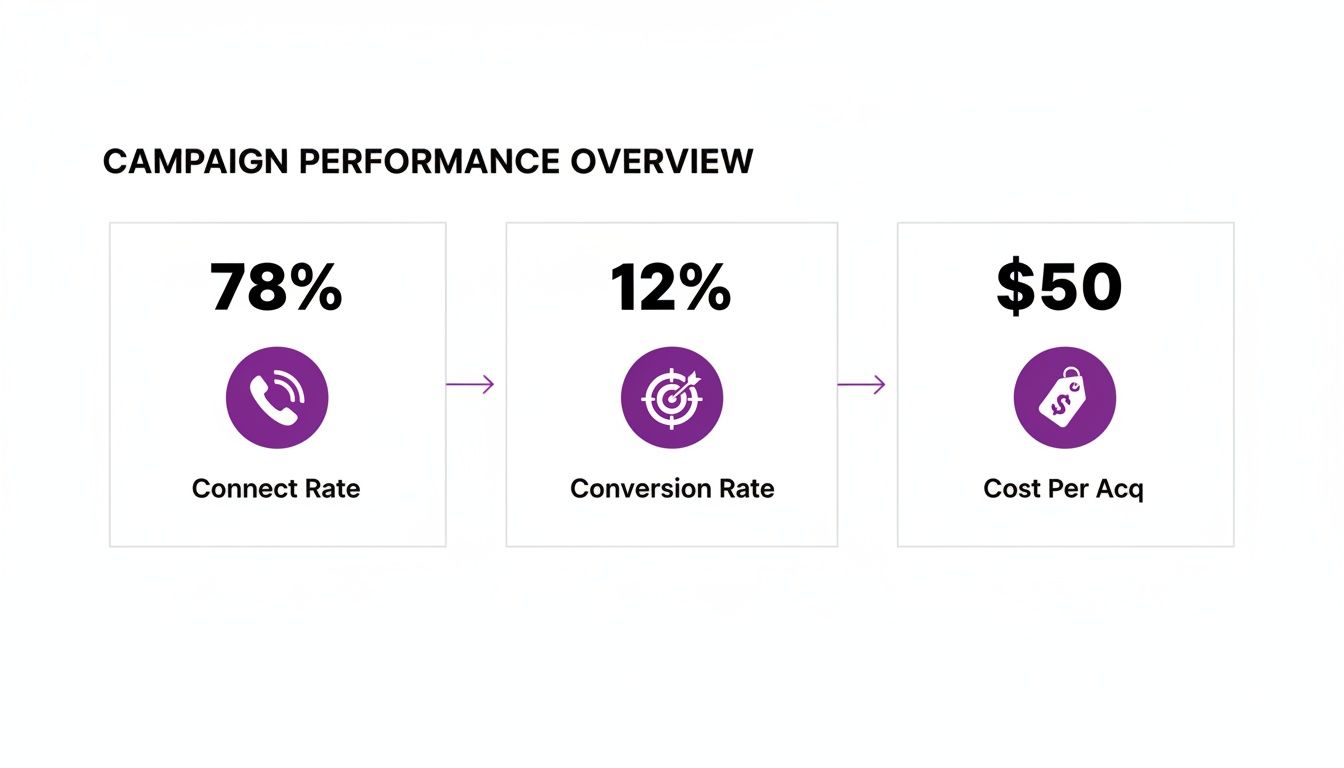
As you can see, AI-driven campaigns often deliver better connect rates, higher conversions, and a much lower cost per acquisition. It completely changes the ROI conversation.
Voice AI vs Traditional Outbound Agent
To really grasp the shift, it helps to see a direct comparison. Here’s a look at how Voice AI stacks up against a traditional agent-led approach.
| Capability | Traditional Agent | Voice AI Agent |
|---|---|---|
| Scalability | Limited by headcount and training time; slow to scale. | Instantly scalable; can handle thousands of calls simultaneously. |
| Consistency | Performance varies based on mood, health, and skill. | 100% consistent; follows scripts perfectly every single time. |
| Cost | High operational costs (salaries, training, infrastructure). | Significantly lower cost per call; reduces overhead. |
| Availability | Works standard shifts with breaks and holidays. | Operates 24/7/365 without any downtime. |
| Data & Analytics | Manual call logging and subjective feedback. | Captures and analyses 100% of call data for real-time insights. |
| Compliance | Risk of human error and script deviation. | Guarantees adherence to all compliance and DNC regulations. |
This table makes it clear: Voice AI isn't just an alternative; it's a strategic upgrade that tackles the core limitations of manual outbound operations head-on.
Strategic Advantages for Leadership
Moving to AI-powered outbound calling isn't just about saving money—it's a smart strategic decision. The global outbound call centre market is set to explode, growing from $25.7 billion in 2023 to $45.6 billion by 2032. India and the broader Asia Pacific region are at the forefront of this growth, with a projected CAGR of 8.2%. In a market expanding this quickly, adopting AI gives you a serious competitive advantage.
Even better, AI can support your existing human team. Tools like real-time agent assist can provide live prompts and guidance during calls, helping your agents perform at their best. It's a powerful combination. For any leader focused on growth, AI acts as a force multiplier, allowing your business to chase opportunities at a scale you could only dream of before. This is especially true when you’re trying to overcome the classic hurdles of outreach, which you can read more about here: https://dialnexa.com/blogs/cold-calling-challenges-and-how-ai-voice-agents-can-save-the-day/.
By automating the top of the funnel—the initial, repetitive outreach—Voice AI frees your best people to focus on what they do best: building relationships and closing deals with warm, qualified leads. It's not about replacing humans, but empowering them.
Ultimately, bringing Voice AI into your workflow transforms the outbound call from a simple task into a powerful, data-driven asset. It standardises quality, eliminates guesswork, and gives you a reliable tool to drive predictable growth, making sure every conversation helps move your business forward.
Real-World Applications Across Key Industries
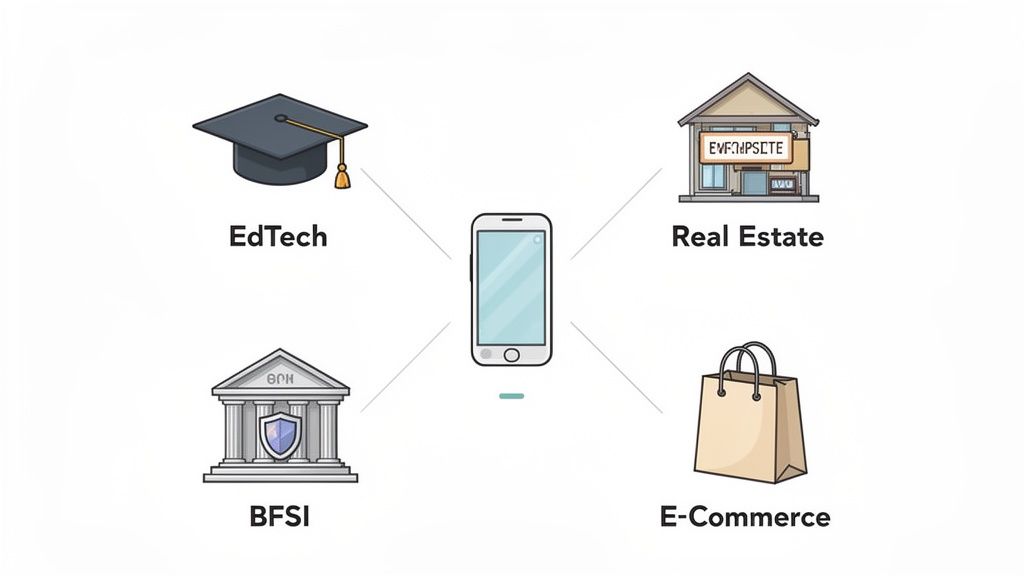
It's one thing to understand the theory behind outbound calls, but it’s another to see them deliver real-world results. For any business leader, the true test of proactive outreach is how it solves specific industry problems. When you automate those first crucial conversations, you're not just making your team more efficient—you’re changing the very nature of how you connect with your market.
Every industry has its own unique headaches, whether it's dealing with a flood of enquiries or navigating a maze of compliance rules. This is where AI-powered outbound calls come in, offering a focused solution that drives real growth and untangles complicated workflows. Let's look at how this plays out on the ground.
Driving Admissions in EdTech
The EdTech world is swamped. Admissions teams have to counsel thousands of potential students, each asking about different programmes, eligibility criteria, and fee structures. Trying to manage this manually is a recipe for burnout and inconsistent advice.
An AI voice agent completely flips the script. It can work through a massive database of enquiries in no time, providing accurate programme details and asking smart qualifying questions to see who’s genuinely interested.
- Student Counselling at Scale: An AI agent can juggle thousands of initial chats at once, so every single prospective student gets an immediate response.
- Smarter Lead Qualification: It acts as a filter, gauging how serious an applicant is and passing only the most promising leads to your human counsellors.
- The Bottom Line: We’ve seen EdTech platforms cut their qualification time by over 70% with this approach. This frees up the admissions team to do what they do best: convert well-informed, serious applicants.
Accelerating Real Estate Bookings
In real estate, timing is everything. When a potential buyer shows interest, they expect an immediate response and an easy way to book a viewing. Hesitate for even a few hours, and that lead is likely gone to a competitor.
This is where an AI-powered outbound strategy really shines. An AI agent can instantly call back on web enquiries, handle common property questions, and schedule site visits directly into an agent's calendar—24/7.
The real game-changer here is that the AI never clocks out. It doesn't need sleep. A lead that comes in at 2 AM gets the same professional, instant follow-up as one that arrives during office hours. This simple shift can make a massive difference in engagement.
The results speak for themselves. Real estate firms that automate their first touchpoints and appointment setting often see site visit bookings jump by as much as 150%. They're turning casual online interest into actual foot traffic.
Ensuring Compliance in BFSI
The Banking, Financial Services, and Insurance (BFSI) sector is built on a foundation of strict regulations. For mortgage brokers and lenders, every outbound call—from KYC reminders to initial loan qualification—has to be perfectly accurate and compliant. There's no room for error.
AI agents are a fantastic tool for hitting this standard every single time. They can be programmed to follow a script to the letter, ensuring every legal disclosure is made and all sensitive data is handled correctly. For a closer look, check out our guide on revolutionizing outbound communication for mortgage brokers and lenders with Global Voice AI. Achieving that level of consistency across a large human team is nearly impossible, which makes AI an essential tool for managing risk.
Staying on the Right Side of the Law: Compliance and Best Practices
As a business leader, you know that a great outbound strategy can't exist without a rock-solid approach to compliance. It’s not just about avoiding risk. Getting this wrong can mean huge fines and, worse, a shattered brand reputation. Every proactive call you make has to be built on a foundation of respecting customer privacy.
In India, that means playing by the rules set by the Telecom Regulatory Authority of India (TRAI). This isn't optional. You must scrub your lists against the National Do Not Disturb (DND) registry and stick to approved calling times. Think of these regulations as the guardrails that keep your business safe and your customer relationships intact.
Building a Framework That Breeds Trust
Simply ticking compliance boxes isn’t enough. The goal is to build genuine trust with every interaction. This requires a thoughtful approach to how you source contacts, what you say on the call, and how you react when someone says "no."
Here are the cornerstones of a truly ethical framework:
- Use Opt-In Lists: The best people to call are those who have already shown interest. Building your lists from opt-ins isn't just compliant; it's smart business that leads to far better conversations.
- Be Honest and Upfront: Your scripts should get straight to the point. No tricks, no vague language. Clearly state who you are and why you're calling. Honesty builds credibility faster than any sales tactic.
- Make Opting Out Easy: If someone wants to be removed from your list, make it simple and immediate. Honouring their choice is just as crucial as chasing a lead.
Following established cold calling best practices is fundamental to running an effective and ethical outreach operation.
Using Technology to Your Advantage
Trying to manage compliance manually across thousands of calls is a recipe for disaster. This is where technology, especially AI, steps in not just as a tool for efficiency, but as a powerful shield for your business.
Modern Voice AI isn't just about making more calls; it’s about making sure every single call is the right one, made compliantly. It gives you a level of control and consistency that’s almost impossible for a human team to maintain, protecting you from very expensive mistakes.
Platforms like DialNexa have compliance baked right in. They can automatically check your lists against DND registries, so you never have to worry about calling the wrong number. What’s more, AI agents deliver the script perfectly every time, with 100% script adherence. This removes the risk of an agent going off-script or making a costly error.
Let’s be realistic. The outbound call centre industry in India has long struggled with high attrition, which historically sat around 50%. Even though it’s improved to 30-35% recently, keeping everyone trained and consistent is a constant battle. AI solves this problem head-on, ensuring every call meets your high standards. By automating compliance, you’re not just protecting your brand—you’re building a smarter, more sustainable way to grow.
Your Top Questions About Outbound Calling, Answered
When you're running a business, every new strategy has to be weighed against its real-world impact. Does it work? Does it protect our brand? How hard is it to get started? Let's tackle the big questions we hear from leaders looking at modern outbound calling.
Is Cold Calling Even Worth It Anymore?
Absolutely, but the game has changed. Forget the old-school image of someone just smiling and dialing. Today’s smart outreach is anything but “cold.” It's all about using targeted data to have a relevant conversation, with the goal of qualifying interest or booking a proper meeting—not trying to force a complex sale on the very first call.
Think about it this way: a B2B software company might see a 4-6% conversion rate from these initial calls to a scheduled demo. That’s a solid pipeline. When you use Voice AI to handle that first touchpoint at scale, you create a powerful, efficient engine for generating qualified leads. Your best people are then freed up to talk only to prospects who are already warmed up and interested.
A modern outbound call isn’t about making a sale on the spot. It's a smart filter. Its job is to quickly sift through a list and find the people who are genuinely interested, so your sales team can invest their time where it will count the most.
How Do I Make Sure Outbound Calls Don't Hurt My Brand?
This is crucial, and the answer is simple: put the customer first. Always. It starts with having a clean, permission-based contact list so you're not bothering people who don't want to hear from you. From there, every single interaction has to offer something of value.
This is one area where AI really shines. It delivers a perfectly consistent and professional experience every single time, eliminating the natural ups and downs you get with a human team. With 100% script adherence, you can be certain that every call reflects your brand positively, protecting—and even building—your reputation.
What's the First Step to Trying Out Voice AI?
Don't try to boil the ocean. Start with a focused pilot project. Pick one task that’s high-volume and repetitive. For a healthcare provider, that could be appointment reminders. For a real estate firm, it might be that initial lead qualification call. A narrow focus like this makes it incredibly easy to measure the return on investment and build a solid business case.
Getting a pilot off the ground is easier than you might think. Modern AI platforms let you build and launch a custom agent for a specific task without a massive upfront cost. This lets you prove the concept and show real results—like seeing connect rates jump from 47% to 91%—before you even think about rolling it out more widely.
Ready to see what an intelligent, automated outbound strategy can do for you? At DialNexa, we create human-like Voice AI agents designed to scale your outreach, qualify leads, and let your team focus on closing deals. Discover how our AI can drive your growth today.
For a deeper look at outbound call meaning, the outbound vs inbound distinction, and how Voice AI is reshaping outbound operations, see our complete guide to outbound call meaning.

This is an excellent breakdown of how outbound calling has evolved from a simple sales activity into a strategic growth engine. The insights on Voice AI, performance metrics, and proactive customer engagement provide tremendous value for modern business leaders.