

What are outbound calls and how they drive strategic growth
Think of an outbound call as your business making the first move. It’s a call initiated by your company, reaching out to a potential or current customer. This is the complete opposite of an inbound call, where you're waiting for the customer to ring you. A well-executed outbound strategy puts your organisation firmly in the driver's seat, enabling you to target specific market segments and achieve clear business objectives.
Seeing Outbound Calls as a Growth Engine
For C-suite executives, it's a strategic misstep to view outbound calling as just another sales tactic. It’s a proactive engine for predictable growth.
Imagine your inbound marketing is a premium retail storefront, perfectly designed and waiting for high-value clients to walk in. Your outbound strategy, in contrast, is the bespoke tailor who personally visits a curated list of executives they know will value their craftsmanship. It is a deliberate, focused approach to acquiring market share.
The era of volume-based, generic cold calling is over. Today's most effective outbound initiatives are surgical, data-driven, and architected around customer value. This is the critical shift for leadership to internalise: it’s about precision and ROI, not just persistence.
From Cold Calls to Strategic Conversations
Let's be clear: the term "outbound call" should not evoke images of unsolicited, low-value interruptions. A modern strategy is a sophisticated operation built on:
- Data-Driven Targeting: Leveraging CRM data, market intelligence, and intent signals to identify high-value accounts that have a genuine, demonstrable need for your solution.
- Personalised Outreach: Crafting a value proposition that speaks directly to a prospect's known pain points or strategic objectives.
- Defined Objectives: Ensuring every call has a clear purpose, whether that's qualifying a lead for a multi-million dollar deal, scheduling a demo with a key decision-maker, or conducting a strategic check-in with a Tier-1 client to mitigate churn risk.
A well-run outbound strategy flips your entire organisation from a reactive posture to a proactive one. You stop waiting for opportunities to materialise and start engineering them, engaging the right decision-makers on your own terms.
Here’s a practical C-level example: A B2B fintech company targeting enterprise clients doesn't just buy a list of phone numbers. They use market intelligence tools to identify corporations whose CFOs have recently spoken publicly about digital transformation in finance. Their first call isn't "cold"—it's a timely, relevant conversation referencing the CFO's own stated priorities. This calculated approach transforms outbound from a cost centre into a powerful tool for predictable revenue and deeper market penetration.
How Different Types of Outbound Calls Drive Business Growth
Understanding what an outbound call is is foundational. Grasping its strategic application across your enterprise is what creates competitive advantage. For VPs and Directors, it’s vital to see these calls not as isolated tasks but as levers for achieving major business goals. Each type of outbound call serves a specific function, whether it’s accelerating revenue, improving customer lifetime value, or informing corporate strategy.
When properly executed, your outbound strategy transcends mere telemarketing. It becomes a reliable engine for building a qualified sales pipeline, compressing sales cycles, and gathering market intelligence that informs critical, board-level decisions. This is about actively creating shareholder value, not passively waiting for the market to come to you.
This mind map breaks down the core pillars of a modern outbound strategy. It is fundamentally proactive, targeted, and data-driven.
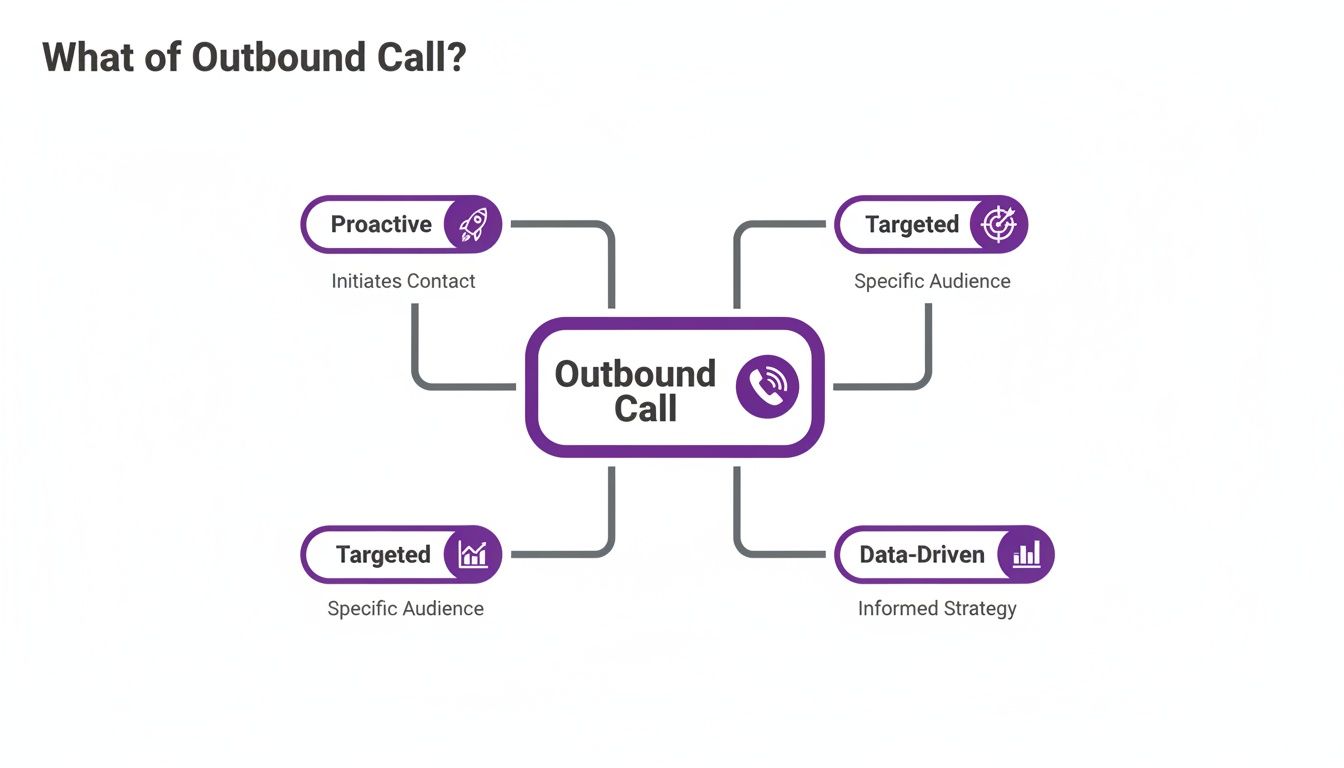
As you can see, successful campaigns are never about arbitrary dialling. They're built on a solid foundation of strategic planning and precise execution.
Connecting Your Calls to C-Suite Goals
You can draw a straight line from different outbound call functions to the KPIs that matter most to leadership, from customer acquisition cost (CAC) to lifetime value (LTV). Let’s examine these applications.
- Lead Qualification: This is the first line of defence for an efficient sales organisation. Outbound calls are used to engage potential leads, rigorously assessing their needs, budget, authority, and timeline (BANT). A well-executed qualification call ensures your most expensive asset—your senior sales team—spends their time exclusively on opportunities with a high probability of closing. Example: An enterprise software firm uses an outbound team to qualify inbound leads, asking targeted questions about their existing tech stack and Q4 budget allocation before booking a demo with a senior account executive.
- Appointment Setting: The primary goal here is to accelerate the sales process. Imagine a MedTech company making targeted calls to book product demonstrations with hospital procurement directors. This bypasses lower-level gatekeepers, places the solution directly in front of decision-makers, and significantly shortens the sales cycle from months to weeks.
- Proactive Customer Success: Outbound calls are not just for acquisition; they are critical for retention. A B2B SaaS company, for instance, can implement scheduled quarterly business reviews (QBRs) via outbound calls to its enterprise clients. These calls proactively identify and resolve issues, reinforcing value and directly impacting churn. Given that a 5% increase in customer retention can boost profitability by 25% to 95%, this is a direct lever for improving bottom-line performance.
- Market Intelligence Surveys: To innovate and maintain market leadership, you need high-fidelity data. Strategic outbound surveys are an invaluable tool for gathering direct feedback on product roadmaps, competitive positioning, and emerging market trends. These conversations deliver qualitative insights that quantitative analysis often misses, directly shaping future corporate strategy.
Think of an outbound call as a direct conduit to your market. Whether you're qualifying a seven-figure deal, scheduling a C-level meeting, or preventing the churn of a key account, every conversation is an opportunity to strengthen your business.
Ultimately, mastering the different types of outbound calls gives your organisation a significant competitive advantage. To delve deeper into overcoming common hurdles, explore our guide on cold calling challenges and how AI voice agents can save the day.
Navigating the Tricky Waters of Outbound Call Compliance
As a business leader, you are the ultimate steward of risk management. Within an outbound calling strategy, regulatory compliance isn't a mere operational checkbox; it's fundamental to protecting brand equity and customer trust. A compliance failure doesn't just lead to fines—it can cause irreparable damage to a reputation built over years.
In India, the regulatory landscape is stringent. The Telecom Regulatory Authority of India (TRAI) and the Digital Personal Data Protection Act (DPDPA) have established clear guardrails to protect consumers. Adherence to the Do Not Disturb (DND) registry is not just best practice; it is a non-negotiable requirement for any legitimate enterprise.
This legal framework exists to eliminate intrusive telemarketing and safeguard privacy. TRAI and the DPDPA enforce strict oversight, including a calling curfew. No promotional calls are permitted between 9:00 PM and 9:00 AM, which applies to all consumers, not only those on the DND list. By September 2024, TRAI also mandated that all telecom operators integrate special 140/160 series numbers (used for outbound calling) into a blockchain platform. This ensures call centres use officially approved caller IDs, combating number spoofing. You can read more about these specific outbound call rules on talk-q.com.
Why Compliance is Your Secret Weapon
Viewing these regulations as a bureaucratic burden is a shortsighted perspective. Astute leaders reframe compliance as a competitive differentiator. When your outreach is conducted respectfully and within legal boundaries, you immediately distinguish your brand from the aggressive, spam-centric players that erode market trust. You build credibility from the very first interaction.
For any leadership team, compliance isn’t just about avoiding penalties. It's about preserving brand value. Every compliant call reinforces your company's commitment to ethical business practices, transforming a potential liability into a relationship-building asset.
Putting Compliance into Practice
Consider a practical scenario from the BFSI sector. A leading private bank must conduct follow-up calls for KYC (Know Your Customer) verification, a regulatory mandate. The penalties for non-compliance are severe.
Here’s their operational framework for compliance:
- DND Scrubbing: Before initiating any campaign, their entire contact list is automatically scrubbed against the national DND registry, programmatically removing any opted-out individuals.
- Time-of-Day Rules: Their dialer system is hard-coded to only place calls within the legally prescribed window, ensuring no customer is contacted outside of approved hours.
- Clear Identification: Every call, whether from a human agent or a Voice AI, begins with a transparent introduction stating the caller's name and the bank they represent.
This disciplined, automated process allows the bank to meet its regulatory obligations without error. By embedding compliance directly into their operational workflow, they minimise risk and fortify their brand image as a trustworthy institution. Modern platforms can automate these checks, freeing up leadership to focus on strategy rather than manual oversight. Furthermore, when adopting new technology, it is crucial to understand the legal and ethical considerations of AI phone calls to remain on the right side of the law.
Measuring the True ROI of Outbound Calling
To truly grasp the strategic value of outbound calls, you must look beyond surface-level activity metrics. For a director or VP, success isn't defined by call volume; it’s measured by tangible impact on revenue, operational efficiency, and market penetration. Discarding vanity metrics is the only way to understand the strategic narrative your campaign data is telling.
An effective outbound strategy is a high-performance engine; each metric is a diagnostic gauge. For instance, a low connection rate isn't just a number—it’s a clear indicator of poor data quality, signalling a need for investment in better intelligence. Similarly, a high conversation rate that yields no qualified appointments points directly to a flawed value proposition or an improperly targeted audience.
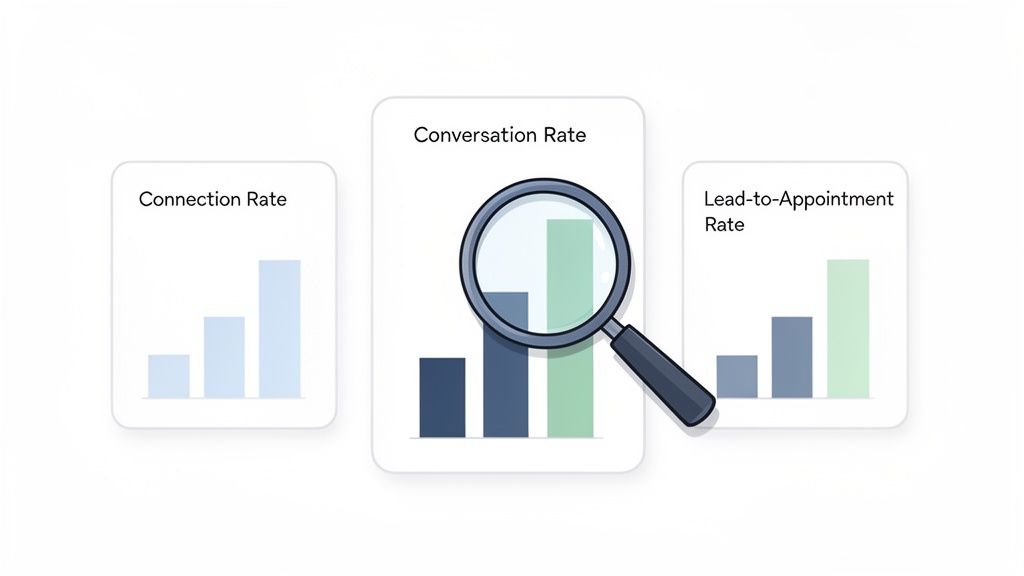
This analytical approach enables sharp, informed decision-making, justifies budget allocation, and allows you to fine-tune your entire outbound apparatus for maximum return.
Key Metrics That Actually Drive Strategy
Focusing on the right Key Performance Indicators (KPIs) is how you monitor the health of your outreach investments. These are the numbers that command attention in the boardroom.
- Connection Rate: The percentage of calls that successfully reach a live human. A healthy connection rate, which often sits between 8-15% with traditional dialling, is a direct reflection of the quality of your contact data.
- Conversation Rate: Of those connected, what percentage engage in a substantive business discussion? This metric diagnoses the effectiveness of your opening script and your team's ability to capture executive attention.
- Lead-to-Appointment Rate: This is where strategy meets execution. It tracks how many qualified conversations convert into scheduled meetings or demos, providing a direct measure of sales pipeline velocity.
As a leader, your role is to translate these data points into strategic action. A declining lead-to-appointment rate is not merely a team performance issue; it is a market signal that may necessitate a strategic pivot in your targeting or messaging.
Tracking the right metrics is fundamental. The table below outlines the most critical KPIs and their strategic meaning for C-level oversight.
Essential Outbound KPIs and Their Strategic Meaning
| KPI | What It Measures | Strategic Implication for CXOs |
|---|---|---|
| Connection Rate | The percentage of dials that result in a live conversation. | Indicates the quality and accuracy of your contact data. Low rates signal a need to invest in better data sources or list hygiene. |
| Conversation Rate | The percentage of connected calls that turn into substantive business discussions. | Reflects the effectiveness of your script's opening and agent engagement skills. A low rate points to a messaging problem. |
| Lead-to-Appointment Rate | The percentage of qualified conversations that convert into a scheduled meeting or demo. | Directly measures sales pipeline velocity. A dip here suggests a disconnect between your value proposition and the target audience's needs. |
| Cost Per Acquisition (CPA) | The total campaign cost divided by the number of new customers acquired. | A core financial metric that determines campaign profitability and ROI. High CPA might require optimising other KPIs to improve efficiency. |
| Call-to-Close Ratio | The percentage of calls that ultimately result in a closed deal. | The ultimate indicator of sales effectiveness, tying outbound efforts directly to revenue generation. |
By maintaining a dashboard with these KPIs, you transition from simply managing campaigns to strategically directing your business towards its growth targets.
Interpreting the Data for Business Impact
Let’s analyse a real-world leadership scenario. The VP of Sales at an EdTech firm is celebrating an impressive 20% connection rate—well above industry benchmarks. However, the lead-to-appointment rate is stalled at a dismal 2%.
Instead of blaming the sales team, a strategic analysis reveals the core issue: operational efficiency is high, but the targeting is flawed. The team is excellent at reaching people, but they are reaching the wrong people. The high connection rate validates the contact data, but the poor conversion rate is a clear signal of a mismatch between the product offering and the audience segment being targeted.
This insight empowers the leadership team to pivot. They can now re-allocate resources to refine the target customer profile, focusing on prospects with higher demonstrated intent, which will directly improve the campaign's overall ROI.
By focusing on these core metrics, you eliminate guesswork and enable targeted, strategic improvements. For a more comprehensive analysis, you can learn more about how to measure the success of your outbound campaigns with our AI voice agent.
Real-World Outbound Strategies That Actually Work
Understanding the theory of outbound calling is one thing. Witnessing its impact on the P&L statement is another. For any senior leader, the ultimate test of a strategy is its real-world performance and contribution to the bottom line. Outbound calling is not a universal solution; it is a powerful tool that, when custom-fit to specific industry challenges, delivers formidable results.
Whether accelerating sales cycles in high-stakes real estate or boosting enrolment in competitive education markets, a sophisticated outbound plan directly addresses core business objectives. The key is to abandon generic scripts and engineer campaigns that resonate with the unique pain points and motivations of your target audience.
This strategic customisation is a significant reason why India has emerged as a global hub for outbound operations. The country currently handles over 56% of the international outbound call centre market, driven by operational cost savings of up to 60% compared to Western nations. The Asia Pacific outbound market, led by India, is projected to grow from $5.7 billion in 2023 to $11.9 billion by 2032, fuelled by high-growth sectors like EdTech and BFSI. You can explore this trend further in this detailed report on the global outbound market.
Real Estate: Accelerating Site Visits and Compressing Sales Cycles
In the hyper-competitive real estate sector, speed is a critical advantage. When a high-value lead submits an online enquiry for a luxury property, there is a very brief window to engage them before a competitor does. Leading developers are now deploying AI-powered outbound calls to instantly connect with these leads, qualifying their interest, budget, and location preferences within minutes.
This automated first touchpoint removes the manual burden from the sales team, allowing them to focus their expertise on high-intent buyers who are ready for a site visit.
- The Business Problem: Sales teams are inundated with low-quality leads, and manual follow-up is too slow, causing high-intent prospects to lose interest.
- The Outbound Solution: An AI agent calls leads within 60 seconds of their online enquiry. It confirms their interest and schedules a site visit directly into a sales executive’s calendar.
- The Executive Impact: This strategic change dramatically reduces lead-to-visit time. The sales team's productivity soars, and the pipeline of qualified site visits—the most crucial metric for the business—increases measurably week over week.
EdTech: Converting Enquiries into High-Value Enrolments
For universities and online learning platforms, the journey from prospect to enrolled student hinges on effective guidance and trust. Outbound calling is indispensable for counselling students who have enquired about premium courses. A well-timed, consultative call can help navigate complex application processes and clearly articulate the program's value proposition.
For a prospective MBA candidate choosing between three top-tier schools, a proactive, insightful call from one institution can be the deciding factor. It transforms the university from a passive name on a list into an active partner in their career advancement.
By offering personalised counselling, institutions can address specific concerns, clarify financing options, and reinforce the ROI of their programs. This builds a strong, early-stage relationship and directly impacts conversion rates for the most profitable courses.
BFSI: Driving Revenue Growth Within a Strict Compliance Framework
The Banking, Financial Services, and Insurance (BFSI) sector operates within a complex web of regulations. Here, outbound calls serve a dual strategic purpose: ensuring compliance and driving revenue. For instance, calls are a standard and secure method for conducting mandatory KYC verification processes.
However, these interactions also present strategic opportunities. Once a customer relationship is established through a compliance-driven call, an outbound agent can intelligently cross-sell relevant financial products, such as a credit card upgrade or a tailored insurance policy. For example, a wealth management division can follow up a mandatory KYC call with a personalised invitation for a portfolio review, creating a new revenue opportunity from a compliance activity. This targeted approach, built on a foundation of trust and regulatory adherence, transforms a cost centre into a profit centre.
How Voice AI Is Redefining Outbound Operations
For leaders focused on achieving massive scale and operational efficiency, the conversation is no longer about hiring more agents. It is about Voice AI. Imagine executing thousands of perfectly compliant, personalised calls simultaneously, without human limitations. This is no longer a future concept—it is the strategic advantage market leaders are leveraging today.
Voice AI agents solve major operational challenges for VPs and Directors. They operate 24/7, ensuring no lead is left uncontacted, and adhere to brand scripts with 100% consistency. This allows you to scale outreach initiatives at an unprecedented rate while simultaneously reducing operational expenditures.

The market data is compelling. In India, AI adoption in contact centres for qualification and presales is reaching 70%. This strategic shift is yielding a 50% cost reduction per call and increasing connection rates from the typical 8-15% to 20-25%. Platforms like DialNexa are demonstrating this power, deploying custom Voice AI agents that manage thousands of daily calls and achieve 97% lead accuracy—on par with human agents. You can dive deeper into the future of AI in outbound call centres on atidiv.com.
A Strategic Roadmap for AI Adoption
Integrating Voice AI is not merely a technology upgrade; it is a strategic business transformation. By automating high-volume, repetitive tasks—such as initial lead qualification or appointment scheduling—you liberate your most skilled human agents. Their expertise is then redeployed to high-value activities: negotiating complex contracts and nurturing strategic client relationships.
For any leader considering this path, the implementation can be a clear, phased process.
-
Define Clear Business Objectives: What specific outcome are you targeting? A 20% reduction in cost-per-lead? A 30% increase in scheduled demos? Or ensuring 100% compliance on customer follow-ups? A clear goal is paramount.
-
Integrate with Existing Systems: Modern Voice AI platforms are designed for seamless integration with your existing CRM and tech stack. This ensures fluid data flow and reporting without requiring a disruptive overhaul of current workflows.
-
Monitor and Optimise Performance: Post-launch, the process of refinement begins. Continuously track key metrics like call outcomes, conversation quality, and conversion rates to optimise scripts and strategy for maximum ROI.
Adopting Voice AI is about augmenting your human talent, not replacing it. It’s a strategic decision to automate the predictable so your team can excel at the exceptional, driving both efficiency and revenue growth.
Frequently Asked Questions
As a leader, asking incisive questions before committing to a new strategy is prudent. Here are answers to common concerns executives raise about implementing a modern outbound calling strategy.
How Do We Ensure Outbound Calls Don't Damage Our Brand Reputation?
Brand equity is a closely guarded asset, and this concern is paramount. The legacy "spray and pray" methodology is what damages reputations. A modern, executive-led outbound strategy is its antithesis—it is built on surgical precision.
The process begins with high-quality, verified data. You are not dialling random numbers; you are contacting specific individuals within targeted accounts who have a high propensity to benefit from your solution. From there, meticulously crafted scripts and the unwavering consistency of Voice AI ensure every conversation is professional, compliant, and value-driven. This transforms the interaction from a "cold call" into a positive brand touchpoint, building trust with every dial.
What's a Realistic ROI for an Outbound Call Campaign?
Return on Investment (ROI) will naturally vary by industry and price point, but the framework for measurement is universal. It boils down to a clear financial equation: comparing your Customer Acquisition Cost (CPA) to the Customer Lifetime Value (CLV).
Consider a high-growth B2B SaaS company. A single successful outbound campaign might secure an enterprise client with an annual contract value in the six or seven figures. The initial cost of acquisition is insignificant compared to the long-term revenue stream. By diligently tracking CPA against CLV, you gain a crystal-clear view of profitability and can confidently justify the strategic investment in outbound initiatives.
How Quickly Can We Get a Voice AI Outbound Solution Up and Running?
The deployment timeline for a Voice AI solution is significantly shorter than leaders often anticipate. Modern platforms are not cumbersome legacy systems; they are agile and designed for rapid, seamless integration with existing tools like your CRM.
A typical implementation timeline is as follows:
- Strategy & Workflow Mapping: 1-2 weeks
- Pilot Launch & Testing: 2-4 weeks
This means you can transition from strategic planning to a fully operational, scalable outbound AI solution in approximately one month. You will begin to see measurable results and gather performance data for optimisation almost immediately.
Ready to see how a strategic outbound approach can reshape your operations? DialNexa offers human-like Voice AI agents that can scale your outreach, sharpen your lead qualification, and free up your human team to do what they do best: close deals. Discover how DialNexa can elevate your strategy today.
For a deeper look at outbound call meaning, KPIs, and how Voice AI is reshaping outbound operations, see our complete guide to outbound call meaning.

Excellent insights on how modern outbound calling has evolved from traditional cold calling into a data-driven growth strategy. The focus on compliance, ROI, and Voice AI adoption clearly shows how proactive outreach can become a powerful competitive advantage for enterprises.